How to Mount Flexible Solar Panel?
How to Mount Flexible Solar Panel?
Flexible solar panels are usually mounted using industrial adhesive, VHB tape, screws with spacers, or hybrid mounting systems. The safest installation keeps airflow under the panel, prevents water buildup, and avoids over-bending the panel surface. Done correctly, a flexible solar panel can stay securely mounted for 5–10 years on RVs, vans, boats, and curved roofs.
I learned this the hard way during a van conversion project in Arizona. The first flexible panel I installed sat completely flush against the roof using cheap adhesive strips. It looked clean for about four months. Then summer arrived. Surface temperatures exceeded 160°F (71°C), the adhesive softened, trapped heat built underneath, and the panel output dropped almost 18%.
That experience changed how I install flexible solar panels today.Learn more about “Flexible Solar Panel Installation Guide“
At Bright Solar, we’ve tested mounting methods across RV roofs, marine decks, off-grid trailers, and aluminum van tops in high-heat, high-humidity, and coastal conditions. The mounting method matters almost as much as the panel quality itself.
Why Proper Mounting Matters More Than Most People Think
Many buyers assume flexible solar panels are simply “stick-and-go.” Technically, yes — you can glue them directly onto a roof.
But long-term reliability is another story.
According to the U.S. National Renewable Energy Laboratory (NREL), elevated operating temperatures significantly accelerate photovoltaic degradation and reduce efficiency over time. Flexible panels mounted flush to hot surfaces often operate hotter than framed rigid panels.
In practical installations, three problems appear repeatedly:
| Common Problem | What Causes It | Real Result |
|---|---|---|
| Heat buildup | No airflow beneath panel | Faster degradation |
| Adhesive failure | Cheap glue or poor prep | Panel lifting at edges |
| Microcracks | Over-bending during install | Permanent power loss |
I’ve inspected RV roofs where the front edge of the panel peeled upward after repeated highway wind exposure. Once airflow gets underneath, failure accelerates fast.
That’s why mounting technique matters.
Best Methods for How to Mount Flexible Solar Panel
Not every roof needs the same mounting approach.
1. VHB Tape Mounting (Most Popular)
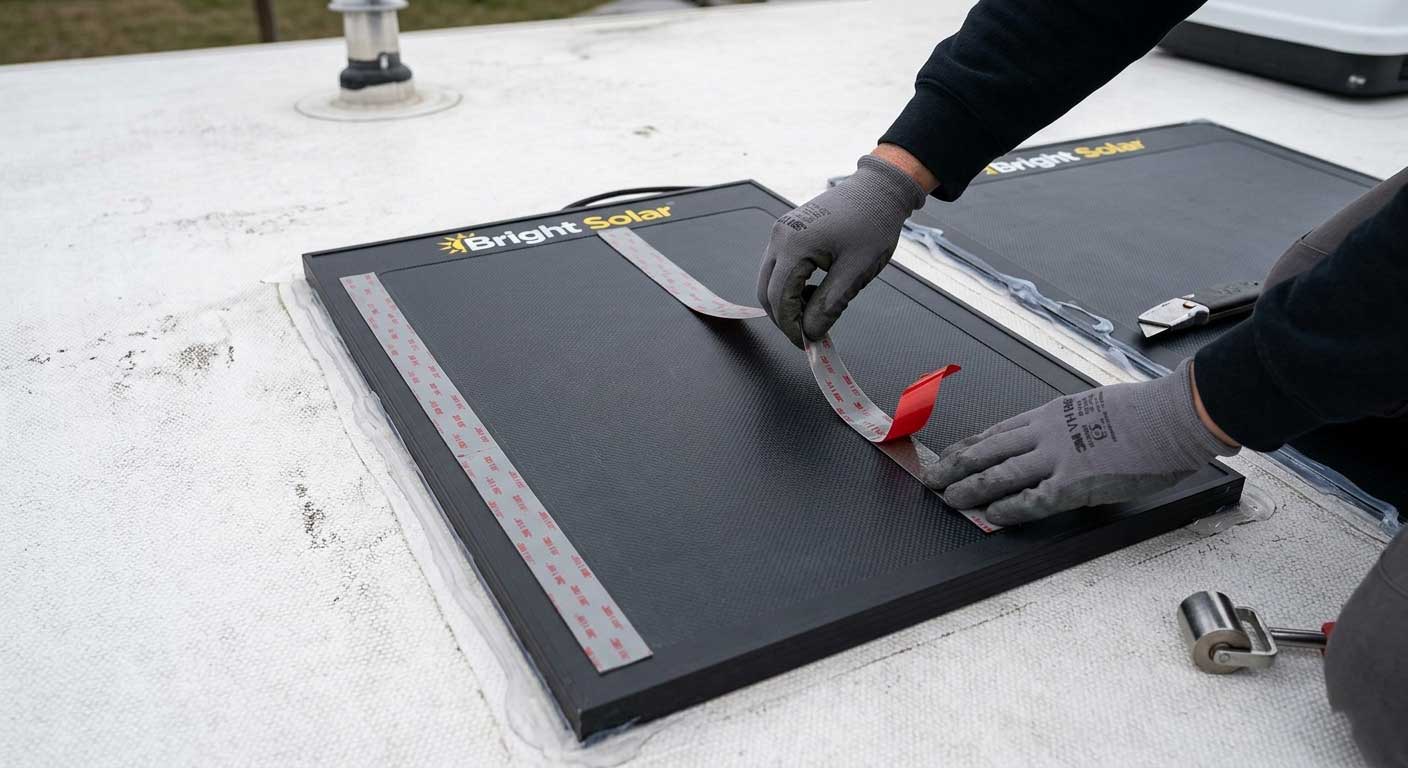
3M VHB tape is widely used in RV and marine applications because it creates an extremely strong bond without drilling holes.
Best for:
- Camper vans
- Fiberglass RV roofs
- Smooth aluminum roofs
- Lightweight panels
Advantages:
- No roof penetration
- Fast installation
- Clean appearance
- Good waterproofing
Weaknesses:
- Difficult removal later
- Surface prep is critical
- Poor-quality tape fails quickly
In our own field testing, genuine 3M VHB consistently outperformed generic acrylic tape after prolonged UV exposure.
According to 3M technical data, VHB tape can maintain high bond strength under extreme weather and vibration conditions when properly applied.
\2. Screw and Spacer Mounting
This method uses screws combined with mounting spacers or aluminum brackets.
Best for:
- High-wind environments
- Marine applications
- Permanent off-grid systems
Why spacing matters
One overlooked detail: airflow.
Leaving even a 10–20 mm gap underneath helps reduce operating temperature noticeably.
The International Energy Agency (IEA) has documented that solar module efficiency decreases as cell temperature rises.
That airflow gap often becomes the difference between a panel lasting 3 years or 8 years.
3. Hybrid Mounting (Recommended for RV Roofs)
This is the method I personally trust most.
It combines:
- VHB tape
- Limited mechanical fasteners
- Edge sealant
- Airflow spacing
It takes longer. It costs slightly more. But it survives vibration better on highways.
Several RV owners we worked with crossed Nevada and Utah summer routes where roof temperatures exceeded 150°F. The hybrid-mounted panels stayed secure with no edge lifting after two years of heavy travel.
Step-by-Step Guide: How to Mount Flexible Solar Panel
Step 1 — Clean the Roof Thoroughly
Never install over:
- Dust
- Wax
- Silicone residue
- Oxidized paint
Use:
- Isopropyl alcohol
- Non-oily cleaner
- Lint-free cloth
This step sounds boring, but poor cleaning causes most adhesive failures.
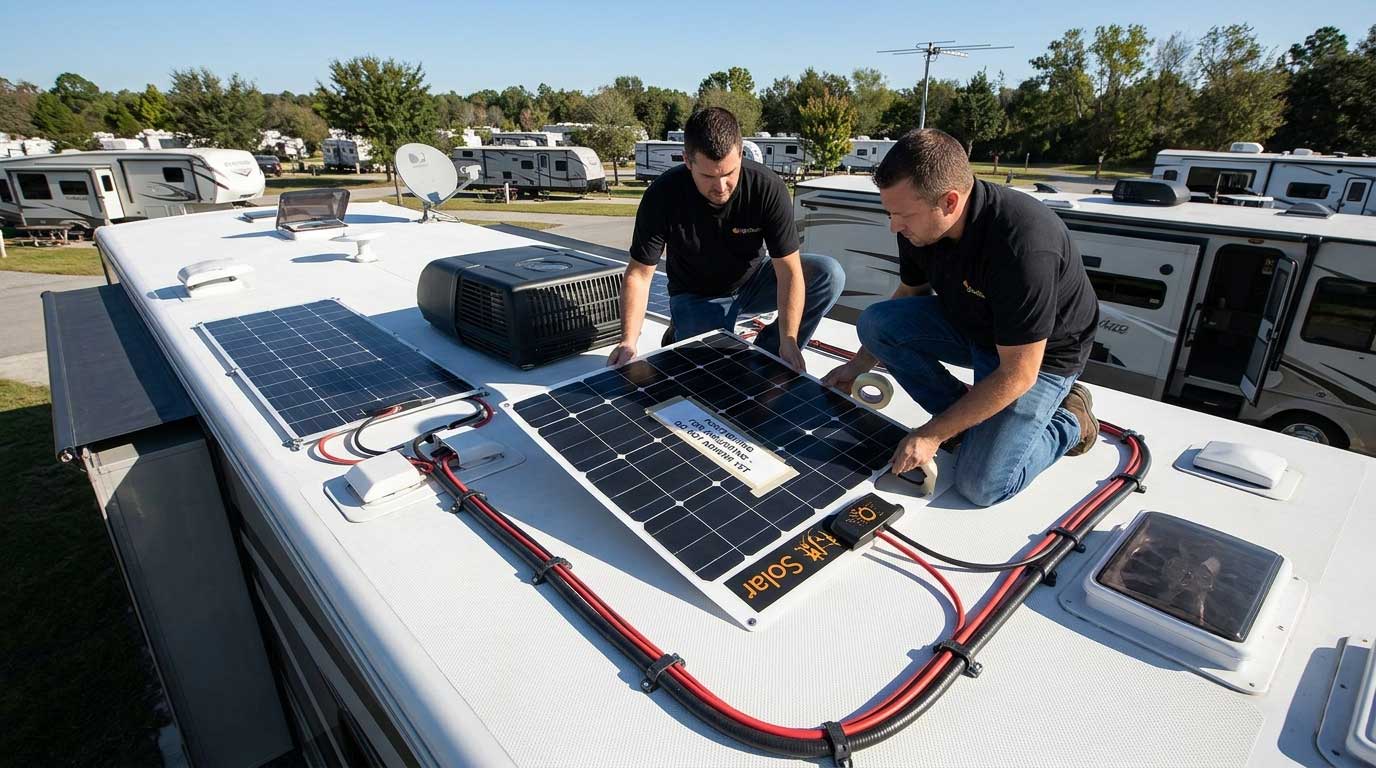
Step 2 — Test Panel Position First
Lay the panel in place before mounting.
Check:
- Roof curvature
- Cable routing
- Vent shadows
- AC unit airflow
- Walking clearance
One installation we corrected had the solar panel placed directly beside an RV air conditioner exhaust. Surface heat became excessive by mid-afternoon.
Placement matters.
Step 3 — Apply Mounting Material
For adhesive installs:
- Apply VHB tape evenly
- Avoid cheap silicone-only mounting
- Use primer if recommended
For screw mounting:
- Pre-drill carefully
- Seal penetrations with roof sealant
- Avoid over-tightening
Flexible panels can crack internally if forced too hard against uneven surfaces.
Step 4 — Leave Space for Cooling
This is the biggest mistake DIY installers make.
Flexible panels mounted directly against metal roofs often run extremely hot.
In one summer test we performed on a dark van roof:
- Flush-mounted panel surface: 168°F
- Raised airflow-mounted panel: 137°F
That temperature difference directly affected charging performance.
Common Mistakes When Mounting Flexible Solar Panels
| Mistake | Consequence |
|---|---|
| Using hardware-store glue | Early panel detachment |
| No airflow underneath | Overheating |
| Over-bending panel | Cell cracking |
| Mounting near roof edge | Wind uplift |
| Walking directly on panel | Microfractures |
I’ve also seen installers use roofing tar. It worked for about six months.
Then everything failed at once.
How Long Does a Properly Mounted Flexible Solar Panel Last?
Realistically:
- Budget flexible panels: 2–5 years
- Quality ETFE flexible panels: 5–10 years
- Professionally mounted systems with airflow: sometimes longer
The mounting quality often determines lifespan more than the solar cells themselves.
That surprises many buyers.
FAQ:How to Mount Flexible Solar Panel?
Can I glue flexible solar panels directly to the roof?
Yes, but direct flush mounting increases heat buildup and may shorten lifespan. A slight airflow gap is usually safer.
Is drilling necessary?
Not always. Many RV and van owners use industrial VHB tape successfully without drilling.
What is the best adhesive for flexible solar panels?
3M VHB tape combined with compatible sealant is widely trusted in marine and RV applications.
Can flexible solar panels fly off while driving?
Improperly mounted panels absolutely can. Edge lift caused by highway wind is a common failure point.
Are flexible solar panels waterproof?
Most quality flexible panels are weather-resistant, but cable connections and roof penetrations must also be sealed properly.
What are flexible solar panel mounts?
Flexible solar panel mounts are systems used to secure lightweight flexible panels on surfaces such as RV roofs, vans, boats, and curved structures. Common options include VHB tape, adhesive mounts, spacers, brackets, and hybrid mounting solutions.
How does flexible solar panel installation work?
Flexible solar panel installation involves preparing the mounting surface, positioning the panel, applying adhesive or hardware, sealing cable connections, and ensuring proper airflow. Correct installation helps prevent overheating, lifting, and long-term performance loss.
What should you know about mounting flexible solar panels?
Mounting flexible solar panels requires more than simply attaching them to a surface. Proper surface preparation, suitable adhesive, temperature control, and vibration resistance are important for reliable performance in outdoor environments.
How do you install semi flexible solar panels?
Installing semi flexible solar panels requires cleaning the mounting area, checking panel placement, applying suitable adhesive or brackets, and protecting wiring connections. Semi-flexible panels are commonly used on RVs, boats, and curved roofs.
What is solar panel flexible mounting?
Solar panel flexible mounting refers to installation methods designed for lightweight and bendable solar modules. These methods allow panels to follow curved surfaces while maintaining secure attachment and weather resistance.
What is flexible solar panel mounting?
Flexible solar panel mounting uses adhesives, tapes, brackets, or hybrid systems to secure flexible solar panels without damaging the installation surface. The best method depends on roof material, environment, and application requirements.
How to install flexible solar panels?
To install flexible solar panels, clean the surface, test the panel position, apply quality mounting materials, seal cable entry points, and avoid excessive bending. Leaving space for cooling can improve efficiency and panel lifespan.
What is the best way for installing flexible solar panels on RV roof?
Installing flexible solar panels on RV roof requires choosing RV-compatible adhesive or mounting hardware, preparing the roof surface carefully, and protecting panels from heat and highway vibration. Hybrid mounting with ventilation often provides better long-term reliability.
How To Mount Flexible Solar Panels To RV Roof?
Mounting flexible solar panels to an RV roof requires proper surface preparation, strong bonding materials, safe wiring, and careful positioning. A correct installation prevents panel damage, water leaks, and power loss during long-term travel.Learn more about “How To Mount Flexible Solar Panels To RV Roof“
How to Mount Flexible Solar Panels on a Fiberglass Roof?
To mount flexible solar panels on a fiberglass roof, thoroughly clean the fiberglass surface, use a compatible structural adhesive, avoid excessive bending, provide ventilation whenever possible, and secure cables properly. Correct installation prevents heat buildup, water intrusion, and long-term panel failure.Learn more about “How to Mount Flexible Solar Panels on a Fiberglass Roof“
how to mount flexible solar panels to rv roof?
The safest way to mount flexible solar panels to an RV roof is by using high-strength adhesive sealant, partial airflow spacing, waterproof cable glands, and proper roof surface preparation. Avoid fully sealing panels flat against the roof because excessive heat buildup can reduce performance and shorten panel lifespan over time.Learn more about “how to mount flexible solar panels to rv roof“
how to mount flexible solar panels on van?
Direct answer first: the safest way to mount flexible solar panels on van roofs is by combining industrial adhesive sealant, proper airflow spacing, cable sealing, and lightweight flexible modules designed for curved surfaces. Avoid fully flush mounting without ventilation, because trapped heat shortens panel lifespan significantly.Learn more about “how to mount flexible solar panels on van“
how to mount flexible solar panels on RV?
Mount flexible solar panels on an RV by cleaning the roof thoroughly, planning airflow gaps, securing panels with industrial adhesive or VHB tape, sealing cable entry points, and connecting them through a charge controller to the battery system. Proper mounting prevents water intrusion, heat buildup, and panel warping during long-term travel.Learn more about “how to mount flexible solar panels on RV“
How to Mount Flexible Solar Panels?
To mount flexible solar panels correctly, clean the surface thoroughly, leave airflow space beneath the panel whenever possible, use high-quality adhesive or mounting hardware designed for outdoor solar use, and secure wiring against vibration and water intrusion. Proper installation directly affects panel lifespan, charging efficiency, and roof safety.Learn more about “How to Mount Flexible Solar Panels“
How to Clean Flexible Solar Panels?
Flexible solar panels should be cleaned using soft water, a non-abrasive sponge, and mild soap while avoiding harsh chemicals, pressure washers, or stiff brushes. Regular cleaning improves energy output, prevents surface degradation, and helps flexible panels last significantly longer in outdoor conditions.Learn more about “How to Clean Flexible Solar Panels“
how to mount portable solar panels?
To mount portable solar panels, unfold the panel on stable ground or secure it to a compatible support, angle it toward direct sunlight, and fasten every contact point before connecting the charge controller or power station.Learn more about how to mount portable solar panels?
Final Thoughts on How to Mount Flexible Solar Panel
Learning how to mount flexible solar panel systems properly is less about sticking a panel onto a roof and more about controlling heat, vibration, airflow, and long-term stress.
The cleanest-looking installation is not always the one that lasts longest.
At Bright Solar, we usually recommend mounting systems that balance secure attachment with ventilation underneath the panel surface. That small design choice consistently improves durability in real-world RV, van, and marine installations.
And after years of seeing failed installations in extreme heat, I’d choose airflow over aesthetics every time.
The prev: How to Mount a Flexible Solar Panel?The next: How to Mount Flexible Solar Panels?
Related recommendations
-

what is the lifespan of a solar panel?
152what is the lifespan of a solar panel? Learn how long solar panels last, what affects durability, degradation rates, and how to extend solar system performance.
View details -
How Does a Portable Solar Panel Work?
322How does a portable solar panel work? Learn how portable solar panels convert sunlight into usable electricity for camping, RVs, and backup power systems.
View details -
How Long Do Solar Panels Last on a House?
273How long do solar panels last on a house? Learn the average lifespan, degradation rates, maintenance factors, and what affects residential solar panel performance with Bright Solar.
View details -
how much do solar panels save?
138Learn how much do solar panels save with real examples, electricity bill reductions, and long-term financial benefits from Bright solar experts.
View details