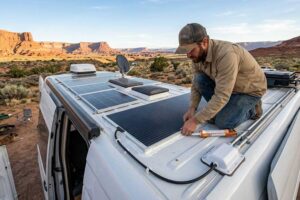
how to mount flexible solar panels on RV?
how to mount flexible solar panels on RV?
Mount flexible solar panels on an RV by cleaning the roof thoroughly, planning airflow gaps, securing panels with industrial adhesive or VHB tape, sealing cable entry points, and connecting them through a charge controller to the battery system. Proper mounting prevents water intrusion, heat buildup, and panel warping during long-term travel.
The first flexible solar panel I mounted on an RV looked perfect on day one. Six months later, the owner called because the panel edges had started lifting near the rear corner. Not because the panel failed — the roof prep failed. Dust trapped under adhesive weakened the bond after repeated heat cycles crossing Arizona and Nevada.
That experience changed the way I approach RV solar installations. Flexible panels are lightweight and convenient, but mounting them correctly matters more than most online tutorials admit.
Why RV owners choose flexible solar panels
Rigid panels still dominate residential rooftops, but RV installations are different.
Weight matters. Curved roofs matter. Wind resistance matters.
Flexible solar panels are commonly used because they:
- Add minimal roof weight
- Sit lower than framed panels
- Reduce aerodynamic drag
- Fit curved RV roofs more easily
- Simplify off-grid upgrades
According to the U.S. Department of Energy, solar adoption for mobile and distributed energy systems continues growing due to improvements in lightweight photovoltaic technologies.
Source: https://www.energy.gov/eere/solar
Most RV owners I work with are not trying to power an entire house. They want reliable battery charging while camping off-grid, running ventilation fans, charging devices, or powering a refrigerator overnight.
That changes the installation priorities completely.
Tools and materials needed before mounting
Essential installation materials
Before mounting flexible solar panels on an RV roof, prepare everything first.
| Item | Purpose |
|---|---|
| Flexible solar panel | Power generation |
| VHB tape or polyurethane adhesive | Panel bonding |
| Dicor or lap sealant | Waterproof sealing |
| MC4 connectors | Electrical connections |
| Charge controller | Battery protection |
| Cable gland entry box | Waterproof cable routing |
| Isopropyl alcohol | Roof cleaning |
| Soft roller | Pressure bonding |
I strongly recommend avoiding generic hardware-store silicone. It often degrades faster under UV exposure than RV-specific sealants.
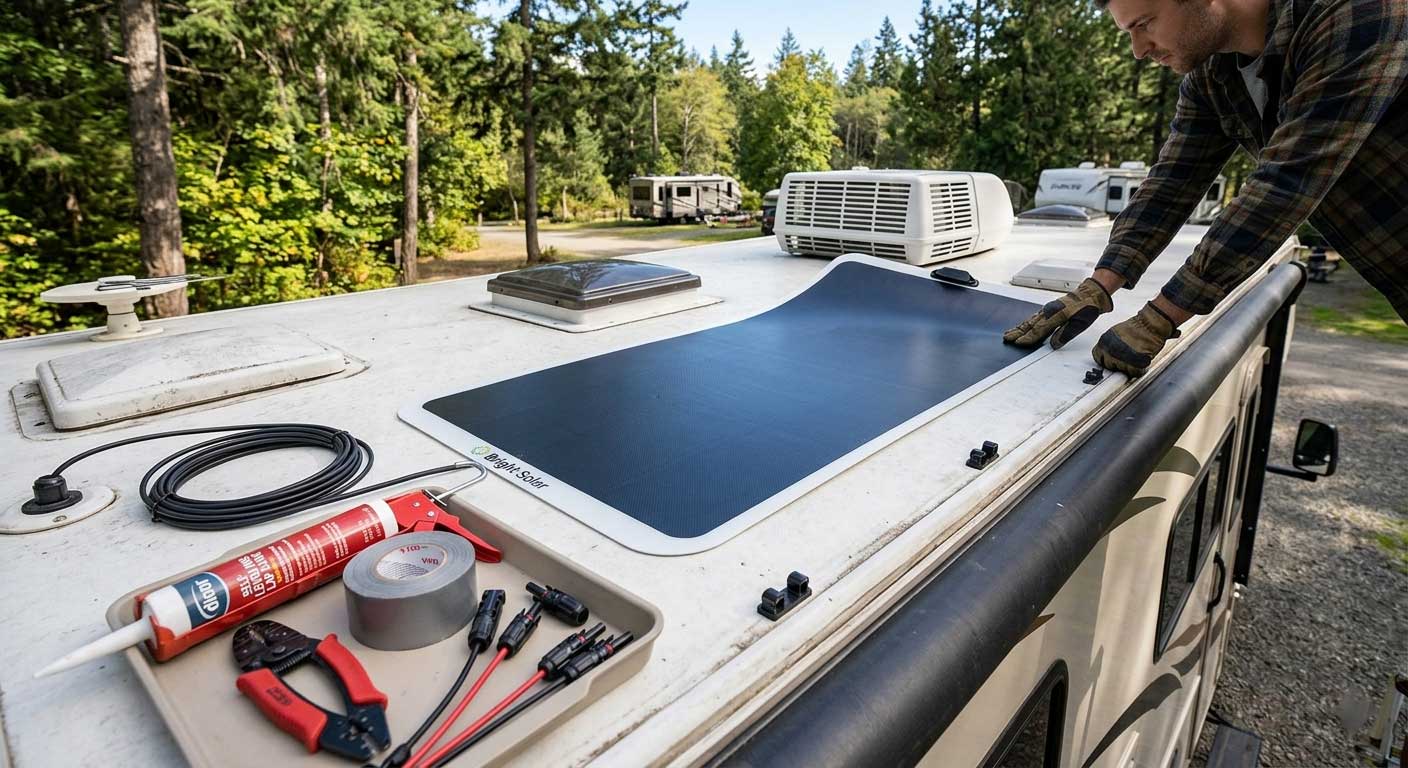
How to mount flexible solar panels on RV roofs properly
Step 1 — Inspect the roof surface
Not every RV roof is ideal for direct panel bonding.
Common RV roof materials include:
- Fiberglass
- Aluminum
- EPDM rubber
- TPO roofing
Flexible panels bond best to smooth, stable surfaces.
I once inspected an RV where someone mounted panels directly onto aging EPDM without reinforcement. The roof membrane expanded in summer heat and caused bubbling beneath the panel.
The panel itself survived. The roof did not.
Step 2 — Clean the roof thoroughly
This part feels boring. It is also the part people skip.
Use:
- Mild detergent
- Water
- Isopropyl alcohol wipe-down
Any oil residue, chalking, oxidation, or dust reduces adhesive performance dramatically.
3M technical guidance for VHB tapes emphasizes surface preparation as critical for long-term bonding reliability.
Source: https://www.3m.com
I usually clean the same section twice. Especially near roof edges where road grime accumulates.
Step 3 — Leave airflow space whenever possible
This is where many RV YouTube tutorials give questionable advice.
Flexible panels mounted fully flush against the roof can trap heat underneath.
Heat lowers solar efficiency.
The National Renewable Energy Laboratory (NREL) notes that solar panel efficiency decreases as operating temperature rises.
Source: https://www.nrel.gov
In practical terms, I have measured surface temperatures above 70°C on dark RV roofs in direct summer sun.
That is brutal for adhesives and panel longevity.
Whenever possible:
- Leave small airflow channels
- Avoid covering roof drainage paths
- Do not block factory roof ventilation
Even a few millimeters help.
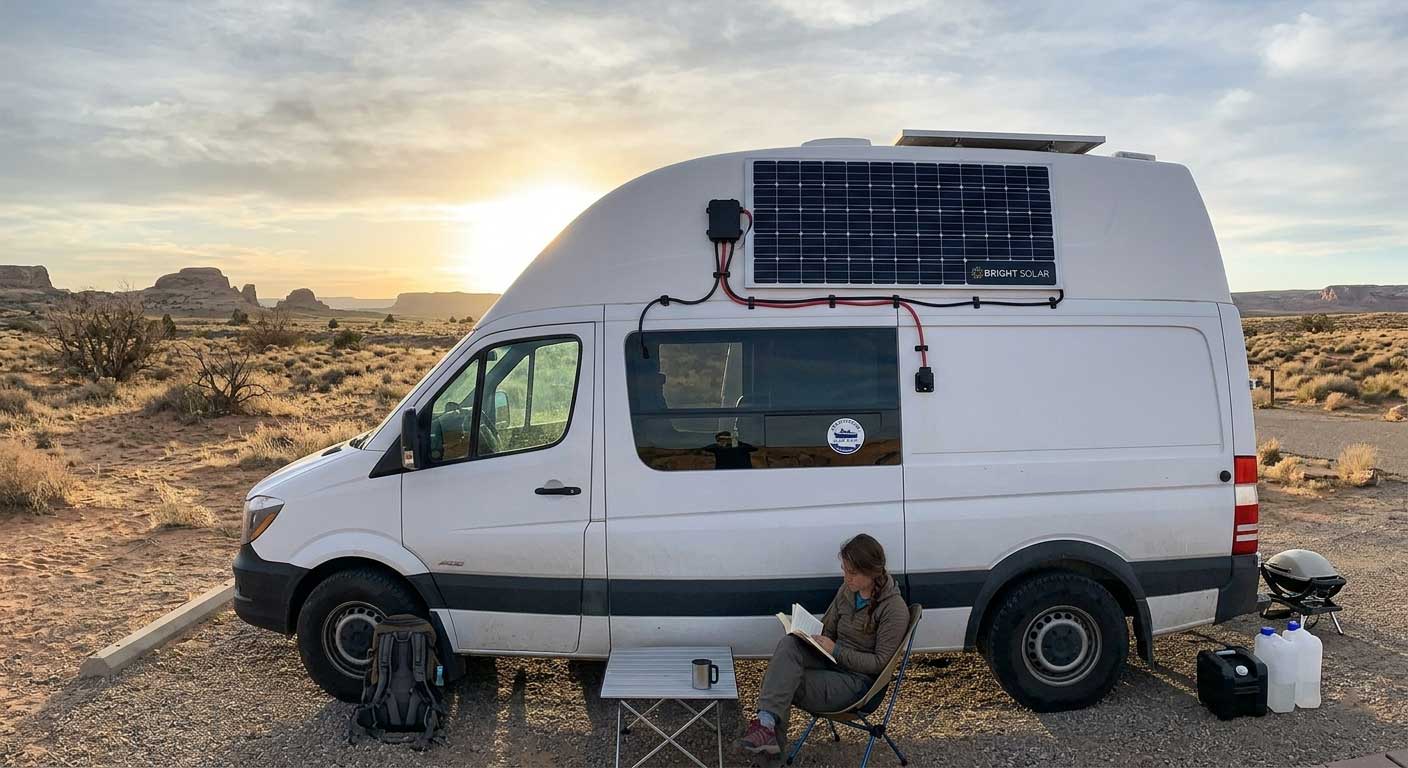
Adhesive vs screw mounting on RV solar installations
Adhesive mounting advantages
Most modern RV flexible panels use adhesive mounting.
Advantages:
- No roof drilling
- Cleaner appearance
- Lower leak risk
- Faster installation
- Better aerodynamics
Industrial VHB tape combined with polyurethane adhesive is the setup I trust most for lightweight flexible panels.
When mechanical fasteners still make sense
For:
- High-speed travel
- Large panel arrays
- Harsh off-road vibration
- Heavy snow regions
Some installers combine adhesive with low-profile corner brackets.
I have seen cross-country overlanding rigs where extra mechanical reinforcement clearly prevented edge lifting after thousands of highway miles.
Wiring flexible solar panels on RV systems
Use a proper charge controller
Never connect panels directly to batteries.
Use:
- MPPT controller for higher efficiency
- PWM controller for small budget systems
MPPT controllers usually perform better in partial shading conditions common on RV roofs.
Tree shadows, rooftop vents, and AC units constantly affect solar exposure while camping.
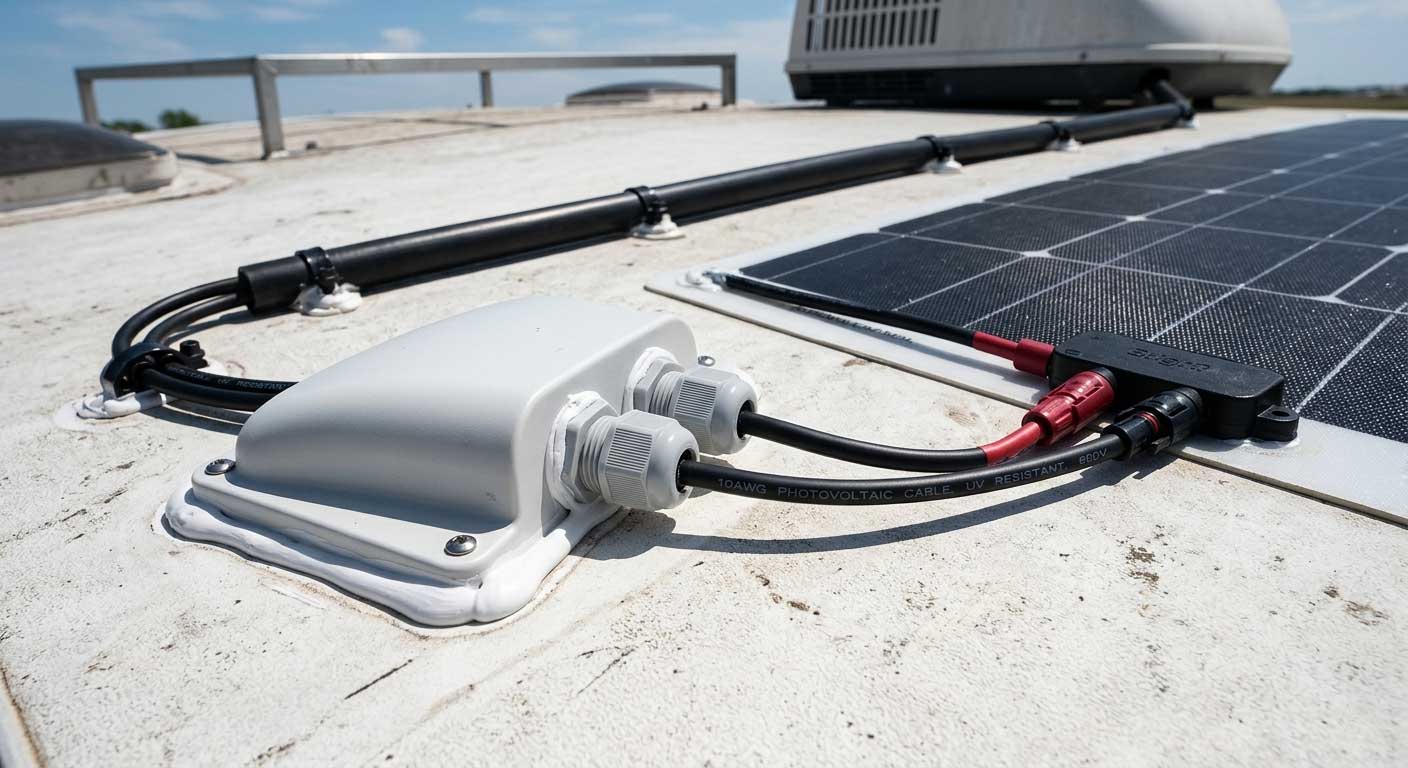
Protect roof cable entry points
Water intrusion destroys RV roofs slowly and expensively.
Every cable penetration should include:
- UV-resistant gland box
- Sealant around edges
- Drip-loop cable routing
The most expensive RV solar repair I ever saw had nothing to do with electricity. Water entered around an improperly sealed cable entry and rotted the roof decking underneath.
The owner noticed the smell before noticing the leak.
Common mistakes when mounting flexible solar panels on RVs
| Mistake | Result |
|---|---|
| Skipping roof cleaning | Adhesive failure |
| Using household silicone | UV cracking |
| Blocking airflow completely | Heat damage |
| Mounting near roof edges | Wind lift risk |
| Poor cable sealing | Water intrusion |
| Walking directly on panels | Cell damage |
One mistake I still see constantly: mounting panels too close to rooftop air conditioners.
Those AC units radiate surprising heat during summer operation.
Your solar panel absorbs every bit of it.
Real-world performance expectations
Flexible panels are convenient, but expectations should stay realistic.
Compared with rigid panels:
- They usually run hotter
- Lifespan may be shorter
- Efficiency can decline faster in harsh heat
Still, for RVs, the tradeoff often makes sense.
Especially for:
- Camper vans
- Lightweight trailers
- Curved fiberglass roofs
- Stealth camping setups
The portability and reduced wind resistance matter more than squeezing out every possible watt.
FAQ:how to mount flexible solar panels on RV?
Can flexible solar panels be glued directly to RV roofs?
Yes. Most RV installations use industrial adhesive or VHB tape combined with weatherproof sealants.
Do flexible solar panels overheat on RV roofs?
They can. Leaving small airflow gaps helps reduce temperature buildup and improves long-term durability.
How long do flexible RV solar panels last?
Most quality flexible panels last between 5 and 15 years depending on heat exposure, installation quality, and travel conditions.
Can flexible solar panels handle highway speeds?
Yes, if properly bonded and sealed. Poor edge preparation is usually the cause of lifting problems.
How to Mount Flexible Solar Panel?
Flexible solar panels are usually mounted using industrial adhesive, VHB tape, screws with spacers, or hybrid mounting systems. The safest installation keeps airflow under the panel, prevents water buildup, and avoids over-bending the panel surface. Done correctly, a flexible solar panel can stay securely mounted for 5–10 years on RVs, vans, boats, and curved roofs.Learn more about “How to Mount Flexible Solar Panel“
Final Thoughts
How to mount flexible solar panels on RV roofs is not really about sticking panels onto a vehicle. It is about managing heat, vibration, airflow, water sealing, and long-term movement across thousands of miles.
That is why the best RV solar installations often look simple from the outside.
The hidden work matters most:
- Surface preparation
- Adhesive selection
- Cable sealing
- Thermal planning
After years around RV retrofits and mobile solar systems, I trust careful installation more than flashy specifications.
A properly mounted 200W flexible panel that survives five summers is worth far more than a poorly installed 400W system already peeling at the corners by next season.
The prev: How to Mount Flexible Solar Panels?The next: how to mount flexible solar panels on van?
Related recommendations
-

How Many Solar Panels to Power House?
175How many solar panels to power house depends on energy use, location, and panel output. Learn sizing methods, real data, and expert tips from Bright Solar.
View details -
How Much for Solar Panels?
237How much for solar panels? Discover average solar panel costs, what affects pricing, and how to estimate your home's solar investment with Bright Solar's expert guide.
View details -
How to Attach Flexible Solar Panel to RV Roof?
253Learn how to attach flexible solar panel to RV roof safely using adhesive, screws, and proper sealing methods. Expert RV solar installation tips from Bright Solar.
View details -
How Much Electric Does a Solar Panel Generate?
236How much electric does a solar panel generate? Discover daily and yearly solar panel output, real-world performance, and expert insights from Bright Solar with verified industry data.
View details