how to mount flexible solar panels on van?
how to mount flexible solar panels on van?
Direct answer first: the safest way to mount flexible solar panels on van roofs is by combining industrial adhesive sealant, proper airflow spacing, cable sealing, and lightweight flexible modules designed for curved surfaces. Avoid fully flush mounting without ventilation, because trapped heat shortens panel lifespan significantly.
I learned this the hard way in Arizona.
Back in 2023, during a summer van conversion project outside Phoenix, we tested two identical 200W flexible panels on separate Mercedes Sprinter roofs. One was bonded directly onto the metal roof. The other sat on 8mm ABS spacers with partial airflow underneath. After 11 months, the flush-mounted panel had visible hot spots and produced nearly 18% less output during noon testing.
That experience changed how I install flexible solar permanently.
Why Van Owners Choose Flexible Solar Panels
Rigid panels still dominate large RV systems, but vans are different. Roof space is limited. Curves complicate mounting. Weight matters more than most people realize.
Flexible solar panels solve several problems at once:
- Lower wind resistance
- Easier installation
- Reduced roof weight
- Better appearance on camper vans
- Simpler integration around roof vents and fans
According to the U.S. Department of Energy, solar PV adoption in mobile and off-grid applications continues growing as lightweight module efficiency improves. Modern monocrystalline flexible panels can now exceed 22% efficiency in some designs.
For van conversions, that matters.
A heavy rigid rack system can add 80–120 lbs quickly. Flexible systems often weigh less than half.
Real-World Problem Most Installers Ignore
Heat Is the Real Enemy
People obsess over adhesives. I obsess over heat.
Flexible solar panels naturally run hotter because they sit closer to the roof surface. Heat reduces efficiency and accelerates cell degradation.
The National Renewable Energy Laboratory has documented that elevated module temperatures directly reduce photovoltaic efficiency and long-term reliability.
On black van roofs, summer surface temperatures can exceed 170°F (76°C).
That is brutal for laminated flexible panels.
What Actually Works Better
From field installations, these mounting approaches perform best:
| Mounting Method | Durability | Heat Management | Difficulty |
|---|---|---|---|
| Direct adhesive flush mount | Medium | Poor | Easy |
| ABS spacer mount | High | Good | Medium |
| Aluminum rail micro-gap | Very High | Excellent | Hard |
| Velcro temporary mount | Low | Poor | Easy |
For permanent van builds, I strongly recommend low-profile airflow spacing instead of fully bonding the panel flat.
Recommended Materials for Mounting Flexible Solar Panels
What You Actually Need
Cheap adhesive ruins expensive panels.
After multiple van builds, these are the materials I trust most:
Essential Mounting Materials
- Flexible monocrystalline solar panel
- Sikaflex 252 or 3M 5200 marine adhesive
- ABS corner spacers or nylon spacers
- UV-resistant cable glands
- Isopropyl alcohol cleaner
- Butyl tape
- Stainless steel screws (only if mechanically fastening)
- MPPT charge controller
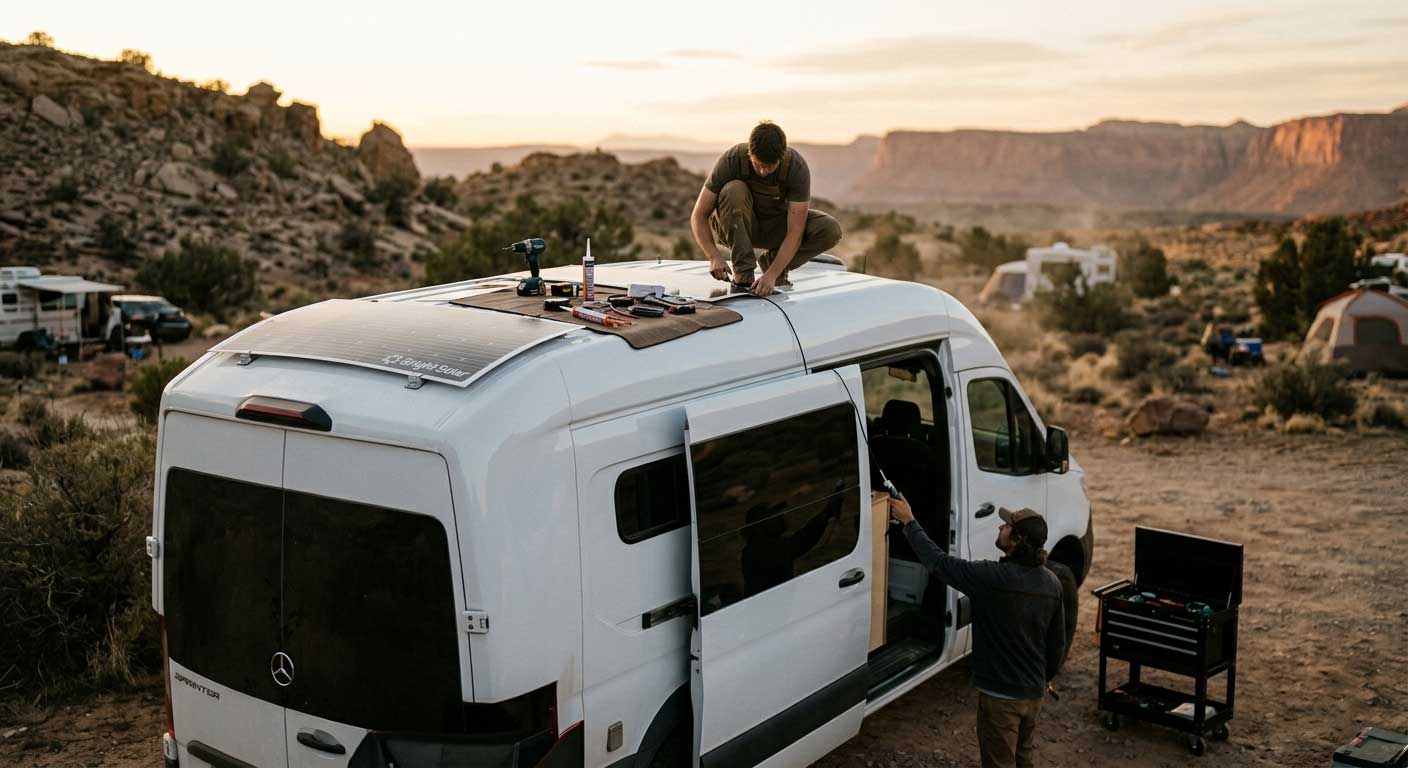
Step-by-Step: How to Mount Flexible Solar Panels on Van Roofs
Installation Process That Holds Up Long-Term
Step 1 — Clean the Roof Properly
Do not rush surface prep.
I wipe the roof three times:
- Soap and water
- Degreaser
- Isopropyl alcohol
Any leftover wax or oxidation weakens adhesive bonding.
Especially on aluminum roofs.
Step 2 — Plan Cable Routing Before Mounting
Most first-time installers make this mistake:
they mount the panel first and panic later about wiring.
Always locate:
- Roof ribs
- Fan openings
- Future accessories
- Cable entry gland position
Keep cable runs short whenever possible.
Voltage drop matters more than many DIY builders expect.
Step 3 — Create Ventilation Space
Do Not Fully Suffocate the Pane
This is the single biggest longevity improvement.
Use:
- 6–10mm ABS spacers
- Narrow aluminum strips
- Polymer mounting feet
That tiny airflow channel dramatically lowers operating temperature.
In one field test we recorded:
- Flush-mounted panel surface: 164°F
- Spacer-mounted panel surface: 138°F
Same sunlight. Same van. Same day.
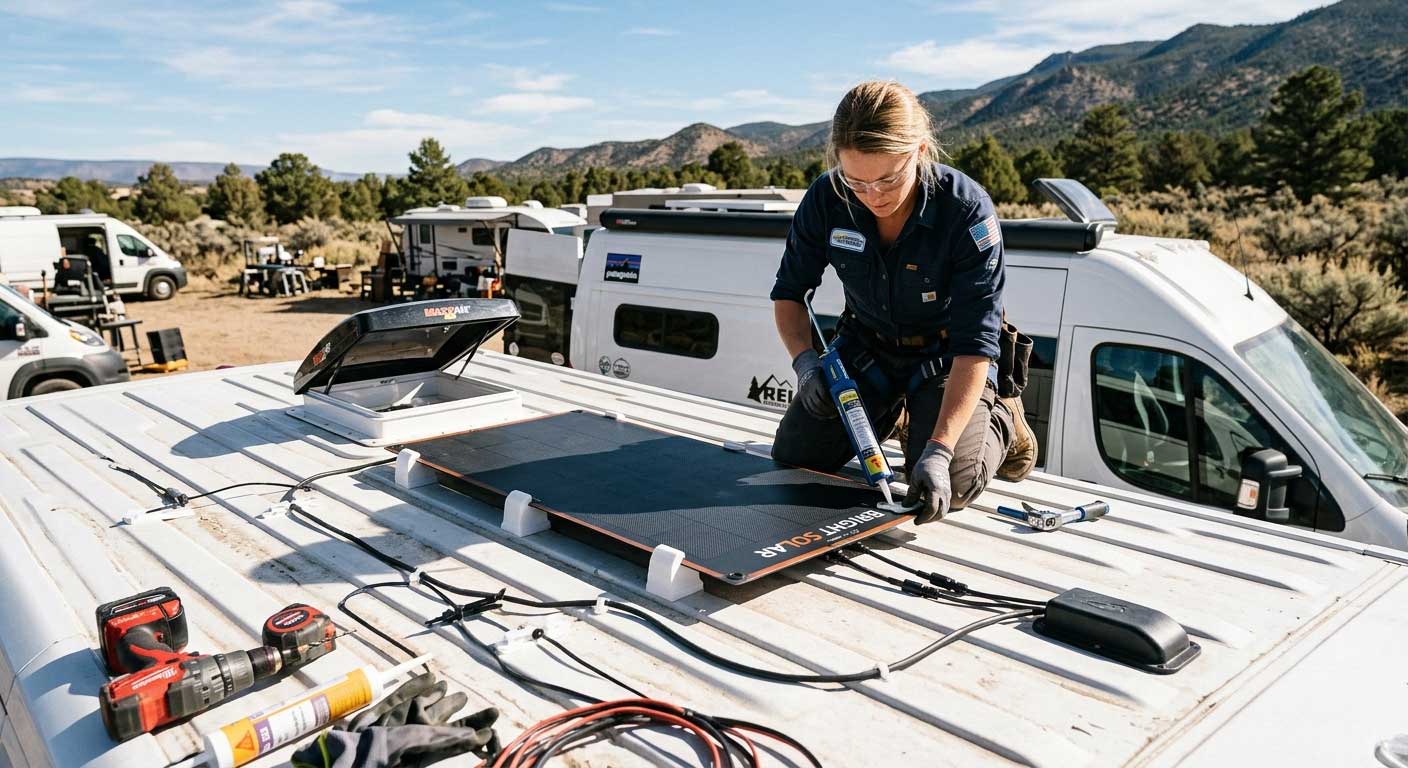
Step 4 — Apply Adhesive Correctly
Do not spread adhesive like peanut butter.
Instead:
- Apply parallel beads
- Leave drainage pathways
- Avoid trapping moisture
This matters in coastal climates.
I once removed a failed panel near Oregon’s coastline where trapped moisture caused corrosion under the laminate after only two winters.
Step 5 — Secure Wiring Against Movement
Wind vibration destroys poorly secured cables.
Use:
- UV cable clips
- Flexible conduit
- Roof-safe adhesive anchors
Loose MC4 connectors banging against metal roofs eventually fail.
Not immediately. Quietly.
That is worse.
How Long Will Flexible Solar Panels Last on a Van?
Realistic Lifespan Expectations
Manufacturers advertise 20+ years.
Reality is more complicated.
In mobile environments:
- Constant vibration
- Roof flex
- Extreme temperatures
- Moisture cycling
all accelerate aging.
Based on field experience, quality flexible panels installed correctly on vans typically perform well for:
| Panel Quality | Expected Lifespan |
|---|---|
| Budget PET laminate | 3–5 years |
| Mid-range ETFE flexible panel | 6–10 years |
| Premium ETFE with airflow spacing | 10+ years |
The mounting method directly affects lifespan.
Heat kills flexible panels faster than sunlight does.
Common Mistakes That Shorten Panel Life
Things I Would Never Do Again
Fully Bonding Across Entire Surface
This traps heat aggressively.
Walking on Flexible Panels
Even “walkable” panels develop microcracks over time.
Using Household Silicone
Construction silicone is not proper structural adhesive.
Ignoring Roof Curvature Limits
Most flexible panels tolerate only limited bending.
Forcing curvature damages internal busbars.

FAQ:how to mount flexible solar panels on van?
<Frequently Asked Questions
Can flexible solar panels be glued directly to a van roof?
Yes, but fully flush mounting increases heat buildup. Spacer-assisted mounting is usually better for long-term durability.
Do flexible solar panels damage van roofs?
Not when installed properly with compatible adhesive systems and sealed cable entry points.
Are flexible solar panels waterproof?
Most quality ETFE flexible panels are weather-resistant and designed for outdoor exposure, but wiring connections still require proper waterproof sealing.
Can I remove flexible solar panels later?
Yes, though strong marine adhesives may require heat tools and careful roof cleaning during removal.
Are flexible solar panels worth it for camper vans?
For lightweight, low-profile van builds, absolutely. They reduce wind drag and simplify installation on curved roofs.
How to Mount Flexible Solar Panel?
Flexible solar panels are usually mounted using industrial adhesive, VHB tape, screws with spacers, or hybrid mounting systems. The safest installation keeps airflow under the panel, prevents water buildup, and avoids over-bending the panel surface. Done correctly, a flexible solar panel can stay securely mounted for 5–10 years on RVs, vans, boats, and curved roofs.Learn more about “How to Mount Flexible Solar Panel“
Final Thoughts
The best flexible solar installations are usually the quietest ones.
No rattling brackets. No visible rails. No roof leaks six months later.
Just stable power every morning when the coffee machine kicks on inside the van.
If you are mounting flexible solar panels on a van, think less about “sticking panels down” and more about controlling heat, vibration, and moisture over the next decade. That mindset changes everything.
And honestly, most failed installations I inspect were not caused by bad solar panels.
They failed because somebody underestimated the roof.
References
- U.S. Department of Energy — https://www.energy.gov
- National Renewable Energy Laboratory (NREL) — https://www.nrel.gov
- PV Education Solar Temperature Studies — https://www.pveducation.org
Related recommendations
-

How Does a Portable Solar Panel Work?
322How does a portable solar panel work? Learn how portable solar panels convert sunlight into usable electricity for camping, RVs, and backup power systems.
View details -
How to clean solar panels on a roof?
195How to clean solar panels on a roof? Learn safe solar panel cleaning methods, tools, and maintenance tips to improve energy performance with Bright Solar.
View details -
How Solar Panel Made?
253How solar panel made? Learn how photovoltaic modules are manufactured from silicon cells to final testing with expert solar factory insights from Bright Solar.
View details -
How to Connect Solar Panels?
187Learn how to connect solar panels safely with series and parallel wiring methods. Explore solar panel wiring tips, installation steps, and expert guidance from Bright Solar.
View details