Top Rated RV Solar Panels: How to Choose the Right One
The top rated RV solar panels are not simply the panels with the highest wattage. For most RVs, the right choice balances power output, roof space, weight, temperature performance, durability, shading conditions, and compatibility with the battery and charge controller.
An RV roof looks bigger from the ground than it actually is.
Once you put an air conditioner, vents, skylights, antennas, roof racks, and walking space into the layout, the usable solar area can disappear surprisingly quickly. That is why choosing an RV solar panel should start with the vehicle rather than with a product catalog.
At Bright Solar, I look at three things first when reviewing an RV solar layout: how much usable roof area is actually available, how much electricity the owner uses each day, and how much weight the roof can reasonably carry. Only then do I decide whether rigid, flexible, or portable panels make more sense.
The U.S. Department of Energy identifies rigid and flexible photovoltaic modules as established vehicle-mounted PV approaches, with lightweight construction, appearance, and efficiency being important considerations for vehicle applications.
That distinction becomes especially important on camper vans and travel trailers where every square foot of roof has another job.
What Makes an RV Solar Panel “Top Rated”?
There is no single specification that makes a solar panel the best RV panel.
A useful evaluation should include:
- Rated power: 100W, 200W, 400W and larger systems
- Module efficiency: important when roof space is limited
- Weight: particularly important for flexible installations and older RV roofs
- Dimensions: determines how much usable roof area remains
- Vmp and Voc: critical for charge-controller selection
- Temperature behavior: affects real-world voltage and power
- Surface durability: important for long-term outdoor exposure
- Shading tolerance: relevant around roof vents and air conditioners
- Mounting method: adhesive, brackets, rails, or portable deployment
- Warranty and manufacturer support
- Compatibility with MPPT or PWM controllers
One specification is rarely enough.
For example, a 200W panel that weighs 10 kg and a 200W flexible panel weighing around 5 kg may deliver the same nominal power, but they are very different products from an RV installation perspective.
That difference can matter more than another percentage point of laboratory efficiency.
Best RV Solar Panel Types
There are three practical categories worth considering.
| Panel Type | Main Advantage | Main Limitation | Best RV Application |
|---|---|---|---|
| Rigid monocrystalline | Strong, established construction | Heavier and taller | Large travel trailers |
| Flexible monocrystalline | Low weight and low profile | Thermal and long-term installation considerations | Camper vans, curved roofs |
| Portable/folding | Easy to reposition | Requires deployment space | Shaded or temporary campsites |
Victron’s current RV guidance similarly separates rigid and flexible panels, noting that flexible panels are thin, light, and able to follow slight roof curves.
The choice becomes easier when you picture the actual campsite.
A rigid panel permanently mounted on a large fifth-wheel roof is one situation.
A low-profile panel bonded to a camper van roof with only a narrow strip of usable space between the vent and roof fan is another.
Flexible Solar Panels for RVs
Flexible panels are particularly interesting when weight and roof clearance matter.
They can sit close to the roof and follow modest curves, which makes them attractive for camper vans, trailers, boats, and other mobile applications.
Bright Solar’s flexible-panel approach is aimed at exactly this type of application: getting useful photovoltaic capacity onto surfaces where a conventional framed module is inconvenient.
But flexible does not mean “install anywhere.”
The roof surface needs to be clean and structurally suitable. Cable routing should be planned before the panel is permanently attached. The panel also needs appropriate thermal consideration because a panel mounted directly against a roof may have different heat dissipation than a raised rigid module.
Victron’s 2026 RV guidance specifically describes flexible panels as lighter and closer to the roof, while also distinguishing their characteristics from rigid panels.
I would therefore avoid choosing a flexible panel simply because it is lighter.
The better question is:
Does the RV roof benefit from the low-profile, lightweight format enough to justify the installation trade-offs?
For many vans, the answer is yes.
How Much Solar Power Does an RV Need?
There is no universal RV solar wattage.
The correct starting point is daily energy consumption.
A simple calculation is:
Daily solar requirement ≈ Daily energy use ÷ usable solar production
Suppose an RV uses approximately:
| Load | Estimated Daily Energy |
|---|---|
| LED lighting | 80 Wh |
| Refrigerator | 500 Wh |
| Water pump | 60 Wh |
| Phone/tablet charging | 100 Wh |
| Laptop | 150 Wh |
| Fans and miscellaneous DC loads | 150 Wh |
| Estimated total | 1,040 Wh/day |
If the system is designed around approximately five peak-sun-hours, the theoretical PV requirement would be:
1,040 Wh ÷ 5 h = 208W
I would not stop at 208W.
Real installations experience temperature losses, wiring losses, controller losses, non-optimal roof orientation, partial shading, dirt, and changing sunlight throughout the day.
A 300–400W array would therefore be a much more practical starting point for this example, depending on the traveler’s battery capacity, location, season, and willingness to supplement with shore power or alternator charging.
Victron’s current RV sizing guide likewise starts with energy consumption and then works through panel capacity, charge controller, battery storage, and additional components rather than recommending one universal panel size.
200W Solar Panels for RV: Is 200W Enough?
A 200W panel can be a very practical RV building block.
It works especially well when roof space is limited or when the owner wants to build the system gradually.
For example:
- 1 × 200W = small auxiliary system
- 2 × 200W = 400W array
- 3 × 200W = 600W array
- 4 × 200W = 800W array
The important point is that four 200W panels do not necessarily need to be installed as four independent systems.
They can be configured as a larger PV array, with the final series/parallel arrangement selected according to the module specifications and charge controller.
Victron explains that series wiring increases PV voltage while current remains approximately the same, whereas parallel wiring keeps voltage similar and increases current.
That gives RV designers considerably more flexibility than simply asking, “How many watts should I buy?”
RV Solar Panels: Series vs Parallel
This is where I recommend doing the electrical calculation before installing anything on the roof.
Consider four identical panels rated approximately:
- 200W
- Vmp: 20V
- Imp: 10A
- Voc: 24V
A four-panel series configuration would theoretically be around:
80V Vmp × 10A ≈ 800W
A four-panel parallel configuration would be around:
20V Vmp × 40A ≈ 800W
The power is similar.
The electrical architecture is not.
Series advantages
- Higher PV voltage
- Lower array current
- Can reduce cable current for a given power
- Works particularly well with MPPT controllers
- Can be useful for longer cable runs
Parallel advantages
- Lower system voltage
- Higher current
- Can be useful where shading affects individual panels
- May suit certain RV layouts with lower-voltage controllers
Victron specifically recommends considering the combined Voc when panels are wired in series and combined Isc when panels are wired in parallel.
For RV roofs, shading deserves extra attention.
A roof vent can create a narrow shadow that moves across one panel for several hours. That is a very different situation from a clean, unobstructed roof.
Why MPPT Matters in an RV Solar System
For modern RV systems, I generally favor MPPT when the budget and system size justify it.
An MPPT controller allows the PV array to operate at a voltage different from the battery charging voltage. That is particularly useful when several panels are connected in series.
Victron describes MPPT as a DC-DC conversion system that tracks the panel’s maximum power point and converts the available power to the battery’s required voltage.
Its technical information also reports that MPPT can have a substantial performance advantage under certain low-irradiance and temperature conditions.
For an RV, that can matter during:
- Early morning
- Late afternoon
- Cool weather
- Winter travel
- Partial shading
- Longer cable runs
The controller still has limits.
You need to check:
- Maximum PV open-circuit voltage
- MPPT operating-voltage range
- Maximum charging current
- Maximum recommended PV power
- Battery voltage
- Battery chemistry and charging profile
Victron’s current controller documentation uses the first number in its controller naming to indicate maximum PV open-circuit voltage and the second number for maximum charge current.
RV Solar Panel Weight Matters More Than Most Buyers Expect
A 200W panel is not just a 200W panel.
It is also a physical object attached to a moving vehicle.
A current example from the RV market illustrates the difference. Renogy lists its 200W flexible panel at approximately 4.9 kg (10.8 lb), while its listed rigid 200W module weighs approximately 10.6 kg (23.4 lb). Those are manufacturer-specific figures rather than universal industry standards, but the comparison shows why weight can become a serious design variable.
Two 200W modules could therefore mean roughly:
- Flexible: around 9.8 kg
- Rigid: around 21.2 kg
Four panels make the difference even more noticeable.
This is not an argument that flexible panels are automatically better. Rigid modules have advantages of their own.
It is an argument for looking at watts per kilogram and watts per square foot, not watts alone.

Top Rated RV Solar Panels: What I Would Compare Before Buying
If I were comparing several panels for the same RV, my specification sheet would look something like this:
| Factor | What to Check | Why It Matters |
|---|---|---|
| Power | W | Determines nominal capacity |
| Efficiency | % | Important when roof area is limited |
| Weight | kg/lb | Affects vehicle and roof loading |
| Dimensions | L × W | Determines layout |
| Vmp | V | Helps determine operating voltage |
| Voc | V | Critical for controller sizing |
| Imp | A | Helps determine charging current |
| Temperature coefficient | %/°C | Important in hot/cold climates |
| Construction | Flexible/rigid | Determines mounting method |
| Surface | ETFE/glass/etc. | Affects durability and weight |
| Warranty | Years | Useful for long-term ownership |
There is one more column I would add:
“Where will it be installed?”
That sounds obvious, but it changes the answer.
A roof with an air conditioner in the center may favor several smaller modules arranged around it. A long, unobstructed fifth-wheel roof may make rigid high-power modules more attractive.
A Realistic 400W RV Solar Example
Consider a couple traveling in a 24-foot travel trailer.
Their typical daily loads are approximately:
- Refrigerator: 450 Wh
- Lighting: 70 Wh
- Water pump: 50 Wh
- Phones and tablets: 80 Wh
- Laptop: 120 Wh
- Ventilation fans: 120 Wh
- Miscellaneous DC loads: 110 Wh
Total:
1,000 Wh/day
They have about five peak-sun-hours available during a typical summer trip.
A 400W array gives a theoretical:
400W × 5h = 2,000 Wh/day
The actual harvested energy will be lower because real-world conditions are not laboratory conditions.
Still, the 400W array provides useful headroom for normal losses and changing weather.
Now imagine one of the four panels sits beside a roof vent and is shaded every afternoon.
I would not automatically add another panel.
First, I would examine the roof layout and string configuration.
That is the difference between buying more solar and designing better solar.
RV Solar Installation: Details That Cause Problems Later
The panel itself is usually not where the installation fails.
Cable entry is one example.
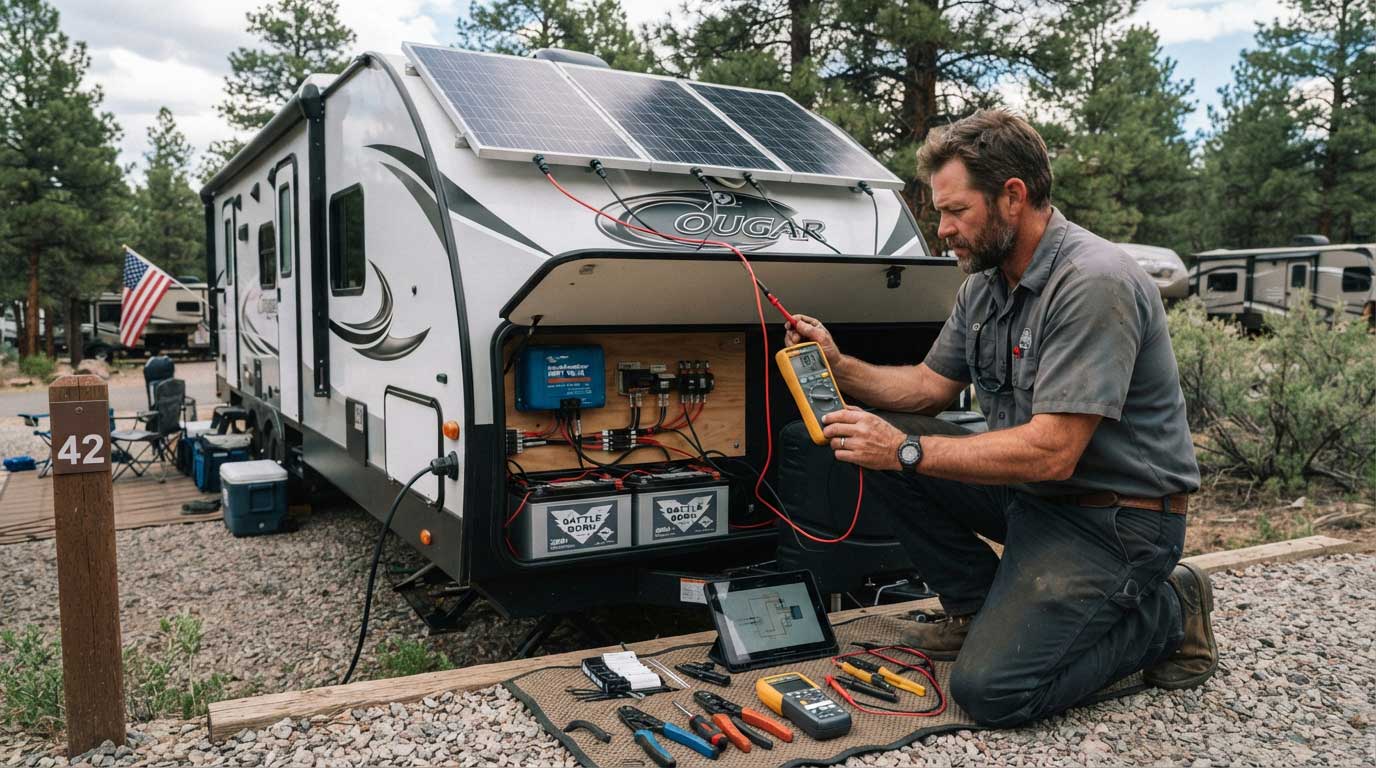
A cable entering through the roof needs a proper weather-resistant solution. The cable should not be stretched tightly across the panel surface. Sharp edges, unsupported cable loops, poor connector placement, and water accumulation are all small installation details that can become expensive later.
The same applies to adhesive-mounted flexible panels.
The roof preparation is not a five-minute cleaning job.
Remove contamination, inspect the roof material, plan the cable route, establish the final panel position, and make sure the panel is not being forced into a curve beyond its manufacturer’s specified installation limits.
I also prefer making a cardboard template before permanent installation.
It sounds almost too simple.
But placing a cardboard rectangle on the roof immediately shows whether the panel will interfere with the AC unit, vent, antenna, skylight, or maintenance access.
Moving cardboard is cheap.
Moving a permanently bonded solar panel is not.
Battery Size and Solar Panel Size Must Match
A large solar array connected to a small battery bank can create a different problem from having too little solar.
For example, a 600W array on a 12V battery system can potentially deliver a substantial charging current through the controller.
The controller must be sized accordingly.
Battery chemistry matters as well.
Victron recommends checking whether the solar charging system is compatible with the battery chemistry and correctly configured for LiFePO₄ batteries when upgrading an RV battery system.
The solar panel, controller, battery, inverter, alternator charger, and shore-power charger should be treated as one electrical system.
Not six separate shopping decisions.
How to Choose the Best RV Solar Panel for Your RV
Use this quick decision guide.
Choose flexible panels when:
- Roof weight is a major concern
- The roof has a modest curve
- Low profile is important
- You want to maximize usable roof area
- The installation surface is appropriate for bonded panels
Choose rigid panels when:
- Roof space is relatively open
- Mechanical mounting is acceptable
- Maximum long-term durability is a priority
- Additional panel height is not a problem
- Weight is within the RV’s design constraints
Consider portable panels when:
- The RV frequently parks in shade
- The vehicle roof is heavily obstructed
- You want to move the solar array toward the sun
- Permanent roof installation is undesirable
The “best” panel changes with the RV.
That is why a top-rated product on a retail website may still be the wrong product for a particular vehicle.

FAQ: Top Rated RV Solar Panels
What are the top rated RV solar panels?
The top rated RV solar panels are those that match the RV’s roof area, energy demand, weight limits, battery bank, and charge controller. Flexible panels are often attractive for low-profile and lightweight installations, while rigid panels can be preferable when roof space and mounting structure are less restrictive.
Are flexible solar panels good for RVs?
Yes. Flexible solar panels can be particularly useful on RVs because they are thin, lightweight, and suitable for some curved or weight-sensitive roofs. However, installation method, heat management, surface compatibility, and long-term outdoor durability should be evaluated before choosing them.
How many watts of solar do I need for an RV?
Many RV systems fall somewhere between a few hundred watts and substantially larger arrays, depending on daily energy consumption. A 300–400W array can be a practical starting point for moderate off-grid use, but actual sizing should be based on daily Wh consumption, sunlight, battery capacity, and expected weather.
Is 200W solar enough for an RV?
A 200W RV solar panel can be enough for light electrical use, especially when combined with a suitable battery and supplemental charging. For refrigeration, electronics, fans, and longer off-grid stays, 400W or more may provide a more comfortable energy margin.
Should RV solar panels be wired in series or parallel?
Series wiring increases PV voltage while keeping current approximately the same; parallel wiring increases current while maintaining similar voltage. Series wiring can work particularly well with MPPT controllers, while parallel configurations can be useful where shading and lower PV voltage are priorities.
Are MPPT controllers better for RV solar?
For many modern RV systems, MPPT is the preferred option because it can operate the PV array at a different voltage from the battery and track the panel’s maximum power point. This becomes particularly useful as array power increases or when panels are wired in series.
Can flexible solar panels be connected in series?
Yes, provided the panels are designed for the configuration and the resulting voltage remains within the charge controller or inverter’s limits. Always calculate the combined Voc and account for temperature before finalizing a series string.
Bright Solar’s Practical View on RV Solar Panels
The best RV solar system is rarely the one with the biggest number printed on the panel.
It is the system that fits the roof without creating a maintenance problem, produces enough energy for the owner’s actual habits, works within the controller’s voltage range, and leaves enough electrical and physical margin for real travel.
For a small camper van, that may mean several lightweight flexible panels.
For a large travel trailer, rigid modules may make more sense.
For an RV that spends most of its time under trees, a portable array may solve a problem that another 200W permanently mounted panel cannot.
The useful specification is not simply watts.
It is watts that can actually be installed, exposed to sunlight, converted efficiently, stored in the battery, and used when you need them.
That is the standard I recommend when evaluating top rated RV solar panels for real-world off-grid travel.
Related recommendations
-

Jingke Energy Tiger Neo N-type Module Distribution Agreement Signed with Aldo Solar
286Jingke Energy Tiger Neo N-type Module Distribution agreement with Aldo Solar brings 600 MW of ultra-high efficiency photovoltaic modules to the Brazilian market, strengthening distributed generation and promoting clean energy adoption in Latin Ame...
View details -
Flexible RV Solar Panels: Complete Guide to Choosing, Installing, and Using Solar Power for RVs
234Discover flexible RV solar panels for campers and motorhomes. Learn benefits, installation, sizing, and how to choose reliable solar solutions for off-grid travel.
View details -
Most Powerful Solar Panel: How to Choose the Highest Output Solar Solution
224Discover the most powerful solar panel options for maximum energy output. Learn efficiency ratings, real-world performance, and how Bright Solar solutions support RV, marine, and off-grid applications.
View details -
Solar Panels for Tiny House: Complete Guide to Off-Grid Energy Solutions
251Solar panels for tiny house provide clean, reliable power. Learn system sizing, costs, installation tips, batteries, and flexible solar solutions from Bright Solar.
View details