100 Watt Flexible Solar Panel Kit: Complete Guide
A 100 watt flexible solar panel kit is a practical small-scale solar system for RVs, vans, boats, cabins, sheds, and other off-grid applications. A properly matched kit can provide useful daily energy while keeping roof weight, installation height, and wiring relatively simple.
The important word here is kit.
A 100W panel by itself is only a power-generating component. A usable system normally needs a charge controller, appropriate cables and connectors, and a battery if the application needs energy after sunset. The right combination depends heavily on the battery voltage, chemistry, daily load, available sunlight, and mounting surface.
I have found that small solar installations are often easier mechanically than electrically. The panel can take 20 minutes to position, while choosing the wrong controller or undersized wiring can create problems that do not become obvious until the system is already installed.
What Is a 100 Watt Flexible Solar Panel Kit?
A 100W flexible solar panel kit combines a lightweight flexible photovoltaic module with some or all of the components needed to connect it to a battery-based solar system.
A typical kit may contain:
- 100W flexible solar panel
- Solar charge controller
- PV cables
- MC4-compatible connectors
- Battery connection cables
- Mounting materials or adhesive
- Fuse or fuse holder, depending on configuration
- Installation instructions
The exact contents vary between manufacturers.
That distinction matters when comparing online products. One seller may call a panel plus two cables a “kit,” while another includes the controller, battery cables, fuse, and mounting hardware.
For a buyer, the useful question is not simply:
“Does this package say 100W?”
Ask instead:
What exactly is included, and are those components electrically compatible with my battery and load?
The U.S. Department of Energy describes PV modules as only one part of a complete photovoltaic system. Other components are needed to make the generated DC electricity useful for the intended application.
How Much Power Does a 100W Flexible Solar Panel Produce?
A 100W panel has a rated maximum output of 100 watts under its specified test conditions. It does not mean the panel will produce 100 watts continuously throughout the day.
For a simple planning example:
100W × 4 peak-sun-hours = 400Wh/day
That is 0.4 kWh of theoretical daily energy before system losses.
A second example:
100W × 5 peak-sun-hours = 500Wh/day
Again, this is a planning calculation rather than a guaranteed production figure.
The Department of Energy explains that PV performance is affected by temperature, sunlight characteristics, reflection, and other factors. Higher temperatures generally reduce voltage, even though current may increase slightly.
DOE also notes that PV performance ratings are measured under standard test conditions of 1,000 W/m² irradiance and 25°C cell temperature, while real-world sunlight is often weaker and operating temperatures are often higher.
That difference is easy to see on an RV roof.
A panel can be sitting under bright sunshine, yet its cell temperature can be considerably above the laboratory rating condition. Add a little morning shade from an air conditioner or roof vent and the actual energy harvested can move further away from the nameplate figure.
100W panel output example
| Equivalent peak sun hours | Simple theoretical output |
|---|---|
| 2 hours | 200Wh |
| 3 hours | 300Wh |
| 4 hours | 400Wh |
| 5 hours | 500Wh |
| 6 hours | 600Wh |
These figures are deliberately simple. They do not include charge-controller, wiring, battery, temperature, shading, dirt, or conversion losses.
For system sizing, that distinction is important.
What Can a 100 Watt Flexible Solar Panel Kit Run?
A 100W kit is best suited to small and moderate DC energy loads, especially when the equipment does not operate continuously at high power.
Typical applications include:
- RV battery maintenance
- LED lighting
- USB charging
- Phones and tablets
- Small ventilation fans
- Wi-Fi or communication equipment
- GPS equipment
- Monitoring devices
- Security cameras
- Small pumps with limited runtime
- Marine electronics
- Cabin lighting
- Shed or workshop sensors
It can also contribute energy toward larger systems, but it should not be presented as a substitute for a properly sized residential or RV solar array.
A refrigerator is a good example.
Suppose an efficient 12V refrigerator averages 35W while its compressor is operating. If it runs for an equivalent 8 hours of compressor operation in a day:
35W × 8h = 280Wh/day.
A 100W panel might contribute meaningfully to that demand under favorable solar conditions, but it would be risky to assume the panel alone can reliably cover the refrigerator every day.
The battery has to absorb the difference.
This is where a “100W solar kit” stops being a product specification and becomes a system-design problem.
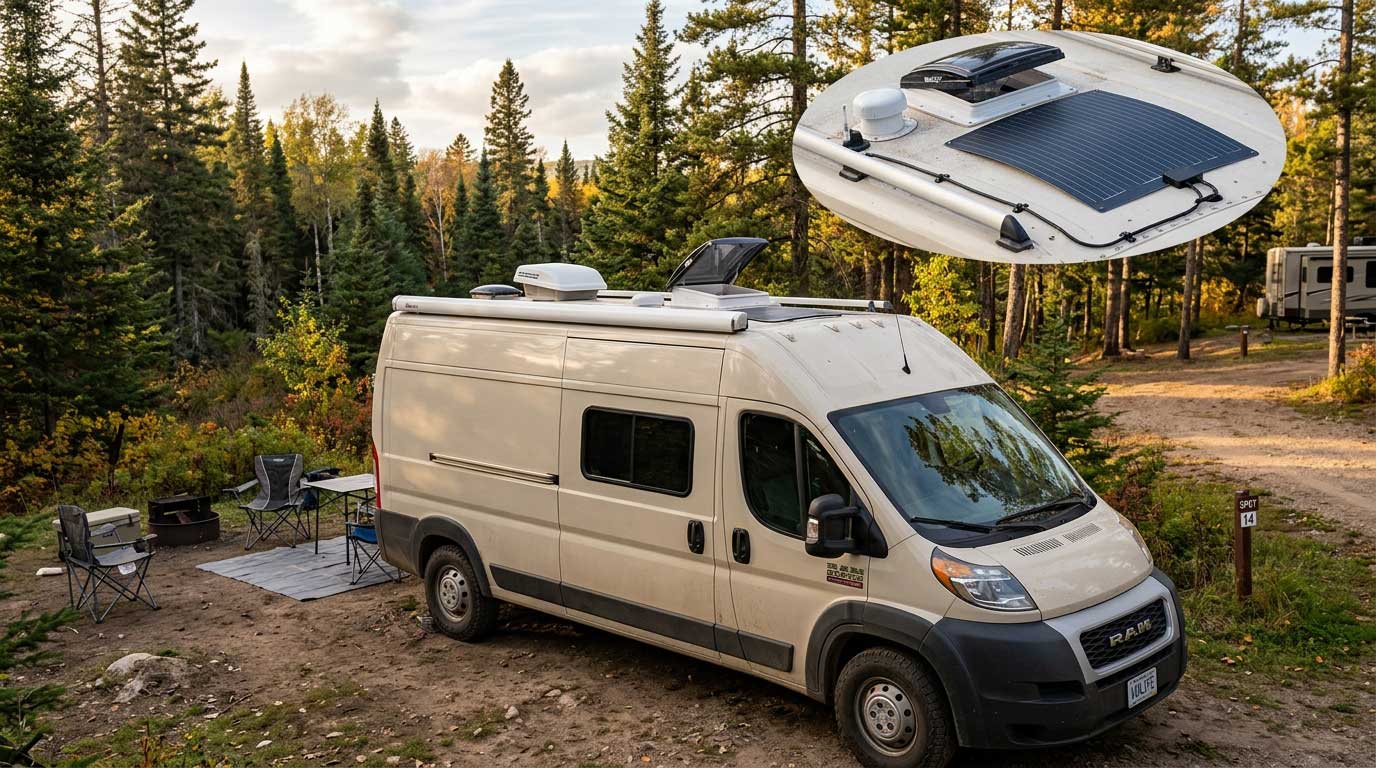
100W Flexible Solar Panel Kit for RVs
A 100W flexible solar panel kit for RV applications is particularly attractive when roof weight and installation height matter.
A rigid framed panel creates a small mechanical structure above the roof. A flexible panel can sit much closer to the surface.
That is useful on:
- Camper vans
- Class B RVs
- Small travel trailers
- Teardrop trailers
- Boats
- Utility vehicles
- Portable shelters
The roof itself is usually the first constraint.
An RV roof can contain:
- Air-conditioning units
- Roof vents
- Skylights
- Antennas
- Satellite equipment
- Roof racks
- Solar wiring
- Maintenance access areas
A 100W flexible module may fit into an awkward section where a conventional framed panel would not.
But I would not install one simply because there is empty space.
Walk around the vehicle at different times of day. Look at where shadows fall. A roof vent that seems insignificant at 10 a.m. can become a much larger problem at 3 p.m.
DOE’s PV system guidance emphasizes the importance of mounting, orientation, tilt, and the physical environment when designing a solar installation.
RV installation example
Consider a small camper van used primarily on weekends.
The owner has:
- A 12V lithium battery
- LED interior lighting
- USB charging
- A small water pump
- A ventilation fan
- No air conditioner
- No electric cooking equipment
A 100W flexible kit can make sense as an auxiliary charging source.
The owner does not need a large rooftop array because the goal is not to run a high-power inverter load. The objective is to replenish a modest amount of stored energy during daylight hours.
That is a much more realistic use case than expecting one 100W panel to support an entire off-grid RV.
What Should Be Included in a 100W Solar Panel Kit?
Before buying a 100 watt solar panel kit with charge controller, check the component list carefully.
1. Flexible solar panel
The panel should have a complete electrical datasheet.
Look for:
- Maximum power (Pmax)
- Voltage at maximum power (Vmp)
- Current at maximum power (Imp)
- Open-circuit voltage (Voc)
- Short-circuit current (Isc)
- Dimensions
- Weight
- Maximum system voltage
- Operating temperature range
- Connector type
A 100W rating without Vmp, Imp, Voc, and Isc is incomplete information for system design.
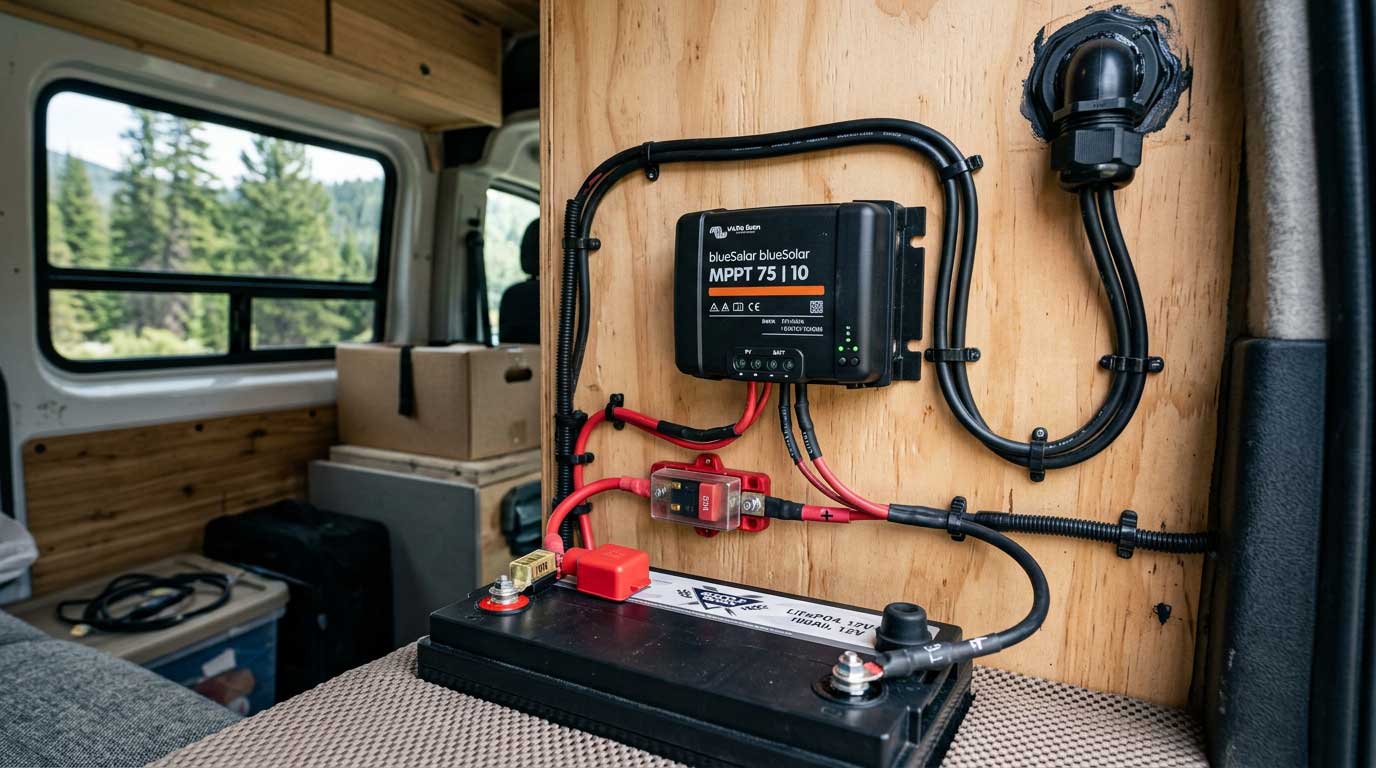
2. Solar charge controller
The controller is one of the most important parts of the kit.
For a small 12V system, a controller needs to be compatible with the panel’s input voltage and current as well as the battery chemistry.
A lithium battery should use a controller with an appropriate lithium charging profile.
A lead-acid battery has different charging requirements.
Do not assume that a controller described simply as “12V” is automatically suitable for every 12V battery.
3. Solar cables
The cable needs to be suitable for outdoor PV service and sized according to current, length, installation conditions, and allowable voltage drop.
Long cable runs deserve more attention than a short connection beside the battery.
4. Fuse and protection
System protection should be designed according to the actual configuration and applicable electrical requirements.
A fuse is not decoration. Its rating and location should be selected based on the conductor and equipment being protected.
5. Mounting materials
This becomes particularly important with flexible panels.
An adhesive-backed installation may look extremely clean, but the roof surface must be compatible with the adhesive system and properly prepared.
The panel also needs to be installed within the manufacturer’s mechanical limits.
100 Watt Flexible Solar Panel Kit Wiring
The basic wiring arrangement for a battery-based system is:
100W flexible solar panel → charge controller → battery → electrical loads
Do not treat the panel as if it were a battery charger by itself.
The controller regulates the energy going into the battery.
A typical installation sequence is:
- Inspect the panel and cables.
- Confirm panel polarity.
- Verify Voc and controller input limits.
- Identify the battery voltage and chemistry.
- Mount the panel according to the manufacturer’s instructions.
- Route the PV cable away from sharp edges.
- Connect the battery to the controller as specified by the controller manufacturer.
- Connect the PV input.
- Confirm charging voltage and current.
- Test the system under sunlight.
One practical detail: follow the charge-controller manufacturer’s connection sequence.
Some controllers specifically require the battery to be connected before the solar input so that the controller can identify system voltage correctly.
Why polarity deserves attention
Small PV systems often use familiar connectors, which can create false confidence.
A connector fitting together does not prove the system has been wired correctly.
Before energizing the controller:
- Confirm positive and negative conductors.
- Check open-circuit voltage with a suitable meter.
- Verify the battery polarity.
- Check that connectors are fully seated.
- Inspect cable insulation.
- Keep exposed connections protected from moisture.
For professional installations, testing before closing everything up saves time.
I prefer discovering a reversed cable while the system is sitting on the workbench rather than after the panel has been permanently bonded to an RV roof.
100W Flexible Panel and 12V Battery Sizing
A common question is whether a 100W flexible panel is enough for a 12V battery.
The answer depends on the battery’s capacity and the energy consumed each day.
For example, a nominal 12V 50Ah battery has:
12V × 50Ah = 600Wh
of nominal stored energy.
A 100W panel producing a simplified 400Wh/day before losses could theoretically replenish a substantial portion of that capacity under suitable solar conditions.
But that does not mean it will fully recharge a deeply discharged 50Ah battery every day.
Why?
Because the real system has losses and the available solar energy changes.
Battery charging is also not perfectly equivalent to multiplying panel wattage by hours of sunlight.
For that reason, I use battery capacity as one input, not the final answer.
The more useful calculation is:
Daily load + charging losses + expected solar resource + desired reserve = system requirement
That gives a more realistic starting point.
100W Flexible vs. Rigid Solar Panels
| Feature | 100W Flexible Panel | 100W Rigid Panel |
|---|---|---|
| Weight | Usually lower | Usually higher |
| Mounting height | Very low | Higher |
| Curved roof | Excellent advantage | Limited |
| Flat roof | Suitable | Excellent |
| Installation profile | Low-profile | Raised |
| Brackets | Often unnecessary | Common |
| Walk-on use | Generally unsuitable | Generally unsuitable |
| Mechanical protection | Depends on construction | Typically stronger |
| Portable applications | Very useful | Less convenient |
| RV roof aesthetics | Clean | More prominent |
There is no universal winner.
If I were installing on a flat workshop roof where mechanical protection and long-term structural mounting were priorities, I would seriously consider rigid modules.
If the project were a curved camper roof where weight and height were major constraints, flexible construction becomes much more compelling.
The application decides the technology.
How to Install a 100 Watt Flexible Solar Panel Kit
Step 1: Measure the mounting area
Do this before ordering.
Measure length, width, roof curvature, obstacles, and cable-routing distance.
Leave enough clearance around roof equipment and maintenance areas.
Step 2: Inspect the surface
The mounting surface must be clean, dry, structurally sound, and compatible with the chosen mounting method.
For adhesive mounting, surface preparation is critical.
Dust, oxidation, wax, grease, and incompatible coatings can reduce adhesion.
Step 3: Dry-fit the panel
Place the panel where it will be installed without removing protective film or committing to the final mounting.
Step back.
Look at it from different angles.
Check whether a vent, antenna, rack, or other object will shade it during important parts of the day.
Step 4: Plan the cable route
The shortest route is not always the best route.
Avoid sharp edges, areas of mechanical movement, hot surfaces, and locations where water can collect around cable penetrations.
Step 5: Install the panel
Follow the flexible panel manufacturer’s mounting instructions.
Do not crease the module.
Do not force a curve tighter than the specified minimum bend radius.
Do not pull on the junction box or cable to position the panel.
IEC 61215:2021 specifically added test methods for flexible PV modules, including a bending test. That is a useful reminder that flexibility is an engineered characteristic, not an invitation to repeatedly fold the module.
Step 6: Complete the electrical connections
Connect the controller, battery, and PV input according to the equipment manufacturer’s instructions.
Use appropriate protection and cable routing.
Step 7: Test before final cleanup
Check:
- Panel voltage
- Controller status
- Battery charging voltage
- Charging current
- Polarity
- Connector temperature
- Cable condition
Then let the system operate through a normal daylight period.
How Temperature and Shading Affect a 100W Flexible Panel
This is one area where product-page specifications can become misleading.
A panel’s 100W rating comes from controlled test conditions.
Real roofs are different.
DOE explains that higher PV temperatures generally cause a larger reduction in voltage than the corresponding increase in current. Extreme temperatures can also affect material durability.
That matters for flexible panels because some installations place the module very close to the mounting surface.
If a roof becomes extremely hot in direct summer sun, the cells do not remain at laboratory test temperature.
Shading is another issue.
A shadow across even part of a module can reduce output depending on the module’s electrical architecture and bypass-diode configuration.
The practical lesson is simple:
Look at the panel as part of its environment, not as an isolated 100W number.
How to Choose a 100W Flexible Solar Panel Kit
Before buying, I recommend checking these specifications rather than comparing only the advertised wattage.
| Specification | Why it matters |
|---|---|
| Pmax | Confirms rated power |
| Vmp | Determines operating voltage |
| Imp | Determines operating current |
| Voc | Important for controller input limits |
| Isc | Useful for protection and controller sizing |
| Panel dimensions | Confirms physical fit |
| Weight | Important for RV and marine applications |
| Bend radius | Prevents mechanical damage |
| Connector type | Simplifies compatibility |
| Battery compatibility | Prevents charging problems |
| Controller type | Affects system operation |
| Warranty | Useful indicator of manufacturer support |
| Outdoor testing | Important for permanent installation |
For a B2B buyer, I would go one step further.
Request the technical datasheet, installation manual, warranty terms, electrical test conditions, connector specification, and packaging details.
If the supplier cannot provide basic electrical parameters for a 100W module, that is a warning sign.
Is a 100W Flexible Solar Panel Kit Worth It?
For the right application, yes.
It is particularly attractive when:
- Roof space is limited.
- Weight matters.
- A low-profile installation is preferred.
- The surface is slightly curved.
- The electrical demand is moderate.
- The system is battery-based.
- Portability matters.
- A large framed module would be inconvenient.
It is less attractive when the project requires hundreds or thousands of watt-hours every day and there is sufficient space for a larger array.
One 100W module is a useful building block.
It is not a magic substitute for system sizing.
FAQ: 100 Watt Flexible Solar Panel Kit
How much power does a 100 watt flexible solar panel produce per day?
A simple four-peak-sun-hour calculation gives approximately 400Wh before system losses. Actual production depends on solar irradiance, temperature, shading, orientation, dirt, wiring, controller efficiency, and other site conditions. DOE emphasizes that real PV operating conditions differ from standardized laboratory ratings.
Can a 100 watt flexible solar panel charge a 12V battery?
Yes. A 100W flexible panel can be used with a 12V battery when paired with a compatible solar charge controller. The controller must support the battery chemistry and the panel’s voltage and current characteristics.
What can a 100W solar panel kit run?
It can support relatively small loads such as LED lights, USB charging, monitoring equipment, communication devices, small fans, GPS equipment and some low-energy pumps. Whether it can support a particular appliance depends on its daily energy consumption and the available solar resource.
Is a 100W flexible solar panel good for an RV?
Yes, especially when roof weight, installation height, or curved mounting surfaces are important. A 100W kit is commonly more appropriate as an auxiliary RV charging source than as the only source of energy for high-power appliances.
Does a 100W flexible solar panel need a charge controller?
For a battery-based system, a suitable solar charge controller is normally required to regulate charging. The correct controller depends on panel voltage, current, battery voltage, and battery chemistry.
Can I glue a 100W flexible solar panel directly to an RV roof?
Some flexible panels are designed for adhesive installation, but the installation method must follow the manufacturer’s instructions. Roof material, adhesive compatibility, surface preparation, thermal expansion, drainage, and cable routing all matter.
Is a flexible solar panel better than a rigid panel?
It depends on the installation. Flexible panels offer advantages in weight, thickness, and curved-surface mounting. Rigid panels can offer advantages in mechanical protection and conventional mounting. Neither construction is universally better.
Bright Solar 100W Flexible Solar Panel Kit: Practical Design Considerations
For Bright Solar, the useful way to approach a 100 watt flexible solar panel kit is to treat the panel, controller, battery, wiring, and mounting surface as one system.
That is particularly important for RV and marine applications.
A good installation should answer five questions before the panel is permanently mounted:
- How many watt-hours does the load consume each day?
- How much usable sunlight is available at the installation site?
- What battery chemistry and capacity are being used?
- What are the panel’s actual Vmp, Imp, Voc, and Isc values?
- What mechanical and environmental stresses will the panel experience?
IEC 61215 is relevant here because its current design-qualification framework includes specific test methods for flexible modules, including bending tests. At the same time, IEC makes clear that qualification testing is not a quantitative prediction of service life; actual life depends on module design, environment, and operating conditions.
That is the distinction I would want a customer to understand before purchasing.
A flexible module should be flexible within its engineering limits.
A 100W panel should produce useful power under appropriate operating conditions.
And a kit should be evaluated by the performance of the whole system, not the number printed on the panel.
Related recommendations
-

High Efficiency Flexible Solar Panels: Advanced Lightweight Solar Power Solution
128Discover high efficiency flexible solar panels from Bright Solar. Learn how advanced materials improve solar output, flexibility, and performance for RV, marine, and off-grid applications.
View details -
12V Folding Solar Panels: Output, Battery Charging and Uses
1712V folding solar panels provide portable solar power for camping, RVs, and compatible off-grid battery systems. Their actual energy output depends on panel ...
View details -
Solar Panels in Parallel vs Series: A Complete Guide to Solar Panel Wiring
305Solar panels in parallel vs series explained with voltage, current, wiring methods, shading effects, and installation tips. Learn the best solar connection method with Bright Solar.
View details -
100W Flexible Solar Panel: Lightweight Solar Power That Makes Sense Off-Grid
116Discover how a 100W flexible solar panel delivers lightweight, reliable solar charging for RVs, boats, campers, and portable off-grid systems.
View details