400W Flexible Solar Panel: High-Output Solar Power Without the Weight
A 400w flexible solar panel delivers high solar output in a lightweight, bendable design ideal for RV roofs, boats, vans, and off-grid systems. Compared with rigid panels, flexible models reduce roof stress, simplify installation, and adapt better to curved surfaces while still producing serious daily charging capacity.
Three years ago, I helped retrofit a 38-foot expedition vehicle that kept cracking aluminum mounting brackets every few thousand miles. The owner had already replaced the rigid solar array twice. We switched the system to flexible ETFE panels bonded directly onto the roof contour. The vibration problem disappeared almost immediately. More interestingly, the vehicle’s fuel efficiency improved slightly because wind resistance dropped.
That experience changed my perspective on high-output flexible solar systems.
People still associate flexible panels with small trickle chargers or portable camping kits. That image is outdated. Modern 400w flexible solar panel systems are now powering full-time van conversions, offshore yachts, mobile command vehicles, and lithium battery banks large enough to support serious off-grid living.
Why 400W Flexible Solar Panels Are Becoming Popular
The solar industry has quietly shifted over the past several years.
According to the International Energy Agency (IEA), global solar PV installations continue growing rapidly as distributed energy systems expand worldwide. At the same time, mobile energy demand has exploded alongside RV travel, marine electrification, and off-grid remote work trends.
That matters because mobile users care about different things than homeowners.
They prioritize:
- Weight reduction
- Roof flexibility
- Aerodynamics
- Vibration resistance
- Portable energy independence
Rigid glass panels still dominate residential rooftops, but the rules change when the roof itself moves every day.
A 400w flexible solar panel solves problems traditional framed panels often create.
What Is a 400W Flexible Solar Panel?
A 400w flexible solar panel uses thin monocrystalline photovoltaic cells laminated onto a lightweight composite backing instead of heavy tempered glass and aluminum frames.
Most premium systems now integrate:
- High-efficiency PERC solar cells
- ETFE anti-aging surfaces
- Fiberglass reinforcement layers
- Flexible polymer substrates
The result is surprisingly thin for the amount of power produced.
Typical Technical Specifications
| Specification | Common Range |
|---|---|
| Power Output | 400W |
| Efficiency | 21%–23% |
| Weight | 6–10 kg |
| Waterproof Rating | IP67/IP68 |
| Surface Material | ETFE |
| Flexibility | 10°–30° curvature |
| Expected Lifespan | 10–20 years |
Bright Solar flexible panels commonly use ETFE coatings instead of PET because ETFE performs dramatically better in long-term UV exposure and salt-air environments.
You can usually spot the difference after two summers outdoors.
Cheap PET surfaces become cloudy and brittle.
ETFE typically stays clear much longer.
Why RV Owners Choose 400W Flexible Solar Panels
Small solar systems are easy.
The real challenge starts when users need enough power to support:
- Refrigerators
- Roof fans
- Starlink systems
- Coffee makers
- Battery charging
- Laptop workstations
That’s where a 400w flexible solar panel becomes practical.
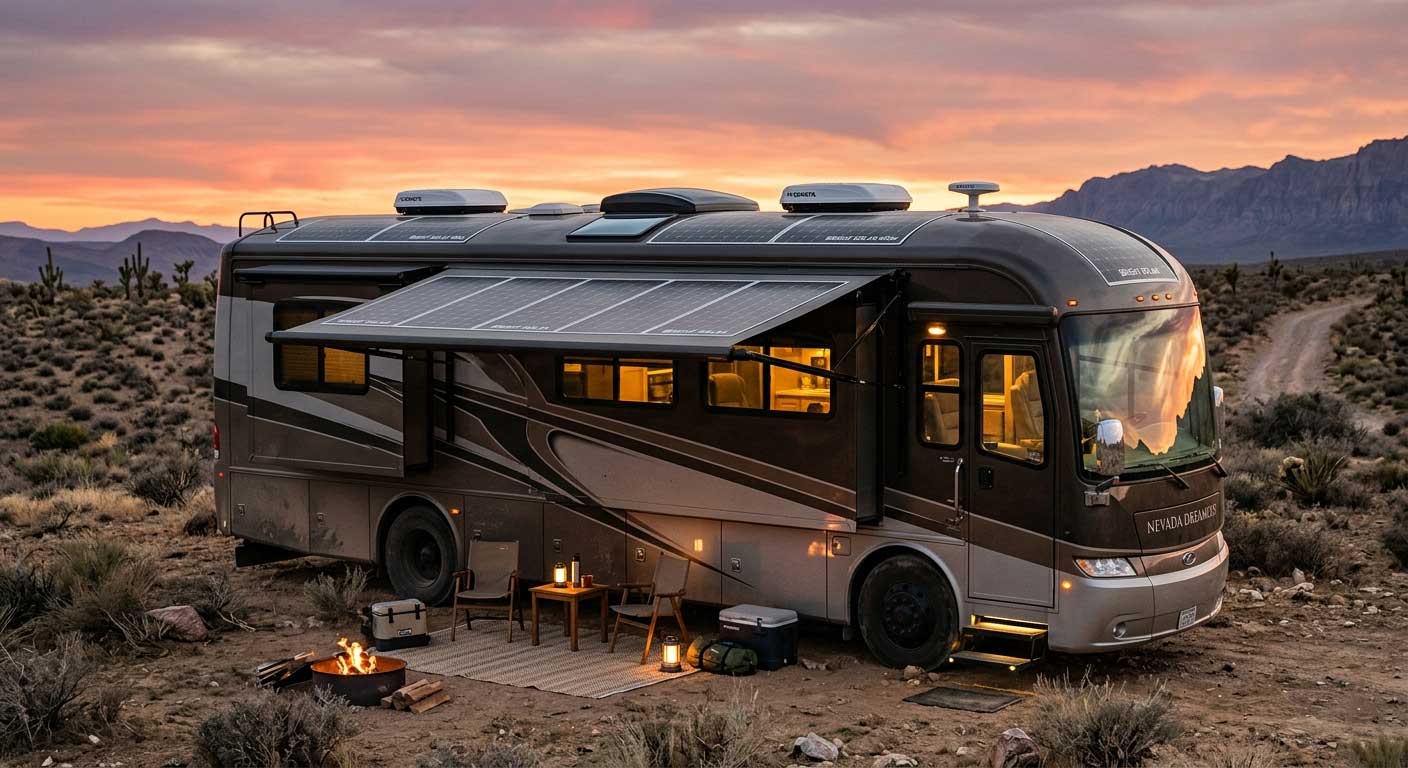
Higher Output Without Heavy Roof Loads
Traditional 400W rigid panels are large and heavy.
On some RV roofs, especially fiberglass designs, that weight creates long-term stress around mounting points.
Flexible systems distribute weight far more evenly.
I’ve seen older RV roofs develop hairline cracks from rigid mounting brackets after repeated highway vibration. Flexible bonded panels reduce those concentrated stress points substantially.
Lower Wind Resistance
This gets overlooked constantly.
Rigid panels sit elevated above the roof using brackets and rails.
Flexible solar panels sit almost flush.
That reduces:
- Highway drag
- Wind noise
- Vibration fatigue
- Mounting stress
On long-distance overland vehicles, even small aerodynamic improvements matter.
Marine Applications Are Driving Massive Demand
Marine environments destroy cheap equipment quickly.
Saltwater attacks almost everything.
I’ve inspected boat installations where low-cost solar laminates failed in less than 24 months because moisture entered poorly sealed junction boxes.
Quality flexible panels behave differently.
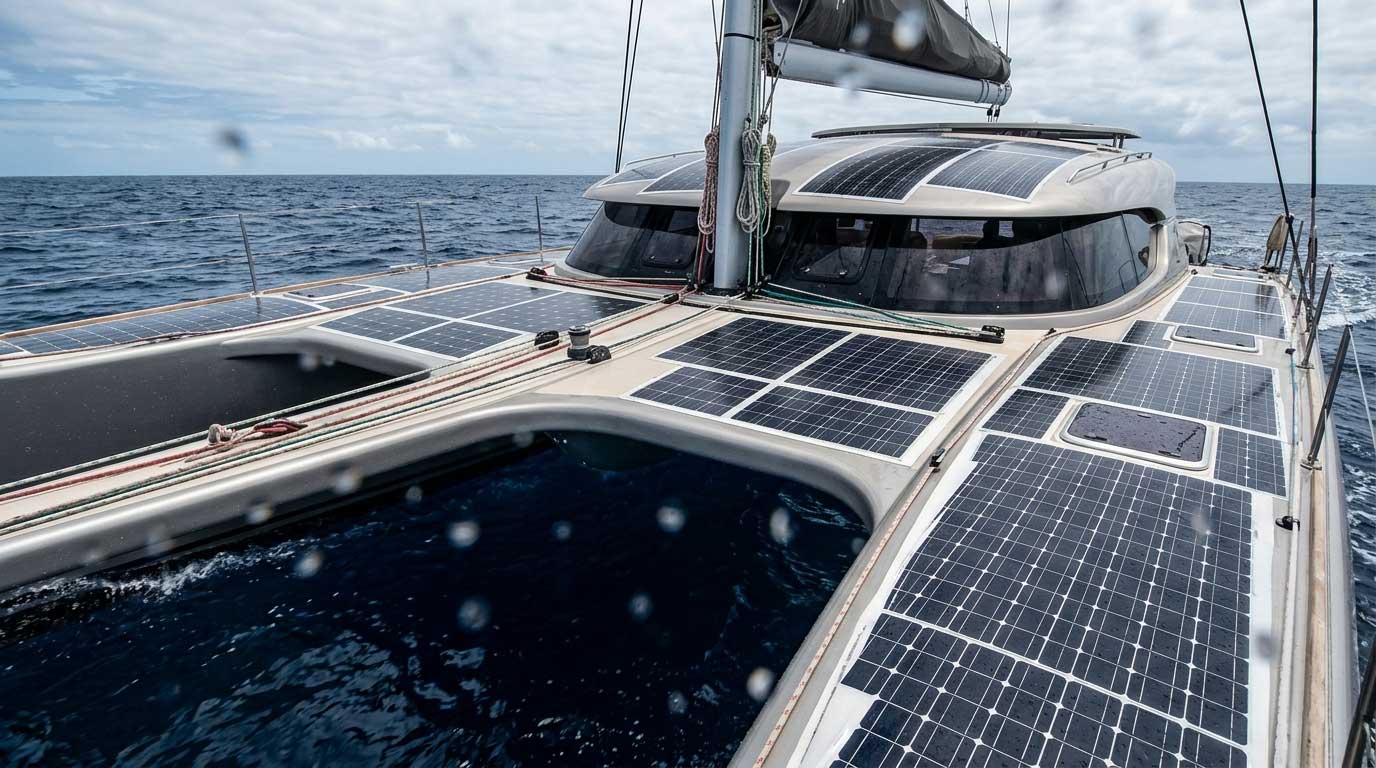
Why Flexible Solar Panels Work Better Offshore
| Marine Challenge | Flexible Panel Advantage |
|---|---|
| Curved deck surfaces | Easier integration |
| Salt exposure | ETFE corrosion resistance |
| Wind uplift | Flush low-profile mounting |
| Weight sensitivity | Lightweight structure |
| Constant vibration | Better mechanical flexibility |
Marine users increasingly choose flexible solar systems for:
- Sailing yachts
- Fishing boats
- Catamarans
- Expedition vessels
- Offshore monitoring systems
The lower profile matters more than many people realize.
Offshore wind loads become violent during storms. Flush-mounted flexible panels experience less uplift stress than framed rigid modules.
ETFE vs PET — The Material Difference Most Buyers Miss
This is one of the biggest quality differences in the flexible solar industry.
Cheap Flexible Panels Usually Use PET
PET surfaces cost less to manufacture.
But prolonged outdoor exposure often causes:
- UV yellowing
- Cracking
- Delamination
- Reduced light transmission
That degradation directly reduces solar performance.
ETFE Performs Better Long-Term
Bright Solar flexible solar panels typically use ETFE because it offers:
- Superior UV resistance
- Better heat tolerance
- Improved anti-scratch performance
- Longer optical clarity
- Higher saltwater resistance
ETFE has even been used in aerospace applications because of its durability under harsh environmental conditions.
That’s not marketing hype.
It’s material science.
Real-World Daily Output of a 400W Flexible Solar Panel
Many buyers misunderstand watt ratings.
A 400w flexible solar panel does not continuously generate 400 watts all day long.
Actual performance depends on:
- Sun angle
- Temperature
- Geographic location
- Shading
- Installation angle
Estimated Daily Energy Production
| Weather Conditions | Estimated Daily Output |
|---|---|
| Strong summer sunlight | 1.6–2.2 kWh |
| Moderate conditions | 1.2–1.6 kWh |
| Cloudy weather | 0.5–1.0 kWh |
That amount of energy can realistically support:
- RV refrigeration
- LED lighting
- Portable induction cooking
- Starlink internet
- Camera batteries
- Ventilation systems
- Lithium battery charging
In practical terms, many full-time van travelers now combine two 400w flexible solar panels with lithium battery banks for near-silent off-grid living.
Flexible Solar Panels vs Rigid Panels
People online often argue as if one technology completely replaces the other.
That’s not how professionals view it.
Rigid Panels Still Have Advantages
Rigid systems usually offer:
- Longer service life
- Better cooling airflow
- Lower cost per watt
- Higher structural rigidity
For stationary rooftops, rigid panels often remain the better option.
Flexible Panels Solve Different Problems
| Feature | Flexible Panel | Rigid Panel |
|---|---|---|
| Weight | Very light | Heavy |
| Curved surface mounting | Excellent | Poor |
| Wind profile | Low | Elevated |
| Installation complexity | Lower | Higher |
| Roof penetration needs | Minimal | Significant |
| Mobility applications | Excellent | Moderate |
Mobile applications change the engineering priorities completely.
Common Installation Mistakes
After years around mobile solar systems, the same installation failures appear repeatedly.
Mounting Directly Without Ventilation
Flexible panels still generate heat.
Without airflow beneath them, operating temperatures increase sharply.
Higher heat reduces efficiency.
Even a small ventilation gap helps significantly.
Using Low-Quality Adhesives
Marine-grade adhesive matters.
Cheap adhesive systems often fail because of:
- UV exposure
- Thermal expansion
- Moisture intrusion
Once edges begin lifting, long-term failure accelerates rapidly.
Poor Cable Management
I still see exposed rooftop wiring routed carelessly across RV roofs.
Eventually:
- UV damages insulation
- Connectors corrode
- Voltage drops increase
Most “panel failures” actually begin as installation failures.
Corrosion Resistance Is More Important Than Wattage
This surprises many first-time buyers.
Solar systems fail from environmental damage far more often than cell degradation.
Bright Solar flexible solar panels commonly integrate:
- Waterproof junction boxes
- UV-resistant cables
- Marine-grade connectors
- Corrosion-resistant hardware
- Salt-resistant ETFE surfaces
In coastal environments, these details matter enormously.
I’ve inspected systems where the solar cells remained functional while cheap mounting hardware completely rusted away.
Off-Grid Living Is Changing Solar Design
The rise of mobile work and remote travel reshaped the solar industry.
People now expect reliable power almost anywhere.
Popular Applications for 400W Flexible Solar Panels
- RV rooftops
- Camper vans
- Tiny homes
- Overlanding trailers
- Sailboats
- Emergency backup systems
- Portable solar charging stations
A properly configured 400w flexible solar panel setup can dramatically reduce generator dependency.
And once users experience quiet solar-powered campsites, they rarely want to return to fuel-powered generators.
FAQ — 400W Flexible Solar Panel
Is a 400w flexible solar panel enough for an RV?
For many RV users, yes. It can support refrigeration, battery charging, lighting, ventilation, and electronics depending on battery storage capacity.
How long do flexible solar panels last?
High-quality ETFE flexible panels commonly last 10–20 years depending on installation quality and climate conditions.
Are flexible solar panels waterproof?
Most premium models are IP67 or IP68 rated for outdoor and marine applications.
Do flexible solar panels overheat?
They can operate hotter than rigid panels if bonded directly to surfaces without airflow beneath them.
Can flexible solar panels be walked on?
Some marine-grade panels tolerate light foot traffic, but repeated walking is generally discouraged unless specifically rated.
Why Bright Solar Flexible Panels Are Used in Mobile Energy Projects
Bright Solar develops flexible solar systems for:
- RV power systems
- Marine applications
- Off-grid cabins
- Portable energy systems
- Lightweight rooftop retrofits
Key features commonly include:
- ETFE anti-aging surfaces
- High-efficiency monocrystalline cells
- Lightweight low-profile construction
- Saltwater resistance
- Waterproof outdoor durability
- UV-resistant materials
These systems are engineered for real outdoor environments where vibration, heat, weather, and corrosion constantly test equipment reliability.
About the Author
Author: JED
Brand: Bright Solar
JED specializes in mobile solar systems, marine photovoltaic installations, flexible solar panel engineering, and off-grid lithium battery integration. His experience includes RV solar retrofits, offshore renewable energy testing, and lightweight solar applications for expedition vehicles across North America and Southeast Asia.
Related recommendations
-

12 Volt PV Panels: The Complete Guide for Reliable Battery Charging and Off-Grid Power
189Discover how 12 volt PV panels power RVs, boats, cabins, and battery systems. Learn sizing, charging performance, installation tips, and expert buying advice.
View details -
Solar Camping Gear: A Practical Guide to Off-Grid Power
208Solar camping gear combines portable solar generation and battery storage for reliable off-grid power during camping, RV travel, boating, and outdoor work.
View details -
Solar Panel Series Parallel: How to Wire Panels Correctly
187Solar panel series parallel wiring combines series and parallel connections to increase both PV voltage and current while staying within equipment limits.
View details -
400w Solar Panel Size: Dimensions, Power Output, and Installation Guide
160A 400W solar panel typically measures about 65–82 × 39–44 inches, with actual dimensions varying by manufacturer, cell technology, and module design.
View details