100 Watt Solar Panel for RV: Complete Sizing Guide
100 Watt Solar Panel for RV: The Short Answer
A 100 watt solar panel for RV use is suitable for maintaining a battery and running small DC or electronic loads, but it is rarely enough for complete off-grid RV power. Actual output depends on sunlight, location, temperature, shading, panel orientation, and system losses.
A 100W panel sounds small when you look at the number printed on the label.
On an RV roof, however, that 100W can be surprisingly useful.
It can keep a house battery topped up during periods of light use, offset refrigerator consumption, support lighting and electronics, and reduce the amount of generator or shore power needed. What it cannot realistically do is run a rooftop air conditioner, electric water heater, microwave, or other large appliance continuously by itself.
That distinction matters.
I have found that RV solar discussions often start with panel wattage and end with battery capacity, when the more useful starting point is the daily energy budget. A 100W module is a generator of energy; it is not a complete RV power system.
For site-specific production, NREL‘s PVWatts Calculator uses location, array orientation, system capacity and other inputs to estimate PV energy production. Its current Version 8 model uses updated National Solar Radiation Database weather data and improved PV and inverter models.
What Can a 100W RV Solar Panel Actually Power?
A 100W panel can produce up to 100 watts under its rated test conditions.
That does not mean it produces 100W continuously from sunrise to sunset.
This is the first number I would explain to an RV owner before discussing batteries or charge controllers.
A useful way to think about the panel is:
100W × usable peak-sun hours × system efficiency = approximate daily energy
For example, if a location provides the equivalent of 4 peak-sun hours:
100W × 4 hours = 400Wh/day
After real-world losses, the usable energy reaching the battery and loads will be lower.
NREL’s PVWatts documentation includes losses from soiling, shading, mismatch, wiring, connections, availability, module rating and other factors. The published Version 5 model used a 14% default total system-loss assumption, although actual losses vary by installation.
Using a simplified 14% loss assumption:
400Wh × 0.86 ≈ 344Wh/day
That is roughly 0.34kWh per day.
Not every RV location gets four equivalent peak-sun hours. A cloudy day in the Pacific Northwest and a clear summer day in Arizona can produce dramatically different results.
That is why I would never put “100W = 400Wh every day” on an RV product page as though it were guaranteed production.
How Much Power Does a 100 Watt Solar Panel Produce?
The answer depends on the solar resource.
Here is a planning example rather than a production guarantee:
| Equivalent Peak Sun | Theoretical Energy | Approx. Energy After 14% Loss |
|---|---|---|
| 2 hours | 200Wh | 172Wh |
| 3 hours | 300Wh | 258Wh |
| 4 hours | 400Wh | 344Wh |
| 5 hours | 500Wh | 430Wh |
| 6 hours | 600Wh | 516Wh |
These numbers are deliberately simple.
They are useful for understanding scale, not for promising a specific RV output.
NREL cautions that PVWatts estimates contain assumptions and uncertainties, while its current calculator uses historical weather data to provide an expected range of production.
For an actual RV trip, production can change because of:
- Cloud cover
- Roof-mounted equipment
- Tree shade
- Dust
- Panel temperature
- Panel angle
- Cable losses
- Charge-controller efficiency
- Battery charging behavior
- Season
- Latitude
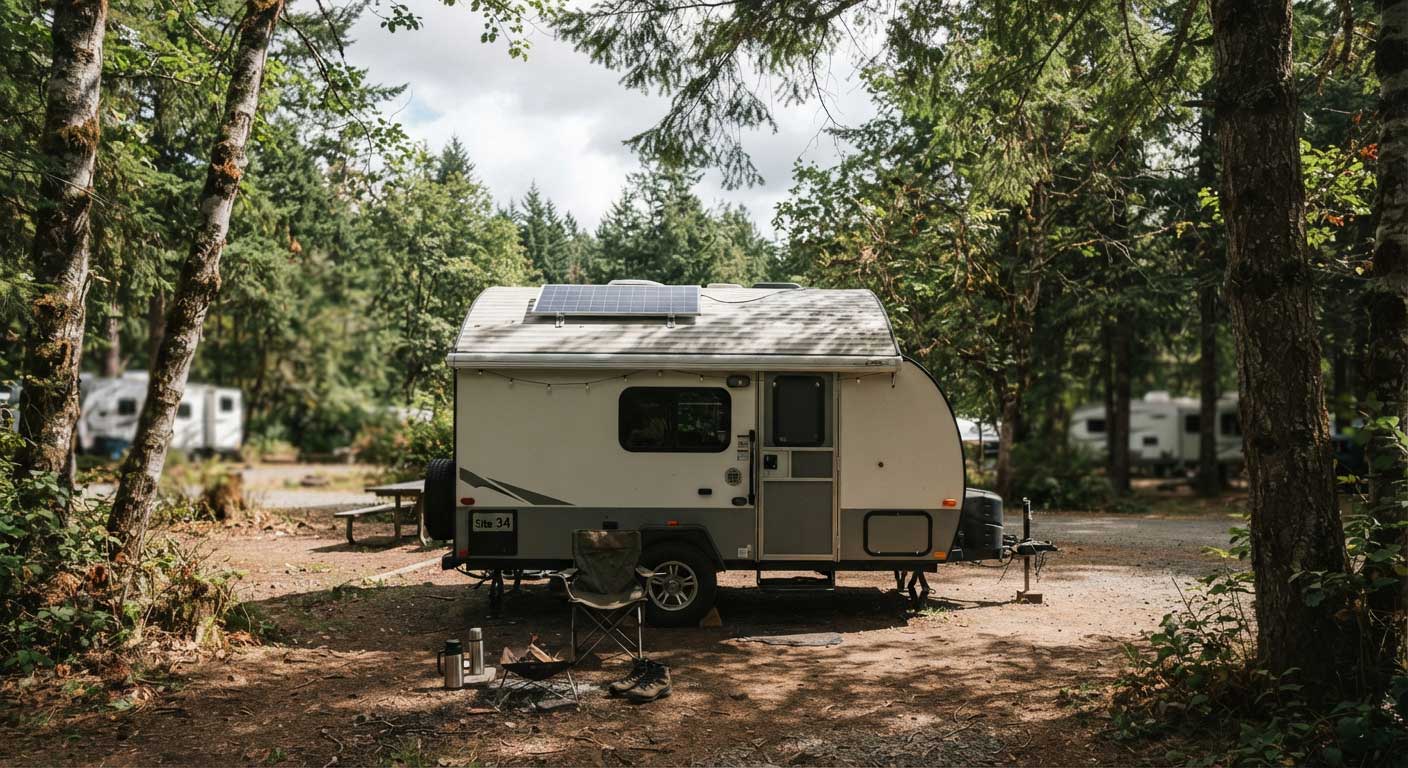
One small RV installation I would pay particular attention to is shade from roof hardware.
A vent only a few inches above the roof can cast a narrow shadow across a portion of a module at the wrong time of day. On a large ground array, you have more options for placement. On an RV roof, you may have only a few usable square feet.
That makes layout surprisingly important.
100W RV Solar Panel Daily Energy Example
Consider a couple traveling in a 24-foot travel trailer.
Their daily electrical use looks approximately like this:
| RV Load | Estimated Daily Consumption |
|---|---|
| LED lighting | 80Wh |
| Phone charging | 30Wh |
| Laptop | 100Wh |
| Wi-Fi/router | 80Wh |
| Water pump | 50Wh |
| TV | 100Wh |
| Refrigerator electronics/control | 100Wh |
| Miscellaneous DC loads | 50Wh |
| Estimated total | 590Wh/day |
A single 100W panel producing roughly 300–400Wh on a reasonably sunny day would offset a meaningful portion of that consumption.
It would not necessarily replace all of it.
Now change the scenario.
Add a 1,200W microwave for 15 minutes:
1,200W × 0.25h = 300Wh
One short microwave session can consume almost as much energy as the panel might harvest over several hours.
That is the part of RV solar sizing that gets lost when people compare appliance wattage with panel wattage without considering time.
A 1,200W appliance used for 15 minutes is very different from a 1,200W appliance running continuously.
What Can One 100W Solar Panel Run on an RV?
A single 100W panel is well suited to relatively modest loads.
Good Matches
- LED lights
- Phones and tablets
- Small USB devices
- Laptop charging
- Wi-Fi router
- Small DC fans
- Battery maintenance
- RV monitoring systems
- Water-pump use in moderation
- Low-power electronics
Possible, But Dependent on Usage
- Compressor refrigerator
- Television
- Small portable cooler
- CPAP equipment
- Small inverter loads
These require a closer look at their daily energy consumption.
Generally Not Suitable as a Standalone 100W System
- Rooftop air conditioner
- Electric water heater
- Electric space heater
- Large microwave used frequently
- Induction cooking as a primary cooking method
- Hair dryer
- High-power coffee maker
The problem is not simply that these appliances have high wattage.
The problem is that a 100W solar module cannot replenish energy at the same rate those loads consume it.
100 Watt Solar Panel for RV Battery Charging
A common application for a 100W RV solar panel is maintaining a 12V battery bank.
For example, a nominal 12V, 100Ah battery has approximately:
12V × 100Ah = 1,200Wh
of nominal stored energy.
For lithium batteries, the usable energy can be substantially closer to the nameplate capacity than for many traditional lead-acid applications, but the exact usable amount depends on the battery’s specifications and recommended operating limits.
A 100W panel therefore should not be viewed as a rapid charger for a large battery bank.
Suppose the panel contributes approximately 350Wh on a particular sunny day.
That is useful.
But if the RV consumes 700Wh that same day, the battery is still losing approximately 350Wh overall.
This is why battery size and solar capacity need to be considered together.
A larger battery gives you more storage.
It does not create more energy.
A larger solar array gives you more potential generation.
It does not automatically increase your nighttime storage.
100W Solar Panel and 100Ah Battery Setup
A 100W panel paired with a 100Ah 12V battery is a common small-system configuration.
A simplified architecture looks like:
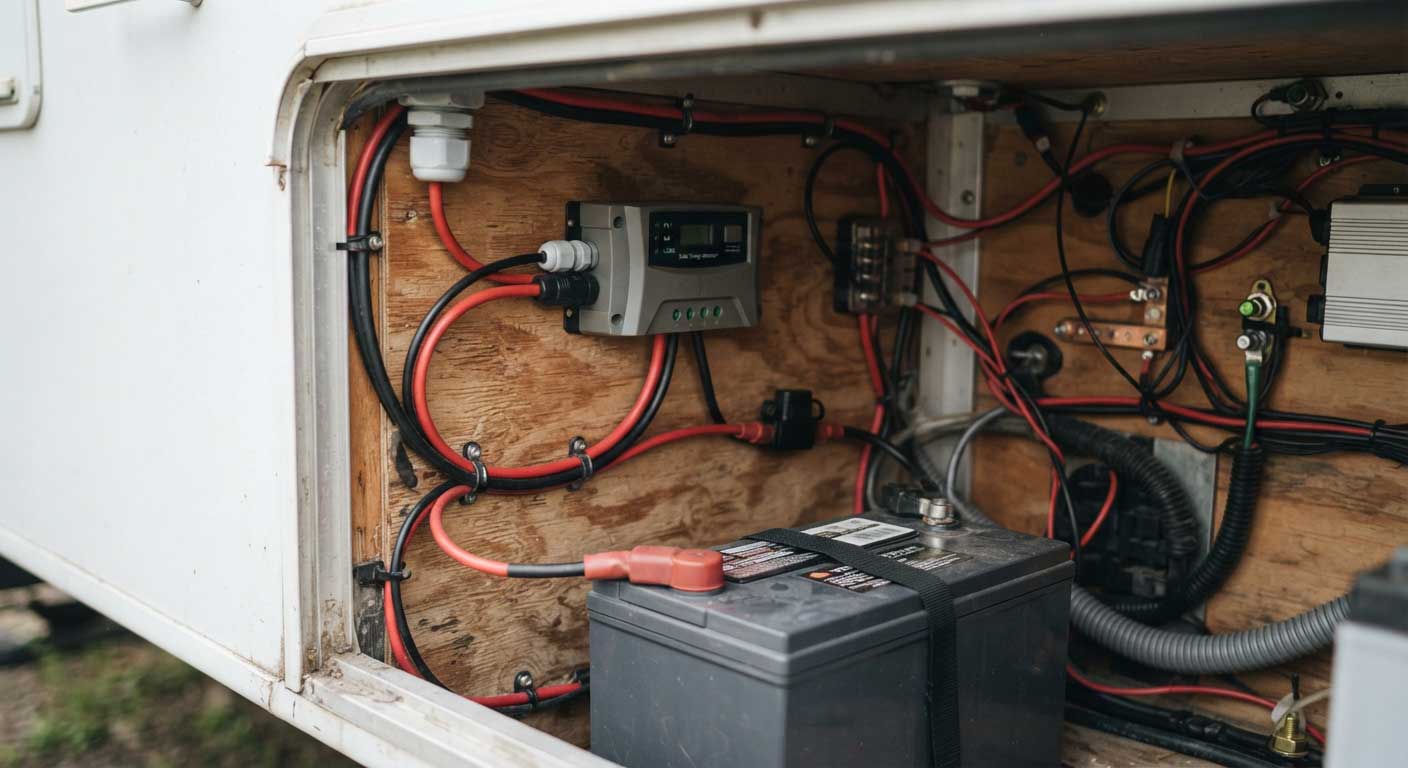
100W Solar Panel → Solar Charge Controller → 12V Battery → DC Loads / Inverter
The charge controller is important.
The panel should not simply be connected directly to a battery. The controller manages charging according to the battery and controller design.
For example, manufacturers such as Renogy explicitly state that solar panels should be connected through an appropriately sized solar charge controller rather than directly to a battery.
PWM vs MPPT
For a small RV system, both PWM and MPPT controllers can be used depending on the panel and system design.
MPPT controllers generally provide more flexibility when the PV operating voltage is higher than the battery charging voltage.
If the RV uses a 12V battery and the panel’s Vmp is around the high teens, the controller’s input specifications and charging requirements should be checked against the exact module.
Do not choose the controller from the panel’s “100W” label alone.
Look at:
- Panel Voc
- Panel Vmp
- Isc
- Imp
- Controller maximum PV voltage
- Controller maximum charging current
- Battery voltage
- Battery chemistry
- Manufacturer installation requirements
100W Solar Panel for Camper: Roof Placement Matters
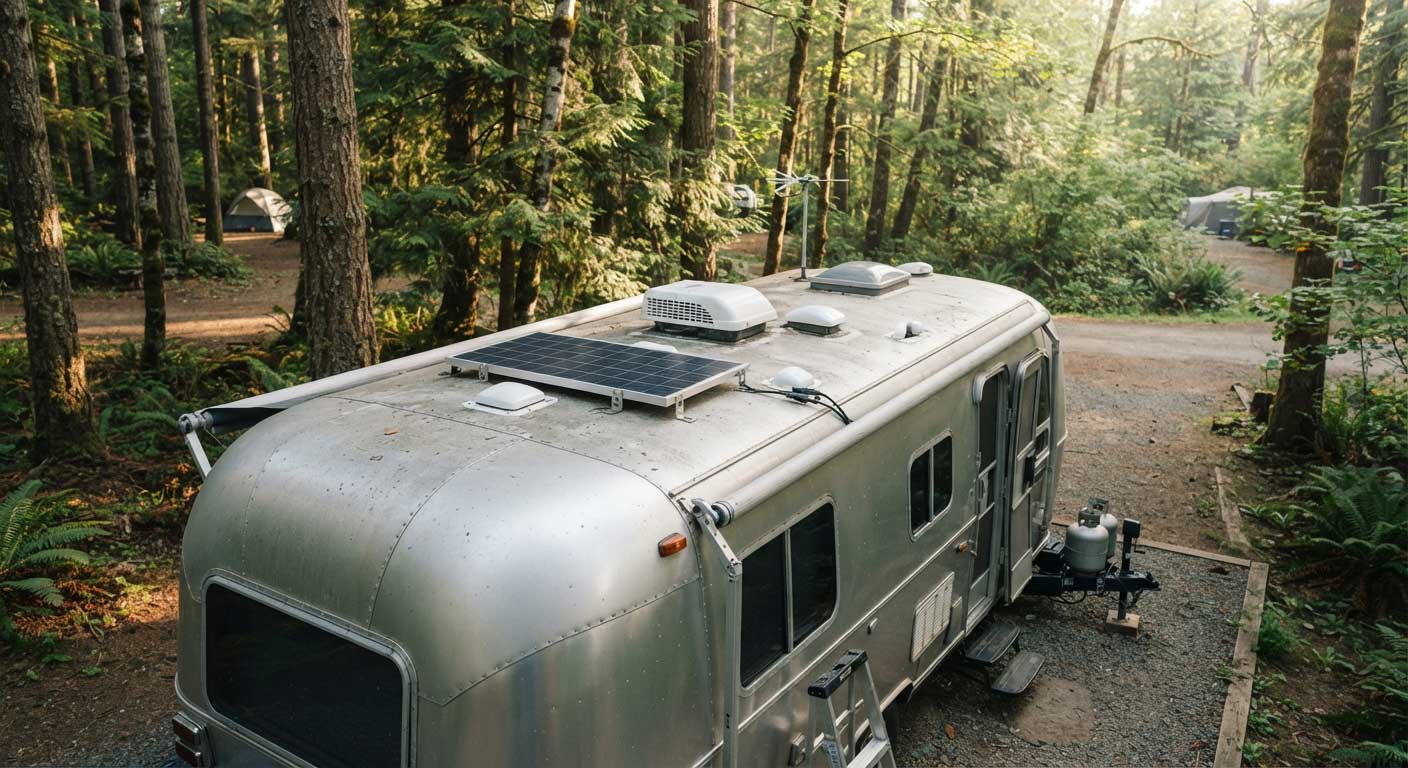
RV roofs are difficult solar surfaces.
They are crowded.
You may have:
- Air conditioners
- Vents
- Skylights
- Antennas
- Satellite equipment
- Roof racks
- Plumbing vents
- Awning hardware
A 100W module can fit into spaces that a larger panel cannot, which is one reason smaller modules remain useful for RV applications.
But fitting the panel is only half the job.
The panel needs usable sunlight.
Flexible 100W Solar Panels for RVs
A rigid framed panel is not the only option.
Flexible solar panels can be useful where:
- Roof weight matters
- The mounting surface is slightly curved
- A low-profile installation is preferred
- Traditional mounting hardware is inconvenient
- The RV roof has unusual geometry
This is particularly relevant for campers, vans, trailers, and lightweight mobile structures.
Bright Solar‘s flexible solar-panel approach focuses on applications where conventional framed modules are not always the most convenient physical solution.Visit product page:Flexible Solar Panel for RV
However, flexible does not mean electrically different in the fundamentals.
A 100W flexible panel still has:
- Rated power
- Voc
- Vmp
- Isc
- Imp
- Temperature characteristics
- Wiring requirements
The same charge-controller and battery-sizing principles apply.
One physical difference is worth watching closely: surface temperature.
A flexible module installed close to a roof may have less airflow underneath than a raised framed panel. Module temperature affects PV voltage and output, so installation conditions can matter.
NREL’s PVWatts modeling framework explicitly incorporates temperature effects into its PV performance modeling.
100 Watt Solar Panel for RV: Wiring Options
For a single 100W panel, the wiring is relatively simple.
A typical system contains:
Solar Panel → PV Cable → Charge Controller → Battery → RV Electrical Loads
When expanding the system, the design becomes more interesting.
Suppose you start with one 100W panel and later add another.
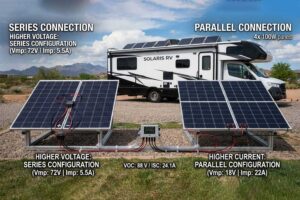
Two 100W panels can be wired:
- In parallel
- In series
With identical modules, parallel wiring generally increases current while keeping voltage similar.
Series wiring increases voltage while current remains approximately similar.
Which is appropriate depends on the charge controller and battery architecture.
For a small 12V RV system, do not assume series is automatically better just because the voltage is higher.
Check the controller’s maximum PV voltage first.
How Many 100W Solar Panels Does an RV Need?
There is no universal answer, but this table gives a useful starting point.
| RV Usage | Approx. Solar Capacity | Number of 100W Panels |
|---|---|---|
| Battery maintenance / occasional use | 100–200W | 1–2 |
| Weekend camping, light loads | 200–400W | 2–4 |
| Moderate off-grid RV use | 400–600W | 4–6 |
| Frequent off-grid living | 600–1,000W+ | 6–10+ |
| Heavy all-electric loads | 1,000W+ | Depends on load and site |
These are planning ranges, not engineering specifications.
The actual answer should come from daily energy consumption and local solar production.
NREL’s current PVWatts system accepts system capacity, array type, tilt, azimuth, location and system-loss assumptions, making it more appropriate for location-specific planning than a generic wattage-per-day rule.
For example, a 400W RV system in a high-solar-resource location may outperform a larger system in a heavily shaded campground.
The number printed on the panels is only the starting point.
Case Study: Is One 100W Panel Enough for a Weekend RV Trip?
Consider a couple using a camper for two nights.
Their estimated weekend-day electrical demand is:
- Lights: 60Wh
- Phones: 30Wh
- Laptop: 100Wh
- Water pump: 40Wh
- Refrigerator/control electronics: 120Wh
- TV: 100Wh
- Miscellaneous: 50Wh
Total:
500Wh/day
A 100W panel in a favorable location might contribute approximately 300–400Wh on a good solar day after system losses, depending on conditions.
That means the panel could cover a large portion of the daily consumption.
For a weekend trip, the battery can absorb the difference.
This is very different from a full-time off-grid RV.
If the same couple starts using a 12V compressor refrigerator, Starlink, a laptop for eight hours, induction cooking, and a 1,500W inverter, the energy budget changes quickly.
The original 100W panel has not become “bad.”
The lifestyle has changed.
That is an important distinction when advising RV customers.
What About Cloudy Days?
Solar panels still produce energy in cloudy conditions, but output can fall substantially compared with clear-sky conditions.
There is no single percentage that applies to every cloudy day.
Cloud thickness, solar angle, diffuse irradiance, panel orientation and weather conditions all matter.
This is another reason battery capacity matters for RV travel.
If you camp under trees for three days, a 100W panel may perform very differently from the same panel parked in an open desert campground.
NREL’s PVWatts tool uses historical weather datasets to estimate expected production and variability rather than assuming every day has identical solar conditions. Its current Version 8 uses 2020 TMY weather datasets for locations covered by the NSRDB.
100W Solar Panel vs 200W or 400W for RV
The decision often comes down to roof space and electrical demand.
| Feature | 100W | 200W | 400W |
|---|---|---|---|
| Roof space | Low | Moderate | Higher |
| Small-load support | Excellent | Excellent | Excellent |
| Battery maintenance | Excellent | Excellent | More than enough |
| Off-grid capability | Limited | Moderate | Much better |
| Large appliance support | Poor | Limited | Better with proper battery/inverter |
| Expansion potential | Easy | Good | Depends on roof/controller |
| Typical use | Light RV use | Weekend/off-grid | Frequent off-grid |
A 100W module can be the right answer when the goal is simple.
If someone only needs battery maintenance while the RV is stored, installing 600W of panels may add unnecessary cost and roof clutter.
If the RV is used for full-time off-grid living, however, 100W may be too little.
This is where Bright Solar recommends starting with the load profile rather than automatically selecting the largest panel that fits.
Installation Tips for a 100W RV Solar Panel
Find the Least-Shaded Roof Position
Do not choose the position only because it is closest to the cable entry.
Track shadows from roof equipment throughout the day.
Keep Cable Runs Practical
Longer cable runs increase voltage drop.
Use appropriately sized PV cable based on current, distance, voltage and installation requirements.
Protect the Roof Penetration
If the installation requires a roof penetration, use an appropriate weatherproof cable entry and sealant system compatible with the RV roof material.
A leak can cost far more than the solar equipment.
Install the Charge Controller in a Suitable Location
Keep the controller close enough to the battery to manage voltage drop while maintaining appropriate ventilation and access.
Check Polarity Before Connection
Confirm positive and negative conductors before connecting the PV array to the controller.
Do Not Judge Performance From One Afternoon
Solar output changes continuously.
A proper evaluation should look at energy production over several days and different weather conditions.
Common Mistakes With 100W RV Solar Panels
Assuming 100W Means 100W All Day
A 100W rating describes the module’s rated power under specified test conditions.
It is not a daily energy rating.
Using Peak Wattage to Size the Battery
Battery sizing should be based on energy consumption and desired autonomy, not simply panel wattage.
Ignoring the RV Refrigerator
A refrigerator can become one of the most important continuous loads in an off-grid system.
Measure it rather than guessing.
Putting the Panel Under Partial Shade
A “mostly sunny” roof position can still produce disappointing results if nearby equipment or trees cast shadows at important times.
Installing Too Small a System for the Lifestyle
A 100W panel is excellent for a lightweight electrical setup.
It becomes frustrating when the owner expects it to support an all-electric RV.
FAQ: 100 Watt Solar Panel for RV
Is a 100 watt solar panel enough for an RV?
A 100 watt solar panel can be enough for battery maintenance, lighting, electronics and light weekend use. It is generally not enough by itself for an RV with air conditioning, electric heating, electric water heating or heavy inverter loads.
How much power does a 100 watt solar panel produce per day?
There is no fixed daily output. As a planning example, four equivalent peak-sun hours gives 400Wh before losses. With a simplified 14% system-loss assumption, that becomes about 344Wh. Actual production depends heavily on location and conditions.
Can a 100W solar panel charge a 100Ah RV battery?
Yes. A 100W panel can charge a 100Ah battery when paired with a suitable solar charge controller, although charging speed depends on available sunlight, battery state of charge, battery chemistry and system losses. A single 100W panel is relatively small for rapidly recharging a deeply discharged 100Ah battery.
Can a 100W solar panel run an RV refrigerator?
It may offset some or much of a refrigerator’s daily energy use depending on the refrigerator type, duty cycle, ambient temperature and solar conditions. The refrigerator’s actual daily Wh consumption should be measured before sizing the complete RV solar system.
Can a 100W solar panel run an RV air conditioner?
Not as a practical standalone system. RV air conditioners typically require far more instantaneous power than a 100W module can provide, and meaningful operation would require a substantially larger solar array, battery bank and inverter.
Should I use an MPPT controller with a 100W RV solar panel?
An MPPT controller can be an appropriate choice, especially when the panel voltage and battery voltage provide useful conversion headroom. The correct controller depends on the exact panel electrical specifications and battery system rather than the 100W rating alone.
Can I add another 100W panel later?
Yes, if the roof space, charge controller, wiring, battery system and PV input limits support expansion. It is smart to check the controller’s maximum PV voltage, current and power before designing a system around future expansion.
Final Takeaway: 100 Watt Solar Panel for RV
A 100 watt solar panel for RV applications is best understood as a compact energy source for light electrical use and battery charging—not as a complete replacement for shore power or a generator.
For a weekend camper, one panel may be enough.
For a frequent off-grid traveler, two, four, six or more panels may make more sense.
The right number comes from three things I would check before ordering anything:
- How many watt-hours the RV consumes each day
- How much solar energy the specific travel location can realistically provide
- How much battery storage is needed between charging opportunities
NREL’s PVWatts model is useful for the second question because it evaluates solar production using location-specific weather and system parameters rather than assuming a universal daily output.
For Bright Solar, the practical goal is not simply to put a 100W panel on an RV roof.
It is to make that panel work as part of a properly matched panel + controller + battery + wiring + load system.
That is what turns 100 watts on a specification sheet into useful energy on the road.
Related recommendations
-

diy solar installation kits: What Actually Matters Before You Buy One
144Explore diy solar installation kits for RVs, cabins, boats, and homes. Learn real installation tips, wiring advice, costs, and mistakes to avoid.
View details -
Flexible Adhesive Solar Panels: Uses, Mounting and Buying Guide
138Flexible adhesive solar panels suit selected low-profile installations when the panel, adhesive, and mounting surface are compatible.
View details -
Solar Panels Series or Parallel: Which Wiring Method Is Better?
258Learn Solar Panels Series or Parallel wiring methods with our complete guide. Compare series, parallel, voltage, current, and choose the best solar setup.
View details -
Car Roof Solar Panel: How It Works and What to Know
304Explore car roof solar panel options for EVs and conventional vehicles. Learn sizing, energy output, flexible PV, installation, shading, safety, and real-world limits.
View details