150w Folding Solar Panel: Output, Battery Charging and Camping Guide
A 150w folding solar panel provides portable electricity for camping, RV travel, and small off-grid systems. Its daily energy output depends on sunlight, panel angle, shading, temperature, and charging equipment—not the rated wattage alone.
For people who need power away from an outlet, 150 watts can be a useful balance between portability and energy collection. It can support personal electronics and help recharge a compatible battery or power station, provided the panel’s electrical specifications match the system.
What Can a 150W Folding Solar Panel Power?
A 150W folding panel is most useful for moderate electrical loads and daytime battery charging. It is not a universal power source for every appliance sold for camping or RV use.
Typical applications include:
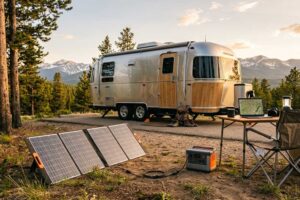
- Camping: charging phones, headlamps, cameras, GPS devices, and power banks.
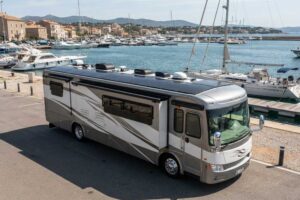
- RV and campervan travel: replenishing a compatible leisure battery when parked in sunlight.
- Portable power stations: collecting energy during the day for use in the evening.
- Outdoor work: supporting small electronics and communication equipment.
- Emergency preparedness: providing supplemental charging during a power outage.
- Small off-grid systems: contributing to a battery-based setup for selected low-power loads.
The practical limit becomes clearer when you look at energy consumption. A phone may need only a modest amount of energy, while a laptop can consume several times as much during a long work session. A refrigerator, kettle, or space heater may demand more energy than a 150W panel can reliably replace each day.
The panel’s rated power also does not tell you whether an appliance can connect directly. Many devices need a regulated USB output, a suitable DC converter, a battery, or a compatible power station.
How Much Energy Can a 150W Panel Generate?
Watts describe power at a given moment. Watt-hours describe energy collected over a period of time. For camping and RV planning, daily watt-hours are often the more useful number.
A first estimate is:
Daily energy (Wh) = panel rating (W) × equivalent peak-sun hours × system efficiency
Suppose a 150W panel receives four equivalent peak-sun hours and the overall system delivers an illustrative 75–85% of the theoretical energy after losses:
150W × 4 hours × 0.75–0.85 = 450–510Wh per day
| Equivalent peak-sun hours | Illustrative daily energy at 75–85% efficiency |
|---|---|
| 2 hours | 225–255Wh |
| 3 hours | 337.5–382.5Wh |
| 4 hours | 450–510Wh |
| 5 hours | 562.5–637.5Wh |
| 6 hours | 675–765Wh |
These figures are estimates for planning, not measured output from a specific Bright Solar product. Actual production can be lower in heavy cloud, partial shade, poor positioning, or high-temperature conditions. It may also vary with the controller, wiring, battery state, and the maximum input accepted by the connected device.
Peak-sun hours are not the same as total daylight hours. A campsite may have eight hours of daylight but receive only a fraction of that time at an intensity equivalent to full rated sunlight.
For background on photovoltaic system design, see the U.S. Department of Energy’s Solar Photovoltaic System Design Basics. For location-based solar estimates, the National Renewable Energy Laboratory provides the PVWatts Calculator.
How to Choose a 150W Folding Solar Panel
Two folding panels with the same rated wattage can differ in weight, folded dimensions, connectors, weather protection, and charging options. Those details affect the experience just as much as the headline power rating.
Check Portability and Folded Dimensions
Consider where the panel will be stored and how far you will carry it. Moving a panel from a van to a nearby sunny patch is different from carrying it along a trail with a backpack.
Before purchasing, check:
- Folded dimensions and total weight.
- Whether a carrying case or bag is included.
- Whether support legs or an adjustable stand are included.
- Cable length and cable-storage arrangements.
- The durability of hinges and protective surfaces.
- Whether the manufacturer recommends vehicle-based use, hiking, or another specific application.
Do not assume a folding design is automatically ultralight, waterproof, or suitable for leaving outdoors overnight. Those characteristics need to be confirmed from the product documentation.
Understand the Electrical Specifications
Rated power alone is not enough to choose a controller or verify compatibility with a battery. Ask for the exact model’s datasheet.
| Specification | Why it matters |
|---|---|
| Rated power (Pmax) | Nominal output under the stated test conditions |
| Voltage at maximum power (Vmp) | Operating voltage near the maximum-power point |
| Current at maximum power (Imp) | Operating current near the maximum-power point |
| Open-circuit voltage (Voc) | Voltage when the panel is not connected to a load |
| Short-circuit current (Isc) | Current under specified short-circuit test conditions |
| Connector type and polarity | Determines whether the panel can connect correctly |
| Controller compatibility | Confirms whether the charging equipment can handle the panel |
| Warranty and weather rating | Clarifies documented product limits and coverage |
Do not calculate or guess Vmp, Imp, Voc, or Isc from the 150W rating. These values must come from the actual product specification sheet.
Confirm Which Accessories Are Included
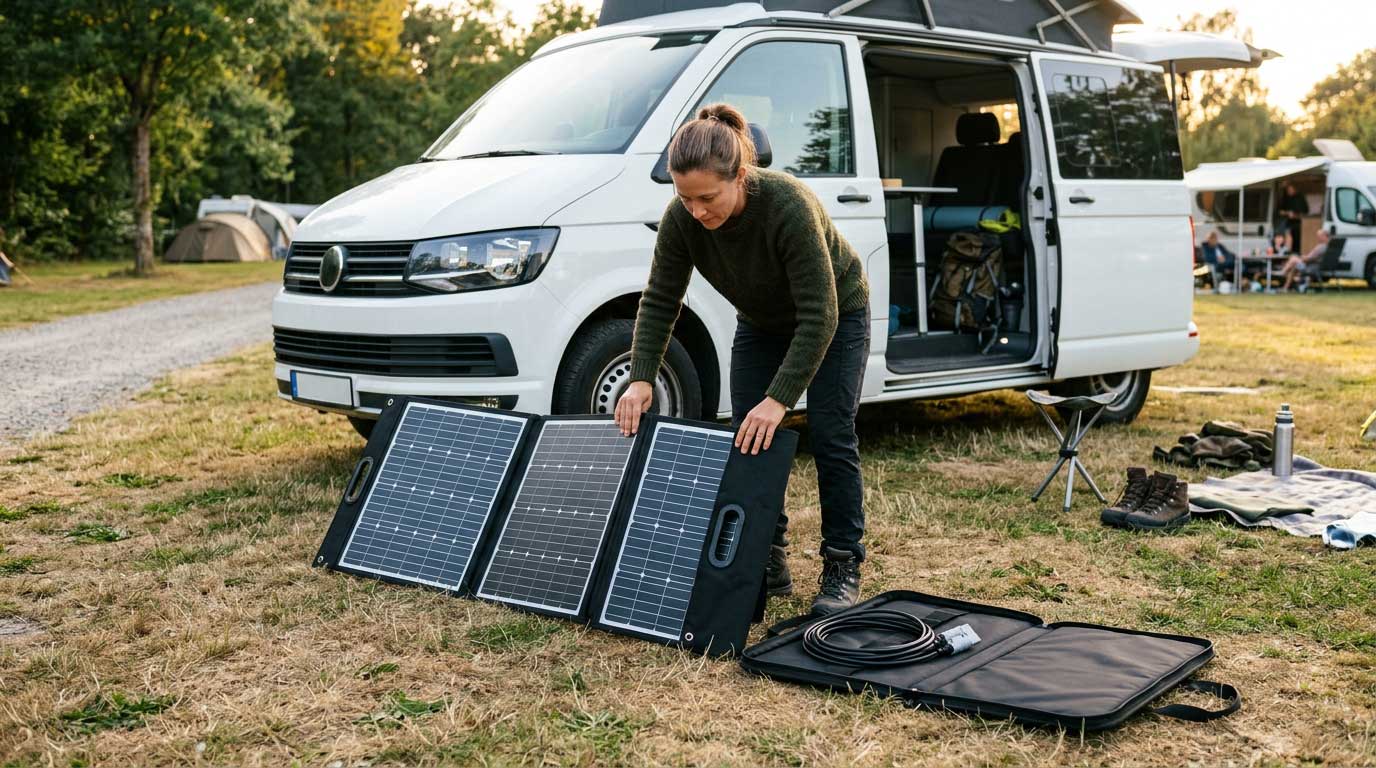
Some portable panels include USB outputs or a charge controller. Others provide panel leads and require a separate controller or a compatible power station. A power station may also need a particular connector cable.
Check the exact package contents before comparing prices. A panel with integrated outputs may be convenient for simple charging, while a separate-controller configuration may suit buyers who want to build a more flexible battery system.View Flexible Solar Panels
How to Set Up a 150W Folding Solar Panel at a Campsite
The best portable setup is stable, unshaded, and electrically compatible with the battery or power station. A folding panel does not normally need a permanent installation, but careless positioning and unsuitable connections can waste energy or create avoidable hazards.
Step 1 — Find an Open, Stable Position
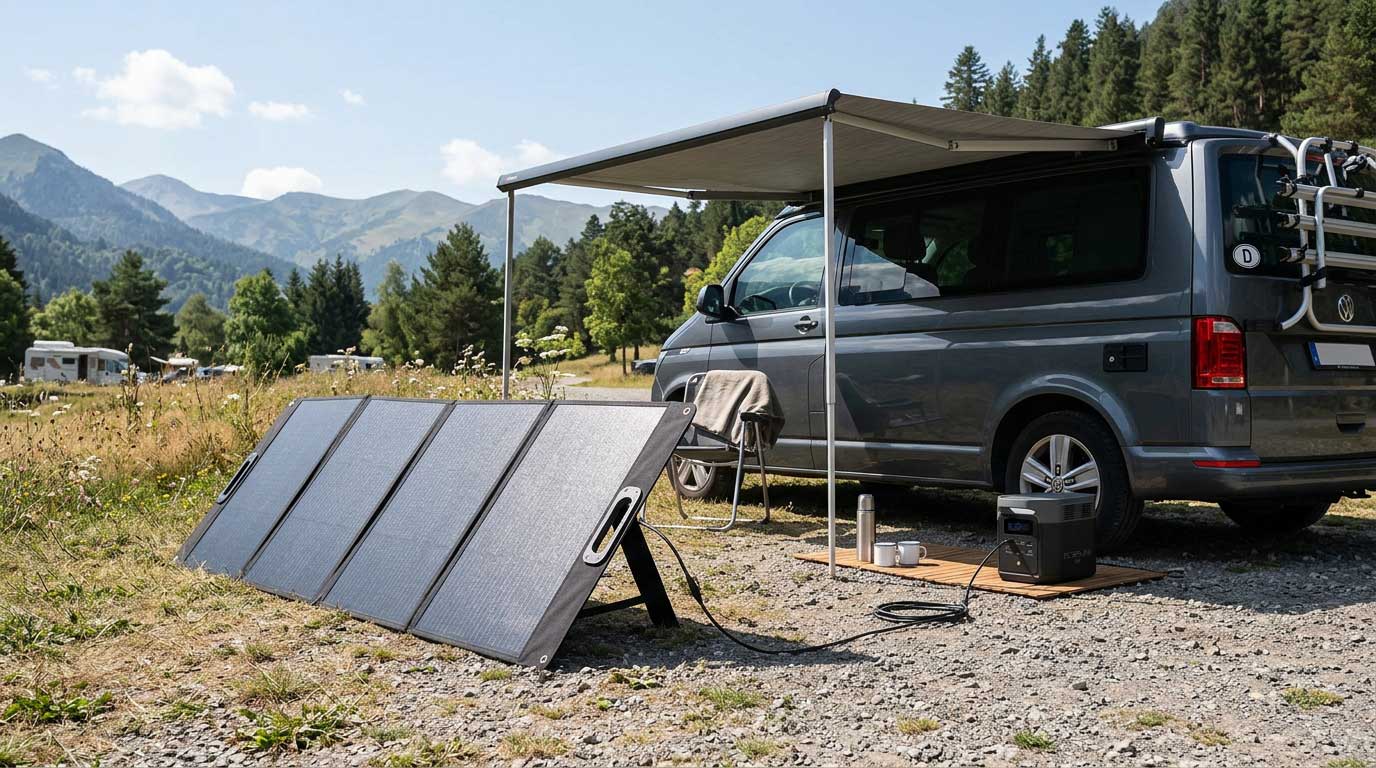
Place the panel on firm ground where it will not be kicked, driven over, or caught by a vehicle door. Point it toward the sun and adjust its angle according to the manufacturer’s instructions.
Look around the whole panel, not just its center. An awning edge, roof rack, tree branch, or tent pole can cast a shadow across the cells. Depending on the panel’s electrical layout, partial shading may reduce output more than expected.
Step 2 — Check Voltage and Connector Compatibility
Read the panel datasheet and the charging equipment manual before plugging anything in. The panel’s open-circuit voltage must remain within the controller or power station’s maximum solar input voltage, including any temperature-related considerations specified by the manufacturer.
A label such as “12V panel” is not enough to establish compatibility. Nominal system voltage and the panel’s actual operating voltage are different concepts. Confirm the permitted input range, current limits, connector type, and polarity.
Step 3 — Connect the System in the Correct Order
A typical system may include the panel, a charge controller, and a battery. Follow the instructions for the exact equipment: some controllers require the battery to be connected before the panel, while other devices specify a different sequence.
Use this pre-start checklist:
- Inspect cables, connectors, and panel surfaces for damage.
- Keep connectors dry unless their documented ratings permit the expected exposure.
- Confirm the controller’s voltage and current limits.
- Follow the manufacturer’s connection and disconnection sequence.
- Check the charging indicator or power-station display.
- Secure cables so people cannot trip over them or pull on the connectors.
A panel can generate electricity whenever it receives light. Never allow exposed conductors to short-circuit, and do not disconnect a live circuit contrary to the equipment instructions.
Step 4 — Check the Charging Input
After setup, note the input power shown by the controller or power station. A reading below 150W does not automatically indicate a fault. Sunlight, panel angle, cell temperature, battery state of charge, and the connected equipment’s input limit can all affect the reading.
If the result seems unusually low, remove nearby shade, adjust the panel position, inspect the connectors, and compare readings under similar conditions. One measurement without a record of weather or setup provides limited information.
Can a 150W Folding Solar Panel Charge a Battery?
Yes, if the panel is paired with compatible charging equipment and the battery’s charging requirements are respected. The energy stored depends on sunlight, conversion losses, battery chemistry, and the battery’s permitted charging limits.
Consider an illustrative 12V battery rated at 100Ah:
12V × 100Ah = 1,200Wh (1.2kWh) nominal energy
This is nominal stored energy, not necessarily the amount that should be used. Battery chemistry, depth-of-discharge limits, temperature, age, and manufacturer recommendations affect usable capacity.
If the panel system delivers 450Wh of charging energy on a particular day, a simple calculation at nominal 12V gives:
450Wh ÷ 12V = 37.5Ah equivalent
This is only a planning approximation. Charging voltage changes during the process, and controller and battery losses affect the final result. It does not guarantee that 37.5Ah will be restored to every 12V battery.
Estimate Your Daily Energy Consumption
Write down the devices you intend to use. For a device rated in watts, multiply its power by the number of hours it operates.
| Example device | Assumed power | Daily use | Estimated energy |
|---|---|---|---|
| LED camping light | 5W | 4 hours | 20Wh |
| Phone charging | 10W | 2 hours | 20Wh |
| Small USB fan | 8W | 5 hours | 40Wh |
| Laptop charging | 45W | 2 hours | 90Wh |
| Total | — | — | 170Wh |
These are illustrative values, not measured consumption figures for specific products. Actual demand varies by device model, operating mode, battery level, and conversion losses.
In this example, daily use totals 170Wh. A 150W panel could potentially cover that demand on a reasonably sunny day, with energy left for battery charging. Heavy cloud or tree cover may change the result considerably, so leave a margin if you depend on the system for essential equipment.
What Affects Real-World Solar Output?
A panel’s rated power is measured under defined test conditions, not every condition encountered on a camping trip. The U.S. Department of Energy’s Solar Photovoltaic Cell Basics explains how solar cells convert light into electricity. The energy collected by a portable system also depends on its surroundings and connected equipment.
Clouds, Shade, and Panel Angle
Clouds reduce the sunlight reaching the panel, although diffuse daylight can still generate electricity. Heavy cloud cover can substantially reduce output. Partial shading from an awning or tree branch may also affect performance depending on the cell layout and bypass-diode design.
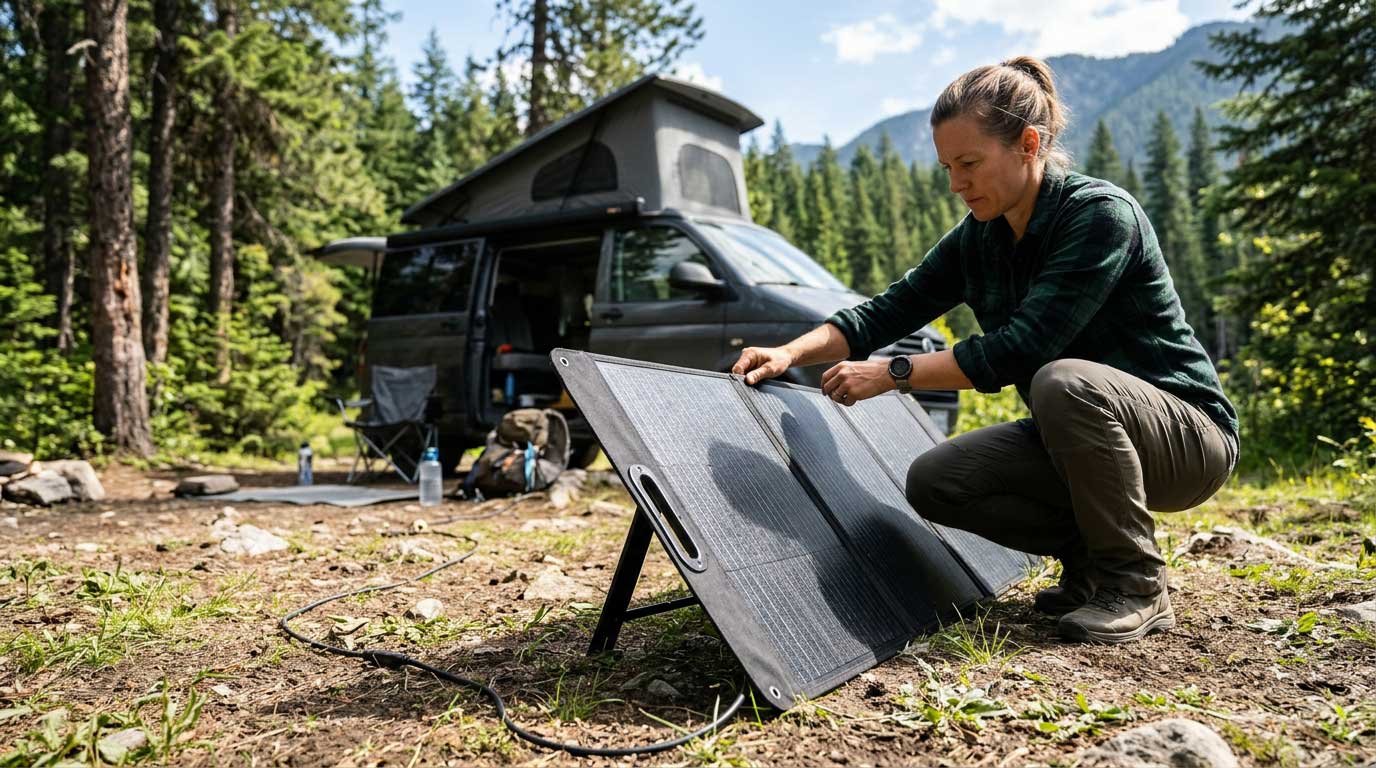
Move the panel when practical instead of leaving it shaded for the entire afternoon. Repositioning it during a long stop can be worthwhile, particularly when the panel is being used to recharge a battery for evening use.
Heat, Dirt, and Ventilation
Solar-cell output can decrease as cell temperature rises. Follow the manufacturer’s instructions for positioning and ventilation rather than covering the back of the panel or placing it against a hot surface.
Dust, pollen, dried water marks, and bird droppings can block sunlight. If cleaning is permitted, use the recommended method and avoid abrasive materials that might damage the protective surface.
Record Performance Over Several Days
If you travel regularly, record approximate charging input alongside the weather, time, and panel position. A short log can reveal whether poor performance is associated with shade, cloudy conditions, a connection issue, or the power station’s input limit.
This is a practical way to build a realistic estimate for your own trips. A sunny afternoon at an open campsite and a cloudy morning beneath trees are not comparable test conditions, even if the same panel is used.
Using a 150W Folding Solar Panel with a Portable Power Station
A portable power station combines a battery with outputs for devices, making it convenient for camping. The station must still accept the panel’s voltage, current, connector, and power level.
Before connecting, verify:
- Solar input voltage range: the panel must operate within the permitted range.
- Maximum input voltage: the panel’s open-circuit voltage must not exceed the limit.
- Maximum input current and power: the station may accept less than the panel’s potential output.
- Connector and polarity: use the correct cable and wiring arrangement.
- Battery capacity: capacity determines how much energy can be stored, not how quickly it will be collected.
For example, if a power station needs another 500Wh and accepts an average of 75W from the panel, the idealized charging estimate is:
500Wh ÷ 75W ≈ 6.7 hours
Actual charging may take longer because sunlight varies, conversion losses occur, and the station may adjust its charging rate. This is a worked example, not a guaranteed charging time for a specific model.
Some folding panels include USB outputs; others require a controller or power station. Check the actual configuration rather than assuming the panel supports USB-C Power Delivery or includes every required adapter.
Storage and Maintenance for Frequent Camping
Portable panels are folded, carried, and unpacked repeatedly. Hinges, cables, connectors, and protective surfaces can be damaged during packing if they are handled carelessly.
Use this checklist after a trip:
- Let the panel cool and dry as directed before folding.
- Remove loose dirt so grit is not trapped against the surface.
- Keep cables free from sharp bends, crushing, and connector strain.
- Use the supplied case or another suitable protective cover.
- Avoid stacking heavy camping equipment on the folded panel.
- Inspect hinges, connectors, and cable insulation before the next trip.
- Follow the manufacturer’s cleaning and storage temperature guidance.
Do not assume that every folding panel is waterproof or suitable for overnight outdoor exposure. Check the stated weather-protection rating and determine whether it applies to the panel, connectors, or selected components only.
FAQ About a 150W Folding Solar Panel
How much electricity does a 150w folding solar panel produce per day?
With four equivalent peak-sun hours and an illustrative system-efficiency factor of 75–85%, a 150W panel could produce approximately 450–510Wh per day. Actual output depends on sunlight, shading, temperature, and system losses.
Can a 150W folding solar panel charge a 12V battery?
Yes, when paired with compatible charging equipment. Check the panel’s voltage and current ratings, use a suitable charge controller where required, and follow the battery manufacturer’s charging instructions.
Can a 150W folding solar panel power a camping refrigerator?
Possibly, but the answer depends on the refrigerator’s daily energy consumption, sunlight, and battery capacity. A refrigerator may consume a large share of the panel’s daily production, so calculate its energy use before choosing the system.
How long does it take to charge a portable power station?
Charging time depends on the energy needed, the average power the panel delivers, and the station’s maximum solar input. Divide the required watt-hours by the average accepted watts for an initial estimate, then allow for variable sunlight and conversion losses.
Does a 150W folding solar panel work on cloudy days?
Yes. Solar panels can generate electricity from diffuse daylight, but output is generally lower than in strong direct sunlight. Heavy cloud cover can substantially reduce production, so avoid planning around the full rated 150W in overcast weather.
Can I leave a 150W folding solar panel outside in the rain?
Only if the manufacturer confirms that the panel and relevant connectors are rated for the expected exposure. Check the product documentation rather than assuming every Portable Solar Panel is waterproof. If the rating is unclear, move it to a dry location.
What should I check before buying a 150W folding solar panel?
Compare rated power, Vmp, Imp, Voc, Isc, folded dimensions, weight, connectors, controller requirements, weather protection, warranty, and included accessories. Confirm that the electrical specifications match your battery or power station.
Conclusion
A 150w folding solar panel offers a useful portable charging option for camping, RV travel, and selected off-grid applications. Its real value depends on daily energy production, the devices you need to power, and the compatibility of the battery or power station. Estimate your loads, verify the datasheet, and plan for less productive weather before choosing a system. For Bright Solar buyers, confirmed product specifications and the intended application should guide the final decision.
Author and Technical References
Author: Bright Solar Technical Content Team
Editorial focus: Portable photovoltaic systems, solar panel specifications, battery-charging compatibility, and off-grid energy planning.
The calculations in this article are illustrative planning examples, not measurements from a named customer installation or claims about a specific Bright Solar model. For system design, consult the equipment manuals and a qualified solar professional where appropriate.
Technical references
- U.S. Department of Energy — Solar Photovoltaic System Design Basics
- U.S. Department of Energy — Solar Photovoltaic Cell Basics
- National Renewable Energy Laboratory — PVWatts Calculator
Related recommendations
-

400 Watt Solar Panels for Reliable Off-Grid and Residential Energy
375400 watt solar panels deliver reliable off-grid and residential energy with high efficiency, durable design, and long-term savings. Explore Bright Solar solutions.
View details -
Biggest Flexible Solar Panel: Size, Power, and Applications
356The biggest flexible solar panel is the largest practical module that fits the surface, weight, bending, electrical, and installation requirements.
View details -
Solar Camping Gear: A Practical Guide to Off-Grid Power
414Solar camping gear combines portable solar generation and battery storage for reliable off-grid power during camping, RV travel, boating, and outdoor work.
View details -
Series Parallel Solar Panels: Smarter Wiring for Higher Solar Efficiency
261Learn how series parallel solar panels improve voltage, current, and off-grid efficiency. Bright Solar explains real-world wiring setups and performance tips.
View details