Flexible Foldable Solar Panels: Portable Power Guide
Flexible foldable solar panels provide portable solar power in a compact format, combining lightweight photovoltaic modules with folding sections for RVs, camping, boats, emergency power, outdoor equipment and mobile off-grid systems.
What Are Flexible Foldable Solar Panels?
Flexible foldable solar panels are portable photovoltaic modules designed to bend or fold into a smaller footprint for transportation and storage. Their value is not simply that they are “flexible.” The useful engineering feature is the combination of flexibility, folding geometry, low weight and deployability.
A conventional rigid solar panel occupies almost the same physical space during transport as it does during operation. A foldable design changes that equation. Several photovoltaic sections can be connected through flexible hinges, laminated joints or other mechanical structures and then opened into a larger generation surface at the destination.
That makes the format particularly practical for situations where solar equipment has to be carried rather than permanently installed.
Typical applications include:
- RV and camper power
- Camping and overlanding
- Portable power stations
- Emergency backup
- Boats and outdoor equipment
- Remote field work
- Temporary shelters
- Off-grid monitoring equipment
- OEM portable power products
The photovoltaic principle itself does not change. DOE describes photovoltaic modules as assemblies of solar cells that absorb sunlight and convert that energy into electrical power.
What changes is the mechanical package surrounding those cells.
Flexible Does Not Always Mean Foldable
This distinction matters when purchasing.
A flexible solar panel may be designed to conform to a curved roof while remaining installed in one position. A foldable solar panel is specifically engineered around repeated opening and closing.
Those are different mechanical requirements.
A panel designed for a permanent curved installation should not automatically be folded for transport. Likewise, a portable foldable panel needs hinges, flexible interconnections and protective layers that can tolerate the intended movement.
For commercial procurement, ask the manufacturer to define:
- Minimum bending radius
- Folding direction
- Folding dimensions
- Recommended folding frequency
- Mechanical-cycle testing
- Storage position
- Electrical performance after cycling
IEC 61215:2021 added specific test methods for flexible PV modules, including bending test MQT 22. However, IEC also states that qualification testing is not a quantitative prediction of module lifetime.
That distinction is easy to miss in a product comparison.
How Flexible Foldable Solar Panels Work
The basic electrical process is familiar.
Sunlight reaches the photovoltaic cells, the semiconductor generates electrical charge, and the module delivers direct-current power through its output cable. The portable system then sends that power to a charge controller, portable power station, battery system or other compatible load.
The folding mechanism does not generate energy. It solves a transportation and deployment problem.
When folded, the module occupies less space. When opened, the photovoltaic surface becomes substantially larger.
A simple example illustrates why this matters.
Suppose a portable solar product contains four 100 W sections:
4 × 100 W = 400 W rated DC power
When folded, the four sections may form a compact package. When deployed, they expose the full photovoltaic area to sunlight.
The 400 W figure is a rated capacity under defined test conditions, not a guarantee that the user will receive 400 W continuously. Real output depends on irradiance, module temperature, orientation, shading, wiring, controller conversion and the receiving power system.
This is why a useful portable solar specification should show more than “400 W.”
The Electrical Specifications That Matter
For a B2B project, request at least:
| Specification | Why It Matters |
|---|---|
| Rated Power (Pmax) | Defines nominal module capacity |
| Vmp | Determines normal operating voltage |
| Imp | Determines operating current |
| Voc | Important for system voltage limits |
| Isc | Important for protection and controller sizing |
| Module Efficiency | Indicates conversion performance |
| Power Tolerance | Defines rated-output variation |
| Temperature Coefficient | Helps evaluate hot and cold conditions |
| Connector | Determines system compatibility |
| Folded Dimensions | Determines transport and storage requirements |
| Deployed Dimensions | Determines usable solar area |
| Weight | Critical for mobile applications |
For a portable system, folded dimensions deserve the same attention as wattage.
A 300 W product that fits neatly into an RV storage compartment can be more practical than a higher-output unit that requires a dedicated transport case.
Why Use Flexible Foldable Solar Panels for RVs and Camping?
RVs create an unusual solar-design problem.
There is usually plenty of sunlight but not necessarily a convenient permanent mounting surface. Roof equipment occupies valuable space. Travelers may also want to park in shaded areas and place the solar array several meters away from the vehicle.
A foldable solar system solves part of that problem by separating the energy-generation location from the battery location.
The RV can remain under a tree while the panels are deployed in an open area.
That is particularly useful during short stops.
A Practical RV Scenario
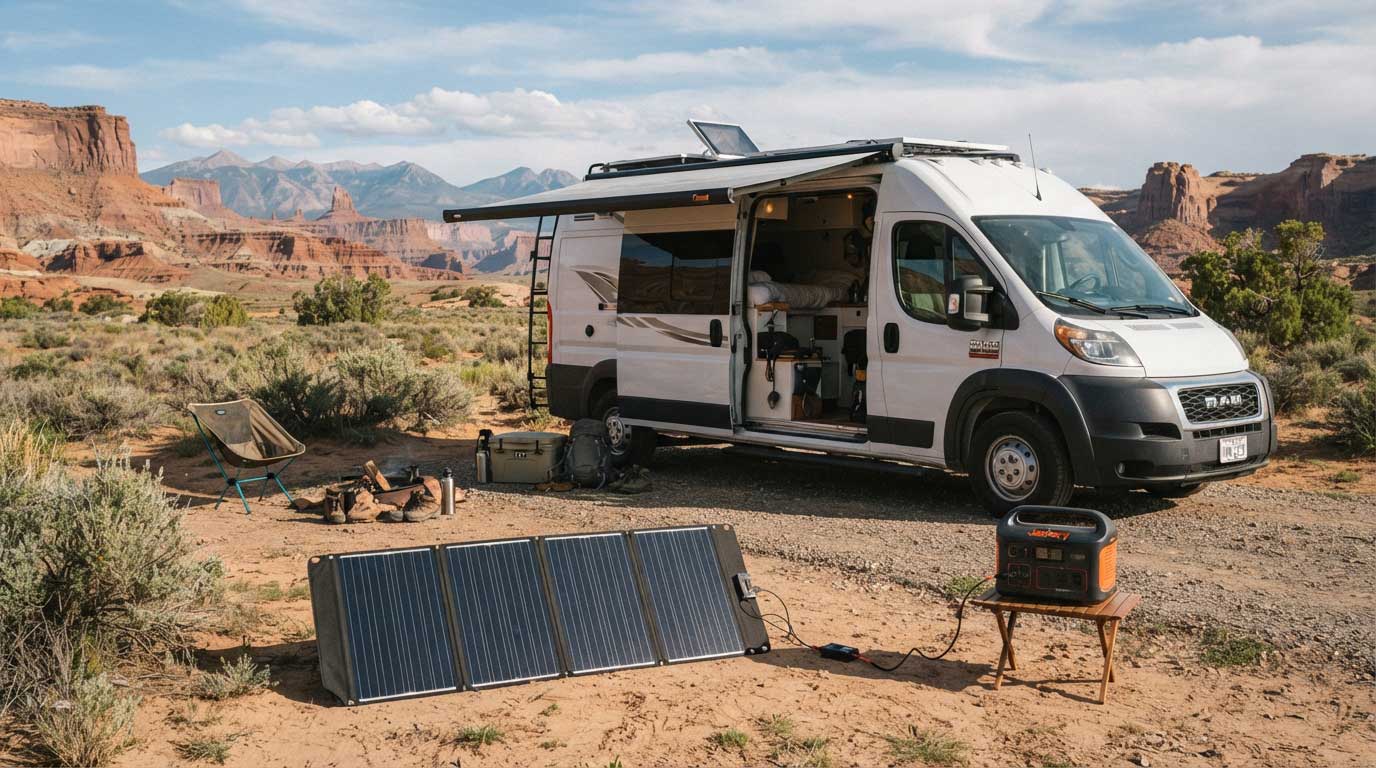
Consider a campervan traveling through the western United States.
The roof already contains an air conditioner, vent, skylight and satellite equipment. Installing additional permanent panels would require new mounting hardware and reduce service access.
Instead, the owner carries a foldable solar array.
At camp:
- The storage case is removed.
- The photovoltaic sections are unfolded.
- The array is placed on a clear section of ground.
- The panels are oriented toward the sun.
- The output cable is connected to the portable power station.
- The system begins charging.
- The array is folded again before departure.
There is no need to redesign the roof.
The compromise is obvious, too: someone has to deploy and retrieve the system, and the panels are exposed to accidental impact, dirt and wind while they are on the ground.
That is not a defect. It is the tradeoff inherent in portable solar.
Flexible Foldable Solar Panels for Portable Power Stations
Portable power stations have changed how small solar arrays are used.
Instead of permanently connecting a rooftop panel to a battery, users can bring a solar generator and foldable PV array to a temporary location.
The panel becomes the energy source. The power station manages charging.
For product developers, compatibility must be checked carefully.
The solar array’s Voc must remain within the power station’s allowable input range, while the operating voltage and current must also fall within its MPPT input window.
This is one of the most common technical mistakes in portable solar purchasing: matching products by wattage alone.
A “200 W solar panel” is not automatically compatible with every “200 W portable power station.”
Why MPPT Input Matters
A portable power station generally has a defined solar-input voltage and current range.
If the panel voltage is too low, the MPPT controller may not operate correctly. If the cold-weather Voc exceeds the input limit, the system can be damaged or shut down.
The correct sequence is:
Panel electrical specifications → controller input range → battery system → expected environmental conditions
Not:
Panel wattage → purchase
For B2B product development, testing the complete combination is preferable to checking each component independently.
Foldable Solar Panels vs. Flexible Solar Panels
The terms are sometimes used interchangeably online, but the products can serve very different purposes.
| Feature | Flexible Foldable Solar Panels | Flexible Solar Panels | Rigid Solar Panels |
|---|---|---|---|
| Main purpose | Portable deployment | Permanent curved installation | Permanent installation |
| Folding | Designed for folding | Usually not | No |
| Storage | Compact when folded | Requires full-length storage | Requires full-length storage |
| Curved surfaces | Suitable depending on design | Strong advantage | Limited |
| RV roof | Possible | Strong application | Strong if space permits |
| Ground deployment | Excellent | Possible | Difficult |
| Weight | Usually designed for portability | Low to moderate | Higher |
| Mounting hardware | Often minimal | Application dependent | Usually required |
| Wind exposure | Must be managed during use | Depends on installation | Requires structural mounting |
| Mechanical cycling | Critical | Application dependent | Less relevant to folding |
| Best fit | Mobile and temporary power | Curved permanent surfaces | Conventional fixed systems |
The key difference is movement.
A flexible roof panel may bend once during installation. A foldable panel may be opened and closed hundreds of times over its service life. That repeated mechanical action deserves its own design consideration.
What Makes a Good Foldable Solar Panel?
The photovoltaic cells are only one part of the product.
A reliable foldable module needs a mechanical architecture that survives transport and repeated deployment.
Hinges and Flexible Interconnections
The joint between sections is a vulnerable area.
Every folding cycle creates movement around the electrical interconnection. Poor strain relief can place stress on conductors, solder joints, connectors or encapsulation.
Look for:
- Reinforced folding areas
- Flexible conductors
- Strain relief
- Controlled folding direction
- Protected electrical connections
- Consistent laminate thickness
- Durable edge finishing
The panel should fold where the manufacturer designed it to fold—not wherever the user happens to find convenient.
Surface Protection
Portable solar panels are handled more aggressively than fixed rooftop modules.
They may be placed on gravel, grass, concrete or vehicle surfaces. They may be folded while dusty. They may be loaded into storage compartments with camping equipment.
A protective surface therefore has to balance:
- Optical transmission
- UV resistance
- Scratch resistance
- Water resistance
- Flexibility
- Weight
- Long-term adhesion
For a B2B supplier, asking for the encapsulation structure is more useful than asking whether the surface “looks durable.”
Durability and Testing for Foldable Solar Panels
IEC 61215 is an important reference when discussing PV module qualification, but there is an important limitation for portable foldable products.
IEC 61215-1:2021 applies to terrestrial flat-plate PV modules and includes bending tests for flexible modules. At the same time, IEC explicitly states that the standard does not cover systems intended as short-term applications such as flexible modules installed in awnings or tenting.
That means a buyer should not simply see “IEC 61215” on a quotation and assume that every aspect of a foldable camping product has been qualified for repeated folding.
Ask what was actually tested.
For a foldable product, a practical qualification program can include:
- Visual inspection after folding cycles
- Electrical performance before and after cycling
- Connector inspection
- Cable fatigue testing
- Laminate edge inspection
- Water exposure
- UV exposure
- Temperature cycling
- Mechanical loading where relevant
- Storage-condition testing
IEC’s current PV module test framework also includes dynamic mechanical load testing and specific bending methods for flexible modules.
The number that matters is not simply “tested.”
It is what was tested, how it was tested, and what changed afterward.
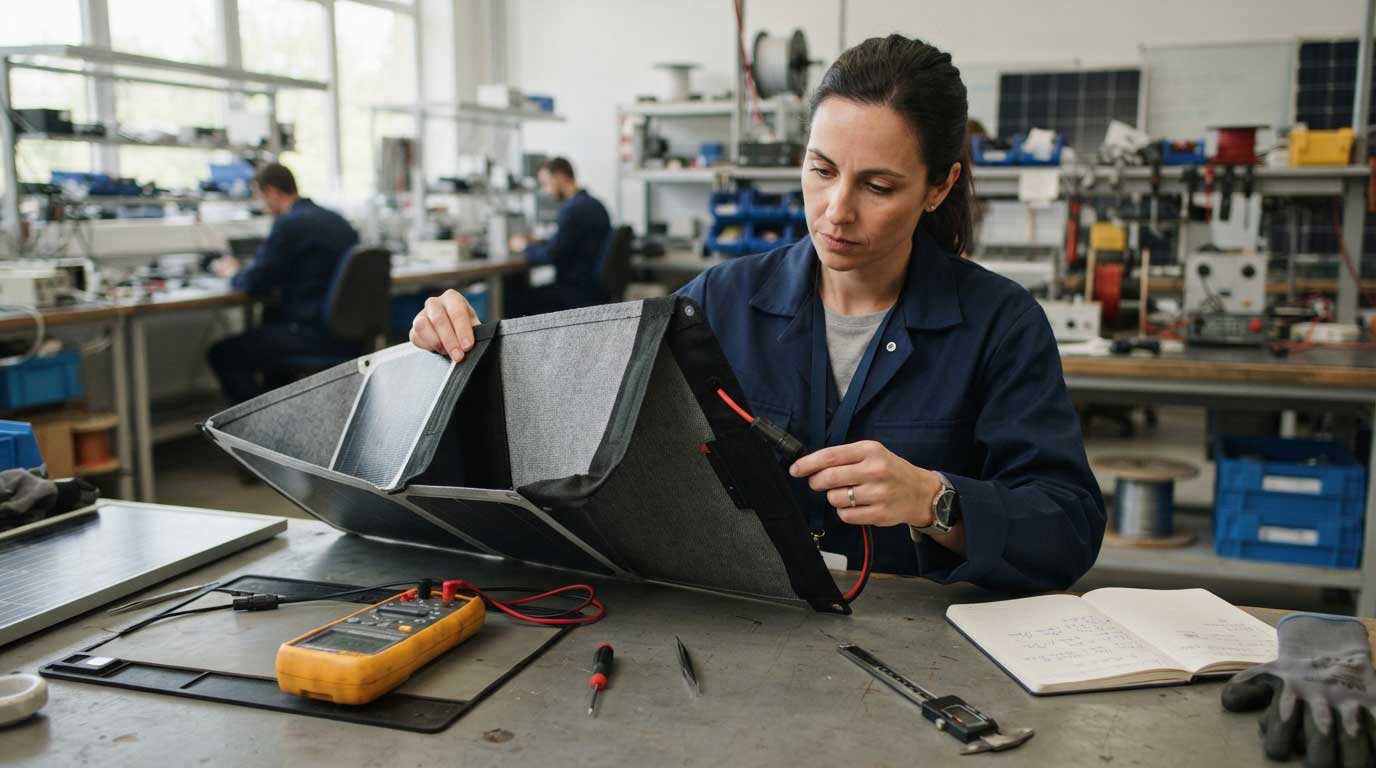
A Realistic B2B Product Development Case
Imagine an outdoor-equipment brand developing a portable 300 W solar kit for European and North American markets.
The initial requirement is simple:
300 W output, compact storage, outdoor use.
That specification is not enough to manufacture the product.
The development team still needs to decide:
- Number of folding sections
- Open dimensions
- Folded dimensions
- Total weight
- Cell technology
- Operating voltage
- Connector
- Cable length
- Carrying handle
- Protective case
- Folding direction
- Minimum bend radius
- Mechanical-cycle requirement
Suppose the design uses three nominal 100 W sections.
The engineering team builds a prototype and immediately finds that the cable exit interferes with the folding sequence.
Moving the cable exit by a relatively small distance makes the package cleaner.
This is a normal OEM development issue. The photovoltaic cell did not fail. The product architecture was simply not finished.
A second prototype can then be evaluated for:
- deployment time;
- folding time;
- cable routing;
- connector accessibility;
- stability in moderate wind;
- output under controlled sunlight;
- surface temperature;
- visual uniformity;
- packing dimensions;
- repeated folding.
This is where a flexible solar manufacturer becomes more than a source of wattage.
The supplier has to understand the product around the module.
How to Choose Flexible Foldable Solar Panels
For consumers, a practical checklist is short.
Check the Electrical Match
Confirm:
- Pmax
- Voc
- Isc
- Vmp
- Imp
- MPPT input range
- Connector compatibility
Check the Physical Match
Measure:
- Deployed size
- Folded size
- Weight
- Number of sections
- Folding direction
- Storage case dimensions
Check the Environmental Match
Consider:
- Rain
- UV exposure
- Dust
- Saltwater
- Heat
- Cold
- Wind
- Ground contact
- Frequency of handling
Check the Mechanical Match
Ask:
- Is it designed to fold?
- Where can it fold?
- What is the bending radius?
- Has repeated folding been tested?
- What happens to power output after testing?
This last question is often more revealing than a marketing claim about flexibility.
Bright Solar Flexible Foldable Solar Panel Solutions
Bright Solar develops flexible and semi-flexible solar panel solutions for B2B applications, including OEM, ODM and bulk procurement.
For portable projects, the useful discussion starts with the application rather than a generic “foldable solar panel” request.
A project specification can include:
- Target rated power
- Voltage architecture
- Open dimensions
- Folded dimensions
- Number of folding sections
- Cell technology
- Surface construction
- Connector configuration
- Cable position
- Weight target
- Environmental exposure
- Quantity
- Branding or OEM requirements
Bright Solar’s flexible solar product experience also covers applications such as RVs, outdoor power, marine use and off-grid systems.
For a custom foldable product, the prototype should be evaluated as a complete product. Panel, hinge or folding joint, cable, connector, carrying method and storage configuration all influence the final user experience.
That is particularly important for commercial buyers who plan to put the product under their own brand.
Common Mistakes When Buying Flexible Foldable Solar Panels
Mistake 1 — Assuming More Watts Always Means Better
Higher rated power is useful only when the system can accept it and the physical package remains practical.
Mistake 2 — Ignoring Folded Dimensions
A panel can have excellent deployed dimensions and still be inconvenient to transport.
Always request both measurements.
Mistake 3 — Folding the Panel Incorrectly
Repeated folding in the wrong direction can stress electrical and structural components.
The manufacturer should specify the intended folding method.
Mistake 4 — Leaving Panels Unsecured in Wind
Portable panels have a large exposed surface area and low mass. Outdoor deployment should account for wind and the manufacturer’s instructions.
Mistake 5 — Confusing Research Efficiency With Commercial Output
Laboratory cell efficiency, module efficiency and real-world energy yield are different measurements. DOE’s photovoltaic research program emphasizes that improving efficiency and reliability involves both cell and module development.
FAQ About Flexible Foldable Solar Panels
What are flexible foldable solar panels?
Flexible foldable solar panels are portable PV modules designed with flexible sections or joints that allow the array to fold for transport and unfold for solar generation.
Are flexible foldable solar panels good for camping?
Yes. Their compact storage and ground-deployment capability make them practical for camping, overlanding and temporary off-grid power, especially when permanent roof installation is unnecessary.
Can flexible foldable solar panels charge a portable power station?
Yes, provided the panel’s voltage, current and connector are compatible with the power station’s solar-input specifications. The panel’s Voc should remain below the system’s maximum permitted input voltage.
Can foldable solar panels be left outside in the rain?
Only when the specific product is designed and rated for that environment. Water resistance depends on the complete module construction, connectors, junction areas and manufacturer’s environmental specifications.
How long do flexible foldable solar panels last?
There is no universal lifespan for all foldable products. Service life depends on photovoltaic technology, encapsulation, environmental exposure and especially the number and type of folding cycles. Qualification testing should be reviewed together with the intended application.
Are flexible foldable solar panels better than rigid solar panels?
They serve different purposes. Foldable panels prioritize portability and temporary deployment, while rigid panels are generally intended for fixed installations. The appropriate choice depends on whether the system needs mobility, permanent mounting or both.
Can Bright Solar customize foldable solar panels?
For B2B projects, Bright Solar can discuss customized flexible and semi-flexible solar solutions around requirements such as dimensions, electrical configuration, application, OEM/ODM needs and procurement volume. Final specifications should be confirmed for each project.
Conclusion
Flexible foldable solar panels make the most sense when solar power needs to travel with the user.
Their advantage is not simply flexibility. It is the ability to turn a relatively large photovoltaic surface into a manageable package, carry it to a useful location, deploy it, collect solar energy and store it again.
For RV owners, campers and portable-power users, that can remove the need for permanent installation. For OEM buyers, the engineering challenge is more detailed: folding geometry, electrical architecture, joint durability, cable routing, environmental protection and storage all have to work together.
When evaluating flexible foldable solar panels, look beyond the wattage printed on the front. The folded dimensions, mechanical design and complete electrical specification often determine whether the product is genuinely useful.
Author & Technical Reference Note
Technical perspective: This article is written from a B2B photovoltaic product-development perspective, focusing on portable module architecture, flexible construction, electrical compatibility, mechanical folding requirements and OEM product development.
The technical references include the U.S. Department of Energy (DOE) for photovoltaic fundamentals and PV research, and the International Electrotechnical Commission (IEC) for current PV module qualification and flexible-module bending requirements. IEC 61215:2021 specifically added MQT 22 bending testing for flexible modules while noting that qualification tests do not constitute a quantitative prediction of module lifetime.
Related recommendations
-

flexible solar panels for van roof: Lightweight Solar Solution for Camper Conversions
108Explore flexible solar panels for van roof with lightweight design, easy installation, and reliable off-grid power solutions for camper conversions and travel vehicles.
View details -
Flexible Film Solar Panels: Technology, Applications and Buying Guide
48Flexible film solar panels use lightweight photovoltaic structures on flexible substrates for curved, weight-sensitive, mobile, marine, and specialty surfaces.
View details -
12 Volt Flexible Solar Panels: Lightweight Solar Power for RV, Marine and Off-Grid Systems
13412 volt flexible solar panels provide lightweight solar power for RVs, boats, camping, and off-grid battery systems. Discover Bright Solar solutions for reliable energy.
View details -
Solar Pergolas for Outdoor Living and Clean Energy Generation
109Discover how solar pergolas combine shade, clean energy, and modern outdoor living. Learn design options, costs, performance, and installation insights from Bright Solar.
View details