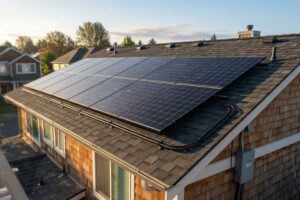
Best RV Solar Kit for Off-Grid Travel
The best RV solar kit is a complete system matched to your daily electricity use, battery capacity, available roof space, and travel style. For many RVs, a 200W–400W setup is a practical starting point, while larger rigs with refrigerators, inverters, laptops, and other continuous loads often need 600W or more.
That is the short answer.
The longer answer starts with something most RV buyers discover after installation: solar panel wattage is only one piece of the system.
A 400W array connected to a poorly sized controller and undersized battery will not behave like a well-designed 400W system.
I have worked through enough solar layouts to know where the problems usually appear. The panel specification is rarely the first failure point. It is usually the mismatch between energy production, battery storage, wiring, shading, and the owner’s actual habits.
For an RV, that distinction matters even more because roof area is limited and the electrical load changes dramatically between a weekend campsite and a month-long off-grid trip.
What Is the Best RV Solar Kit?
A complete RV solar kit normally includes more than solar panels.
A properly designed system may contain:
- Solar panels
- MPPT or PWM charge controller
- Battery bank
- Solar cables
- Inline fuses or circuit protection
- Connectors
- Roof mounting hardware
- Cable-entry gland
- Battery cables
- Monitoring equipment
- Inverter, when AC appliances are required
The U.S. Department of Energy explains that batteries allow solar-generated electricity to be stored and used when sunlight is unavailable, while inverters convert DC electricity into AC electricity for conventional appliances.
That relationship is easy to overlook in an RV.
The solar panels make electricity.
The controller manages charging.
The battery stores energy.
The inverter, if installed, supplies AC loads.
Remove one piece and the system’s purpose changes.
Best Solar Kit for RV: Start With Your Actual Loads
Before selecting a kit, make a rough energy inventory.
Here is a realistic example for a midsize travel trailer:
| RV Load | Approx. Power | Daily Use | Estimated Daily Energy |
|---|---|---|---|
| LED lighting | 25W | 4 hours | 100Wh |
| Refrigerator | 50W average | 12 hours | 600Wh |
| Phone/tablet charging | 30W | 3 hours | 90Wh |
| Laptop | 60W | 4 hours | 240Wh |
| Water pump | 60W | 0.5 hour | 30Wh |
| Wi-Fi/router | 15W | 8 hours | 120Wh |
| TV | 80W | 3 hours | 240Wh |
| Estimated total | — | — | 1,420Wh/day |
These numbers are examples rather than universal RV consumption figures.
A refrigerator rated at 50W does not necessarily consume 50W continuously. It cycles.
The same applies to pumps, compressors and heating equipment.
The useful number is the energy consumed over a full day, measured in watt-hours.
That is the number I use when sizing an RV solar system.
RV Solar System Sizing: How Many Watts Do You Need?
A simple first-pass calculation is:
Required solar power ≈ Daily energy use ÷ usable solar hours
For example, suppose an RV consumes approximately:
1,400Wh/day
and the planning assumption is:
4 peak-sun-equivalent hours/day
Then:
1,400 ÷ 4 = 350W
A 350W theoretical array would cover the daily energy demand under that simplified assumption.
I would not stop there.
Real installations lose energy through:
- Heat
- Wiring resistance
- Controller conversion
- Battery charging
- Dust and dirt
- Roof shading
- Clouds
- Panel orientation
- Partial shading from vents and roof equipment
The Department of Energy notes that solar production varies with sunlight, clouds, dust, haze, shadows, rain, snow and dirt.
For an RV, shadows deserve special attention.
A roof vent can cast a shadow across part of a panel.
A roof-mounted air conditioner can do the same.
And a satellite dish can turn a perfectly sunny roof into a surprisingly complicated solar layout.
200W vs 400W vs 600W RV Solar Kits
There is no universal “correct” kit size.
| RV Solar Size | Typical Use Case | Good For |
|---|---|---|
| 100W | Small auxiliary charging | Phones, lights, battery maintenance |
| 200W | Light weekend use | Basic electronics, lighting |
| 400W | General off-grid RV use | Refrigerator, electronics, lighting |
| 600W | Frequent boondocking | Larger electrical loads |
| 800W+ | Heavy off-grid use | Large battery banks, inverter loads |
A 200W system can make sense for a minimalist camper.
A 400W system is often a much more useful middle ground.
A 600W or 800W system becomes attractive when the RV owner wants more independence from shore power.
But there is a catch.
If the battery is too small, adding more solar does not automatically solve the problem.
You can generate electricity faster than the battery can comfortably absorb it.
Battery Size Matters More Than Most RV Buyers Expect
Solar panels produce energy during daylight.
The RV often needs energy after sunset.
That is why the battery is not an accessory.
It is the buffer between production and consumption.
The DOE describes energy storage as a way to capture electricity when generation is available and use it later when demand occurs.
For example:
12V 100Ah battery
Nominal energy:
12V × 100Ah = 1,200Wh
That does not mean 1,200Wh is necessarily available for every battery chemistry and operating condition.
Usable capacity depends on:
- Battery chemistry
- Recommended depth of discharge
- Temperature
- Battery age
- BMS limitations
- System losses
This is one reason modern lithium-based RV batteries can be attractive for off-grid applications.
But the battery must still be matched to the charging equipment.
Best RV Solar Kit With Lithium Batteries
A common modern configuration is:
400W solar + 12V lithium battery bank + MPPT controller + optional inverter
For example:
- 400W solar array
- 40A–50A MPPT controller, depending on actual array voltage/current and manufacturer specifications
- 200Ah 12V battery bank
- 1000W–2000W inverter for selected AC loads
This is only a design example.
The controller should always be selected from the actual module Voc, Isc, Vmp and Imp, array configuration, battery voltage and controller limits.
A commercial 400W RV kit illustrates how much variation exists even at the same nominal wattage. Renogy’s current 400W RV kit, for example, offers configurations using either rigid or flexible 200W modules and includes an MPPT-based DC-DC charging configuration in some versions. Its published module specifications show why voltage and current—not wattage alone—matter when configuring the system.
That is exactly the sort of detail I check before recommending a kit.
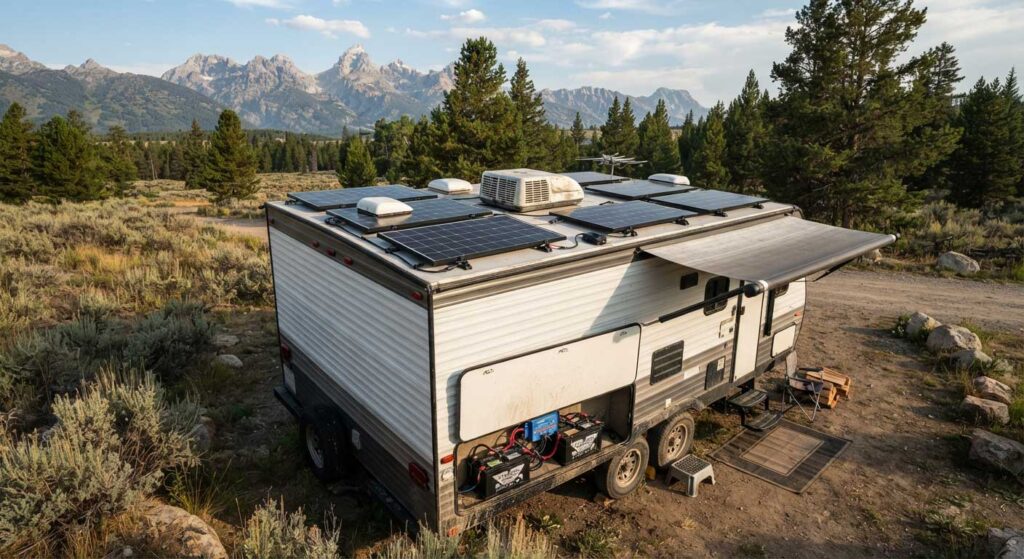
Flexible vs Rigid RV Solar Panels
This is one of the most practical decisions for RV owners.
Rigid Solar Panels
Rigid panels are usually mounted above the roof using brackets or rails.
Advantages include:
- Strong mechanical structure
- Air gap beneath the panel
- Good ventilation
- Familiar installation methods
- Easy visual inspection
- Wide product availability
The downside is straightforward:
They add height.
And sometimes quite a bit of it.
For a large Class A motorhome, that may be insignificant.
For a low-profile campervan, it can matter.
Flexible Solar Panels
Flexible panels are useful where:
- Roof weight matters
- Low profile is important
- The roof has slight curvature
- Drilling should be minimized
- The installation needs to blend into the roof
Bright Solar’s flexible-panel approach is particularly relevant for RV applications where roof geometry and weight are important design constraints.
But flexible panels should not be selected simply because they are thin.
The installation surface, panel temperature, adhesive method, bend radius and maintenance access all need consideration.
A flexible panel pressed tightly against a hot roof can experience a very different thermal environment from a rigid panel installed with airflow underneath.
Flexible RV Solar Panels: When They Make More Sense
Consider a compact camper with:
- Limited roof load capacity
- Curved roof sections
- Several roof vents
- Minimal space between equipment
- A strong preference for low-profile installation
A rigid array may require awkward brackets and several mounting points.
A flexible array can make better use of the available surface.
This is not about saying flexible is “better.”
It is about using the panel that fits the vehicle.
In RV solar design, usable roof area often matters more than theoretical roof area.
A 600W array that interferes with a vent, skylight or service hatch may be less useful than a well-positioned 400W array.
MPPT vs PWM for an RV Solar Kit
For a larger RV system, MPPT is often the more capable choice.
An MPPT controller continuously adjusts the operating point of the solar array to extract available power while regulating the battery charge.
A PWM controller is simpler and can be appropriate for smaller, straightforward systems.
The decision should consider:
- Array voltage
- Battery voltage
- Panel configuration
- Cable length
- Temperature
- Shading
- Budget
- Future expansion
Do not select the controller solely from the panel wattage printed on the box.
The controller must stay within its maximum PV voltage and current limits.
For example, a 400W array can have very different electrical characteristics depending on whether four 100W panels are wired in parallel, two pairs are wired in series/parallel, or two higher-voltage modules are used.
Same watts.
Different electrical system.
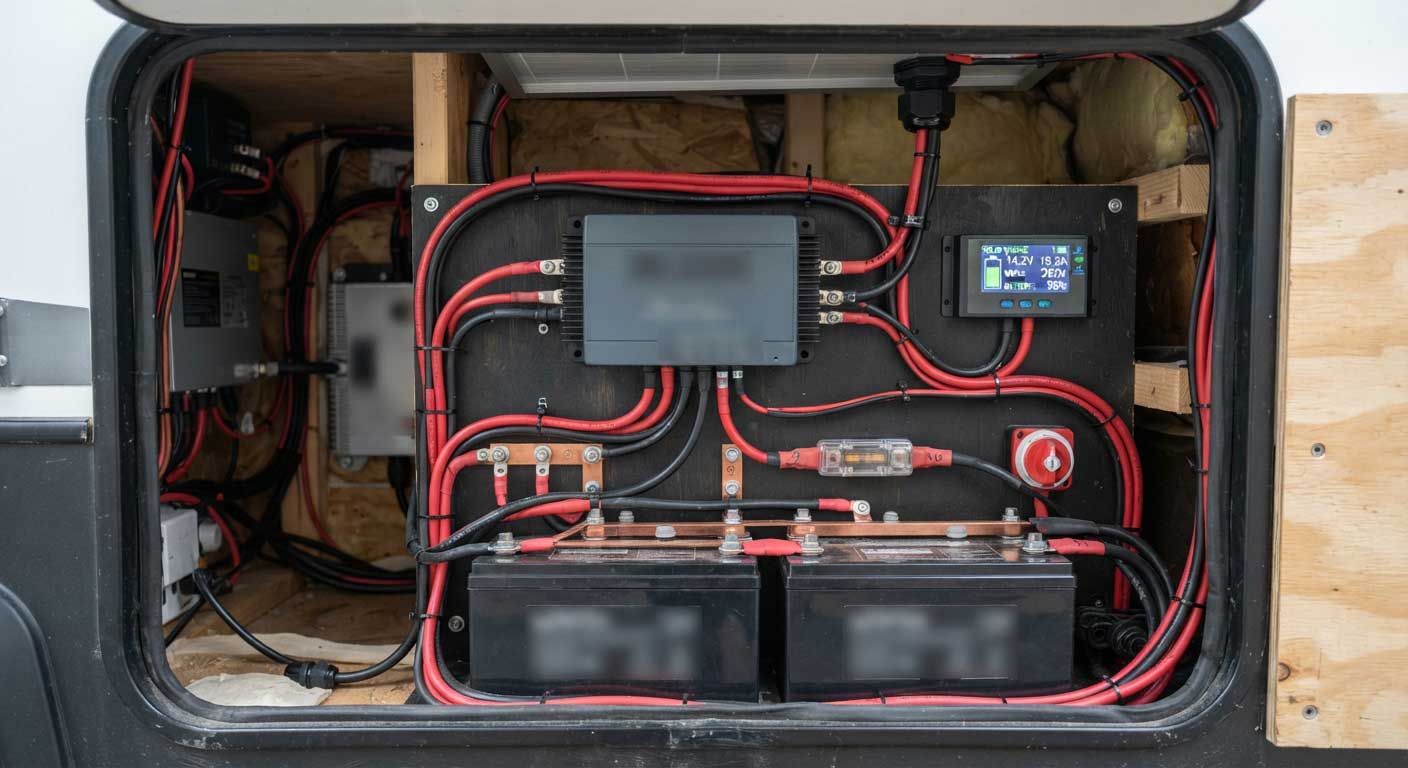
Best RV Solar Kit for Boondocking
Boondocking changes the equation.
At a campground with electrical hookups, solar is convenient.
Without hookups, solar becomes part of the RV’s energy infrastructure.
The question becomes:
How many days can you operate without starting the generator or plugging into shore power?
A useful off-grid system should consider both daily production and stored energy.
For example:
Scenario A — Light boondocking
Daily use:
700Wh
Solar:
300W
Battery:
100Ah lithium at 12V nominal
This can work well for modest electrical loads under favorable conditions.
Scenario B — Heavy boondocking
Daily use:
1,800Wh
Solar:
600W
Battery:
200Ah lithium at 12V nominal
This is a very different system.
The second RV has approximately 2.0–2.4 times the daily electrical demand of the first example, so simply copying a 300W setup would be unrealistic.
How to Install an RV Solar Kit
A professional installation should begin on the roof.
Not at the battery.
Step 1: Measure the Roof
Record:
- Roof dimensions
- Vents
- Air conditioner
- Skylights
- Antennas
- Satellite equipment
- Existing wiring
- Walkable areas
Mark the proposed panel footprint.
Then look at it again.
Roof plans often look generous on paper and surprisingly crowded when equipment is physically measured.
Step 2: Check Shading
Watch the roof at different times of day.
A panel that receives clean sun at 10 a.m. may be shaded by the air conditioner at 2 p.m.
Step 3: Plan Cable Entry
Keep cable runs short where practical.
Avoid creating low points where water can collect.
Use appropriate weatherproof cable-entry hardware.
Step 4: Install the Panels
Rigid and flexible panels require different mounting approaches.
Follow the panel manufacturer’s mechanical specifications.
Do not assume an adhesive suitable for household use is automatically suitable for an RV roof exposed to vibration, heat and weather.
Step 5: Install the Charge Controller
Mount the controller where it has appropriate ventilation and remains accessible for inspection.
Step 6: Add Protection
Use the correct fuses, disconnects and wire sizes for the actual system design.
Step 7: Test Before Closing Everything
Check:
- PV voltage
- Battery voltage
- Charging current
- Polarity
- Controller status
- Inverter operation
- Cable temperature under load
A ten-minute test before sealing a cable entry can save an afternoon of roof work later.
RV Solar Wiring: Series or Parallel?
This depends on the modules and controller.
Suppose two hypothetical 200W panels each have:
- Vmp = 20V
- Imp = 10A
In series:
40V × 10A ≈ 400W
In parallel:
20V × 20A ≈ 400W
The nominal power is essentially unchanged.
The voltage and current are not.
Series can be attractive when:
- Higher array voltage is useful
- Long cable runs are involved
- The controller accepts the higher Voc
- Shading conditions are manageable
Parallel can be attractive when:
- Lower array voltage is preferred
- The controller requires it
- Independent panel behavior is desirable
- The array is affected by different shading patterns
But never exceed the controller’s maximum PV voltage.
Cold temperatures can increase a panel’s open-circuit voltage, so the cold-weather Voc calculation matters.

How Much Does an RV Solar Kit Produce?
There is no fixed answer.
A 400W panel array does not automatically produce 400W for eight hours.
400W is the array’s rated power under specified test conditions.
Actual daily energy depends on the available sunlight and system conditions.
For simple planning:
Daily energy ≈ Solar array watts × equivalent peak sun hours × system efficiency
Example:
400W × 4 hours × 0.80 = 1,280Wh/day
That 80% factor is only an illustrative planning assumption, not a universal loss value.
Weather, shading, temperature, wiring and controller behavior can move the result significantly.
The DOE explicitly notes that solar output changes with weather and obstructions, while storage allows generated energy to be used at a different time from when it was produced.
This is why experienced RV owners watch daily energy harvested, not simply the number of watts printed on the panel.
Common RV Solar Kit Mistakes
Buying Too Much Solar and Too Little Battery
A large array cannot compensate for an undersized storage system.
Ignoring Roof Shading
A small shadow in the wrong place can affect production significantly.
Using an Undersized Cable
Long cable runs increase voltage drop.
Choosing a Controller Without Checking Voc
This is especially important for series-connected panels and cold-weather operation.
Forgetting the Inverter
If you want to run 120V AC appliances, the inverter becomes a major part of the design.
Running High-Power Appliances From Solar Without Doing the Math
Microwaves, hair dryers, coffee makers, induction cooktops and air conditioners can consume substantial power.
A 1,500W appliance running for 20 minutes uses:
1,500W × 0.333h ≈ 500Wh
That single appliance can consume a surprisingly large portion of a small RV’s daily solar budget.
RV Solar Kit Comparison
| System | Solar Array | Battery Example | Best For |
|---|---|---|---|
| Compact | 100–200W | 50–100Ah | Weekend camping |
| Standard | 300–400W | 100–200Ah | General off-grid use |
| Extended | 500–600W | 200Ah+ | Frequent boondocking |
| Large | 800W+ | 300Ah+ | High electrical demand |
| Custom | 1kW+ | Sized to loads | Long-term off-grid living |
These are starting points, not engineering specifications.
A refrigerator-heavy RV in Arizona during summer may need a very different system from a minimalist camper used in the Pacific Northwest.
What Should Be Included in the Best RV Solar Kit?
Before buying a kit, I recommend checking the actual contents.
A serious kit should clearly identify:
Solar side
- Panel quantity
- Individual wattage
- Voc
- Vmp
- Isc
- Imp
- Maximum system voltage
Controller
- Controller type
- Maximum PV voltage
- Maximum PV current
- Battery compatibility
- Charging profile
Wiring
- Cable gauge
- Cable length
- Connector type
- Fuse rating
- Disconnect requirements
Mounting
- Brackets or adhesive
- Cable-entry gland
- Hardware
- Roof compatibility
Battery
- Nominal voltage
- Amp-hour capacity
- Usable capacity
- Battery chemistry
- BMS specifications
If a kit only advertises “400W solar system” and provides little information about the controller or wiring, I would not consider the specification complete.
Why Bright Solar Takes a Different Approach
Bright Solar focuses on flexible solar solutions for applications where conventional rigid panels are not always the most practical answer.
For RVs, that means looking beyond wattage.
A flexible module can be valuable when:
- Roof weight is restricted
- Clearance matters
- The roof has a curved profile
- Low-profile installation is preferred
- Available roof space is irregular
But the correct design still depends on the electrical system.
A flexible panel does not eliminate the need for:
- Correct wire sizing
- Proper fusing
- Charge-controller matching
- Battery sizing
- Shading analysis
- Weatherproof cable entry
- Appropriate installation practices
The panel is the beginning of the system, not the entire system.
FAQ About the Best RV Solar Kit
What is the best RV solar kit?
The best RV solar kit is one sized to the RV’s daily energy consumption and matched to its battery, charge controller, roof area, wiring and expected off-grid usage. A 400W system is a practical starting point for many moderate RV applications, but larger loads require more capacity.
Is 400W of solar enough for an RV?
400W can be enough for moderate RV use when sunlight is favorable and the battery is appropriately sized. Refrigeration, laptops, inverters and other continuous loads may push an RV toward 600W or more.
Are flexible solar panels good for RVs?
Yes. Flexible panels work particularly well when low weight, low profile and curved or irregular roof surfaces are important. Installation temperature, ventilation, bend radius and mounting requirements still need to be considered.
What battery size should I use with a 400W RV solar system?
A 100Ah to 200Ah 12V battery bank is a common starting range for a 400W system, but the correct size depends on daily consumption, battery chemistry, desired autonomy and charging conditions.
Is MPPT better than PWM for RV solar?
MPPT generally provides more flexibility for larger or higher-voltage arrays and can be particularly useful when panel voltage differs substantially from battery voltage. PWM can still be appropriate for smaller, simpler systems.
Can RV solar panels run an air conditioner?
They can be part of a system designed to support air-conditioning loads, but residential-style RV air conditioners require substantial instantaneous power and energy. The array, battery bank, inverter and climate conditions must all be sized accordingly.
Can I install an RV solar kit myself?
Some smaller systems can be installed by experienced DIY users, but DC wiring, fusing, battery connections and roof penetrations require careful attention. Follow the panel, controller and battery manufacturers’ instructions and applicable electrical requirements.
Conclusion: Choosing the Best RV Solar Kit
The best RV solar kit is not the largest kit you can fit on the roof.
It is the system that matches the way you actually travel.
For a lightly equipped camper, 200W may be perfectly sensible. For regular boondocking, 400W can provide a much stronger starting point. RV owners running larger refrigerators, computers, inverters and other heavy loads may need 600W, 800W or more.
The important part is the relationship between solar panels, battery storage, charge controller, wiring and daily energy use.
Solar production happens during the day. Your refrigerator does not care what time it is.
Your laptop does not care either.
The battery is what connects those two realities.
The U.S. Department of Energy’s solar-storage guidance makes the same fundamental point: storage allows solar-generated electricity to be retained and used when generation and demand do not occur at the same time.
For Bright Solar, that is the useful way to evaluate an RV system.
Don’t start with “How many watts can I buy?”
Start with:
“How much energy does my RV actually use, where can I put the panels, and how much stored energy do I need when the sun is gone?”
That is where the best rv solar kit begins.
Related recommendations
-

Thin Film Flexible Solar Panel: Lightweight Solar Solutions for Modern Applications
140Discover thin film flexible solar panel technology for RV, marine and off-grid applications. Learn benefits, performance, installation tips and real project insights.
View details -
300w flexible solar panel for RV, Marine and Off-Grid Solar Applications
210Explore 300w flexible solar panel technology from Bright Solar for RV, marine, and off-grid applications. Learn output, installation methods, materials, and real project experience.
View details -
300 Watt Solar Panels for RV, Marine and Off-Grid Power Systems
204Discover how 300 watt solar panels power RVs, boats, cabins, and off-grid systems. Learn real performance, battery charging, and installation tips from Bright Solar.
View details -
Solar Panels Wired in Series: Wiring, Voltage, and Safety Guide
217Solar panels wired in series increase voltage while current stays nearly unchanged. Safe string design requires checking Voc, temperature effects, MPPT volta...
View details