RV Flexible Solar Panels: Lightweight Solar Power Solution for Off-Grid Travel
RV flexible solar panels provide lightweight renewable energy solutions designed for campers and motorhomes. They fit curved RV roofs, reduce installation weight, and help travelers generate reliable off-grid power for batteries, appliances, and outdoor adventures.
When RV owners ask Bright Solar about adding solar power to their vehicles, the conversation usually starts with a practical concern:
“I have limited roof space. How can I get more energy without adding too much weight?”
That question is more important than simply asking for the highest wattage panel.
An RV is not a house.
The roof moves through different environments:
- Highway vibration
- Strong sunlight
- Rainstorms
- Temperature changes
- Limited installation space
Over the years, Bright Solar has worked with customers who needed solar systems for camper vans, motorhomes, and travel trailers.
One customer wanted to travel through remote areas of Western Europe without depending on campground electricity.
Another RV manufacturer needed a solar solution that maintained the vehicle’s clean exterior design.
These projects showed us that rv flexible solar panels are valuable because they solve real installation challenges.
They are not only about producing electricity.
They are about making solar energy practical for mobile lifestyles.
What are RV flexible solar panels?
RV flexible solar panels are lightweight photovoltaic modules designed specifically for recreational vehicles, camper vans, and motorhomes where traditional rigid solar panels may not be suitable.
Unlike conventional glass solar modules, flexible RV solar panels usually use:
- Lightweight photovoltaic cells
- Flexible composite materials
- Protective polymer coatings
- Low-profile structures
This design allows installation on:
- Curved RV roofs
- Camper tops
- Travel trailers
- Van conversions
A typical RV solar system includes:
| Component | Function |
|---|---|
| Flexible solar panels | Convert sunlight into electricity |
| Charge controller | Controls battery charging |
| Battery bank | Stores energy |
| Inverter | Powers AC appliances |
| Monitoring system | Tracks performance |
The purpose is not necessarily to replace campground electricity completely.
Instead, RV solar systems provide energy independence for daily travel.
Common uses include:
- LED lighting
- Refrigerators
- Fans
- Mobile phones
- Laptops
- Water pumps
- Communication equipment
Why choose RV flexible solar panels instead of rigid panels?
The biggest difference between flexible and rigid solar panels is installation adaptability.
RV roofs create several challenges:
- Limited weight capacity
- Curved surfaces
- Space restrictions
- Aerodynamic concerns
A traditional solar panel normally requires:
- Aluminum frame
- Mounting brackets
- Roof penetration
- Additional support structures
Flexible panels reduce many of these requirements.
Lightweight design for RV applications
Weight matters in recreational vehicles.
Every additional kilogram affects:
- Fuel efficiency
- Vehicle balance
- Payload capacity
According to the U.S. Department of Energy, reducing vehicle weight can improve transportation energy efficiency because less energy is required to move the vehicle.
Source:
U.S. Department of Energy – Vehicle Technologies Office
https://www.energy.gov/eere/vehicles
For RV owners, lightweight solar installation means:
- Less roof stress
- Easier installation
- Cleaner vehicle design
A customer using a camper van conversion in Germany originally planned to install traditional framed panels.
During evaluation, they discovered:
- The roof structure required reinforcement
- Installation hardware increased weight
- The final appearance became bulky
After changing to flexible solar panels:
| Item | Improvement |
|---|---|
| Roof load | Reduced |
| Installation process | Simplified |
| Vehicle appearance | Improved |
| Available solar area | Increased |
The customer’s main goal was not maximum panel size.
It was keeping the freedom of travel while adding reliable energy.
Better fit for curved RV roofs
Many recreational vehicles do not have perfectly flat roofs.
Examples:
- Airstream-style trailers
- Camper vans
- Compact motorhomes
Rigid solar panels often create unused space because they cannot follow roof curves.
Flexible panels can better match:
- Roof contours
- Narrow installation areas
- Irregular surfaces
This allows RV owners to use more available space for solar generation.
Lower-profile installation appearance
Many RV owners care about design.
A large framed solar system can change the appearance of a vehicle.
Flexible solar panels provide:
- A smoother appearance
- Reduced wind resistance
- Better roof integration
This is especially important for:
- Premium motorhomes
- Adventure campers
- Custom van conversions
How much power can RV flexible solar panels generate?
The energy output of RV solar panels depends on:
- Panel wattage
- Sunlight hours
- Installation angle
- Geographic location
- Weather conditions
The basic calculation:
Daily Solar Energy = Panel Wattage × Peak Sun Hours × System Efficiency
Example:
A 300W RV flexible solar panel system:
300W × 5 sunlight hours × 80% efficiency
≈ 1.2kWh per day
Actual results vary depending on location.
According to the National Renewable Energy Laboratory (NREL), solar energy production depends strongly on local solar resources and system conditions.
Source:
National Renewable Energy Laboratory Solar Resource Data
https://www.nrel.gov/gis/solar-resource-maps.html
A properly designed RV solar system can support:
| Appliance | Typical Usage |
|---|---|
| LED lights | Daily operation |
| Phone charging | Easy support |
| Small refrigerator | Possible with battery storage |
| Laptop charging | Suitable |
| Ventilation fans | Suitable |
Bright Solar RV solar project experience
At Bright Solar, we have seen many RV solar projects where the biggest challenge was not the technology.
It was fitting the technology into real travel conditions.
One European camper manufacturer approached us with a specific requirement.
Their customers wanted longer off-grid trips.
However:
- Roof space was limited
- Vehicle weight had strict limits
- Customers wanted a premium appearance
The original design used traditional modules.
During testing, several problems appeared:
- Installation time increased
- Additional mounting parts were required
- Roof modification became necessary
After switching to flexible RV solar panels:
The final solution achieved:
| Project Result | Performance |
|---|---|
| Solar integration | Improved |
| Roof modification | Reduced |
| Installation complexity | Lower |
| User experience | Better |
The most valuable feedback came from travelers.
They wanted a solar system that worked quietly in the background.
They did not want solar equipment to become another thing they had to manage.

Choosing the right RV flexible solar panels
Selecting an RV solar panel requires evaluating more than wattage.
Important factors include:
| Factor | Why It Matters |
|---|---|
| Panel efficiency | Determines energy output |
| Weight | Protects RV structure |
| Flexibility | Fits roof design |
| Durability | Handles outdoor conditions |
| Warranty | Supports long-term use |
For RV applications, the best panel is the one that matches:
- Travel style
- Energy needs
- Available roof area
- Environmental conditions
How to install RV flexible solar panels correctly?
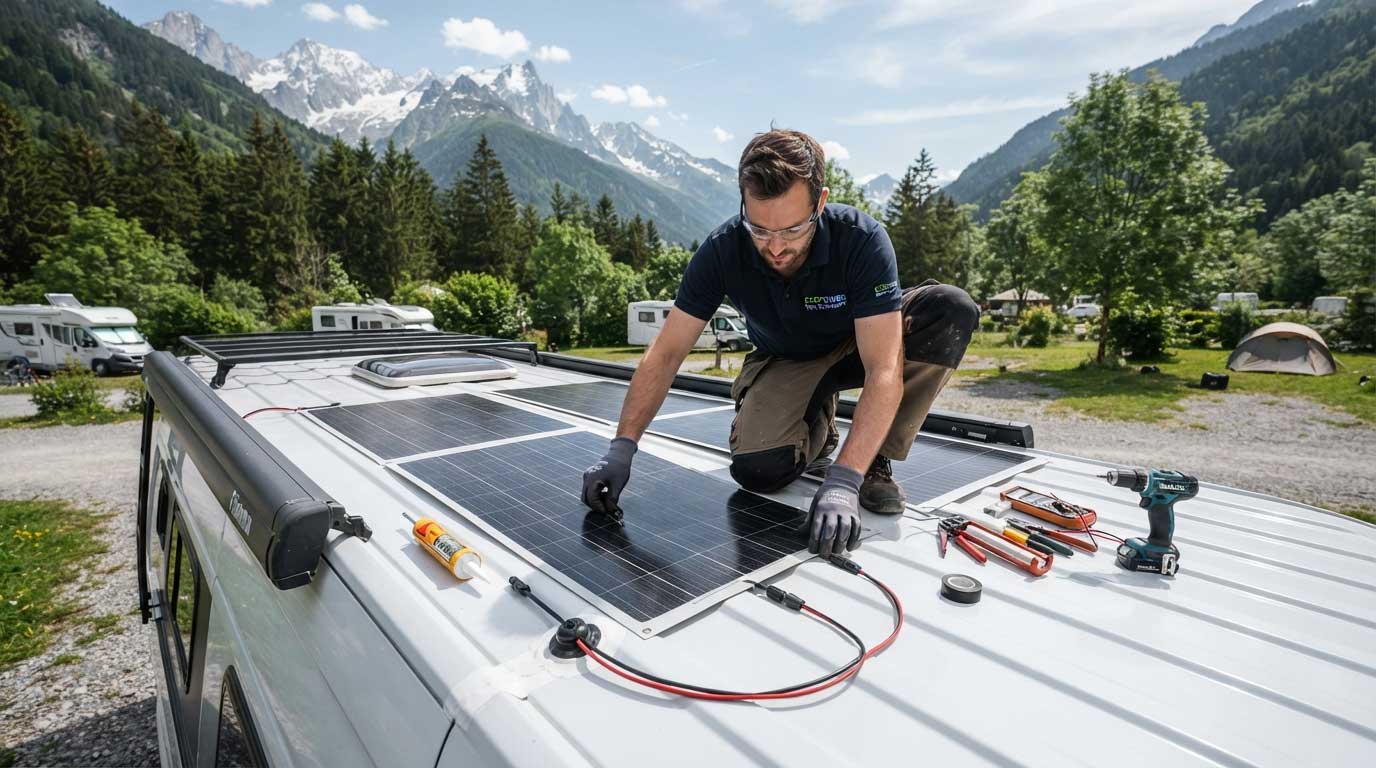
Installing RV flexible solar panels is simpler than installing traditional framed modules, but careful preparation is still necessary.
A common mistake we see in RV projects is focusing only on attaching the panel.
The electrical design, roof condition, and cable protection are equally important.
At Bright Solar, our recommended installation process follows four practical stages:
Step 1: Calculate RV energy requirements
Before selecting solar panels, determine how much electricity the RV actually needs.
Start by listing:
- Appliances
- Daily operating hours
- Battery capacity
- Travel conditions
Example:
A couple traveling in a camper van may use:
| Device | Daily Energy |
|---|---|
| LED lights | 50Wh |
| Refrigerator | 400Wh |
| Mobile devices | 50Wh |
| Laptop | 100Wh |
| Ventilation fan | 150Wh |
Total daily demand:
Approximately 750Wh per day.
A solar system should be designed based on energy usage rather than simply choosing the largest available panel.
Step 2: Inspect the RV roof area
Before installation, check:
- Available flat or curved surface
- Roof material
- Shade conditions
- Cable routing path
Avoid locations near:
- Air conditioners
- Roof vents
- Satellite antennas
Partial shading can significantly reduce solar output.
Even a small shadow from an antenna can affect multiple connected cells.
Step 3: Prepare the installation surface
A clean mounting surface improves long-term reliability.
Recommended preparation:
- Remove dust and debris
- Clean oil or wax residue
- Dry completely
- Mark panel position
For RV applications, vibration resistance is important.
The panel may experience:
- Highway movement
- Wind pressure
- Temperature expansion
Proper surface preparation reduces installation issues later.
Step 4: Connect solar electrical components
A complete RV solar system normally includes:
| Component | Purpose |
|---|---|
| Flexible solar panel | Generates DC electricity |
| MPPT controller | Optimizes charging efficiency |
| Battery | Stores energy |
| Inverter | Converts DC to AC |
| Fuse protection | Improves safety |
For many RV systems, MPPT charge controllers are preferred because they can extract more energy under changing sunlight conditions.
RV flexible solar panels wattage guide
Different RV owners require different power levels.
The correct wattage depends on:
- Vehicle size
- Travel style
- Appliance usage
- Battery capacity
100W RV flexible solar panels
Suitable for:
- Small camper vans
- Basic battery charging
- Emergency power
Typical applications:
- Phones
- GPS devices
- Small lights
200W RV flexible solar panels
A popular choice for compact RV systems.
Suitable for:
- Weekend camping
- Small refrigerators
- Electronics charging
Many van conversion projects use 200W systems because they balance:
- Cost
- Weight
- Energy output
300W RV flexible solar panels
300W systems are often selected by travelers who spend more time off-grid.
They can support:
- Larger battery banks
- More electronics
- Longer travel periods
For many medium-sized RVs, 300W provides a practical balance between available roof space and energy generation.
400W and higher RV solar systems
Large motorhomes with higher electricity demand may require:
- Multiple flexible panels
- Larger batteries
- Advanced controllers
Applications include:
- Full-time RV living
- Remote work
- Long-distance travel
RV flexible solar panels vs traditional RV solar panels
Both technologies have advantages.
The correct choice depends on the vehicle and usage.
| Feature | Flexible Solar Panels | Rigid Solar Panels |
|---|---|---|
| Weight | Lower | Higher |
| Installation | Easier | More complex |
| Roof compatibility | Excellent | Requires flat areas |
| Appearance | Low profile | More visible |
| Durability | Depends on material quality | Usually very strong |
For large flat RV roofs, rigid panels may still be practical.
For curved or weight-sensitive RV designs, flexible panels provide unique advantages.
How long do RV flexible solar panels last?
A quality flexible solar panel is designed for years of outdoor operation.
Actual lifespan depends on:
- Material quality
- Installation method
- Weather exposure
- Maintenance
The International Energy Agency (IEA) reports that photovoltaic technologies continue improving in reliability and long-term performance as manufacturing standards advance.
Source:
International Energy Agency – Solar PV Analysis and Technology
https://www.iea.org/energy-system/renewables/solar-pv
Factors affecting lifespan include:
UV exposure
Long-term sunlight can affect surface materials.
Premium flexible panels use protective coatings to reduce UV degradation.
Temperature changes
RV solar panels experience:
- Hot summer conditions
- Cold winter environments
- Rapid temperature changes
Good materials help maintain performance.
Mechanical stress
Travel vibration requires:
- Strong electrical connections
- Reliable bonding
- Proper cable management
Cost of RV flexible solar panels
The total cost depends on system size and components.
Typical flexible RV solar equipment pricing:
| System Size | Approximate Cost Range |
|---|---|
| 100W system | $150–$350 |
| 200W system | $300–$600 |
| 300W system | $500–$900 |
| 400W+ system | $800–$1,500+ |
A complete RV solar installation may include:
- Solar panels
- Controller
- Battery
- Inverter
- Wiring
- Installation accessories
Many RV owners initially focus on panel price.
However, the total system design determines real value.
A cheaper panel that produces less energy may require additional modules later.
Maintenance tips for RV flexible solar panels
One advantage of flexible solar panels is low maintenance.
However, simple checks improve reliability.
Clean the surface regularly
Dust and road pollution can reduce sunlight absorption.
Recommended:
- Clean water
- Soft cloth
- Mild cleaning solution
Avoid:
- Abrasive brushes
- Strong chemicals
Inspect wiring connections
Every few months check:
- Cable condition
- Connectors
- Junction areas
- Charge controller display
Road vibration can slowly loosen connections.
Monitor solar output
Keep records of:
- Daily charging performance
- Battery voltage
- Seasonal changes
A sudden output drop may indicate:
- Dirt buildup
- Shading
- Connection problems
Bright Solar RV flexible solar panels advantages
Bright Solar develops flexible solar solutions based on real application requirements.
Our focus includes:
Lightweight construction
Designed for mobile applications where every kilogram matters.
Flexible integration
Suitable for:
- RV roofs
- Camper vans
- Marine applications
Outdoor durability
Designed for exposure to:
- Sunlight
- Rain
- Temperature changes
Application-focused engineering
We believe solar products should solve customer problems, not only provide technical specifications.
FAQ About RV Flexible Solar Panels
Are RV flexible solar panels worth it?
Yes, they are especially valuable for RV owners who need lightweight solar solutions, curved roof installation, and improved energy independence during travel.
Can flexible solar panels power an RV refrigerator?
Yes. With a properly sized solar system and battery storage, RV flexible solar panels can support refrigerators and other essential appliances.
How many watts of solar do I need for my RV?
Most RV users choose between 200W and 400W depending on energy consumption, battery size, and travel style.
Can RV flexible solar panels be walked on?
Most flexible solar panels are not designed for regular foot traffic. Always follow the manufacturer’s installation instructions.
Do flexible solar panels work in cloudy weather?
Yes, they can still generate electricity in cloudy conditions, although output is reduced compared with direct sunlight.
Can I install RV flexible solar panels myself?
Many RV owners complete DIY installations, but electrical connections should be designed carefully for safety and performance.
Are RV flexible solar panels waterproof?
Quality RV flexible solar panels are designed for outdoor environments, but waterproof performance depends on product construction and correct installation.

Conclusion: Choosing RV Flexible Solar Panels for Smarter Travel
RV flexible solar panels give travelers a practical way to generate clean energy without adding unnecessary weight or complicated structures.
They are especially useful for:
- Camper vans
- Motorhomes
- Travel trailers
- Off-grid adventures
The right solar solution depends on more than wattage.
It depends on how people actually travel.
At Bright Solar, our experience with RV applications shows that successful solar systems combine:
- Reliable technology
- Correct sizing
- Practical installation
- Long-term durability
For modern RV owners, flexible solar technology turns unused roof space into a valuable energy source.
Related recommendations
-

400W Solar Module Performance, Applications and Buying Guide
166400W solar module solutions for RVs, marine systems and off-grid applications. Learn output, efficiency, installation methods and real-world performance from Bright Solar.
View details -
Solar Panels for Cloudy Days Trailers: What You Need to Know
240Solar panels can still charge trailers on cloudy days, but output decreases with cloud cover. Proper sizing requires real weather data, daily energy use, roo...
View details -
Flexible Fabric Solar Panels: Uses, Design and Buying Guide
101Flexible fabric solar panels integrate photovoltaic technology with lightweight fabric-compatible structures for portable, curved, and flexible applications.
View details -
Solar Panels Series vs Parallel: Which Configuration Delivers Better Performance?
276Compare solar panels series vs parallel wiring with real-world examples, performance data, shading effects, voltage calculations, and expert installation advice from Bright Solar.
View details