How Many Amps Does a 100 Watt Solar Panel Produce? 5A or 8.3A?
Ask “how many amps does a 100 watt solar panel produce” and you get two defensible answers. At its operating voltage of 20V, a 100W panel produces 5.0 amps (100W ÷ 20V). Divide the same 100W by a 12V battery’s nominal voltage instead and the answer is 8.3 amps (100W ÷ 12V). Both numbers are correct — they just answer different questions, and that is the reason this topic confuses so many buyers. On the label you will read 5.0A, because that is the current flowing inside the panel’s own circuit. At the battery you will measure 6-7A at peak sun through an MPPT controller, or 4-5A through a PWM controller. The 8.3A figure is an arithmetic ceiling, not a reading you will ever see on a clamp meter.
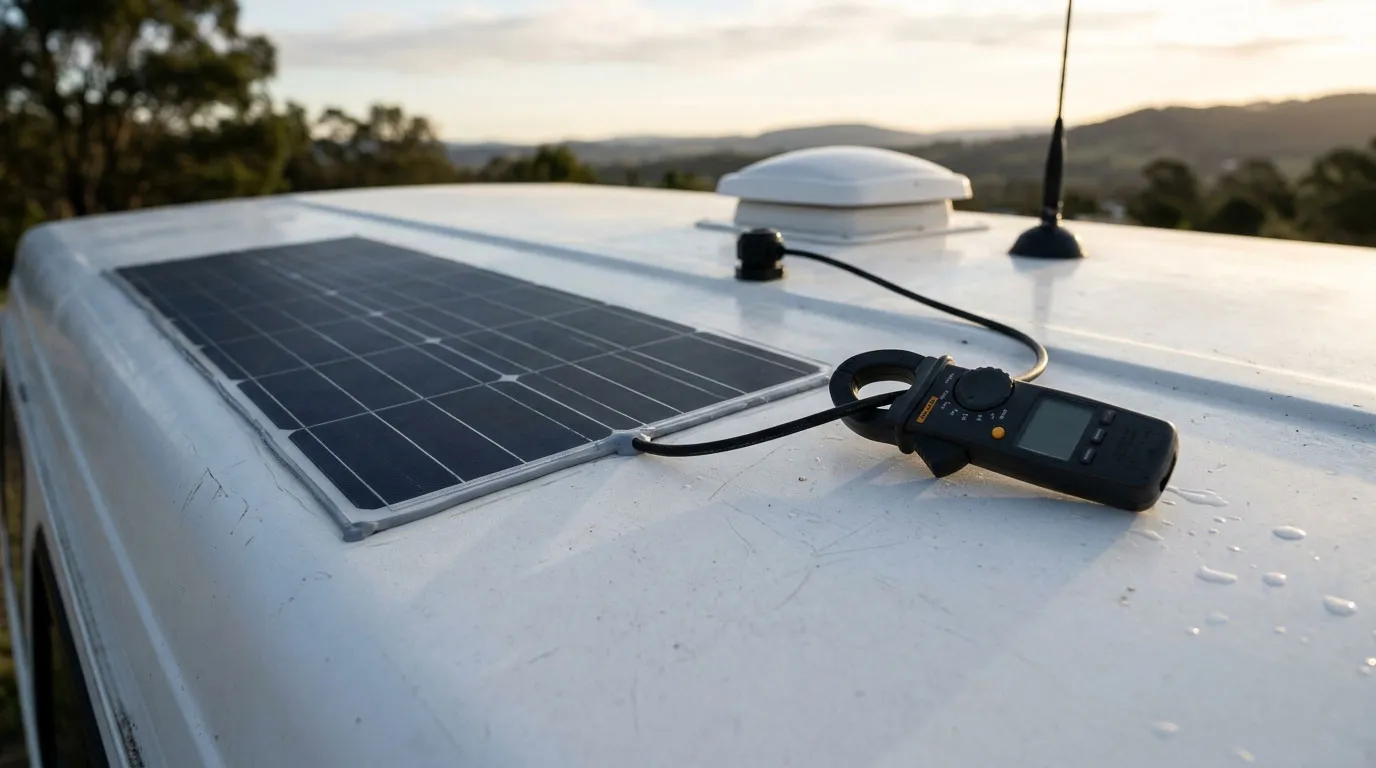
We build and test 100W flexible modules on our own bench before they ship — the L Series BS100-FT-M(E) below is a real production unit, not a datasheet sample. What follows is the number you quote to a customer, the number your controller sees, and the number your battery actually stores, in that order.
1. How Many Amps Does a 100 Watt Solar Panel Produce? The Two Answers
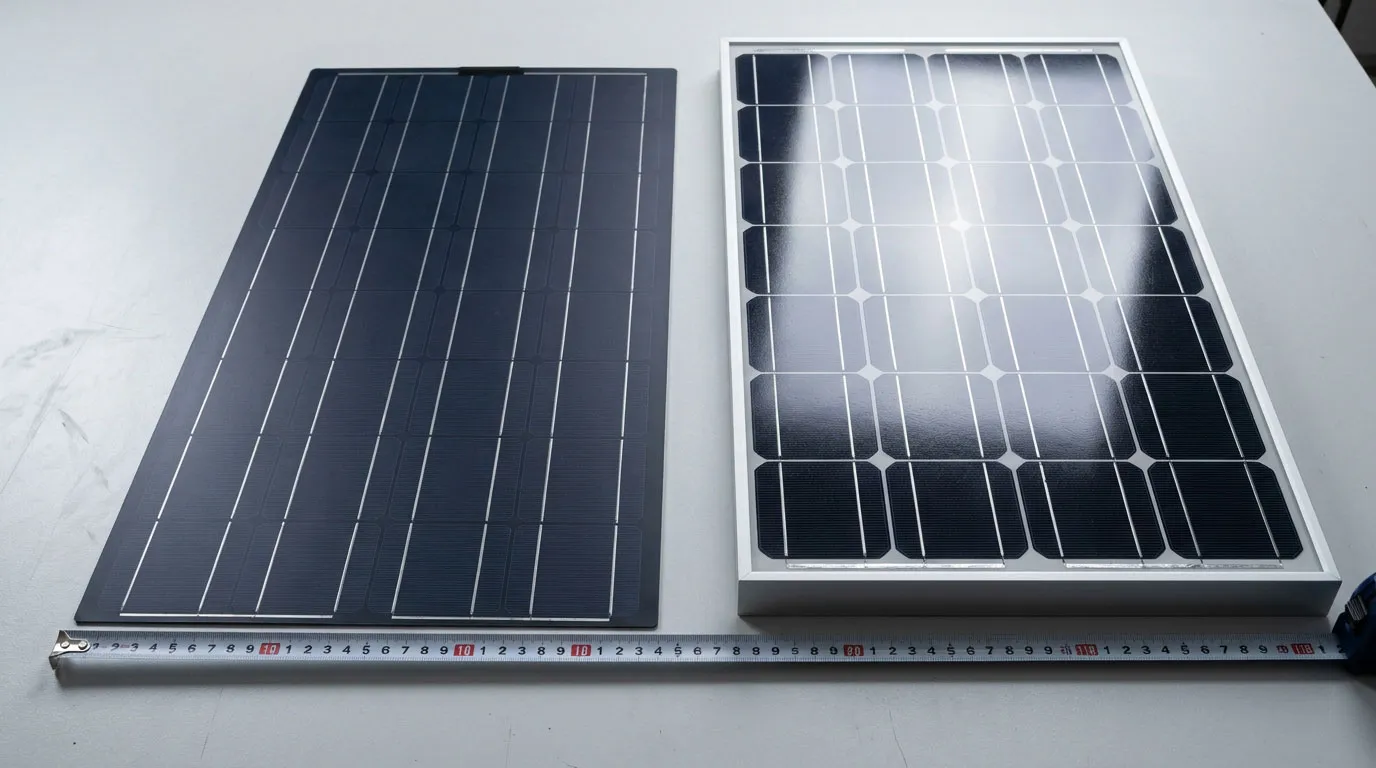
Every 100W panel is rated at Standard Test Conditions: 1,000 W/m² irradiance, 25°C cell temperature, AM 1.5 spectrum. Under those conditions the panel produces 100W at whatever voltage its cell string is designed for. A 36-cell flexible module like ours runs at Vmp 20V, so current at maximum power is 5.0A. A 32-cell rigid module runs at Vmp 18V, so its Imp is 5.6A. Same 100W, different current — because current is what changes when voltage changes.
The 8.3A figure comes from a different calculation entirely: it treats the battery’s 12V nominal voltage as the denominator. That is also why the same 100 watt solar panel how many amps question gets answered as 5A on one site and 8.3A on another — neither is wrong, they are quoting different volts. The 8.3A route is the right way to answer a physics homework question and the wrong way to predict what your controller will do, because a 12V battery is never at 12V while charging — it sits at 13.5 to 14.4V, and an MPPT controller converts the panel’s 20V down to that level rather than throwing the difference away.
| What you divide by | Calculation | Result | What that number actually describes |
|---|---|---|---|
| Vmp = 20.0V (the panel’s own operating voltage) | 100 ÷ 20 | 5.0A | Current inside the panel circuit at STC — this is the Imp on the label |
| 12V nominal battery | 100 ÷ 12 | 8.3A | The textbook answer. An arithmetic ceiling, not a measured charging current |
| 13.5-14.4V charging voltage | 100 ÷ 13.8 | 7.2A | Closest to real MPPT output at peak sun, before losses |
| 24V battery bank | 100 ÷ 24 | 4.2A | Two 100W panels in series on a 24V system |
| 48V bank | 100 ÷ 48 | 2.1A | Rare at this size, but the formula still holds |
2. The Only Formula You Need
Watts = Volts × Amps. Rearranged: Amps = Watts ÷ Volts. The entire difficulty of this topic is not the arithmetic, it is picking the right volts. Four different voltages appear in a single 100W installation, and mixing them up is how people end up buying a 30A controller for a 5A panel.
- Vmp (20.0V) — voltage at maximum power, measured under load at STC. This is the number that pairs with Imp to give you the rated wattage.
- Voc (25.0V) — open-circuit voltage, no load. Always higher than Vmp, and it rises further in cold weather. This is the number that decides whether your controller survives.
- 12V nominal — a label for the battery family, not a measurement. A “12V” battery ranges from 11.8V discharged to 14.4V on charge.
- 13.5-14.4V — the actual charging voltage. This is the voltage the controller regulates to, and the one that determines charging current once the panel is connected.
3. What a Real 100W Panel’s Label Actually Says
Specifications for our L Series 100W flexible module, model BS100-FT-M(E), taken from the production datasheet:
| Parameter | Value | What it tells you |
|---|---|---|
| Rated power (Pmax) | 100W | At STC only — expect 75-85W in real sun |
| Vmp | 20.0V | Divide 100W by this to get the label current |
| Imp | 5.00A | The 5A printed on the junction box |
| Voc | 25.0V | Controller input must exceed this, including cold-weather rise |
| Isc | 5.32A | Fuse and cable must be rated above this |
| Cell type | 166 × 166 mm mono, 22.5-25.8% efficiency | Higher efficiency means a smaller footprint for the same watts |
| Dimensions | 1072 × 532 × 2.8 mm | About 0.57 m² of roof area |
| Weight | 1.8 kg | Roughly a quarter of an equivalent framed glass panel |
| Max system voltage | 150-300 VDC | Irrelevant for one panel; matters when you series-string them |
| Power tolerance | 0 to +3% | Flash-tested, so it will not arrive below 100W |
Note the Vmp: 20V, not 18V. That single number explains why our 100W module is 5.0A while a budget rigid 100W panel is 5.6A. Neither is better in isolation — but if you are comparing panels on amps alone, you are comparing the wrong column. The L Series 100W flexible panel datasheet lists both the 20V and 18V variants for this reason.
4. Amps Into a 12V Battery: PWM vs MPPT
This is where the 8.3A number collapses in practice. A PWM controller connects the panel almost directly to the battery, so the panel is forced to operate at battery voltage. Current stays near Imp (5A), but the voltage drops from 20V to 13.8V — which means 31% of the array’s wattage is discarded as heat inside the controller. An MPPT controller converts the excess voltage into extra current instead, so the same panel delivers roughly 6.5-7A into the battery at peak sun.
| Controller | What happens to the 20V | Charging current at peak sun | Daily harvest (5 peak-sun hours) |
|---|---|---|---|
| PWM, 10A | Clamped to battery voltage; ~31% of the wattage lost | 4-5A | 20-25Ah |
| MPPT, 10A | 20V converted down to 13.8V; watts preserved | 6-7A | 28-33Ah |
The gap is worth about 8Ah a day, or 2,900Ah a year. On a 100Ah battery that is the difference between “topped up most days” and running a generator every third day in winter. At this system size the MPPT premium is roughly the price of one extra panel — and it does not need roof space.
5. Amp Hours Per Day: the Number That Actually Sizes Your System
Amps answer “how fast”, amp hours answer “how much”. Multiply the realistic charging current by peak sun hours at your latitude, then take off 10-15% for heat, soiling and cable loss. Peak sun hours are not daylight hours: most of the continental US averages 4.0-5.5 in summer and 2.0-3.0 in winter.
| Condition | Realistic current | Peak sun hours | Ah per day |
|---|---|---|---|
| Clear summer day, panel tilted, cool morning | 6.5A | 5.5 h | ≈ 33Ah |
| Spring or autumn, mixed sky | 5.5A | 4.0 h | ≈ 22Ah |
| Winter, northern US, low sun angle | 4.5A | 2.0 h | ≈ 9Ah |
| Overcast, panels flat on a roof | 1.5-2.0A | 4.0 h | ≈ 6-8Ah |
Worked example: a 100Ah 12V battery at 50% depth of discharge needs 50Ah replaced. At 30Ah a day in summer that is under two days of good sun; in December in Minnesota it is five to six days. If the load cannot wait that long, the answer is not a bigger controller — it is a second panel, or accepting that a 100W module is a maintenance charger rather than a power plant.
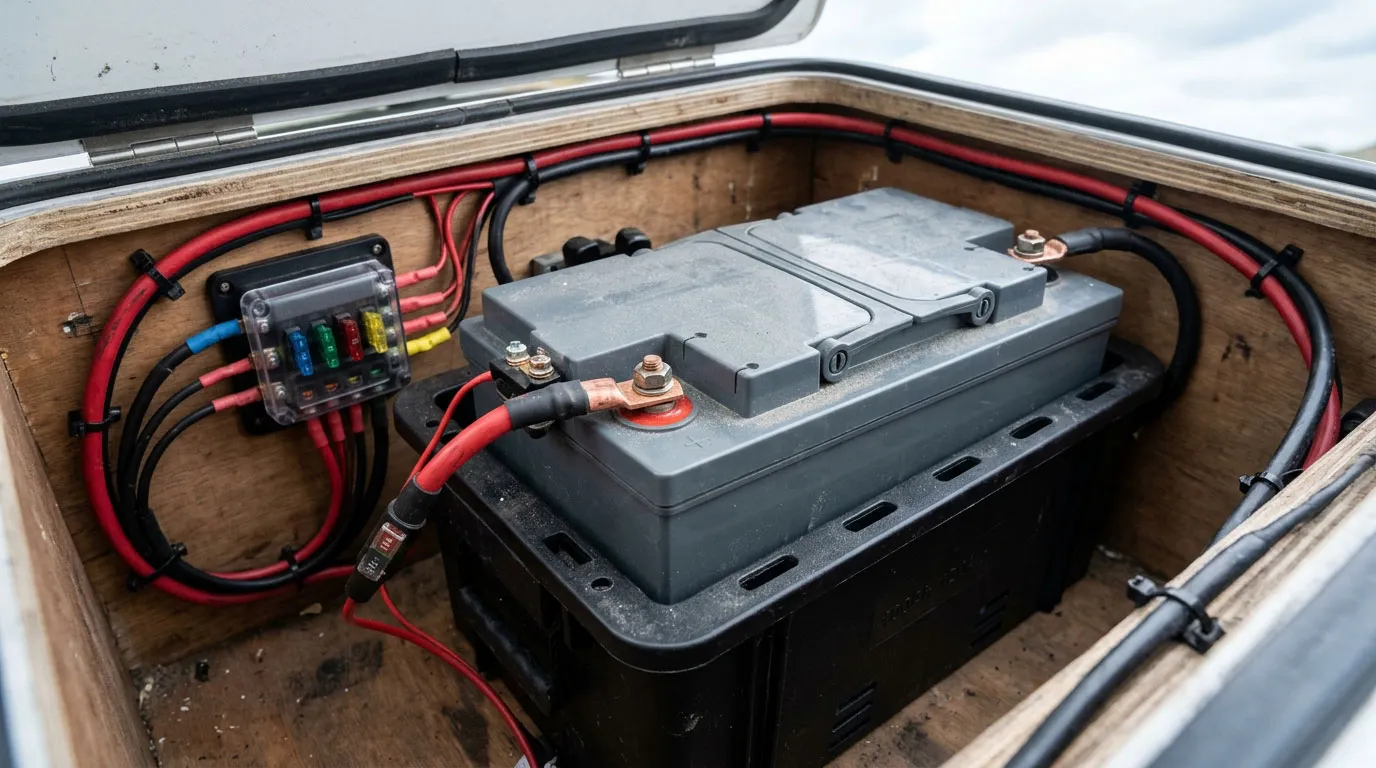
6. Controller, Cable and Fuse Sizing
Size the controller on Isc, not on Imp, and add 25% headroom. For a single 100W panel that lands on a 10A MPPT; the nearest standard size above 5.32A × 1.25 = 6.65A is 10A, and it also covers the brief current spike at cold sunrise.
| Configuration | Controller | Cable (run under 3 m) | Fuse | Voltage drop at rated current |
|---|---|---|---|---|
| 1 × 100W, 12V | 10A MPPT | 2.5 mm² (14 AWG) | 10A | ≈ 1.1% |
| 2 × 100W parallel, 12V | 20A MPPT | 4 mm² (12 AWG) | 15A | ≈ 1.5% |
| 2 × 100W series, 24V | 10A MPPT, 100V input | 2.5 mm² (14 AWG) | 10A | ≈ 0.6% |
Keep total voltage drop under 3% — above that you are heating the cable instead of charging the battery. If the run from roof to battery is longer than 6m, go one size up rather than accepting the loss. The MPPT controllers we supply are rated for 100V input, which covers two 100W panels in series even at -10°C.Learn more about “wiring order for panels and controller“.
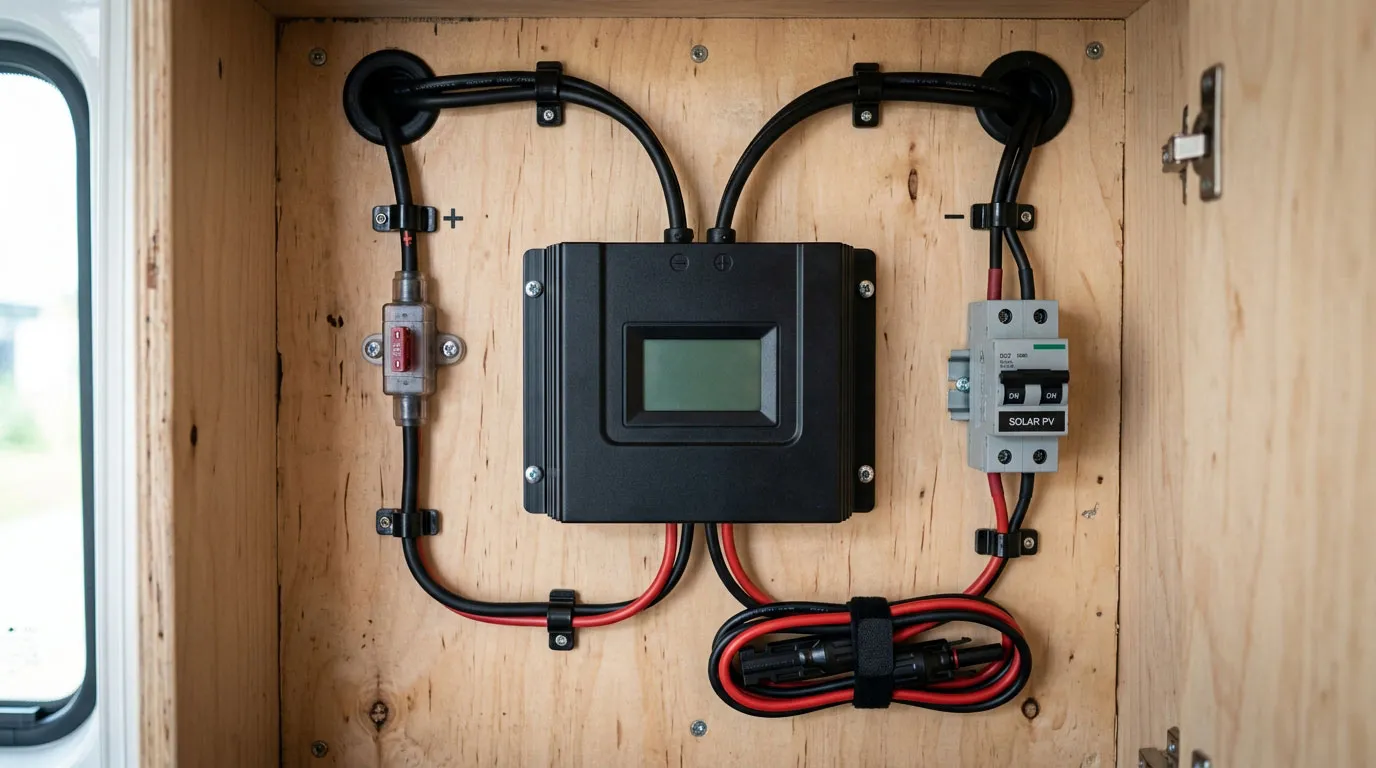
7. Two 100W Panels: Series or Parallel?
Parallel doubles the current and keeps the voltage at 20V; series doubles the voltage and keeps the current at 5A. For a 12V system, parallel is almost always correct, because a series string on a 12V battery needs an MPPT controller rated for the higher input and behaves badly under partial shade — one shaded panel drags the whole string down.
| Wiring | Array output | Best for | Watch out for |
|---|---|---|---|
| Parallel | 10A at 20V | 12V systems, roofs with vents or antennas casting shade | Cable and fuse must handle double the current |
| Series | 5A at 40V (Voc 50V) | 24V systems, long cable runs | Cold-weather Voc can exceed a cheap controller’s input limit |
One more number people miss: Voc rises about 0.3% per °C below 25°C. Two panels in series at -10°C put out close to 55V open-circuit, not 50V. A controller rated 50V max is already out of specification on a cold morning in Colorado — which is exactly when it fails.
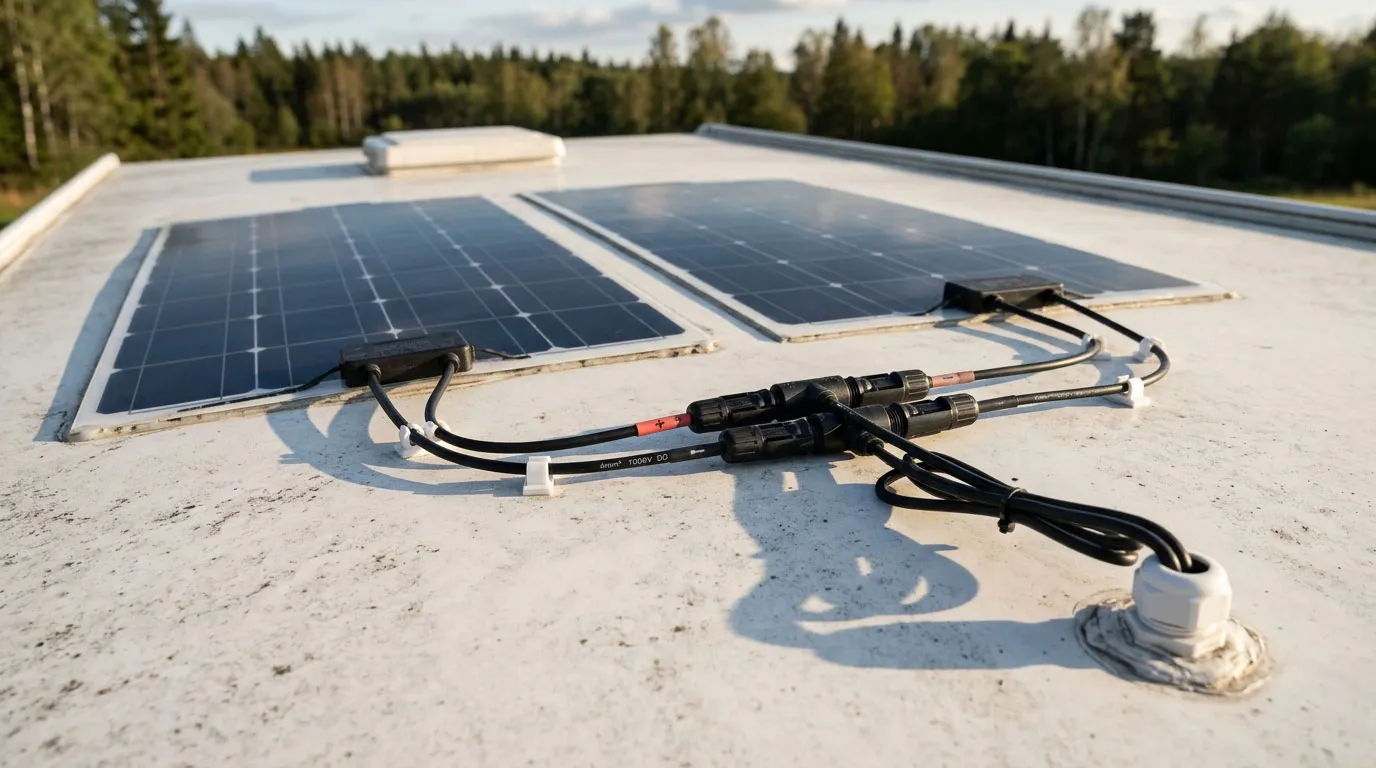
8. Why You Measure 4A When the Label Says 5A
A clamp meter reading 4A on a “100W” panel is usually not a faulty panel. It is a panel doing its job under conditions that are not STC. Five derates stack up:
- Irradiance. Current scales linearly with sunlight. At 800 W/m² you get 80% of Imp — 4.0A from a 5A panel, before anything else.
- Cell temperature. Voltage falls roughly 0.3-0.35% per °C above 25°C. A black panel on a roof in July can sit at 65°C, costing 12-14% of its power.
- Angle. A flat-mounted panel in winter at 40° latitude loses 20-30% against one tilted to latitude.
- Soiling and shading. Even a thin film of dust costs 3-5%; a single leaf over one cell string can cost 30%.
- Cable and connector loss. 1-3% in a well-sized install, more if the cable is undersized or the MC4 crimp is poor.
| Measured current (100W panel) | Verdict | Likely cause |
|---|---|---|
| 4.5-5.0A | Healthy | Full sun, cool panel, correct angle |
| 3.5-4.5A | Normal | Heat, haze, flat mounting, light soiling |
| 2.0-3.5A | Investigate | Partial shade, heavy soiling, wrong angle |
| Under 2.0A in clear sun | Fault | Cell string failure, cracked interconnect, bad MC4 crimp |
9. How to Test the Amps With a Multimeter
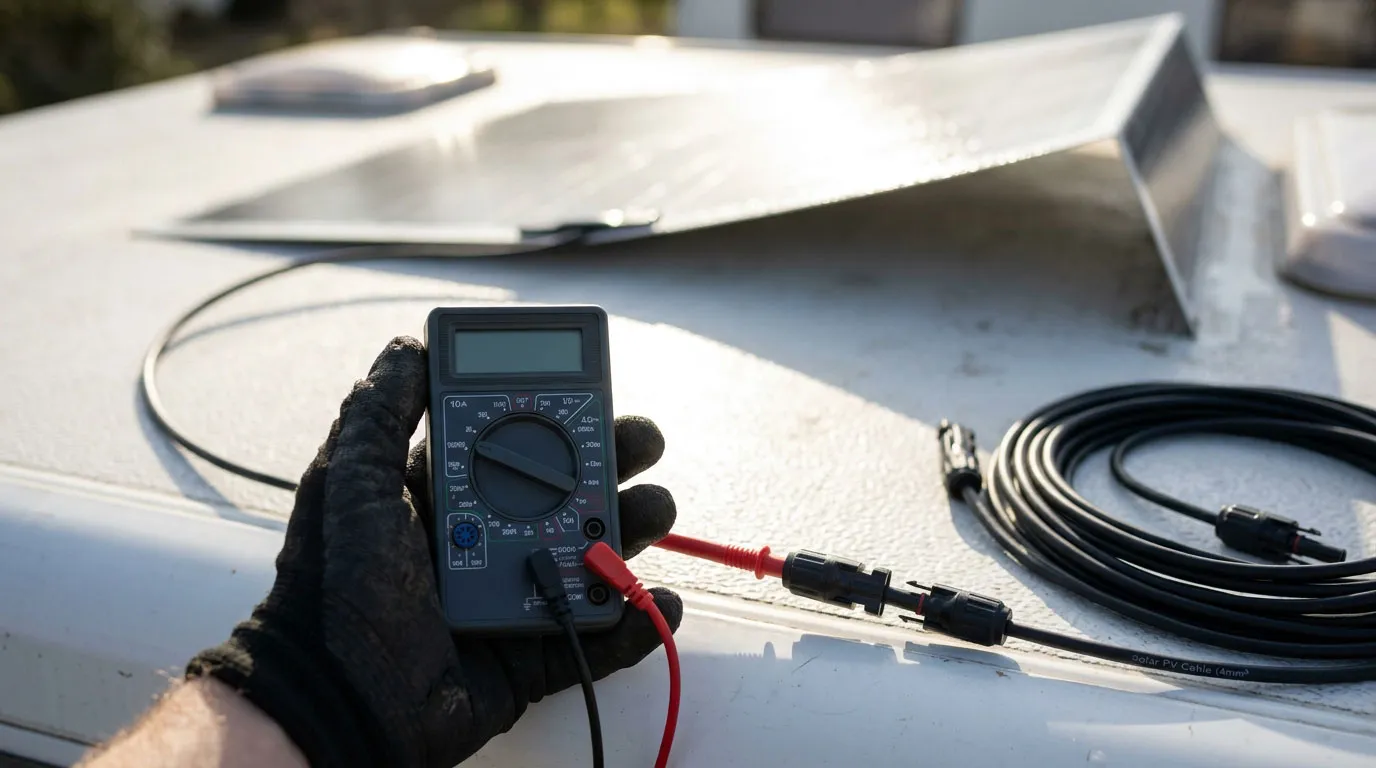
Two minutes with a $30 meter tells you more than any datasheet. Measure current in series — never across the panel terminals, which is a dead short.
- Set the meter to 10A DC and move the red probe to the 10A socket.
- Disconnect the panel’s positive lead from the controller. Connect the meter in series between the panel positive and the controller PV+ input.
- Face the panel at the sun at solar noon, hold it steady, and read the current. Note the time and sky condition.
- Compare with the label Isc (5.32A for our 100W module). 85-95% of Isc in good sun is healthy; below 70% points to shade, soiling or a failed string.
- To measure charging current instead, clamp a DC ammeter around the positive battery cable with the controller running — that reading includes the controller’s conversion, so it will be higher than the panel-side number on MPPT.
10. What a 100W Panel Can Actually Run
At 25-33Ah a day into a 12V battery, a 100W panel delivers roughly 300-400Wh of usable energy. In practical terms:
- LED lighting for a camper or cabin — 10-15W for five hours, comfortably.
- Phones, a laptop, a camera battery, a drone — a full day of charging for two people.
- A 12V roof fan or a water pump — yes, in daylight.
- A 12V compressor fridge (35-50W cycling) — borderline. It will keep up in summer sun, fall behind in winter or on cloudy weeks.
- A TV — only a small 12V unit for a couple of hours; see what a 200W panel can run if that is your target load.
- Anything with a heating element — kettle, induction plate, air conditioning — no. Those need 1,000W+ and an inverter far beyond this array.
11. 100W or 200W?
A 100W panel is the right first panel when the load is lights, devices and a fan, and the roof or budget is tight: 0.57 m² and 1.8 kg for a flexible unit, which is why it is the default for campervans, small boats and balcony setups. Step up to 200W when you want a compressor fridge to run unattended, or when winter sun is your limiting season — the second 100W roughly doubles daily harvest for the same controller family.
| 100W | 200W | |
| Current at Vmp (20V class) | 5.0A | 10.0A |
| 12V battery, theoretical | 8.3A | 16.7A |
| Realistic daily harvest | 25-33Ah | 50-65Ah |
| Roof area | 0.57 m² | 1.1 m² |
| Typical use | Lights, devices, fan, maintenance charging | Fridge, longer off-grid trips, winter margin |
If you are sizing the larger system, the maths is worked through in how many amps a 200 watt solar panel produces, and the physical footprint is broken down in the size guide for a 200W panel. For mounting a flexible module on a curved roof, the bonding method matters more than the wattage: see our RV roof flexible panel installation guide.
12. FAQ
How many amps does a 100 watt solar panel produce?
5.0A at its operating voltage of 20V (100W ÷ 20V), which is the Imp printed on the label. Divide 100W by a 12V battery’s nominal voltage and you get 8.3A, but that is an arithmetic ceiling rather than a measured current. Real charging current into a 12V battery is 6-7A through MPPT and 4-5A through PWM at peak sun.
How many amps does a 100W solar panel produce at 12V?
The calculation is 100 ÷ 12 = 8.3A. In practice a PWM controller delivers 4-5A because it clamps the panel to battery voltage and loses about 31% of the wattage, while an MPPT controller converts the voltage difference into current and delivers 6-7A at peak sun.
How many volts does a 100 watt solar panel produce?
A 100W module has a Vmp of about 20V and a Voc of about 25V in the 36-cell flexible format, or Vmp 18V / Voc 21.6V in the 32-cell rigid format. Voc rises roughly 0.3% per °C in cold weather, which is why controller input ratings are checked against the coldest morning, not the label.
How many amp hours does a 100W panel produce per day?
Roughly 33Ah on a clear summer day (6.5A × 5.5 peak sun hours), 22Ah in spring or autumn, and 9Ah in a northern winter. Subtract another 10-15% if the panel is flat-mounted or lightly soiled.
What size charge controller do I need for a 100W solar panel?
A 10A MPPT controller. Isc is 5.32A, and 5.32 × 1.25 headroom = 6.65A, so 10A is the nearest standard size with margin. PWM in 10A will work but wastes about 8Ah a day compared with MPPT on a 20V panel.
Can a 100W solar panel charge a 100Ah battery?
Yes. At 25-33Ah a day it replaces a 50% depth of discharge (50Ah) in under two days of good summer sun, and three to six days in winter. It is a maintenance-level charger for a 100Ah bank rather than a fast one; two panels are the better match for daily deep cycling.

13. Final Thoughts
The number you need depends on which question you are asking. For a spec sheet or a customer conversation, quote 5.0A — that is what the panel produces at 20V. For battery sizing, work in amp hours, because 8.3A is a ceiling that no controller will ever hold for an hour. For component selection, use Isc plus 25% and stop guessing.
We make 100W flexible modules from 1.8 kg in the L Series through to walkable 4.0 kg panels in the H Series, and we build custom sizes for OEM and project work — if your roof or deck has an awkward shape, send us the dimensions and we will quote a panel that fits it rather than a rectangle you have to work around. More electrical questions are answered in our solar FAQ.
Related recommendations
-

do solar panels emit radiation?
249do solar panels emit radiation? Learn how solar panels work, whether they produce harmful radiation, electromagnetic fields, and what science says about PV safety.
View details -
Solar Panel in Series: How to Wire Panels for Higher Voltage
502Learn how solar panel in series connections increase voltage, size strings safely, and match MPPT controllers. Practical wiring guidance for RV and off-grid solar.
View details -
solar flexible panel (Real Field Engineering Guide from Bright Solar)
312solar flexible panel explained with real RV installs, efficiency data, heat behavior insights, comparison tables, and field-tested off-grid performance cases.
View details -
Do Solar Panels Add Value to Your House?
253Solar panels can add value to a house, but the effect is not guaranteed. Ownership, system condition, documented performance, local electricity prices, and b...
View details