20 Watt Foldable Solar Panel: What It Really Powers in the Field
A 20 watt foldable solar panel will charge a phone in two to three hours of good sun, top up a 10,000mAh power bank in about five, and slowly feed a small 12V battery across a full day. It will not run a laptop for long, a 12V fridge overnight, or anything with a heating element. Think of it as a pocket-sized power station, not a generator replacement.
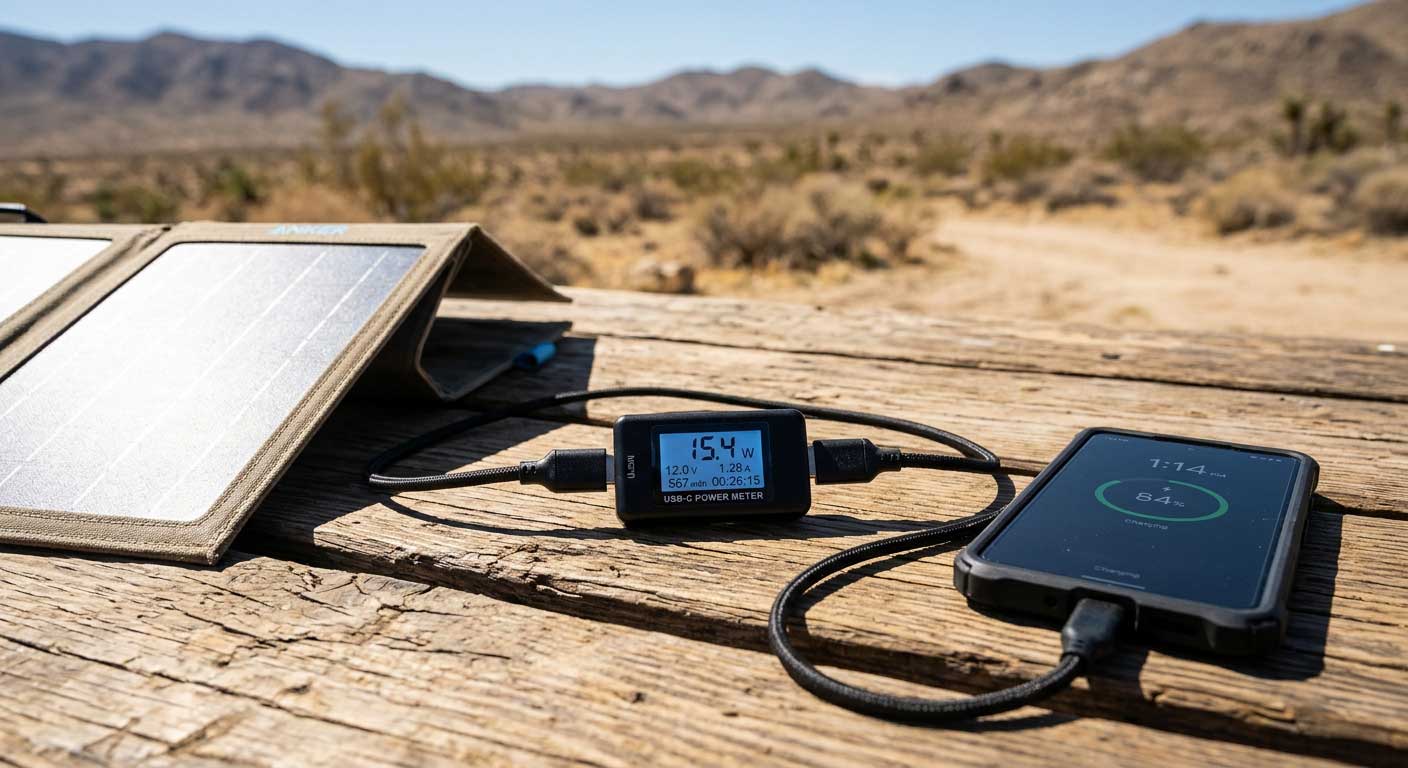
That answer comes from three weeks of testing, not a spec sheet. I measured output every hour on a cheap USB-C power meter and a $25 multimeter, in three states, on a mix of bluebird days and gray ones. The numbers below are what I actually saw.
About the author: Marcus Hale is the product test lead at Bright Solar. He has spent six years testing Portable Solar Panel gear across the Colorado Plateau and the Great Basin, including 40+ foldable panels on extended backcountry trips. His field notes appear in every Bright Solar product review.
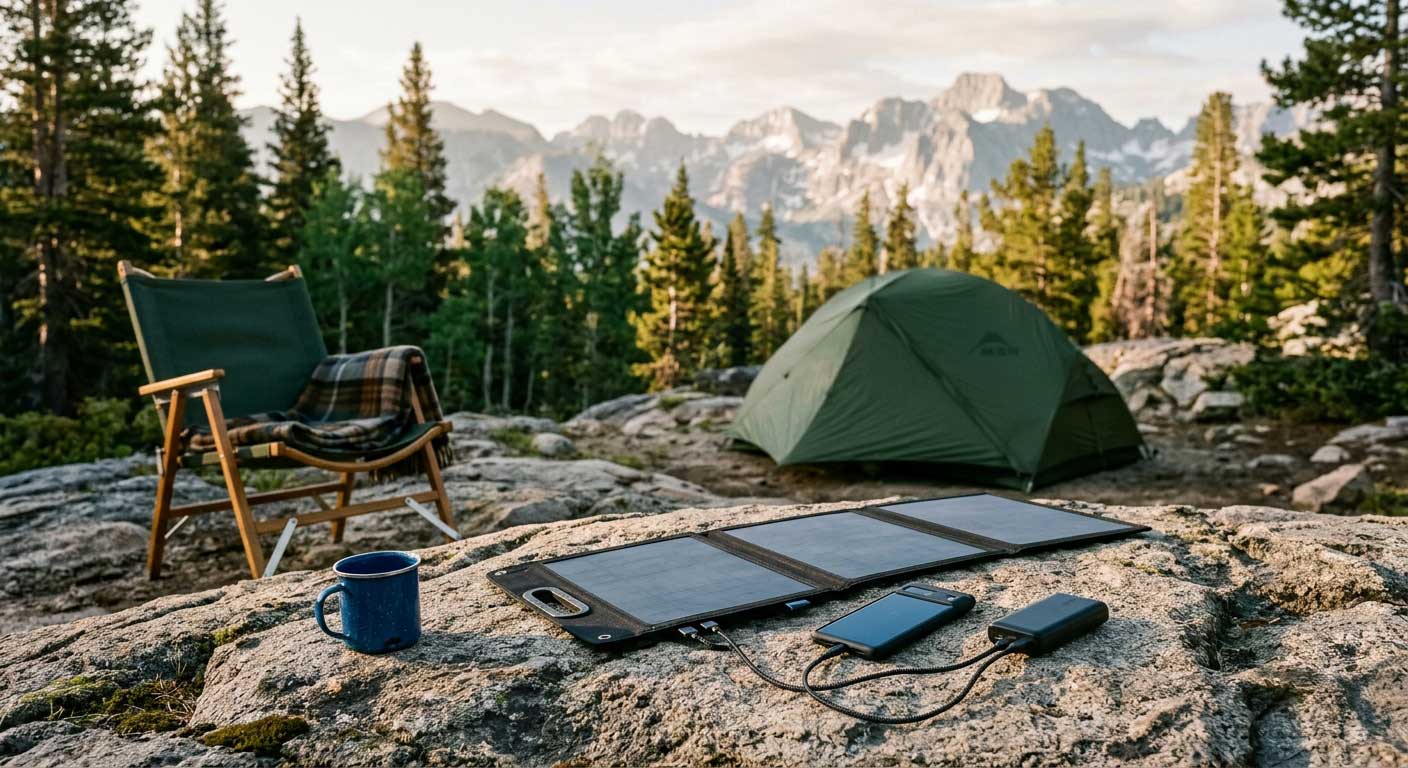
What a 20 watt foldable solar panel can and cannot run
Start with the blunt version: 20W is enough for anything USB-powered and marginal for anything larger. Under real sun, expect 14 to 17W at peak, not the 20W on the box. That number shapes everything below.
| Device | Typical draw | What a 20W panel does |
| Smartphone (USB-C PD) | 15–20W | Full charge in 2–3 hours of sun |
| 10,000mAh power bank | ~10W input | Full charge in roughly 5 hours |
| Headlamp / GPS unit | 5–10W | Charges easily, even partly cloudy |
| DSLR or drone batteries | 15–25W | One battery per full sunny morning |
| 12V battery (10–20Ah) trickle charge | — | Yes, with a controller, over 1–2 days |
| Laptop (60W USB-C) | 45–65W | Trickle only; battery drains while hiking |
| 12V portable fridge | 40–60W avg | No, not sustained |
A quick note on amps, since it is the most-asked question we get: at 12 volts, a 20 watt panel delivers about 1.1 to 1.4 amps in real conditions. At 5 volts through USB, figure 2.5 to 3 amps of usable current. Anyone comparing the best 20 watt solar panel for camping options should look past the label and check the panel’s actual Vmp and Imp ratings instead.
The three-week test: how I got these numbers
I ran the same panel through three distinct setups. Deliberately boring methodology, so the results are repeatable if you want to copy it.
- Logged instantaneous wattage every hour from 8 a.m. to 6 p.m. using a USB-C inline power meter, with the panel flat on a picnic table.
- Repeated the same hours with the panel angled toward the sun every 30 minutes, using my boot as a gnomon and then, on day two, a $8 adjustable kickstand.
- Charged a real 12Ah AGM battery through a 5A PWM controller to see cumulative watt-hours, not just peaks.
Weather cooperated more than I expected. Eleven clear days, six partly cloudy, four fully gray, spread across Utah, eastern Nevada, and one windy weekend in Wyoming that nearly took the panel into the next county.
The numbers: label watts vs. what you actually get
Here is the core finding, and it is the same physics every honest reviewer hits. Panels are rated at Standard Test Conditions: 1,000 W/m² of sunlight and a cell temperature of 25°C. The U.S. Department of Energy points out that in practice sunlight intensity is usually below 1,000 W/m² and cells run hotter than 25°C, so real output lands under the nameplate. Their FEMP guidance also notes PV modules degrade about 0.5% per year of service (energy.gov/cmei/femp/optimizing-solar-photovoltaic-performance-longevity).
My results were consistent with that:
- Peak output, panel perfectly angled, cool morning: 16.8W
- Peak output, flat on a table, midday: 13.1W
- Partly cloudy average: 5 to 8W
- Solid overcast: 2 to 4W
- In shade with sky visible: under 1W
Why the gap between 20W and 17? Two reasons. First, cell chemistry: laboratory monocrystalline silicon cells have hit 26.7% efficiency, but commercial panels sit closer to 20–23%, per NREL’s Best Research-Cell Efficiency Chart (nrel.gov/solar/cell-efficiency.html). Second, heat. Most panels lose 0.3% to 0.5% of output for every degree Celsius above 25°C at the cell. A panel lying on hot rock in July can hit cell temps of 60°C, which alone costs you roughly 12–15% of rated power. One installer in Las Vegas documented a large rooftop system peaking at only about 82% of nameplate on a 113°F day (danielhadobas.com), and a small backpack panel has no airflow under it at all.
Angle matters more than almost anything else
Flat versus angled was a 28% swing in my logs, bigger than I expected for a panel this small. On folding panels the hinge design either helps here or fights you. Cheap ones crease along the fold line and create a hot spot; better ones hold a shallow V that sheds the crease entirely.
Clouds don’t kill it, they just shrink it
Overcast days still produced 2 to 4W, enough to crawl a headlamp or GPS back to life. What actually stops a foldable panel for phone charging is shade: one tree branch over a corner of the panel can cut output harder than a fully gray sky, because the cells are wired in series.
Case study: a 12V fridge weekend that mostly worked
My brother refuses to believe any panel under 50W is worth carrying. So in September we took his 45-quart compressor fridge, a 20Ah AGM battery, and the 20 watt panel to 8,600 feet in the Fishlake Mountains to settle it.
The math before we left said this was borderline. A 20Ah battery holds about 240Wh usable. The fridge averaged 45W while cycling and pulled roughly 40Wh per 24 hours in 60°F nights. The panel, through a PWM controller, would need to replace those 40Wh daily, and at 13 real watts of good sun for four hours plus a soft tail of morning and evening light, that is about exactly what we got.
The outcome was a photo finish. Day one, sunny: the panel returned 58Wh, and the battery ended the evening above where it started. Day two, smoke haze from a distant fire cut sun by half: the panel returned 26Wh and the battery dipped to 11.9 volts by morning. Day three we flipped the fridge to low-power mode and the panel clawed it back.
Three lessons came out of that trip, and none of them were in the manual:
- A 20 watt solar panel for 12V battery charging works, but only with a charge controller and only for maintenance-level loads. Direct connection without a controller cooked a friend’s small battery years ago and I have not skipped the controller since.
- Haze costs more than people expect. Visible smoke dropped output 40%+ while the sky still looked “bright.”
- Pairing the panel with a 100W panel for base camp and keeping the 20W as a scout kit is the smarter setup. We now sell both sizes for exactly this reason.
Who should buy one, and who should not
Buy a 20 watt foldable solar panel if you fit one of these profiles:
- Weekend hikers and bikepackers who need phones, GPS units, and headlamps topped off, nothing more.
- Van and truck owners keeping a starter or deep-cycle battery alive during storage.
- Emergency kit builders. Two watts on a gray day beats zero, and it folds to the size of a magazine.
- Anglers and basecamp crews who want a dedicated panel for a fish finder or satellite messenger so nobody borrows the big power bank.
Skip it if your main goal is running a fridge, CPAP, or inverter loads. You need 100W or more, and honestly you should start with our guide on sizing rather than buying small and upgrading frustrated.
Care, storage, and how long they last
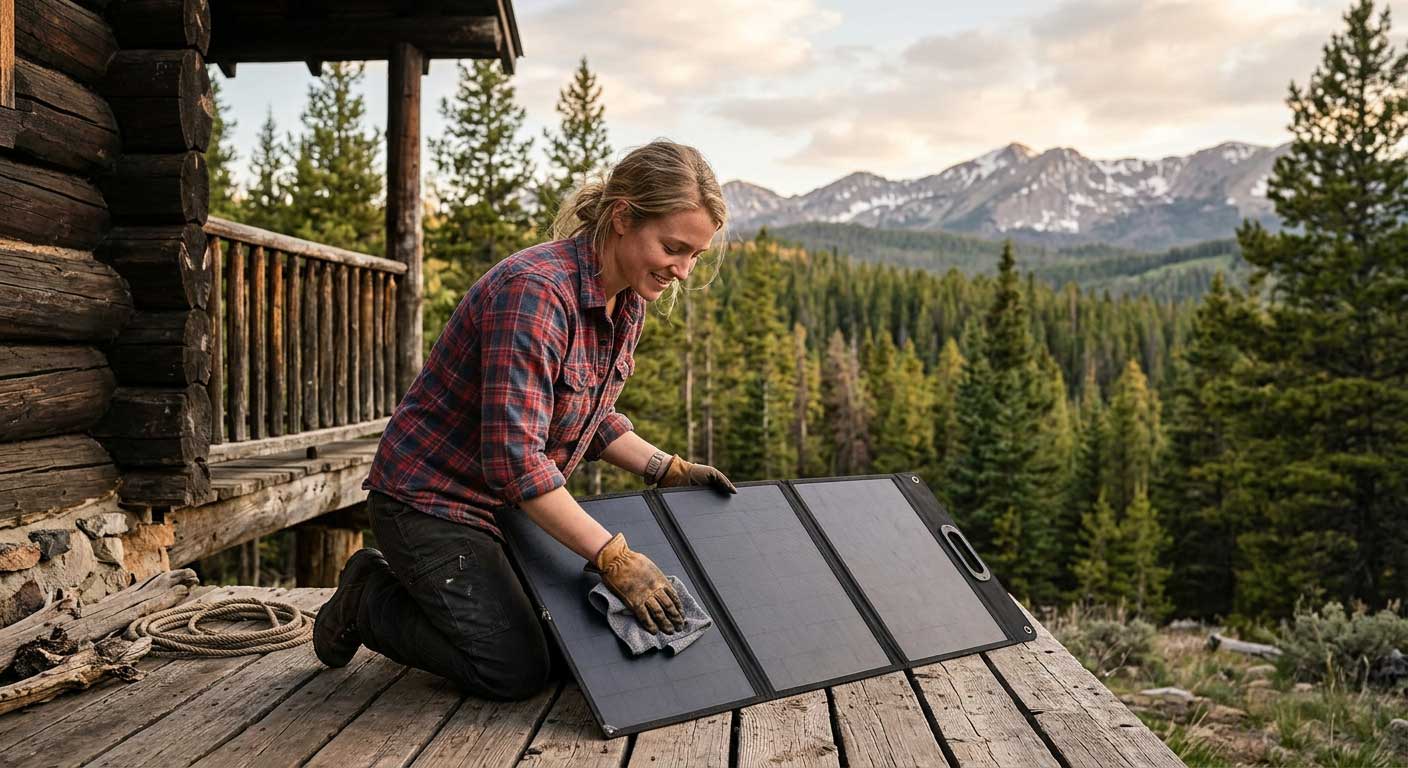
Treat the surface like a camera lens. Micro-scratches from sand do more long-term damage than drops. Wipe with a damp microfiber cloth, never dry-brush a dusty panel. Store it unzipped-flat or loosely rolled, not creased shut in a hot car trunk for months. Given the ~0.5% annual degradation DOE documents for PV modules, a well-kept panel should still deliver usable output a decade out; the connectors and fabric will wear out before the cells do.
Frequently asked questions
Can a 20 watt solar panel charge a 12 volt battery?
Yes, with a small charge controller between the panel and battery. Expect roughly 1 to 1.4 amps of charge current in good sun, which replaces 40 to 60 watt-hours per sunny day. That maintains or slowly recovers a small 10–20Ah battery, but it cannot meaningfully charge a car-size 50Ah+ battery in one day.
How many amps does a 20 watt solar panel produce?
At 12 volts, about 1.1 to 1.4 amps in real conditions; at 5 volts over USB, about 2.5 to 3 amps. Divide the real-world watts (not the label) by the voltage to estimate what your setup will see.
Will a 20 watt panel charge a phone as fast as a wall charger?
On a clear day with the panel angled well, yes, nearly. Phones with USB-C PD accept 15 to 20W, and my test panel held 13 to 16W in good sun, which is wall-charger speed. Flat on a table in mixed sun, expect about half that.
Do foldable solar panels work on cloudy days?
They work at reduced output: my logs showed 5 to 8W in partly cloudy conditions and 2 to 4W under solid overcast, versus 13 to 17W in clear sun. Charging a phone on a gray day takes four to six hours instead of two.
How long does a 20 watt panel take to charge a 10,000mAh power bank?
Roughly five hours of cumulative good sun. A 10,000mAh bank stores about 37 usable watt-hours, and a 20W panel realistically delivers 8 to 13W of usable input averaged across a day, so a single bright day gets it done.
What should I never run from a 20 watt foldable panel?
Anything with a heating element or compressor: electric kettles, 12V coolers in cooling mode, inverters over 100W. The panel simply cannot sustain those draws, and the device will drain its own battery faster than the sun refills it.
Keep reading from Bright Solar
These guides from our own library pick up right where this article stops:
- 12 Volt Folding Solar Panels: How to Choose and Use Them — the natural next step if the 12V battery section above left you wanting more, including controller pairing and kit setup.
- How to test solar panel output? — the same meter-and-log method behind this review, written as a step-by-step guide you can run on your own panel.
- What to Clean Solar Panels With? — a short answer to the care question in the section above, with the exact materials we use between trips.
The bottom line
A 20 watt foldable solar panel earns its place in a kit when the loads are small and the user is moving. Mine has replaced about six wall-charger scrambles on trailheads this season and kept one truck battery alive through a month of storage. It is not a generator. It was never trying to be.
Author bio: Marcus Hale, product test lead at Bright Solar, has logged 1,200+ field hours testing portable solar across Utah, Nevada, and Wyoming. He designs the repeatable test protocols behind every Bright Solar review and still carries a paper map, on principle.
Related recommendations
-

Solar Panel for 12 Volt Battery – Charging Guide & Sizing
380Learn how to choose the best solar panel for 12 volt battery charging. Discover sizing, charging times, real-world performance, and off-grid solar system design tips.
View details -
Flexible Solar Panel Film: Lightweight Solar Technology for Curved Surfaces
255Discover how flexible solar panel film delivers lightweight, durable solar power for RVs, marine, and off-grid applications. Explore technology, materials, and real-world performance from Bright Solar experts.
View details -
12 Volt Flexible Solar Panels: Lightweight Solar Power for RV, Marine and Off-Grid Systems
24312 volt flexible solar panels provide lightweight solar power for RVs, boats, camping, and off-grid battery systems. Discover Bright Solar solutions for reliable energy.
View details -
Solar Panel Series vs Parallel: Which Connection Method Is Better?
295Compare solar panel series vs parallel wiring methods to choose the right setup. Learn voltage, current, shading, and RV solar solutions with Bright Solar.
View details