160w folding solar panel: Output, Setup and Camping Guide
A 160w folding solar panel provides portable electricity for camping, RV travel, and off-grid battery charging. With four equivalent peak sun hours, it may generate roughly 480–544Wh per day under an illustrative 75–85% system-efficiency assumption.
That figure is useful for planning, but it is not a guaranteed daily result. A panel unfolded in an open field can perform very differently from one placed beside a van under tree shade. The practical value of a folding solar panel comes from being able to move it, angle it toward the sun, and pack it away when the charging session is over.
For anyone comparing portable solar equipment, three questions matter more than the wattage printed on the label: how much energy can it realistically harvest, which battery or power station can accept that energy, and how much space does it occupy when folded?
What Is a 160w Folding Solar Panel?
A 160w folding solar panel is a portable photovoltaic module with a rated power of 160 watts under specified standard test conditions. Its panel sections are designed to fold into a more compact form for transport and unfold for outdoor use.
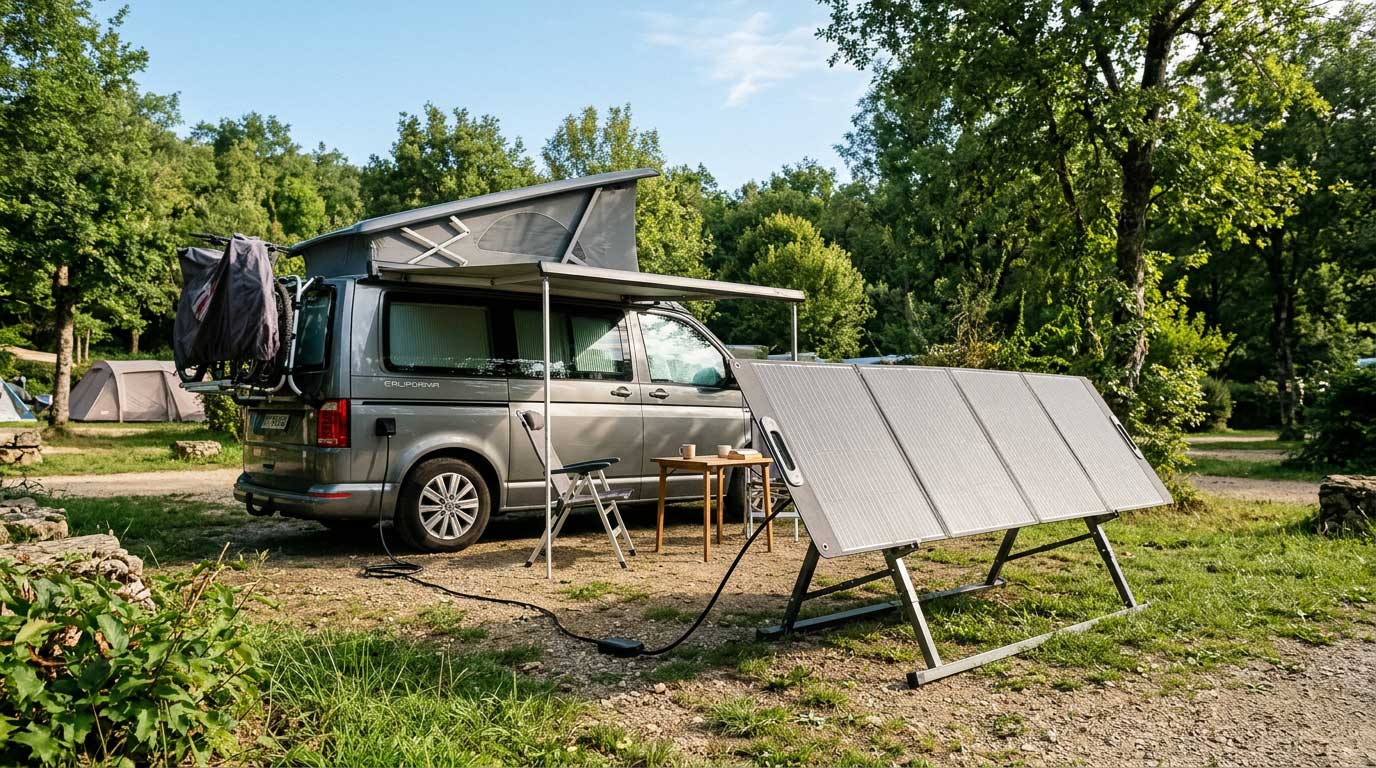
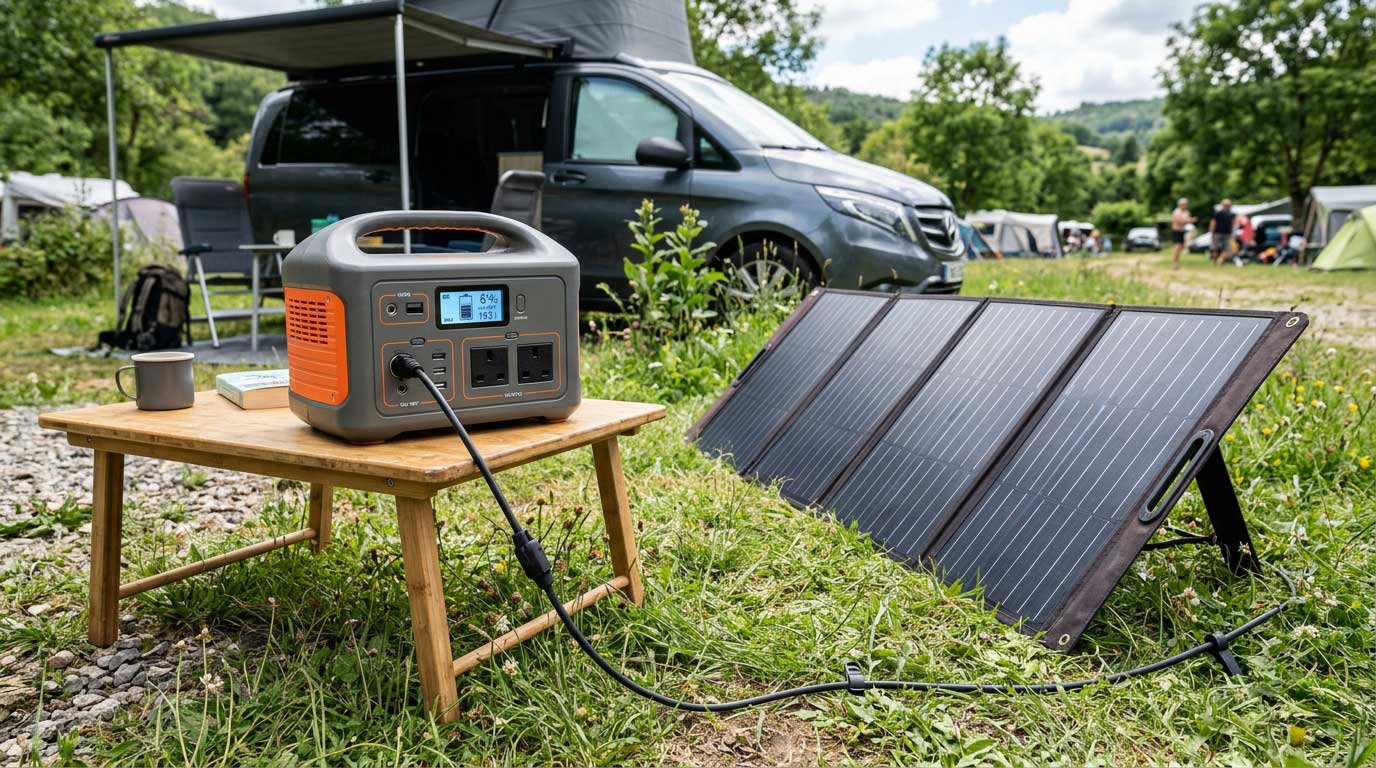
Unlike a permanently mounted rigid solar panel, a folding model can be placed away from the vehicle. This is particularly useful when the campervan is parked in shade but an open, sunny patch of ground is available nearby.
Typical applications include:
- Camping: Charging phones, lights, cameras, and portable power stations.
- RV travel: Supplementing battery charging while parked.
- Van life: Collecting solar energy without permanently occupying roof space.
- Outdoor work: Supplying energy to compatible battery systems for laptops and small equipment.
- Emergency preparedness: Providing an additional daytime charging option when grid power is unavailable.
A folding panel is not automatically waterproof, walkable, or suitable for permanent installation. Its construction, protective materials, connectors, and weather limits depend on the specific model. Always check the manufacturer’s datasheet rather than assuming that all 160W panels share the same features.
How Much Power Does a 160W Folding Solar Panel Generate?
A 160W panel is rated to produce 160 watts under standard test conditions. Outdoor output varies with sunlight intensity, panel temperature, orientation, shading, and the connected charging equipment.
A useful estimate for daily energy is:
Daily energy (Wh) = Rated power (W) × Peak sun hours × System efficiency
For the following examples, system efficiency is assumed to be 75–85%. This is an illustrative planning range, not a verified performance specification for every panel or power station.
| Equivalent peak sun hours | Estimated daily energy |
|---|---|
| 2 hours | 240–272Wh |
| 3 hours | 360–408Wh |
| 4 hours | 480–544Wh |
| 5 hours | 600–680Wh |
| 6 hours | 720–816Wh |
Peak sun hours are not the same as the number of daylight hours. Four peak sun hours represent an equivalent amount of solar energy, not four hours during which the panel necessarily operates at exactly 160W.
For location-specific planning, the National Renewable Energy Laboratory provides the PVWatts Calculator, which estimates photovoltaic energy production using location and system inputs. Its results are a useful reference, although a portable panel’s real output also depends heavily on how and where it is deployed.
What Reduces Actual Solar Output?
A few ordinary campsite conditions can make a significant difference:
- Partial shade: A shadow from a tree branch, awning, or vehicle can reduce output. The impact depends on the panel’s cell and bypass-diode design.
- Poor orientation: A panel lying flat may receive less direct sunlight than one angled toward the sun.
- High cell temperature: Solar module voltage generally decreases as cell temperature rises.
- Cloud cover: Passing clouds can cause rapid changes in available solar irradiance.
- Electrical limitations: A power station may restrict incoming current or voltage, even when the panel could otherwise produce more.
The U.S. Department of Energy’s Solar Photovoltaic System Design Basics explains how modules, inverters, and other system components work together. For portable systems, the same principle applies: the panel is only one part of the charging chain.
What Can a 160W Folding Solar Panel Run?
A 160W folding solar panel is most useful when it charges a compatible portable power station or battery system. It does not supply a constant 160W to every device throughout the day. The energy available depends on sunlight and the limits of the connected equipment.
For a quick comparison, consider these illustrative daily energy needs:
| Device | Example use | Estimated energy |
|---|---|---|
| LED camping lights | 8W × 4 hours | 32Wh |
| Two smartphones | 12Wh × 2 | 24Wh |
| Laptop | 60W × 2 hours | 120Wh |
| Portable Wi-Fi router | 10W × 5 hours | 50Wh |
| Small accessories | Estimated allowance | 30Wh |
| Total | 256Wh |
This example adds up to approximately 256Wh per day. If the panel harvests 480Wh in a day, the energy budget may be sufficient for these loads, subject to battery and conversion losses. It does not mean every device can be powered directly from the panel at any time.
A portable refrigerator needs more careful planning. Its energy use changes with ambient temperature, ventilation, thermostat settings, how often the lid is opened, and the amount of food inside. A refrigerator advertised with a particular rated wattage may cycle on and off rather than draw that power continuously. Use its measured daily consumption, if available, when sizing the system.
Can a 160W Folding Solar Panel Charge a 12V Battery?
Yes, when the panel and charging equipment are electrically compatible. A panel’s “160W” rating does not mean it should be connected directly to any 12V battery.
Check these specifications first:
- Vmp: The panel’s voltage at maximum power.
- Voc: Its open-circuit voltage, which must remain within the controller’s permitted PV input range.
- Imp and Isc: The panel’s operating and short-circuit current.
- Battery chemistry: Lead-acid, lithium iron phosphate (LiFePO4), and other battery types have different charging requirements.
- Controller settings: The charging profile must match the battery manufacturer’s instructions.
A suitable solar charge controller regulates the power supplied to the battery. Some portable power stations have an integrated solar charge controller, but their maximum input voltage, current, and wattage still need to be checked.
Do not choose an adapter based on the connector shape alone. Confirm polarity and electrical compatibility before connecting the system.
How to Set Up a 160W Folding Solar Panel
A good outdoor setup should be stable, unshaded, and easy to monitor. The panel does not need to be placed directly beside the campervan if a better sunny position is available and the cable can safely reach the charging equipment.
Step 1 — Choose a Sunny, Stable Position
Look for a firm surface away from vehicle movement, foot traffic, and standing water. Check the panel’s full surface for shadows. A narrow branch shadow can matter even when most of the campsite looks bright.
If the ground is uneven, use the manufacturer’s support system or place the panel on a stable surface recommended for the product. Avoid improvised supports that could twist the panel or put pressure on its hinges.
Step 2 — Adjust the Panel Angle
Point the active surface toward the sun. In many Northern Hemisphere locations, a southerly direction is a useful starting point, but the best orientation changes with season, location, and time of day.
A simple field check is often more useful than trying to calculate a perfect angle at the campsite: compare the power station’s solar input reading after moving the panel to a clearer position or adjusting its tilt. Keep the panel secure, especially when wind picks up.
Step 3 — Check the Charging Input
Before connecting, compare the panel’s voltage and current specifications with the power station or charge controller’s input limits. Use the manufacturer’s specified cable and adapter.
When the system is connected, look at the solar input display if one is available. The reading may rise and fall as clouds pass or the sun moves. A low reading does not automatically mean the panel is defective; shade, connector issues, input limits, or battery charging restrictions may be responsible.
Step 4 — Monitor and Reposition
If the charging session lasts several hours, check the panel periodically. A position that was sunny in the morning may become shaded by the vehicle or nearby trees later in the day.
Avoid moving a connected panel by pulling its cable. Follow the equipment instructions when disconnecting or repositioning it.
Step 5 — Fold and Store It Carefully
When charging is complete, disconnect the system as directed by the manufacturer. Keep the panel’s connectors clean and dry, fold only along its intended hinges or sections, and store it in a protective case if supplied.
Do not force the panel flat if its structure is caught or misaligned. Repeated stress on the folding sections, cable exits, and junction areas can shorten product life.
How to Choose the Right 160W Folding Solar Panel
Two products with the same 160W rating may have different folded sizes, weights, connectors, protective materials, and electrical characteristics. A product that is easy to carry may be more useful to a weekend camper than a larger, heavier design with similar rated power.
Use this checklist when comparing models:
| Specification | What to check | Why it matters |
|---|---|---|
| Rated power | 160W under stated test conditions | Establishes the nominal output |
| Vmp and Voc | Actual voltage values | Confirms controller compatibility |
| Imp and Isc | Operating and short-circuit current | Helps verify input limits |
| Folded dimensions | Packed length, width, and thickness | Determines storage convenience |
| Weight | Complete product weight | Affects portability |
| Connectors | Type, polarity, and included adapters | Avoids connection problems |
| Weather protection | Documented protection rating and limitations | Clarifies outdoor-use conditions |
| Warranty | Coverage period and exclusions | Sets expectations for after-sales support |
Folding Solar Panel vs. Flexible Solar Panel
These product types are not interchangeable.
- Folding solar panel: Designed to fold at designated sections or hinges for storage and transport.
- Flexible solar panel: Designed to bend within a specified limit, often for installation on curved surfaces.
- Rigid solar panel: Built with a fixed structure and typically used for permanent mounting.
A folding panel should not be bent beyond its intended folding design. A flexible module should not be folded repeatedly unless the manufacturer explicitly states that it is designed for that use.
What B2B Buyers Should Confirm
For distributors, outdoor brands, and system integrators, the purchase decision involves more than a retail wattage label. Request a current datasheet and confirm:
- Electrical parameters and production tolerances.
- Cell technology and module construction.
- Cable length, connector type, and polarity.
- Folded and unfolded dimensions, including packed weight.
- Product testing and quality documentation.
- Warranty terms and packaging requirements.
- Available customization and minimum order quantities.
Bright Solar works with buyers evaluating solar panel solutions for different applications. For OEM or bulk projects, confirm the final product configuration and documentation with the supplier before placing an order. Features such as stands, cables, controllers, and weather protection should be treated as model-specific rather than assumed to be included.
A Practical Energy Budget for a Weekend RV Trip
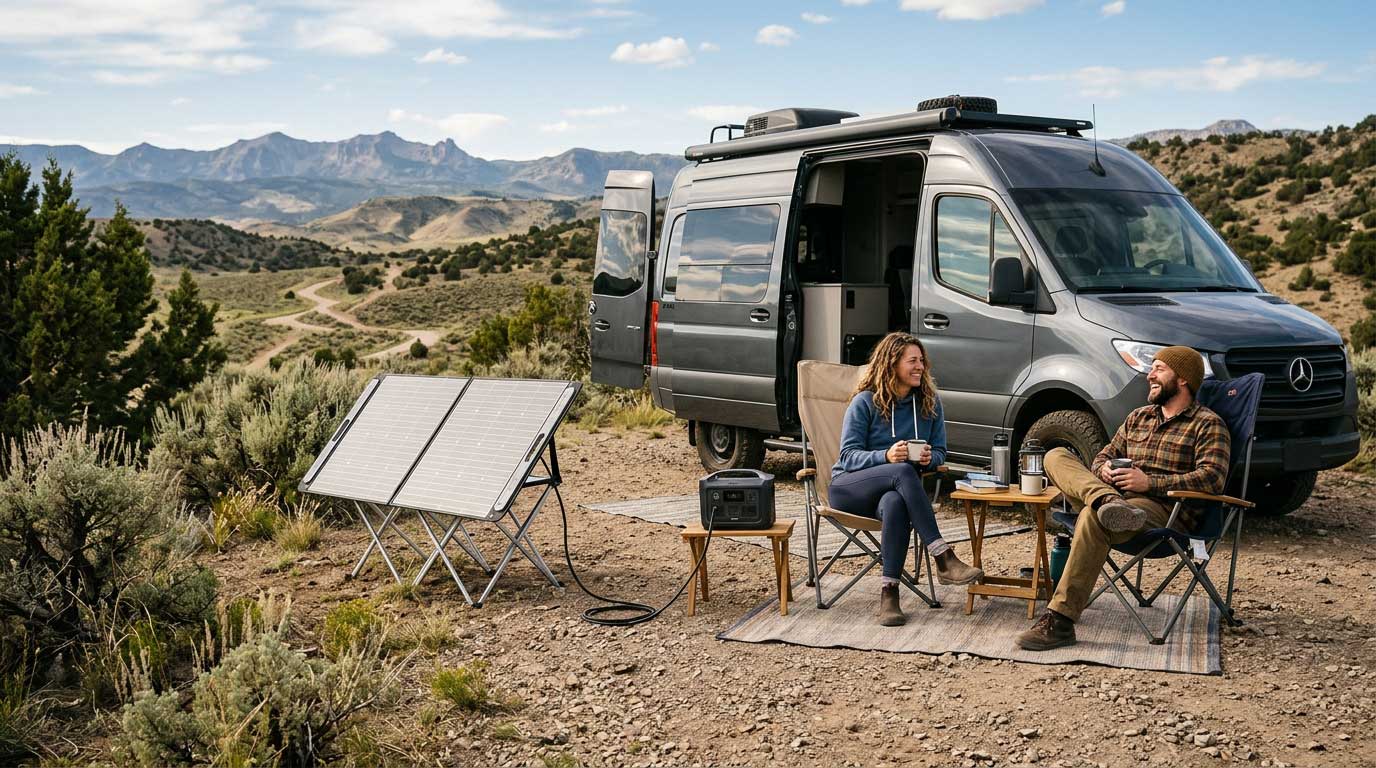
Imagine a couple spending two days at a campsite in the western United States. They use a portable power station for lighting, phones, a laptop, and a small router. They bring a 160W folding solar panel and want to avoid running the vehicle engine just to recharge their electronics.
Their estimated daily consumption looks like this:
| Equipment | Daily energy estimate |
|---|---|
| Two phones | 24Wh |
| LED lights | 32Wh |
| Laptop | 120Wh |
| Wi-Fi router | 50Wh |
| Small accessories | 30Wh |
| Total daily use | 256Wh |
For planning purposes, assume four equivalent peak sun hours and 75% system efficiency:
160W × 4 hours × 0.75 = 480Wh
The estimated solar harvest is 480Wh, compared with 256Wh of daily use. On paper, that leaves approximately 224Wh before accounting for any additional loads or battery-related limitations.
Now consider a cloudy day with only two equivalent peak sun hours:
160W × 2 hours × 0.75 = 240Wh
The estimated harvest falls below the same 256Wh daily demand. The difference is small in this example, but it demonstrates why a battery reserve matters. A power station charged before departure can help cover periods when sunlight is weak.
These figures are an illustrative energy budget, not a measured campsite result. Actual production depends on location, weather, panel orientation, shading, and equipment. The NREL PVWatts Calculator is a useful starting point for understanding how solar resources vary by location.
FAQ About a 160W Folding Solar Panel
How much electricity does a 160W folding solar panel produce?
A 160W folding solar panel can generate approximately 480–544Wh in a day with four equivalent peak sun hours, assuming an illustrative 75–85% system efficiency. Actual production varies with sunlight, temperature, shading, orientation, and charging equipment.
Is a 160W folding solar panel good for camping?
Yes. It can be a useful option for camping when the main loads are phones, LED lights, cameras, laptops, and compatible portable power stations. If you plan to run a refrigerator or other high-energy equipment, calculate its daily consumption before choosing the panel size.
Can a 160W folding solar panel charge a portable power station?
Yes, provided the power station accepts the panel’s voltage and current and the connectors are compatible. Check the power station’s maximum solar input, permitted voltage range, and connection instructions before use.
Can I use a 160W folding solar panel with a 12V battery?
Yes, with compatible charging equipment. Check the panel’s Vmp, Voc, Imp, and Isc against the charge controller’s input limits, and select a charging profile suitable for the battery chemistry. Do not connect a panel directly to a battery unless the equipment manufacturer specifically permits that configuration.
Does a folding solar panel work on cloudy days?
It can still generate electricity in cloudy conditions, but output is generally lower than under strong direct sunlight. The amount depends on cloud density, available daylight, panel technology, and the angle of the panel. Plan to use stored battery energy when solar production falls.
Is a 160W folding solar panel better than a 200W model?
A 200W panel has a higher rated output under the same test conditions, but it may be larger or heavier. A 160W model can be a sensible choice when portability and moderate energy demand matter more than maximum output. Compare packed dimensions, weight, electrical compatibility, and expected daily consumption.
What should I check before buying a 160W folding solar panel?
Check the rated power, Vmp, Voc, Imp, Isc, folded dimensions, weight, connector type, weather limitations, warranty, and included accessories. If you’re buying for an RV or power station, confirm electrical compatibility before ordering.
Conclusion
A 160w folding solar panel is a practical portable charging option for campers, RV owners, and people who need supplemental electricity away from the grid. Its performance depends on real sunlight and the complete charging system—not just its rated wattage.
Before choosing a model, calculate your daily energy use, check battery and power-station compatibility, and consider how the folded panel will fit into your vehicle or storage space. For portable solar product sourcing and project requirements, Bright Solar can help buyers evaluate suitable solar panel solutions.
Related recommendations
-

100 Watt Flexible Solar Panel Kit: Complete Guide
348A 100W flexible solar panel kit combines a 100W flexible panel with compatible charging, wiring, and mounting components for small off-grid systems such as R...
View details -
Solar Panel for Electric Fence: How to Choose the Right System
353Learn how to choose a solar panel for electric fence systems, size the battery and panel correctly, reduce downtime, and keep remote livestock fencing reliable.
View details -
Best semi flexible solar panels: A Complete Guide for RV, Marine and Off-Grid Applications
282Explore the best semi flexible solar panels for RV, marine, and off-grid systems with expert advice, performance data, installation insights, and Bright Solar experience.
View details -
ETFE Flexible Solar Panels: Benefits, Uses and Buying Guide
260ETFE flexible solar panels use ETFE film as a protective front layer and may suit RV, marine, and off-grid applications. Selection should be based on the com...
View details