Do Solar Panels Add Value to Your House?
Yes, do solar panels add value to your house? In many cases, a home solar system can increase a property’s appeal and resale value, particularly when it is owned, operational, and supported by clear energy-production records. However, the effect is not guaranteed: local housing markets, electricity prices, system costs, ownership terms, and buyer preferences all matter.
What the Research Says About Solar and Home Value
One of the most frequently cited U.S. studies comes from Lawrence Berkeley National Laboratory (Berkeley Lab). Its 2015 analysis examined 22,822 home sales across eight states from 2002 to 2013, including 3,951 homes with solar. Researchers found that homeowner-owned solar systems were associated with an average premium of approximately $4 per watt, or about $15,000 for a typical 3.6 kW system in that historical sample.
That figure is useful evidence, but it should not be presented as a guaranteed increase for a home being sold today. The study’s transaction period is historical, and solar costs, electricity rates, financing products, and local real-estate markets have changed. A valuation should reflect the system’s remaining useful life and the benefits a buyer can reasonably expect—not simply multiply the original system size by an old average.
A later Berkeley Lab study, published in 2017, found that homes with third-party-owned solar systems—such as leased systems—did not attract a measurable price premium over comparable homes without solar in its analysis. The study examined nearly 20,000 California home sales and 18 paired transactions in San Diego.
Research source: Berkeley Lab’s solar-home price premium research
What Determines Whether Solar Adds Value?
A solar system’s contribution to a home’s value is specific to the property. Buyers and appraisers may consider several factors:
1. Whether the system is owned or leased
An owned system is generally easier to evaluate as part of the property because the homeowner controls the equipment. With a lease or power purchase agreement (PPA), the buyer may need to assume contractual obligations or qualify for a transfer. Make the agreement and transfer requirements available early in the sale process.
2. The system’s age, condition, and documented performance
A newer system with maintenance records and accessible production history may be easier for a buyer to assess than an older system with incomplete documentation. The remaining service life matters; original installation cost alone does not establish current market value.
3. Local electricity prices and compensation rules
Potential bill savings depend on how much electricity the system generates, when that electricity is used, and how the utility credits exported energy. The same system can have different financial value in different locations.
4. Installation quality and roof condition
Buyers may ask about roof age, penetrations, mounting hardware, permits, warranties, and whether the system complicates future roof work. A well-documented installation helps answer these practical questions.
How to Make a Solar Home Easier to Evaluate
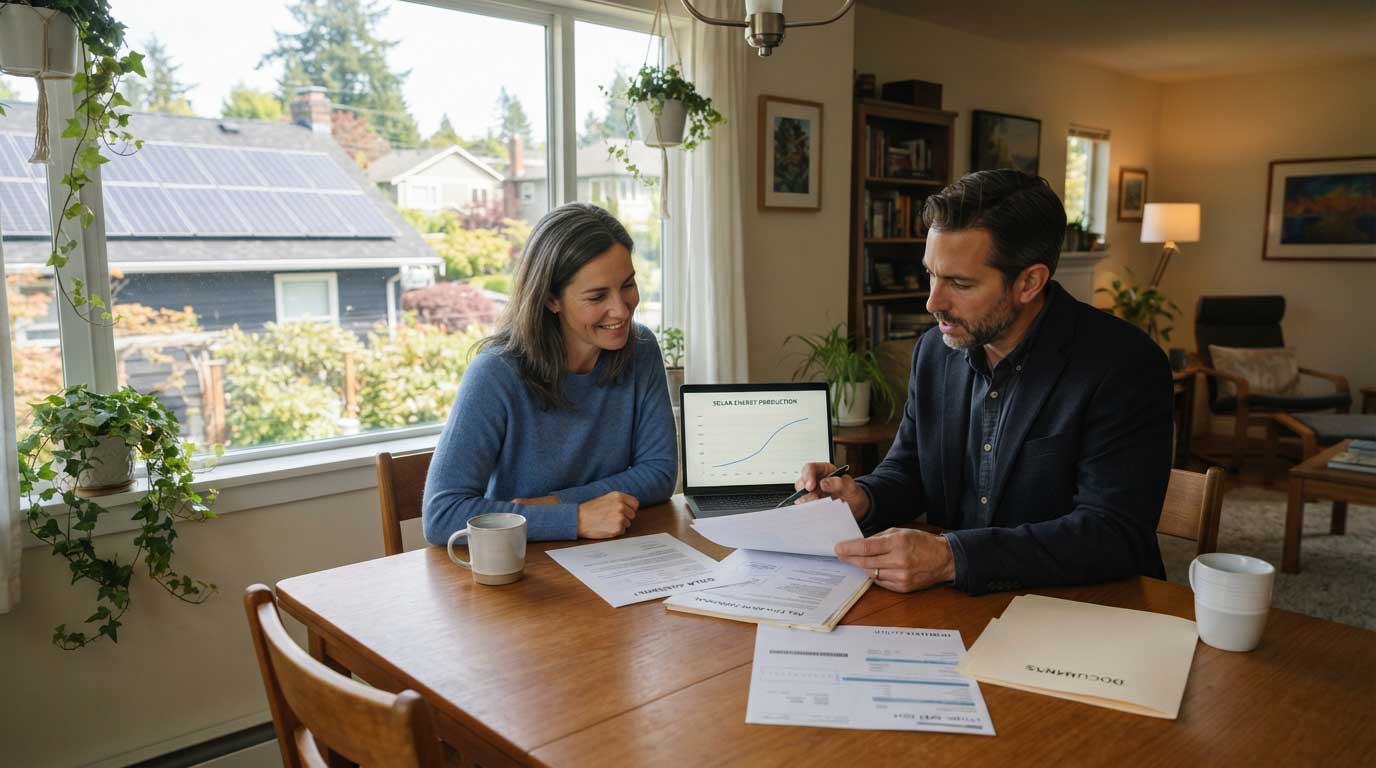
If you are planning to sell a solar-equipped property, prepare a compact document package before listing it. It can help the agent, appraiser, and prospective buyer understand what is installed and what obligations come with it.
| Document or detail | Why it matters |
|---|---|
| System size and installation date | Establishes the system’s basic specifications and age. |
| Ownership or financing agreement | Clarifies whether the system is owned, leased, or covered by a PPA. |
| Recent electricity bills | Helps show the household’s actual energy costs, while allowing for seasonal variation. |
| Solar production records | Provides evidence of system operation over time. |
| Warranty and maintenance records | Helps buyers understand available coverage and service history. |
| Permits and installation documentation | Supports due diligence and may answer questions about compliance and workmanship. |
Avoid promising a particular increase in resale price. Instead, present verifiable details: the system’s capacity, documented production, contract terms, and any relevant utility arrangements.
FAQ About Do Solar Panels Add Value to Your House?
Do solar panels always increase a house’s value?
No. Solar Panels may add value in some markets, but the effect depends on ownership, system condition, energy savings, local demand, and how the property is appraised.
How much value do solar panels add to a house?
There is no universal amount. Berkeley Lab’s historical U.S. research reported an average premium of about $15,000 for a 3.6 kW homeowner-owned system, but that result should not be treated as a current guaranteed valuation.
Do leased solar panels add value to a house?
A lease can make a sale more complicated because the buyer may need to assume or otherwise resolve the contract. Berkeley Lab’s 2017 analysis found no measurable premium for third-party-owned systems in the transactions it studied.
Should I pay off my solar panels before selling?
That depends on the loan terms, payoff amount, sale arrangements, and local market. Review the financing agreement with the lender and your real-estate professional before deciding.
Can solar panels make a house harder to sell?
They can raise questions if ownership, warranties, roof condition, or contract transfers are unclear. Organized records and a clear explanation of the system can help address buyer concerns.
Does a solar system’s age affect its value?
Yes. Buyers and appraisers may consider its condition, remaining expected service life, warranty coverage, and documented performance. An older system should not automatically be valued at its original purchase price.
Conclusion
Do solar panels add value to your house? They can, particularly when the system is homeowner-owned, in good condition, and supported by clear records—but the amount depends on the property and local market. Bright Solar recommends evaluating a solar installation through its documented performance, ownership terms, and practical benefits rather than relying on a fixed resale-value promise.
The prev: Do Solar Panels Charge on Cloudy Days?The next: Do I Need to Clean My Solar Panels?
Related recommendations
-

How to Dispose of Solar Panels?
250Learn how to dispose of solar panels safely, recycle old photovoltaic modules, reduce solar energy waste, and understand solar panel recycling options.
View details -
how do you mount flexible solar panels?
289How do you mount flexible solar panels? Learn proven RV and van installation methods, adhesive tips, airflow strategies, and real-world mounting mistakes to avoid.
View details -
How Do You Install Solar Panels?
142Solar panels are installed by assessing the site, planning the array, mounting the modules, connecting wiring and system equipment, then completing testing, ...
View details -
Can You Put Solar Panels on a Mobile Home?
206Yes. Solar panels can be installed on a mobile home if the structure, mounting method, electrical system, and applicable requirements support the installation.
View details