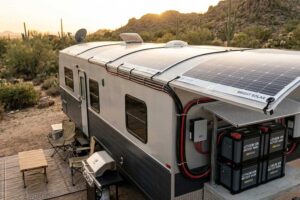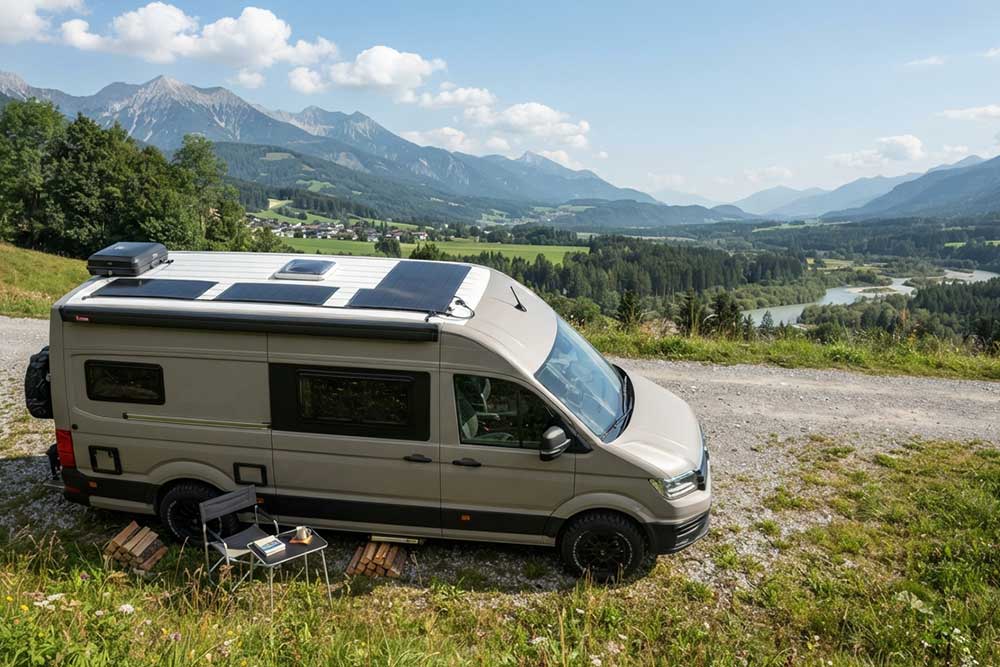
solar flexible panel (Real Field Engineering Guide from Bright Solar)
Direct answer :
A solar flexible panel is a lightweight photovoltaic module designed to bend slightly for curved surfaces like RV roofs and boats. It prioritizes mobility, low weight, and easy installation over maximum peak efficiency. In real use, mounting quality and heat control strongly determine long-term performance.
What a solar flexible panel actually is in real engineering terms
On product sheets, a solar flexible panel looks like a simplified version of rigid solar technology.
In field reality, it behaves differently.
At Bright Solar, we classify flexible panels not as “lighter solar panels,” but as:
surface-integrated energy layers
Once bonded, they become part of the structure—not just equipment mounted on top.
This difference explains why installation quality affects performance more than panel specs.
Core characteristics of solar flexible panels
Before choosing or installing them, it helps to understand their real-world behavior.
| Feature | Flexible Solar Panel | Rigid Solar Panel |
|---|---|---|
| Weight | Very low (2–5 kg per panel) | Higher (18–25 kg per panel) |
| Installation | Adhesive / low-profile mount | Frame + bracket |
| Heat behavior | Higher surface temperature | Better heat dissipation |
| Vibration resistance | Excellent | Moderate |
| Efficiency (lab) | 17–22% typical | 19–24% typical |
| Lifespan (field) | 5–15 years | 20–25 years |
This table reflects what we consistently observe in RV and marine deployments rather than laboratory-only conditions.
Why solar flexible panels behave differently in real environments
Flexible panels are sensitive to thermal and mechanical stress.
Three field realities matter most:
1. Heat accumulation under full surface bonding
Without airflow gaps, heat has no escape path.
2. Continuous micro-vibration (RV / marine use)
Small structural movement accumulates over time.
3. Roof surface curvature stress
Even slight bending changes internal cell pressure distribution.
According to U.S. Department of Energy (Energy.gov), PV performance is strongly influenced by installation environment, including thermal conditions and mechanical mounting structure.
Source: https://www.energy.gov
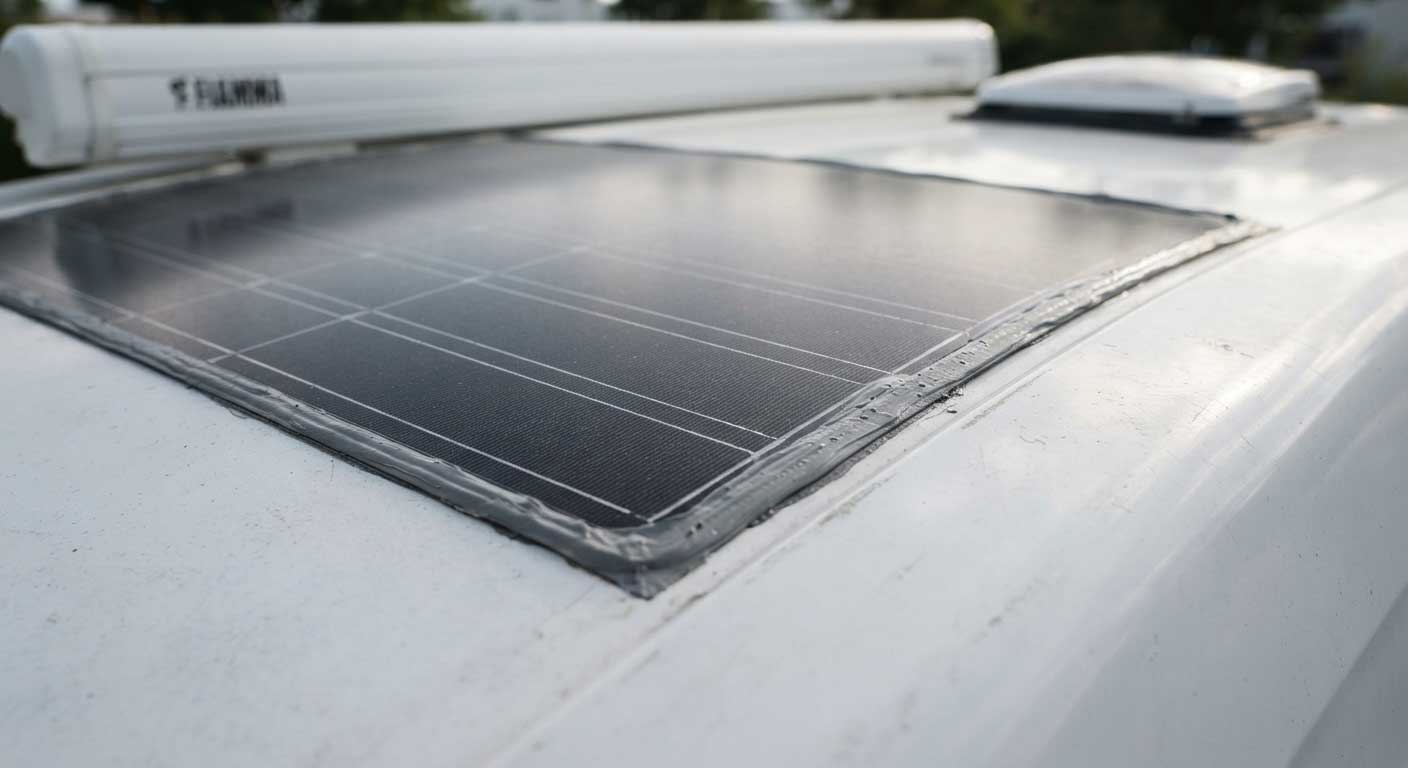
Field case — RV installation performance comparison
A Bright Solar field project compared two RV systems over 4 months:
System A:
- 500W flexible solar array
- full adhesive bonding (no airflow gap)
- desert + coastal travel route
System B:
- same 500W flexible system
- hybrid mounting with 6mm airflow gap
- identical battery and controller setup
Observed results:
| Metric | System A | System B |
|---|---|---|
| Average surface temperature | 64°C | 53°C |
| Efficiency stability | lower | higher |
| Daily output variation | ±18% | ±9% |
| Long-term degradation risk | higher | lower |
Key insight:
airflow control changed performance more than panel model or brand.
Where solar flexible panels perform best (real-world use cases)
RV and camper vans
- curved roofs
- vibration exposure
- weight limitations
marine systems
- saltwater environment
- irregular mounting surfaces
portable off-grid setups
- temporary installations
- lightweight transport requirements

Engineering insight — what most users misunderstand
The biggest misconception is this:
“Flexible means weaker.”
In field engineering, that is not accurate.
The real difference is:
- not strength
- but thermal behavior + mounting dependency
A poorly installed flexible panel can underperform a rigid one.
A well-installed flexible system can outperform expectations in mobile environments.
Field observation from Bright Solar projects
Across multiple installations, one pattern repeats:
- electrical failure rate is low
- mechanical and thermal stress is the main risk
This includes:
- adhesive degradation
- heat buildup under sealed surfaces
- edge lifting from expansion cycles
That’s why mounting design is treated as part of the electrical system, not just mechanical work.

FAQ — solar flexible panel (Real field answers from Bright Solar)
These answers come from actual RV, marine, and off-grid installations—not lab assumptions. Most issues appear only after months of real exposure to heat, vibration, and travel cycles.
Are solar flexible panels worth it?
Yes, especially for RVs, boats, and curved roofs.
In real field use, they are worth it when:
- weight is a constraint
- roof cannot support rigid frames
- vibration resistance is required
However, they require proper thermal and mounting design to perform long-term.
How long do solar flexible panels last?
Typical lifespan depends heavily on installation quality:
- well-installed systems: 5–15 years
- poor thermal design systems: 3–7 years
Field inspections show that heat buildup and adhesive degradation are the main factors that shorten lifespan—not electrical failure.
Do flexible solar panels work as well as rigid ones?
Not exactly.
Based on field comparisons:
- rigid panels → slightly higher peak efficiency
- flexible panels → better adaptability and mechanical stability
In real RV environments, performance difference is often smaller than installation quality differences.Visit the product page: Flexible Solar Panel
Can solar flexible panels overheat?
Yes, and this is one of the most important design risks.
Without airflow:
- surface temperature can exceed 60°C in hot climates
- efficiency drops by 10–25%
- long-term adhesive stress increases
This is why hybrid mounting (with small ventilation gaps) is often used in professional systems.
Can solar flexible panels be walked on?
Generally no.
Even if some models are labeled “semi-walkable,” repeated pressure causes:
- micro-cell damage
- internal delamination
- performance degradation over time
In field practice, stepping on them is strongly avoided.
What is the biggest problem with solar flexible panels?
The biggest issue is not electrical performance—it is thermal management under full-surface mounting.
When panels are fully sealed:
- heat accumulates
- adhesive weakens over time
- output gradually decreases
Most real-world failures are linked to installation design, not product defects.
Where should solar flexible panels NOT be used?
They are not ideal for:
- high-temperature sealed rooftops without ventilation
- heavy industrial vibration with no structural damping
- systems requiring maximum long-term efficiency (20–25 years stable output)
In those cases, rigid framed panels perform better over time.
Field insight — what actually defines success with solar flexible panels
After multiple Bright Solar field deployments, one consistent pattern emerges:
The success of a solar flexible panel system is defined more by thermal design and mounting method than by panel specification.
Systems that last longer typically share:
- controlled airflow beneath panels
- high-quality adhesive application
- proper edge sealing against moisture
- realistic load matching with battery storage
In contrast, systems that fail early often look perfect on paper but ignore environmental stress factors.
Related recommendations
-

12 Volt Solar Panels for Reliable Off-Grid and Mobile Power
218Discover how 12 volt solar panels power RVs, boats, cabins, and off-grid systems. Learn sizing, performance, installation tips, and expert insights from Bright Solar.
View details -
Most Powerful Solar Panel: How to Choose the Highest Output Solar Solution
225Discover the most powerful solar panel options for maximum energy output. Learn efficiency ratings, real-world performance, and how Bright Solar solutions support RV, marine, and off-grid applications.
View details -
Flexible 12 Volt Solar Panels: A Practical Guide to RV, Marine and Off-Grid Power
194Flexible 12 volt solar panels suit selected RV, marine, and off-grid systems, but compatibility depends on actual voltage, power, mounting limits, controller...
View details -
300 W Solar Panel Performance Guide for RV, Battery and Off-Grid Systems
333Discover how a 300 w solar panel performs for RVs, boats, cabins, batteries, and off-grid systems. Learn output, applications, sizing, and real-world performance.
View details