Solar Panel in Series: How to Wire Panels for Higher Voltage
A solar panel in series connection increases the total voltage while keeping the current approximately the same. It is useful when an MPPT charge controller needs higher PV voltage, but the complete string must stay within the controller’s voltage limits, including cold-weather Voc.
That basic rule sounds simple. The mistakes usually happen after the panels are physically connected.
A string that looks perfectly reasonable on a warm afternoon can produce a substantially higher open-circuit voltage on a cold morning. A controller that accepts the nominal battery system voltage may still reject the PV input. And two panels with the same wattage can behave differently if their electrical specifications do not match.
At Bright Solar, we look at the electrical characteristics of the complete PV string rather than choosing a series configuration from panel wattage alone. That distinction matters on RVs, boats, remote cabins and off-grid systems where there is little room for a wiring mistake.
U.S. Department of Energy — Solar Photovoltaic Technology Basics
What Happens When Solar Panels Are Connected in Series?
When solar modules are wired in series, the voltages add together while the current remains approximately at the level of one panel.
For example, consider two identical modules with these simplified electrical values:
| Configuration | Voltage | Current | Power |
|---|---|---|---|
| One panel | 20 V | 10 A | 200 W |
| Two panels in series | 40 V | 10 A | 400 W |
| Two panels in parallel | 20 V | 20 A | 400 W |
The important point is that connecting panels in series does not magically make each panel produce more watts.
The array still has 400 W under the same test conditions. What changes is how that electrical power is presented to the charge controller or inverter.
The U.S. Department of Energy describes the same basic architecture: PV modules can be connected in series and parallel to create arrays, with series connections increasing string voltage and parallel connections increasing current.
Why higher voltage can be useful
Higher PV voltage can be particularly useful when the distance between the solar array and charge controller becomes significant.
Suppose a system needs roughly 400 W of solar input.
At 20 V and 20 A, the current is relatively high.
At 40 V and 10 A, the same nominal power is carried at half the current.
That matters because resistive cable losses are related to current. In practical installations, reducing current can make voltage-drop management easier and may allow a more efficient cable layout.
This is one reason series wiring is common with MPPT-based systems.
How to Connect Solar Panels in Series
The physical wiring is straightforward, but polarity needs to be checked before making the final connection.
For two conventional panels:
- Identify the positive (+) and negative (–) connectors on both modules.
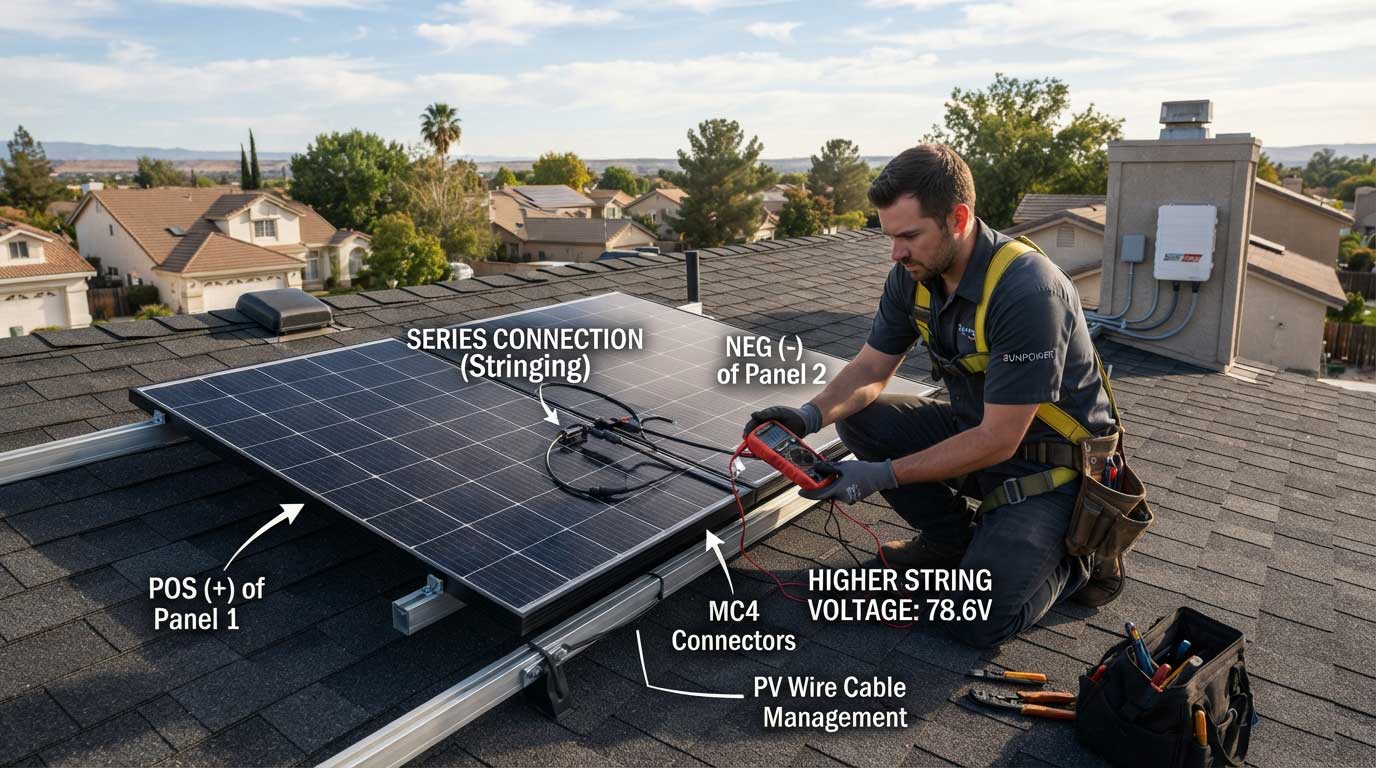
- Connect the positive terminal of Panel 1 to the negative terminal of Panel 2.
- The unused negative terminal of Panel 1 becomes the string negative.
- The unused positive terminal of Panel 2 becomes the string positive.
- Measure the string voltage before connecting it to the charge controller.
- Confirm that the measured and calculated voltage are compatible with the controller.
The electrical path looks like this:
Panel 1 (+) → Panel 2 (–)
The two remaining terminals become the PV output.
For three panels, the same pattern continues:
Panel 1 (+) → Panel 2 (–)
Panel 2 (+) → Panel 3 (–)
The remaining positive and negative terminals feed the controller.
A practical check before energizing the controller
Do not rely only on the label saying “12 V panel” or “24 V panel.”
Read the actual specification sheet.
Look for:
- Voc — open-circuit voltage
- Vmp — voltage at maximum power
- Isc — short-circuit current
- Imp — current at maximum power
- Maximum system voltage
- Temperature coefficient
- Maximum recommended series configuration
This is where professional PV design differs from simply joining connectors together.
Victron’s technical guidance specifically warns that the open-circuit voltage of the complete array must remain below the MPPT’s maximum PV voltage, and that temperature must be considered because Voc rises at lower temperatures.
Solar Panel Series Voltage: The Number That Actually Matters
A common mistake is calculating the string using Vmp alone.
For normal operating performance, Vmp is important.
For maximum voltage safety, Voc is the number that deserves attention.
Imagine a panel with:
- Vmp: 18.5 V
- Voc: 22.5 V
- Imp: 10.8 A
- Isc: 11.4 A
Three panels in series would have approximately:
Vmp = 18.5 × 3 = 55.5 V
and
Voc = 22.5 × 3 = 67.5 V
The controller must be able to tolerate the 67.5 V Voc, not merely the 55.5 V operating voltage.
And even that is not the final calculation if the system operates in a cold climate.
Cold weather changes the calculation
Solar modules generally produce a higher voltage at lower temperatures.
This is why a series string that appears comfortably below a controller’s maximum voltage at 25°C should not automatically be considered safe.
For example, Victron explicitly states that when calculating the number of panels in series, designers must account for both Voc and the temperature coefficient; below 25°C, Voc will be higher.
This is not a minor detail for installations in northern U.S. states, Canada or high-altitude locations.
A designer working on an Arizona RV roof and another designing a cabin in Minnesota may start with the same panel specifications but arrive at different maximum series counts.
Series Solar Panels and MPPT Charge Controllers
A series-connected solar array is often paired with an MPPT charge controller because the controller can accept a higher PV voltage and convert it to the appropriate battery-charging voltage.
The battery does not need to have the same voltage as the PV array.
For example:
Solar array: approximately 60 V
Charge controller: MPPT
Battery bank: 12 V
The controller converts the higher PV voltage into a suitable charging voltage while managing the available power.
This is fundamentally different from connecting a solar panel directly to a battery.
The charge controller is part of the electrical system, not an optional accessory.
Victron’s installation documentation gives an example in which a 12 V battery system uses a 75 V-rated MPPT controller, with the PV array designed so its voltage remains within the controller’s limits.
Why MPPT matters with series wiring
An MPPT controller continuously operates the PV array around its maximum-power point rather than simply forcing the panel voltage to match battery voltage.
That becomes especially useful when the PV operating voltage is substantially above battery voltage.
The controller still has limits, though.
You need to check:
- Maximum PV Voc
- Maximum PV input current
- Recommended PV power
- Minimum PV voltage
- Battery voltage compatibility
- Cold-weather string voltage
- Controller operating temperature
Never size a series string from the controller’s marketing wattage alone.
Series vs Parallel Solar Panels
The choice becomes much easier once the electrical priorities are clear.
| Factor | Panels in Series | Panels in Parallel |
|---|---|---|
| Voltage | Increases | Stays approximately the same |
| Current | Stays approximately the same | Increases |
| Total power | Adds | Adds |
| Cable current | Lower | Higher |
| PV voltage | Higher | Lower |
| Typical controller | MPPT preferred | MPPT or suitable PWM |
| Long cable runs | Often advantageous | May require heavier cable |
| Shading behavior | More sensitive to string mismatch | Can offer greater flexibility |
The U.S. Department of Energy gives the same fundamental distinction: series wiring increases voltage, while parallel wiring increases current.
Victron’s wiring documentation also demonstrates that two 120 W modules can form a 240 W array in either configuration, but the series version produces approximately 24 V at 10 A while the parallel version produces approximately 12 V at 20 A.
That is a useful real-world comparison because it shows something installers often explain poorly:
Series and parallel wiring can deliver the same nominal power while creating very different electrical conditions.
What Happens If One Panel Is Shaded?
Shading deserves more attention than the basic “series increases voltage” rule.
In a series string, the same current flows through each module. If one panel is heavily shaded and its ability to produce current drops, the string can be affected.
This is particularly relevant for:
- RV roof accessories
- Satellite dishes
- Roof vents
- Boat masts
- Chimneys
- Tree shadows
- Uneven rooftop layouts
A small shadow moving across one module can create a surprisingly noticeable change in string behavior.
This does not mean series wiring is automatically bad.
It means the array should be designed around the actual roof.
For an RV, I would rather see three panels arranged with predictable sunlight exposure than four panels squeezed around vents and air-conditioning equipment simply because the nameplate wattage looks better.
That is one of the practical differences between a theoretical array and one that spends its life outdoors.
How Many Solar Panels Can You Connect in Series?
There is no universal number.
The maximum series count depends primarily on the panel’s Voc, temperature coefficient, minimum expected temperature, and the maximum PV voltage accepted by the charge controller or inverter.
A simple starting calculation is:
Maximum theoretical panel count ≈ Controller maximum PV voltage ÷ Panel Voc
But this is only a starting point.
You still need to apply the temperature correction.
Example: three-panel string
Assume:
- Panel Voc = 22 V
- Controller maximum PV voltage = 75 V
- Three-panel Voc = 66 V
At first glance, three panels appear acceptable.
However, if the site can experience significantly colder temperatures, the actual maximum string Voc can rise above the value calculated at standard test conditions.
That is why professional sizing uses the panel’s temperature coefficient and the site’s minimum design temperature.
Victron’s documentation provides a practical example: a panel described as a “12 V” module may have a Voc around 22 V, allowing up to three such modules on a 75 V MPPT under the stated conditions—but it still emphasizes temperature when determining series count.
The phrase “12 V panel” therefore does not mean the panel outputs exactly 12 V.
It is a nominal system classification.
That distinction prevents a lot of bad wiring decisions.
Series String Design: A Field Example
Consider a small off-grid cabin using four 200 W solar modules.
Each module has approximately:
- Vmp: 20.5 V
- Voc: 24.5 V
- Imp: 9.8 A
The owner uses a 24 V battery bank and an MPPT controller.
One possible configuration is:
2 panels in series × 2 parallel strings
Each series string provides approximately:
- Vmp: 41 V
- Voc: 49 V
- Current: 9.8 A
- Power: 400 W
Two strings in parallel then provide approximately:
- Array power: 800 W
- Operating voltage: 41 V
- Current: 19.6 A
This arrangement raises PV voltage without pushing array current unnecessarily high.
It is also easier to route than four separate low-voltage parallel branches.
The exact configuration still has to be checked against the controller’s specifications, cable size, fusing requirements and environmental conditions.
Common Mistakes When Wiring Solar Panels in Series
1. Using “12 V” as the actual panel voltage
A nominal 12 V module can have a Vmp around the high teens and a Voc around the low twenties.
Always use the electrical datasheet.
2. Ignoring cold-weather Voc
This is probably the most important mistake in series-string sizing.
A controller’s maximum PV voltage is a hard electrical limit, not a target.
3. Mixing very different panels
Series strings work best when modules have compatible electrical characteristics.
Mixing panels with substantially different current characteristics can reduce the usefulness of the string.
4. Choosing the controller from battery voltage alone
A “24 V MPPT controller” does not automatically tell you what PV voltage it can accept.
Check the PV input specification separately.
5. Assuming more series panels always means more energy
More panels mean more available generation capacity.
Series wiring changes voltage and current characteristics; it does not remove shading, temperature, orientation or irradiance limitations.
The DOE notes that PV output depends on electrical characteristics and environmental conditions, with temperature having a significant effect on module voltage.
How to Test a Solar Panel in Series Before Connecting the Controller
The safest time to discover a wiring mistake is before the PV string reaches the charge controller or inverter.
For a small series string, I recommend checking the installation in this order:
- Verify every panel’s polarity.
- Confirm the module specifications from the datasheet.
- Connect the panels positive-to-negative.
- Leave the final PV output disconnected from the controller.
- Measure the string’s open-circuit voltage with a properly rated multimeter.
- Compare the measured value with the expected string Voc.
- Confirm the result is below the controller or inverter’s maximum PV voltage.
- Only then make the final PV connection.
A field measurement will not necessarily equal the datasheet value. Irradiance, temperature and the measuring conditions all affect the result.
The important thing is not whether the number is exactly what you calculated. It is whether the result makes electrical sense and remains safely inside the equipment’s operating limits.
The National Association of Boards of Certified Energy Practitioners (NABCEP) describes a PV string as modules connected negative-to-positive, with series voltage equal to the sum of the individual module voltages while current remains approximately the same for similar modules.
What I check before closing the connectors
A quick field checklist:
| Check | What to confirm |
|---|---|
| Panel polarity | Positive and negative identified correctly |
| Voc | String value calculated from module specifications |
| Vmp | Appropriate operating voltage for controller |
| Isc | Controller and protection equipment compatibility |
| Temperature | Cold-weather Voc considered |
| Panel matching | Similar electrical characteristics |
| Cable connectors | Correct type, polarity and secure connection |
| Controller | PV voltage within rated range |
This takes minutes.
Replacing a damaged controller does not.
Why Panel Matching Matters in a Series String
One of the less obvious problems with a solar panel in series configuration is mismatched current.
Imagine two modules:
- Panel A: 10 A at maximum power
- Panel B: 8 A at maximum power
Their voltages can still add when connected in series, but the string’s usable current is constrained by the weaker-current module.
This is why combining random panels from different manufacturers is rarely a good design choice simply because their wattage labels look similar.
NABCEP’s PV installer resource guide specifically notes that series-connected modules with dissimilar current ratings can cause power loss, with the lower-current device limiting the series circuit.
The same principle appears in educational PV testing from Northern Illinois University, which explains that current in a series-connected group is limited by the lowest-performing cell or module.
A practical example
Suppose a system uses:
- 400 W Panel A
- 400 W Panel B
- 400 W Panel C
At first glance, they match.
But imagine their actual operating specifications are:
| Panel | Vmp | Imp |
|---|---|---|
| A | 31.0 V | 12.9 A |
| B | 30.8 V | 12.8 A |
| C | 31.1 V | 12.9 A |
This is a sensible string.
Now replace Panel B with a 400 W module rated at 36 V and 11.1 A.
The wattage still says “400 W.”
The string does not suddenly become a 1,200 W perfectly matched system.
Electrical matching matters more than the large number printed on the front of the specification sheet.
When a Series Connection Is Better for Long Cable Runs
One of the strongest practical reasons to use series wiring is reducing PV-side current.
Consider a 600 W array.
At approximately 20 V:
600 W ÷ 20 V = 30 A
At approximately 60 V:
600 W ÷ 60 V = 10 A
The power is similar. The current is not.
Cable resistance creates voltage drop and heat, and the effect becomes more significant as current rises. That is why higher-voltage PV strings are often attractive when the panels and controller are separated by a meaningful distance.
This does not mean “higher voltage is always better.”
It means the PV voltage should be designed around the equipment, cable run, environmental conditions and electrical code.
The DOE’s solar procurement guidance describes the same system-design principle: PV modules are connected in series to increase string voltage, while parallel strings increase array current.
For an RV, the cable run may be only a few feet.
For a detached cabin, water-pumping system or ground-mounted array, it can be considerably longer.
That changes the design conversation.
Solar Panel in Series for RV and Off-Grid Systems
Series wiring is particularly useful in small off-grid systems when the solar array needs to operate at a higher voltage than the battery bank.
A common arrangement might look like:
2 × 200 W panels → series → MPPT controller → 12 V battery
If each panel has an operating voltage around 20 V, the PV operating voltage is roughly 40 V.
The battery may still be a nominal 12 V system.
The MPPT controller sits between them.
This arrangement can work well because the controller is designed to convert the PV input into the appropriate charging voltage.
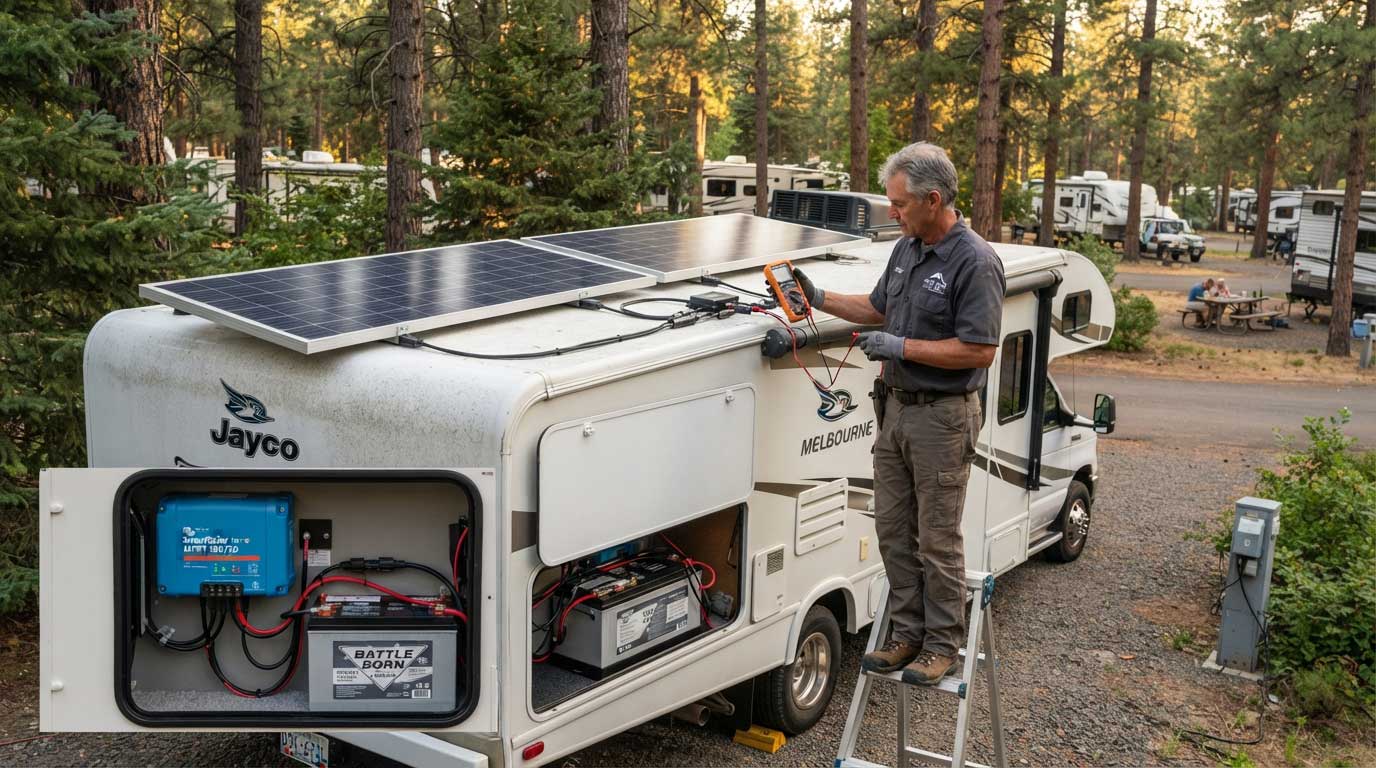
For an RV, however, roof layout can complicate the decision.
A roof vent may shade one panel for part of the afternoon. An air conditioner may cast a sharp shadow across a section of the array. A roof rack can create narrow bands of shade that move across the modules.
That is where I would stop looking at the system only as a voltage calculation.
Look at the roof.
Take a photo around 9 a.m., noon and 3 p.m. on a clear day. Note where the shadows fall. Then choose the string arrangement.
A theoretically efficient series configuration can perform worse than a slightly less elegant arrangement if one module spends hours under partial shade.
Can You Put Solar Panels in Series With Different Wattages?
Technically, different modules can be connected in series, but that does not make it a good design choice.
The important electrical characteristics are not simply the wattage printed on the label.
Compare:
- Voc
- Vmp
- Isc
- Imp
- Temperature coefficients
- Module technology
- Manufacturer specifications
A 300 W panel and a 400 W panel may have completely different current characteristics.
When placed in series, the lower-current module can restrict the string.
NABCEP’s installer guidance specifically warns against using dissimilar PV devices in series because current mismatch can cause power loss.
What about different voltages?
Different voltage modules can technically add their voltages in series.
For example:
18 V + 20 V + 21 V = 59 V
But that does not mean the three panels will operate at their individual maximum-power points simultaneously.
For a professionally designed system, matching modules is the cleaner approach.
If replacement modules are needed later, I would check the complete electrical specifications rather than buying a panel simply because it has the same wattage.
Series-Parallel Solar Panel Configuration
Once an array becomes larger, the most useful configuration is often neither purely series nor purely parallel.
It is series-parallel.
For example:
2S2P
means:
- 2 panels connected in series per string
- 2 identical strings connected in parallel
Suppose each panel is rated:
- 200 W
- 20 V Vmp
- 10 A Imp
One series string becomes:
40 V × 10 A = 400 W
Two strings in parallel become:
40 V × 20 A = 800 W
The result is an 800 W array with approximately 40 V operating voltage and 20 A current under the simplified conditions above.
This structure is useful when the controller requires a higher PV voltage but the array also needs more current.
The Florida Solar Energy Center gives the same basic concept using series strings connected in parallel to raise both voltage and current to the required system values.
How Series Wiring Changes Shading Behavior
Shading is not an argument against series wiring by itself.
It is an argument for understanding the module’s bypass-diode behavior and the physical layout.
A series string forces the modules to operate along a common current path. If one module is affected by significant shade, the string’s operating point can shift.
This is why installers pay close attention to:
- Chimneys
- Roof vents
- Trees
- Antennas
- HVAC equipment
- Roof racks
- Nearby buildings
A small off-grid cabin surrounded by trees may need a different array architecture from a wide-open warehouse roof.
NABCEP notes that series-connected modules with different irradiance conditions can suffer power loss in much the same way as modules with mismatched current ratings.
That observation is useful beyond textbooks.
When I evaluate a rooftop, I do not ask only, “How many watts fit here?”
I ask, “Which panels see the same sun at the same time?”
That question often produces a better string design.
Series Wiring and Battery Voltage
Another common misunderstanding is assuming that the PV string must have the same nominal voltage as the battery.
It does not.
A system could have:
| Component | Nominal Voltage |
|---|---|
| PV array | ~40–80 V |
| MPPT controller | PV input accepts higher voltage |
| Battery bank | 12 V |
| Inverter | 12 V DC input |
The controller handles the conversion between the PV array and battery charging voltage.
What matters is whether the controller’s PV input range is compatible with the solar string.
Victron’s published installation examples show that a 12 V battery system can use multiple PV cells/modules in series with an appropriately rated MPPT controller. Its documentation also specifically instructs users to account for Voc and temperature coefficient when calculating the maximum series count.
This is why “I have a 12 V battery” is not enough information to determine how many solar panels belong in series.
A Field-Style Sizing Example
Consider a small off-grid workshop using six 250 W panels.
Each panel:
- Vmp: 30 V
- Voc: 37 V
- Imp: 8.3 A
- Isc: 8.8 A
Total rated power:
6 × 250 W = 1,500 W
One possible architecture is:
3 panels in series × 2 parallel strings
Each string:
- Vmp ≈ 90 V
- Voc ≈ 111 V
- Current ≈ 8.3 A
- Power ≈ 750 W
Two strings:
- Array power ≈ 1,500 W
- Operating current ≈ 16.6 A
But before selecting a controller, the designer must check whether the cold-weather string Voc remains within the controller’s maximum PV voltage.
If the controller has a 100 V maximum PV input, this three-panel arrangement would already be unsuitable based on the nominal Voc figure alone.
That is a critical point.
The correct number of panels in series is determined by the equipment limits, not by the desired wattage.
Safety Checks Before Commissioning a Series String
PV modules can generate voltage whenever light reaches them.
That means a disconnected panel is not necessarily electrically dead.
Before working on a string:
- Follow the equipment manufacturer’s shutdown procedure.
- Use appropriately rated test equipment.
- Verify polarity.
- Do not short-circuit PV connectors casually.
- Use connectors and cables rated for the PV environment.
- Confirm the controller’s maximum PV voltage.
- Confirm the array’s maximum current.
- Provide appropriate disconnecting and overcurrent protection where required.
- Follow local electrical code and installation requirements.
The DOE describes PV systems as electrical systems that require integration with balance-of-system equipment such as wiring, disconnects, controllers and inverters.
The exact protection requirements depend on the system architecture and jurisdiction, so a residential or commercial installation should be reviewed against the applicable electrical code.
Solar Panel in Series: Practical Design Checklist
Before finalizing a series string, I would put these numbers on one sheet:
Panel data
- Voc
- Vmp
- Isc
- Imp
- Temperature coefficient of Voc
- Maximum system voltage
Array data
- Number of panels in series
- Number of parallel strings
- Maximum cold-weather Voc
- Operating Vmp
- Array Imp
- Total rated wattage
Controller data
- Maximum PV voltage
- Minimum startup/operating PV voltage
- Maximum PV current
- Maximum recommended PV power
- Battery voltage compatibility
Installation data
- Cable length
- Cable size
- Connector type
- Roof orientation
- Expected shading
- Minimum ambient temperature
- Maximum ambient temperature
This is a much better design record than simply writing “4 × 400 W panels.”
FAQ: Solar Panel in Series
What does a solar panel in series connection do?
A series connection adds the voltage of the solar panels while keeping the current approximately the same for matched modules. This creates a higher-voltage PV string.
Does connecting solar panels in series increase watts?
The connection itself does not create additional power. The total rated power of the modules is still the sum of their individual ratings. Series wiring changes the voltage-current relationship.
Is solar panel in series better than parallel?
Neither is universally better. Series is often useful when higher PV voltage and lower current are desirable, while parallel can be useful when maintaining lower voltage or increasing array current is more appropriate.
Can I connect two different solar panels in series?
It is technically possible, but mismatched current characteristics can reduce string performance. Matching electrical specifications is strongly preferred for a well-designed series string.
How do I calculate solar panel series voltage?
For similar panels, multiply the number of panels in series by the individual panel voltage. For example, three panels with a 40 V Voc would have approximately 120 V Voc under the same reference conditions. Cold-weather correction must also be considered.
Can I connect solar panels in series to a 12 V battery?
Yes, when an appropriately rated MPPT charge controller is used. The PV array can operate at a substantially higher voltage than the battery, provided the controller’s PV input range and maximum voltage are respected.
How many solar panels can I put in series?
There is no fixed number. Calculate the maximum string Voc using the panel’s specifications and temperature coefficient, then keep the corrected value below the controller or inverter’s maximum PV input voltage.
Key Takeaway for System Designers
The value of a solar panel in series configuration is not simply “more voltage.” It is the ability to shape the PV array’s voltage and current so the modules, cables, MPPT controller, battery system and inverter work within compatible electrical ranges.
For a real installation, start with Voc, Vmp, Imp, temperature coefficient and controller limits—then look at the roof, cable distance and shading.
That sequence prevents the most expensive mistake: designing the array around wattage first and discovering later that the electrical characteristics do not fit the system.
Bright Solar recommends using the complete module datasheet and the receiving equipment specifications when selecting a series configuration. A panel string should be designed as part of the complete PV system, not as an isolated group of modules.
Related recommendations
-

ECO WORTHY 130W Flexible Solar Panel: Features, Uses and Buying Guide
142The ECO WORTHY 130W flexible solar panel is designed for space-conscious applications such as RVs, boats, and irregular surfaces. Buyers should verify its ex...
View details -
Flexible Foldable Solar Panels: Portable Power Guide
38Flexible foldable solar panels provide portable solar power by combining lightweight PV modules with folding sections for compact transport and deployment.
View details -
best direction for solar panels (Field Guide from Bright Solar)
197best direction for solar panels explained with real field data, tilt insights, and case studies. Learn optimal orientation for higher solar yield and ROI.
View details -
flexible solar panels for sailboats: Lightweight Marine Solar Power Solution
151Explore flexible solar panels for sailboats from Bright Solar with lightweight design, marine durability, and reliable solar energy for cruising, yachts, and offshore adventures.
View details