Flexible RV Solar Panels: Complete Guide to Choosing, Installing, and Using Solar Power for RVs
Introduction
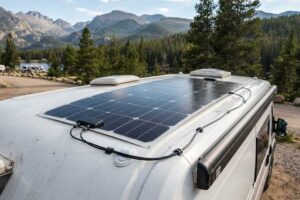
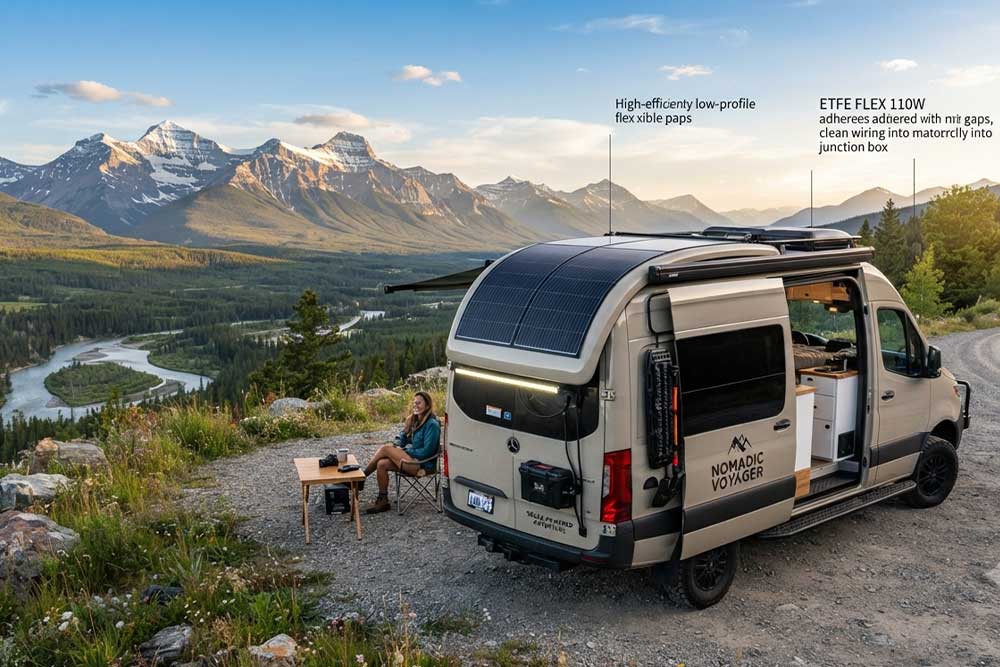
Flexible RV solar panels are lightweight photovoltaic panels designed for RV roofs, camper vans, and motorhomes where traditional rigid panels may be difficult to install. Their thin, bendable design allows them to fit curved surfaces while providing reliable solar power for off-grid travel.
As more RV owners choose remote camping and off-grid lifestyles, solar energy has become an essential power solution. A properly designed RV solar system can reduce dependence on generators, recharge batteries during travel, and provide electricity for essential appliances such as lights, fans, refrigerators, and portable devices.
Unlike traditional framed solar panels, flexible RV solar panels focus on weight reduction, simple installation, and better compatibility with limited roof space. However, choosing the right panel requires understanding efficiency, durability, installation methods, and power requirements.
This guide explains how flexible solar panels work, their advantages and limitations, sizing recommendations, installation methods, and how to choose the best option for your RV.
What Are Flexible RV Solar Panels?
Flexible RV solar panels are lightweight solar modules that can bend slightly to match curved surfaces on RV roofs, camper vans, and trailers. They use photovoltaic cells to convert sunlight into electricity while offering a thinner and lighter alternative to conventional rigid solar panels.
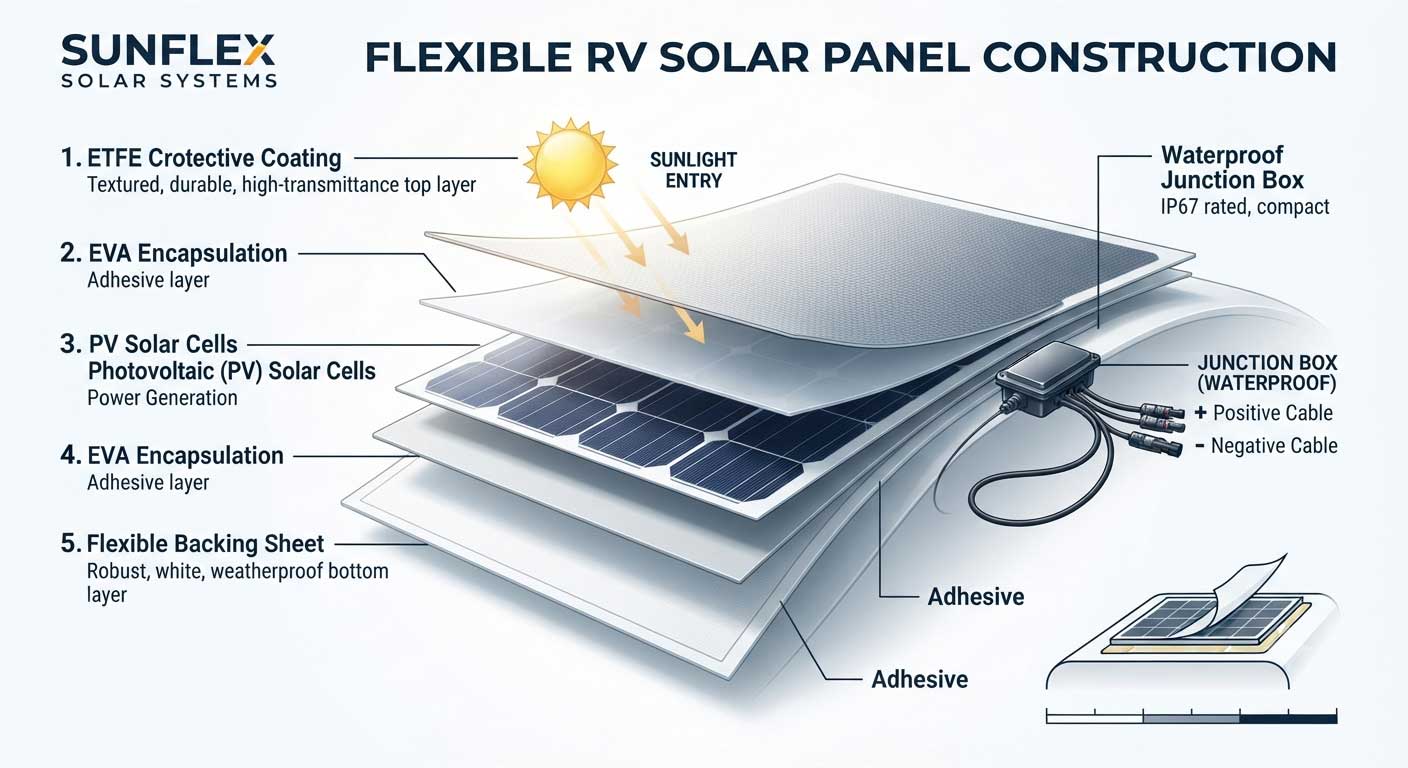
Unlike rigid solar panels that use aluminum frames and glass surfaces, flexible RV solar panels are manufactured with lightweight materials such as ETFE coatings, polymer layers, and flexible backing materials. This construction reduces weight and allows installation on vehicles where traditional panels may not be suitable.
A typical flexible RV solar panel consists of several key layers:
Solar Cells
The photovoltaic cells are the main power-generating component. Most high-quality flexible RV solar panels use monocrystalline solar cells because they provide higher efficiency and better power output in limited spaces.
Protective Surface Layer
Premium flexible panels often use ETFE (Ethylene Tetrafluoroethylene) coatings. ETFE provides:
- High UV resistance
- Better scratch protection
- Improved weather durability
- Longer outdoor lifespan
Compared with traditional PET surfaces, ETFE coatings generally offer better performance for long-term RV applications.
Flexible Backing Material
The backing layer allows the panel to bend and adapt to slightly curved RV surfaces. This makes flexible solar panels suitable for vehicles with aerodynamic roofs or limited mounting areas.
Junction Box and Wiring
The junction box connects the solar panel output to the charge controller and battery system. Waterproof junction boxes help protect electrical connections from rain, dust, and outdoor conditions.
Flexible RV solar panels are not completely foldable like fabric solar chargers. Most models are semi-flexible, meaning they can bend within a limited range while maintaining structural stability.
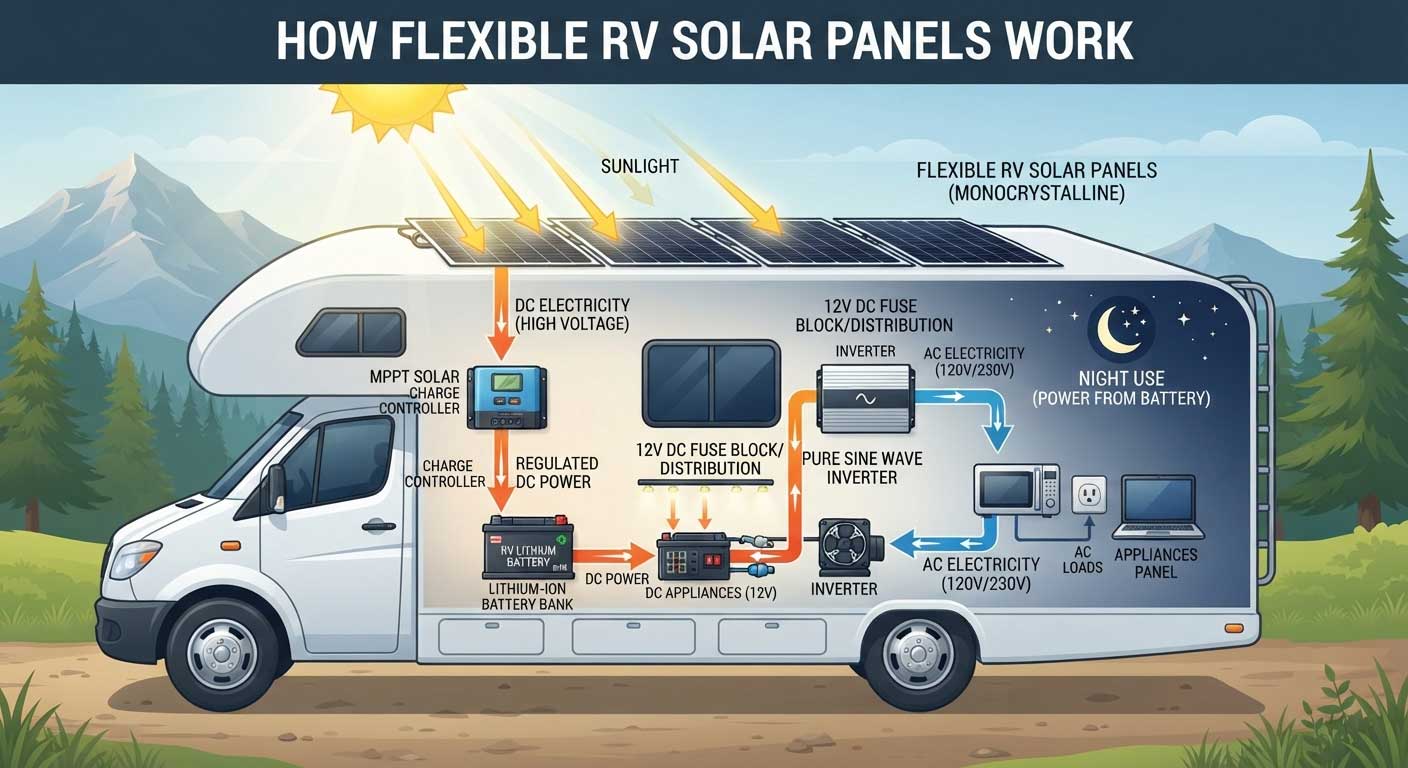
How Do Flexible Solar Panels Work on an RV?
Flexible RV solar panels work through the same photovoltaic process as traditional solar panels. When sunlight reaches the solar cells, the photovoltaic effect converts solar energy into direct current (DC) electricity.
The generated electricity then passes through several components before powering RV appliances:
Sunlight → Flexible Solar Panel → Charge Controller → RV Battery → Electrical Devices
The charge controller regulates voltage and current to protect the battery from overcharging. The stored energy can then be used whenever power is needed, including during nighttime or cloudy conditions.
A typical RV solar system using flexible solar panels includes:
1. Flexible Solar Panels
The panels capture sunlight and generate electricity. The required wattage depends on RV size, travel habits, and energy consumption.
2. Solar Charge Controller
The controller manages energy flow between the panels and batteries. MPPT (Maximum Power Point Tracking) controllers are commonly recommended because they can improve charging efficiency compared with basic PWM controllers.
3. Battery Storage System
RV solar systems usually store energy in:
- Lithium batteries
- AGM batteries
- Lead-acid batteries
Lithium batteries are increasingly popular because they provide higher usable capacity, longer cycle life, and lower weight.
4. Power Inverter
If the RV requires AC power for devices such as laptops, kitchen appliances, or small electronics, an inverter converts stored DC power into usable AC electricity.
Flexible RV solar panels are especially valuable for off-grid applications because they provide silent, renewable energy without fuel costs or generator noise.
For example, a camper using a 300W–500W flexible solar system can typically support daily needs such as LED lighting, phone charging, ventilation fans, and small refrigerators when combined with a suitable battery system.
Types of Flexible Solar Panels for RVs
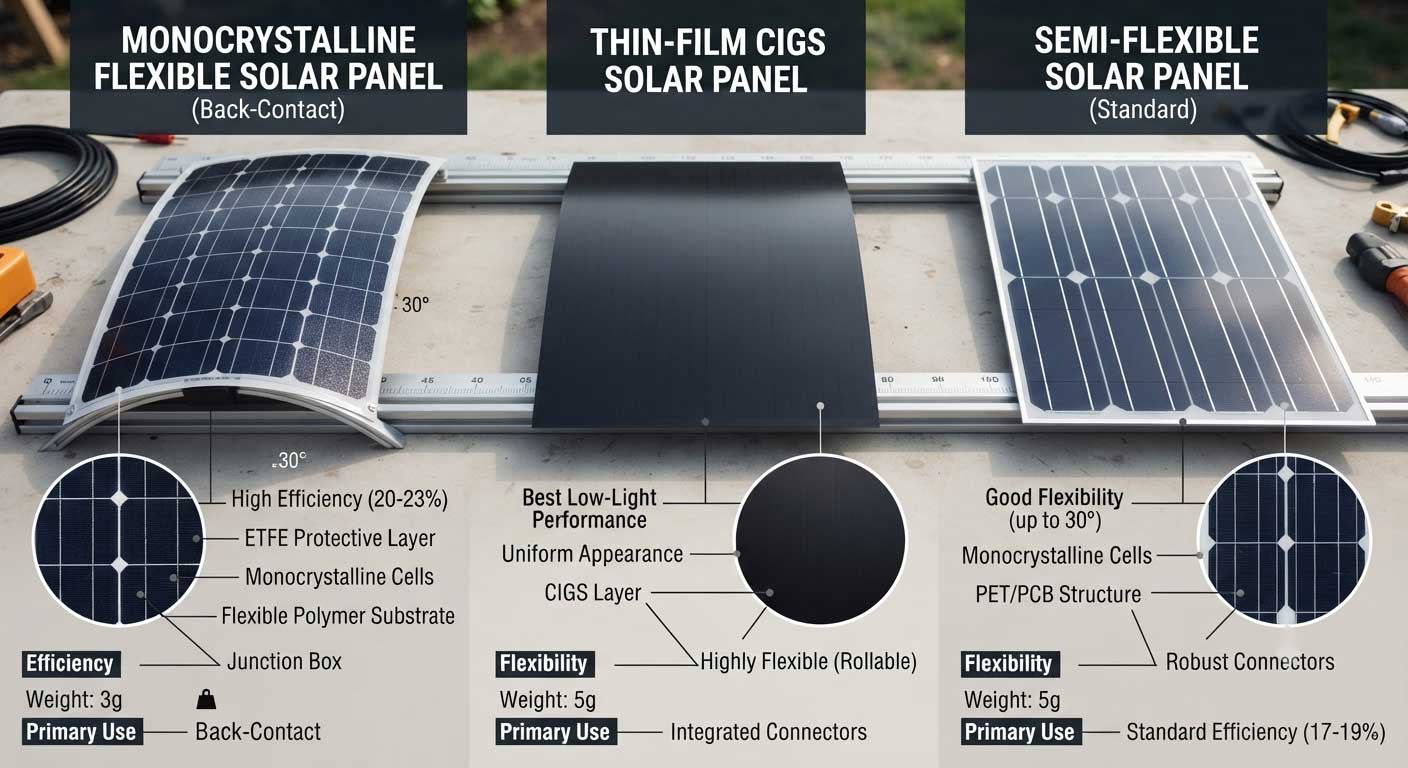
Flexible RV solar panels are available in different technologies, but not all types provide the same efficiency, durability, and performance. For most RV applications, monocrystalline flexible solar panels are the preferred choice because they deliver higher power output while using less roof space.
The main types of flexible solar panels used for RVs include monocrystalline, thin-film, and semi-flexible solar panels.
Monocrystalline Flexible Solar Panels
Monocrystalline flexible solar panels are currently the most common choice for RV solar systems. They are made from high-purity silicon cells and provide higher conversion efficiency compared with other flexible solar technologies.
The main advantages include:
- Higher power output per square meter
- Better performance in limited installation areas
- Longer service life
- Improved low-light performance
Because RV roofs often have limited available space, efficiency is an important factor. A high-efficiency 200W or 300W flexible solar panel can generate more electricity without requiring a large mounting area.
Monocrystalline flexible solar panels are ideal for:
- Camper vans
- Motorhomes
- Travel trailers
- Off-grid RV systems
For users who spend extended periods away from electrical hookups, monocrystalline flexible panels provide a better balance between size, weight, and energy production.
Thin-Film Flexible Solar Panels
Thin-film flexible solar panels use a different photovoltaic technology that allows extremely lightweight and flexible designs.
Their main advantages include:
- Very low weight
- Excellent flexibility
- Better performance under certain low-light conditions
- Easy integration into unusual surfaces
However, thin-film panels usually have lower efficiency compared with monocrystalline panels. This means they require a larger installation area to produce the same amount of power.
Thin-film flexible solar panels may be suitable for:
- Large RV roofs
- Temporary solar applications
- Lightweight mobile power solutions
For most modern RV owners, monocrystalline flexible solar panels are usually a more practical choice because roof space is limited.
Semi-Flexible Solar Panels
Semi-flexible solar panels are the most widely used category for RV applications. They combine lightweight construction with moderate bending capability.
Unlike traditional rigid panels with aluminum frames and glass surfaces, semi-flexible panels typically use:
- Fiberglass or polymer backing
- ETFE protective coating
- Lightweight solar cells
They can usually bend several degrees to follow slightly curved RV roofs while maintaining good electrical performance.
Semi-flexible panels are popular because they offer:
- Easier installation
- Lower vehicle weight
- Better appearance
- Reduced wind resistance
For most camper and RV owners, semi-flexible monocrystalline solar panels provide the best overall solution.
Flexible RV Solar Panels vs Rigid Solar Panels
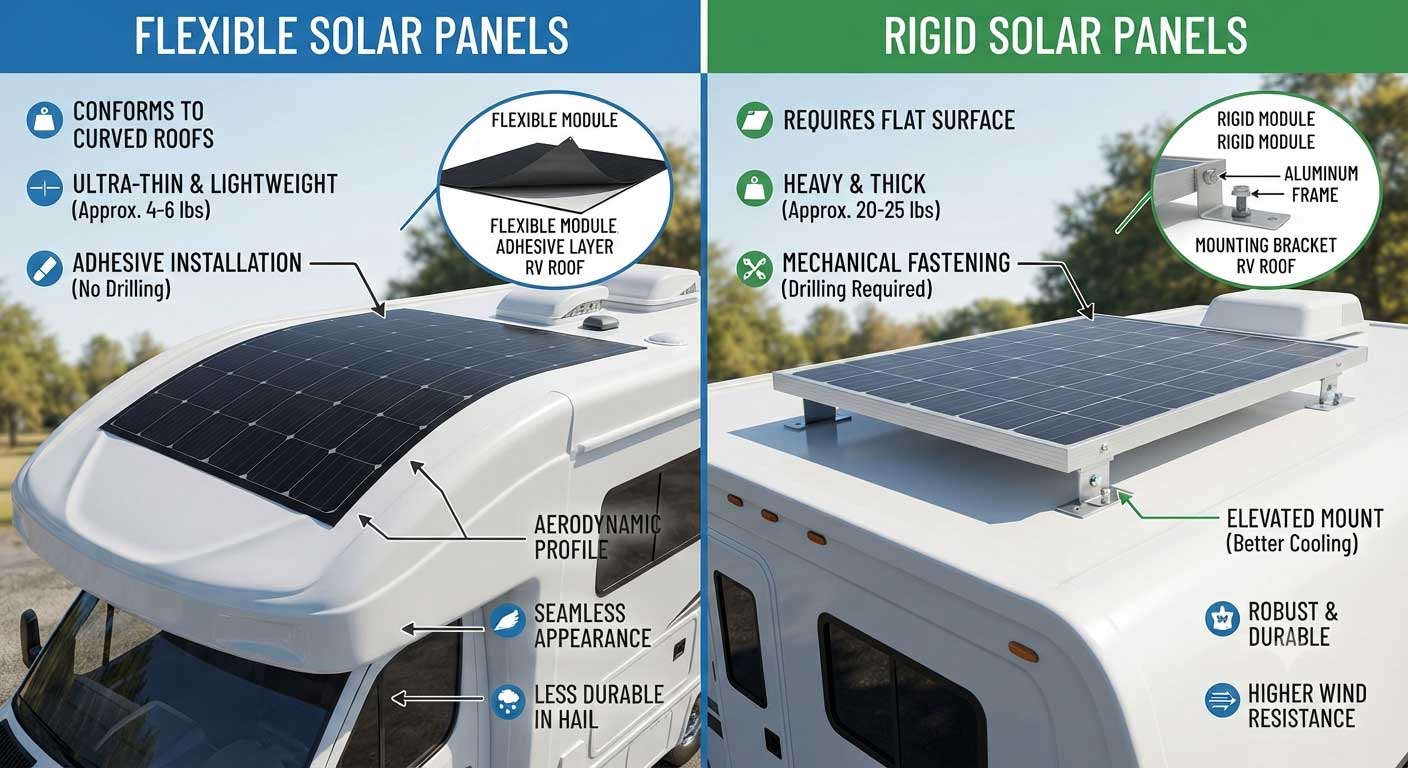
Choosing between flexible and rigid solar panels is one of the most important decisions when designing an RV solar system. Both technologies can generate reliable solar power, but they are designed for different installation requirements.
Flexible RV solar panels focus on lightweight design and installation convenience, while rigid solar panels prioritize maximum efficiency, cooling performance, and long-term durability.
The right choice depends on your RV type, roof structure, energy requirements, and travel style.
| Comparison Factor | Flexible RV Solar Panels | Rigid Solar Panels |
|---|---|---|
| Weight | Lightweight | Heavier due to frame and glass |
| Installation | Simple mounting, fewer components | Requires brackets and mounting hardware |
| Roof Compatibility | Suitable for curved surfaces | Best for flat surfaces |
| Roof Penetration | Often requires fewer holes | Usually requires mounting points |
| Efficiency | High but slightly lower in some cases | Generally higher |
| Heat Dissipation | Limited airflow under panel | Better cooling performance |
| Wind Resistance | Lower profile design | Higher profile structure |
| Maintenance | Simple cleaning and inspection | More complex mounting checks |
| Cost per Watt | Usually higher | Usually lower |
Weight and Vehicle Load
Weight is a major consideration for RV owners. Every additional kilogram affects:
- Fuel consumption
- Vehicle handling
- Payload capacity
Flexible RV solar panels can weigh significantly less than traditional framed modules, making them attractive for camper vans and lightweight trailers.
For smaller RVs with strict weight limits, flexible panels provide additional solar capacity without adding excessive load.
Installation Differences
Rigid solar panels normally require:
- Roof brackets
- Drilling
- Mounting rails
- Additional sealing work
Flexible panels can often be installed using:
- Industrial adhesive
- Mounting tape
- Low-profile brackets
This reduces installation complexity and minimizes potential roof damage.
However, proper surface preparation is still essential. Poor installation can cause adhesive failure, water problems, or reduced panel lifespan.
Efficiency and Heat Management
Rigid solar panels generally have better airflow underneath because they are mounted above the roof surface. This allows heat to escape and helps maintain higher operating efficiency.
Flexible panels are installed closer to the roof, which can increase operating temperature during hot weather.
Since solar panel efficiency decreases as temperature rises, installation location and ventilation should be considered carefully.
For RV owners in hot climates, choosing high-quality flexible panels with good heat-resistant materials is important.
Which Is Better for an RV?
Flexible RV solar panels are usually the better choice when:
- Roof space is limited
- The roof has curves
- Weight reduction is important
- A low-profile installation is preferred
- You want a simpler installation process
Rigid panels may be better when:
- Maximum efficiency is the priority
- The RV has a large flat roof
- Long-term stationary use is expected
- Additional mounting weight is acceptable
There is no universal winner. The best option depends on the RV design and how the solar system will be used.
Benefits of Flexible RV Solar Panels
Flexible RV solar panels have become increasingly popular because they solve several challenges associated with traditional solar installations on mobile vehicles.
Their lightweight structure, easy installation, and adaptable design make them suitable for many RV and camper applications.
Lightweight Design
One of the biggest advantages of flexible RV solar panels is their reduced weight.
Traditional solar panels use:
- Aluminum frames
- Tempered glass surfaces
- Heavy mounting structures
Flexible panels replace these components with lightweight materials, reducing the overall system weight.
This is especially beneficial for:
- Small camper vans
- Travel trailers
- Vehicles with limited payload capacity
A lighter solar system helps maintain better fuel efficiency and driving performance.
Fits Curved RV Roofs
Many RVs do not have completely flat roofs. Camper vans, trailers, and motorhomes often feature curved surfaces designed for better aerodynamics.
Rigid panels may require complex mounting solutions to fit these shapes.
Flexible RV solar panels can follow gentle curves, making them suitable for:
- Rounded camper roofs
- Van conversions
- Teardrop trailers
- Specialty vehicles
This allows RV owners to maximize available roof space.
Easy Installation Without Drilling
Flexible RV solar panels are often selected because they simplify installation.
Compared with rigid systems, they usually require fewer structural components and can be mounted closer to the roof surface.
Benefits include:
- Faster installation
- Lower installation complexity
- Reduced roof modification
- Cleaner appearance
For DIY RV solar projects, flexible panels are often easier to handle because they are lighter and easier to position.
Low-Profile Appearance
Flexible panels sit close to the RV roof, creating a cleaner appearance compared with raised framed modules.
A low-profile design provides:
- Reduced visual impact
- Less wind resistance
- Better vehicle aesthetics
This is especially important for users converting vans or maintaining a factory-style exterior appearance.
Disadvantages of Flexible RV Solar Panels
Although flexible RV solar panels offer many advantages, they are not the perfect solution for every application. Understanding their limitations helps RV owners choose the right solar system and avoid performance issues.
The main disadvantages include heat management challenges, higher cost per watt, and sensitivity to installation quality.
Heat Management Issues
One of the biggest challenges with flexible RV solar panels is heat dissipation.
Traditional rigid solar panels are installed above the roof with an air gap underneath. This allows airflow to cool the back of the panel and helps maintain better operating efficiency.
Flexible panels are usually installed directly onto the RV roof, which reduces airflow and can cause higher operating temperatures.
Solar panel output decreases as temperature increases. In hot environments, excessive heat may lead to:
- Reduced energy production
- Faster material aging
- Lower long-term performance
To improve heat management:
- Choose panels with high-quality heat-resistant materials
- Avoid installing on surfaces with excessive heat buildup
- Keep the panel surface clean
- Use proper installation methods
For RV owners traveling in hot climates, selecting flexible solar panels with durable ETFE coatings and reliable encapsulation technology is important.
Higher Cost Per Watt
Flexible RV solar panels usually cost more per watt compared with standard rigid solar panels.
The higher price comes from:
- Lightweight materials
- Flexible manufacturing processes
- Advanced protective coatings
- Specialized photovoltaic designs
For example, a rigid solar panel may offer a lower cost per watt because its aluminum frame and glass construction are produced at a larger scale.
However, flexible panels provide additional value through:
- Easier installation
- Lower vehicle weight
- Better roof compatibility
- Reduced mounting requirements
For many RV applications, the installation advantages can justify the higher initial cost.
Shorter Lifespan Compared With Some Rigid Panels
High-quality flexible RV solar panels can provide many years of service, but they may experience more stress than rigid panels because of:
- Continuous temperature changes
- Vehicle vibration
- UV exposure
- Mechanical bending
The lifespan depends heavily on:
- Solar cell quality
- Surface materials
- Waterproof protection
- Installation quality
When choosing flexible RV solar panels, look for:
- ETFE surface coating
- Strong encapsulation
- Waterproof junction boxes
- Manufacturer warranty support
A well-designed flexible solar panel system can provide reliable performance for years when properly installed and maintained.
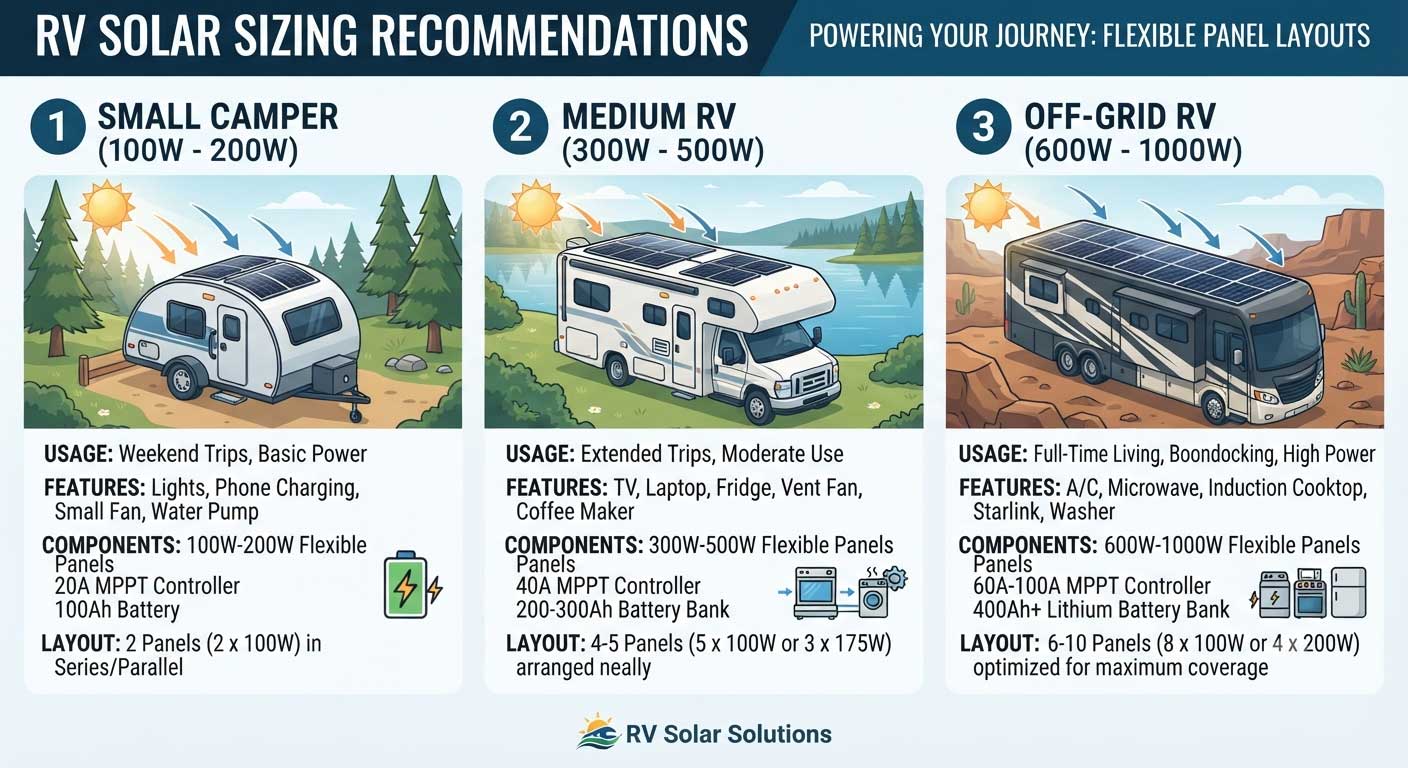
How Many Watts of Flexible Solar Panels Does an RV Need?
The required wattage of flexible RV solar panels depends on your daily electricity consumption, battery capacity, travel style, and available roof space.
There is no single wattage that works for every RV. A weekend camper may only need a small solar setup, while a full-time off-grid traveler may require a much larger system.
A simple calculation method is:
Daily Energy Consumption (Wh) ÷ Average Sun Hours = Required Solar Panel Capacity
For example:
If an RV uses approximately 1,000Wh per day and receives 5 peak sun hours:
1,000Wh ÷ 5 hours = around 200W solar capacity
In real applications, additional capacity is recommended to compensate for:
- Cloudy weather
- Heat losses
- Charging inefficiency
- Seasonal changes
100W Flexible Solar Panels for Small RVs
A 100W flexible solar panel is suitable for basic energy needs.
Typical applications:
- Charging phones
- LED lighting
- Small electronics
- Battery maintenance
It is commonly used for:
- Small camper trailers
- Weekend camping setups
- Auxiliary charging
However, 100W may not provide enough energy for larger appliances such as refrigerators or air conditioners.
200W–400W Flexible Solar Panels for Medium RVs
For most RV owners, a 200W to 400W flexible solar system provides a practical balance between power output and installation space.
It can support:
- RV refrigerator
- Ventilation fans
- LED lighting
- Internet equipment
- Portable devices
Common configurations include:
- Two 100W flexible solar panels
- Two 200W flexible solar panels
- One high-power 300W or 400W panel
This range is popular for camper vans and travel trailers because it provides useful daily energy without requiring a large roof area.
500W–1000W Flexible Solar Systems for Off-Grid RV Living
Full-time RV travelers or users who spend long periods without electrical hookups often require higher solar capacity.
A 500W–1000W flexible RV solar system can support:
- Larger battery banks
- Multiple electronic devices
- More frequent appliance usage
- Extended off-grid travel
These systems are commonly combined with:
- Lithium batteries
- MPPT charge controllers
- High-capacity inverters
For serious off-grid applications, solar capacity should always be designed according to actual energy consumption rather than simply choosing the largest available panel.
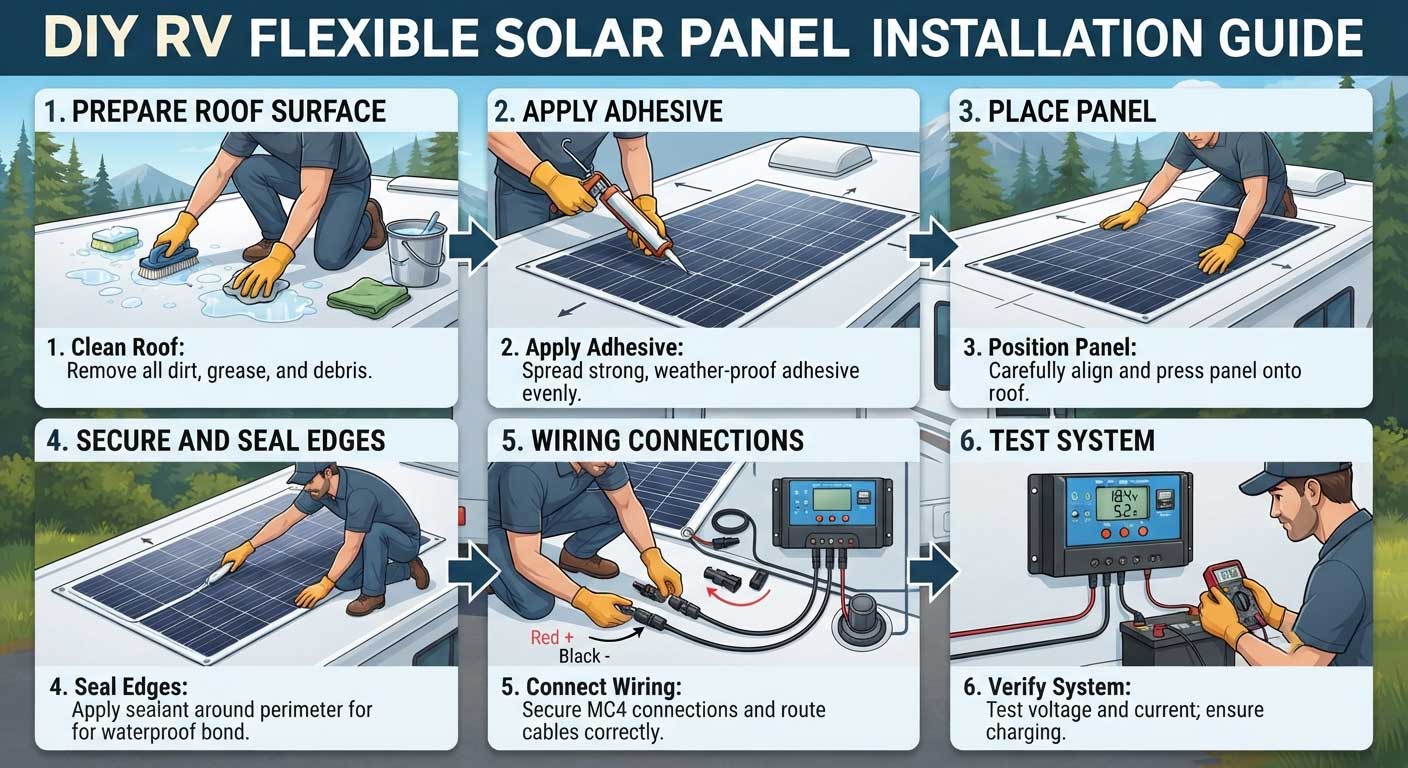
How to Install Flexible Solar Panels on an RV Roof
Installing flexible solar panels on an RV roof is generally simpler than installing traditional framed panels, but correct installation is essential for long-term reliability.
A professional installation process usually includes surface preparation, mounting, electrical connection, and system testing.
Step 1: Measure Available Roof Space
Before installation, measure the available roof area and identify:
- Flat and curved sections
- Roof vents
- Air conditioners
- Antennas
- Existing accessories
The available space determines how many flexible RV solar panels can be installed.
Planning the layout before mounting prevents shading problems and improves solar performance.
Step 2: Clean and Prepare the Surface
Proper preparation is critical because flexible panels are often installed directly on the RV roof.
Recommended steps:
- Remove dust and dirt
- Clean oil or grease
- Dry the surface completely
- Mark the installation position
A clean surface improves adhesive strength and prevents installation failure.
Step 3: Mount the Flexible Solar Panels
Depending on the panel design, installation methods may include:
- Industrial adhesive
- Double-sided mounting tape
- Marine-grade sealant
- Low-profile mounting brackets
Avoid excessive bending during installation because sharp folds can damage internal solar cells.
The panel should follow the roof curve naturally without mechanical stress.
Step 4: Connect Wiring and Charge Controller
After mounting the panels:
- Connect panel cables
- Install a solar charge controller
- Connect to the RV battery system
- Install an inverter if AC power is required
Using proper cable sizing and waterproof connectors helps improve system safety and efficiency.
Step 5: Test the Solar System
After installation, check:
- Voltage output
- Charging current
- Battery charging status
- Waterproof connections
Testing ensures the flexible RV solar panels are operating correctly before long-term use.
Best Applications for Flexible RV Solar Panels
Flexible RV solar panels are designed for mobile solar applications where weight, space, and installation flexibility are important. Their lightweight structure and low-profile design make them suitable for a wide range of recreational and commercial vehicles.
Unlike traditional solar systems that require large flat mounting areas, flexible panels can adapt to different vehicle designs and provide reliable power for off-grid use.
Camper Vans
Camper vans are one of the most popular applications for flexible RV solar panels.
Because camper vans often have:
- Limited roof space
- Curved surfaces
- Strict weight limitations
Flexible solar panels provide an efficient way to add renewable energy without significantly increasing vehicle weight.
A properly designed camper van solar system can support:
- Interior LED lighting
- Mobile devices
- Ventilation fans
- Small refrigerators
- Communication equipment
For van conversions, low-profile flexible solar panels also maintain the original vehicle appearance while providing additional energy independence.
Motorhomes
Motorhomes usually have higher electricity demands compared with smaller campers.
Flexible RV solar panels can help provide additional power for:
- Battery charging
- Entertainment systems
- Lighting
- Water pumps
- Small appliances
For larger motorhomes, multiple flexible panels can be combined with lithium battery storage and an MPPT charge controller to create a complete off-grid solar solution.
The key consideration is balancing:
- Available roof area
- Daily energy consumption
- Battery capacity
- Travel conditions
Travel Trailers and Caravans
Travel trailers and caravans often have large roof areas but may still benefit from flexible solar technology.
Advantages include:
- Reduced roof loading
- Easier installation
- Better compatibility with curved trailer surfaces
Flexible solar panels are especially useful for lightweight trailers where additional mounting structures could increase overall weight.
They provide a practical solution for travelers who want to camp away from traditional power connections.
Teardrop Trailers
Teardrop trailers have aerodynamic curved roofs that make rigid solar panel installation more challenging.
Flexible RV solar panels are a natural fit because they can follow the shape of the roof while maintaining a clean appearance.
A small flexible solar system can provide enough power for:
- Lighting
- Charging devices
- Ventilation
- Basic camping equipment
Boats and Other Mobile Applications
Although designed for RV use, flexible solar panels are also widely used in other mobile environments.
Common applications include:
- Boats
- Marine cabins
- Work vehicles
- Expedition vehicles
- Emergency power systems
Their lightweight construction and weather-resistant materials make them suitable for applications where traditional panels may be impractical.
How Long Do Flexible RV Solar Panels Last?
High-quality flexible RV solar panels typically last around 5–15 years depending on materials, installation quality, environmental conditions, and maintenance.
The actual lifespan can vary significantly because RV solar panels experience more demanding conditions than stationary rooftop systems.
Factors affecting lifespan include:
- UV exposure
- Temperature changes
- Moisture
- Vehicle vibration
- Installation method
- Material quality
Material Quality
The protective materials used in flexible solar panels directly affect durability.
Premium flexible RV solar panels often use:
ETFE Surface Coating
ETFE provides:
- Strong UV resistance
- Scratch protection
- Better weather durability
- Improved transparency
Compared with lower-cost PET surfaces, ETFE coatings generally provide better outdoor performance.
Installation Quality
Proper installation is one of the most important factors affecting panel lifespan.
Common installation problems include:
- Uneven mounting surfaces
- Excessive bending
- Poor adhesive bonding
- Improper cable protection
A correctly installed flexible solar panel should sit flat against the mounting surface without unnecessary mechanical stress.
Environmental Conditions
RV solar panels operate in constantly changing environments.
Exposure to:
- Strong sunlight
- High temperatures
- Rain
- Dust
- Road vibration
can gradually affect performance.
Regular maintenance helps extend service life:
- Clean the panel surface periodically
- Check cable connections
- Inspect waterproof seals
- Monitor system performance
How to Choose the Best Flexible RV Solar Panels
Choosing the best flexible RV solar panels requires evaluating more than just wattage. The right panel should match your RV size, energy requirements, climate conditions, and installation needs.
The following factors should be considered before purchasing.
1. Check Solar Cell Efficiency
Efficiency determines how much electricity a panel can generate from available sunlight.
For RV applications, high-efficiency monocrystalline cells are usually recommended because roof space is limited.
Higher efficiency means:
- More power from smaller areas
- Better use of limited roof space
- Improved daily energy production
2. Choose Durable Surface Materials
The surface material plays an important role in long-term outdoor performance.
For RV applications, ETFE-coated flexible solar panels are generally preferred because they provide:
- Better UV resistance
- Higher scratch resistance
- Improved durability
- Easier cleaning
Since RV panels are exposed to outdoor conditions every day, material quality should not be overlooked.
3. Consider Waterproof Protection
RV solar panels must withstand changing weather conditions.
Look for features such as:
- Waterproof junction boxes
- Sealed electrical connections
- Weather-resistant construction
A reliable waterproof design helps prevent moisture damage and improves system stability.
4. Match Panel Wattage to Your Energy Needs
Choosing the correct wattage prevents both under-sizing and unnecessary cost.
Common flexible RV solar panel sizes include:
| Panel Power | Recommended Application |
|---|---|
| 100W | Small campers and basic charging |
| 200W | Weekend RV trips and light usage |
| 300W–400W | Medium RV systems |
| 500W+ | Off-grid and full-time RV living |
The ideal system depends on your actual electricity consumption.
5. Check Warranty and Manufacturer Reliability
A trustworthy manufacturer should provide:
- Product warranty
- Technical specifications
- Quality testing
- Customer support
For long-term RV applications, choosing a reliable supplier is often more important than selecting the cheapest option.
FAQ About Flexible RV Solar Panels
Are flexible solar panels good for RVs?
Yes. Flexible solar panels are a good choice for RVs because they are lightweight, easy to install, and can fit curved roof surfaces. They are especially suitable for camper vans, trailers, and vehicles where weight and space are limited.
Can flexible solar panels power an RV?
Yes. Flexible RV solar panels can power many RV appliances when combined with a suitable battery system and charge controller.
They can support:
- LED lights
- Fans
- Refrigerators
- Mobile devices
- Small electronics
Larger appliances require a properly sized solar array and battery capacity.
How many flexible solar panels do I need for an RV?
The number of panels depends on your daily energy usage.
Typical systems:
- Small RV: 100W–200W
- Medium RV: 300W–500W
- Off-grid RV: 600W–1000W+
Calculating energy consumption before installation helps determine the correct solar capacity.
Can you walk on flexible RV solar panels?
Most flexible RV solar panels are not designed to be walked on.
Although they are more flexible than rigid panels, walking pressure can damage internal solar cells and reduce performance.
Always follow the manufacturer’s installation and usage recommendations.
How do you attach flexible solar panels to an RV roof?
Flexible solar panels can be attached using:
- Industrial adhesive
- Mounting tape
- Sealant
- Specialized brackets
The roof surface must be clean and properly prepared before installation to ensure long-term adhesion.
Are flexible solar panels better than rigid panels?
Flexible and rigid solar panels have different advantages.
Flexible panels are better for:
- Lightweight RVs
- Curved roofs
- Simple installation
Rigid panels are better for:
- Maximum efficiency
- Large flat roofs
- Long-term stationary installations
The best option depends on the RV design and energy requirements.
Conclusion: Are Flexible RV Solar Panels Worth Choosing?
Flexible RV solar panels are an excellent solution for RV owners who need lightweight, space-saving, and easy-to-install solar power systems.
Their ability to fit curved surfaces, reduce installation complexity, and provide reliable off-grid energy makes them especially suitable for camper vans, motorhomes, and travel trailers.
When choosing flexible RV solar panels, focus on key factors such as solar cell efficiency, ETFE coating, waterproof protection, wattage requirements, and manufacturer quality.
A properly selected and installed flexible RV solar system can provide clean, quiet, and renewable energy for years of outdoor travel.
For RV owners looking to improve energy independence without adding unnecessary weight, flexible solar panels offer a practical and modern solar solution.
Related recommendations
-

350 watt solar panels: Output, Size and Installation Guide
281350 watt solar panels provide 350W of rated DC power under STC, while actual daily output depends on sunlight, temperature, shading, orientation, wiring, and...
View details -
100W Flexible Solar Panel – RV & Off-Grid
270Bright Solar’s 100W flexible solar panel combines 100W peak power with a lightweight, 2.8 mm-thick design for RV, marine, and off-grid applications.
View details -
Zonergy demonstrates innovative energy storage solutions in Europe
300Zonergy Corporation presents cutting-edge energy storage solutions and smart microgrid products at EES Europe. With advanced photovoltaic and storage technologies, Zonergy leads in residential, commercial, and large-scale renewable energy projects...
View details -
Solar Energy for Travel Trailers: A Practical Guide to Off-Grid Power
154Discover how solar energy for travel trailers delivers reliable off-grid power, lower generator use, and greater camping freedom with efficient solar solutions.
View details