CIGS Flexible Solar Panels: Technology, Benefits and Applications
CIGS flexible solar panels use thin-film photovoltaic technology based on copper, indium, gallium, and selenium. They can be manufactured on flexible substrates, including metal foils and polymers, making them suitable for selected lightweight, curved-surface, mobile, and off-grid applications. Bright Solar helps buyers evaluate flexible solar panel solutions according to their installation and electrical requirements.
What Are CIGS Flexible Solar Panels?
CIGS stands for copper indium gallium selenide, a semiconductor material used to convert sunlight into electricity. Unlike conventional crystalline-silicon modules that commonly use rigid glass construction, CIGS photovoltaic layers can be deposited onto different substrates.
The National Renewable Energy Laboratory explains that CIGS can be fabricated on glass, metal foils, and polymer substrates. Metal foils and polymers make lightweight or flexible module designs possible.
The word flexible, however, describes a product’s mechanical design—not unlimited bendability. The permitted curvature, mounting method, and handling requirements depend on the finished module.
How CIGS photovoltaic technology works
A CIGS module generates electricity through the photovoltaic effect. When sunlight reaches the semiconductor absorber, energy from the light creates charge carriers. The device’s internal structure separates and collects those charges, producing electrical current.
The process involves several layers and electrical contacts. The CIGS absorber is only one part of the module: substrate selection, protective layers, interconnections, and encapsulation also affect the finished product.
For a buyer, the practical point is that two modules described as CIGS may still have different mechanical properties, efficiencies, and environmental limits.
CIGS versus conventional crystalline-silicon panels
The main distinction is the photovoltaic material and the way the module is constructed.
| Feature | CIGS flexible modules | Conventional rigid crystalline-silicon modules |
|---|---|---|
| Photovoltaic material | Copper, indium, gallium, and selenium compound semiconductor | Crystalline silicon |
| Typical construction | Thin-film absorber on a suitable substrate, with protective layers | Silicon cells commonly assembled beneath a rigid glass front |
| Form factor | Can be manufactured in flexible formats | Commonly supplied as rigid framed modules |
| Mounting considerations | Depends on substrate, laminate, and permitted bending | Depends on frame, glass, and mounting system |
| Potential applications | Selected curved, lightweight, and mobile installations | Rooftops, ground-mounted systems, and other compatible installations |
| Key purchasing check | Flexibility limits, substrate, encapsulation, and electrical ratings | Dimensions, frame, mounting requirements, and electrical ratings |
These are general technology distinctions, not a claim that every CIGS product is flexible or that every crystalline-silicon module has identical construction.
Why Buyers Consider CIGS Flexible Solar Panels
CIGS technology is relevant when a project needs a form factor that differs from a conventional Rigid Solar Panels. That does not automatically make it the right choice for every installation. The design needs to be assessed against available space, expected energy production, environmental exposure, and total system requirements.
Lightweight and flexible construction
CIGS thin-film modules can use flexible substrates such as metal foil or polymer. This opens up design possibilities for applications where rigid glass modules may be difficult to accommodate.
Potential benefits can include:
- Reduced module weight in certain product designs.
- Compatibility with selected gently curved surfaces.
- Alternative mounting approaches for specific roof or equipment designs.
- Greater freedom in product integration where rigid frames are impractical.
Actual weight and flexibility are product-specific. Buyers should compare the complete module—not just the semiconductor material.
Potential for building and equipment integration
Flexible photovoltaic technology may be considered for structures and equipment where a conventional framed panel is not a convenient fit.
Examples include selected vehicle roofs, lightweight structures, and specialized building-integrated photovoltaic concepts. Any such application requires checking the substrate, mounting surface, structural limitations, fire and electrical requirements, and relevant local codes.
A module’s flexibility alone does not establish that it is suitable for bonding directly to a roof or using as a building material.
Thin-film manufacturing methods
CIGS can be produced using different deposition processes. Research documented by NREL describes manufacturing development involving flexible stainless-steel and polymer substrates, including roll-to-roll processing.
These research and manufacturing developments explain why CIGS is of interest for specialized form factors. They should not be treated as proof that every supplier uses the same production method or achieves the same cost, yield, or reliability.
CIGS Flexible Solar Panel Efficiency and Real-World Output
Efficiency describes how effectively a solar module converts the sunlight reaching its active area into electrical power. It is important, but it is not the only factor that determines whether a module will meet a project’s energy needs.
CIGS research has demonstrated a range of efficiencies across different cell and module configurations. For example, NREL’s historical technical reports document specific results from research and development programs. Those figures belong to the stated devices and test periods; they are not current specifications for every commercial CIGS panel.
Rated power is not daily energy production
A panel’s rated power is expressed in watts (W). The amount of electricity it generates over time is measured in watt-hours (Wh) or kilowatt-hours (kWh).
A simplified planning equation is:
Daily energy (Wh) = Rated power (W) × Equivalent peak-sun hours × System performance factor
For example, consider a hypothetical 100W module receiving four equivalent peak-sun hours, with an assumed system performance factor of 0.75:
100W × 4 hours × 0.75 = 300Wh per day
This is an illustrative calculation, not a measured CIGS product result. The performance factor is an assumption for the example, not a Bright Solar specification.
Actual output depends on sunlight, module temperature, orientation, shading, wiring, charge-controller operation, and other system conditions. The National Renewable Energy Laboratory PVWatts calculator can help estimate photovoltaic energy production using location and system inputs.
What to check when comparing efficiency claims
When suppliers quote module efficiency, request:
- The exact model and datasheet revision.
- The stated efficiency and whether it refers to cell, aperture, or total module area.
- The test conditions and measurement method.
- The rated power and its tolerance.
- The temperature coefficient and operating limits, where available.
- The warranty terms and any applicable performance guarantees.
A percentage without its measurement basis can make two products appear more directly comparable than they really are.

Applications of CIGS Flexible Solar Panels
CIGS flexible solar panels are worth considering when a project has specific requirements for weight, module shape, or integration. The intended use must still be supported by the manufacturer’s documentation.
RVs, campervans, and mobile homes
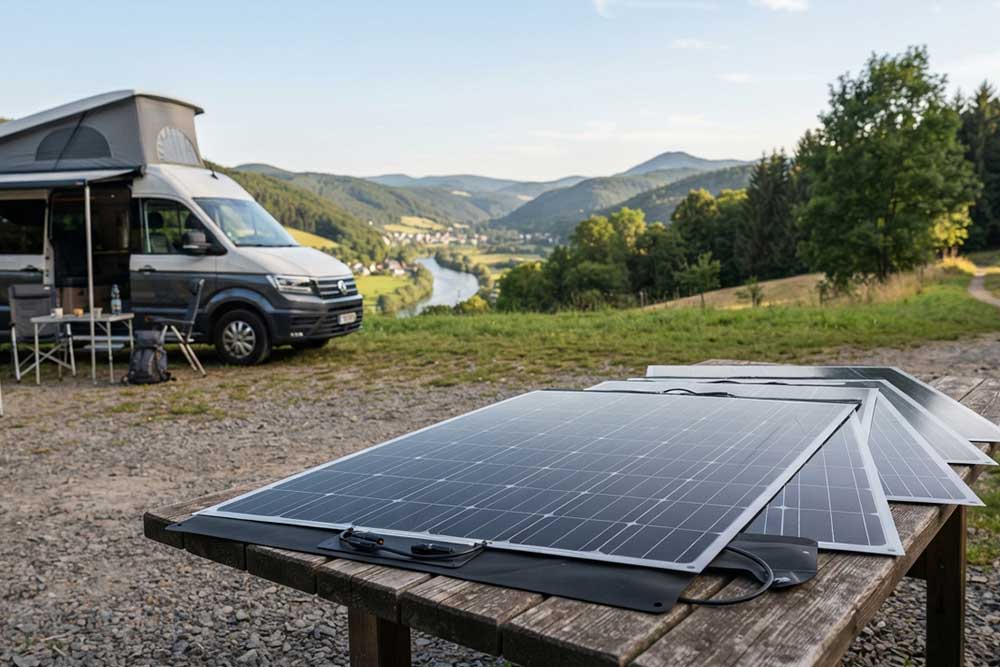
For recreational vehicles, roof space is often interrupted by vents, antennas, air-conditioning units, and other equipment. A flexible module may provide an alternative where a compatible mounting surface cannot conveniently accommodate a conventional rigid panel.
Before selecting a CIGS module, check:
- Available roof area and installation clearances.
- Roof material and manufacturer restrictions.
- Module dimensions, weight, and permitted bending.
- Cable routing and protection from abrasion.
- Charge-controller voltage and current limits.
- Access for inspection, cleaning, and maintenance.
A curved roof is not, by itself, sufficient reason to choose a flexible module. The curve must fall within the product’s permitted mechanical limits, and the mounting method must be approved for the application.
Boats and marine equipment
Marine environments create additional challenges, including salt exposure, moisture, movement, and limited installation space.
CIGS technology may be considered for marine projects, but buyers should not assume that a thin-film module is automatically waterproof, corrosion-resistant, or suitable for use on a yacht.
Ask the manufacturer to confirm:
- Whether the exact model is intended for the proposed marine environment.
- The environmental tests or ratings that apply to the complete module.
- Whether the mounting surface and adhesive system are compatible.
- How connectors and cable entries must be protected.
- Whether the panel can tolerate the expected movement and operating conditions.
Where the installation involves foot traffic, confirm that the product is explicitly approved for that use. A flexible surface does not automatically make a module walkable.
Off-grid and remote power systems
CIGS flexible modules may be incorporated into selected off-grid systems, but the panel is only one component of the power solution.
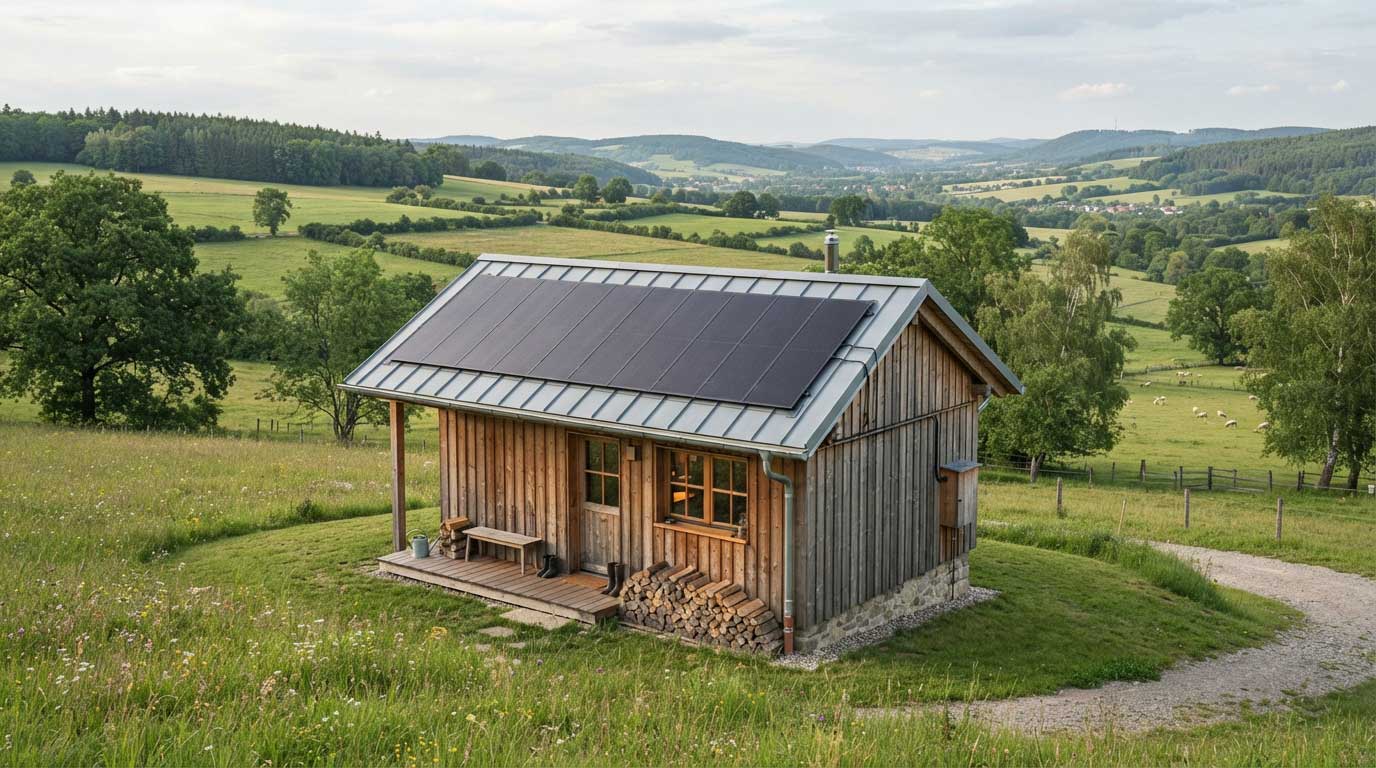
The designer must account for daily energy demand, solar-resource conditions, battery storage, controller compatibility, inverter requirements, and system losses. A small cabin with occasional lighting has a different load profile from a remote site operating refrigeration, pumps, and communications equipment.
Start with a load list. Record each device’s power rating, expected operating hours, and whether it runs continuously or intermittently. Then estimate daily energy use and size the generation and storage components accordingly.

How to Evaluate a CIGS Flexible Solar Panel Supplier
A product description can introduce a technology, but procurement decisions require evidence about the exact module being offered. This is particularly important when the application has unusual mechanical or environmental requirements.
Step 1 — Confirm the product construction
Ask what substrate the module uses and how the photovoltaic layers are protected. Determine whether the product is genuinely designed to flex or whether it is a thin, lightweight module intended to remain flat.
Request information about:
- Substrate material.
- Protective and encapsulation layers.
- Permitted bending radius or other mechanical limits.
- Module dimensions and weight.
- Approved mounting and bonding methods.
- Environmental limitations and maintenance instructions.
Do not assume that specifications from one CIGS product can be applied to another model.
Step 2 — Check the electrical datasheet
Use the exact model datasheet to check the following parameters.
| Parameter | Why it matters |
|---|---|
| Rated power (Pmax) | Establishes nominal module output under stated test conditions |
| Maximum power voltage (Vmp) | Helps determine operating-voltage compatibility |
| Maximum power current (Imp) | Helps establish operating-current requirements |
| Open-circuit voltage (Voc) | Important when checking controller and system voltage limits |
| Short-circuit current (Isc) | Relevant to electrical design and protection |
| Module efficiency | Allows comparison when the measurement basis is consistent |
| Temperature coefficient | Helps estimate temperature-related power changes |
| Operating temperature | Defines the manufacturer’s stated operating range |
| Maximum system voltage | Establishes a critical electrical design limit, where specified |
| Warranty | Clarifies coverage, exclusions, and applicable conditions |
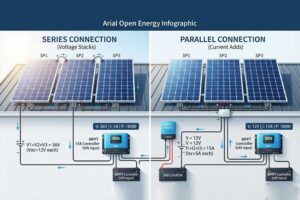
For series-connected modules, voltage increases. For parallel-connected modules, current increases. The array configuration must remain within the charge controller, inverter, wiring, and protection-device limits.
Step 3 — Verify documentation and quality controls
Ask the supplier for applicable certificates, test reports, inspection procedures, and warranty documents. Check that the documentation identifies the correct model and configuration.
A useful supplier review may include:
- Confirmation of the company’s role as manufacturer, assembler, or trading company.
- Traceability of materials and finished products.
- Documented inspection and acceptance criteria.
- Sample evaluation before bulk production.
- Clear procedures for reporting and resolving defects.
- Agreement on packaging, labeling, and shipment requirements.
For projects in regulated markets, confirm the applicable requirements with the responsible technical or compliance team. A certificate should not be assumed to cover a different model simply because the product names are similar.
Bright Solar and Flexible Solar Panel Selection
Bright Solar supplies flexible and semi-flexible solar panel solutions for applications such as RVs, marine use, outdoor power, and off-grid systems.
When evaluating a Bright Solar product for a CIGS-related project, buyers should first confirm the actual cell technology and construction of the proposed model. Flexible solar panel describes a form factor; it does not establish that the module uses CIGS cells.
Bright Solar’s product families include:
- L Series: Specified with PERC monocrystalline cells, a DuPont ETFE surface, and a maximum flexibility of 30%.
- H Series: Designed for marine and yacht applications, with double-ETFE construction and a walkable design specified for the range.
These are product-family descriptions, not claims that the L Series or H Series uses CIGS technology. Buyers seeking CIGS modules should request model-specific confirmation before treating any Bright Solar product as a CIGS option.
Information to include in a project inquiry
To help establish whether a product is suitable, provide:
- The application and installation environment.
- Required rated power and system voltage.
- Available mounting area and surface curvature.
- Expected temperature, moisture, and salt exposure.
- Required connectors and cable lengths.
- Target quantity and destination market.
- Any certification, packaging, or customization requirements.
Clear project information makes it easier to identify which technical questions need to be resolved before a quotation or order is approved.
FAQ About CIGS Flexible Solar Panels
What does CIGS stand for in flexible solar panels?
CIGS stands for copper indium gallium selenide, a semiconductor compound used in thin-film photovoltaic technology. It can be deposited onto different substrates, including metal foils and polymers, which makes flexible module designs possible.
Are CIGS flexible solar panels better than monocrystalline panels?
The technologies have different construction characteristics and application considerations. CIGS can be manufactured in flexible formats, while conventional monocrystalline modules are commonly rigid. The appropriate choice depends on efficiency, weight, available space, mechanical requirements, cost, and the conditions of the installation.
Can CIGS flexible solar panels be installed on curved roofs?
Some CIGS modules are designed for curved surfaces, but the permitted curvature depends on the specific product. Check its bending limits, mounting instructions, roof compatibility, and warranty conditions before installation. Do not assume that every CIGS module can be bent.
Do CIGS flexible solar panels work in cloudy weather?
CIGS modules generate electricity when they receive usable sunlight, including under diffuse-light conditions. However, output generally decreases when less solar energy reaches the module. Actual performance depends on the product, weather, orientation, shading, and system design.
Are all flexible solar panels made with CIGS cells?
No. Flexible solar panels can use different photovoltaic technologies. A flexible form factor does not establish the cell chemistry. Check the manufacturer’s datasheet to confirm whether a particular model uses CIGS, monocrystalline silicon, or another technology.
What should I check before buying CIGS flexible solar panels in bulk?
Confirm the exact model, cell technology, rated power, electrical specifications, dimensions, weight, mechanical limits, applicable certifications, warranty, and quality-control procedures. For a commercial order, also agree on sample approval, packaging, labeling, inspection criteria, and delivery requirements.
Does Bright Solar offer CIGS flexible solar panels?
Bright Solar offers flexible and semi-flexible solar panel product ranges, including the L Series and H Series. The specified L Series uses PERC monocrystalline cells. Buyers specifically requiring CIGS technology should request confirmation of the cell technology and documentation for the proposed model before ordering.
Conclusion
CIGS flexible solar panels provide a thin-film photovoltaic option for projects where module construction, weight, or flexibility are important design considerations. Their suitability depends on the finished product—not simply the CIGS label.
For RVs, marine equipment, and off-grid installations, buyers should verify the cell technology, electrical ratings, bending limits, substrate, environmental protection, and mounting requirements. A carefully checked datasheet and a clearly defined installation plan provide a more reliable basis for purchasing than broad claims about flexibility alone.
Bright Solar supports flexible solar panel sourcing for different applications. Share your project requirements to discuss product suitability, available specifications, and customization possibilities.
Related recommendations
-

Cost of Flexible Solar Panels: Prices, Factors and Buying Guide
121The cost of flexible solar panels varies by power, technology, materials, dimensions, customization, quantity, and installation requirements.
View details -
Solar Panels in Parallel vs Series: A Complete Guide to Solar Panel Wiring
237Solar panels in parallel vs series explained with voltage, current, wiring methods, shading effects, and installation tips. Learn the best solar connection method with Bright Solar.
View details -
mounting flexible solar panels (Field Installation Guide from Bright Solar)
190mounting flexible solar panels explained with real RV roof installations, adhesive methods, airflow design, durability insights, and field-tested mounting practices.
View details -
Solar Panels for AC Units: How Many Do You Need?
169Solar panels for AC units should be sized from actual AC power, operating hours, solar production, efficiency, and system losses—not BTU alone.
View details