Solar Energy for Mobile Homes: What Homeowners Need to Know Before Investing
Solar energy for mobile homes is one of the most practical ways to reduce long-term electricity costs and gain greater energy independence. A properly designed system can offset a significant portion of household power consumption, lower utility expenses, and provide reliable energy production for 25 years or more.
I still remember standing on the roof of a double-wide mobile home outside Yuma, Arizona, in late July.
The temperature was well above 100°F. The homeowner had just shown me three months of utility bills spread across his kitchen table. Every bill looked worse than the last. Air conditioning was running almost constantly, and electricity costs had become unpredictable.
His question wasn’t complicated.
“Can solar actually make a difference, or is it just another expensive upgrade?”
That conversation happened several years ago. Today, that same homeowner generates a large percentage of his annual electricity from the roof above his head.
The lesson wasn’t that solar is magical.
The lesson was that sunlight already existed. The only difference was whether it was being used.
At Bright Solar, our engineering team has spent years working with residential solar systems, RV applications, marine installations, off-grid energy projects, and mobile home solar solutions. One thing becomes clear after enough site visits: the best solar projects begin with realistic expectations and proper system design, not marketing slogans.
Why Solar Energy Makes Sense for Mobile Homes
Mobile homes occupy a unique position in the residential housing market.
Compared with traditional houses, they often offer:
- Lower total energy consumption
- Simpler roof structures
- Faster installation timelines
- Lower overall system costs
- Strong solar exposure in many regions
These factors can make solar energy particularly attractive.
According to the U.S. Energy Information Administration (EIA), residential electricity prices have generally trended upward over time across many regions of the United States.
Source:
https://www.eia.gov
Most homeowners have little control over future utility rates.
Solar changes that equation.
Instead of purchasing all electricity from the grid, homeowners generate a portion of their own energy directly from sunlight.
That shift creates a different relationship with monthly energy costs.
Understanding Mobile Home Energy Consumption
One of the biggest mistakes homeowners make is assuming they know how much electricity they use.
In reality, most people underestimate consumption.
Before recommending any solar system, I always start with utility bills rather than solar panel catalogs.
A year’s worth of electricity records tells a much clearer story than any online calculator.
Typical energy consumption often falls within these ranges:
| Mobile Home Type | Average Monthly Usage |
|---|---|
| Small Single-Wide | 500–800 kWh |
| Average Single-Wide | 700–1,000 kWh |
| Double-Wide | 900–1,500 kWh |
| Large Double-Wide | 1,200–2,000+ kWh |
What surprises many homeowners is where that electricity actually goes.
The biggest energy consumers are usually:
- Air conditioning systems
- Electric water heaters
- Space heating equipment
- Refrigerators and freezers
- Clothes dryers
Televisions, phone chargers, and laptops receive far more attention than they deserve.
The heavy hitters are almost always heating and cooling equipment.
A Real Consumption Audit From Texas
Several years ago, a homeowner near Dallas wanted enough solar panels to eliminate his electric bill entirely.
At first glance, that seemed reasonable.
Then we reviewed twelve months of utility data.
His summer electricity use was nearly triple his winter consumption.
The culprit wasn’t difficult to identify.
An aging HVAC system was operating inefficiently and consuming enormous amounts of electricity.
Replacing the HVAC equipment reduced annual energy demand before solar installation even began.
The result?
A smaller solar system.
Lower installation cost.
Improved financial return.
Solar works best when combined with energy efficiency improvements.
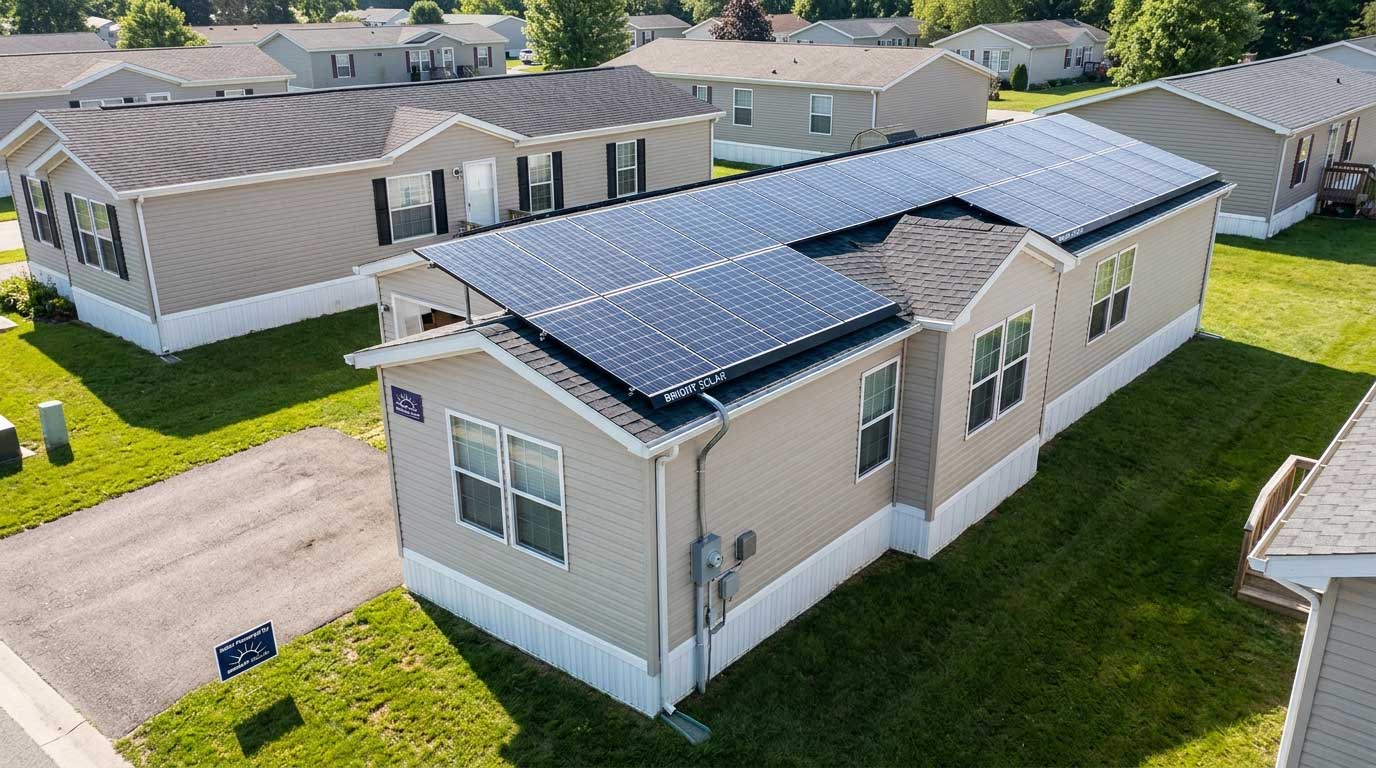
How Much Solar Energy Can a Mobile Home Produce?
Production depends on several factors.
Not all sunlight is equal.
A solar panel in Arizona behaves differently than the same panel in Oregon.
Location matters.
Roof orientation matters.
Shade matters.
Temperature matters.
According to the National Renewable Energy Laboratory (NREL), solar resource availability varies significantly across different regions of the United States.
Source:
https://www.nrel.gov
As a general reference:
| Solar System Size | Annual Production Range |
|---|---|
| 3kW | 3,500–5,000 kWh |
| 5kW | 6,000–8,500 kWh |
| 8kW | 10,000–13,500 kWh |
| 10kW | 12,000–17,000+ kWh |
Actual results depend on site-specific conditions.
This is why professional solar assessments remain essential.
Two neighboring homes can produce very different amounts of energy despite using identical equipment.
Choosing the Right Solar System Size
There is no universal answer.
The right solar system depends on:
- Household energy usage
- Roof size
- Geographic location
- Budget
- Future energy plans
- Utility rate structure
Many mobile homeowners eventually purchase:
- Electric vehicles
- Heat pumps
- Battery storage systems
- Additional appliances
A system designed only for today’s consumption may become undersized tomorrow.
When evaluating solar energy for mobile homes, I generally encourage homeowners to think five to ten years ahead rather than focusing exclusively on current usage.
Future-proofing often costs less than future expansion.
Small System Example
A retired couple living in a single-wide mobile home in New Mexico averaged approximately 650 kWh per month.
Their goals were straightforward.
Reduce utility bills.
Maintain simplicity.
Avoid batteries.
A 4kW system matched their objectives perfectly.
The installation remained relatively affordable while offsetting a significant portion of annual electricity consumption.
Not every homeowner needs a massive system.
Sometimes the smartest design is simply the one that matches actual needs.
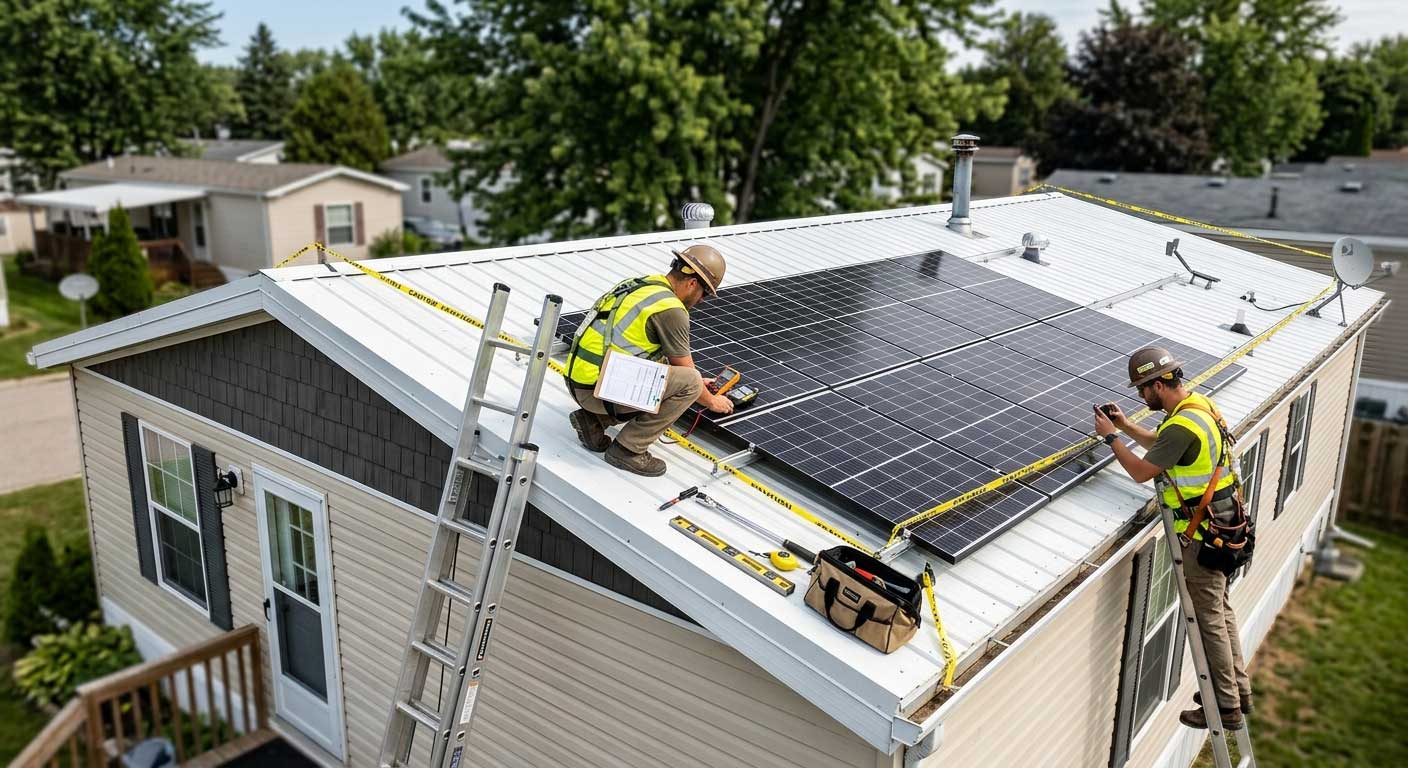
Roof Considerations for Mobile Homes
This topic receives far less attention than it deserves.
Solar panels are only as reliable as the structure supporting them.
Before installation, several factors should be evaluated:
- Roof age
- Structural integrity
- Roofing materials
- Wind exposure
- Water drainage
- Existing repairs
I once inspected a mobile home that looked perfectly suitable from ground level.
Once we climbed onto the roof, the situation changed.
Previous repair work had weakened multiple mounting locations.
Installing solar immediately would have created long-term reliability concerns.
The solution wasn’t complicated.
Address the roof first.
Install solar second.
Patience prevented future problems.
Flexible Solar Panels vs Traditional Rigid Panels
This question appears frequently.
Flexible panels have become increasingly popular, particularly among RV owners and marine users.
For mobile homes, however, the answer isn’t always straightforward.
Flexible panels offer advantages such as:
- Lower weight
- Easier transportation
- Simpler handling
- Compatibility with curved surfaces
Rigid panels offer advantages including:
- Higher efficiency
- Better heat dissipation
- Longer service life
- Stronger structural durability
The best option depends on the specific installation environment.
There is no universally superior technology.
Only appropriate applications.
What Does Solar Energy for Mobile Homes Cost?
This is usually the first question homeowners ask.
Ironically, it’s often the wrong first question.
The better question is:
“What value will the system produce during its lifetime?”
Still, installation cost matters.
Typical residential market ranges often look like this:
| System Size | Estimated Cost Range |
|---|---|
| 3kW | $7,000–$11,000 |
| 5kW | $11,000–$18,000 |
| 8kW | $17,000–$28,000 |
| 10kW+ | $22,000–$40,000+ |
Actual pricing varies based on:
- Equipment quality
- Installation complexity
- Local labor costs
- Permitting requirements
- Battery storage options
The cheapest proposal is rarely the most economical over twenty-five years.
Equipment reliability matters.
Warranty support matters.
Engineering quality matters.
I’ve seen systems that looked inexpensive on day one become expensive by year five.
Solar should be viewed as infrastructure, not simply as a product purchase.
The Shift From Utility Customer to Energy Producer
There’s a psychological aspect to solar that rarely appears in sales brochures.
Homeowners often tell me something changes after installation.
They start paying attention.
Not obsessively.
Just differently.
Energy becomes visible.
Production becomes measurable.
Consumption becomes understandable.
That awareness frequently leads to additional savings beyond what the solar panels generate themselves.
The roof begins producing electricity.
The homeowner begins understanding electricity.
Those two things together often create the strongest results.
Real Mobile Home Solar Projects: What Actually Happens After Installation
Solar proposals often look impressive on paper.
The reality begins six months later.
Then one year later.
Then after the homeowner has lived through summer heat, winter weather, utility rate increases, and real-world energy usage.
Those are the periods that reveal whether a system was designed correctly.
One project I remember clearly involved a retired couple in southern Nevada.
Their mobile home was not large. Roughly 1,400 square feet.
Their monthly electricity bills, however, regularly exceeded expectations because the home relied heavily on air conditioning for nearly eight months of the year.
After reviewing utility records, roof conditions, and available sunlight exposure, a 6kW system was recommended.
The homeowners initially wanted a larger array.
After modeling actual consumption patterns, the larger system offered little additional financial benefit.
Twelve months after installation, annual production aligned closely with projections.
More importantly, the homeowners reported something unexpected.
Their concern about electricity costs largely disappeared.
The system wasn’t producing “free” power.
But it was producing predictability.
That is often more valuable than homeowners realize.
Florida Coastal Mobile Home Installation
Florida creates a different challenge.
People assume constant sunshine guarantees maximum production.
Not necessarily.
Humidity, afternoon thunderstorms, salt exposure, and seasonal weather patterns create variables that many generic solar articles ignore.
A mobile home owner near Tampa requested a system sized to offset approximately 80% of annual electricity use.
The site received excellent morning sunlight.
Afternoon cloud formation was common.
Panel placement became more important than panel quantity.
Several roof sections were intentionally avoided despite available space.
The result was a cleaner production profile throughout the year.
Sometimes engineering restraint creates better outcomes than simply adding more equipment.
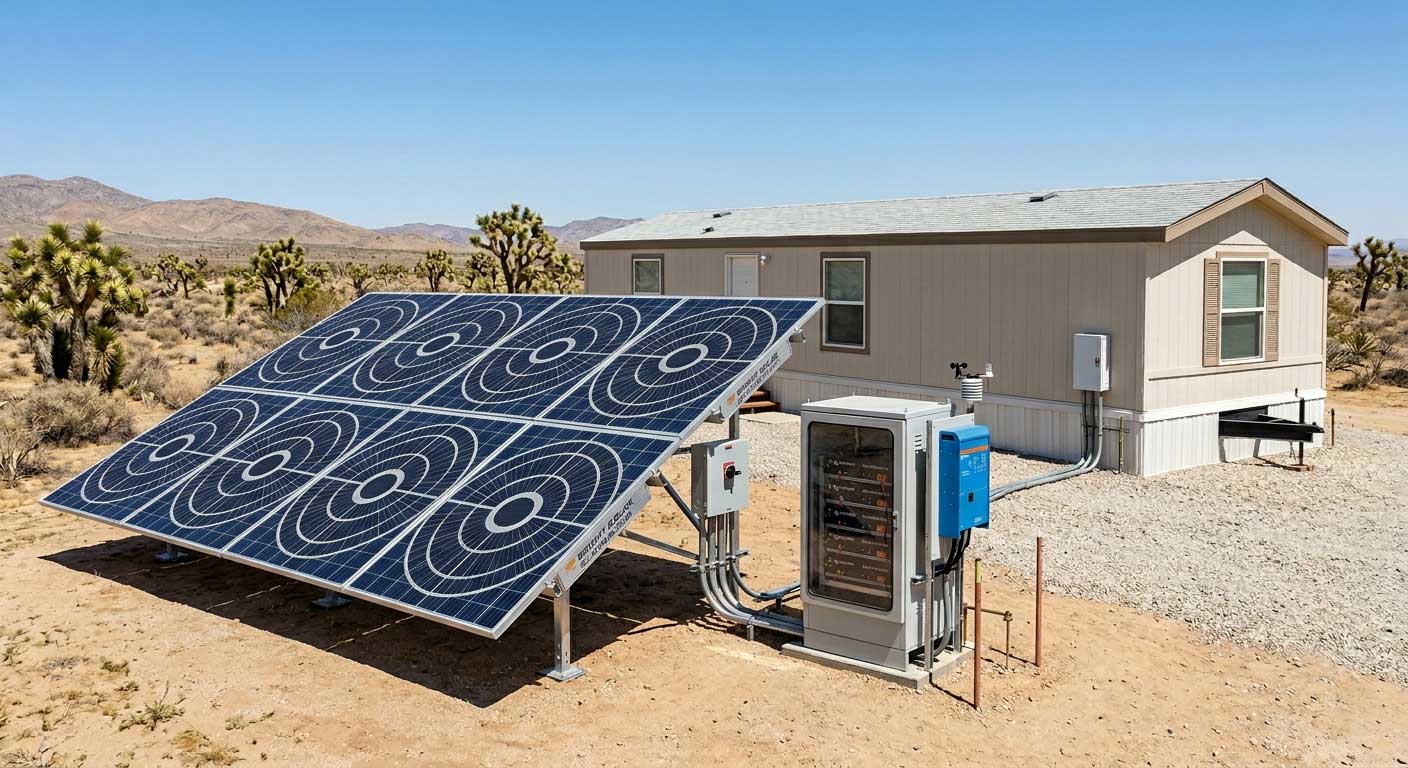
Rural Arizona Off-Grid Mobile Home
This project remains one of my favorites.
The property sat miles away from utility infrastructure.
Grid connection would have required significant investment.
Solar became the obvious solution.
The system included:
- High-efficiency solar panels
- Lithium battery storage
- Charge controllers
- Backup generator integration
- Remote monitoring
What impressed me most wasn’t the technology.
It was the homeowner’s preparation.
Energy usage had been carefully documented before system design began.
Every major appliance was evaluated.
Every load was categorized.
As a result, the system performed exactly as intended.
Off-grid success rarely comes from oversized equipment.
It comes from understanding consumption.
Calculating Return on Investment for Solar Energy for Mobile Homes
The phrase “solar payback period” appears everywhere.
Unfortunately, many calculations oversimplify reality.
Real-world ROI depends on:
- Utility rates
- Future electricity price increases
- System production
- Equipment lifespan
- Maintenance requirements
- Financing structure
- Local incentives
The most useful perspective is often lifetime energy production.
Consider a mobile home using approximately 10,000 kWh annually.
If a solar system offsets a large portion of that consumption over twenty-five years, the cumulative value becomes substantial.
Electricity prices rarely remain static for decades.
According to historical utility pricing trends published by the U.S. Energy Information Administration, long-term electricity costs generally trend upward despite periodic fluctuations.
Source:
https://www.eia.gov
This is why many homeowners view solar not merely as a purchase but as a hedge against future utility expenses.
Battery Storage: When Does It Make Sense?
Battery technology receives enormous attention.
Sometimes deservedly.
Sometimes excessively.
A common misconception is that every solar system requires batteries.
That simply isn’t true.
Many grid-connected solar installations operate effectively without storage.
Battery systems become valuable when specific objectives exist:
- Backup power during outages
- Greater energy independence
- Time-of-use rate management
- Off-grid living
- Critical equipment support
For example, a homeowner relying on refrigerated medications may value battery backup differently than someone living in an area with exceptionally reliable utility service.
The technology is impressive.
The question remains practical.
What problem is the battery solving?
Lithium Batteries vs Traditional Lead-Acid Batteries
The battery market has changed dramatically during the last decade.
Lithium batteries now dominate many residential applications due to:
- Longer lifespan
- Higher usable capacity
- Faster charging
- Lower maintenance
- Reduced weight
Lead-acid batteries still exist in certain installations but are becoming less common in new residential solar projects.
Choosing the correct storage solution depends on usage patterns rather than marketing claims.
Common Mistakes Mobile Home Owners Make When Going Solar
After reviewing hundreds of systems, a few mistakes appear repeatedly.
Not because homeowners lack intelligence.
Because the solar industry sometimes oversimplifies complex decisions.
Mistake #1: Focusing Only on Panel Wattage
Bigger numbers attract attention.
Higher wattage sounds better.
But system performance depends on much more than panel ratings.
Critical factors include:
- Roof orientation
- Shade analysis
- Inverter efficiency
- Wiring quality
- Installation workmanship
- System monitoring
A well-designed system frequently outperforms a larger poorly designed one.
Mistake #2: Ignoring Roof Age
Solar panels often carry performance warranties extending twenty-five years or longer.
If the roof requires replacement in five years, installation timing deserves reconsideration.
Removing and reinstalling solar equipment later adds avoidable expense.
The roof and solar system should ideally have similar life expectancies.
Mistake #3: Underestimating Future Energy Consumption
Life changes.
Energy consumption changes.
Future additions may include:
- Electric vehicles
- Heat pumps
- Home offices
- Battery storage
- Additional appliances
A system sized only for today’s needs may become inadequate surprisingly quickly.
Mistake #4: Choosing the Lowest Bid
I understand the temptation.
Solar is a significant investment.
But the lowest proposal often excludes details that matter later.
Mounting hardware quality.
Electrical components.
Warranty support.
Engineering review.
Monitoring systems.
Installation expertise.
Those differences may not appear obvious during the sales process.
They become obvious years later.
Why Solar Energy for Mobile Homes Is Becoming More Popular
Several trends continue driving adoption.
Electricity costs remain a concern.
Solar equipment continues improving.
Battery technology advances.
Homeowners increasingly value energy independence.
At the same time, awareness has improved.
Ten years ago, many mobile homeowners assumed solar was only practical for large suburban houses.
Today, that perception has changed.
Many mobile homes are excellent candidates for solar energy systems.
In some situations, they can achieve faster returns than larger residences simply because their overall energy requirements are lower.
My Experience After Years of Residential Solar Projects
If I had to summarize hundreds of site visits in one sentence, it would be this:
The best solar system is rarely the largest one.
The best system is the one that matches the homeowner’s actual needs.
I’ve seen oversized arrays underperform financially.
I’ve seen modest systems exceed expectations.
The difference usually comes down to planning.
Good solar design begins with understanding energy consumption.
Everything else follows.
Panels matter.
Inverters matter.
Batteries matter.
But understanding how electricity is used inside the home matters most.
FAQ About Solar Energy for Mobile Homes
Can solar energy power an entire mobile home?
Yes. A properly sized solar system can supply most or all household electricity needs depending on energy consumption, available roof space, and whether battery storage is included.
How many solar panels are needed for a mobile home?
The answer depends on electricity usage. Many mobile homes require systems ranging from 3kW to 8kW, though larger homes may require more capacity.
Are mobile homes suitable for solar installation?
Many are excellent candidates, provided the roof structure and site conditions are evaluated professionally before installation.
Do solar panels work during cloudy weather?
Yes. Solar panels continue generating electricity under cloudy conditions, although production levels are reduced compared to full sunlight.
Is battery storage required?
No. Many grid-connected systems operate effectively without batteries. Storage becomes valuable when backup power or greater independence is desired.
How long do solar panels last?
Most modern solar panels are designed for long-term operation and commonly carry performance warranties of 25 years or more.
Can solar increase mobile home value?
While market conditions vary, reduced operating costs and energy savings can improve overall property appeal.
What maintenance do solar panels require?
Solar systems generally require minimal maintenance. Periodic inspections and occasional cleaning are usually sufficient.
Final Thoughts on Solar Energy for Mobile Homes
When people first explore solar energy for mobile homes, they often focus on equipment.
Panel efficiency.
Battery capacity.
System size.
Those details matter.
But they are not where successful projects begin.
The strongest solar investments begin with understanding the home itself.
How much electricity is used.
When it is used.
What challenges the homeowner hopes to solve.
Over the years, I have walked across hundreds of rooftops, reviewed countless utility bills, and spoken with homeowners in environments ranging from humid coastal regions to remote desert communities.
The pattern remains remarkably consistent.
Solar works best when expectations are realistic and design decisions are grounded in actual energy needs.
At Bright Solar, we believe solar should be practical before it is impressive.
A well-designed system doesn’t need exaggerated promises.
It simply needs to produce reliable electricity year after year.
For many homeowners, the sunlight falling on their roof every day already represents a valuable energy resource.
The opportunity lies in capturing it.
And that is exactly what solar energy for mobile homes is designed to do.
Related recommendations
-

400w Solar Panel Size: Dimensions, Power Output, and Installation Guide
160A 400W solar panel typically measures about 65–82 × 39–44 inches, with actual dimensions varying by manufacturer, cell technology, and module design.
View details -
400 Watt Flexible Solar Panel for Serious Off-Grid Energy Systems
144Discover how a 400 watt flexible solar panel delivers lightweight, high-output off-grid energy for RVs, boats, vans, and solar battery systems.
View details -
1000W Solar Panel Guide: What a 1000W Solar Panel Can Really Power
221Learn how a 1000W solar panel system works, what it can power, expected daily output, installation options, and whether it fits your RV, home, boat, or off-grid project.
View details -
Flexible Portable Solar Panels for Reliable Mobile Solar Power
163Discover flexible portable solar panels for RV, camping and off-grid use. Learn how lightweight solar solutions deliver reliable power with Bright Solar experience.
View details