Best Solar Panel for RV: How to Choose the Right One
The best solar panel for RV use is one that matches your daily electricity consumption, available roof space, battery bank, shading conditions, and travel style. For many campers, 200W–400W is a practical starting range, while frequent boondockers with refrigerators, inverters and larger battery banks may need 600W or more.
That is the direct answer.
The mistake is assuming the highest-wattage panel is automatically the best panel.
It isn’t.
An RV roof is a strange solar site. It has vents, air conditioners, skylights, antennas, curved sections, cable penetrations and equipment that casts shadows at different times of the day. The roof may also be only a few square meters, so every usable section matters.
When I evaluate an RV solar design, I don’t begin by asking, “How many watts can we put up there?”
I start with the battery.
Then the loads.
Then the roof.
Only after that do I choose the panel.
What Is the Best Solar Panel for RV Use?
There are two main choices for most RV installations:
Both can work extremely well.
The better choice depends on the vehicle and how the owner uses it.
| Factor | Flexible Panel | Rigid Panel |
|---|---|---|
| Weight | Very low | Higher |
| Roof curvature | Excellent | Limited |
| Installation profile | Very low | Higher |
| Airflow beneath panel | Limited | Better |
| Mechanical rigidity | Lower | Higher |
| Bimini/curved surfaces | Excellent | Poor to moderate |
| Large flat roof | Good | Excellent |
| Low-profile appearance | Excellent | Moderate |
| Maintenance access | Can be difficult | Usually easier |
| Typical mounting | Adhesive/direct mounting depending on product | Brackets/rails |
For a low-profile camper with a slightly curved roof, flexible modules can make much more sense.
For a large Class A motorhome with a broad, flat roof, rigid modules may be easier to ventilate, inspect and replace.
Neither answer should be treated as universal.
Best RV Solar Panels: Start With Electricity Use
Before choosing the panel, write down everything that consumes electricity.
A realistic RV load inventory might look like this:
| Appliance | Example Power | Daily Runtime | Approx. Energy |
|---|---|---|---|
| LED lights | 25W | 4h | 100Wh |
| Refrigerator | 50W average | 12h | 600Wh |
| Laptop | 60W | 4h | 240Wh |
| Phone charging | 15W | 3h | 45Wh |
| Water pump | 60W | 0.5h | 30Wh |
| Wi-Fi router | 15W | 8h | 120Wh |
| TV | 80W | 3h | 240Wh |
| Example total | — | — | 1,375Wh/day |
These are planning examples, not manufacturer-rated consumption figures.
A refrigerator rated at 50W does not necessarily consume 50W every minute of the day. Compressors cycle.
The same applies to pumps and other intermittent loads.
The number that matters is watt-hours per day.
The U.S. Department of Energy explains that solar production can vary with season, time of day, clouds, dust, haze, shadows, rain, snow and dirt.
That is particularly important on an RV roof.
RV Solar Panel Wattage: How Much Do You Need?
A useful first calculation is:
Solar array size ≈ Daily energy consumption ÷ usable solar hours
Suppose the RV uses:
1,400Wh/day
and you plan around:
4 peak-sun-equivalent hours/day
Then:
1,400Wh ÷ 4h = 350W
So a 350W array is the theoretical starting point.
I would not specify exactly 350W and call the job finished.
Real installations have losses.
You have:
- Heat
- Cable resistance
- Controller losses
- Battery charging losses
- Dirt
- Clouds
- Shading
- Suboptimal orientation
- Roof equipment
NREL’s PVWatts modeling tools explicitly account for soiling and other system factors when estimating photovoltaic production rather than assuming the nameplate rating is the actual daily output.
For an RV, roof shading is one of the details I check first.
A 20-minute observation from 10 a.m. to 10:20 a.m. tells you almost nothing about the whole day.
Watch the roof at different times.
The air conditioner may shade one panel at noon.
The antenna may shade another at 3 p.m.
That is the reality.
100W, 200W, 400W or 600W: Which RV Solar Panel Size?
There is no magic wattage.
But these ranges are useful for initial planning.
| Solar Capacity | Typical RV Application |
|---|---|
| 100W | Battery maintenance, lights, phones |
| 200W | Small camper or weekend trips |
| 300–400W | General off-grid RV use |
| 500–600W | Frequent boondocking |
| 800W+ | High electrical consumption |
A small camper with LED lights and USB charging may never need 600W.
A larger RV running refrigeration, computers, entertainment equipment and an inverter may use that capacity surprisingly quickly.
The important distinction is between energy generation and instantaneous power.
A 400W solar array does not mean you can run a 1,500W microwave indefinitely.
It means the array can generate energy during daylight under appropriate conditions.
Best Solar Panel for RV With a Battery Bank
Solar panels and batteries perform different jobs.
The panel produces energy.
The battery stores energy.
The controller manages the charging relationship.
The Department of Energy describes storage as a way to capture generated electricity and use it at a different time, which is particularly important because solar production and electricity demand do not always occur simultaneously.
For example:
12V 100Ah battery
Nominal stored energy:
12V × 100Ah = 1,200Wh
That does not mean the RV should automatically consume the full 1,200Wh.
Actual usable energy depends on:
- Battery chemistry
- Depth-of-discharge limits
- Temperature
- Battery management system
- Battery age
- Manufacturer specifications
This is why a solar panel should never be selected separately from the battery.
A 400W panel connected to a very small battery can be an awkward system.
Likewise, a huge battery with only 100W of solar may take too long to recharge during normal travel.
Flexible Solar Panels for RV vs Rigid Panels
This is where RV design becomes more interesting.
A flexible solar panel can follow a curved surface and sit much closer to the roof.
That can be a major advantage on:
- Camper vans
- Teardrop trailers
- Small travel trailers
- Curved RV roofs
- Low-clearance vehicles
- Lightweight builds
The panel is less visually intrusive.
There are fewer protruding brackets.
The installation can be remarkably clean.
But there is another side.
A flexible panel installed directly on a roof generally has less airflow beneath it than a rigid module mounted above the roof.
That can matter because module operating temperature affects PV output.
So I would not evaluate a flexible panel solely by its thickness or weight.
I would ask:
How will this panel behave on this particular roof?
A dark fiberglass roof in Arizona is a very different installation environment from a white roof in Oregon.
Flexible Solar Panels for RV: When They Are the Better Choice
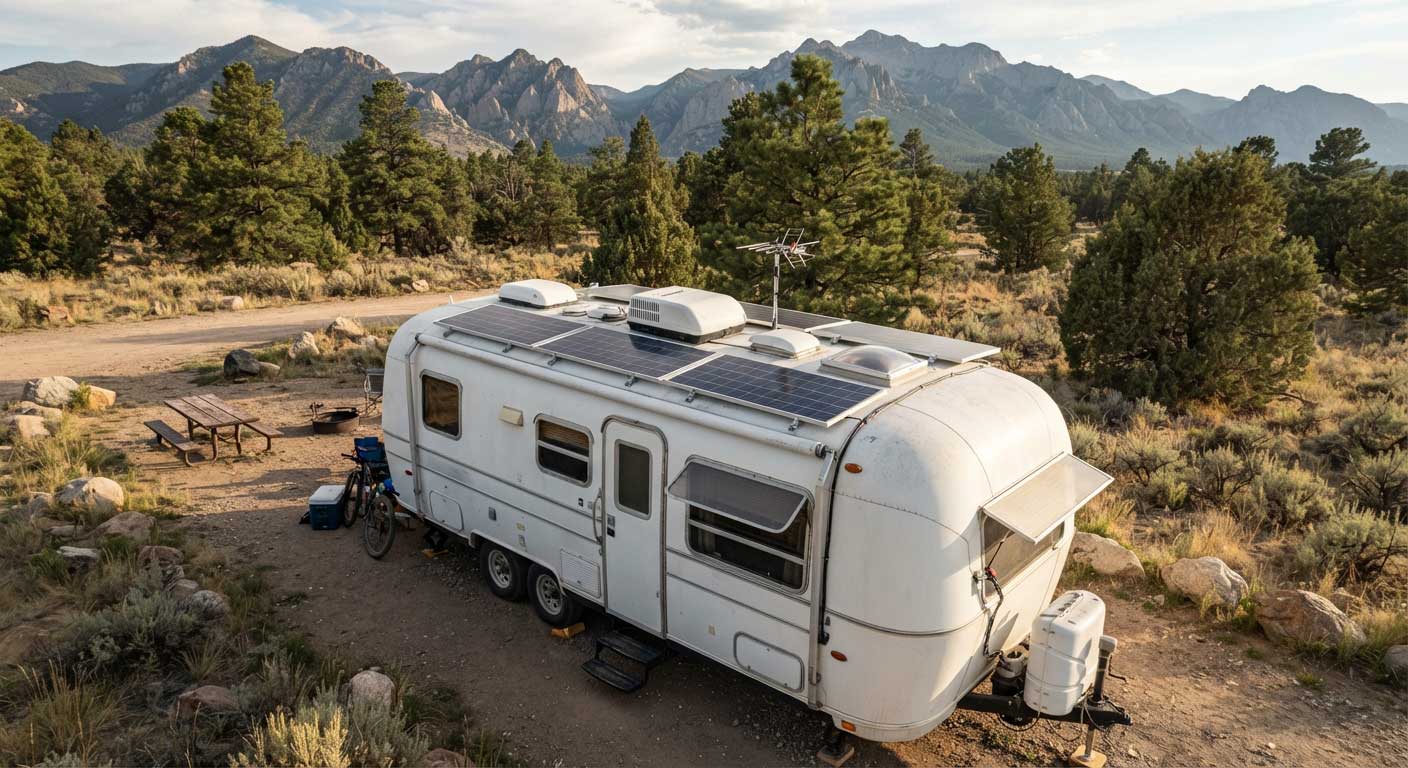
Flexible modules become especially attractive when the RV roof is crowded.
Imagine a 24-foot travel trailer.
The owner has:
- One roof air conditioner
- Two vents
- One skylight
- A TV antenna
- A bathroom exhaust
- A curved front section
A rigid 400W array might technically fit.
But fitting it does not mean installing it well.
A flexible layout may allow the installer to use sections of roof that rigid mounting hardware would make difficult.
This is one of the reasons Bright Solar focuses on flexible solar applications.
The value is not simply that the panel bends.
The value is that the available surface becomes easier to use.
Rigid Solar Panels for RVs
Rigid modules remain an excellent option.
They provide a sturdy frame and can be installed with an air gap above the roof.
That gap is useful.
It allows air to move underneath the panel, makes inspection easier and can simplify replacement.
Rigid panels can be particularly attractive on:
- Class A motorhomes
- Large fifth wheels
- Flat travel-trailer roofs
- Work trailers
- Permanent RV installations
The drawback is mostly physical.
Brackets increase height.
More hardware means more roof penetrations or mounting points depending on the installation method.
For a vehicle traveling thousands of miles per year, every mounting point deserves attention.
Vibration changes the installation environment compared with a stationary rooftop solar array.
Best Solar Panel for RV: Roof Space Is the Real Limitation
RV owners sometimes tell me:
“I have a 30-foot RV, so I have plenty of room.”
Then we measure the roof.
The actual usable area is much smaller.
The air conditioner might occupy a large central section.
The front skylight needs clearance.
The vents cannot simply disappear.
The satellite equipment needs service access.
Suddenly the “30-foot roof” has a much smaller usable solar area.
I recommend drawing the roof from above before buying panels.
Mark:
- Air conditioners
- Vents
- Skylights
- Antennas
- Satellite dishes
- Existing solar panels
- Cable-entry locations
- Walkable areas
- Required maintenance clearances
Then calculate the remaining rectangular and irregular areas.
This simple exercise often changes the panel choice.
Shading: The RV Solar Problem People Underestimate
NREL maintains a dedicated PV shading database for modeling partial-shading effects. Its published methodology reports performance predictions within approximately 1%–2% of measured data for several partially shaded PV systems.
That is useful evidence that shading is not merely a theoretical concern.
On an RV, the source of shade is usually obvious:
- Air conditioner
- Roof vent
- Antenna
- Satellite dish
- Awning hardware
- Nearby trees
The problem is that the shadow moves.
If you camp under trees, the situation becomes even more variable.
A beautiful campsite can be a terrible solar site.
I have seen RV layouts where moving one panel 12–18 inches produced a more useful installation than adding another panel into a heavily shaded position.
That is not something a wattage calculator can tell you.
Best RV Solar Panel for Boondocking
Boondocking is where solar design gets serious.
At a powered campground, solar reduces dependence on shore power.
In a remote campsite, solar may be the primary energy source.
Suppose an RV consumes approximately:
1.2kWh/day
A 400W array might produce roughly:
400W × 4h = 1.6kWh
under the simplified assumption of four equivalent peak-sun hours.
That looks comfortable.
But reduce the effective production to 2.5 hours during a cloudy day:
400W × 2.5h = 1.0kWh
Now the RV has a deficit.
The battery absorbs the difference.
This is why battery capacity matters so much for extended off-grid travel.
How I Size an RV Solar System
My preferred process is fairly simple.
Step 1: Measure daily energy consumption
Record actual usage where possible.
Don’t rely entirely on appliance labels.
Step 2: Measure the roof
Draw the roof and mark every obstruction.
Step 3: Check shading
Observe the roof throughout the day.
Step 4: Select panel type
Choose flexible or rigid based on the physical installation.
Step 5: Select array wattage
Use daily energy consumption and local solar conditions as the starting point.
Step 6: Size the battery
Decide how much energy must be available after sunset or during poor weather.
Step 7: Select the controller
Check:
- Maximum PV voltage
- Maximum PV current
- Battery voltage
- Array configuration
- Temperature-adjusted Voc
Step 8: Design the wiring
Check cable length, voltage drop, connectors and protection.
Step 9: Test before sealing
Measure actual PV voltage and charging current.
Check polarity.
Check every connection.
Only then close up the installation.
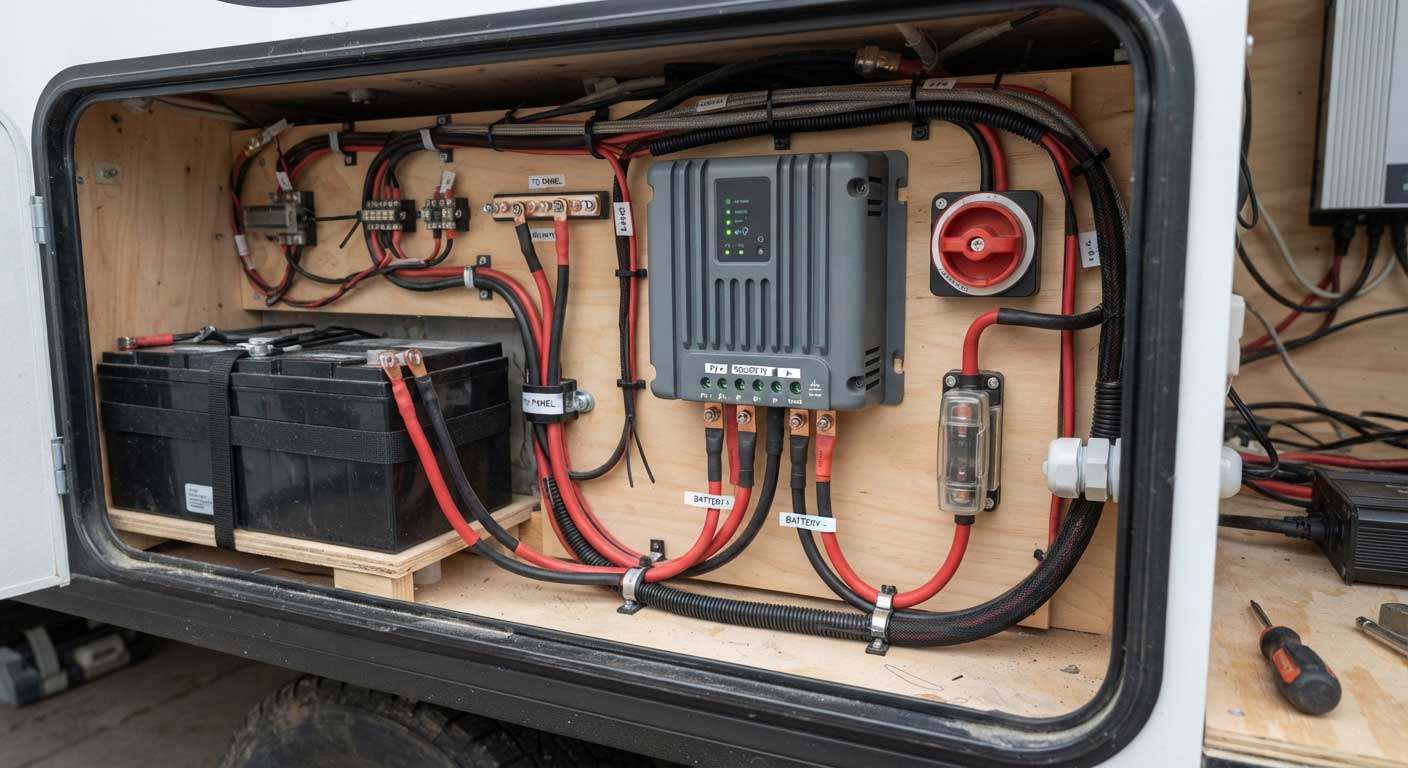
MPPT or PWM for an RV Solar Panel?
For larger RV arrays, MPPT is often the more flexible choice.
The important part is not the acronym.
It is matching the controller to the electrical characteristics of the array.
Suppose two hypothetical 200W panels each have:
- Vmp = 20V
- Imp = 10A
Series connection:
40V × 10A ≈ 400W
Parallel connection:
20V × 20A ≈ 400W
Same nominal power.
Different voltage and current.
The choice affects wiring, controller requirements and shading behavior.
The controller’s maximum PV voltage must not be exceeded.
This is particularly important when panels are connected in series because cold-weather open-circuit voltage can be higher than the nominal value listed under standard test conditions.
How Much Energy Can an RV Solar Panel Produce?
A panel’s wattage is its rated power under specified test conditions.
It is not a daily energy guarantee.
A useful planning equation is:
Daily energy ≈ Panel watts × equivalent sun hours × system efficiency
For example:
400W × 4h × 0.80 = 1,280Wh/day
The 80% figure here is an illustrative planning assumption.
It should not be presented as a guaranteed system efficiency.
Actual performance changes with:
- Temperature
- Shading
- Soiling
- Orientation
- Weather
- Wiring
- Controller behavior
- Battery charging conditions
NREL’s national soiling data provides a useful reminder of how much surface contamination can matter. Its current map covers fielded PV systems and soiling stations at 255 locations in the United States; an insolation-weighted soiling ratio of 0.95 represents approximately 5% annual energy loss from soiling.
An RV traveling through dusty deserts, agricultural areas or pollen-heavy regions can accumulate contamination quickly.
A panel does not have to look filthy before its performance begins to change.
Cleaning and Maintaining RV Solar Panels
RV solar panels live in a particularly dirty environment.
The vehicle moves through:
- Dust
- Pollen
- Road film
- Tree sap
- Insects
- Bird droppings
- Desert sand
NREL research notes that soiling losses can become significant in dry and dusty environments, with annual losses reaching much higher levels in some regions.
For RV owners, the maintenance routine can be simple.
Inspect regularly
Check for:
- Dirt accumulation
- Surface damage
- Loose hardware
- Cable wear
- Water entry
- Connector damage
Clean when necessary
Use the cleaning method recommended by the panel manufacturer.
Avoid aggressive tools or chemicals that can damage the surface.
Inspect after long trips
This is especially important after:
- Rough roads
- Heavy wind
- Severe storms
- Long-distance travel
A solar panel can be electrically perfect and mechanically loose.
Those are different failure modes.

Best Solar Panel for RV: Flexible or Rigid?
Here is the practical comparison I use when discussing an RV project:
| Situation | Better Starting Point |
|---|---|
| Curved roof | Flexible |
| Low-profile installation | Flexible |
| Weight-sensitive camper | Flexible |
| Bimini installation | Flexible |
| Large flat Class A roof | Rigid |
| Maximum airflow | Rigid |
| Easy panel replacement | Rigid |
| Frequent rooftop maintenance | Rigid |
| Crowded irregular roof | Flexible |
| Large unobstructed surface | Rigid |
There is an important caveat.
These are installation tendencies, not universal rules.
A premium rigid module can outperform a poorly installed flexible panel.
A properly designed flexible system can outperform a rigid system that wastes half the available roof because of mounting constraints.
Realistic RV Case Study: 400W Solar System
Consider a 25-foot travel trailer used by two people for extended weekend trips and occasional one-week boondocking.
The owner uses:
- Refrigerator
- LED lighting
- Two laptops
- Phones
- Water pump
- Wi-Fi
- Small television
Measured daily consumption averages approximately:
1.2–1.5kWh/day
The roof can accommodate approximately:
400–500W
after accounting for the air conditioner and vents.
The owner wants a low-profile installation.
A flexible array becomes attractive.
The design could use:
- Approximately 400W of flexible PV
- 12V lithium battery storage
- MPPT charge controller
- Properly sized PV wiring
- Battery protection
- Monitoring
The important point is not the exact component list.
It is the relationship between them.
The solar array is sized around actual consumption.
The battery provides nighttime storage.
The controller is selected from the panel electrical specifications.
The roof layout is built around the real equipment already there.
That is what makes the system coherent.
Common Mistakes When Choosing the Best Solar Panel for RV
Choosing Based Only on Wattage
Two 400W panels can have very different physical dimensions and electrical characteristics.
Ignoring Roof Shading
A panel sitting beside an air conditioner may look perfect at installation and perform poorly during important parts of the day.
Installing Too Many Panels
More panels are not useful if they interfere with vents, maintenance or safe roof access.
Undersizing the Battery
Solar cannot directly solve nighttime energy storage.
Forgetting the Inverter
Running AC appliances requires appropriate inverter capacity and battery power.
Ignoring Cable Length
Long DC cable runs can introduce meaningful voltage drop.
Not Planning for Expansion
If the owner expects to add another 200W later, the controller and wiring should be considered accordingly.
What Should You Look for in the Best Solar Panel for RV?
Before purchasing, check the technical datasheet.
Panel specifications
Look for:
- Rated power
- Voc
- Vmp
- Isc
- Imp
- Dimensions
- Weight
- Operating temperature
- Maximum system voltage
- Mechanical specifications
For flexible panels
Also check:
- Maximum bend radius
- Surface material
- Mounting method
- Adhesive compatibility
- Junction-box construction
- Cable exit location
For RV applications
Pay particular attention to:
- Roof weight
- Vibration
- UV exposure
- Water exposure
- Cable entry
- Maintenance access
A product page saying “RV solar panel” is not enough.
The datasheet is where the engineering starts.
Why Bright Solar Flexible Panels Fit Certain RV Designs
Bright Solar focuses on flexible solar solutions for applications where conventional rigid modules are not always convenient.
For RVs, that matters when the roof is:
- Lightweight
- Slightly curved
- Crowded
- Weight-sensitive
- Better suited to a low-profile installation
A flexible solar panel can turn otherwise difficult roof sections into useful generating space.
That is the practical advantage.
Not simply flexibility for its own sake.
The correct Bright Solar configuration should still be matched to:
- RV electrical consumption
- Battery voltage
- Battery capacity
- Charge controller
- Roof dimensions
- Shading
- Cable length
- Expected travel conditions
The panel is part of the system.
It isn’t the entire system.
FAQ About the Best Solar Panel for RV
What is the best solar panel for RV use?
The best solar panel for RV use is the one that fits the roof, matches the battery and controller, provides enough daily energy, and suits the RV’s operating conditions. Flexible panels are excellent for curved and weight-sensitive roofs, while rigid panels work well on large flat roofs.
How many watts of solar do I need for an RV?
Many RVs can start around 200W–400W for moderate electricity use. Frequent boondocking or high consumption from refrigerators, inverters and electronics may require 600W or more.
Are flexible solar panels good for RV roofs?
Yes. Flexible panels are particularly useful when low weight, low profile and curved or irregular roof surfaces are important. The installation must still account for panel temperature, mounting conditions and manufacturer specifications.
Is 400W solar enough for an RV?
400W can be enough for moderate off-grid RV use under favorable solar conditions. Actual performance depends on daily consumption, shading, weather, panel orientation, battery capacity and system losses.
What size battery do I need with an RV solar panel?
A 12V 100Ah–200Ah battery bank is a common starting range for moderate RV systems, but the correct capacity depends on daily energy consumption, desired autonomy, battery chemistry and allowable depth of discharge.
Should RV solar panels be wired in series or parallel?
Either configuration can work. Series increases array voltage, while parallel increases current. The correct choice depends on panel specifications, controller limits, cable length, shading and system voltage.
Can solar panels power an RV air conditioner?
They can contribute to an air-conditioning system, but RV air conditioners typically require substantial electrical power. A practical design needs enough solar generation, battery storage and inverter capacity to support the compressor load.
Conclusion: Choosing the Best Solar Panel for RV
The best solar panel for RV use is not necessarily the most powerful panel you can fit onto the roof.
It is the panel that works with the vehicle.
A small camper with modest electrical needs may be perfectly served by 200W. A family traveling without hookups may find 400W more practical. Heavy boondocking can push the requirement toward 600W, 800W or beyond.
Flexible panels are especially useful when weight, roof curvature and low-profile installation matter. Rigid panels remain excellent where a large, flat, structurally strong roof provides room for conventional mounting.
The most useful RV solar design starts with three measurements:
How much energy you use.
How much roof you actually have.
How much energy you need after the sun goes down.
From there, the panel, battery, controller and wiring can be sized as one system.
That approach is more reliable than buying a panel first and trying to make everything else fit around it.
For RV owners comparing the best solar panel for rv applications, Bright Solar’s flexible modules are particularly worth considering when conventional rigid panels create problems with roof weight, curvature or available installation space.
The right panel is the one that gives your RV more usable energy without making the vehicle harder to live with.
Related recommendations
-

Walkable Solar Panels for Boats, RVs and High-Traffic Surfaces
219Discover how walkable solar panels provide reliable power while supporting foot traffic on boats, RVs, and marine decks. Learn key specifications, durability, and installation tips.
View details -
High Efficiency Flexible Solar Panels: Advanced Lightweight Solar Power Solution
111Discover high efficiency flexible solar panels from Bright Solar. Learn how advanced materials improve solar output, flexibility, and performance for RV, marine, and off-grid applications.
View details -
Series vs Parallel Solar Panels: Which Wiring Method Performs Better?
110Compare series vs parallel solar panels for RVs, homes, and off-grid systems. Bright Solar explains voltage, current, shading, and wiring efficiency.
View details -
Best Solar Panel Setup for RV and Off-Grid Systems: Complete Guide
204Discover the best solar panel setup for RV and off-grid systems with wiring options, battery sizing, MPPT controllers, and flexible solar panel solutions.
View details