
Solar Panels in Parallel vs Series: A Complete Guide to Solar Panel Wiring
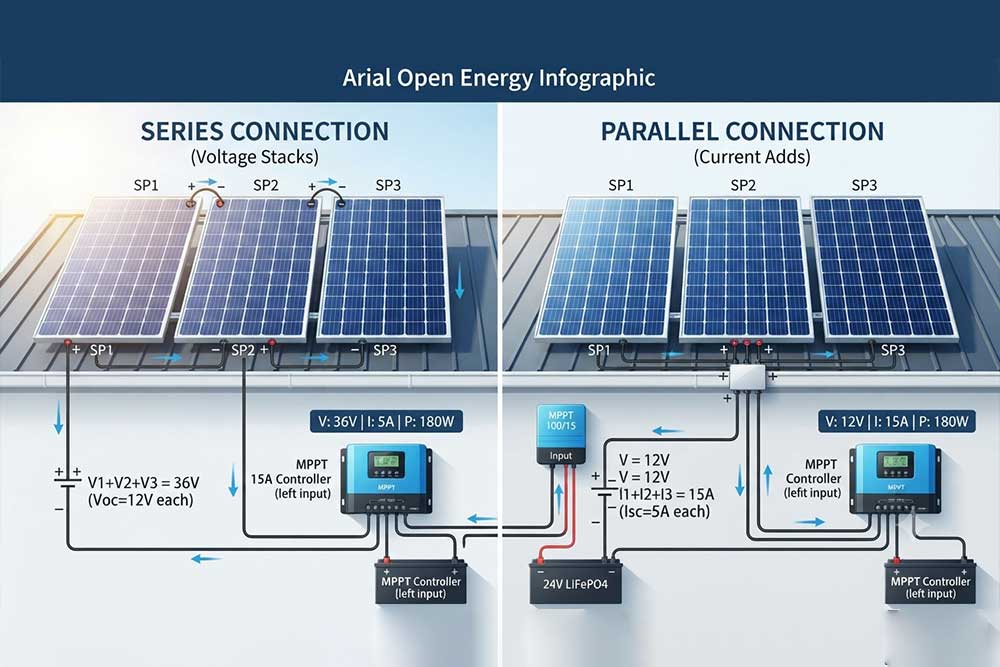
Solar panels in parallel vs series is one of the most important decisions when designing a photovoltaic system. A series connection increases voltage while keeping current the same, whereas a parallel connection keeps voltage unchanged while increasing current. The right choice depends on your charge controller, inverter, cable distance, shading conditions, and energy requirements.
For homeowners, RV owners, marine users, and off-grid installers, understanding solar panel wiring can directly affect system efficiency, safety, and long-term performance.
At Bright Solar, we often see customers focus only on solar panel wattage while overlooking the importance of electrical configuration. Two systems using the same panels can produce different results simply because the panels are connected differently.
Before choosing between solar panels in series or parallel, it is important to understand how voltage, current, and power behave in each configuration.
Solar Panels in Parallel vs Series: What Is the Difference?
The main difference between solar panels connected in series and parallel is how they change voltage and current.Understanding the relationship between voltage and current is the foundation of solar panel wiring design. If you want to learn how these electrical values affect solar output, read our complete guide on solar panel voltage vs current explained.
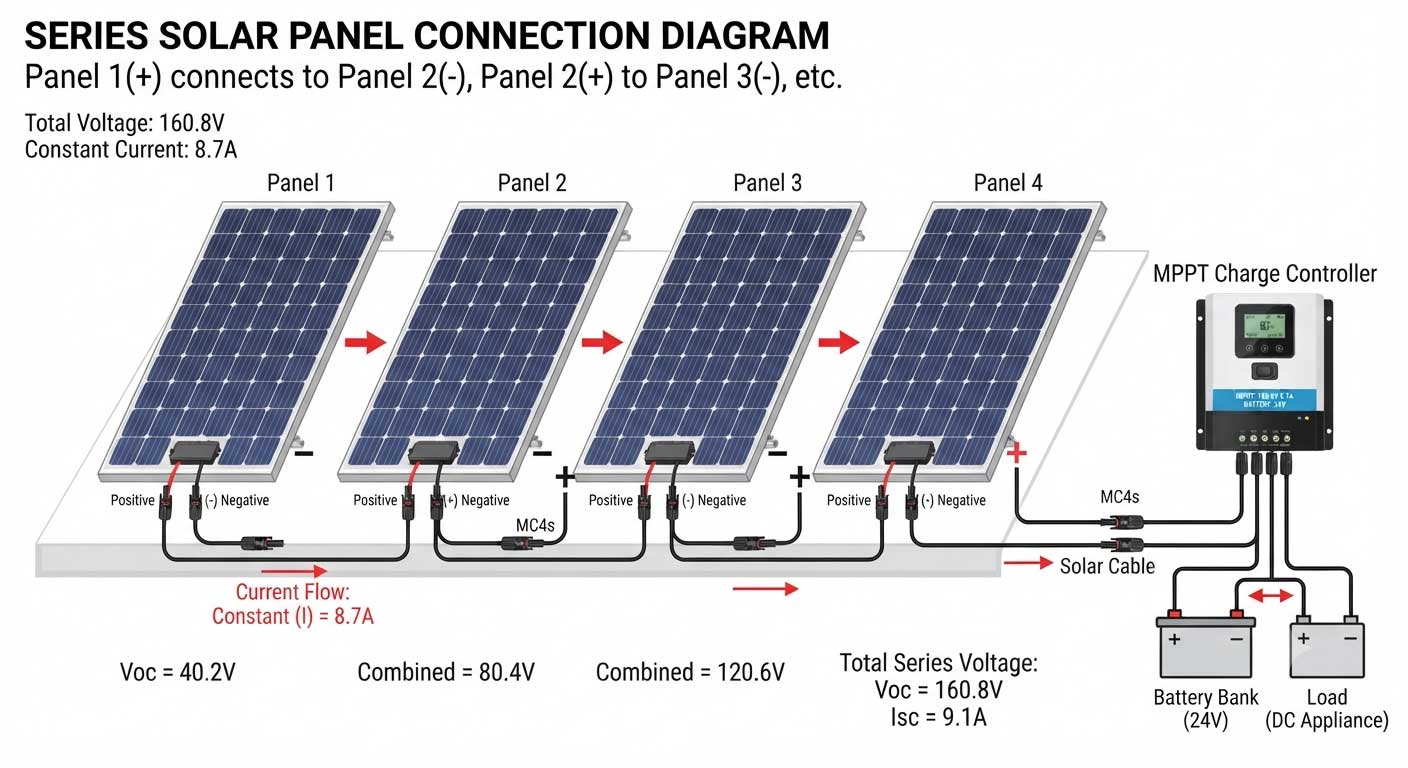
In a series connection, the positive terminal of one solar panel connects to the negative terminal of the next panel. The voltage of each panel adds together, while the current remains the same.
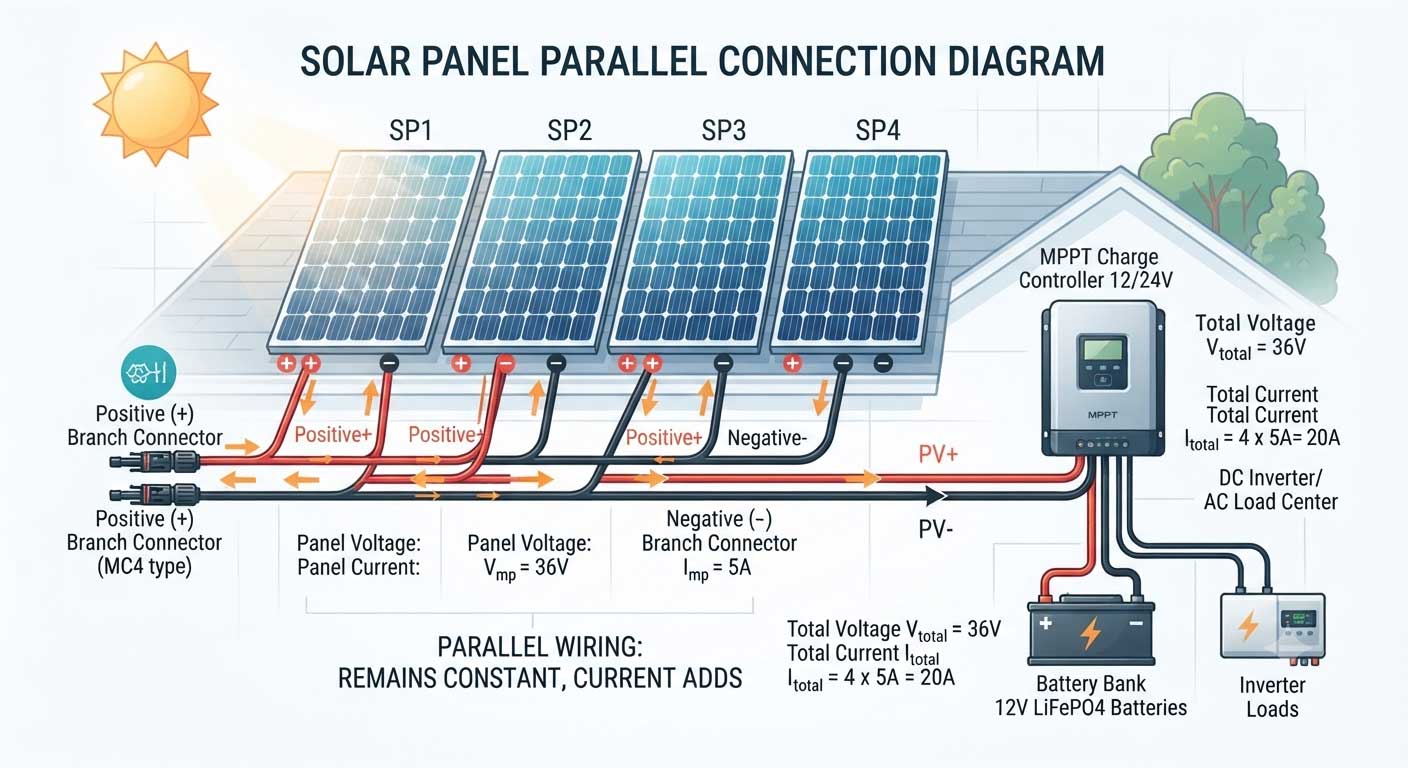
In a parallel connection, all positive terminals are connected together and all negative terminals are connected together. The voltage stays the same as a single panel, but the current increases.
For example, assume you have two identical 100W solar panels:
Series connection:
- Panel voltage: 20V
- Panel current: 5A
Total output:
- Voltage: 20V + 20V = 40V
- Current: 5A
- Power: 40V × 5A = 200W
Parallel connection:
- Panel voltage: 20V
- Panel current: 5A
Total output:
- Voltage: 20V
- Current: 5A + 5A = 10A
- Power: 20V × 10A = 200W
The total power remains theoretically similar, but the way electricity travels through the system changes. This difference affects cable size, controller selection, installation cost, and real-world performance.
The basic electrical relationship follows:
Power (Watts) = Voltage (Volts) × Current (Amps)
This formula is commonly used in photovoltaic system design to calculate solar output.
How Solar Panels in Series Work
Solar panels in series are connected like a chain. The positive output of one panel connects to the negative input of the next panel, creating a single solar string.The maximum number of solar panels connected in series depends on the open-circuit voltage (Voc) of each panel and the maximum PV input voltage of your inverter or charge controller. For a detailed calculation method, see our guide on how many solar panels can be connected in series.
The main advantage of series wiring is higher system voltage.
When solar panels are connected in series:
- Voltage increases
- Current stays unchanged
- Total wattage increases according to the combined voltage
According to Renogy’s technical explanation, series connections add panel voltages together while maintaining the same current level throughout the string.
Example of Solar Panels Connected in Series
Imagine four 200W flexible solar panels:
Each panel:
- Operating voltage: 20V
- Current: 10A
Connected in series:
Voltage:
20V × 4 = 80V
Current:
Remains 10A
Power:
80V × 10A = 800W
This higher voltage design is useful when solar panels are installed far away from the charge controller or inverter.
Higher voltage allows the system to transmit the same amount of power with lower current, which can reduce cable losses and allow the use of smaller wire sizes.
For larger residential and commercial solar systems, series wiring is commonly used because inverters and MPPT charge controllers are often designed to operate with higher PV input voltages.
Benefits of Connecting Solar Panels in Series
1. Lower Current and Reduced Cable Loss
One major advantage of series wiring is reducing current flow.
Electrical losses in cables increase as current increases. Therefore, increasing voltage while keeping current lower can improve transmission efficiency, especially when panels are installed far from batteries or controllers.
This is why many:
- Residential rooftop systems
- Commercial solar arrays
- Large off-grid systems
use series-connected solar strings.
2. Better Compatibility With MPPT Controllers
Maximum Power Point Tracking (MPPT) charge controllers are designed to optimize solar energy harvesting by adjusting electrical operating points.
Higher PV input voltage allows MPPT controllers to operate efficiently across a wider voltage range.
For example:
A solar array producing 80V may provide more flexibility for an MPPT controller than a low-voltage 20V array, depending on the equipment specifications.
Always check:
- Maximum PV input voltage
- Maximum charging current
- Battery voltage requirements
before designing a series solar system.
Series solar panel configurations are commonly paired with MPPT charge controllers because they can efficiently convert higher PV voltage into battery charging power. To understand the differences between controller technologies, check our guide on MPPT vs PWM charge controller for solar panels.
3. Cleaner Solar Panel Wiring Layout
Series connections require fewer parallel branches.
For example:
Eight solar panels can be connected as:
- One string of eight panels in series
or:
- Eight panels connected separately in parallel
The series configuration usually requires fewer connectors and simpler cable management.
This is especially useful for:
- RV solar installations
- Marine solar systems
- Custom flexible solar panel projects
Bright Solar flexible solar panels are often used in applications where installation space is limited, such as RV roofs, boats, and curved surfaces. Choosing series or parallel wiring depends on the system voltage requirement and the connected equipment.Visit product page:Flexible Solar Panels
How Solar Panels in Parallel Work
Solar panels connected in parallel work differently from series-connected panels. Instead of increasing voltage, parallel wiring increases the available current while keeping the system voltage unchanged.
In a parallel configuration, the positive terminals of all solar panels are connected together, and the negative terminals are connected together. The combined current from each panel flows into the charge controller or inverter, increasing the total current capacity of the solar array.
For example, two identical 200W solar panels may have:
- Operating voltage: 20V
- Operating current: 10A
When connected in parallel:
- Voltage remains: 20V
- Current increases: 10A + 10A = 20A
- Total power: 20V × 20A = 400W
According to Renogy’s solar wiring guide, parallel connections add the current output of each solar panel while maintaining the same voltage level. This makes parallel wiring useful for systems where maintaining lower voltage is important.
Source: https://www.renogy.com/blogs/learn-center/learn-series-and-parallel
Advantages of Wiring Solar Panels in Parallel
1. Better Performance in Partial Shading Conditions
One of the biggest advantages of wiring solar panels in parallel is improved performance when individual panels receive different amounts of sunlight.
In a parallel solar array, each panel operates independently at the same system voltage. If one panel produces less power because of shade, dirt, or a different orientation, the other panels can continue producing energy.
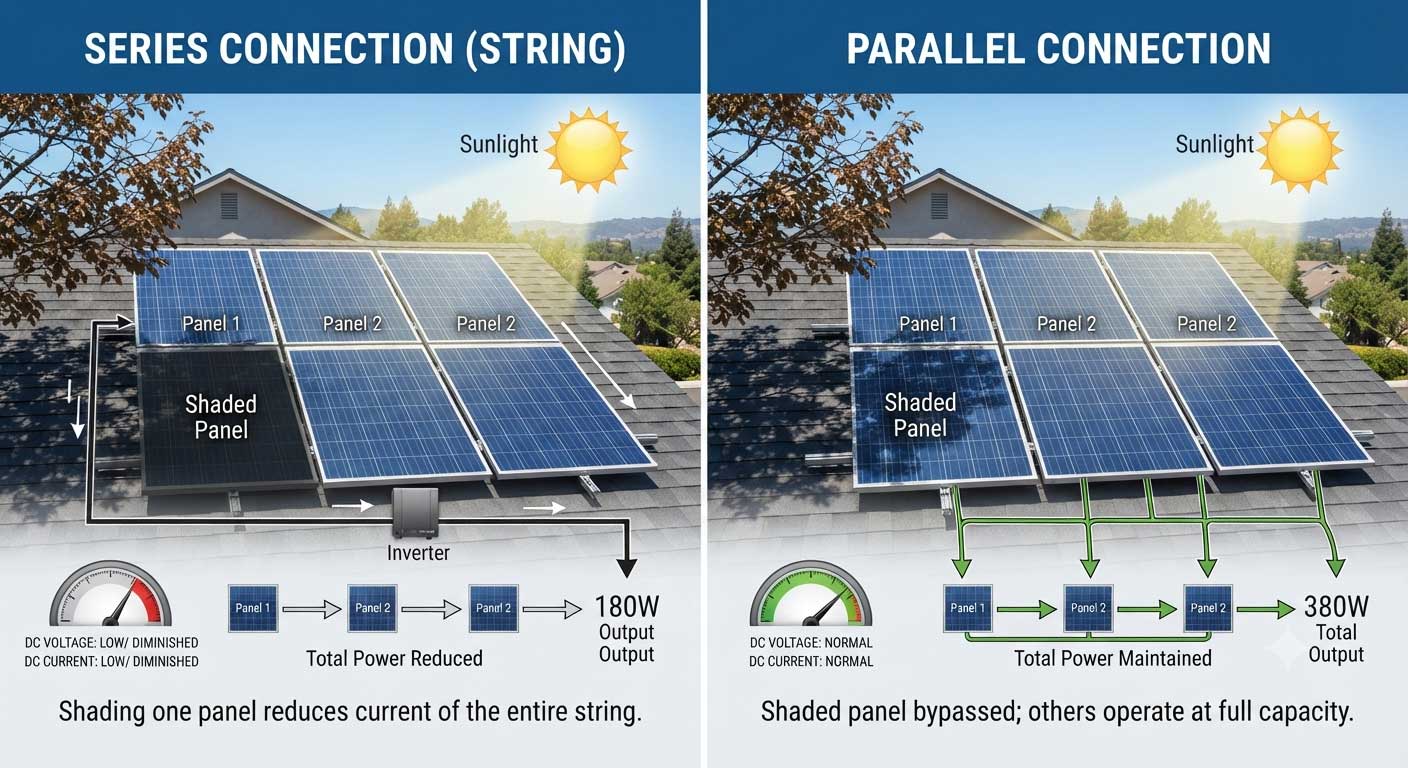
In contrast, solar panels in series are connected as one electrical string. When one panel’s current output decreases, the entire string may be affected because the same current flows through every panel.
However, real-world shading behavior depends on many factors, including panel design, bypass diodes, inverter type, and system configuration.
The National Renewable Energy Laboratory (NREL) explains that photovoltaic modules include bypass diodes to reduce the impact of partial shading and prevent excessive heating in shaded cells.
Source: https://www.nrel.gov/docs/fy12osti/53870.pdf
For applications such as:
- RV solar panels
- Marine solar systems
- Portable solar panels
- Flexible solar panels installed on uneven surfaces
parallel wiring can be a practical solution when shading conditions are unpredictable.
2. Suitable for Low-Voltage Solar Systems
Parallel solar panel wiring is commonly used in smaller solar applications where the system voltage needs to match battery voltage directly.
Typical examples include:
- 12V battery systems
- Portable solar chargers
- Small off-grid systems
- Camper solar setups
For example, many RV owners use 12V solar panels connected in parallel because the voltage remains close to the battery charging range.
However, modern RV systems increasingly use higher-voltage series configurations combined with MPPT charge controllers because they can reduce cable losses and improve installation flexibility.
The best choice depends on:
- Battery voltage
- Charge controller type
- Panel specifications
- Cable distance
3. Easier Expansion for Small Solar Arrays
Parallel wiring can make it easier to add additional solar panels in some small systems.
For example:
A user with two 100W solar panels connected in parallel may add another compatible 100W panel without significantly changing the system voltage.
However, the charge controller must still support:
- Higher input current
- Increased solar wattage
- Proper fuse protection
A common mistake is adding more panels without checking the maximum charging current of the controller.
Bright Solar recommends checking the complete electrical design before expanding a solar array. Matching panel specifications with controllers and batteries helps avoid performance issues and improves system reliability.
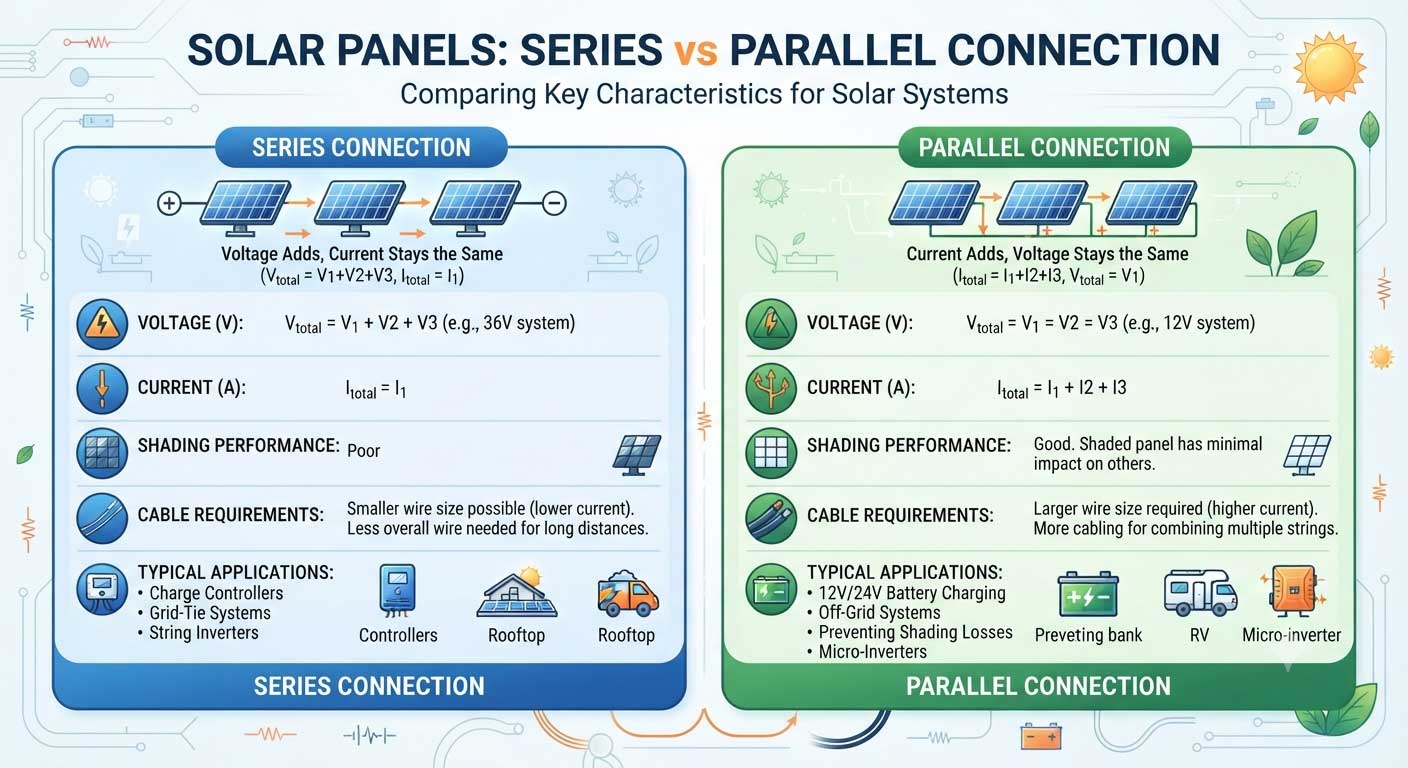
Solar Panel Series vs Parallel Comparison
Choosing between solar panels in series or parallel depends on the application, equipment specifications, and installation environment.
The following comparison summarizes the main differences:
| Feature | Solar Panels in Series | Solar Panels in Parallel |
|---|---|---|
| Voltage output | Increases | Remains the same |
| Current output | Remains the same | Increases |
| Wiring method | Positive to negative connection | Positive to positive, negative to negative |
| Cable requirements | Lower current, smaller cable possible | Higher current, thicker cable often required |
| Shading tolerance | Lower in traditional string systems | Generally better |
| Long cable distance | Better | Requires larger cable |
| MPPT compatibility | Excellent | Good |
| PWM controller compatibility | Limited by voltage range | More common |
| Installation complexity | Simpler wiring | More branches and connections |
| Common applications | Home solar, commercial systems, large RV setups | Small off-grid, portable, shaded systems |
When Should You Use Solar Panels in Series?
Solar panels in series are usually a better choice when:
You Need Higher Voltage
Higher voltage allows solar energy to travel more efficiently over longer distances.
For example:
A solar array installed on a large RV roof may be several meters away from the battery compartment. Increasing voltage can help reduce voltage drop between the panels and the controller.
You Use an MPPT Charge Controller
MPPT controllers can convert higher solar input voltage into usable charging power.
The U.S. Department of Energy explains that MPPT technology helps photovoltaic systems operate closer to their maximum power point, improving energy harvesting compared with simpler charge control methods.
Source:
https://www.energy.gov/eere/solar/solar-photovoltaic-system-design-basics
You Have Limited Cable Space
Because series systems carry lower current, they often require smaller conductors compared with equivalent parallel systems.
This can reduce:
- Cable cost
- Installation complexity
- Voltage loss
When Should You Use Solar Panels in Parallel?
Parallel wiring is often preferred when:
Your Installation Has Partial Shading
Examples:
- RV parked under trees
- Boats with changing sunlight conditions
- Roof areas with obstacles
Parallel connections allow each panel to contribute power independently.
You Need a Lower Voltage System
Parallel wiring is suitable when:
- Battery voltage is low
- Equipment has limited PV voltage input
- Safety requirements favor lower voltage
You Install Multiple Flexible Solar Panels
Flexible solar panels are often used on curved surfaces where panel positioning may vary.
Examples:
- RV roofs
- Camper vans
- Marine decks
- Portable solar systems
A parallel configuration can help maintain stable output when panels experience different sunlight exposure.
Bright Solar flexible solar panels are designed for applications where lightweight installation and adaptable mounting are important. The ideal wiring method depends on the system architecture rather than the panel type alone.
Advantages and Disadvantages of Series Solar Panel Wiring
Advantages
Higher System Voltage
Series wiring increases voltage, making it suitable for systems requiring higher PV input.
Lower Current Losses
Lower current reduces resistive losses in cables.
The electrical relationship is:
Power Loss = Current² × Resistance
This means increasing current has a larger impact on cable losses because current is squared.
Cleaner Installation
Series strings require fewer parallel connections, resulting in simpler solar panel wiring.
Disadvantages
One Panel Can Affect the String
Although bypass diodes reduce shading problems, a heavily affected panel can still reduce the output of a series string.
Higher Voltage Safety Requirements
Higher-voltage systems require:
- Proper insulation
- Correct connectors
- Appropriate equipment ratings
Requires Compatible Equipment
The charge controller or inverter must support the total open-circuit voltage of the series string.
Advantages and Disadvantages of Parallel Solar Panel Wiring
Advantages
Better Shading Performance
Individual panels can continue operating even when another panel produces less energy.
Lower System Voltage
Lower voltage can simplify some small solar installations.
Flexible Panel Arrangement
Parallel wiring works well when panels have different exposure conditions.
Disadvantages
Higher Current Requires Larger Cables
Because parallel wiring increases current, cable size requirements may increase.
For example:
A 40A solar array requires a larger conductor than a 10A solar array transmitting the same power.
More Wiring Connections
Parallel systems require:
- More connectors
- More branch wiring
- More protection devices
Higher Current Management
Installers must consider:
- Fuse ratings
- Connector limits
- Controller current capacity
Series-Parallel Solar Panel Connection Explained
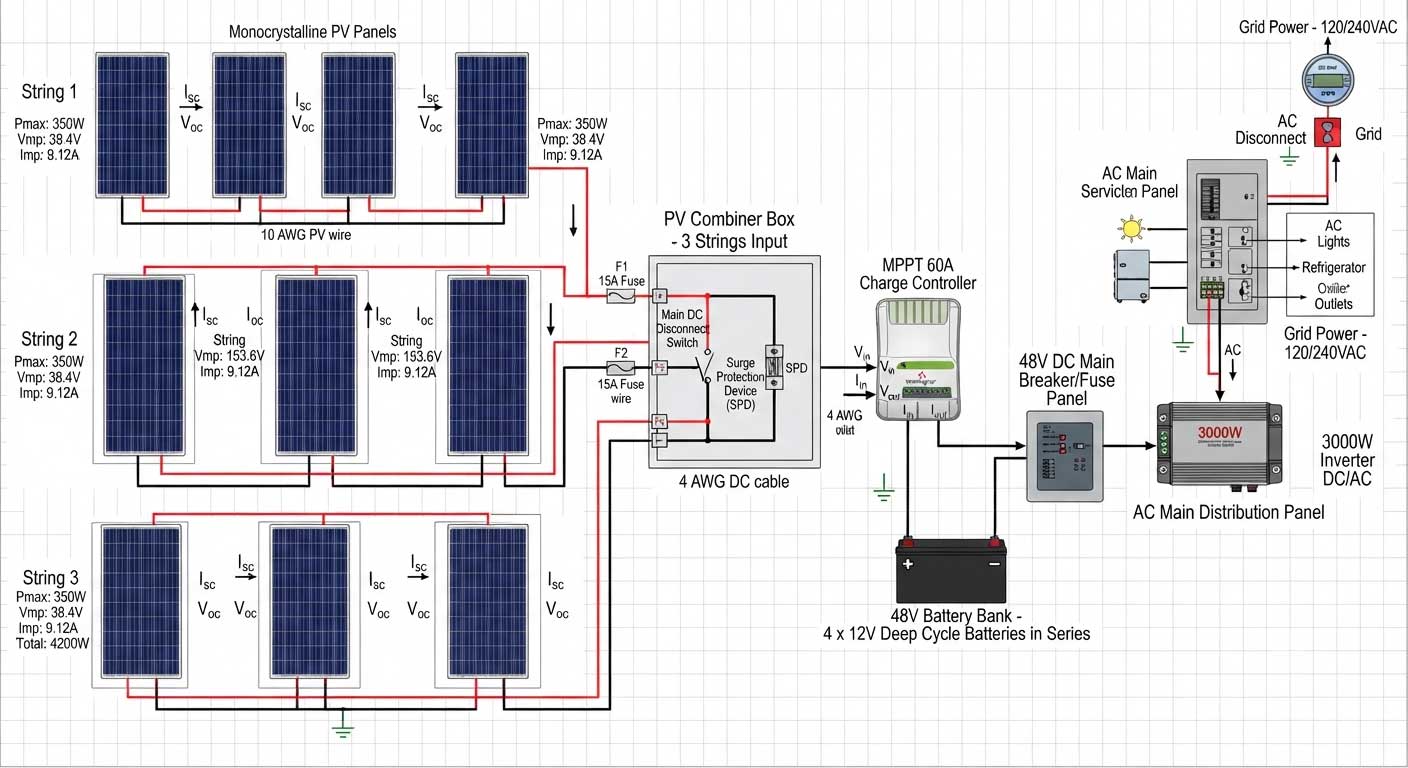
A series-parallel solar panel connection combines the advantages of both wiring methods. Instead of connecting every panel only in series or only in parallel, installers create multiple series strings and then connect those strings together in parallel.
This configuration is commonly used in larger solar systems because it allows designers to increase both voltage and current while maintaining compatibility with inverters, charge controllers, and battery systems.
For example, imagine eight identical 200W solar panels:
Each panel:
- Voltage: 20V
- Current: 10A
- Power: 200W
A series-parallel configuration could be arranged as:
String 1:
4 panels connected in series:
- Voltage: 20V × 4 = 80V
- Current: 10A
String 2:
4 panels connected in series:
- Voltage: 80V
- Current: 10A
Then connect both strings in parallel:
Final output:
- Voltage: 80V
- Current: 20A
- Total power: 3,200W
This type of solar panel wiring is widely used in:
- Residential rooftop solar systems
- Large RV solar installations
- Off-grid cabins
- Commercial solar arrays
According to the National Renewable Energy Laboratory (NREL), photovoltaic system design requires matching array voltage and current characteristics with inverter and power electronics requirements to achieve reliable operation.
Source:
https://www.nrel.gov/research/re-photovoltaics.html
Why Use a Series-Parallel Solar Panel Configuration?
1. Balancing Voltage and Current Requirements
A pure series connection may create too much voltage, while a pure parallel connection may create excessive current.
Series-parallel wiring allows designers to find a middle point.
For example:
A 48V battery system may require a higher solar input voltage, but the charge controller may also have a maximum current limit. Combining series and parallel connections helps optimize both values.
2. Better for Larger Solar Arrays
As the number of solar panels increases, connecting every panel in parallel becomes impractical because current levels become very high.
A series-parallel design reduces the number of parallel branches while maintaining sufficient system voltage.
This approach improves:
- Cable management
- System organization
- Installation efficiency
3. More Flexible Solar System Expansion
Many solar systems grow over time.
A series-parallel configuration allows additional solar strings to be added if:
- Voltage remains compatible
- Current remains within controller limits
- Panels have similar electrical characteristics
However, adding different solar panels without proper system analysis can reduce overall performance.
How to Connect PV Panels: Step-by-Step Wiring Guide
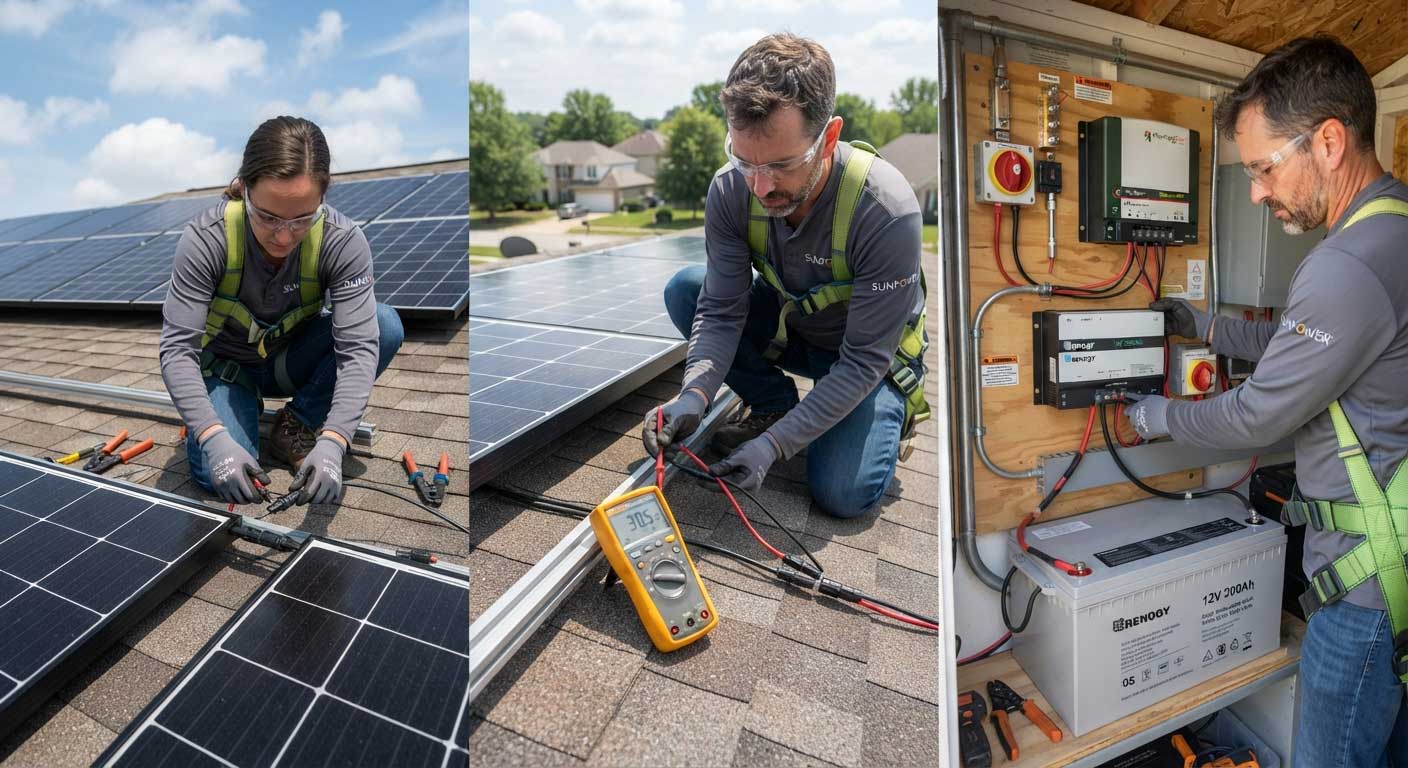
Understanding how to connect PV panels correctly is essential for system safety and performance.
Although the exact wiring method depends on the equipment, most solar installations follow several basic steps.
Step 1: Check Solar Panel Specifications
Before connecting panels, check the electrical information on the panel label.
Important specifications include:
Maximum Power Voltage (Vmp)
The voltage when the panel produces maximum power.
Open Circuit Voltage (Voc)
The maximum voltage produced when the panel is not connected to a load.
Maximum Power Current (Imp)
The operating current at maximum power.
Short Circuit Current (Isc)
The highest current output under test conditions.
These values determine whether panels can be connected safely in series or parallel.
For series connections:
Add:
- Panel voltage
Keep:
- Current approximately the same
For parallel connections:
Keep:
- Voltage approximately the same
Add:
- Current
Step 2: Choose Series, Parallel, or Series-Parallel Wiring
Before connecting cables, determine your system requirements.
Choose solar panels in series when:
- Higher voltage is required
- Cable distance is long
- Using an MPPT controller
- Reducing current loss is important
Choose wiring solar panels in parallel when:
- Lower voltage is preferred
- Partial shading is common
- Multiple panels have different sunlight exposure
Choose series-parallel wiring when:
- The solar array contains many panels
- Both higher voltage and higher current are needed
Step 3: Connect Solar Panels Correctly
Connecting Solar Panels in Series
The connection method:
Panel 1 positive (+)
→ Panel 2 negative (-)
→ Panel 3 negative (-)
Continue until the required voltage is reached.
The unused positive and negative terminals become the solar array output.
The voltage increases with each added panel.
Wiring Solar Panels in Parallel
The connection method:
All positive (+) terminals connect together.
All negative (-) terminals connect together.
A combiner connector or branch connector is often used to combine multiple solar panels safely.
The voltage remains unchanged, but current increases.
Step 4: Connect the Solar Array to the Charge Controller
The charge controller must match the solar array output.Before connecting your solar panels to a controller, it is important to understand the correct wiring sequence, voltage requirements, and safety considerations. Learn more in our detailed guide on how to connect solar panels to charge controller.
Check:
- Maximum PV voltage
- Maximum charging current
- Battery voltage compatibility
For example:
A 12V battery system does not automatically mean the solar array should be 12V. Many modern systems use higher-voltage solar strings with MPPT controllers.
The charge controller specification should always determine the final wiring design.
Step 5: Test the Solar Panel Wiring
Before operating the system:
Check:
Polarity
Confirm positive and negative connections.
Voltage
Measure solar array voltage with a multimeter.
Current
Verify operating current under sunlight conditions.
Connections
Check that:
- MC4 connectors are fully locked
- Cables are protected
- No exposed conductors exist
Proper testing prevents common installation failures.
How Shading Affects Solar Panels in Series vs Parallel
Shading is one of the most important factors when comparing solar panels in parallel vs series.
A solar panel rarely operates under perfect sunlight conditions. Real installations often experience:
- Trees
- Roof structures
- Antennas
- Air conditioners
- Seasonal shadow changes
The impact depends on the wiring configuration.
Series Solar Panels and Shading
In a series solar array, all panels carry the same current.
If one panel becomes shaded and produces less current, it can reduce the output of the entire string.
For example:
Four panels connected in series:
Panel output:
10A + 10A + 3A + 10A
The string current may be limited closer to the lowest-performing panel.
However, modern solar modules use bypass diodes to reduce the effect of shading.
According to NREL research, bypass diodes help prevent hot spots and allow current to bypass shaded sections of photovoltaic modules.
Source:
https://www.nrel.gov/docs/fy12osti/53870.pdf
Parallel Solar Panels and Shading
In a parallel configuration, each panel operates on its own current path.
If one panel receives less sunlight:
- That panel produces less current
- Other panels can continue producing power
This makes parallel wiring attractive for:
- Boats
- RVs
- Campers
- Flexible solar installations
where changing sunlight conditions are common.
Does Parallel Always Perform Better Under Shade?
Not necessarily.
Many people assume parallel wiring completely solves shading problems, but real systems depend on:
- Panel quality
- Bypass diode design
- Inverter technology
- Solar optimizer systems
- Shade intensity
For example, a heavily shaded panel in a parallel system still contributes very little energy.
Likewise, a modern series system with optimized electronics may perform very well under partial shading.
The correct design considers the entire solar system rather than choosing wiring based on one factor alone.
Choosing the Best Solar Panel Wiring Method for Different Applications
Different solar applications require different wiring strategies.
There is no universal answer to whether series or parallel is better.
The correct choice depends on:
- System size
- Battery voltage
- Installation environment
- Controller type
- Cable distance
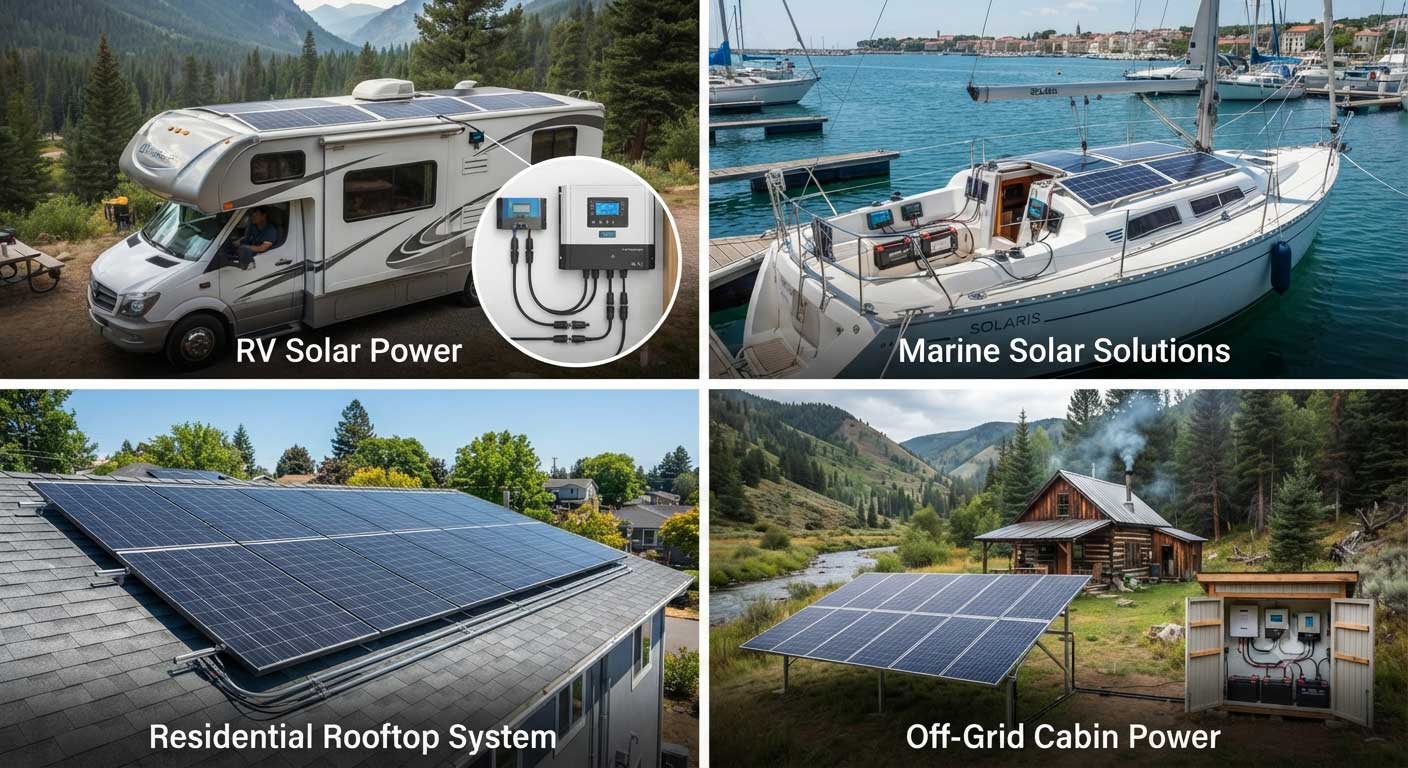
RV Solar Systems
RV solar systems often use both configurations.
Choosing between series and parallel wiring depends on your RV battery voltage, available roof space, shading conditions, and energy requirements. For a complete system design guide, see our article about the best solar panel setup for RV and off-grid systems.
Series Wiring Advantages:
- Higher voltage
- Lower cable losses
- Better for longer cable runs
Parallel Wiring Advantages:
- Better for shaded campsites
- Compatible with many small battery systems
For modern RV systems using MPPT controllers, series or series-parallel designs are becoming increasingly common.
Bright Solar flexible solar panels are widely used in RV and mobile solar applications because their lightweight structure allows installation on curved surfaces. The ideal wiring method depends on the RV electrical system and power requirements.
Marine Solar Systems
Boats often experience:
- Moving shadows
- Limited installation space
- Multiple panel locations
Parallel wiring can be useful because panels may receive different sunlight throughout the day.
Flexible solar panels are especially popular in marine applications because they can be mounted on surfaces where traditional rigid panels are difficult to install.
Flexible solar panels are often installed on RV roofs, boats, and irregular surfaces where traditional rigid modules are difficult to mount. Learn more about mounting methods and installation considerations in our flexible solar panel installation guide.
Home Solar Systems
Residential solar systems typically use:
- Series strings
- Series-parallel arrays
Most grid-tied inverters require specific voltage ranges, making series connections common.
The inverter datasheet determines the maximum number of panels that can safely be connected in one string.
Off-Grid Solar Systems
Off-grid systems vary widely.
Small systems may use parallel wiring for simplicity.
Larger systems often use series-parallel configurations to balance:
- Battery charging requirements
- Cable efficiency
- Controller limitations
Common Solar Panel Wiring Mistakes
Even when choosing the correct connection method, mistakes during solar panel wiring can reduce system performance or create safety risks.
Many installation problems are not caused by the solar panels themselves but by incorrect system design, mismatched components, or poor electrical connections.
Below are the most common mistakes to avoid when connecting solar panels in series or parallel.
Mistake 1: Exceeding the Charge Controller Voltage Limit
One of the most serious mistakes is connecting too many solar panels in series.
When panels are connected in series, voltage increases with every additional panel. The total open-circuit voltage (Voc) of the solar array must stay below the maximum PV input voltage of the charge controller or inverter.
For example:
Three solar panels:
Voc per panel: 40V
Series connection:
40V × 3 = 120V
If the charge controller maximum PV input is 100V, this configuration can damage the equipment.
The correct calculation should always use the panel’s Voc value, especially because cold temperatures can increase solar panel voltage.
The National Renewable Energy Laboratory (NREL) highlights that photovoltaic system designers must consider temperature effects because module voltage changes with operating conditions.
Source:
https://www.nrel.gov/docs/fy07osti/40577.pdf
Mistake 2: Ignoring Current Limits in Parallel Systems
Parallel solar panel wiring increases current.
A common mistake is adding more panels without checking whether the charge controller, connectors, and cables can handle the increased current.
For example:
Three panels:
Each panel current: 10A
Parallel connection:
10A + 10A + 10A = 30A
The system components must support this higher current.
Before expanding a solar array, check:
- Charge controller maximum charging current
- Cable ampacity
- Fuse rating
- Connector specifications
Mistake 3: Mixing Different Solar Panels Incorrectly
Connecting different solar panels together can create performance issues.
Problems may occur when panels have different:
- Voltage ratings
- Current ratings
- Cell technologies
- Power outputs
For example:
A 200W panel with a 20V operating voltage connected with a 200W panel with a 35V operating voltage may not operate efficiently in the same string.
For best results:
- Use identical panels whenever possible
- Match electrical specifications
- Avoid combining old and new modules without system analysis
Bright Solar recommends evaluating the complete electrical characteristics before combining different flexible solar panels into one array.
Mistake 4: Choosing Wiring Based Only on Wattage
Many beginners focus only on solar panel wattage.
However, two systems with the same total wattage can behave differently.
Example:
Four 100W panels:
System A:
- Series connection
- Higher voltage
- Lower current
System B:
- Parallel connection
- Lower voltage
- Higher current
Both produce 400W theoretically, but the installation requirements are different.
A proper solar design considers:
- Voltage
- Current
- Cable length
- Controller type
- Environmental conditions
Mistake 5: Using Incorrect Cable Sizes
Cable size is an important part of solar panel wiring.
If the cable is too small:
- Voltage drop increases
- Energy losses increase
- Cables may overheat
Parallel systems usually require larger cables because they carry higher current.
Series systems often allow smaller cables because current remains lower.
The wire size should be selected according to:
- Current
- Cable length
- Allowable voltage drop
- Installation environment
Mistake 6: Reversing Polarity During Connection
Incorrect polarity is a common installation error.
Before connecting solar panels:
Always confirm:
- Positive terminal (+)
- Negative terminal (-)
A reversed connection can prevent the system from operating and may damage electrical components.
Using a multimeter before final connection is a simple way to verify polarity.
FAQ About Solar Panels in Parallel vs Series
Are Solar Panels Better in Series or Parallel?
Neither option is always better.
Solar panels in series are usually better when you need higher voltage, longer cable distances, and lower current losses.
Solar panels in parallel are often better when shading conditions are unpredictable or when a lower-voltage system is preferred.
The best configuration depends on:
- Solar controller type
- Battery system
- Installation environment
- Panel specifications
Can You Connect Solar Panels in Series and Parallel Together?
Yes.
This is called a series-parallel solar panel connection.
It combines multiple panels in series strings and then connects those strings in parallel.
This method is commonly used for larger solar arrays because it increases both voltage and current while keeping the system within equipment limits.
Do Solar Panels Produce More Power in Series or Parallel?
The total rated power is usually the same if identical panels are used.
For example:
Two 200W panels:
Series:
- Higher voltage
- Same current
Parallel:
- Same voltage
- Higher current
Both configurations can produce approximately 400W under identical test conditions.
The difference is how electricity is delivered to the system.
Do Solar Panels Work Better in Parallel When Shaded?
Parallel wiring can perform better when individual panels experience different shading because each panel has its own current path.
However, shading performance also depends on:
- Bypass diodes
- Solar inverter technology
- Panel design
- Shade intensity
A properly designed series system can also perform well under partial shading.
How Many Solar Panels Can Be Connected in Series?
The number of solar panels that can be connected in series depends on the maximum PV input voltage of the inverter or charge controller.
The calculation should consider:
- Panel open-circuit voltage (Voc)
- Lowest expected temperature
- Equipment voltage limit
Never determine the number of panels only by wattage.
Can Different Watt Solar Panels Be Connected Together?
Technically, different wattage panels can sometimes be connected, but it is generally not recommended.
The best practice is to use panels with matching:
- Voltage
- Current
- Electrical characteristics
Different specifications may reduce the output of the solar array.
Should RV Solar Panels Be Wired in Series or Parallel?
Both options can work.
Series wiring is often preferred for larger RV systems because it increases voltage and reduces cable losses.
Parallel wiring can be useful for RVs that frequently experience partial shading.
The final decision depends on:
- RV battery voltage
- Charge controller type
- Roof layout
- Solar panel specifications
Final Thoughts: Choosing the Right Solar Panel Connection
Understanding solar panels in parallel vs series is essential for designing an efficient photovoltaic system.
The main differences are simple:
- Series connections increase voltage.
- Parallel connections increase current.
- Series wiring is often better for longer cable distances and MPPT systems.
- Parallel wiring can be useful for shaded environments and lower-voltage applications.
- Series-parallel configurations provide flexibility for larger solar arrays.
There is no single wiring method that works for every solar installation.
A properly designed system considers the complete picture:
- Solar panel specifications
- Charge controller limits
- Battery voltage
- Installation environment
- Future expansion plans
For flexible solar applications such as RVs, marine systems, and custom off-grid projects, Bright Solar focuses on providing lightweight and adaptable solar solutions that can be integrated into different system designs.
Choosing the right solar panel wiring method is not about selecting series or parallel blindly. It is about matching the electrical design with the real conditions of your solar project.
Related recommendations
-

400W Solar Module Performance, Applications and Buying Guide
131400W solar module solutions for RVs, marine systems and off-grid applications. Learn output, efficiency, installation methods and real-world performance from Bright Solar.
View details -
Solar Power Flexible Panels for Modern Off-Grid Energy
153Solar power flexible panels deliver lightweight off-grid electricity for RVs, boats, campers, and rooftops. Discover durable ETFE solar solutions from Bright Solar.
View details -
1000W Solar Panel Guide: What a 1000W Solar Panel Can Really Power
221Learn how a 1000W solar panel system works, what it can power, expected daily output, installation options, and whether it fits your RV, home, boat, or off-grid project.
View details -
Solar Pergolas for Outdoor Living and Clean Energy Generation
110Discover how solar pergolas combine shade, clean energy, and modern outdoor living. Learn design options, costs, performance, and installation insights from Bright Solar.
View details