
MPPT vs PWM Charge Controller for Solar Panels: Complete Comparison Guide
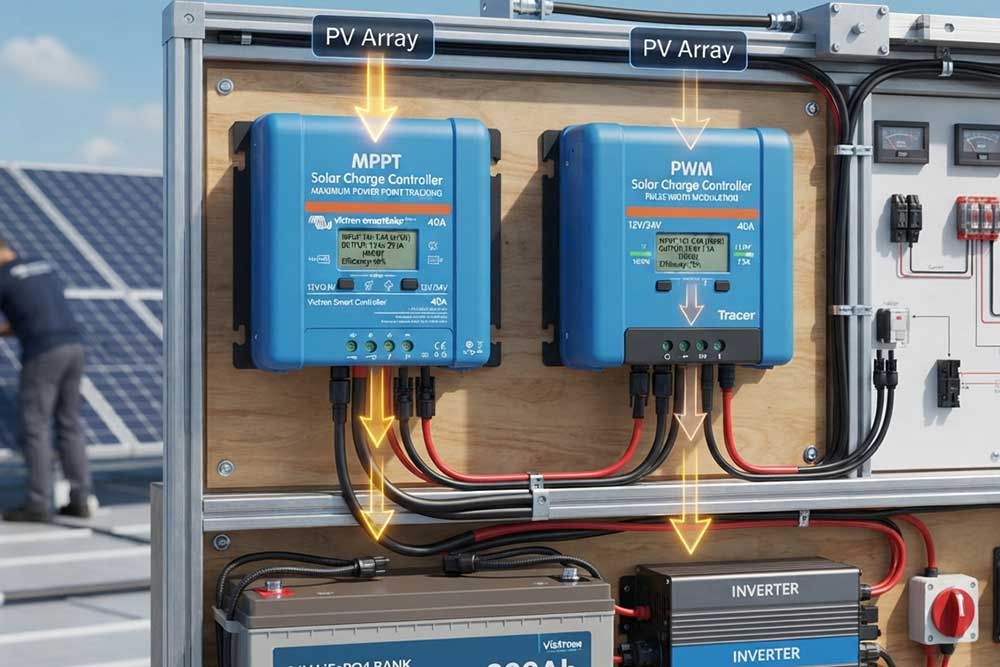
MPPT vs PWM charge controller for solar panels depends on system size, solar panel voltage, battery type, and energy requirements. MPPT controllers provide higher efficiency and support higher PV voltage, while PWM controllers are simpler and more affordable for small solar systems.
A solar charge controller is an essential component between solar panels and batteries. It regulates charging voltage, controls current flow, and protects batteries from overcharging.
Choosing the right controller affects:
- Solar energy harvest
- System efficiency
- Panel wiring options
- Battery charging performance
At Bright Solar, we often find that users select controllers based only on price. However, the correct choice depends on the complete solar system design, including panel voltage, current, battery capacity, and installation environment.
What Is a Solar Charge Controller?
A solar charge controller manages the electricity flow from photovoltaic panels to batteries.
Its main functions include:
Prevent Battery Overcharging
Solar panels can produce fluctuating voltage depending on sunlight conditions.
The controller regulates charging to protect batteries.
Control Charging Current
The controller adjusts the energy flow based on battery condition.
Protect Solar Systems
Many controllers include protection features such as:
- Overvoltage protection
- Overcurrent protection
- Reverse polarity protection
- Short circuit protection
Solar charge controllers are especially important in:
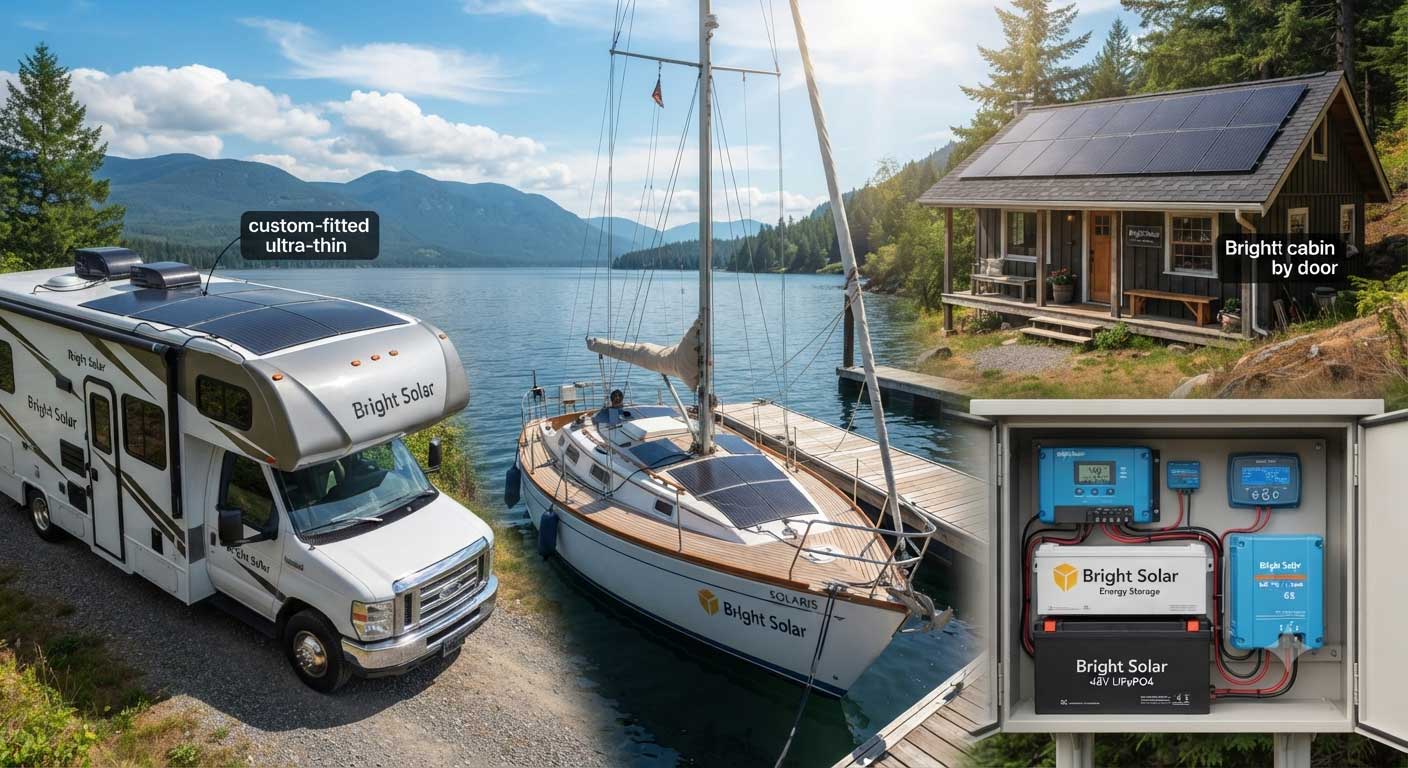
- RV solar systems
- Off-grid cabins
- Marine solar systems
- Portable solar applications
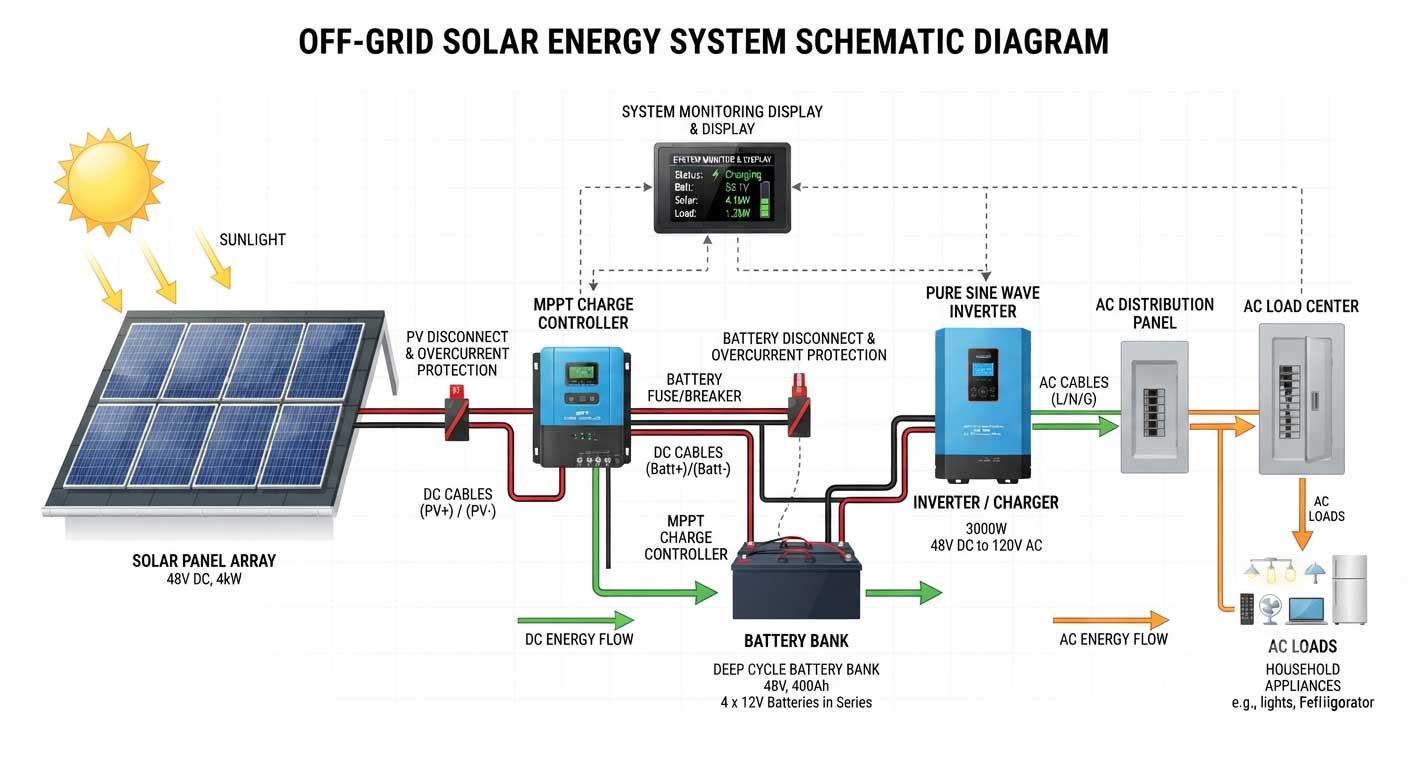
What Is a PWM Solar Charge Controller?
PWM stands for:
Pulse Width Modulation
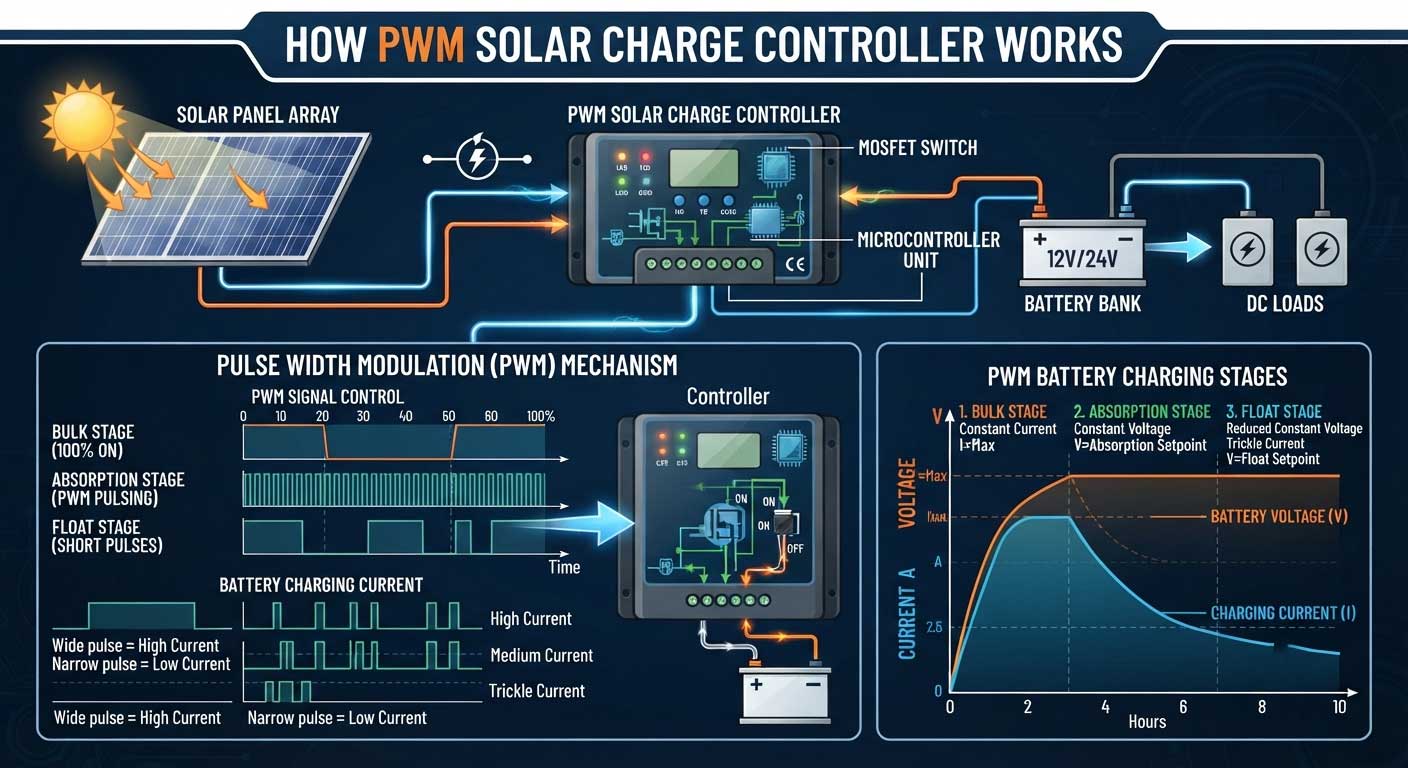
A PWM controller works by gradually reducing the charging current as the battery approaches full capacity.
It connects the solar panel voltage closely to the battery charging voltage.
Example:
Solar panel:
18V operating voltage
Battery:
12V
The PWM controller adjusts charging by switching current pulses between the panel and battery.
Advantages of PWM Charge Controllers
Lower Cost
PWM controllers have a simpler design.
They are usually more affordable than MPPT controllers.
Simple Installation
PWM systems typically require:
- Fewer components
- Lower configuration complexity
- Simple wiring
Suitable for Small Systems
PWM controllers work well for:
- Small RV systems
- Basic battery charging
- Low-power applications
Limitations of PWM Charge Controllers
Lower Efficiency
PWM controllers cannot fully utilize higher solar panel voltage.
If the solar panel voltage is significantly higher than the battery voltage, some available energy may not be converted.
Limited Solar Panel Flexibility
PWM controllers generally require solar panels that closely match battery voltage.
Less Suitable for Large Systems
For higher-power solar installations, MPPT controllers usually provide better performance.
What Is an MPPT Solar Charge Controller?
MPPT stands for:
Maximum Power Point Tracking
An MPPT controller continuously adjusts the electrical operating point of the solar panels to capture the maximum available power.
It converts excess solar voltage into additional charging current.
Example:
Solar array:
80V
Battery:
24V
An MPPT controller can convert the higher PV voltage into suitable battery charging power.
Advantages of MPPT Charge Controllers
Higher Efficiency
MPPT controllers can extract more energy from solar panels, especially when:
- Weather changes
- Temperature changes
- Solar voltage varies
According to the U.S. Department of Energy, maximum power point tracking helps photovoltaic systems operate closer to their maximum power point, improving energy harvesting.
Source:
https://www.energy.gov/eere/solar/solar-photovoltaic-system-design-basics
Supports Higher Solar Panel Voltage
MPPT controllers allow more flexible solar panel configurations.
They work well with:
- Series-connected solar panels
- Higher voltage solar arrays
- Long cable distances
Better for Larger Systems
MPPT controllers are commonly used in:
- Residential solar systems
- Large RV systems
- Off-grid power systems
Limitations of MPPT Charge Controllers
Higher Cost
MPPT controllers are more complex and usually more expensive.
More Complex Design
System planning requires checking:
- Maximum PV voltage
- Maximum charging current
- Panel configuration
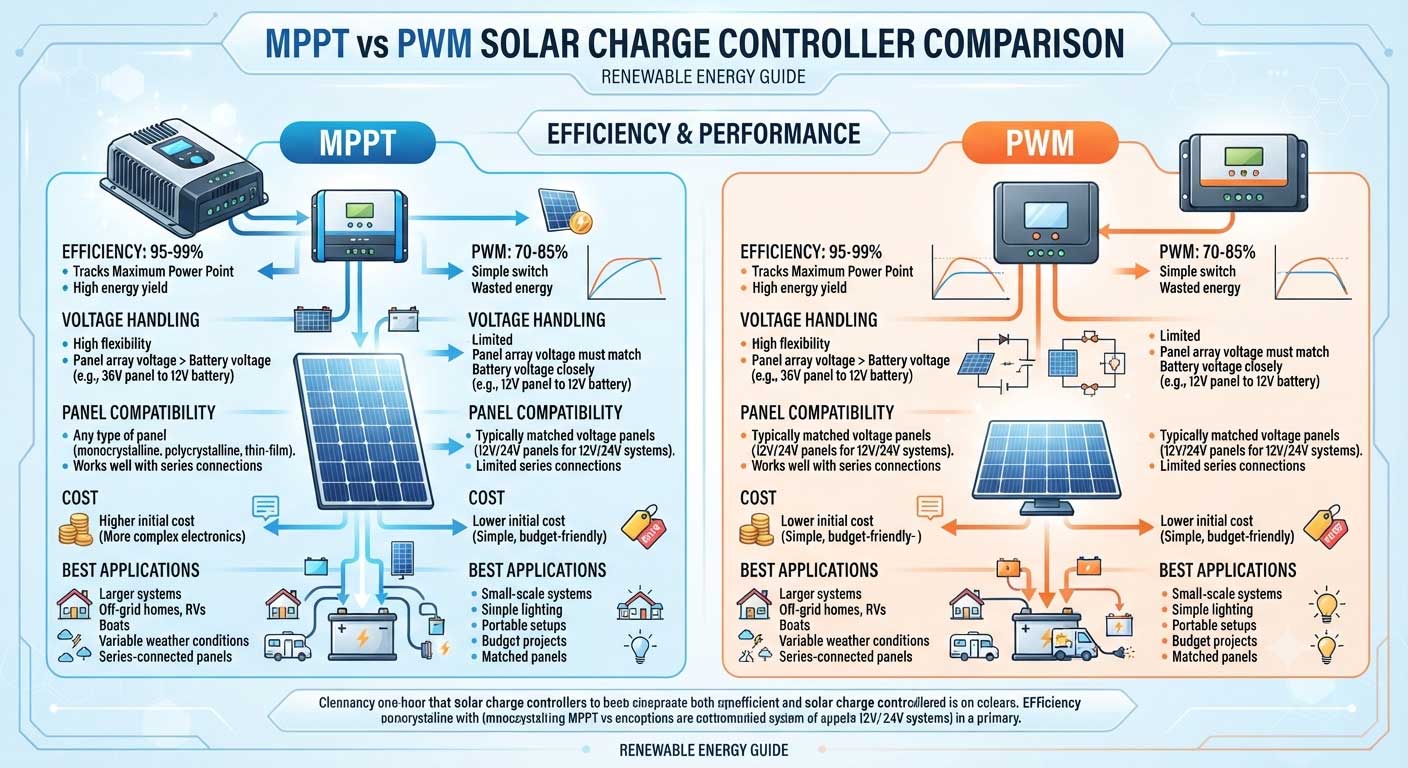
MPPT vs PWM Charge Controller Comparison
| Feature | MPPT Controller | PWM Controller |
|---|---|---|
| Technology | Maximum Power Point Tracking | Pulse Width Modulation |
| Efficiency | Higher | Lower |
| Cost | Higher | Lower |
| Solar voltage flexibility | Excellent | Limited |
| Series solar panels | Suitable | Less suitable |
| Large systems | Recommended | Limited |
| Small systems | Good | Suitable |
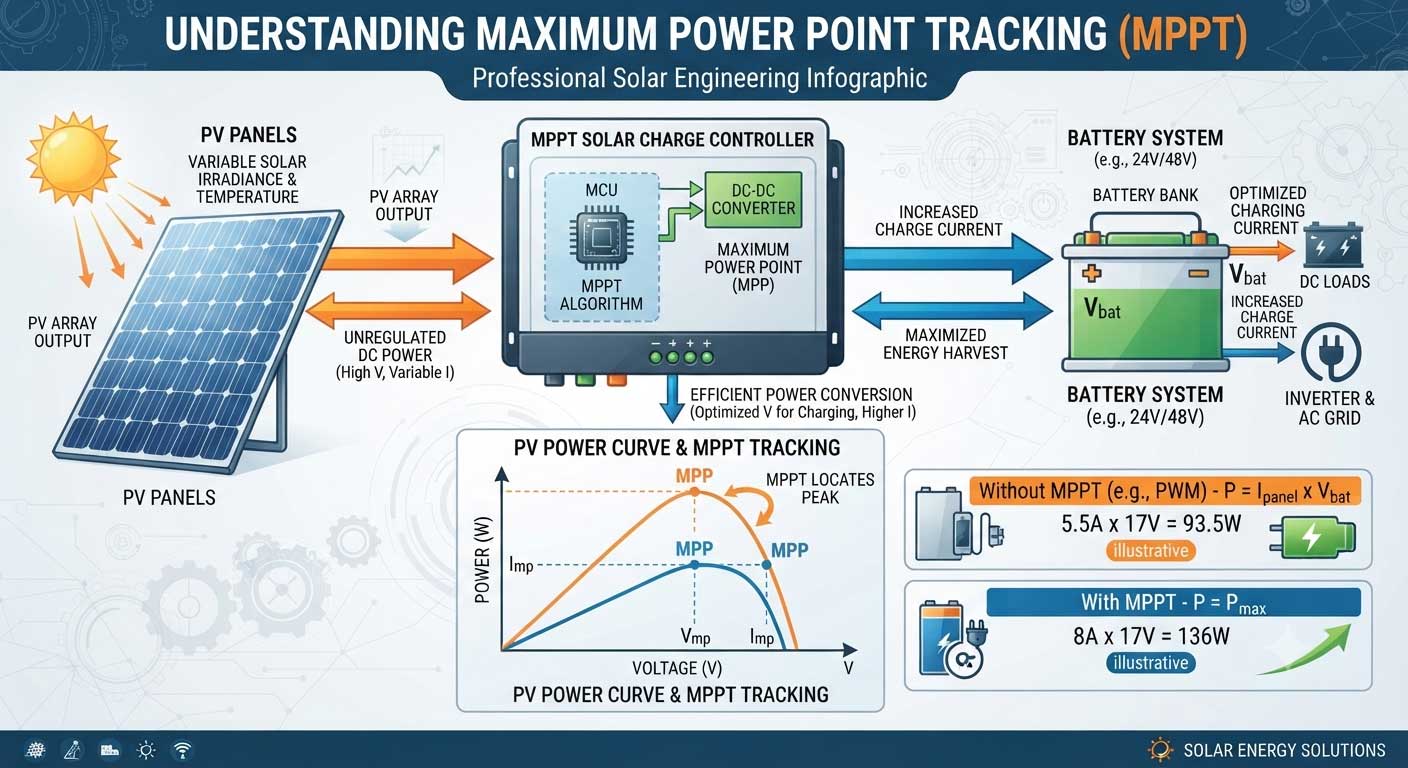
MPPT vs PWM Efficiency Difference
The efficiency difference mainly comes from how each controller handles solar panel voltage.
Example:
Solar panel:
36V
Battery:
12V
PWM controller:
Reduces voltage to battery level
MPPT controller:
Converts extra voltage into additional charging current
The MPPT controller can use more of the available solar power.
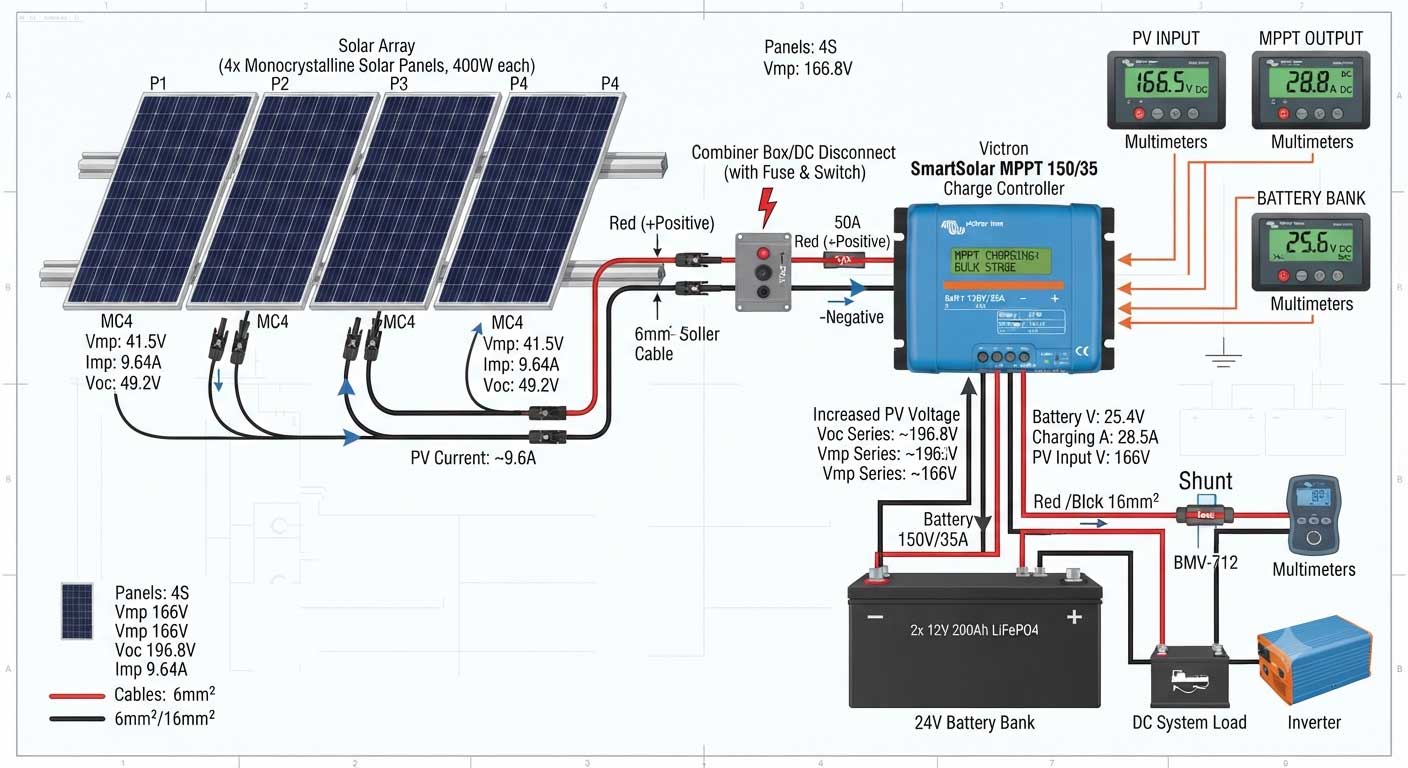
MPPT vs PWM for Series Solar Panels
Series-connected solar panels increase voltage.
Understanding how voltage changes between wiring methods is important when selecting a controller. Learn more about the differences between configurations in our guide on solar panels in parallel vs series.
Example:
Two panels:
40V each
Series output:
80V
MPPT controller:
Can efficiently process higher PV voltage.
PWM controller:
May not effectively use the additional voltage.
This is why MPPT controllers are commonly recommended for:
- Series solar panels
- Higher wattage systems
- Long cable installations
For more information about panel wiring, see:
solar panels in parallel vs series
MPPT vs PWM for Parallel Solar Panels
Parallel solar panels increase current while maintaining voltage.
Example:
Two panels:
20V
10A
Parallel output:
20V
20A
PWM controllers can work well in some parallel configurations if:
- Panel voltage matches battery requirements
- Current remains within controller limits
However, higher current requires:
- Larger cables
- Proper protection
Which Charge Controller Is Better for RV Solar Systems?
The best controller depends on the RV system design.
PWM Controller for RV
Suitable for:
- Small campers
- Low power requirements
- Simple battery charging
MPPT Controller for RV
Better for:
- Larger solar arrays
- Flexible solar panels
- Limited roof space
Advantages:
- Higher energy harvest
- Better performance in changing conditions
- Supports series panel configurations
Bright Solar flexible solar panels are commonly used in RV applications where lightweight design and efficient energy conversion are important.Visit product page:Flexible Solar Panels
Which Charge Controller Is Better for Off-Grid Solar Systems?
For larger off-grid systems, MPPT controllers are usually preferred.
Reasons:
- Higher efficiency
- Better voltage flexibility
- Supports larger solar arrays
Off-grid systems often require:
- Higher energy production
- Longer cable distances
- More complex battery storage
How to Choose Between MPPT and PWM Controllers
Consider these factors:
1. Solar Panel Voltage
Higher voltage solar arrays:
→ MPPT recommended
Lower voltage panels:
→ PWM may be suitable
2. System Size
Small systems:
→ PWM
Large systems:
→ MPPT
3. Budget
PWM:
Lower initial cost
MPPT:
Higher upfront cost but better energy utilization
4. Solar Panel Wiring Method
Series wiring:
→ MPPT preferred
Parallel wiring:
→ Both may work depending on specifications
Common Mistakes When Choosing Solar Charge Controllers
Mistake 1: Selecting Based Only on Price
A cheaper controller may limit future system expansion.
Mistake 2: Ignoring PV Voltage Limits
Connecting high-voltage solar arrays to unsuitable controllers can damage equipment.
Mistake 3: Choosing Controller Size Based Only on Panel Wattage
Both voltage and current must be considered.
Mistake 4: Using PWM With High Voltage Solar Panels
PWM controllers cannot take full advantage of many modern high-voltage solar modules.
How Bright Solar Designs Solar Systems With Controllers
Bright Solar focuses on flexible solar panels designed for different energy applications.
Controller selection depends on:
Solar Panel Configuration
Including:
- Series wiring
- Parallel wiring
- Series-parallel systems
Installation Environment
Including:
- RV roofs
- Marine applications
- Off-grid locations
Power Requirements
The correct combination of:
- Solar panels
- Charge controller
- Battery storage
helps achieve reliable solar performance.
MPPT vs PWM Detailed Technical Comparison
Understanding the technical differences between MPPT and PWM charge controllers helps you select the right solution for your solar system.
Although both controllers regulate energy between solar panels and batteries, their operating methods are different.
How PWM Charge Controllers Work
A PWM controller works like an electronic switch between the solar panel and battery.
When the battery requires charging, the controller connects the solar panel output to the battery.
As the battery voltage rises, the controller reduces charging pulses to prevent overcharging.
The main characteristic of PWM technology is that the solar panel voltage is pulled down close to the battery voltage.
Example:
Solar panel:
- Vmp: 32V
- Battery: 12V
A PWM controller may operate the panel closer to battery voltage rather than using the full 32V operating potential.
The unused voltage cannot be converted into additional charging power.
How MPPT Charge Controllers Work
An MPPT controller uses electronic conversion technology to continuously find the solar panel’s maximum power point.
The controller adjusts:
- PV voltage
- Charging current
to extract the highest available power from the solar array.
Example:
Solar panel output:
- Voltage: 40V
- Current: 10A
Solar power:
40V × 10A
=
400W
Battery charging system:
- Voltage: 12V
The MPPT controller converts the higher PV voltage into additional charging current while maintaining approximately the same power output minus conversion losses.
MPPT vs PWM: Voltage Conversion Example
Assume:
Solar panel:
400W
Panel operating voltage:
40V
Panel current:
10A
Battery:
12V
PWM Controller Result
The controller may only use voltage close to the battery charging range.
Available power utilization:
Lower
MPPT Controller Result
The controller converts excess voltage into charging current.
Available power utilization:
Higher
This difference becomes more noticeable when:
- Solar panels have higher voltage
- Weather conditions change
- System size increases
MPPT vs PWM for Solar Panel Wiring
The wiring method directly affects controller selection.
Series Solar Panel Wiring With MPPT
Series connection:
- Increases voltage
- Keeps current similar
Example:
Three panels:
Each:
40V
10A
Series output:
Voltage:
120V
Current:
10A
An MPPT controller can efficiently manage this higher voltage input.
Before designing a series solar array, calculate the maximum number of panels your controller can safely support. See our guide on how many solar panels can be connected in series.
This configuration is commonly used for:
- RV solar systems
- Off-grid cabins
- Residential solar arrays
Parallel Solar Panel Wiring With PWM
Parallel connection:
- Keeps voltage unchanged
- Increases current
Example:
Three panels:
Each:
20V
10A
Parallel output:
Voltage:
20V
Current:
30A
PWM controllers can work well when panel voltage closely matches battery voltage.
Series-Parallel Solar Systems
Many larger solar systems combine both methods.
Example:
Four panels:
Two panels in series:
Voltage:
80V
Current:
10A
Two strings in parallel:
Final output:
Voltage:
80V
Current:
20A
This configuration provides:
- Higher voltage
- Higher current capacity
It is common in larger solar installations.
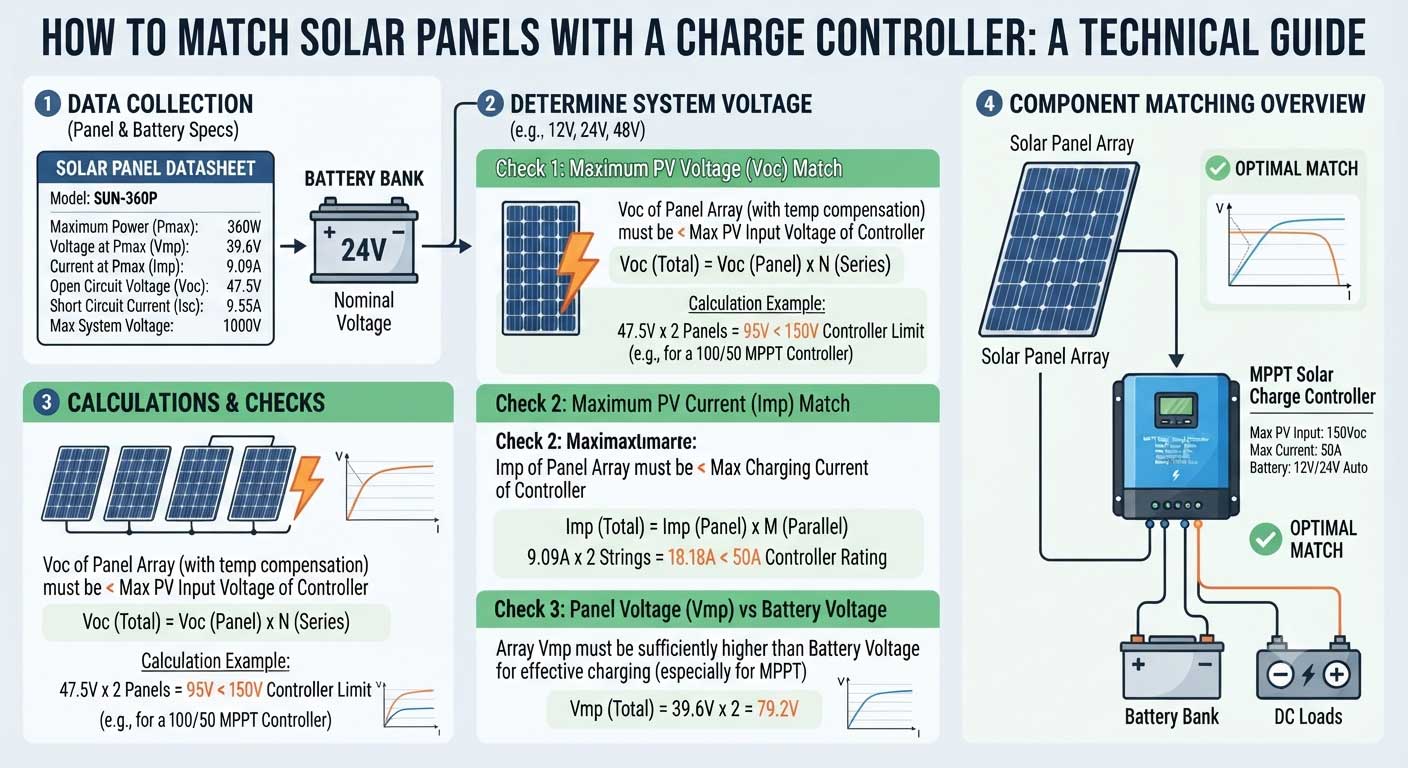
How to Match Solar Panels With Charge Controllers
Selecting the correct charge controller requires checking several electrical specifications.
After selecting the correct controller type, proper wiring is equally important. Follow our guide on how to connect solar panels to charge controller for installation steps.
Step 1: Check Solar Panel Voltage
Review:
- Voc (Open Circuit Voltage)
- Vmp (Maximum Power Voltage)
The controller’s maximum PV input voltage must be higher than the solar array’s maximum voltage.
Example:
Controller:
150V maximum PV input
Solar string:
120V Voc
Compatible:
Yes
Step 2: Check Solar Panel Current
Review:
- Isc
- Imp
The controller must support the expected charging current.
Example:
Solar array:
800W
Battery:
24V
Maximum charging current:
800W ÷ 24V
≈ 33A
A controller rated below this may not be suitable.
Step 3: Match Battery Voltage
Charge controllers are designed for specific battery systems.
Common battery voltages:
12V Systems
Used for:
- Small RV systems
- Portable solar
- Basic off-grid applications
24V Systems
Used for:
- Medium solar systems
- Larger RV setups
48V Systems
Used for:
- Residential off-grid systems
- High-power applications
Best Charge Controller Choice for Different Applications
The best option depends on the application, solar panel configuration, and energy requirements.
RV Solar Systems
RV solar systems usually have limitations:
- Limited roof space
- Weight restrictions
- Partial shading
For small RV systems:
PWM may be acceptable.
For larger RV systems:
MPPT is usually preferred.
Advantages:
- Better energy harvesting
- Supports flexible solar panels
- Allows higher voltage configurations
Bright Solar flexible solar panels are designed for RV applications where lightweight installation and efficient charging are important.
Home Solar Systems
Residential solar systems usually require higher efficiency and reliable performance.
MPPT controllers are commonly preferred for:
- Larger solar arrays
- Higher voltage configurations
- Battery storage systems
Benefits:
- Better energy utilization
- More flexible panel wiring
- Improved system scalability
Marine Solar Systems
Marine environments create unique challenges:
- Limited installation area
- Curved mounting surfaces
- Changing sunlight conditions
Flexible solar panels are often selected for boats and marine applications.
For mounting methods, cable routing, and installation considerations, explore our complete flexible solar panel installation guide.
Controller selection should consider:
- Panel voltage
- Shading conditions
- Battery type
For marine installations with multiple flexible panels, MPPT controllers often provide better design flexibility.
Off-Grid Solar Systems
Off-grid systems often require maximum energy efficiency because solar power may be the only electricity source.
MPPT controllers are generally preferred for:
- Cabins
- Remote sites
- Agricultural systems
Reasons:
- Higher efficiency
- Better performance with larger arrays
- Supports series solar panel configurations
MPPT vs PWM Charge Controller: Which One Should You Choose?
Use PWM when:
- System size is small
- Budget is limited
- Solar panel voltage matches battery voltage
- Simple charging is required
Use MPPT when:
- Solar array voltage is higher
- System size is larger
- Maximum energy production is important
- Using series-connected solar panels
FAQ about MPPT vs PWM Charge Controller for Solar Panels
Is MPPT Better Than PWM?
For most medium and large solar systems, MPPT provides better efficiency and flexibility.
PWM can still be a practical choice for small, simple systems.
How Much More Efficient Is MPPT Than PWM?
The efficiency difference depends on:
- Solar panel voltage
- Battery voltage
- Weather conditions
- System design
MPPT usually provides greater energy harvesting when panel voltage is significantly higher than battery voltage.
Can I Use MPPT With Solar Panels in Series?
Yes.
MPPT controllers are commonly used with series-connected solar panels because they can handle higher PV input voltage.
Can I Use PWM With Solar Panels in Series?
Sometimes, but it depends on the controller and battery system.
Many series configurations create voltage levels that PWM controllers cannot effectively utilize.
Do Flexible Solar Panels Need MPPT Controllers?
Not always.
The correct controller depends on:
- Panel specifications
- System voltage
- Battery type
- Wiring configuration
However, many flexible solar panel systems benefit from MPPT controllers, especially when higher voltage configurations are used.
Can I Replace PWM With MPPT?
Yes, in many systems.
However, you must verify:
- Solar array voltage
- Controller rating
- Battery compatibility
What Size MPPT Controller Do I Need?
Controller size depends on:
- Solar panel wattage
- Battery voltage
- Maximum charging current
Example:
1000W solar array:
48V battery
Charging current:
1000W ÷ 48V
≈ 21A
A controller above this rating may be suitable.
Conclusion: MPPT vs PWM Charge Controller for Solar Panels
Choosing between MPPT vs PWM charge controller for solar panels depends on your system requirements, solar panel configuration, and energy goals.
PWM controllers provide a simple and affordable solution for small solar applications.
MPPT controllers provide higher efficiency, better voltage flexibility, and stronger performance for larger systems, especially when using series-connected solar panels.
For RV, marine, and off-grid applications, the right controller should match:
- Solar panel voltage
- Solar panel current
- Battery voltage
- Installation conditions
Bright Solar recommends evaluating the complete solar system instead of selecting a charge controller based only on price.
A properly matched controller improves energy harvesting, protects batteries, and creates a more reliable solar power system.
Related recommendations
-

Solar Panels for Van Life: Complete Solar Power Guide
36Solar panels for van life help power refrigerators, lights, fans, and electronics off-grid. Learn sizing, flexible panel options, installation tips, and practical solar system design.
View details -
flexible solar panel 100w: Lightweight Solar Solution for RV, Marine and Off-Grid Applications
25Discover flexible solar panel 100w solutions from Bright Solar with lightweight design, durable materials, and reliable solar power for RV, marine, camping, and off-grid use.
View details -
Flexible Solar Panels Marine Solutions for Boats and Offshore Power
25Discover how flexible solar panels marine solutions provide lightweight, durable power for boats, yachts, and offshore vessels. Learn installation, efficiency, and marine benefits.
View details -
150 Watt Flexible Solar Panel: Lightweight Solar Power Solution for RV and Off-Grid Applications
9Discover the 150 watt flexible solar panel from Bright Solar for RV, marine, and off-grid applications. Learn efficiency, installation, output, and real-world uses.
View details