Flexible vs Rigid Solar Panels: Which Solar Panel Is Better for Your Application?
Flexible vs rigid solar panels depends on your installation environment, not only efficiency ratings. Flexible panels are lightweight and adaptable for RVs, boats, and curved surfaces, while rigid panels provide higher durability and performance for fixed rooftop systems. The right choice depends on your power needs and mounting conditions.
When customers contact Bright Solar asking, “Which is better, flexible or rigid solar panels?”, they usually expect a simple answer. In reality, the decision is more complicated.
During our years developing and supplying flexible photovoltaic solutions, we have installed and evaluated solar modules in environments ranging from European camper vans to marine equipment exposed to saltwater conditions. The biggest mistake we see is choosing a panel based only on wattage.
A 400W rigid panel may outperform a flexible panel in a laboratory test, but it may not be the right product for a curved RV roof where weight and installation limitations matter more.
Solar technology works best when the panel design matches the environment.
What Is the Difference Between Flexible vs Rigid Solar Panels?
The main difference between flexible and rigid solar panels is their construction method.
Rigid solar panels are built around traditional photovoltaic module designs:
- Tempered glass surface
- Aluminum frame
- Rigid backsheet
- Heavy mounting structure
Flexible solar panels remove many of these rigid components and replace them with lightweight materials:
- Flexible polymer layers
- Thin photovoltaic cells
- ETFE protective coating
- Lightweight composite backing
This difference changes how each panel performs in real-world applications.
| Feature | Flexible Solar Panels | Rigid Solar Panels |
|---|---|---|
| Structure | Bendable composite design | Glass and aluminum frame |
| Weight | Lightweight | Heavier |
| Installation | Curved and irregular surfaces | Flat surfaces |
| Efficiency | Usually slightly lower | Usually higher |
| Durability | Depends on material quality | Strong mechanical protection |
| Best Applications | RV, marine, portable systems | Homes, commercial rooftops |
At Bright Solar, we do not view flexible and rigid panels as competing technologies. They solve different installation problems.
Flexible vs Rigid Solar Panels: Construction and Material Differences
Rigid Solar Panel Construction
Traditional rigid panels have dominated the solar industry for decades because they offer excellent protection.
A typical rigid solar module includes:
- Tempered glass layer
- EVA encapsulation layer
- Solar cells
- Backsheet
- Aluminum frame
The glass layer provides mechanical strength and protects cells from environmental damage.
According to the National Renewable Energy Laboratory (NREL), crystalline silicon photovoltaic technology remains the dominant solar technology because of its proven reliability, efficiency improvements, and manufacturing scale.
Source:
National Renewable Energy Laboratory
https://www.nrel.gov/solar/
Rigid panels are particularly suitable for:
- Residential rooftops
- Commercial buildings
- Solar farms
- Permanent structures
Where installation space is available, rigid panels remain one of the most cost-effective solar solutions.
Flexible Solar Panel Construction
Flexible solar panels are designed for situations where traditional panels are impractical.
Instead of relying on heavy glass protection, flexible modules use lightweight protective materials.
A typical flexible solar panel includes:
- ETFE outer coating
- Monocrystalline solar cells
- Flexible substrate
- Electrical connection layers
The result is a thinner and lighter solar product.
For example, during an RV solar conversion project in Germany, our team worked with an installer who needed to reduce roof loading. The original rigid panel solution required additional reinforcement because of weight concerns.
After switching to flexible modules:
- Installation became simpler
- Roof modifications were reduced
- Vehicle payload capacity improved
The customer was not looking for maximum theoretical efficiency. They needed a practical solar system that worked on a moving vehicle.
Weight Comparison: Flexible vs Rigid Solar Panels
Weight is one of the biggest differences between these technologies.
A typical rigid solar panel uses glass as its primary protective layer. This creates excellent durability but increases weight.
Flexible panels remove this glass structure.
Approximate comparison:
| Panel Type | Typical Weight Range |
|---|---|
| 100W Flexible Solar Panel | Around 2–5 kg |
| 200W Flexible Solar Panel | Around 4–7 kg |
| 400W Rigid Solar Panel | Around 20–25 kg |
Actual weight depends on manufacturer design and materials.
For mobile applications, this difference becomes significant.
A camper van owner may have strict payload limitations. Adding 40–50kg of rooftop solar equipment can affect:
- Fuel consumption
- Vehicle handling
- Storage capacity
This is why flexible solar panels have become popular among RV owners.
Efficiency Comparison Between Flexible and Rigid Solar Panels
Efficiency is often the first specification customers compare.
However, efficiency numbers do not tell the complete story.
Rigid solar panels generally achieve higher efficiency because they can use:
- Larger solar cells
- Better cooling conditions
- More optimized structures
Flexible panels prioritize:
- Lower weight
- Installation freedom
- Portability
According to the U.S. Department of Energy, photovoltaic module performance depends on technology type, operating temperature, installation conditions, and system design.
Source:
U.S. Department of Energy Solar Photovoltaics
https://www.energy.gov/eere/solar/solar-photovoltaics
A rigid panel installed at the perfect angle may generate more electricity per square meter.
But a flexible panel installed on a curved surface where no rigid panel fits may produce more usable energy overall.
That difference is important.
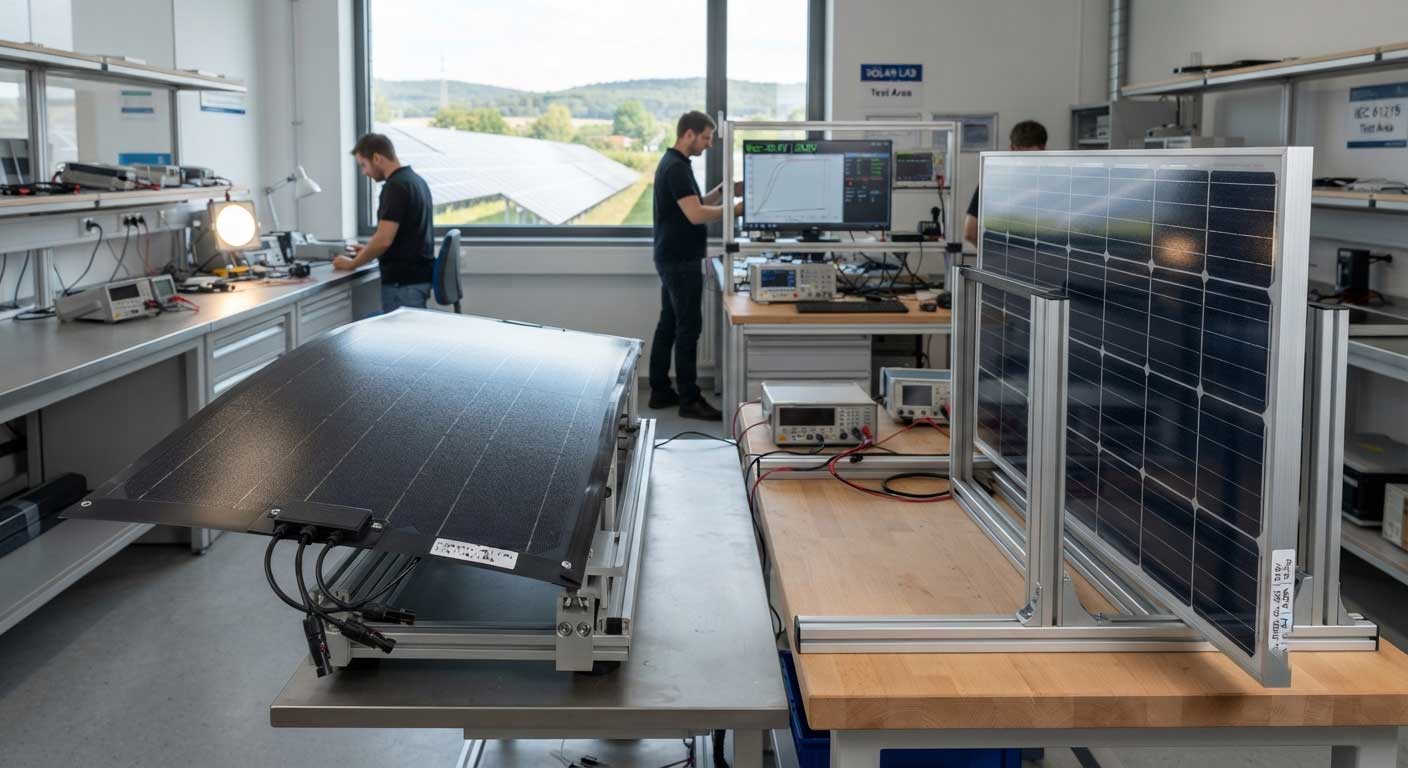
Installation Differences: Flexible vs Rigid Solar Panels
Installation requirements are where the difference becomes obvious.
Rigid panels usually require:
- Mounting brackets
- Rails
- Roof anchors
- Structural support
Flexible panels often allow:
- Adhesive mounting
- Low-profile installation
- Direct surface attachment
For flat residential roofs, rigid panels usually make sense.
For:
- RV roofs
- Boat decks
- Vans
- Portable systems
flexible panels often provide a better solution.
Real Installation Experience: RV Solar Project in Europe
In 2025, Bright Solar supported an RV conversion partner in Europe working on lightweight camper upgrades.
The original design included rigid solar modules. During installation planning, engineers discovered that the roof structure had limited additional load capacity.
The project team compared both options:
| Factor | Rigid Panel | Flexible Panel |
|---|---|---|
| Roof weight | Higher | Lower |
| Installation height | Raised profile | Low profile |
| Wind resistance | Higher exposure | Reduced profile |
| Surface adaptation | Limited | Better |
The final solution used flexible solar modules.
The customer’s priority was not achieving the highest efficiency number on paper. The priority was creating a reliable energy system without compromising vehicle design.
This type of practical decision is where flexible technology has its strongest advantage.
Durability Comparison: Flexible vs Rigid Solar Panels
Durability is one of the most misunderstood topics when comparing flexible vs rigid solar panels.
Many people assume rigid panels are always more durable because they use glass. In some environments, that is true. A glass-covered rigid panel provides excellent protection against physical impact and long-term outdoor exposure.
However, durability is not only about hardness.
In mobile applications, durability also means:
- Handling vibration
- Surviving movement
- Adapting to temperature changes
- Maintaining electrical connections
- Resisting moisture penetration
A rigid solar panel performs extremely well on a stationary rooftop, but it may experience additional stress when installed on a moving vehicle or curved structure.
Flexible panels are designed around different challenges.
Rigid Solar Panel Durability
Rigid solar panels have decades of field experience behind them.
Their advantages include:
- Strong glass protection
- Proven manufacturing process
- Excellent mechanical stability
- High resistance to environmental exposure
They are commonly used for:
- Residential solar systems
- Commercial buildings
- Utility-scale solar farms
According to the National Renewable Energy Laboratory (NREL), modern photovoltaic modules are designed for long service periods, with manufacturers commonly providing 25-year performance warranties for many crystalline silicon products.
Source:
National Renewable Energy Laboratory
https://www.nrel.gov/solar/
For permanent installations, rigid panels remain an excellent choice.
Flexible Solar Panel Durability
Flexible panels approach durability differently.
Instead of protecting the solar cells with glass, manufacturers rely on:
- Advanced encapsulation
- Protective coatings
- Flexible substrates
- Lightweight composite materials
At Bright Solar, one of the most important testing procedures is not simply bending the panel in a factory environment. We evaluate how products behave after repeated outdoor exposure.
Real conditions include:
- Summer heat cycles
- Rain exposure
- Vehicle vibration
- Marine humidity
- Transportation stress
A flexible solar panel that performs well for one day is easy to produce. A flexible solar panel that continues working after years of movement requires better engineering.
Flexible vs Rigid Solar Panels Cost Comparison
Price is another factor customers consider when selecting solar technology.
At first glance, rigid panels often appear cheaper because they are produced at enormous manufacturing scale.
Flexible panels usually cost more per watt because they require:
- Specialized materials
- Lightweight construction
- Advanced manufacturing processes
However, the total project cost should include installation factors.
A comparison:
| Cost Factor | Flexible Solar Panels | Rigid Solar Panels |
|---|---|---|
| Panel price | Usually higher per watt | Usually lower per watt |
| Mounting hardware | Often reduced | Usually required |
| Installation labor | Lower in some applications | Higher for complex surfaces |
| Structural modification | Often unnecessary | May be required |
For example, installing rigid panels on a curved RV roof may require:
- Custom brackets
- Additional reinforcement
- More installation time
A flexible panel may have a higher purchase price but lower total installation complexity.
Which Solar Panel Is Better for RVs: Flexible or Rigid?
For RV applications, the answer depends on the travel style and energy requirements.
Flexible solar panels are usually better when:
- Roof weight is limited
- The roof has curves
- A low-profile appearance is preferred
- Installation space is unusual
Rigid solar panels are usually better when:
- Maximum efficiency is the priority
- Roof space is large
- Weight is not a concern
- Permanent installation is planned
During RV projects, Bright Solar engineers usually ask customers three questions:
- How much electricity do you need daily?
- How much roof space is available?
- How much additional weight can the vehicle support?
These questions often determine the correct technology faster than comparing specifications.
Flexible vs Rigid Solar Panels for Marine Applications
Marine solar installations are one of the areas where flexible technology demonstrates a clear advantage.
Boats have unique challenges:
- Limited flat areas
- Curved surfaces
- Saltwater exposure
- Continuous vibration
A rigid panel installation may require additional structures that affect:
- Boat appearance
- Weight distribution
- Available space
Flexible solar panels can often integrate more naturally into marine designs.
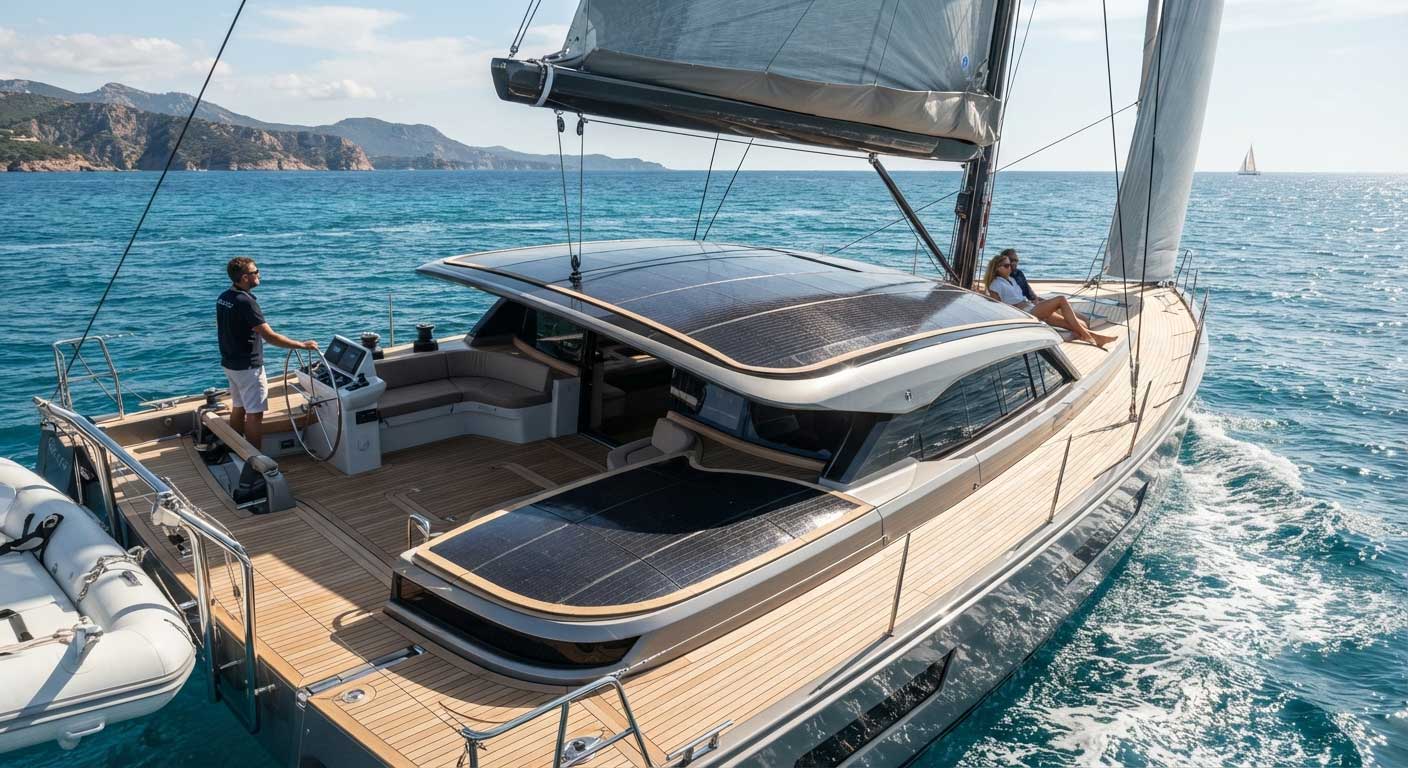
Marine Case Study: Yacht Auxiliary Power System
Bright Solar worked with a European marine equipment supplier that needed additional charging capacity for a sailing yacht.
The original proposal used rigid modules, but the available installation area created difficulties.
The challenges included:
- Curved deck surface
- Limited mounting height
- Maintaining the original yacht appearance
The final solution used flexible solar modules.
The system supported:
- Battery charging
- Navigation electronics
- Communication equipment
- Lighting systems
The customer valued the cleaner installation because the solar system blended into the vessel instead of becoming a visible structure.
Flexible vs Rigid Solar Panels: Which One Should You Choose?
There is no universal winner between flexible and rigid solar panels.
The better choice depends on your application.
Use flexible solar panels when you need:
- Lightweight solar solutions
- Curved surface installation
- Mobile energy systems
- Easy transportation
Choose rigid solar panels when you need:
- Maximum efficiency
- Lowest cost per watt
- Long-term fixed installation
- Large available space
At Bright Solar, we recommend choosing based on the project environment rather than following general opinions.
A solar panel is not just a power generator. It is part of a complete energy system.
Bright Solar Experience in Flexible and Rigid Solar Solutions
Bright Solar focuses on developing practical solar products for real-world applications.
Our experience includes:
- Flexible solar modules for RV manufacturers
- Marine solar projects
- Portable energy systems
- Customized photovoltaic solutions
Through customer feedback, we have learned that solar requirements are becoming more diverse.
Ten years ago, most solar discussions focused on rooftops.
Today, customers ask about:
- Solar on vehicles
- Solar on boats
- Solar for remote equipment
- Lightweight energy systems
This change is why flexible solar technology continues growing.

FAQ About Flexible vs Rigid Solar Panels
Are flexible solar panels better than rigid solar panels?
Flexible solar panels are better for mobile, curved, and lightweight applications. Rigid solar panels are usually better for fixed installations where maximum efficiency and lower cost per watt are priorities.
Do flexible solar panels produce less power than rigid panels?
Some flexible panels have lower efficiency compared with premium rigid panels, but the actual energy output depends on installation conditions, available space, and system design.
Are rigid solar panels more durable than flexible solar panels?
Rigid panels provide excellent mechanical protection, while flexible panels are designed for applications requiring movement and lightweight installation. Durability depends on materials and environment.
Are flexible solar panels good for RVs?
Yes. Flexible solar panels are popular for RVs because they reduce roof weight and can fit curved vehicle surfaces.
Can flexible solar panels be installed on boats?
Yes. Marine applications are one of the strongest use cases because flexible panels adapt well to limited and curved installation areas.
Which solar panel lasts longer, flexible or rigid?
Both technologies can provide long service life when manufactured with quality materials and installed correctly. The ideal choice depends on the environment.
Are flexible solar panels worth the extra cost?
For applications where weight, installation difficulty, or surface shape are important, flexible panels can provide better overall value despite a higher initial price.
Final Conclusion: Flexible vs Rigid Solar Panels
The choice between flexible vs rigid solar panels is not simply about choosing the most powerful panel.
Rigid solar panels remain the preferred solution for many fixed solar installations because of their efficiency, durability, and cost advantages.
Flexible solar panels provide a different value: freedom.
They allow solar energy to be installed on surfaces that were previously difficult or impossible to use.
From RV roofs crossing European highways to marine systems operating in coastal environments, flexible technology expands where solar power can be applied.
At Bright Solar, our experience shows that the best solar solution is the one designed around the real application.
The future of solar energy will not be limited to rooftops.
It will include vehicles, boats, portable systems, and new surfaces where lightweight solar technology creates possibilities.
Related recommendations
-

Solar Panel Series vs Parallel: Which Connection Method Is Better?
175Compare solar panel series vs parallel wiring methods to choose the right setup. Learn voltage, current, shading, and RV solar solutions with Bright Solar.
View details -
Best Flexible Solar Panel for RVs, Boats, and Off-Grid Travel
210Find the best flexible solar panel for RVs, boats, vans, and off-grid systems. Lightweight, durable, and built for real outdoor conditions.
View details -
1000w Flexible Solar Panel: Output, Sizing and Installation Guide
205A 1000W flexible solar panel system suits larger RVs, boats, vans, cabins, and off-grid systems. Actual energy output depends on sunlight, temperature, shadi...
View details -
50w flexible solar panel: Lightweight Solar Solution for RV, Camping and Portable Power Applications
204Discover 50w flexible solar panel solutions from Bright Solar with lightweight design, reliable output, and easy installation for RV, marine, camping, and off-grid applications.
View details