
ETFE Flexible Solar Panels: Benefits, Uses and Buying Guide
ETFE flexible solar panels use an ethylene tetrafluoroethylene (ETFE) surface layer to protect the photovoltaic module while allowing sunlight to reach the solar cells. They are considered for RVs, boats and off-grid installations where weight, surface shape and weather exposure matter. The right panel depends on its full construction, electrical ratings and mounting requirements—not the ETFE label alone.
ETFE is a material choice, not a guarantee of overall panel quality. Two modules with an ETFE front layer can still differ significantly in cell technology, encapsulation, flexibility, output, durability and suitability for a particular environment.
What Is ETFE, and Why Is It Used on Solar Panels?
ETFE stands for ethylene tetrafluoroethylene, a fluoropolymer used in applications where a lightweight, weather-resistant and light-transmitting material is useful. In solar modules, ETFE may be used as the outer front sheet instead of a conventional glass front.
The material supplier Airtech describes ETFE film for solar cells as having good weatherability, optical transparency retention, tear strength and flexibility. Those properties help explain why manufacturers use it in lightweight photovoltaic designs. However, film properties do not by themselves establish the performance or service life of a finished solar module.
Light Transmission and the Front Surface
Sunlight must pass through the panel’s front layer before reaching the photovoltaic cells. A transparent front sheet therefore needs to balance optical performance with protection against the conditions the module will face.
ETFE film is used in solar applications partly because of its optical properties. Saint-Gobain’s photovoltaic materials information also discusses light transmission and surface treatments as factors affecting how much sunlight reaches the cells. The actual power output, however, depends on the complete module—including the cells, electrical layout and operating conditions—not just the front film.
Weatherability and Surface Durability
ETFE is often selected for outdoor use because of its material characteristics, including weatherability. Airtech notes that its ETFE film is designed to retain optical transparency over extended exposure and offers tear strength and flexibility. These statements describe the film material; buyers should still look for module-level testing and warranty information before drawing conclusions about the life of a finished panel.
For a buyer, the practical questions are:
- Is the front film suitable for the expected UV and weather exposure?
- Does the complete module have documented environmental testing?
- What cleaning products and methods are permitted?
- Is the surface designed for the expected handling and contact?
- What warranty applies to the finished panel and its installation?
ETFE Is Not the Same as the Encapsulant
The outer ETFE film and the internal encapsulation perform different roles. ETFE may form the exposed front surface, while encapsulant materials bond and protect the cell layers within the module stack.
That distinction matters when comparing product descriptions. A statement such as “ETFE surface” does not reveal the entire layer structure, the rear-sheet material or the method used to seal the cells and electrical connections. For project procurement, ask for a construction drawing or datasheet rather than relying on a short marketing description.
ETFE Flexible Solar Panels vs. Conventional Rigid Solar Panels
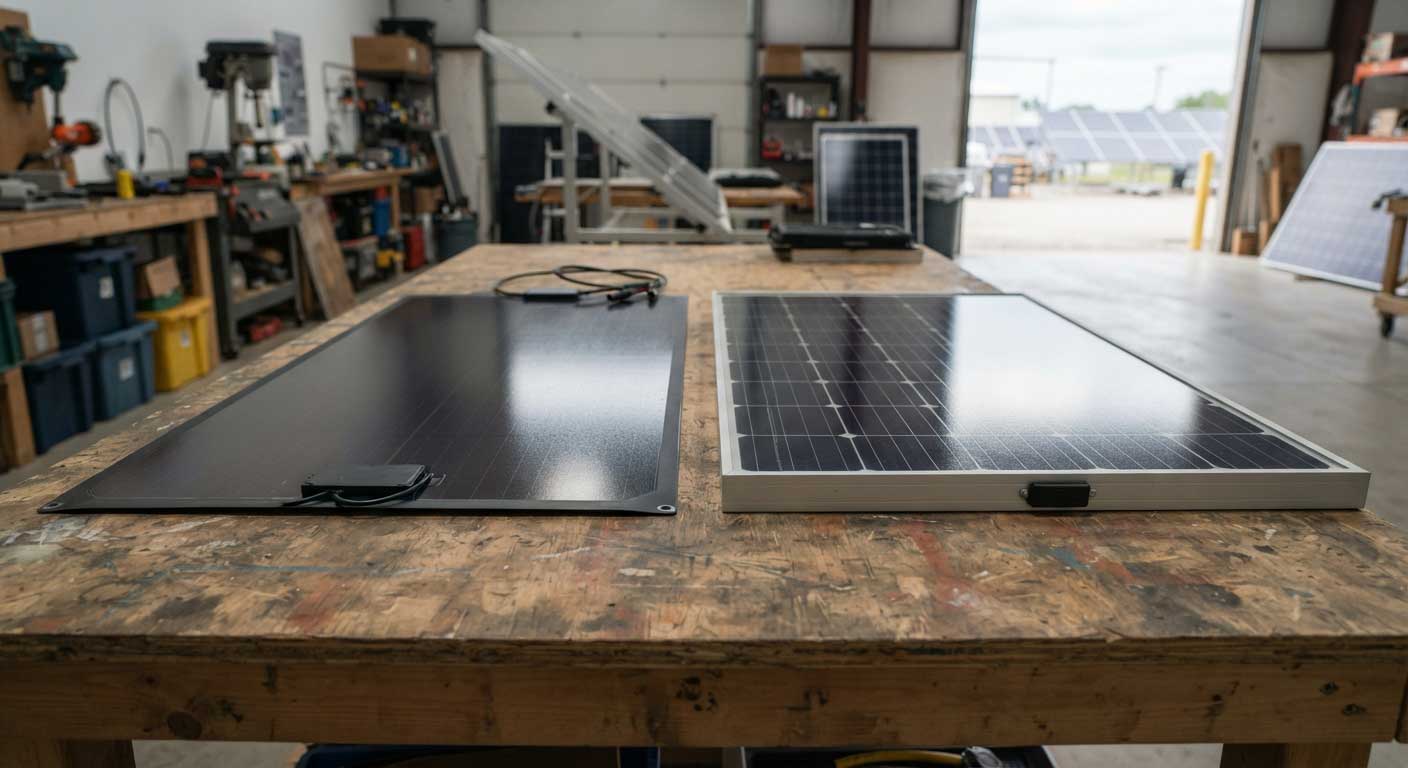
The main difference is structural. ETFE identifies a material, while “flexible” and “rigid” describe how a module is built and how it can be installed. An ETFE front sheet does not automatically make a panel flexible; the complete module construction determines its mechanical behavior.
| Feature | ETFE flexible module | Conventional rigid module |
|---|---|---|
| Front surface | May use ETFE film | Commonly uses glass |
| Structure | Designed to bend only within specified limits | Typically built around a rigid frame or support structure |
| Weight | Often selected for weight-sensitive installations; verify the actual model | Depends on glass, frame and module dimensions |
| Mounting | May use approved bonding or other model-specific methods | Commonly uses a rack or mounting system |
| Curved surfaces | Potentially suitable where the module’s permitted curvature matches the surface | Usually requires a sufficiently suitable mounting plane or specialized support |
| Mechanical limits | Must follow the module’s bend and handling instructions | Must follow the module’s load and mounting requirements |
| Durability evidence | Requires module-level documentation and warranty review | Requires module-level documentation and warranty review |
Neither format is universally better. A rigid module may be appropriate where a stable mounting structure and airflow are available. A flexible module may be useful where weight or surface geometry is a constraint, provided the roof or deck and module are compatible.
Advantages and Limitations of ETFE Flexible Solar Panels
Potential Advantages
Lightweight construction: ETFE front film can be part of a lightweight module design. The actual weight advantage depends on the full product construction, so compare datasheet weights rather than assuming every flexible module is lighter by the same amount.
Low-profile installation: Flexible modules can be useful where a raised frame is difficult to accommodate. This can matter on campervans, boats and other mobile equipment with limited clearance.
Curved-surface compatibility: A panel designed to bend may fit some gently curved surfaces that are awkward for rigid modules. The permitted bend must be checked carefully; the word “flexible” is not permission to force the module into a tight curve.
Outdoor material properties: ETFE film suppliers identify weatherability and transparency retention as useful properties. The finished panel’s resistance to water, salt, abrasion and other exposures still needs to be established from product-specific documentation.
Limitations Buyers Should Not Ignore
Heat management: Low-profile mounting can reduce airflow behind a panel. The National Renewable Energy Laboratory’s System Advisor Model documentation accounts for mounting configuration when estimating module temperature. NREL also reports that module temperature is a major influence on electrical output, second only to the amount of sunlight received.
Mechanical restrictions: A Flexible Solar Panels can still be damaged by creasing, sharp bends, twisting or unsupported areas. Follow the exact module’s mounting and bending instructions.
Surface and system compatibility: The panel must be compatible with the roof or deck, adhesives or fasteners, controller, wiring and intended environment. A surface film alone does not establish that the entire product is suitable for marine use or foot traffic.
Model-specific performance: ETFE does not determine cell efficiency, rated power, voltage, current, warranty or expected service life. These need to be checked separately for each model.
How to Choose ETFE Flexible Solar Panels for Your Project
Choosing a panel should start with the installation requirements. A module that performs well on an open test rack may behave differently when bonded close to a hot roof, partly shaded by equipment or exposed to repeated movement.
Check These Specifications Before Ordering
| Specification | What to confirm |
|---|---|
| Rated power | The module’s stated wattage and test conditions |
| Vmp and Imp | Operating voltage and current at maximum power |
| Voc and Isc | Open-circuit voltage and short-circuit current for system design |
| Cell technology | Monocrystalline, thin-film or another documented technology |
| Dimensions and weight | Actual measurements, including cables and connectors where relevant |
| Front and rear materials | ETFE film type and the rest of the module’s layer construction |
| Bend limit | Maximum permitted curvature and any restrictions on repeated bending |
| Mounting method | Approved adhesive, fasteners, support and surface preparation |
| Temperature rating | The product’s specified operating limits |
| Environmental protection | Module-level ratings and test scope, not just one component’s IP rating |
| Warranty | Duration, exclusions, installation conditions and claim process |
Do not fill gaps in a product datasheet with assumptions based on another model. If a value is missing, request written confirmation from the supplier.
Estimate Energy Using Realistic Inputs
A basic estimate can help establish whether the proposed array is in the right range:
Daily energy (Wh) = rated power (W) × equivalent peak-sun hours × performance factor
For example, a hypothetical 200W panel receiving four equivalent peak-sun hours would produce 800Wh before applying a performance factor. That is a mathematical illustration, not a site forecast.
For a more realistic estimate, account for:
- Local solar resource and seasonal changes.
- Panel orientation and any persistent shading.
- Module temperature and mounting arrangement.
- Soiling and maintenance.
- Controller, wiring and other system losses.
The National Renewable Energy Laboratory’s PVWatts calculator includes inputs for soiling and shading losses, illustrating why estimates need to account for conditions beyond nameplate wattage.
Match the Panel to the Mounting Surface
Before ordering, measure the actual installation area and inspect its shape. Note roof seams, vents, hatches, rigging, drainage paths and any location where cables could be pinched or abraded.
A practical check is to make a full-size paper or cardboard template of the proposed module. Place it on the surface and inspect clearance from different angles. This simple step can reveal problems that are easy to miss when comparing dimensions on a screen.
For a B2B project, keep a record of the approved module model, installation method and relevant datasheet revision. That makes it easier to maintain consistency across production batches or multiple vehicles.
Installing ETFE Flexible Solar Panels

Installation methods differ by model, so the manufacturer’s instructions take priority. The following sequence is a general planning framework.
Step 1 — Inspect and Measure
Check the roof or deck for damage, loose coatings, sharp edges and irregularities. Measure the usable mounting area, accounting for roof accessories and cable exits.
Confirm that the panel’s dimensions and permitted curvature match the surface. If the module needs to be forced into position, stop and reassess the layout.
Step 2 — Prepare the Surface
Clean and prepare the surface using materials and methods compatible with the roof and panel. Do not assume that a particular adhesive will bond safely to every painted, coated, composite or plastic surface.
If bonding is specified, follow the adhesive manufacturer’s surface preparation, temperature and curing requirements alongside the solar module instructions. If mechanical fasteners are required, make sure the installation does not compromise waterproofing or create stress points.
Step 3 — Secure the Panel and Route the Cables
Use the approved mounting method and avoid sharp bends, creases or unsupported sections. Route cables away from abrasion, moving parts, hot surfaces and places where water can collect.
Check connector polarity and compatibility before connecting the module. The charge controller, wiring and protective devices must be selected for the complete array and battery system—not just the panel’s nominal wattage.
Step 4 — Test and Document
Inspect the finished installation and verify that the panel is secure. Check the electrical readings using the system’s monitoring equipment and compare them with expected behavior under the prevailing sunlight and temperature.
Record the module model, installation date and initial readings. These details provide a useful reference for later inspection and troubleshooting.
A Realistic Planning Example for a Campervan
Consider an illustrative campervan project using one 200W ETFE flexible panel. The owner has measured the roof and identified a clear mounting area, but a roof vent may cast a shadow in the late afternoon.
For an initial energy estimate, assume four equivalent peak-sun hours:
200W × 4 hours = 800Wh before system losses.
That number is not a measured result or a guarantee. The owner would need to account for seasonal sunlight, shading, temperature, panel orientation and electrical losses before relying on the estimate.
The owner’s next task is to list daily loads. Lighting, device charging, a refrigerator and ventilation can have very different energy requirements. The load calculation should use each device’s power consumption and expected operating time rather than a guess based on the number of appliances.
The roof vent also deserves attention. NREL’s PV modeling guidance explains that shading from nearby objects can reduce the irradiance reaching modules, while the electrical effect depends on factors such as cell layout and bypass-diode configuration. The owner should therefore inspect the shadow pattern and review the panel’s electrical design before deciding where to mount it.
Project lesson: a panel’s nominal wattage is only one input. Mounting geometry, shade, heat and the actual load profile can determine whether the design meets the owner’s needs.
How Bright Solar Evaluates ETFE Flexible Solar Panels
Bright Solar supplies flexible and semi-flexible solar panel products for B2B applications. When evaluating an ETFE module for a project, the material is one part of the specification—not a substitute for reviewing the finished product.
Bright Solar’s L Series is described as offering up to 30% flexibility, a DuPont ETFE surface and salt-water resistance. The H Series is positioned for marine and yacht applications and is described as featuring double ETFE construction, a walkable design and an IP67 junction box. These descriptions apply to Bright Solar’s product families and should not be assumed to describe products from another manufacturer.
For OEM buyers, distributors and system integrators, a useful review process includes:
- Confirming the exact model and current datasheet.
- Checking power, voltage, current, dimensions and weight.
- Reviewing the complete layer construction and permitted bend limits.
- Confirming the mounting method and environmental ratings.
- Checking warranty coverage and documentation requirements.
- Matching the module to the application’s expected temperature, shading and movement.
A procurement comparison becomes more meaningful when every supplier is asked for the same categories of evidence. This reduces the risk of comparing one manufacturer’s tested specification with another manufacturer’s general marketing description.
FAQ About ETFE Flexible Solar Panels
What are ETFE flexible solar panels?
ETFE flexible solar panels are photovoltaic modules that use ETFE film as a protective front layer and have a construction designed to bend within specified limits. ETFE describes the surface material; flexibility depends on the complete module design.
Are ETFE solar panels better than PET solar panels?
The material name alone is not enough to determine which finished panel is more suitable. Compare the exact products’ construction, optical properties, environmental testing, mounting requirements, warranty and intended use. Avoid assuming that every ETFE panel will outperform every PET-surface panel.
Can ETFE flexible solar panels be installed on a curved roof?
They can be considered for curved surfaces when the module’s permitted curvature and mounting instructions match the roof. Do not crease the panel or force it around a tight curve. Confirm the allowed bend geometry for the exact model.
Are ETFE flexible solar panels waterproof?
Do not infer that the entire module is waterproof simply because it has an ETFE front layer. Check the module’s environmental ratings, junction-box and connector protection, installation conditions and warranty documentation.
Do ETFE flexible solar panels need cleaning?
They may still need inspection and cleaning. Dust, bird droppings, salt deposits and other contamination can reduce the sunlight reaching the cells. Follow the manufacturer’s cleaning instructions and avoid abrasive tools or unapproved chemicals.
Can ETFE flexible solar panels be walked on?
Only if the exact module is explicitly designed and approved for foot traffic under the relevant conditions. ETFE surface film and flexible construction do not automatically make a panel walkable.
What should I check before buying ETFE flexible solar panels?
Review rated power, Vmp, Imp, Voc, Isc, dimensions, weight, bend limits, construction, mounting instructions, environmental ratings, warranty and controller compatibility. Then compare those details with the installation surface and expected loads.
ETFE Flexible Solar Panels for Off-Grid and Marine Projects
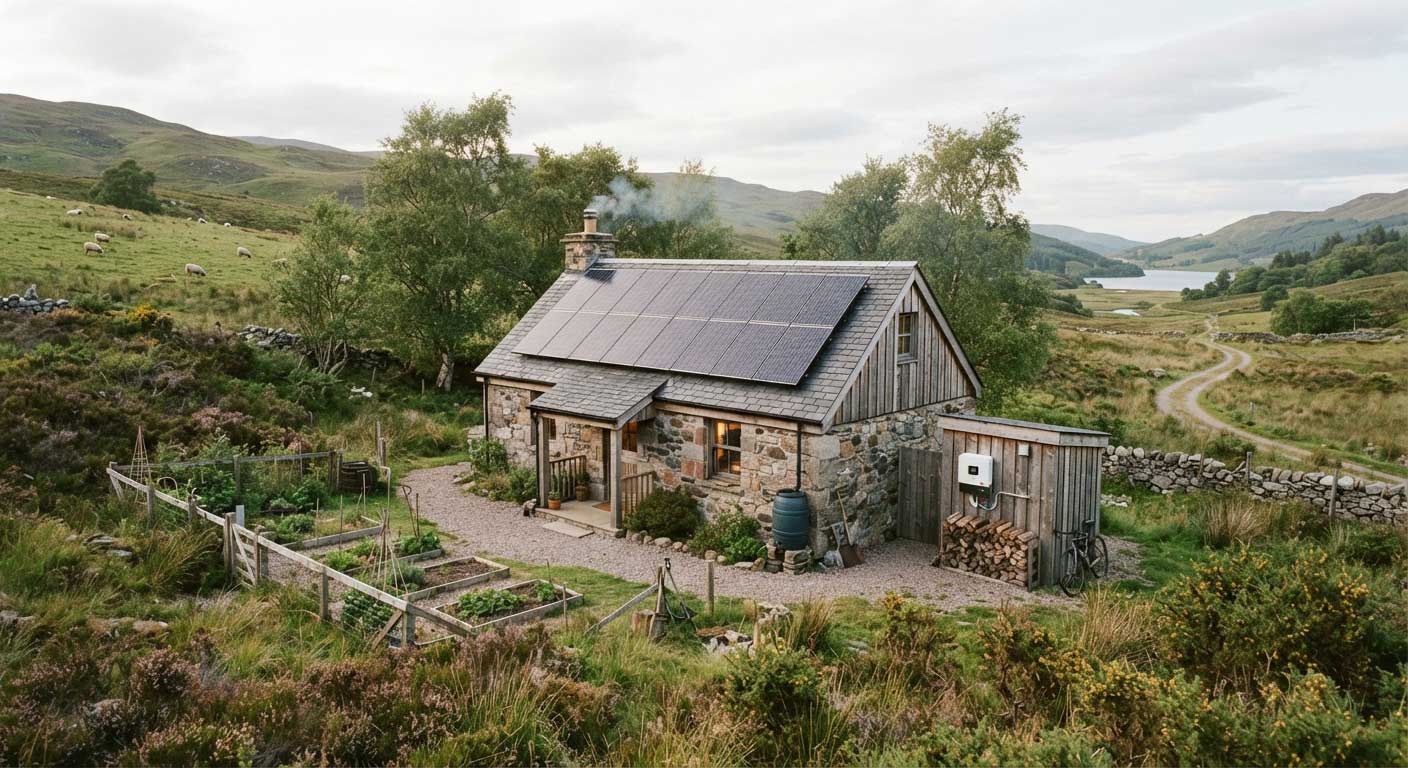
ETFE modules may be considered for cabins, boats and other off-grid installations, but the application should guide the specification. For a cabin, roof construction, local weather and electrical demand are central. For a boat, buyers should also review exposure to salt, vibration, movement and the possibility of water collecting around the installation.
A module’s material description is only the starting point. The complete system must be designed around the real surface, environment and loads.
Conclusion
ETFE flexible solar panels offer a material and construction option for installations where a lightweight profile or limited curvature may be useful. ETFE’s optical and weatherability properties help explain its use as a solar-module front sheet, but the material alone does not guarantee panel efficiency, durability, walkability or marine suitability.
Before purchasing, compare the complete module specifications, confirm the mounting method and assess shading, heat and electrical compatibility. For project and OEM decisions, use model-specific documentation and test evidence rather than relying on the ETFE label alone.
Related recommendations
-

Flexible Fabric Solar Panels: Uses, Design and Buying Guide
102Flexible fabric solar panels integrate photovoltaic technology with lightweight fabric-compatible structures for portable, curved, and flexible applications.
View details -
Flexible 12 Volt Solar Panels: A Practical Guide to RV, Marine and Off-Grid Power
193Flexible 12 volt solar panels suit selected RV, marine, and off-grid systems, but compatibility depends on actual voltage, power, mounting limits, controller...
View details -
Best RV Solar Kit for Off-Grid Travel
197Find the best rv solar kit for off-grid travel. Learn how to size solar panels, batteries, charge controllers and wiring for reliable RV power.
View details -
300 Watt Solar Panels for RV, Marine and Off-Grid Power Systems
264Discover how 300 watt solar panels power RVs, boats, cabins, and off-grid systems. Learn real performance, battery charging, and installation tips from Bright Solar.
View details