Solar Panel Foldable 100W: Output, Uses and Buying Guide
A solar panel foldable 100w is a portable solar charging option for camping, RV travel, and small off-grid power needs. It can recharge compatible power stations and electronic devices, but actual energy production depends on sunlight, panel orientation, temperature, and charging-system losses.
For people who camp away from electrical hookups, a 100W foldable solar panel fills a useful middle ground: more practical for regular charging than many small USB solar chargers, yet easier to carry and deploy than a large fixed solar array.
The important distinction is between power and energy. A 100W rating describes the panel’s nominal power under specified test conditions. It does not mean the panel supplies 100 watts continuously from sunrise to sunset, nor does it guarantee 100 watt-hours every hour outdoors.
Bright Solar‘s approach to solar product selection starts with the application. Before comparing panel designs, consider what needs charging, how long you will stay away from a wall outlet, and whether you can place the panel in direct sunlight for several hours.
What Is a Solar Panel Foldable 100W?
A 100W foldable solar panel is a portable photovoltaic product designed to pack into a more compact form for transport and unfold for use. Its solar cells convert sunlight into direct-current electricity. Depending on its design, it may connect to a compatible portable power station, solar charge controller, or supported electronic device.
The term foldable refers to the product’s transport and deployment design. It does not, by itself, specify cell type, conversion efficiency, weather resistance, or connector compatibility. Those details must be checked in the datasheet for the exact model.
Common applications include:
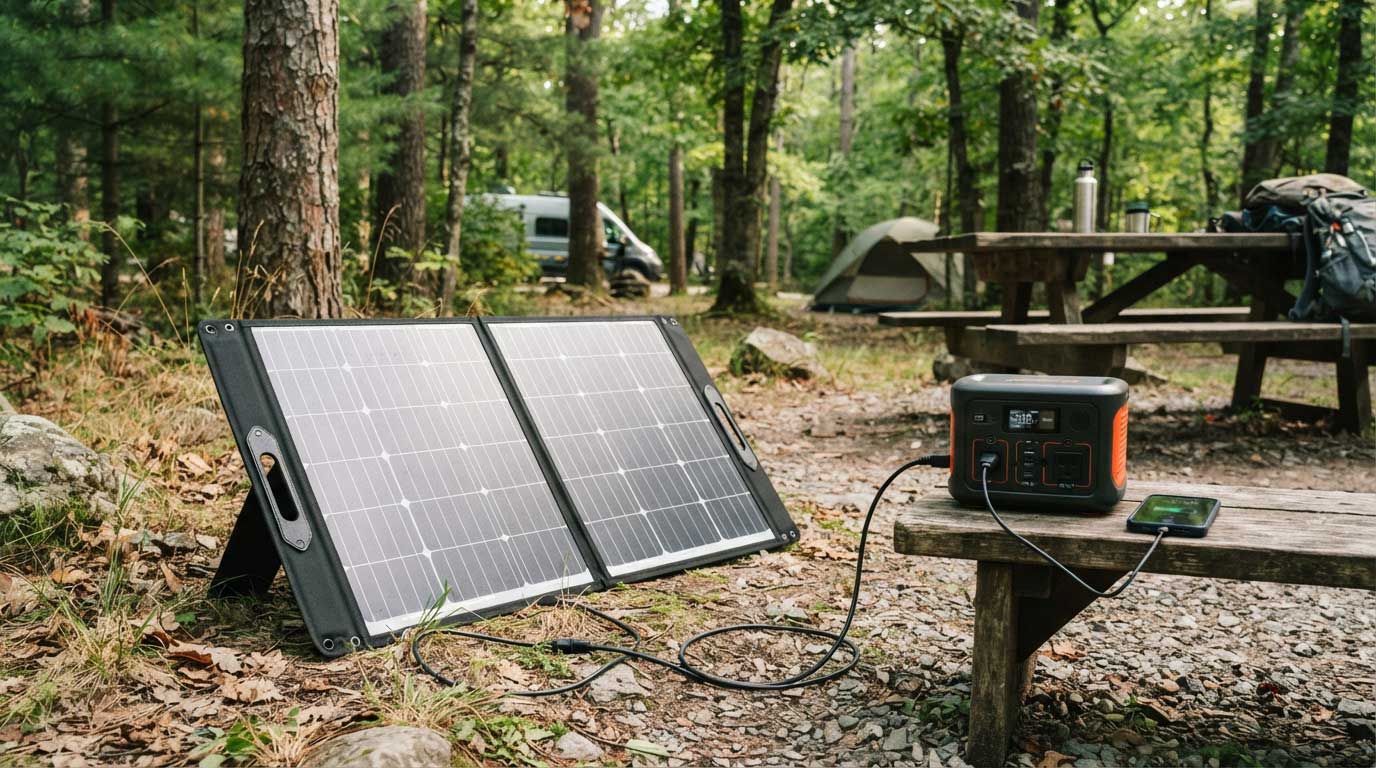
- Camping: Recharging a portable power station for phones, lights, cameras, and other small electronics.
- RV and van travel: Providing supplemental energy when parked in a sunny location.
- Fishing and outdoor recreation: Supporting compatible low-power equipment during extended trips.
- Emergency preparedness: Offering a charging option when grid power is unavailable, provided weather and sunlight permit.
- Small off-grid setups: Supplying supplemental solar energy to a suitably configured battery system.
Foldable Does Not Mean Suitable for Every Installation
A foldable panel is designed to be deployed and packed away. It is not automatically suitable for permanent rooftop mounting, continuous outdoor exposure, or walking on. Check the manufacturer’s mounting instructions, maximum bending limits where relevant, environmental ratings, and intended use.
For a temporary campsite, the ability to reposition the panel can be more valuable than having it permanently attached to a vehicle. At a shaded campsite, for example, the panel can be moved into an open area while the vehicle remains parked under the trees.
How Much Power Does a 100W Foldable Solar Panel Produce?
A 100W panel can produce up to its rated 100 watts under suitable conditions, but real-world output varies throughout the day. To estimate daily energy, multiply the panel’s rated power by equivalent peak sun hours and then account for system losses.
Estimate Daily Energy in Watt-Hours
Use this planning formula:
Daily energy (Wh) = rated power (W) × peak sun hours × estimated system factor
For a simple example, assume a 100W panel receives four equivalent peak sun hours and an illustrative system factor of 0.75:
100W × 4 hours × 0.75 = 300Wh per day
This is an estimate, not a measured result for a specific product. Actual output may be lower in shade, cloudy weather, poor orientation, or when the connected device limits the input. On a clear day with favorable conditions, production may be higher than on a cloudy day, but it should not be treated as guaranteed.
The U.S. Department of Energy states that photovoltaic module ratings are measured under standard test conditions of 1,000 W/m² irradiance and a cell temperature of 25°C. Outdoor sunlight intensity and cell temperature often differ from those conditions. See the DOE guidance on photovoltaic performance.
What Can 300Wh Run?
The following examples show how a hypothetical daily yield of 300Wh might be used. Device consumption varies, so check actual labels and usage.
| Device or load | Illustrative energy use | What 300Wh could cover |
|---|---|---|
| LED camping light | 10W for 4 hours = 40Wh | Several evenings of lighting, depending on usage |
| Phone charging | 15Wh per charge | About 10 charge-equivalents before additional losses |
| Laptop | 60W for 2 hours = 120Wh | Around two hours of use at that assumed draw |
| Camera batteries | 30Wh per day | A portion of the day’s charging needs |
| Small 12V refrigerator | 300Wh or more per day in some conditions | May use most or all of the available energy |
These are illustrative calculations, not universal device specifications. For example, a phone’s actual energy demand depends on its battery capacity, charging efficiency, and how much power it needs to restore its charge. A refrigerator’s consumption varies with ambient temperature, insulation, thermostat settings, and how often it is opened.
A 100W panel is best viewed as a way to supplement a battery system or recharge smaller devices—not as a guaranteed source for every appliance at a campsite.
How to Choose a 100W Foldable Solar Panel
Not every panel labeled 100W will suit every power station. Before purchasing, check the full electrical specifications and physical design.
Check Voltage, Current, and Connector Compatibility
Confirm the following details in the panel and power station manuals:
- Rated power and operating voltage.
- Maximum input voltage and current supported by the power station.
- Connector type, polarity, and cable length.
- Whether a separate charge controller is needed.
- Whether the panel is intended for direct device charging or battery charging through a compatible system.
A connector that physically fits is not proof of electrical compatibility. Never exceed the power station’s maximum solar input voltage. If using an adapter, confirm the wiring and specifications rather than relying on connector shape alone.
Compare Folded Dimensions and Weight
For car camping, a panel that takes up more trunk space may still be manageable. For backpacking or frequent travel, folded dimensions and carrying weight become much more important.
Compare:
| Buying factor | Why it matters |
|---|---|
| Folded size | Determines whether it fits your storage space |
| Unfolded size | Affects how much clear space you need at camp |
| Total weight | Includes the panel, cables, and any required accessories |
| Support structure | Helps the panel remain stable during use |
| Cable and connector design | Affects setup convenience and compatibility |
| Weather guidance | Clarifies when the panel should be packed away |
Understand the Construction and Weather Rating
A foldable panel may use a fabric-supported structure, hinged sections, or another collapsible design. Check the actual model’s surface material, hinge construction, support design, and stated environmental rating.
Do not assume that all foldable panels are waterproof. Dew, dust, wind, rain, and repeated packing can affect different products in different ways. Follow the manufacturer’s instructions for storage, cleaning, and outdoor use.
Bright Solar’s flexible solar panel products are designed for specific applications and specifications; those characteristics should not be assumed to apply to every portable folding panel. For B2B buyers, the exact datasheet, test reports, customization options, and warranty terms should be confirmed for the product being quoted.
How to Set Up a Solar Panel Foldable 100W
A simple setup can work well, but placement and compatibility matter more than many first-time users expect. A panel laid partly under a tree may generate less energy than the same panel positioned in an open, sunny area.
Step 1 — Choose an Open, Stable Location
Unfold the panel on a stable surface where it receives direct sunlight. Look beyond the immediate area: a tent, vehicle, or nearby tree may cast a longer shadow as the sun moves.
Avoid placing the panel where people will walk over it or where wind can easily tip it over. Use the manufacturer’s supplied supports and follow its instructions for securing the panel.
Step 2 — Position the Panel Toward the Sun
Adjust the panel’s direction and angle when the design allows. The best orientation varies with location, season, and time of day. Repositioning the panel when sunlight changes can help maintain charging performance.
Do not focus on precise angle adjustments while ignoring shade. Removing a shadow across the panel may be more useful than making a small tilt adjustment.
Step 3 — Connect the Correct Charging Equipment
Check the panel’s electrical output and the receiving device’s input limits before connecting them. Follow the manufacturer’s connection sequence, and use a suitable charge controller if required.
Keep connectors clean and dry, avoid sharp cable bends, and route cables away from foot traffic. If the power station does not recognize the panel, disconnect safely and consult the equipment manuals rather than experimenting with unverified adapters.
Step 4 — Monitor the Input Reading
If your power station displays solar input, check the reading after setup. A 100W-rated panel will not necessarily show 100W in every moment. Cloud cover, temperature, orientation, and the battery’s charging state can all affect the result.
For a useful comparison, observe the input at different times of day under similar weather conditions. One low reading does not establish that a panel is defective.
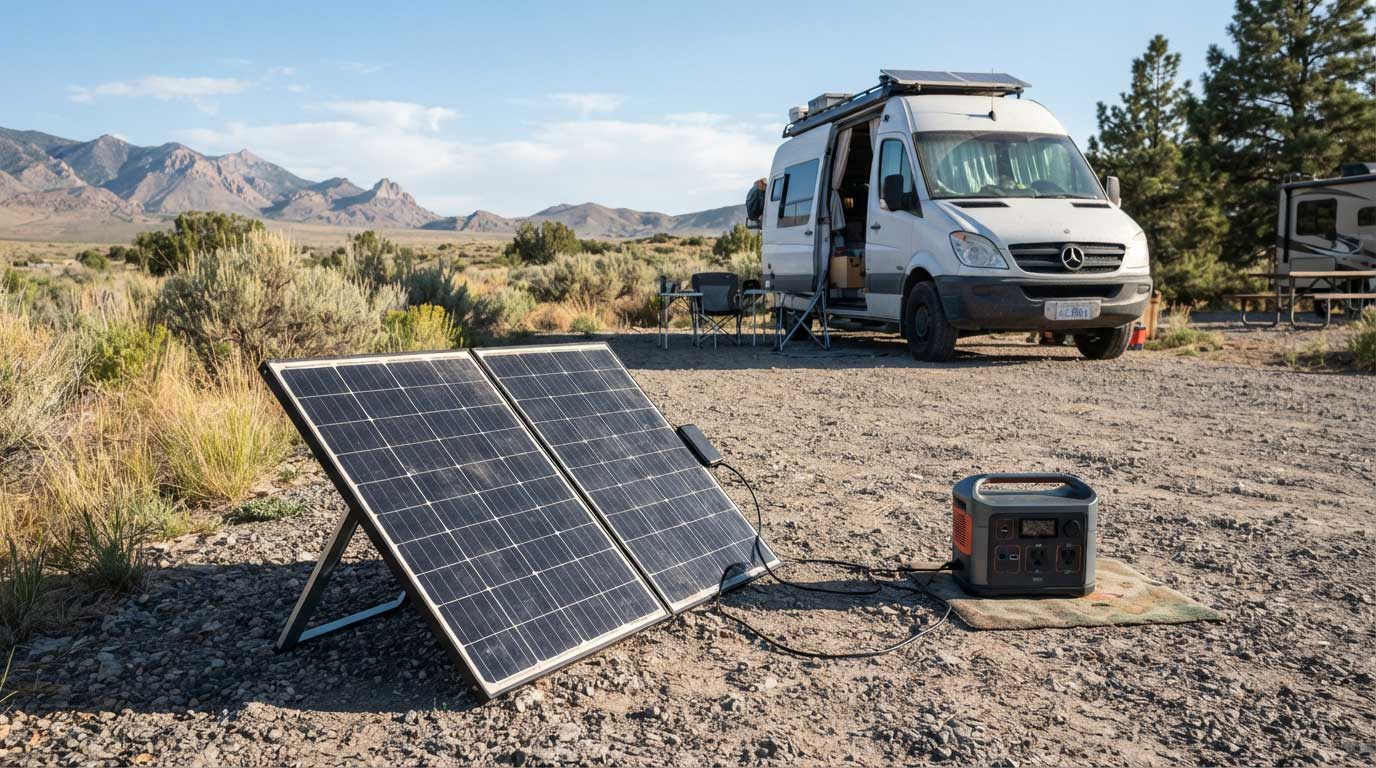
A Realistic Example: One Panel for a Weekend Trip
Imagine a traveler taking a two-night trip in a camper van. Their estimated daily electricity use is 180Wh for phone charging, LED lighting, and camera batteries. They bring a power station charged at home and a 100W folding solar panel.
Using four equivalent peak sun hours and an assumed system factor of 0.75, the panel’s estimated daily energy is:
100W × 4 hours × 0.75 = 300Wh
In this illustrative scenario, the estimated solar energy exceeds the assumed 180Wh daily requirement. That margin could help replenish the power station, but actual results will depend on weather, shading, and the equipment’s charging efficiency.
Now change one condition: the campsite is under dense trees, and the panel can only be placed in partial sunlight. The original estimate may no longer be realistic. The traveler may need to reduce consumption, move the panel into an open area, or use energy stored before departure.
This is why a practical solar plan includes both a production estimate and a backup. A 100W panel can be useful for a modest load, but it should not be treated as a guaranteed supply for critical equipment.
Common Mistakes to Avoid
- Choosing by wattage alone: A 100W rating does not tell you the folded dimensions, actual daily yield, or connector compatibility.
- Ignoring power station limits: Confirm maximum input voltage and current before connecting the panel.
- Leaving the panel in shade: Check for shadows from the vehicle, tent, and trees throughout the day.
- Assuming waterproof construction: Follow the exact product’s weather and storage instructions.
- Expecting identical output every day: Seasonal changes, clouds, and temperature affect solar production.
- Forgetting cable management: Keep cables away from walkways, sharp edges, and places where they may be pinched.
For estimates based on a specific location, the NREL PVWatts Calculator can help explain how solar resource, orientation, and system losses influence photovoltaic output. It models grid-connected systems, so its results should be treated as a general planning reference rather than a direct performance prediction for a portable 100W panel.
FAQ About solar panel foldable 100w
How much electricity can a 100W foldable solar panel generate per day?
It depends on equivalent peak sun hours and system losses. For example, four peak sun hours and an assumed 0.75 system factor give an estimate of 300Wh per day. This is a calculation, not a guaranteed product output.
Can a 100W foldable solar panel charge a power station?
Yes, if the panel’s voltage, current, connector, and output are compatible with the power station’s solar input. Always check the specifications and maximum input limits before connecting the equipment.
Is a 100W foldable solar panel enough for camping?
It can be suitable for phones, lights, camera batteries, and other modest loads when sunlight is sufficient. Running a refrigerator or larger appliances may require more generation capacity and battery storage.
Does a foldable 100W solar panel work on cloudy days?
It can still generate electricity in cloudy weather, but output is generally lower and depends on cloud cover and available sunlight. Keep a charged battery or alternative charging method available for essential needs.
Can I connect a 100W foldable panel directly to my phone?
Only if the panel has a suitable regulated USB output or is used with compatible charging equipment. Do not connect an unregulated solar output directly to a device unless the manufacturer explicitly supports that configuration.
What should I check before buying a foldable 100W solar panel?
Compare rated power, voltage, connectors, folded dimensions, carrying weight, support design, weather guidance, warranty, and compatibility with your intended equipment. Confirm model-specific specifications rather than relying on the wattage label alone.
Technical Sources and Editorial Note
The technical guidance in this article draws on the following public resources:
- U.S. Department of Energy — Optimizing Solar Photovoltaic Performance for Longevity: standard test conditions and factors affecting real-world generation.
- U.S. Department of Energy — Solar Photovoltaic Performance and Efficiency Basics: solar-cell efficiency and the effects of temperature.
- National Renewable Energy Laboratory — PVWatts Calculator: photovoltaic production estimates based on system and location inputs.
Author and review note: This article is prepared for Bright Solar’s solar-product audience, with a focus on practical power estimates, portable-system compatibility, and outdoor use. The numerical examples are clearly identified as illustrative calculations rather than firsthand field-test measurements. Always verify the specifications of the exact panel and charging equipment before use.
A solar panel foldable 100w is most useful when its portability matches your trip, its electrical output matches your charging equipment, and your expectations reflect real sunlight rather than the rated wattage alone.
Related recommendations
-

Sungrow and Tata Power Help India’s Photovoltaic Projects with a BESS Project in Ladakh
260Sungrow is working with Tata Power Solar Systems Limited on a 60.56 MWh BESS project in Phyang, Leh, Ladakh, combining PV plus ESS solutions to support India’s photovoltaic projects, peak power management, and long-term clean energy growth.
View details -
400 Watt Flexible Solar Panel for Serious Off-Grid Energy Systems
184Discover how a 400 watt flexible solar panel delivers lightweight, high-output off-grid energy for RVs, boats, vans, and solar battery systems.
View details -
solar panel golf cart roof Solutions from Bright Solar
315Bright Solar’s solar panel golf cart roof keeps golf cart batteries topped up while driving, reducing downtime and electricity use. Ideal for eco-conscious courses with solar charging options.
View details -
solar panel 100w flexible (Real Compact Off-Grid Guide from Bright Solar)
236solar panel 100w flexible explained with RV installation cases, real output data, mounting insights, and off-grid performance analysis for travel and camping use.
View details