100 Watt Flexible Solar Panel: Lightweight Solar Power for Real Off-Grid Travel
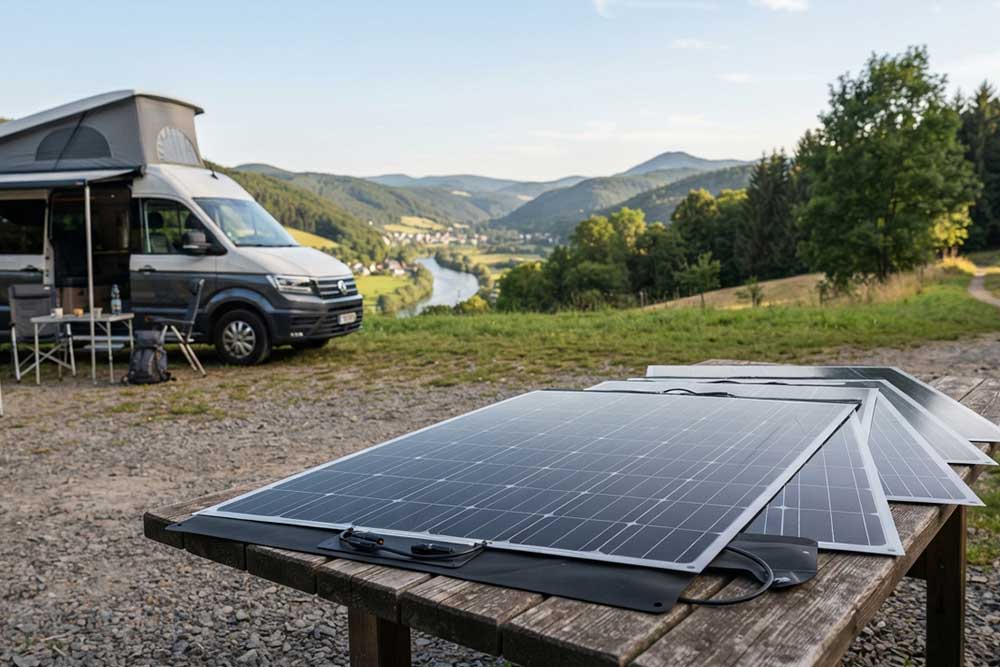
A 100 watt flexible solar panel is one of the most practical solutions for lightweight off-grid charging on RVs, boats, vans, and portable battery systems. It delivers reliable daily power without the bulk, weight, or wind resistance of traditional rigid panels.
I stopped dismissing 100W panels years ago during a windstorm in western Utah.
A larger Class A motorhome nearby carried a massive rooftop array mounted on raised aluminum rails. The system looked impressive until crosswinds started hammering the interstate. You could hear the brackets flexing every time the gusts hit sideways.
Meanwhile, a compact camper van parked two spaces over sat almost silent with a pair of low-profile 100 watt solar panel flexible bonded directly to the roof.
That contrast stuck with me more than any specification sheet ever did.
People love talking about maximum wattage online. Real-world off-grid travel teaches something else: simplicity matters. Weight matters. Roof stress matters. Quiet reliability matters.
And that is exactly where a 100 watt flexible solar panel becomes surprisingly useful.
Why 100 Watt Flexible Solar Panels Became So Popular
The portable solar market changed rapidly over the last decade.
Off-grid camping exploded.
Van life became mainstream.
Marine solar installations expanded.
Portable lithium batteries became affordable.
According to the International Energy Agency (IEA), solar PV deployment continues reaching record growth levels globally, driven partly by mobile and distributed energy systems.
Source: International Energy Agency
https://www.iea.org/reports/renewables-2024
The appeal of a 100 watt flexible solar panel is not just efficiency.
It is flexibility in the literal sense.
These lightweight pv panels can install on:
- Curved RV roofs
- Sailboat decks
- Camper vans
- Portable charging stations
- Truck canopies
- Off-grid shelters
Without heavy mounting hardware.
Without large roof penetrations.
Without turning the roof into an aluminum rack system.

How Much Power Does a 100 Watt Flexible Solar Panel Actually Produce?
This is where expectations need honesty.
A 100 watt flexible solar panel does not continuously generate 100 watts all day.
Actual production depends on:
- Sunlight hours
- Temperature
- Panel angle
- Shade
- Cable losses
- Charge controller efficiency
Still, under realistic conditions, most 100W flexible panels generate approximately:
- 300Wh to 600Wh per day
Assuming:
- 4–6 peak sunlight hours
- Proper MPPT controller
- Minimal shading
The U.S. Department of Energy notes that solar panel efficiency drops under excessive heat and partial shading conditions.
Source: U.S. Department of Energy
https://www.energy.gov/eere/solar
And 100 watt solar panel flexible experience heat differently than rigid panels.
That matters.
What Can a 100W Flexible Solar Panel Power?
| Device | Estimated Runtime |
|---|---|
| LED lighting | Multiple nights |
| Portable fridge | 8–24 hours depending on battery |
| Laptop charging | Daily charging support |
| Smartphones | Several full charges |
| Small fan | All night |
| GPS & marine electronics | Continuous support |
One properly configured 100W setup will not power an air conditioner.
But that is not really the point.
For many travelers, the goal is battery maintenance and quiet energy independence — not replacing an entire residential electrical system.
Why Flexible Panels Work Well for RVs and Boats
Rigid solar panels still dominate residential rooftops for good reasons.
They dissipate heat better.
They generally last longer.
They maintain stable output over decades.
But mobile installations change the priorities completely.
Weight Changes Everything
A traditional framed 100W rigid panel can weigh 15–20 pounds once brackets and rails are included.
Many 100 watt flexible solar panels weigh under 5 pounds.
That difference matters on:
- Fiberglass RV roofs
- Pop-top campers
- Sailboats
- Lightweight van conversions
Especially after thousands of highway miles or rough offshore conditions.
I once inspected a cracked fiberglass roof on an older camper outside Flagstaff where elevated rigid panel mounts had slowly stressed the roof structure over years of vibration.
The lightweight pv panels survived.
The roof did not.
100 watt solar panel flexible systems reduce some of that mechanical stress dramatically.
Low-Profile Installation Improves Aerodynamics
This point rarely gets enough attention.
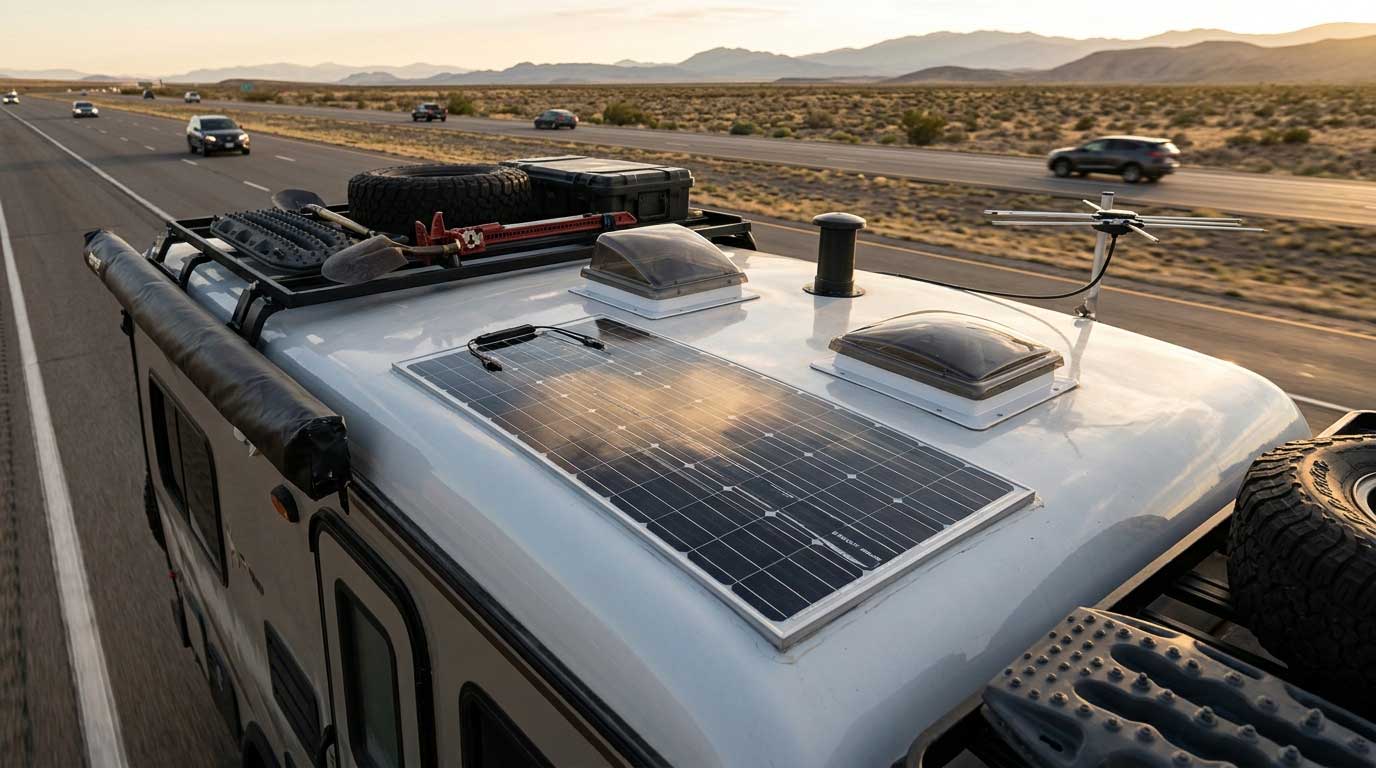
Raised solar brackets create turbulence at highway speed.
100 watt solar panel flexible mounted nearly flush against the roof produce:
- Less wind noise
- Reduced drag
- Lower vibration
- Cleaner appearance
One Bright Solar customer tracked fuel usage over roughly 7,000 travel miles after switching from raised rigid panels to low-profile 100 watt solar panel flexible. The fuel savings were modest — around 3% — but consistent enough to notice during extended interstate driving.
At 70 mph, airflow matters.
Where Cheap Flexible Solar Panels Usually Fail
This section matters more than marketing claims.
Most failures come from materials and heat management.
1. Poor Surface Coatings
Cheap PET coatings discolor and crack faster under UV exposure.
ETFE surfaces perform significantly better outdoors.
According to DuPont material testing, ETFE offers superior UV resistance and outdoor durability compared with many conventional polymer materials.
Source: DuPont
https://www.dupont.com
2. Heat Buildup
100 watt solar panel flexible mounted directly against dark surfaces can trap heat aggressively.
I measured surface temperatures exceeding 80°C on a black van roof outside Las Vegas during midsummer.
That level of heat accelerates degradation.
Small ventilation gaps can help considerably.
3. Weak Junction Boxes
Water intrusion destroys poorly sealed connectors quickly.
Marine installations are especially unforgiving.
A proper 100 watt flexible solar panel should include:
- IP67 or IP68 waterproof protection
- UV-resistant cabling
- Tinned copper wire
- Durable MC4 connectors
Best Uses for a 100 Watt Flexible Solar Panel
Not every solar setup needs massive capacity.
In many cases, smaller systems are actually smarter.
Ideal Applications
| Application | Why 100W Works Well |
|---|---|
| Camper vans | Lightweight charging |
| Sailboats | Curved surface compatibility |
| Battery maintenance | Reliable trickle charging |
| Weekend camping | Portable off-grid power |
| Emergency backup | Compact storage |
One of the cleanest setups I ever saw used just two 100W flexible panels on a minimalist Sprinter conversion.
No giant roof rack.
No excessive wiring.
No complicated structure.
Just enough solar to quietly support refrigeration, lighting, cameras, and laptop charging for weeks at a time.
Simple systems often survive longer because there are fewer failure points.
Choosing the Right 100 Watt Flexible Solar Panel
A good lightweight pv panels is not just about wattage.
The important details are usually hidden underneath the marketing:
- Cell quality
- Encapsulation materials
- Waterproofing
- Cable quality
- Heat tolerance
- Long-term UV resistance
At Bright Solar, 100 watt solar panel flexible products are engineered specifically for:
- Mobile off-grid use
- Lightweight installation
- Harsh outdoor environments
- Marine compatibility
- Long-distance travel durability
Because real travel conditions are messy.
Road vibration.
Salt air.
Tree debris.
Extreme heat.
Sudden storms.
Laboratory numbers alone do not prepare a solar system for that reality.
FAQ: 100 Watt Flexible Solar Panel
How much power does a 100 watt flexible solar panel produce daily?
Most 100 watt flexible solar panels generate approximately 300Wh to 600Wh daily under good sunlight conditions.
Can a 100W flexible solar panel charge a battery?
Yes. A 100 watt flexible solar panel is commonly used to charge lithium and AGM battery systems for RVs, boats, and portable power stations.
Are flexible solar panels waterproof?
High-quality flexible solar panels typically include waterproof junction boxes and weather-resistant ETFE coatings suitable for outdoor use.
Can flexible solar panels bend?
Yes. Flexible solar panels are designed to conform slightly to curved surfaces, making them ideal for RV roofs and marine installations.
How long does a 100 watt flexible solar panel last?
Premium 100 watt solar panel flexible generally last between 5 and 15 years depending on installation quality, heat exposure, and environmental conditions.
Final Thoughts
A 100 watt flexible solar panel is not about building the biggest off-grid power system possible.
It is about efficient, lightweight, reliable energy where mobility matters more than raw scale.
Curved roofs.
Marine decks.
Camper vans.
Portable battery charging.
Those environments reward simplicity.
And after enough miles listening to oversized aluminum solar racks howl in desert crosswinds, quiet low-profile solar starts looking a lot smarter.
Related recommendations
-

Cost of Flexible Solar Panels: Prices, Factors and Buying Guide
121The cost of flexible solar panels varies by power, technology, materials, dimensions, customization, quantity, and installation requirements.
View details -
Series vs Parallel Solar Panels: Which Wiring Method Performs Better?
110Compare series vs parallel solar panels for RVs, homes, and off-grid systems. Bright Solar explains voltage, current, shading, and wiring efficiency.
View details -
450 Watt Solar Panels: Output, Sizing and Applications
221Discover how 450 watt solar panels perform, how much energy they can produce, and how to size, wire and install them for RV, home and off-grid systems.
View details -
500 watt flexible solar panel: High Power Flexible Solar Solution for RV, Marine and Off-Grid Applications
209Discover how a 500 watt flexible solar panel delivers high power output with lightweight design, durability, and versatile installation options for RVs, marine, and off-grid applications.
View details