Lightweight Portable Solar Panels: How to Choose the Right One
Lightweight portable solar panels provide mobile electricity for camping, RV trips, outdoor work, and off-grid applications without requiring permanent installation. Compare packed weight, rated power, folded size, and charging compatibility to find a panel that is easy to carry and practical for your energy needs.
A solar panel can be powerful on paper and still be the wrong choice for a trip. If it takes up too much storage space, requires awkward mounting, or cannot connect to your battery system, its rated wattage matters less than you might expect.
That is why lightweight portable solar panels deserve to be evaluated as complete portable power solutions, not simply as smaller versions of rooftop modules. Weight affects how often a panel gets used. Output affects how much energy it can collect. The folding mechanism, cables, support legs, and charging electronics determine how convenient the system feels once you leave home.
For Bright Solar and buyers looking for portable solar solutions, the aim is to balance these factors without sacrificing electrical compatibility or making unsupported assumptions about product performance.
This guide explains how to compare portable panels, estimate useful energy, select a suitable setup, and avoid common mistakes when using solar power outdoors.
What Are Lightweight Portable Solar Panels?
Lightweight portable solar panels are photovoltaic products designed to be transported and deployed where electricity is needed. Depending on their construction, they may use folding sections, flexible laminates, lightweight frames, or compact rigid modules.
These designs serve different purposes. A folding panel usually closes into a smaller package. A Flexible Solar Panel can conform to certain curved surfaces within its specified bending limits. A compact rigid panel retains a fixed shape but may offer a convenient balance of durability and portability.
The word lightweight has no single universal weight threshold across all portable solar products. A panel that feels light enough for car camping may be impractical for backpacking. Buyers should compare actual product weight, packed dimensions, and the weight of accessories rather than relying on the product name alone.
Common applications include:
- Camping and weekend outdoor trips.
- RVs, campervans, and mobile homes.
- Portable power stations and compatible battery systems.
- Remote work, photography, and outdoor monitoring.
- Temporary off-grid power for selected low-consumption devices.
- Marine and other mobile applications when the product is specifically designed for the environment.
A portable panel generates electricity; it does not necessarily store it. If you need power after sunset, you will generally need a compatible battery or power station.
Why Weight Matters When Choosing Portable Solar Panels
The most useful panel is one you can realistically transport, set up, and use. That sounds obvious, but product comparisons often focus on rated watts while overlooking the equipment required to make those watts useful.
Consider two hypothetical products. Panel A weighs 2.5 kg and is easy to carry, but its output may be insufficient for a larger battery. Panel B weighs 5 kg and offers a higher rated power, but it takes up more room and requires a more stable support. Neither is automatically the better option: the answer depends on the load, journey, and available storage.
Match Weight to the Way You Travel
| Application | Main priority | What to check |
|---|---|---|
| Backpacking | Minimum carried weight | Total packed weight, folded dimensions, and charging needs |
| Car camping | Balance of output and portability | Carrying case, support legs, and cable length |
| RV travel | Convenient deployment | Packed size, panel stability, and battery compatibility |
| Remote work | Reliable daily energy | Output, power station limits, and backup capacity |
| Marine use | Environmental suitability | Corrosion resistance, water protection, and mounting requirements |
These are selection guidelines, not fixed product categories. The same panel may suit several applications if its weight, construction, and electrical specifications match the conditions.
Compare the Complete Carrying Weight
The panel’s listed weight is only part of the total. A real portable setup may also include:
- A carrying case or protective cover.
- Cables and connector adapters.
- A solar charge controller, if required.
- A battery or portable power station.
- A stand, ground anchors, or mounting accessories.
For a hiker, an extra kilogram can be significant. For a campervan owner storing the system in a rear compartment, packed dimensions may matter more than the difference in panel weight.
A useful buying habit is to ask for the ready-to-use system weight. That number provides a more meaningful comparison than panel weight alone.
How Much Energy Can Lightweight Portable Solar Panels Generate?
A lightweight panel’s rated wattage tells you its power under specified test conditions, not how much electricity it will produce over a full day.
The U.S. Department of Energy identifies standard photovoltaic module rating conditions as 1,000 W/m² of irradiance and a cell temperature of 25°C. Outdoor conditions often differ, so real-world output is variable.
For preliminary planning, use this equation:
Estimated daily energy (Wh) = Panel rating (W) × Equivalent peak-sun hours × Estimated system factor
The system factor is an allowance for losses. Choose it based on your equipment and conditions rather than treating one percentage as universally correct.
For example, a hypothetical 100W panel receiving four equivalent peak-sun hours with an illustrative system factor of 0.75 would produce an estimated 300Wh of usable daily energy:
100W × 4 hours × 0.75 = 300Wh
This is a calculation example, not a measured result from a Bright Solar product. The actual figure depends on the location, weather, panel orientation, temperature, and connected equipment.
| Equivalent peak-sun hours | Theoretical energy from a 100W panel | Illustrative energy at a 0.75 system factor |
|---|---|---|
| 2 hours | 200Wh | 150Wh |
| 3 hours | 300Wh | 225Wh |
| 4 hours | 400Wh | 300Wh |
| 5 hours | 500Wh | 375Wh |
For a location-specific estimate, use the National Renewable Energy Laboratory’s PVWatts Calculator. It uses location and system information to estimate photovoltaic production, although its standard model is intended for grid-connected systems rather than a guarantee of portable-panel output.
Why Shade, Weather, and Heat Matter
A panel positioned in direct sunlight will generally have more available solar energy than one under dense tree cover. Even a small shadow can matter, depending on the cell layout and electrical configuration.
The U.S. Department of Energy also explains that solar radiation varies by location, season, time of day, and local weather.
When assessing a portable panel, pay attention to three conditions:
- Shading: Trees, tents, vehicles, and nearby buildings may reduce the sunlight reaching the cells.
- Temperature: Strong sunlight does not guarantee maximum electrical output because higher cell temperatures can reduce voltage.
- Orientation: Moving the panel to face available sunlight more directly can improve energy collection when conditions allow.
For mobile use, the ability to reposition the panel is a practical advantage. It will not eliminate cloudy weather or limited daylight, but it gives you more control over where the panel collects sunlight.
How to Choose the Right Lightweight Portable Solar Panel
1. Select Wattage According to Your Daily Loads
Begin by listing the devices you intend to power and estimating their daily energy use in watt-hours.
| Intended use | Selection consideration |
|---|---|
| Phones and small USB devices | Check regulated USB output and daily charging needs |
| Cameras and tablets | Check connector requirements and battery charging arrangements |
| Portable power stations | Match solar input voltage, current, and maximum power |
| RV battery charging | Confirm battery chemistry and charge-controller compatibility |
| Remote equipment | Allow for cloudy weather, battery storage, and periods without sunlight |
A higher-wattage panel may collect more energy under comparable conditions, but it can also be heavier and bulkier. Choose the smallest system that reasonably meets your requirements, with a suitable allowance for changing weather and future loads.
2. Compare Foldable, Flexible, and Compact Rigid Designs
Lightweight portable solar panels are not all built the same way.
- Foldable panels are designed to close into a compact package for transport. Check the hinges, protective surfaces, support legs, and packed dimensions.
- Flexible panels can suit certain curved mounting surfaces when the product’s permitted bending limits allow it. Do not assume they can be folded repeatedly like a fabric item.
- Compact rigid panels retain their shape and may be suitable where a fixed surface or protective case is available.
The right design depends on how the panel will be carried, deployed, and stored. A foldable model may work well for a campsite, while a lightweight flexible module may be more appropriate for a compatible curved installation. Their specifications and installation requirements should be evaluated separately.
3. Verify Electrical Compatibility
Before connecting a panel to a power station or battery system, check the manufacturer’s electrical specifications.
Important values include:
- Rated maximum power (Pmax).
- Voltage at maximum power (Vmp).
- Current at maximum power (Imp).
- Open-circuit voltage (Voc).
- Short-circuit current (Isc).
Confirm that the panel falls within the receiving device’s input limits, including any maximum voltage and current. Also verify connector type, polarity, and whether an external charge controller is required.
A connector that physically fits is not proof of electrical compatibility. If you are charging a battery directly through a controller, make sure the controller supports that battery’s chemistry and voltage and follow the manufacturer’s connection instructions.
4. Inspect Materials and Outdoor Protection
Portable solar panels may encounter dust, moisture, repeated handling, and temperature changes. Check the manufacturer’s stated operating conditions, cleaning instructions, and any IP rating supplied for the product.
Do not assume that the entire assembly is waterproof because one component has an IP rating. The rating may apply only to a particular junction box or connector.
Also inspect the cable exits and folding joints. Repeatedly pulling on a cable or forcing a hinge into an unintended position can damage a panel even if the photovoltaic surface remains intact.
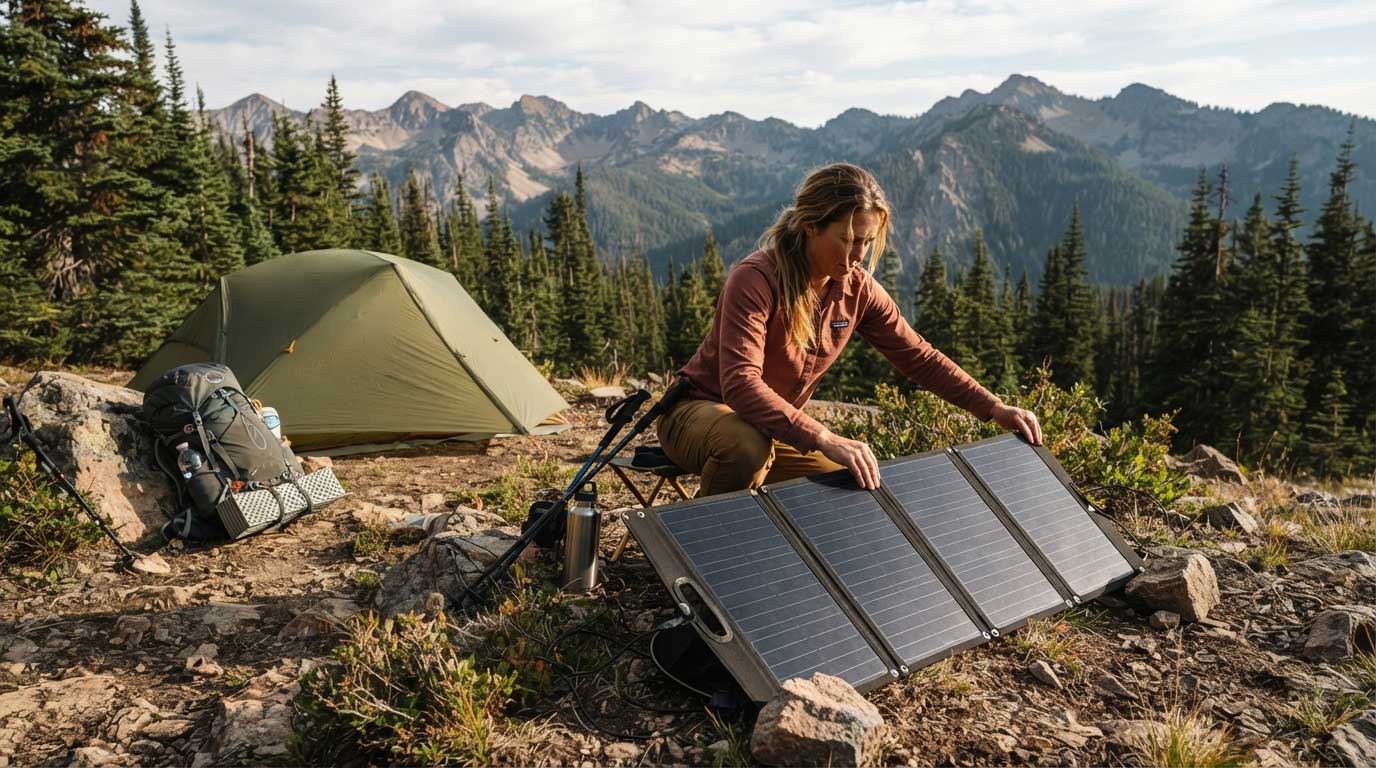
How to Set Up Lightweight Portable Solar Panels
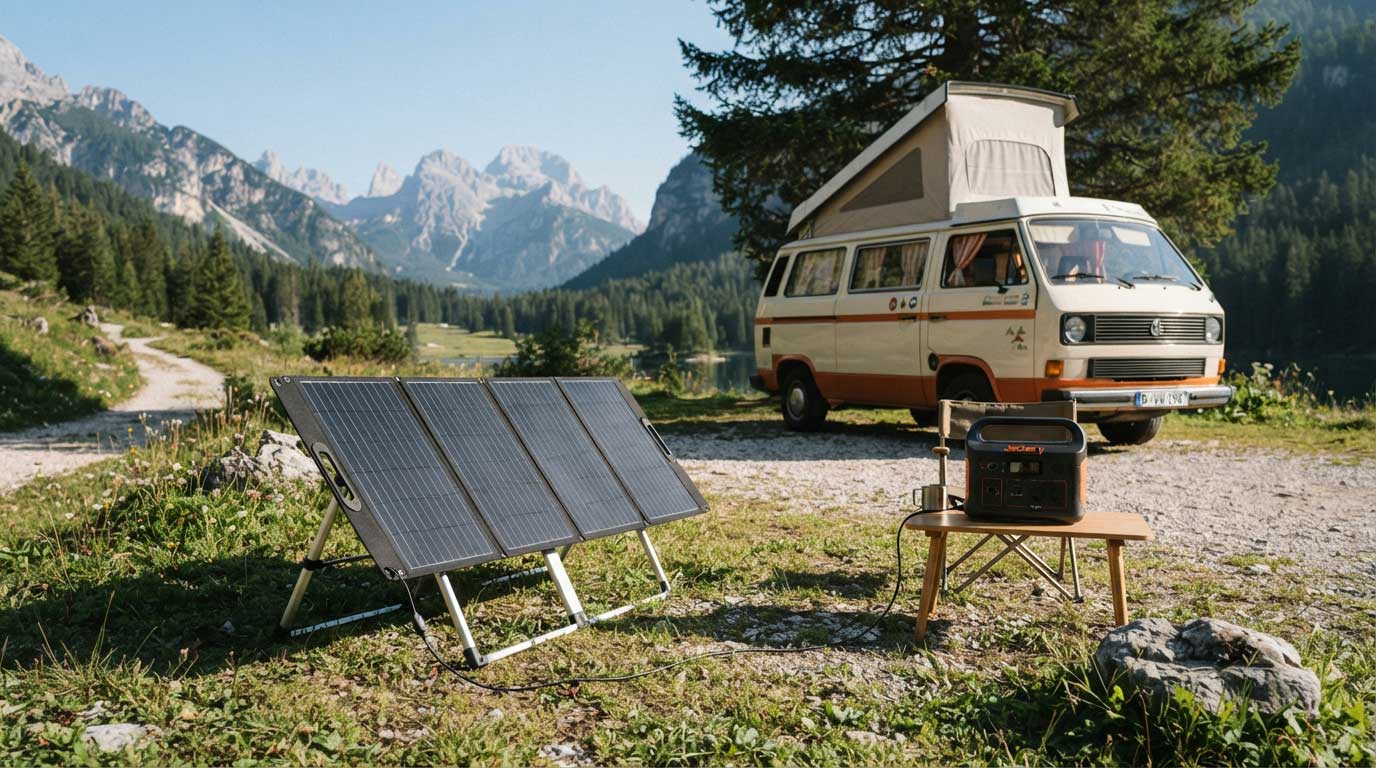
A portable panel is only useful when it is positioned securely and connected correctly. These steps apply broadly to portable systems, but the product manual takes precedence whenever a model specifies a different procedure.
Step 1 — Choose a Suitable Location
Find a stable area with the least practical shading during your charging period. Check the shadows cast by trees, vehicles, tents, and nearby structures. Keep the panel within your permitted campsite area.
Step 2 — Unfold or Position the Panel
Open the panel according to its instructions, or place a flexible or compact Rigid Solar Panels on a compatible support. Secure it against foreseeable wind, and avoid excessive bending, pressure, or unstable mounting.
Step 3 — Connect the Charging System
Check the voltage, current, connector, and input limits before connecting the panel. Use the specified cable and charge controller where required. Protect connections from moisture according to the equipment manufacturer’s instructions.
Step 4 — Check the Charging Input
If a power station has an input display, observe the reading after connecting the panel. Output below the rated wattage is not necessarily a fault. Check for shade, unfavorable orientation, high cell temperature, and input limitations before troubleshooting further.
Step 5 — Pack and Store the Equipment
Disconnect the system using the recommended procedure. Clean the panel with an approved method, allow it to dry when required, and store cables without sharp bends. Avoid trapping cables inside folding sections.
A Practical Example: Choosing a Panel for a Weekend Trip
Consider a hypothetical traveler spending two nights at a campsite. They want to charge a phone, camera, headlamp, and small tablet without relying on a campsite electrical hookup.
Their estimated daily energy budget might look like this:
| Device | Illustrative daily energy use |
|---|---|
| Smartphone | 15Wh |
| Camera battery | 20Wh |
| Headlamp | 5Wh |
| Tablet | 30Wh |
| Total estimated daily use | 70Wh |
These figures are planning assumptions, not measured consumption values for specific devices.
If a portable panel and charging system deliver 200Wh of usable energy in a day, that would exceed the example’s 70Wh daily load. The traveler could potentially store surplus energy in a compatible power station for evening use, subject to battery capacity and charging efficiency.
But the result changes if the campsite is shaded or the traveler adds a refrigerator. Rather than buying a larger panel immediately, the traveler should first verify the actual daily energy requirement and assess the available sunlight.
This example illustrates a useful purchasing principle: the lightest panel that meets your needs in ideal weather may not provide enough energy during a cloudy weekend. Portability and energy reliability need to be considered together.
FAQ About Lightweight Portable Solar Panels
Are lightweight portable solar panels worth buying?
Yes, they can be worthwhile when mobility and temporary electricity are important. Compare the panel’s total carrying weight, rated power, durability, and compatibility with your charging equipment before choosing a model.
What is the best lightweight solar panel for camping?
The right panel depends on your daily energy use, carrying limits, and charging equipment. Smaller panels suit basic electronics, while higher-wattage models may be more practical for compatible power stations and larger loads.
Can lightweight portable solar panels charge a power station?
Yes, provided the panel’s voltage, current, connector, and power rating are compatible with the station’s solar input. Check the specifications of both products before connecting them.
Do portable solar panels work on cloudy days?
Yes, photovoltaic panels can generate electricity from diffuse daylight, but output generally decreases when cloud cover reduces available sunlight. Battery storage helps maintain access to power when generation falls.
Are flexible solar panels lighter than foldable panels?
Not always. Weight depends on the panel’s materials, construction, dimensions, and protective components. Compare published weights and packed dimensions rather than assuming one design is always lighter.
Can lightweight solar panels power an RV?
They can supplement an RV electrical system when paired with a compatible battery and charging arrangement. Whether they provide enough energy depends on the RV’s daily loads, available sunlight, and the panel’s actual output.
How do I maintain lightweight portable solar panels?
Keep the surface clean, inspect connectors and cables, protect folding joints from unnecessary stress, and follow the manufacturer’s storage and weather-protection instructions. Check for damage before each trip.
Choosing Lightweight Portable Solar Panels from Bright Solar
Lightweight portable solar panels offer a practical way to collect solar energy for camping, RV travel, outdoor electronics, and selected off-grid applications. The best choice balances rated power with carrying weight, packed dimensions, electrical compatibility, and the conditions in which the panel will be used.
For individual buyers, start with a realistic energy budget and choose a panel that suits the way you travel. For distributors, outdoor equipment brands, and other B2B buyers, compare verified product specifications, construction requirements, connector options, and customization needs before finalizing a product selection.
Bright Solar supports solar panel solutions for different applications. Confirm the specifications and intended use of the selected model with the manufacturer before purchasing or integrating it into a larger system.
Technical references
- U.S. Department of Energy: Solar Photovoltaic Performance and Efficiency Basics
- U.S. Department of Energy: Solar Radiation Basics
- U.S. Department of Energy: Optimizing Solar Photovoltaic Performance for Longevity
- National Renewable Energy Laboratory: PVWatts Calculator
Author note: Prepared for Bright Solar by its solar product content team. Technical explanations are based on established photovoltaic principles and the cited public resources. Numerical energy examples are illustrative calculations, not independently verified field-test results or claims about a specific Bright Solar product.
Related recommendations
-

solar panel golf cart roof Solutions from Bright Solar
316Bright Solar’s solar panel golf cart roof keeps golf cart batteries topped up while driving, reducing downtime and electricity use. Ideal for eco-conscious courses with solar charging options.
View details -
Panel Solar Flexible 100W for RV, Marine, and Off-Grid Use
150Discover panel solar flexible 100W systems for RVs, boats, vans, and portable power. Lightweight, durable, and built for outdoor performance.
View details -
Flexible Folding Solar Panels: Portable Power, Design and Buying Guide
126Flexible folding solar panels provide portable solar power in a compact package that unfolds into a larger photovoltaic array.
View details -
100 watt solar panel flexible: A Practical Guide for RV, Marine and Off-Grid Applications
254100 watt solar panel flexible solutions explained with real RV, marine, and off-grid applications, performance data, installation tips, and expert insights.
View details