Solar Panels Series or Parallel: Which Wiring Method Works Better?
Solar panels series or parallel wiring changes how voltage and current move through a solar system. Series wiring increases voltage and improves long-distance efficiency, while parallel wiring increases current and performs better under partial shading conditions often found on RVs, boats, and mobile off-grid systems.
The first time I saw a poorly planned solar array fail in real conditions, it wasn’t because of the panels.
The panels were premium.
The batteries were expensive.
The inverter looked impressive.
The problem was wiring strategy.
A customer running an off-grid camper in Oregon wired four rooftop panels in series because an online video claimed it was “always more efficient.”
Technically, that statement sounds reasonable.
Until one roof vent shadow moved across a single panel around 3:30 every afternoon.
Then the entire array output collapsed.
The owner assumed:
- the batteries were failing
- the charge controller was defective
- one solar panel had gone bad
None of that was true.
The system simply wasn’t designed for real-world shading conditions.
And honestly, this happens constantly.
People debate:
- wattage
- battery chemistry
- inverter size
But solar wiring layout quietly determines how systems behave when conditions stop being perfect.
Which they always do eventually.
What Does Solar Panels Series or Parallel Mean?
Solar systems can connect multiple panels in two primary ways:
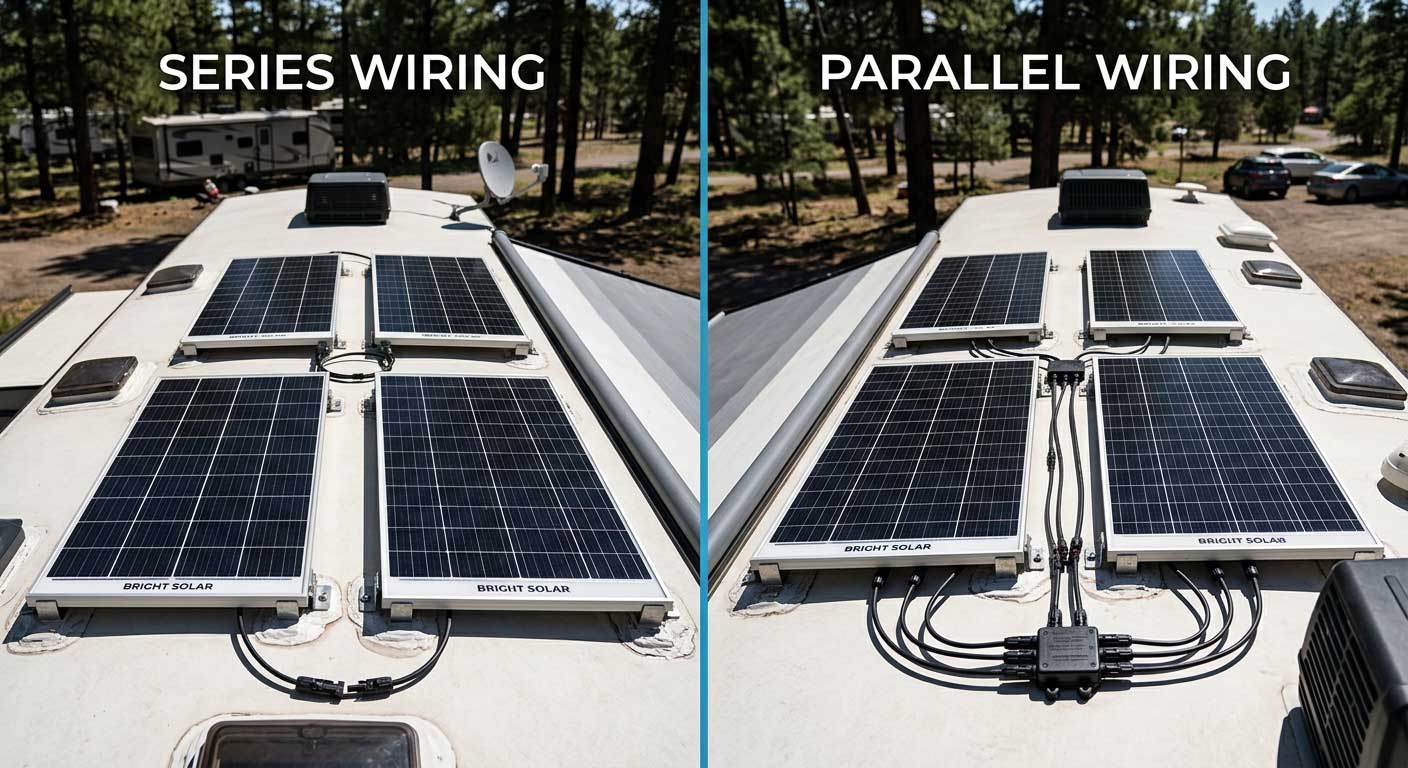
- Series wiring
- Parallel wiring
Each changes electrical behavior dramatically.
Series Wiring Explained
Series wiring connects:
- positive terminal to negative terminal
Voltage increases.
Current stays the same.
Example:
- Two 12V solar panels in series
- Result: 24V system voltage
This setup is common in:
- Larger residential systems
- Long cable runs
- MPPT charge controller installations
Parallel Wiring Explained
Parallel wiring connects:
- positive to positive
- negative to negative
Current increases.
Voltage remains constant.
Example:
- Two 12V panels in parallel
- Result: 12V system with doubled current
This setup is common for:
- RV solar systems
- Marine solar
- Small off-grid systems
- Partial shading environments
Why Series Wiring Became Popular
Series wiring improves efficiency across long distances.
That matters because voltage loss decreases when:
- voltage rises
- current decreases
According to the U.S. Department of Energy, electrical resistance and transmission losses affect solar system efficiency significantly, especially over extended cable lengths.
Source: U.S. Department of Energy
https://www.energy.gov/eere/solar
This is one reason large residential systems commonly use higher-voltage solar arrays.
Less current means:
- lower cable heat
- smaller wire sizes
- reduced energy loss
On paper, series wiring often looks superior.
But paper is not a campground.
Or a marina.
Or a dusty overlanding trail.
Why Parallel Wiring Performs Better in Shaded Conditions
Parallel systems behave differently under partial shading.
This matters enormously in mobile applications.
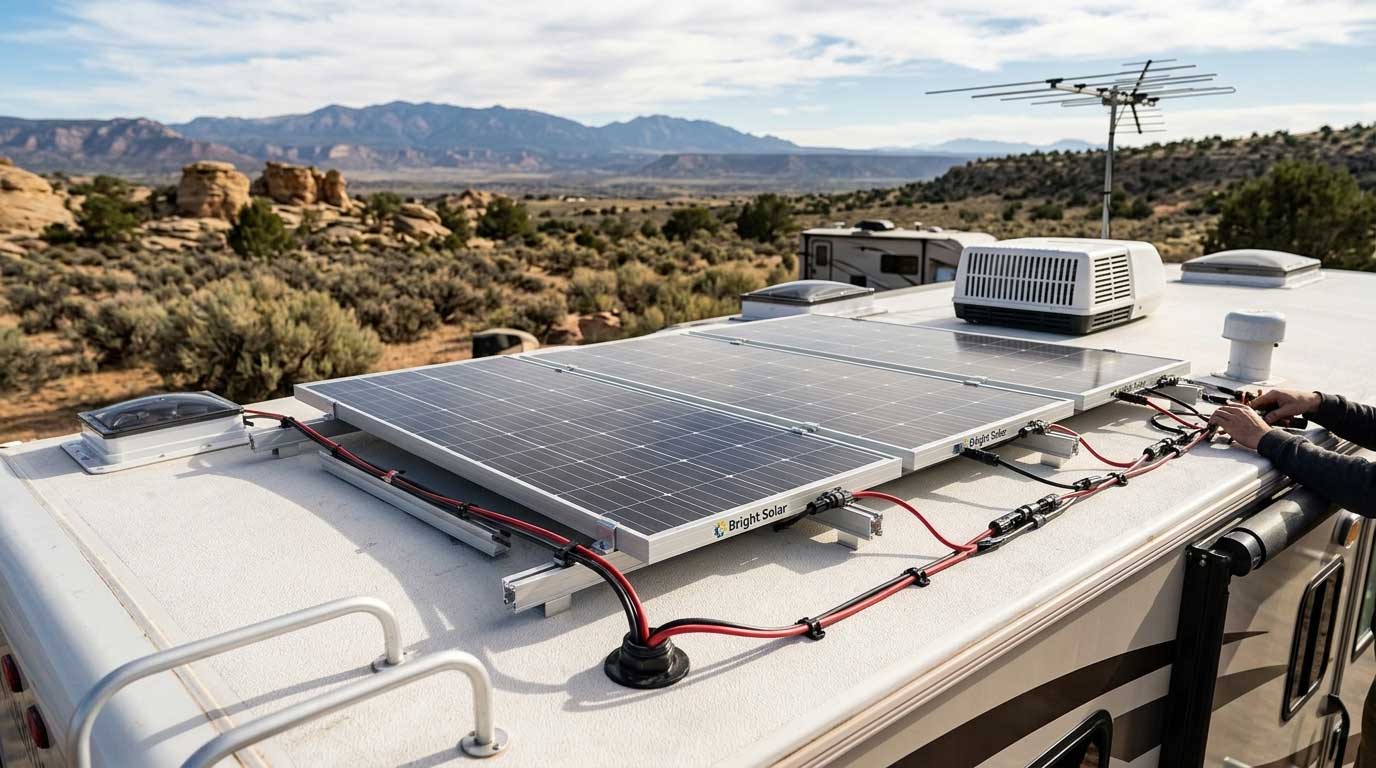
RV roofs rarely receive perfect sunlight all day.
Objects creating shadows include:
- Air conditioners
- Roof vents
- Satellite antennas
- Trees
- Boat rigging
In series systems, one shaded panel can reduce output across the entire string.
In parallel systems, unaffected panels continue producing more independently.
Real RV Case Study: Colorado Campsite
One Bright Solar customer operated:
- 400W rooftop solar
- lithium battery bank
- mountain travel trailer
Originally wired in series.
Charging performance looked excellent in open desert environments.
Then came Colorado forest campsites.
Tall pine trees caused moving shade across one panel during mornings and evenings.
Daily charging dropped sharply.
After rewiring the system in parallel:
- overall midday peak output decreased slightly
- daily charging consistency improved substantially
The customer gained more usable energy across the full day.
Not because the panels changed.
Because the wiring strategy matched the environment better.
Series vs Parallel Solar Panels: Key Differences
| Feature | Series Wiring | Parallel Wiring |
|---|---|---|
| Voltage | Increases | Stays same |
| Current | Stays same | Increases |
| Shade Performance | Lower | Better |
| Cable Efficiency | Better | Lower |
| Best Use | Long cable runs | RVs & boats |
| Wire Size | Smaller possible | Larger often needed |
No configuration is universally better.
Good solar design depends on:
- installation environment
- cable distance
- shading patterns
- controller specifications
- future expansion plans
How Charge Controllers Affect Solar Wiring Choices
The charge controller changes everything.
Especially MPPT systems.
MPPT Controllers
MPPT controllers work very efficiently with higher voltage input.
This makes series wiring attractive.
Advantages:
- lower transmission losses
- improved cold-weather charging
- efficient long-distance power transfer
PWM Controllers
PWM controllers generally work better with lower-voltage panel configurations.
Parallel wiring often fits these systems more naturally.
Especially in:
- small RV setups
- camper vans
- boats
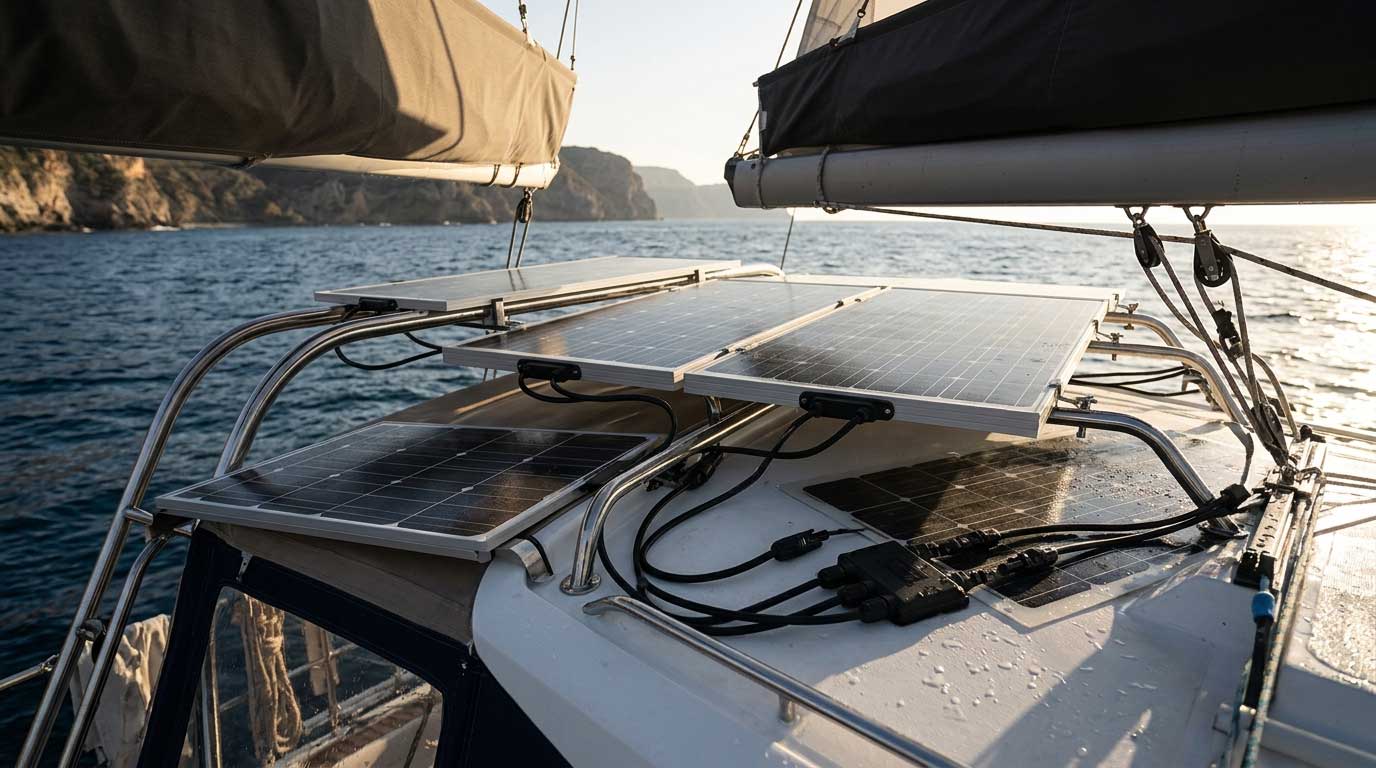
Real Marine Solar Example: Sailboat Wiring Failure
A customer operating a 42-foot sailboat near Florida installed:
- three rigid solar panels
- MPPT controller
- series wiring layout
At sea, mast shadows crossed one section repeatedly throughout the day.
Battery charging became unpredictable.
The installer later switched to:
- parallel panel wiring
- independent fuse protection
The change reduced voltage slightly but stabilized charging dramatically.
The owner cared less about peak numbers.
Reliable refrigeration mattered more offshore.
And that’s something many online comparisons miss:
real-world solar performance is rarely about perfect laboratory conditions.
Temperature Changes and Solar Wiring Performance
Temperature affects solar voltage more than many beginners realize.
Cold weather increases Flexible solar panel voltage.
This becomes important in series systems.
If combined voltage exceeds controller limits:
- controller shutdowns occur
- hardware damage becomes possible
According to the National Renewable Energy Laboratory (NREL), photovoltaic voltage output varies significantly with temperature fluctuations.
Source: National Renewable Energy Laboratory
https://www.nrel.gov
I once inspected a winter cabin system in Montana where:
- cold temperatures pushed array voltage above controller specifications
- repeated shutdowns occurred during bright winter mornings
The panels themselves were fine.
The wiring design ignored seasonal voltage behavior.
Common Mistakes When Wiring Solar Panels Series or Parallel
After years around RV and off-grid systems, certain mistakes repeat constantly.
Ignoring Shade Conditions
Perfect sunlight rarely exists in real travel conditions.
Using Undersized Wiring
Especially dangerous in parallel systems where current increases substantially.
Mixing Different Solar Panels
Combining mismatched voltage or wattage ratings reduces efficiency.
Overloading Charge Controllers
Series voltage can exceed controller specifications surprisingly fast.
Poor Fuse Protection
Parallel systems require proper overcurrent protection for safety.
According to NFPA electrical safety guidance, improper overcurrent protection increases fire risk in DC electrical systems.
Source: NFPA
https://www.nfpa.org
When Series Wiring Makes the Most Sense
Series solar wiring often works best for:
- large residential systems
- long-distance cable runs
- cold-weather environments
- high-voltage MPPT systems
- open-sun installations
Especially where shading is minimal.
When Parallel Wiring Makes More Sense
Parallel wiring performs especially well for:
- RVs
- boats
- shaded campsites
- mobile off-grid systems
- irregular sunlight environments
In real travel situations, stable daily charging often matters more than peak theoretical efficiency.
That distinction becomes obvious after enough time living with solar systems outdoors.
FAQ: Solar Panels Series or Parallel
Is it better to wire solar panels in series or parallel?
It depends on the installation environment. Series wiring improves efficiency over distance, while parallel wiring performs better under partial shading conditions.
Do solar panels charge faster in series or parallel?
Series systems often charge more efficiently under full sunlight, but parallel systems may produce more usable daily energy in shaded environments.
Are RV solar panels better in parallel?
Many RV solar systems perform better in parallel because campground shading and rooftop obstacles affect series arrays more severely.
Can I combine series and parallel wiring?
Yes. Many larger solar systems use series-parallel configurations to balance voltage and current efficiently.
Does series wiring reduce wire size requirements?
Yes. Higher voltage reduces current, allowing smaller cable sizes across long distances.
Final Thoughts
Solar panels series or parallel wiring discussions often become oversimplified online.
Reality is more complicated.
The “best” configuration depends less on theory and more on:
- where the system operates
- how shadows move
- cable routing
- seasonal temperatures
- daily travel conditions
After years around:
- RV systems
- sailboats
- overlanding rigs
- remote cabins
one pattern becomes obvious:
The most reliable solar systems are rarely the ones optimized only for perfect sunlight.
They are the systems designed for imperfect conditions.
Because outdoors, conditions are almost never perfect for long.
Related recommendations
-

Flexible solar panel boat: Lightweight Marine Solar Solution for Modern Vessels
230Discover flexible solar panel boat solutions from Bright Solar. Learn how lightweight marine solar panels improve boat energy efficiency, installation flexibility, and off-grid performance.
View details -
12 Volt Solar Panels for Reliable Off-Grid and Mobile Power
217Discover how 12 volt solar panels power RVs, boats, cabins, and off-grid systems. Learn sizing, performance, installation tips, and expert insights from Bright Solar.
View details -
flexible 400w solar panel: Lightweight High-Power Solar Solution for RV, Marine and Off-Grid Use
275Explore flexible 400w solar panel solutions from Bright Solar with lightweight design, high efficiency, and reliable power for RV, marine, and off-grid applications.
View details -
Jingke Energy Tiger Neo N-type Module Distribution Agreement Signed with Aldo Solar
289Jingke Energy Tiger Neo N-type Module Distribution agreement with Aldo Solar brings 600 MW of ultra-high efficiency photovoltaic modules to the Brazilian market, strengthening distributed generation and promoting clean energy adoption in Latin Ame...
View details