Foldable Solar Panel for Camping: How to Choose and Use One
A foldable solar panel for camping lets you charge compatible devices and portable power stations using sunlight without relying on a campsite electrical hookup. Choose the wattage based on your daily energy needs, check connector compatibility, and position the panel in unobstructed sunlight for better results.
Camping is easier when a dead phone battery does not dictate the day’s plans. But bringing power into the outdoors takes a little more thought than unfolding a panel and leaving it beside a tent. Cloud cover, tree shadows, battery capacity, cable length, and the timing of your activities all influence how much useful energy you collect.
For campers, van travelers, hikers, and outdoor equipment suppliers, Bright Solar recognizes that portability is only one part of a useful solar solution. The panel must also match the equipment being charged, suit the environment, and be practical to carry, position, and store.
This guide explains what to look for in a foldable camping solar panel, how to estimate the power you need, and how to avoid common setup mistakes before your next trip.
Why Choose a Foldable Solar Panel for Camping?
A foldable solar panel is designed to collapse into a more compact form for transportation and open into a larger surface when generating electricity. Compared with a permanently mounted rigid panel, it is easier to move between a sunny clearing, a picnic table, and a vehicle.
Its biggest advantage is flexibility. You can park a campervan in the shade while positioning the panel in a sunnier location, provided the connecting cable reaches safely. At a walk-in campsite, you can unfold the panel near your permitted camping area rather than carrying a fixed installation.
Common applications include:
- Charging phones, GPS units, headlamps, and cameras.
- Recharging compatible portable power stations.
- Supporting tablets, small USB-powered accessories, and communication equipment.
- Supplying energy for selected low-power camping devices through a suitable battery or power system.
- Reducing dependence on vehicle batteries for everyday electronics.
A foldable panel is not a replacement for every type of generator. High-power cooking appliances, electric heaters, and air conditioners can consume far more energy than a compact camping panel can provide. Solar is most practical when the energy source and the load are matched from the beginning.
Foldable Solar Panels vs. Rigid Solar Panels
| Feature | Foldable solar panel | Rigid solar panel |
|---|---|---|
| Portability | Designed for folding and transport | Usually heavier and less convenient to move |
| Installation | Often uses built-in stands or portable supports | Usually requires fixed mounting or a rack |
| Positioning | Can be moved to follow available sunlight | Position depends on the installation |
| Typical use | Camping, hiking base camps, road trips | RV roofs, cabins, permanent systems |
| Storage | Folds into a smaller package | Requires storage space for its full dimensions |
| Main consideration | Handle carefully and secure against wind | Account for mounting, weight, and structural support |
Neither design is automatically better in every situation. A foldable panel is usually the more practical choice when you need temporary, movable power. A rigid panel may be more suitable when the objective is a permanent installation with a predictable mounting position.
How to Choose the Best Foldable Solar Panel for Camping
The best panel is not necessarily the one with the highest wattage. A 200W panel may be useful for a car-camping setup with a power station, while a smaller panel can be more convenient for a weekend trip where the main priorities are a phone, a GPS device, and a headlamp.
Start with the equipment you plan to use. Then compare rated power, folded dimensions, weight, output connections, and the battery system you intend to charge.
1. Choose the Right Wattage for Your Camping Needs
Solar panels are rated in watts, which indicate their power output under specified test conditions. The wattage printed on the panel is not a guarantee that the panel will deliver that amount continuously outdoors.
The U.S. Department of Energy explains that photovoltaic output depends on the technology and the sunlight reaching the cells. Location, weather, time of day, and the angle of incoming sunlight all affect the available solar resource. See the U.S. Department of Energy‘s solar radiation guide.
Use the following ranges as starting points for shopping, rather than guaranteed performance levels.
| Rated panel power | Potential camping application | What to consider |
|---|---|---|
| 20–50W | Phones, small USB devices, basic electronics | Limited energy for several devices or large batteries |
| 60–100W | General weekend camping and small power stations | A useful balance of portability and charging capability |
| 100–200W | Car camping, longer trips, multiple devices | More demanding transport and setup requirements |
| 200W and above | Larger power stations and higher daily energy needs | Confirm weight, folded size, controller limits, and battery compatibility |
These wattage bands are practical selection categories, not industry-wide standards defining a panel’s intended use. Actual suitability depends on the product’s design and the electrical requirements of the connected equipment.
2. Check Folded Size, Weight, and Carrying Comfort
A panel can look compact in a product photograph and still be awkward to transport. Before purchasing, check its folded length, width, thickness, carrying handle, and total packed weight, including any accessories you will need.
For a backpacking trip, every additional item competes with food, water, clothing, and safety equipment. For car camping, a larger panel may be perfectly reasonable because it travels in the vehicle rather than on your back.
Look for practical features such as:
- A protective carrying case or reinforced outer edges.
- A stable kickstand or another secure positioning method.
- Cables that can be stored without sharp bends.
- A folding design that protects the active surface during transport.
- Clearly specified operating and storage conditions.
Do not assume that a foldable panel is waterproof simply because it is designed for outdoor use. Check the manufacturer’s documentation for the panel, connectors, junction box, and controller separately.
3. Match the Panel to Your Power Station
A solar panel and a power station are two different parts of a charging system. The panel generates electricity, while the power station stores it and supplies power to compatible devices.
Before connecting them, verify the following:
- Operating voltage: The panel’s output must fall within the power station’s permitted solar-input range.
- Maximum input current: The panel must not exceed the controller’s current limits.
- Maximum solar input power: A station rated for a particular maximum wattage may limit the power it accepts.
- Connector type and polarity: A physically fitting plug does not automatically mean the connection is electrically compatible.
- Charging requirements: Some power stations require a specific cable, adapter, or solar charging protocol.
If you are using a panel without an integrated USB output, you may need a compatible charge controller or power station to manage the electricity safely. Never connect a panel directly to a phone or battery unless the equipment manufacturer explicitly specifies that connection method.
4. Consider Durability and Weather Protection
Camping exposes equipment to dust, moisture, temperature changes, and repeated handling. A useful foldable panel should have construction appropriate for its intended environment, but the term foldable alone does not establish durability.
Inspect the published specifications for surface materials, edge protection, cable strain relief, connector sealing, and the recommended operating temperature range. If the product has an IP rating, check exactly which assembly the rating covers.
The solar cells also need protection from unnecessary stress. Do not fold a panel beyond its designed hinge positions, place heavy equipment on it, or force it into a storage bag that is too small. For a panel that uses articulated sections, follow the manufacturer’s instructions rather than treating the entire surface as a flexible sheet.View flexible solar panels
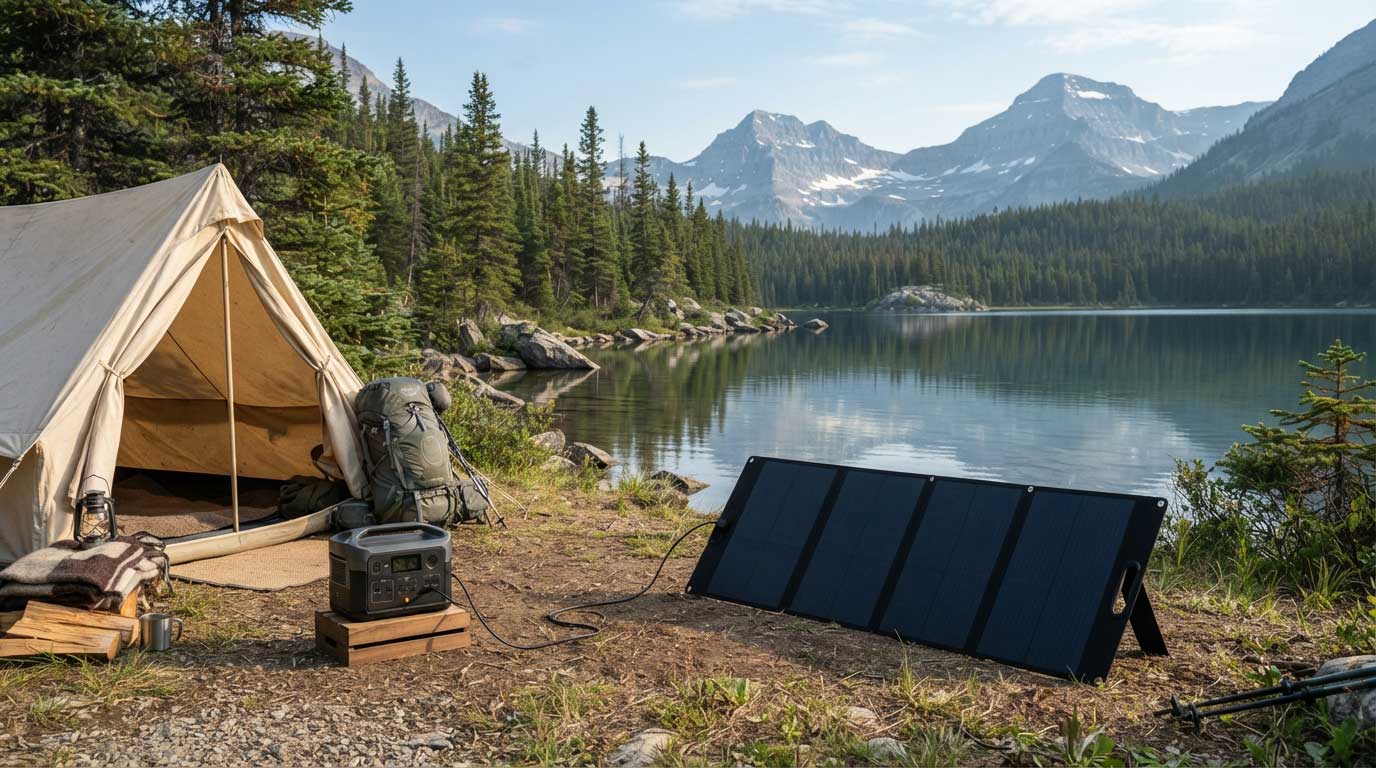
How Much Electricity Can a Camping Solar Panel Generate?
A realistic energy estimate is more useful than choosing a panel based on its wattage alone. A 100W panel does not necessarily generate 100Wh every hour of the day, because sunlight intensity and panel operating conditions change.
A simple planning calculation is:
Estimated daily energy (Wh) = rated panel power (W) × equivalent peak-sun hours × overall system factor
The system factor accounts approximately for losses caused by real operating conditions, including conversion and charging losses. It is not a universal fixed value; use product data or a suitable solar calculator when you need a more precise estimate.
For example, consider a hypothetical 100W panel receiving the equivalent of four peak-sun hours per day. If you assume an illustrative system factor of 0.75, the estimate becomes:
100W × 4 hours × 0.75 = 300Wh per day
This is a planning example, not a performance claim for a specific Bright Solar product. Actual results may be lower or higher depending on conditions, equipment, and the chosen calculation assumptions.
The National Renewable Energy Laboratory’s PVWatts calculator illustrates how solar estimates use location-specific weather and system parameters. Its model is designed for grid-connected PV systems, so its results should not be treated as a direct guarantee for a portable camping panel.
Example: Estimate Your Daily Camping Power Needs
Suppose two campers spend three days at a drive-in campsite. Their equipment includes a phone, a headlamp, and a camera. The following table uses illustrative energy consumption figures to show how to build a load estimate.
| Device | Assumed daily energy use | Daily total |
|---|---|---|
| Two smartphones | 12Wh each | 24Wh |
| Two headlamps | 5Wh each | 10Wh |
| Camera batteries | 20Wh | 20Wh |
| Small USB accessories | 10Wh | 10Wh |
| Total | 64Wh/day |
The figures above are examples, not universal measurements. Actual consumption depends on battery capacity, usage, charging efficiency, and the device’s power-management settings.
With a daily target of 64Wh, a suitable small solar setup may be enough in favorable sunlight. A power station adds a useful buffer because it can store energy collected during sunny periods for evening use.
However, if the campers also want to run a portable refrigerator, the calculation changes substantially. A refrigerator cycles on and off, and its consumption depends on ambient temperature, insulation, settings, and how often it is opened. Use the manufacturer’s measured or rated daily energy consumption when sizing a system for that load.
One practical lesson stands out: calculate energy in watt-hours, not just watts. The panel’s rated watts describe power at a particular moment; watt-hours describe energy accumulated over time.
How to Set Up a Foldable Solar Panel at a Campsite
A good setup starts with the location, not the cable. Before unfolding the panel, look for an area with direct sunlight through the hours when you expect to collect the most energy. A beautiful campsite under dense trees may be comfortable for sleeping but less useful for solar charging.
Step 1 — Find a Sunny, Stable Position
Choose a flat surface where the panel can stand securely without blocking a path, disturbing other campers, or creating a tripping hazard. Avoid loose ground where the support legs might sink or shift.
Check the sun’s position throughout the day. A spot that receives morning sunlight may be shaded by a tree or nearby vehicle in the afternoon.
Step 2 — Unfold and Position the Panel
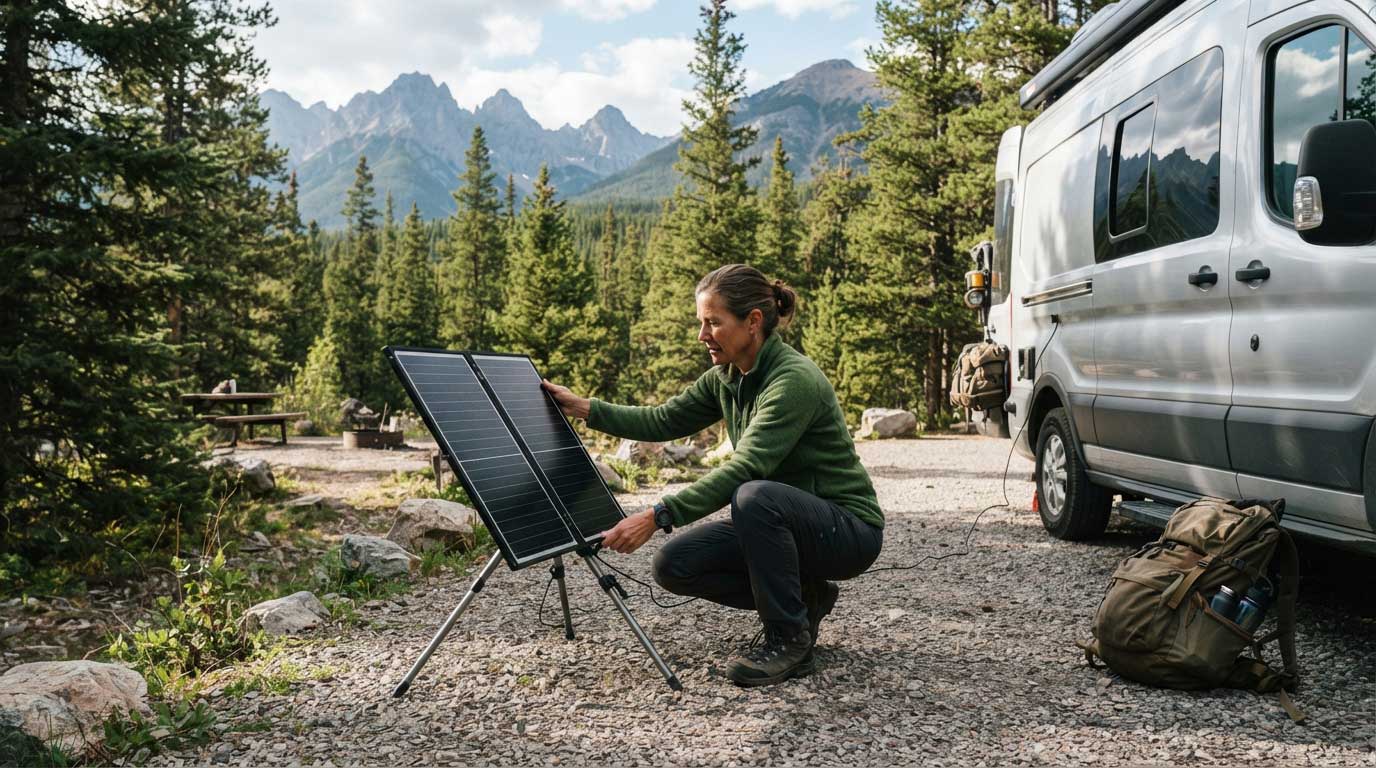
Open each section according to the manufacturer’s instructions. Adjust the support so that the panel faces the available sunlight, and secure it against foreseeable wind.
Avoid positioning the panel where people may step on it or where a tent flap could cover the cells. Partial shading can reduce output, and the impact depends on the panel’s electrical design and the location of the shadow.
Step 3 — Connect the Charging Equipment
Place the power station or compatible controller on a stable surface. Check the panel’s voltage, current, connector polarity, and the receiving device’s input limits before making the connection.
Follow the equipment manufacturer’s recommended connection sequence. Keep electrical connections protected from moisture as specified in the product instructions, and never handle damaged cables or connectors.
Step 4 — Monitor Charging and Reposition as Needed
Check the power station’s display, if available, to see how much solar input it is receiving. If the output drops, look for passing clouds, shadows, dirt, loose connections, or an unfavorable panel angle.
You do not need to adjust the panel every few minutes. A quick check when you return from a hike or prepare lunch may be enough to identify a major change in sunlight.
Step 5 — Disconnect, Clean, and Store
When charging is finished, disconnect the equipment following the manufacturer’s instructions. Allow the panel to dry if needed, remove loose dirt with an approved cleaning method, and fold it without forcing the hinges or trapping cables.
The National Park Service’s camping etiquette guidance emphasizes respecting campsite boundaries and leaving the area clean. Keep the panel and its cables within your designated space, and pack away all accessories before leaving.
Common Mistakes That Reduce Camping Solar Performance
Even a well-made panel can disappoint when the surrounding setup is poorly planned.
- Leaving the panel in shade: Tree branches, tent edges, and vehicle shadows can obstruct sunlight. Move the panel when practical.
- Confusing rated power with daily energy: A 100W rating does not mean the panel produces 100W continuously.
- Ignoring battery capacity: A large panel cannot compensate for an incompatible or undersized charging system.
- Using the wrong adapter: Connector fit alone does not establish electrical compatibility.
- Expecting identical results every day: Weather, season, latitude, and time of day affect the solar resource.
- Overlooking heat and airflow: Solar cells generally perform better at lower operating temperatures; excessive heat can reduce voltage and affect output. The Department of Energy explains these factors in its solar photovoltaic performance guide.
- Packing a wet or dirty panel: Moisture trapped during storage and accumulated dirt can create avoidable maintenance problems. Follow the manufacturer’s cleaning and storage guidance.
A useful troubleshooting habit is to compare the panel’s current input with its performance earlier in the day under similar conditions. A sudden change can help you identify shading, a connection problem, or a change in weather before assuming the panel itself is defective.
A Practical Camping Scenario: Choosing Between 100W and 200W
Consider a hypothetical couple planning a four-day road trip through the American West. They want to charge two phones, a camera, headlamps, and a portable power station. They also hope to use a small camping refrigerator.
A 100W foldable panel may be an appealing option because it is relatively easy to transport and set up. However, its suitability depends on the refrigerator’s actual energy use and the amount of sunlight available at the campsite.
A 200W panel offers a higher rated power, but that advantage matters only when the receiving equipment can accept the input and the available sunlight supports useful generation. It may also take up more space and weigh more.
Here is how the couple should make the decision:
- Check the daily energy consumption of every device, especially the refrigerator.
- Estimate available solar energy for the trip’s location and season.
- Check the power station’s solar-input limits and battery capacity.
- Compare the packed size and weight of the two panels.
- Decide whether charging speed, portability, or storage space matters most.
For this scenario, there is no honest universal answer that says 100W or 200W is always better. The correct choice depends on the load calculation and the equipment specifications.
For Bright Solar and other manufacturers serving outdoor power markets, this is also a useful product-selection principle: portable solar products should be evaluated as part of a complete charging system, rather than by headline wattage alone.
FAQ About Foldable Solar Panels for Camping
Is a foldable solar panel good for camping?
Yes. A foldable solar panel is useful for camping because it is designed for portable power generation and can be repositioned as sunlight changes. Choose its wattage, weight, and connectors according to your devices and charging system.
What size foldable solar panel do I need for camping?
A 50–100W panel may suit basic electronics and light weekend use, while 100–200W or more may be worth considering for a power station and additional equipment. Calculate daily energy consumption before choosing a size.
Can a foldable solar panel charge a power bank?
Yes, if the panel’s output is compatible with the power bank’s supported charging input. Many conventional power banks require a regulated USB output, so a panel without suitable output electronics may need an appropriate intermediary device.
Do foldable solar panels work on cloudy days?
Yes, they can still generate electricity in diffuse light, but output is generally lower than under strong direct sunlight. The amount depends on cloud thickness, panel characteristics, and local conditions. Plan for reduced charging on overcast days.
Can I leave a foldable solar panel outside overnight?
Only if the manufacturer permits the expected conditions and the panel is secured appropriately. Dew, rain, wind, and temperature changes may affect the panel or its accessories. Disconnect and store it when required by the product instructions.
Is a 100W foldable solar panel enough for camping?
It may be sufficient for phones, headlamps, cameras, and other modest loads when sunlight is favorable. It may not cover the energy needs of a refrigerator or other power-hungry equipment. Estimate daily watt-hours and charging losses before deciding.
How do I maintain a foldable solar panel?
Clean it with the method recommended by the manufacturer, inspect cables and connectors, avoid excessive bending or pressure, and store it dry when required. Check hinges, protective surfaces, and electrical connections periodically for signs of damage.
Choosing a Foldable Solar Panel for Your Next Camping Trip
A foldable solar panel for camping is most useful when its power rating, portability, and charging connections match the way you travel. Start with your daily energy needs, consider the sunlight available at your destination, and choose a compatible charging system with enough capacity for your devices.
For campers, the right setup can make it easier to keep essential electronics charged without relying entirely on campsite hookups. For outdoor equipment buyers and businesses, evaluating portability alongside electrical compatibility and construction helps identify products suited to real camping conditions.
Bright Solar focuses on solar panel solutions for different applications. When evaluating products for portable or outdoor use, confirm the specific model’s specifications and intended use before making a purchasing decision.
Related recommendations
-

400 Watt Solar Panel: Real Performance, Efficiency, and Buying Guide
373400 watt solar panel systems deliver reliable off-grid and residential power. Learn efficiency, output, installation tips, and real-world performance.
View details -
300 watt flexible solar panels for RV, Marine and Off-Grid Applications
169Explore 300 watt flexible solar panels from Bright Solar for RV, marine, and off-grid applications. Learn real installation experience, output, materials, and performance.
View details -
Flexible Solar Panels Marine Solutions for Boats and Offshore Power
161Discover how flexible solar panels marine solutions provide lightweight, durable power for boats, yachts, and offshore vessels. Learn installation, efficiency, and marine benefits.
View details -
Solar Panels for Cloudy Days Trailers: What You Need to Know
243Solar panels can still charge trailers on cloudy days, but output decreases with cloud cover. Proper sizing requires real weather data, daily energy use, roo...
View details