How Many Solar Panels Can Be Connected in Series?
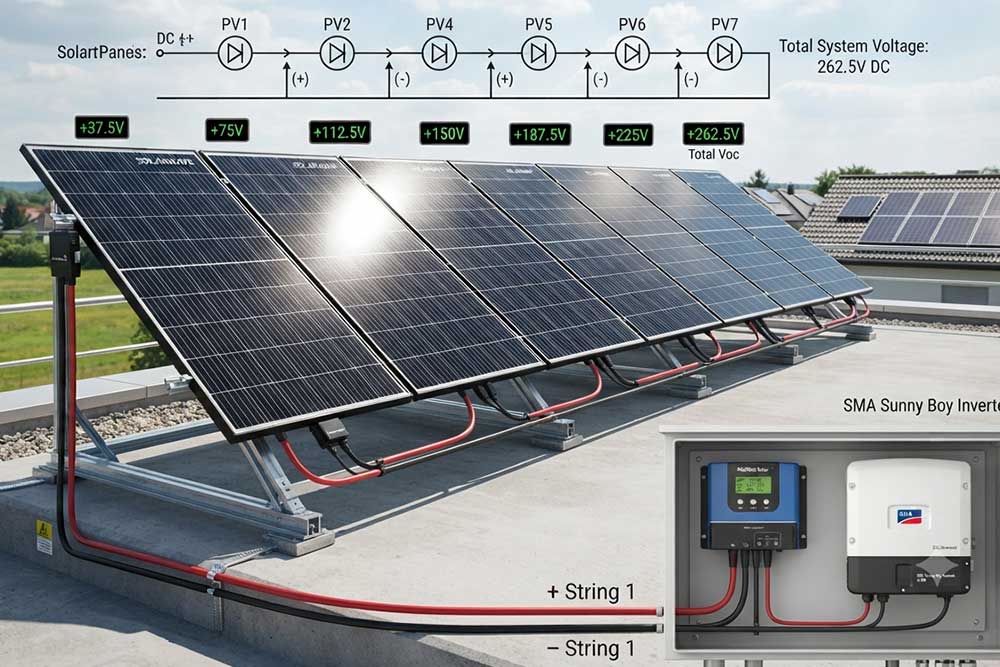
How many solar panels can be connected in series depends on the solar panel open-circuit voltage (Voc), the maximum PV input voltage of the inverter or charge controller, and local operating conditions. The total voltage of all panels connected in series must always stay below the equipment limit to ensure safe and reliable operation.
Connecting solar panels in series is a common method for increasing system voltage while keeping current unchanged. This wiring method is widely used in residential solar systems, RV installations, and off-grid applications where higher voltage helps reduce cable losses.
However, the answer is not simply based on the number of panels. A properly designed solar string must consider electrical specifications, temperature effects, and system requirements.
At Bright Solar, we often recommend calculating the maximum series panels before installation instead of adding modules based only on available roof space or total wattage. Correct voltage design improves system efficiency and protects important components.
What Happens When Solar Panels Are Connected in Series?
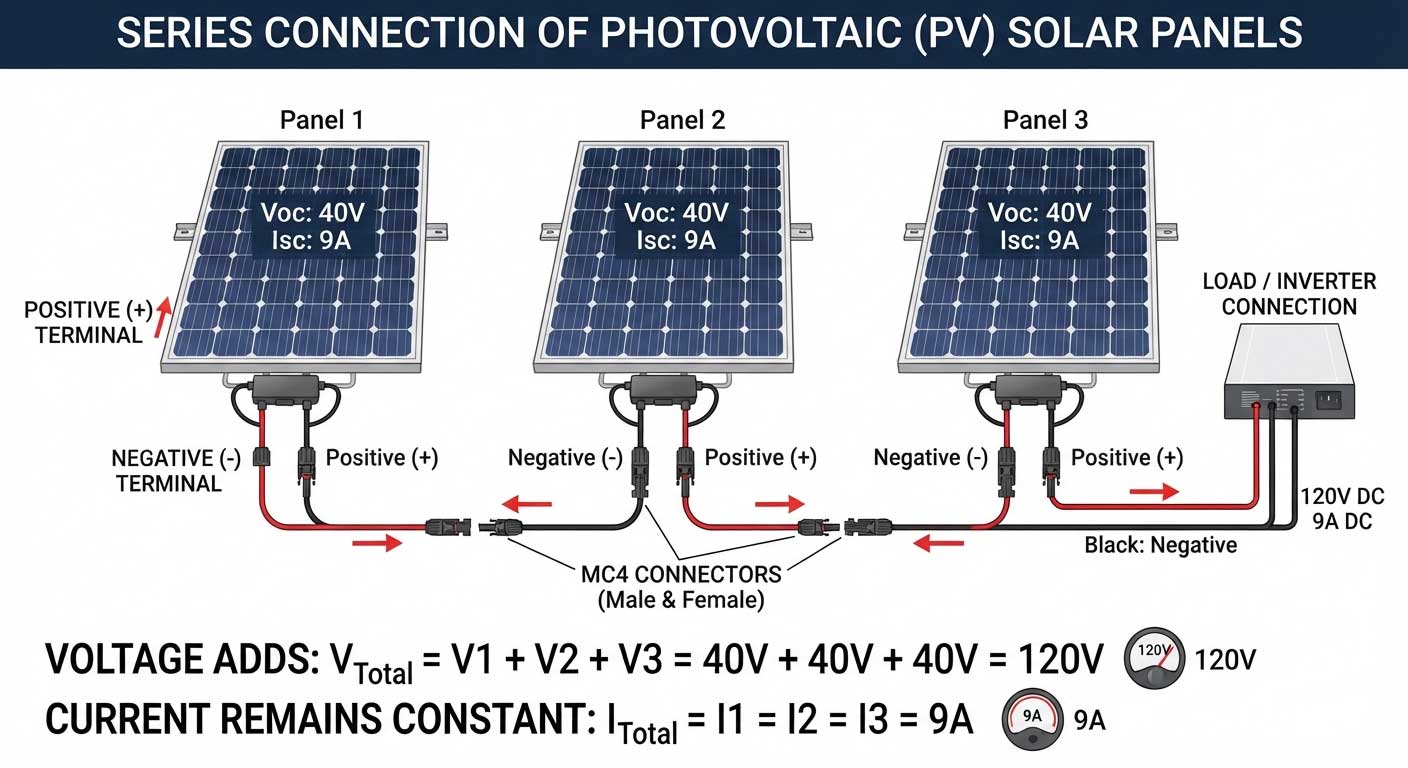
When solar panels are connected in series, the positive terminal of one panel connects to the negative terminal of the next panel.
The voltage of each panel adds together, while the current remains approximately the same.
Example:
One solar panel:
- Voltage (Vmp): 20V
- Current (Imp): 10A
Three panels connected in series:
Output:
- Voltage: 60V
- Current: 10A
The total power remains:
60V × 10A = 600W
Series wiring is commonly used because increasing voltage can improve transmission efficiency, especially when solar panels are located far from batteries or controllers.
The Main Factors That Determine How Many Solar Panels Can Be Connected in Series
The maximum number of solar panels in a series string depends on several important electrical factors.
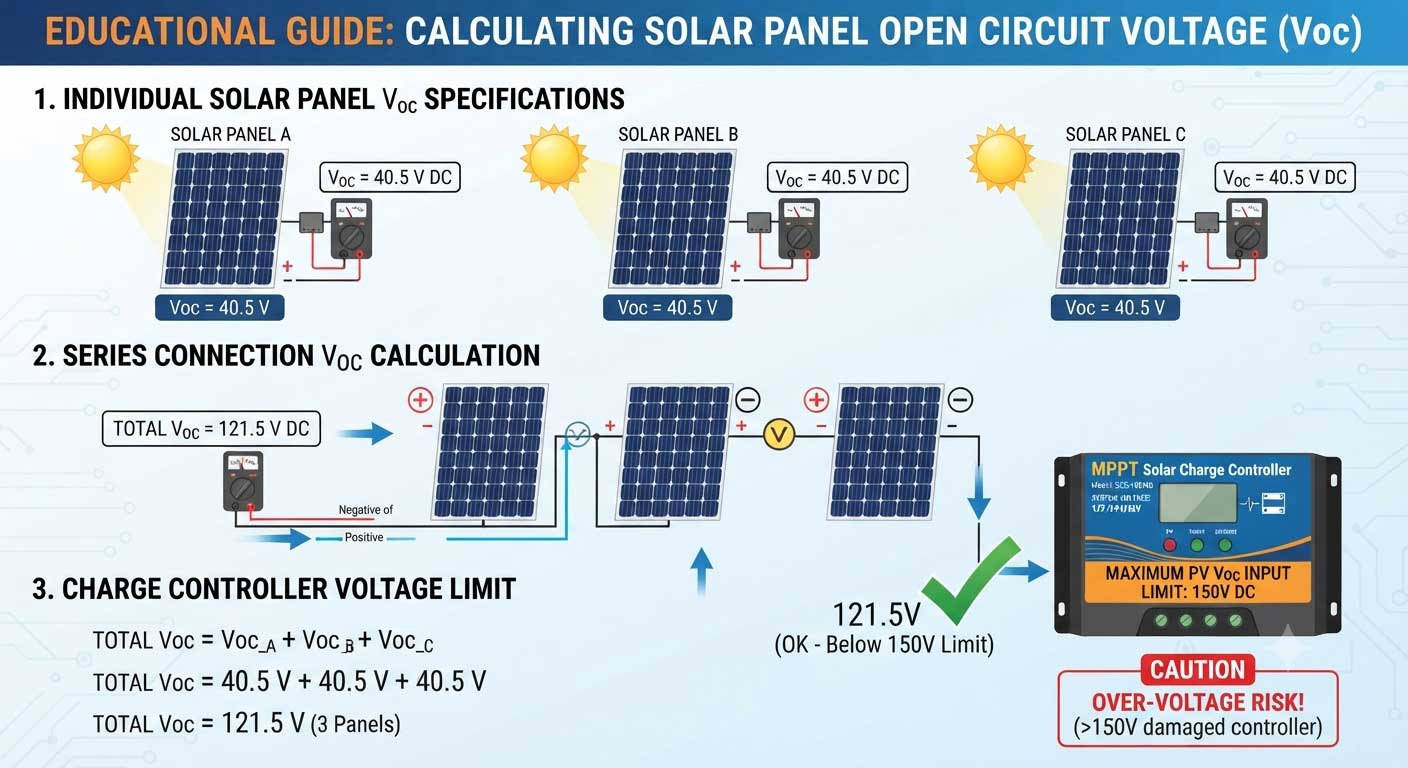
1. Solar Panel Open Circuit Voltage (Voc)
The most important value when calculating series solar panels is Voc.
Voc represents the maximum voltage a solar panel can produce when there is no electrical load connected.
For series connections:
Total Voc =
Individual Panel Voc × Number of Panels
Example:
Solar panel:
Voc = 40V
Four panels:
40V × 4 = 160V
The solar system must be designed so this value remains below the maximum PV input voltage of the inverter or charge controller.
2. Maximum PV Input Voltage of the Inverter or Charge Controller
Every inverter and charge controller has a maximum PV voltage rating.
Example:
Charge controller:
Maximum PV input voltage:
150V
Solar panel:
Voc:
38V
Calculation:
150V ÷ 38V = 3.9
Maximum safe configuration:
3 solar panels in series
Although the calculation suggests 3 panels, engineers usually leave a safety margin because environmental conditions can increase voltage.
3. Temperature Effects on Solar Panel Voltage
Solar panel voltage changes with temperature.
Cold temperatures can increase Voc, which means a solar string may produce higher voltage during winter conditions.
For example:
A system that appears safe at 25°C may exceed the voltage limit in colder climates.
According to the National Renewable Energy Laboratory (NREL), photovoltaic module voltage varies with temperature, and system designers must consider temperature coefficients when calculating array voltage.
Source:
https://www.nrel.gov/docs/fy07osti/40577.pdf
4. Solar Panel Specifications
Not all solar panels have the same voltage characteristics.
Before connecting panels in series, check:
Maximum Power Voltage (Vmp)
The voltage when the panel operates at maximum power.
Open Circuit Voltage (Voc)
The highest voltage output.
Maximum Power Current (Imp)
The operating current.
Short Circuit Current (Isc)
The maximum current output.
The series configuration should always match panel specifications with inverter or controller requirements.
How to Calculate the Maximum Number of Solar Panels in Series
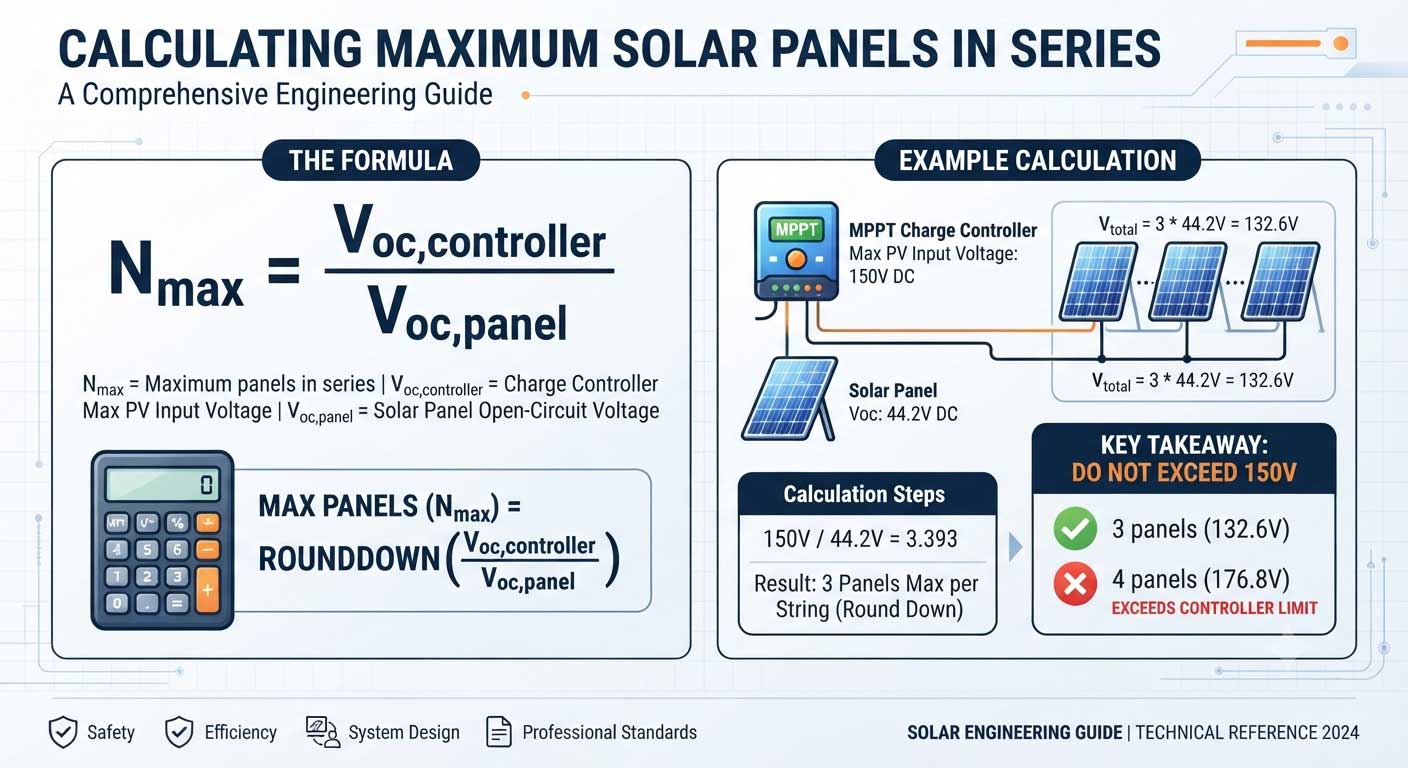
The basic calculation is:
Maximum Series Panels =
Maximum PV Input Voltage ÷ Panel Voc
Example:
Solar controller:
Maximum PV input:
150V
Solar panel:
Voc:
37V
Calculation:
150 ÷ 37 = 4.05
Maximum:
4 panels in series
However, professional system design should also consider:
- Temperature coefficient
- Safety margin
- Manufacturer recommendations
Example: Calculating Solar Panels in Series for an RV System
Assume an RV solar system uses:
Solar panels:
200W each
Panel specifications:
Voc:
24V
MPPT controller:
Maximum PV input:
100V
Calculation:
100V ÷ 24V = 4.16
Possible configuration:
4 panels in series
System output:
Voltage:
24V × 4 = 96V
Power:
200W × 4 = 800W
This configuration provides higher voltage input while maintaining manageable current levels.
How Many Solar Panels Can Be Connected in Series With an MPPT Controller?
MPPT controllers usually allow more flexible series configurations because they can accept higher PV input voltage.
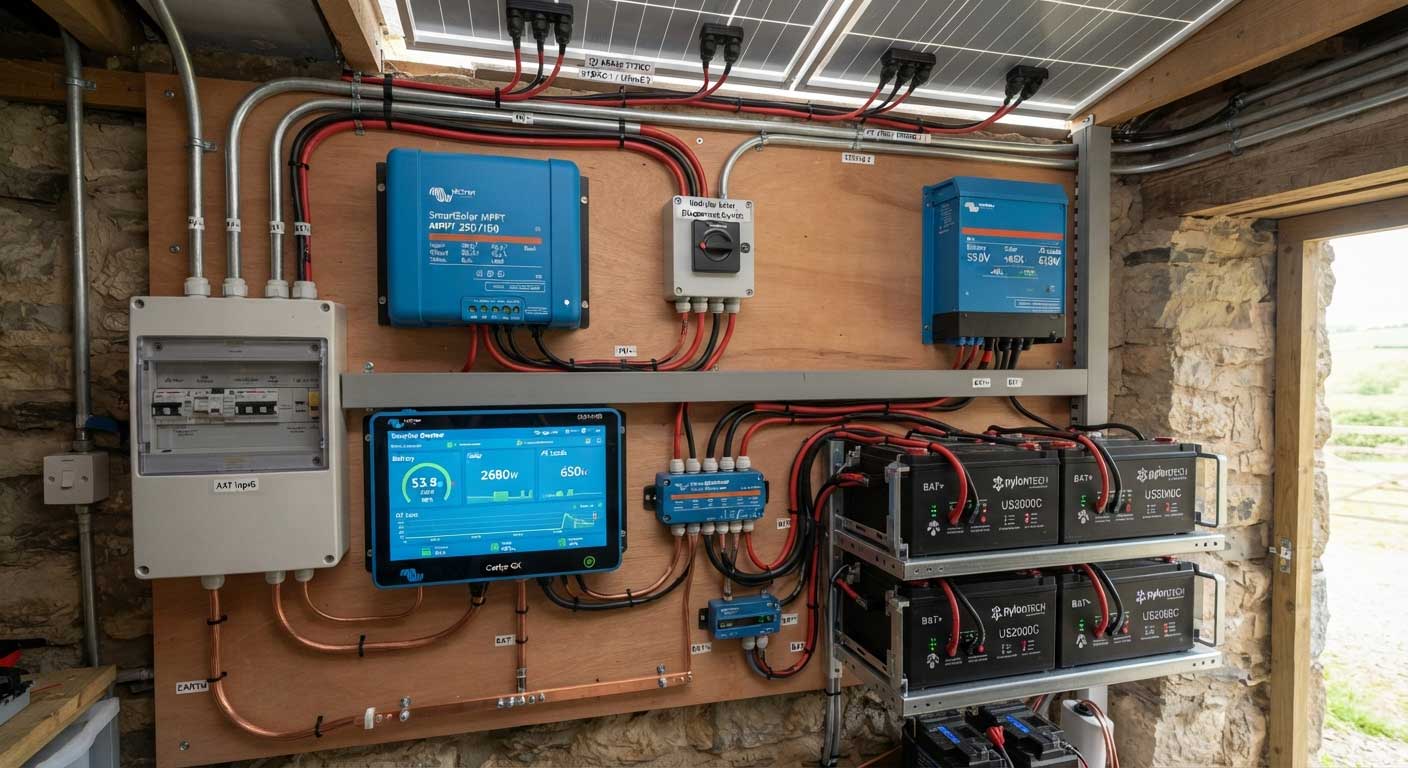
Common examples:
Small MPPT Controllers
Typical systems:
- 1–3 panels in series
Applications:
- RV solar
- Small cabins
- Portable systems
Large MPPT Controllers
Typical systems:
- 3–10+ panels in series
Applications:
- Home solar
- Commercial systems
- Large off-grid installations
The exact number depends on:
- Controller voltage rating
- Panel Voc
- Environmental conditions
For more details about connecting panels with controllers, see our guide:
How to Connect Solar Panels to Charge Controller
Series vs Parallel: Which Connection Allows More Solar Panels?
Both series and parallel configurations can support multiple solar panels, but they increase different electrical values.Choosing the correct wiring method depends on your voltage requirements, shading conditions, and system design. Learn more about the differences in our complete guide to solar panels in parallel vs series.
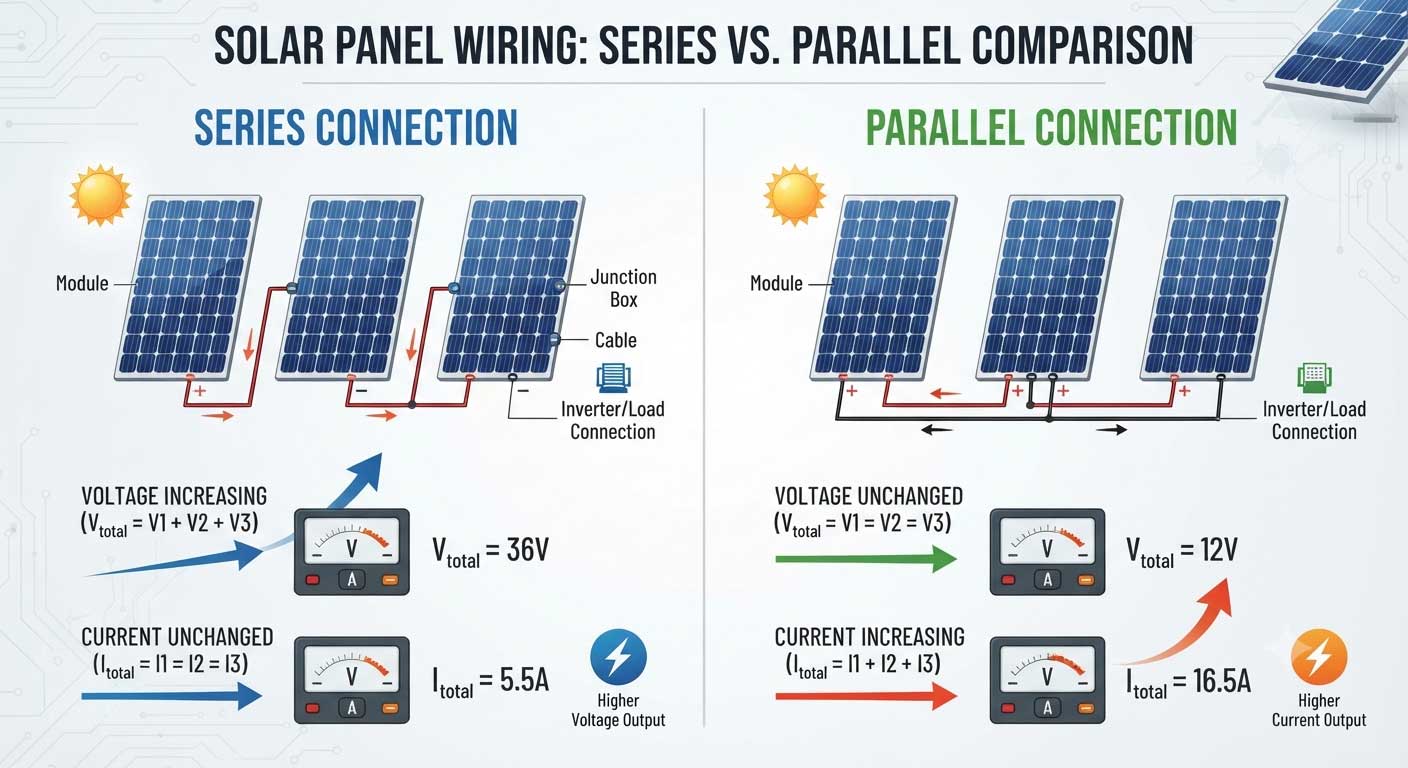
Series Connection
Increases:
- Voltage
Keeps:
- Current the same
Best for:
- Long cable distances
- MPPT controllers
- Higher-voltage systems
Parallel Connection
Increases:
- Current
Keeps:
- Voltage the same
Best for:
- Lower voltage systems
- Some shaded environments
- Simple battery charging systems
For a complete comparison:
Read our guide on:
solar panels in parallel vs series
Can You Connect Too Many Solar Panels in Series?
Yes.
Connecting too many solar panels in series can exceed the maximum voltage rating of:
- Charge controllers
- Inverters
- Electrical components
Possible problems include:
- Equipment damage
- Controller shutdown
- Reduced system reliability
The most common mistake is calculating based only on wattage.
For example:
Adding five 200W panels does not automatically mean the system is safe. Voltage compatibility is the key factor.
Common Mistakes When Connecting Solar Panels in Series
Mistake 1: Ignoring Voc
Some users calculate using operating voltage (Vmp) instead of Voc.
For safety calculations, Voc is the critical value.
Mistake 2: Using Maximum Voltage Without Temperature Adjustment
Cold weather can increase voltage.
Always consider local climate conditions.
Mistake 3: Mixing Different Solar Panels
Different panels may have different:
- Voltage
- Current
- Electrical characteristics
Mixing them in the same series string can reduce performance.
Mistake 4: Exceeding Charge Controller Limits
Even if panels physically connect together, the controller may not support the resulting voltage.
Always check:
- Maximum PV voltage
- Maximum charging current
How Bright Solar Helps Design Flexible Solar Systems
Bright Solar flexible solar panels are designed for applications where weight, space, and installation flexibility are important.
Common applications include:
- RV solar systems
- Marine solar systems
- Off-grid power solutions
- Custom solar installations
When using flexible solar panels, series configuration should be selected based on:
- Battery voltage
- Charge controller type
- Installation distance
- Energy requirements
A correct solar panel series design helps maximize power output while maintaining system safety.
Series Solar Panel Wiring Diagram
Understanding the wiring method is essential before calculating how many solar panels can be connected in series.
In a series connection, each solar panel is connected end-to-end:
Solar Panel Positive (+)
↓
Solar Panel Negative (-)
↓
Next Solar Panel Positive (+)
The final unused positive and negative terminals become the solar array output connected to the charge controller or inverter.
A series connection increases the total system voltage while maintaining approximately the same current output.
Example:
Three solar panels:
Each panel:
- Vmp: 30V
- Imp: 10A
Series connection:
Total voltage:
30V × 3 = 90V
Current:
10A
Total power:
90V × 10A = 900W
This higher-voltage configuration is commonly used with MPPT charge controllers because they can efficiently convert higher PV voltage into battery charging power.
How Many Solar Panels Can Be Connected in Series for Different Systems?
The ideal number of solar panels connected in series depends on the application.
Different solar systems have different voltage requirements, controller limitations, and installation environments.
RV Solar Systems
RV solar systems commonly use series solar panel configurations because they provide higher voltage and reduce cable losses.
A typical RV setup may include:
Example:
Four flexible solar panels:
Panel power:
200W each
Panel Voc:
24V
Series connection:
Voltage:
24V × 4 = 96V
Total power:
800W
This configuration can work well with a compatible MPPT charge controller.
However, RV owners should consider:
- Roof space
- Partial shading
- Battery voltage
- Controller specifications
For RV applications using flexible solar panels, Bright Solar recommends checking the complete electrical system before choosing series or parallel wiring.
Home Solar Systems
Residential solar systems often use multiple solar panels connected in series strings.
This is because grid-connected inverters usually require a specific DC voltage range to operate efficiently.
A typical home solar array may include:
- Multiple panels in one string
- Several strings connected in parallel
Example:
Ten solar panels:
Each panel:
40V Voc
One series string:
10 × 40V
= 400V
The actual design depends on:
- Inverter voltage range
- Panel specifications
- Local climate conditions
Professional residential installations always calculate string voltage before installation.
Off-Grid Solar Systems
Off-grid systems vary significantly depending on battery voltage and power requirements.
Small systems:
- 12V batteries
- Few solar panels
Larger systems:
- 24V or 48V batteries
- Multiple solar strings
Higher-voltage series configurations are often preferred for larger off-grid systems because they reduce current and improve cable efficiency.
Common applications:
- Cabins
- Remote workstations
- Agricultural systems
Marine Solar Systems
Marine solar installations often have limited mounting space.
Flexible solar panels are popular because they can fit curved surfaces and lightweight structures.For proper mounting methods, cable routing, and installation considerations, see our complete flexible solar panel installation guide.
Series wiring may be suitable when:
- Cable distance is long
- MPPT controller is used
- Space is limited
However, boats may experience:
- Changing sunlight
- Shadows from equipment
- Different panel orientations
In these cases, system design should consider whether parallel or series-parallel wiring provides better performance.
How Many Solar Panels Can Be Connected in Series With Different Controllers?
The charge controller type strongly affects the maximum number of panels.
MPPT Charge Controller
MPPT controllers generally support higher solar input voltage.
After determining your solar string voltage, the next step is connecting the panels correctly to your controller. Follow our guide on how to connect solar panels to charge controller for complete wiring steps.
Understanding controller technology is important before selecting a series configuration. Compare the advantages of both technologies in our guide about MPPT vs PWM charge controller for solar panels.
Advantages:
- Allows more panels in series
- Reduces current losses
- Improves system design flexibility
Example:
Controller maximum PV voltage:
150V
Panel Voc:
35V
Calculation:
150 ÷ 35
≈ 4 panels
Possible configuration:
4 panels in series
For larger systems, multiple strings may be combined.
PWM Charge Controller
PWM controllers usually have stricter voltage requirements.
They typically work best when solar panel voltage closely matches battery voltage.
For example:
12V battery system:
Commonly paired with:
12V nominal solar panels
Using many panels in series with PWM controllers is usually not recommended because the additional voltage cannot be efficiently converted.
Series Solar Panel Installation Tips
Connecting solar panels in series is simple, but correct design requires attention to several details.
1. Always Calculate Using Voc
When determining the maximum number of panels in series, use:
- Open circuit voltage (Voc)
Not only:
- Operating voltage (Vmp)
Voc represents the highest voltage condition and protects equipment from overvoltage.
2. Leave a Safety Margin
Do not design a solar string exactly at the controller’s maximum voltage limit.
Example:
Controller limit:
150V
Calculated string voltage:
148V
This may be too close.
Temperature changes can increase voltage beyond the expected value.
A safer design leaves additional margin.
3. Use Matching Solar Panels
Solar panels connected in series should ideally have similar specifications.
Recommended:
- Same model
- Same wattage
- Similar electrical characteristics
Mixing different panels may cause the entire string to operate at the lower-performing panel’s characteristics.
4. Check Cable Requirements
Although series wiring reduces current, cable selection still matters.
Consider:
- Cable length
- Voltage drop
- Environmental exposure
- Connector quality
High-quality solar cables and connectors improve long-term reliability.
5. Use Proper Protection Devices
A complete solar installation may require:
- DC disconnect switches
- Fuses
- Surge protection devices
- Proper grounding
Protection requirements depend on:
- System size
- Installation location
- Electrical regulations
FAQ About How Many Solar Panels Can Be Connected in Series?
How Many Solar Panels Can Be Connected in Series?
There is no fixed number.
The maximum depends on:
- Solar panel Voc
- Charge controller or inverter maximum PV voltage
- Temperature conditions
The correct calculation is:
Maximum PV voltage ÷ Panel Voc
Can I Connect 2 Solar Panels in Series?
Yes.
Two solar panels can be connected in series to increase voltage.
Example:
Two 30V panels:
Voltage:
60V
Current:
Same as one panel
Can I Connect 4 Solar Panels in Series?
Yes, if the combined voltage remains within the equipment limit.
Example:
Four panels:
Voc:
35V
Total:
140V
A controller rated above this voltage may support the configuration.
Are More Solar Panels Better in Series?
Not always.
Adding more panels increases voltage, but exceeding controller or inverter limits can damage equipment.
The correct number depends on system design, not simply the amount of available solar power.
Do Solar Panels in Series Charge Faster?
Series wiring does not directly increase total power.
It increases voltage.
The charging speed depends on:
- Total solar wattage
- Charge controller efficiency
- Battery capacity
- Sunlight conditions
Can Different Watt Solar Panels Be Connected in Series?
It is possible in some situations, but not recommended.
Different panels may have different:
- Voltage
- Current
- Power characteristics
For best performance, use matching panels in the same series string.
Should RV Solar Panels Be Connected in Series or Parallel?
Both methods can work.
Series wiring is often preferred with MPPT controllers because it provides higher voltage and lower current losses.
Parallel wiring may be useful where shading conditions are common.
The best option depends on the RV electrical system.
Conclusion: Designing the Right Solar Panel Series Configuration
Knowing how many solar panels can be connected in series is essential for creating a safe and efficient solar system.
The correct number depends on:
- Solar panel Voc
- Charge controller or inverter limits
- Temperature conditions
- System voltage requirements
Series wiring provides higher voltage and lower current, making it useful for many residential, RV, and off-grid solar applications.
However, the goal is not to connect as many panels as possible. The goal is to create a balanced solar array that matches the complete electrical system.
Bright Solar recommends evaluating panel specifications, controller capacity, and installation conditions before designing a series solar configuration.
A properly calculated solar string improves energy efficiency, protects equipment, and creates a more reliable renewable energy system.
Related recommendations
-

How to Connect Solar Panels to Charge Controller: Complete Wiring Guide
225Learn how to connect solar panels to charge controller with step-by-step wiring instructions, safety tips, MPPT and PWM setup guidance for efficient solar systems.
View details -
Solar Camping Gear: A Practical Guide to Off-Grid Power
208Solar camping gear combines portable solar generation and battery storage for reliable off-grid power during camping, RV travel, boating, and outdoor work.
View details -
Most Powerful Solar Panel: How to Choose the Highest Output Solar Solution
170Discover the most powerful solar panel options for maximum energy output. Learn efficiency ratings, real-world performance, and how Bright Solar solutions support RV, marine, and off-grid applications.
View details -
Jinko Solar Signed a Supply Agreement with Datang Group for About 1 GW of n-type Tiger Neo Components
203Jinko Solar signed a supply agreement with Datang Group for about 1 GW of n-type tiger Neo components, supplying 560W Tiger Neo n-type TOPCon modules to Datang Group’s large ground-mounted projects in China, including agricultural-PV and rocky des...
View details