Fold Up Solar Panel: Portable Power for RVs, Camping and Off-Grid Use
A fold up solar panel gives you portable solar power without permanent installation. Fold the panel for transport, unfold it in direct sunlight, connect it to a compatible power station or charge controller, and adjust its position as the sun moves.
For RV owners, campers, overlanders and mobile work crews, the practical advantage is not simply that the panel folds. It is that the generating surface can be carried to the best available sunlight instead of being tied to the position of a vehicle or building. The U.S. Department of Energy explains that solar radiation varies with location, time of day, season, landscape and weather, while solar energy reaching a surface is strongest when sunlight strikes it more directly.
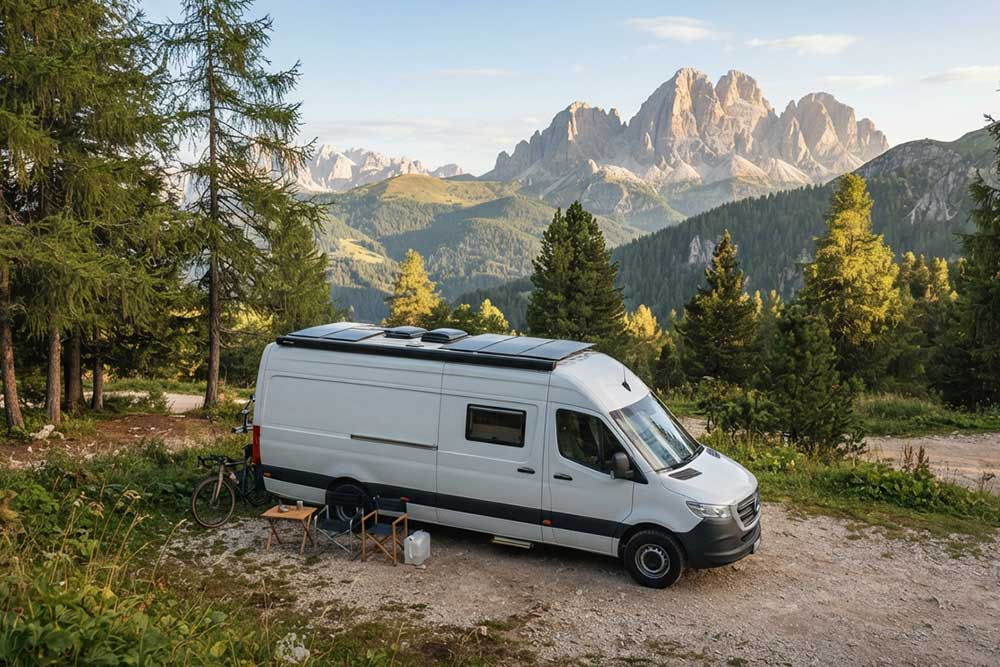
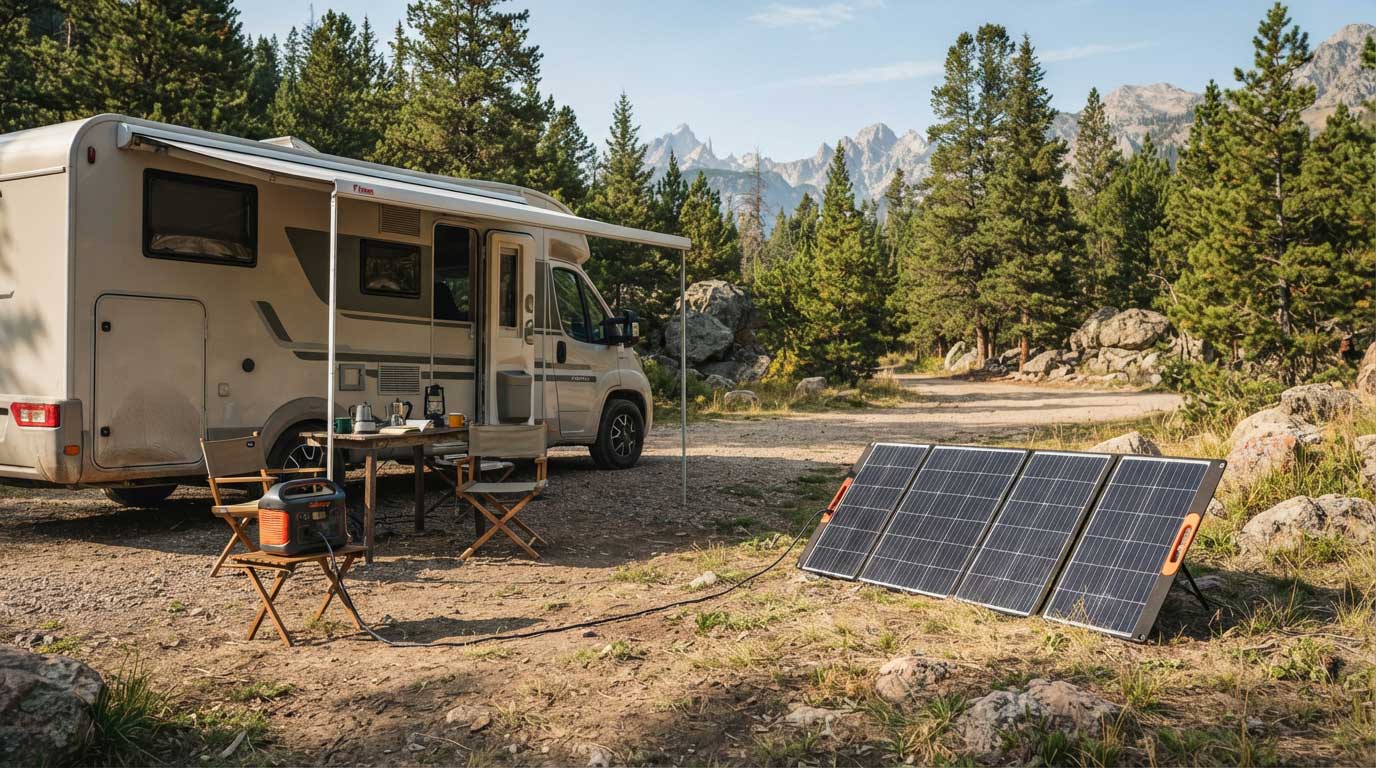
That distinction matters in the field. An RV parked under partial tree cover may have a poor roof position but a sunny patch 15 or 20 feet away. A portable panel can move.
What Is a Fold Up Solar Panel?
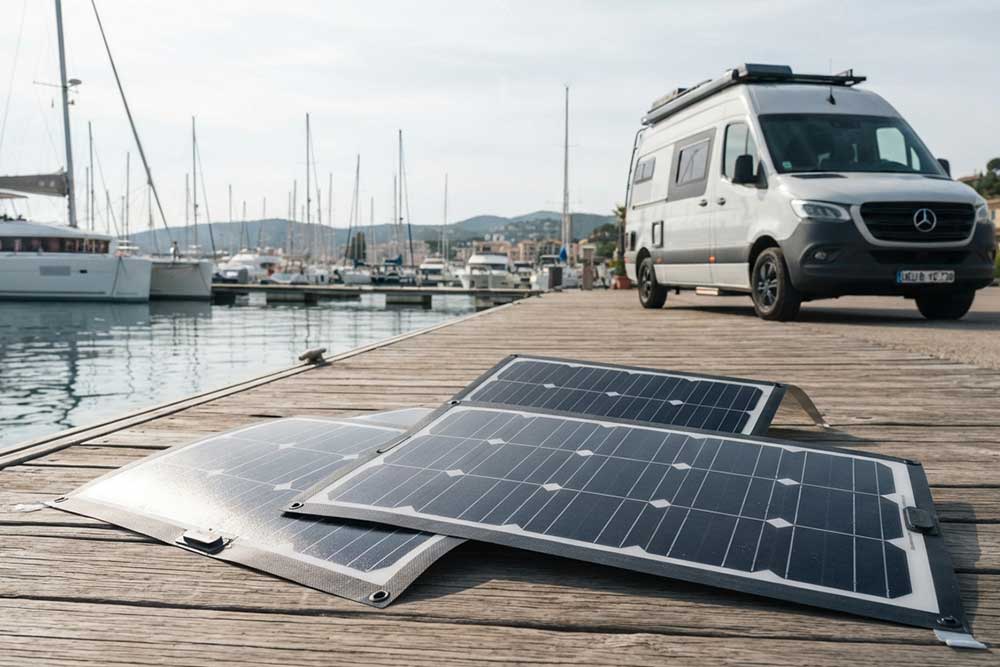
A fold up solar panel is a portable photovoltaic module or group of modules connected through folding sections, hinges or flexible interconnections. When opened, the sections form a larger solar collection surface. When closed, the package occupies considerably less space for transport and storage.
The photovoltaic principle itself is unchanged. Solar cells convert sunlight into electrical energy, and cells are connected together to create a higher-output module. The U.S. Department of Energy describes PV cells as semiconductor devices that convert sunlight into electricity; larger panels are built by connecting many cells together.
What changes is the mechanical format.
A conventional rigid panel is normally designed to remain installed. A fold up solar panel is designed around repeated handling:
- Carry it to the campsite or work area.
- Unfold the sections.
- Position the active surface toward the sun.
- Connect the electrical output.
- Monitor charging.
- Fold it back after use.
- Store it without occupying the full deployed footprint.
This makes folding solar particularly useful when permanent roof mounting is undesirable or impossible.
Fold Up Solar Panel vs. Flexible Solar Panel
The two terms are often mixed together, but they describe different physical approaches.
A fold up solar panel normally uses multiple sections that close together.
A flexible solar panel is manufactured with a bendable construction and can conform to a curved surface within its specified bending limit.
A folding product is therefore not automatically a flexible solar panel, and a flexible panel is not automatically foldable. Buyers should check the manufacturer’s mechanical specification rather than assuming that “portable,” “flexible,” and “foldable” mean the same thing.
Bright Solar approaches portable solar from the application side: RV, mobile home, camping, boat, ship, portable power station and off-grid use each place different demands on size, weight, electrical configuration and environmental protection.
Why Use a Fold Up Solar Panel?
The strongest reason is positioning.
Permanent solar panels have a fixed orientation once installed. A portable folding panel can be moved during the day. The DOE notes that the amount of solar radiation depends heavily on the sun’s angle, with solar energy generally greatest around solar noon when the sun is highest.
That becomes very noticeable at a campsite.
A vehicle may be shaded while an open area nearby is receiving direct sunlight. Instead of relocating the entire RV, the panel can be carried into the open area.
Other advantages include:
| Feature | Practical benefit |
|---|---|
| Folding construction | Smaller storage footprint |
| Portable deployment | Can be moved toward better sunlight |
| No permanent roof mounting | Useful for leased vehicles and temporary setups |
| Reusable across locations | One panel can serve multiple trips |
| Easy seasonal storage | Can be packed away when not needed |
| Compatibility with portable batteries | Suitable for mobile energy systems |
| Modular deployment | Multiple panels can be used where the system allows |
The portable solar market is also no longer a tiny camping niche. A 2026 market analysis from Global Market Insights estimates the global portable solar panel market at about $2.3 billion in 2026, following an estimated $2 billion in 2025.
That growth reflects a wider change in how portable electricity is being used: camping, RV travel, emergency preparedness, remote work and temporary off-grid applications.
How Does a Fold Up Solar Panel Work?
The electrical side is straightforward, but the real-world output is not a fixed number.
A panel’s rated wattage is measured under specified test conditions. Actual energy production changes with irradiance, temperature, orientation, shading, dirt and electrical losses. The DOE specifically identifies conversion efficiency as the percentage of solar energy reaching a PV device that becomes usable electrical energy and notes that multiple factors limit conversion.
For a portable system, think in two separate numbers:
Power: how much electricity the panel can produce at a particular moment.
Energy: how much electricity it produces over a period of time.
For example, a nominal 200W panel does not mean it will continuously deliver 200W from sunrise to sunset. If usable solar conditions were equivalent to 4 peak-sun-hours, a simplified theoretical calculation would be:
200W × 4h = 800Wh
Real-world energy will be lower or higher depending on conditions and system losses. This is why Bright Solar does not recommend treating rated wattage as a promise of daily energy production.
The panel’s job is only one part of the system. A portable setup may also contain:
- Fold up solar panel
- Solar cable and connectors
- Charge controller, when required
- Portable power station or battery
- Inverter, when AC output is required
- Loads such as phones, lights, refrigerators or laptops
The DOE similarly describes a PV system as more than the module itself; mounting, electrical conversion and other components determine how generated DC electricity becomes useful power.
How to Set Up a Fold Up Solar Panel
The physical setup is simple, but a few details determine whether the system performs well.
Step 1 — Choose an Unshaded Location
Look beyond the first sunny-looking patch.
A tree may cast a narrow shadow across one section of the panel while the rest remains bright. Depending on the electrical architecture of the panel, partial shading can have a disproportionate effect on output.
Open ground, a picnic table or another stable surface is usually preferable to an unstable slope.
Avoid locations where people will repeatedly walk across the cables.
Step 2 — Unfold the Panel Completely
Place the panel on a clean, stable surface and unfold every section according to the manufacturer’s instructions.
Do not force hinges past their intended movement.
For flexible or semi-flexible constructions, respect the manufacturer’s specified bending limits. A panel being described as flexible does not mean it should be repeatedly creased or folded at any point.
Step 3 — Aim the Panel Toward the Sun
Orientation is one of the easiest variables to improve without buying another panel.
In the northern hemisphere, the general annual orientation for fixed PV installations is toward the south, but a portable panel has an important advantage: it can be repositioned throughout the day. DOE guidance notes that solar radiation changes with the sun’s position and that more direct sunlight generally provides greater available solar energy.
For a short camping trip, checking the panel every couple of hours can be more useful than obsessing over a perfect fixed angle.
Step 4 — Connect the Electrical System
Before connecting anything, verify:
- Panel voltage
- Panel current
- Power station input limits
- Charge-controller specifications
- Connector type and polarity
- Maximum permitted solar input
- Battery voltage requirements
Do not assume that a connector physically fitting means the electrical configuration is correct.
For B2B projects, this is where product customization becomes important. A portable panel intended for one power station ecosystem may require a different connector or voltage configuration from a panel intended for a 12V battery system.
Step 5 — Monitor the First Charging Cycle
The first deployment is worth watching.
Check whether the power station recognizes the solar input. Look at the charging wattage under stable sunlight. Check cable temperature and connector condition. If output drops sharply when a cloud passes, that may be normal; if it remains unusually low after the sun returns, inspect shading, orientation, connections and the system’s input settings.
Field troubleshooting is often faster when you start with the simplest variable: sunlight.
How Much Power Can a Fold Up Solar Panel Produce?
There is no single daily output figure that applies to every fold up solar panel.
A useful starting point is:
Estimated energy = panel rated power × equivalent peak-sun hours × system efficiency factor
The calculation is only an estimate because peak-sun conditions are not the same as the total hours of daylight.
DOE explains that solar radiation varies by geography, season, time of day, weather and landscape. Thick clouds can substantially reduce direct solar radiation, while clear conditions provide much stronger direct sunlight.
Consider a simple 200W example:
| Condition | Simplified calculation | Theoretical energy |
|---|---|---|
| 2 peak-sun-hours | 200W × 2h | 400Wh |
| 4 peak-sun-hours | 200W × 4h | 800Wh |
| 5 peak-sun-hours | 200W × 5h | 1,000Wh |
| 6 peak-sun-hours | 200W × 6h | 1,200Wh |
These are not guaranteed field outputs. They intentionally exclude real-world losses.
A panel sitting flat under partial shade can produce dramatically less energy than the same panel aimed at unobstructed sunlight. That is one reason portable deployment is valuable.
What Reduces Real-World Output?
Common causes include:
- Partial shade from trees, buildings or vehicles
- Cloud cover
- Poor panel orientation
- High operating temperature
- Dust and surface contamination
- Cable losses
- Connector resistance
- Charge-controller conversion losses
- Power-station input limitations
- Battery charging conditions
The DOE’s PV performance guidance also emphasizes that not all sunlight reaching a solar cell becomes electricity; optical, material and electrical factors all contribute to conversion losses.
Choosing the Right Fold Up Solar Panel for RV and Camping
The biggest panel is not automatically the best panel.
For a weekend camper carrying equipment in a compact vehicle, a heavy high-output folding system may become inconvenient. For an RV owner running a larger portable power station, the extra deployed area may be worthwhile.
Start with the load.
| Application | Typical priority |
|---|---|
| Phone and small electronics | Compact size and easy setup |
| Laptop and camera equipment | Moderate output and portability |
| RV weekend use | Higher output and storage efficiency |
| Portable refrigerator | Higher daily energy availability |
| Emergency backup | Reliable storage and simple deployment |
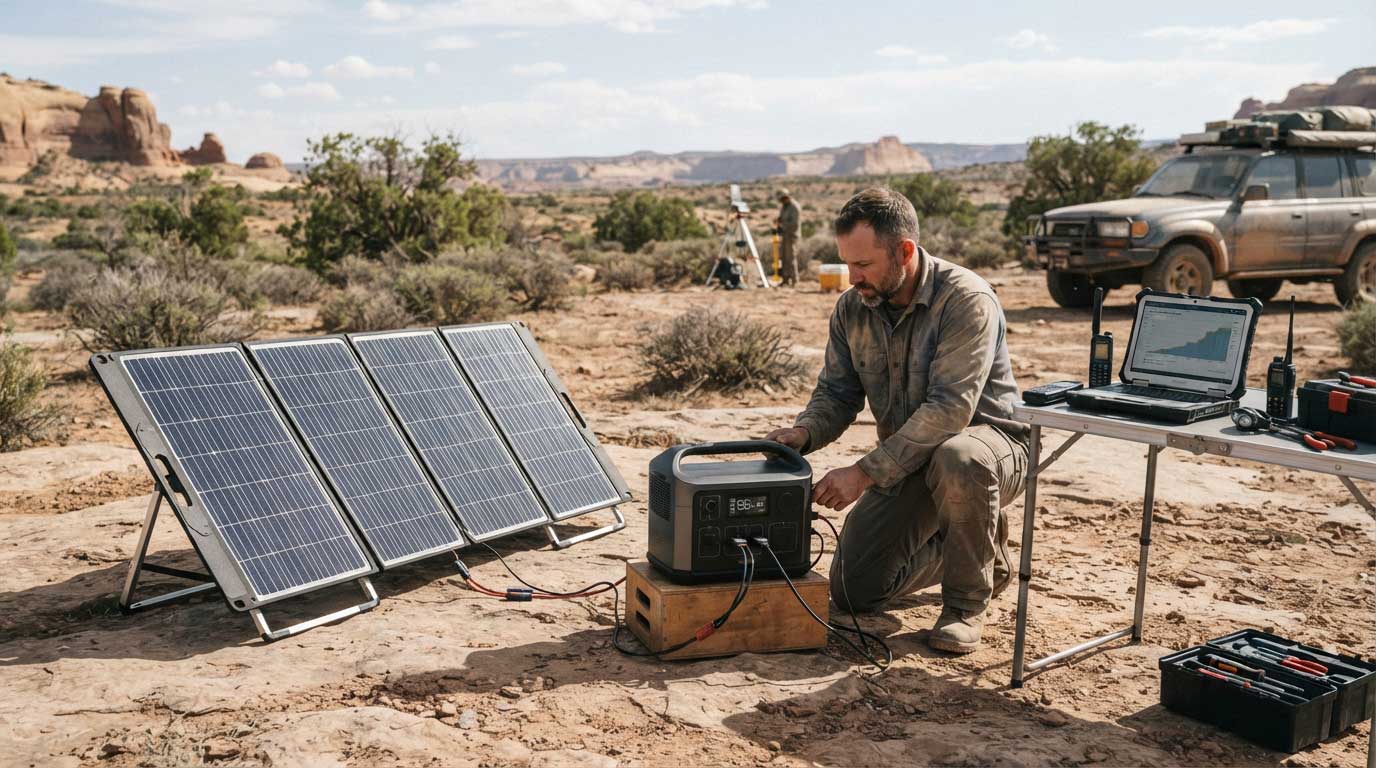
| Remote worksite | Durability, connector compatibility and output |
| Marine use | Environmental resistance and appropriate construction |
For OEM buyers, the decision becomes more detailed. A manufacturer may need a particular folded dimension, cable length, connector, cell technology, surface material, output configuration or branding arrangement.
That is where simply buying an off-the-shelf consumer panel can become limiting.
Fold Up Solar Panel for RVs, Boats and Mobile Homes
RV use is one of the clearest applications because the panel can be separated from the vehicle.
That creates a useful operating pattern:
Drive → park → unfold → position in sunlight → charge → pack away.
The vehicle does not need to remain perfectly positioned for solar collection.
Marine applications require more caution. A panel intended for a boat should be selected according to its actual environmental specification rather than assuming that every portable folding panel is suitable for saltwater exposure.
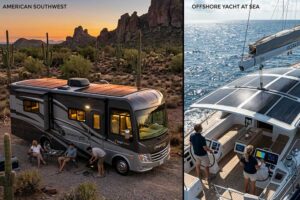
Bright Solar’s product portfolio includes portable solar applications for RVs, mobile homes, camping, boats, ships and portable power systems. For B2B projects, the correct construction should be selected from the intended application rather than applying one specification across every market.
For example, the Bright Solar L Series is designed as a lightweight flexible solar product with a maximum bending capacity of 30%, while the H Series is positioned for marine/yacht applications and uses a double-ETFE construction. Those are different product decisions because the operating environment is different.
A Practical Field Example: Why Position Can Matter More Than Rated Wattage
Consider an RV parked for the afternoon.
The roof receives intermittent sunlight because the vehicle is under trees. A portable 200W fold up solar panel is placed 20 feet away in a clearing.
The panel rating has not changed.
The battery has not changed.
The weather has not changed.
Only the available sunlight has changed.
This is a useful way to understand portable solar. Portability is not merely a convenience feature. It can be an energy-management tool.
Recent market research supports the same direction. TechSci Research reports that foldable portable chargers led the North American portable solar panel segment in 2024, citing portability, energy generation and suitability for camping, hiking and RV travel as key advantages.
A separate 2026 market analysis from ASINSIGHT recorded more than 217,000 units sold among the top 50 Amazon U.S. listings for the “portable solar panel” keyword during the 12 months ending July 2026, with approximately 20,000 units recorded in July alone. These figures are marketplace-specific rather than a measurement of the entire market, but they show the scale of consumer demand around portable solar equipment.
The interesting part is not the sales number itself. It is what buyers repeatedly prioritize: portability, storage, compatibility and usable charging.
Safety and Quality Checks Before Buying
A fold up solar panel is still an electrical product exposed to outdoor conditions.
For professional procurement, look beyond wattage.
Check Electrical Compatibility
Confirm the panel’s electrical specifications against the receiving equipment.
Never select a panel solely because the connector looks compatible.
Check Environmental Protection
If the product will be used outdoors, verify the actual environmental rating and intended use.
Water resistance claims should be supported by documented specifications rather than generic phrases such as “weatherproof.”
Check Mechanical Construction
Folding products experience repeated mechanical movement. Hinges, seams, cable exits, connectors and junction areas deserve particular attention.
For conventional PV modules, IEC 61730-1:2023 defines fundamental construction requirements for safe electrical and mechanical operation, addressing risks including electric shock, fire and mechanical/environmental stresses. IEC 61730-2:2023 specifies safety testing requirements.
For portable products, buyers should still verify which standards and certifications actually apply to the specific product and market. An IEC reference is not a substitute for checking the product’s own test documentation.
Fold Up Solar Panel Maintenance
Portable equipment benefits from simple habits.
After outdoor use, inspect the panel before folding it. Remove loose dirt and debris with a method approved by the manufacturer. Check the cable for cuts, crushed sections or unusual wear. Inspect connectors for damage or contamination.
Do not fold a dirty panel and leave abrasive grit trapped between sections.
Storage matters too. Keep the folded panel in a dry, protected location and avoid placing heavy objects on top of it.
For products with hinges, repeated rough handling is often more damaging than normal outdoor sunlight. A folding panel should be treated as electrical equipment with a mechanical operating cycle, not as a piece of camping fabric.
Bright Solar Fold Up Solar Panel Solutions for B2B Buyers
For distributors, RV equipment brands, outdoor-power companies and system integrators, a fold up solar panel is often more than a single finished product.
The required design may depend on:
- Target power rating
- Folded dimensions
- Deployed dimensions
- Cell technology
- Surface material
- Cable configuration
- Connector type
- Weight target
- Portable power station compatibility
- Branding requirements
- OEM packaging
- Application environment
Bright Solar provides flexible and portable solar panel solutions for B2B applications, with OEM/ODM customization available for projects requiring specific product dimensions, configurations and procurement volumes.
A useful procurement discussion should therefore begin with the application rather than simply asking, “What wattage do you have?”
For example:
What will the panel charge? Where will it be stored? How often will it be folded? Will it be used around salt water? What connector does the receiving system use? What folded size can the customer accept?
Those questions usually reveal the correct product direction much faster.
FAQ About Fold Up Solar Panels
What is a fold up solar panel?
A fold up solar panel is a portable photovoltaic product designed with sections that fold together for transportation and storage. When deployed, the sections provide a larger solar collection area for charging batteries or compatible portable power systems.
Are fold up solar panels good for RVs?
Yes. Fold up solar panels are particularly useful for RVs because they can be carried away from the vehicle and placed in a sunny location. This is helpful when the RV itself is parked under trees or in partial shade.
Can a fold up solar panel charge a power station?
Yes, provided the panel’s voltage, current, connector and maximum solar-input specifications are compatible with the power station. The physical connector alone does not establish electrical compatibility.
How do I get more power from a fold up solar panel?
Place the complete panel in unobstructed sunlight, orient it toward the sun, keep the surface clean and minimize unnecessary cable and conversion losses. Repositioning the panel during the day can also improve solar exposure.
Are fold up solar panels waterproof?
Some are designed for outdoor exposure, but waterproofing depends on the specific construction and rating. Buyers should check the manufacturer’s documented IP or environmental rating instead of assuming every folding panel is waterproof.
Can I use a fold up solar panel for camping?
Yes. Camping is one of the most common applications for portable solar. Foldable construction makes it easier to transport the panel between the vehicle, campsite and sunny open areas.
What should I check before buying a fold up solar panel?
Check rated power, voltage, current, folded and deployed dimensions, weight, connector type, environmental protection, mechanical construction and compatibility with the battery or portable power station. For commercial procurement, also verify applicable certifications and test documentation.
Conclusion
A fold up solar panel is most useful when portability changes where you can collect sunlight. For RVs, camping, mobile work and temporary off-grid power, the ability to unfold, reposition and store the panel can be more valuable than simply adding more rated wattage.
For B2B buyers, the right design depends on the complete application: electrical compatibility, folded size, mechanical construction, environmental conditions and intended operating environment all matter. Bright Solar can support customized flexible and portable solar panel requirements for OEM, ODM and bulk procurement projects.
Related recommendations
-

400W Flexible Solar Panel: High-Output Solar Power Without the Weight
152400w flexible solar panel solutions for RVs, boats, and off-grid systems. Discover lightweight ETFE solar panels with high efficiency and real-world durability.
View details -
China Flexible Solar Panel: Manufacturer Guide for Global Buyers
96A China flexible solar panel is a lightweight photovoltaic module designed for applications where rigid panels may be difficult to install. Buyers should ver...
View details -
Solar Panel for AC: How Many Solar Panels Are Needed to Run an Air Conditioner?
209Discover how a solar panel for ac systems works, how many panels are required, and how Bright Solar solutions reduce cooling costs for homes, RVs, and off-grid applications.
View details -
eco worthy flexible solar panels: Features, Uses and Buying Guide
157ECO-WORTHY flexible solar panels suit selected RV, marine, and off-grid installations where low weight, profile, or curved surfaces matter. Exact model speci...
View details