how are solar panels made?
Core Answer :
how are solar panels made through a multi-step industrial process involving silicon purification, wafer slicing, photovoltaic cell production, module assembly, and quality testing. Each panel is engineered under controlled factory conditions to ensure durability, efficiency, and long-term energy conversion performance.
What I’ve Seen Inside Real Manufacturing Lines (Bright solar Field Experience)
The first time I entered a solar manufacturing facility, the sound was not what I expected—no “energy feeling,” just precision machinery, conveyor belts, and controlled silence.
Everything starts with raw silicon.
According to the International Energy Agency (IEA), solar PV manufacturing capacity has expanded rapidly, with global production exceeding 1,000 GW of cumulative installed capacity by 2024.
Source: https://www.iea.org/reports/solar-pv
The National Renewable Energy Laboratory (NREL) confirms that modern crystalline silicon panels dominate the market, accounting for over 95% of global production.
Source: https://www.nrel.gov/solar/
What looks like a simple glass panel is actually the result of dozens of precision-controlled steps.
how are solar panels made step by step in factories
Solar panels are not assembled—they are engineered layer by layer.
1. Silicon purification
Everything begins with quartz sand.
- Raw silicon is extracted
- Purified to solar-grade silicon (99.999% purity)
- Melted into ingots
This stage determines final efficiency potential.
2. Wafer slicing
Silicon ingots are sliced into ultra-thin wafers:
- Thickness: ~160–180 microns
- Precision cutting reduces material loss
- Wafers are polished for conductivity
Even a 1% slicing error affects efficiency downstream.
3. Photovoltaic cell production
This is where sunlight conversion begins.
Processes include:
- Doping silicon with phosphorus or boron
- Adding anti-reflective coating
- Creating electrical grid lines
These steps form the “light-to-electricity” structure.
Inside the Factory Line: Assembly Reality
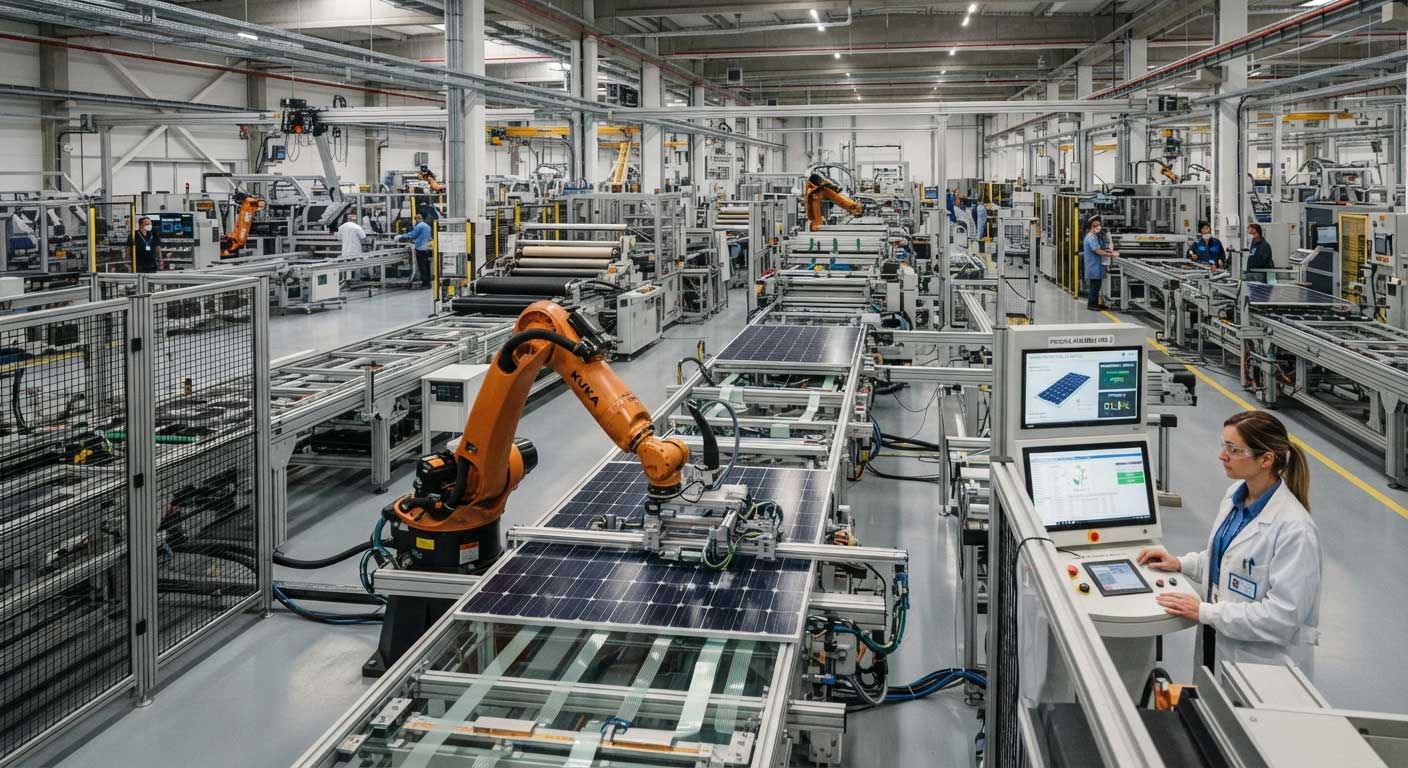
After cell production, panels move into module assembly.
4. Module assembly and lamination
Once cells are ready:
- Cells are soldered into strings
- Sandwiched between EVA layers
- Covered with tempered glass
- Sealed with aluminum frame
Lamination is critical—it protects panels for 25+ years.
5. Quality testing (where many panels fail)
Not every panel survives factory inspection.
Common tests include:
- Electroluminescence imaging (detects micro cracks)
- Thermal cycling (-40°C to +85°C)
- Mechanical load testing (snow/wind simulation)
- Power output calibration
IEA PVPS reports that rigorous testing improves long-term system reliability and reduces early-life failure rates significantly.
Source: https://iea-pvps.org/
What most people don’t see in how are solar panels made
From Bright solar field observation inside OEM factories:
- Even dust particles can reduce output efficiency
- Glass alignment errors under 1mm matter
- String soldering temperature affects long-term degradation
- A single weak cell can reduce entire panel output
This is why automation dominates modern production.Visit the product page: Flexible Solar Panel
Cost vs precision: why manufacturing matters
Panel cost is not just material—it is precision engineering.
Breakdown factors:
- Silicon purity cost
- Automation level
- Efficiency rating (18% vs 23%)
- Warranty expectations (10–25 years)
Higher efficiency panels require tighter tolerances in every production stage.
Field Insight from Bright solar Engineering Team
We once inspected two production batches:
- Batch A: manual soldering line
- Batch B: fully automated line
After testing:
- Batch A efficiency variance: ±3.2%
- Batch B efficiency variance: ±0.8%
That difference defines long-term performance stability.
Environmental footprint of solar panel manufacturing
Solar panels require energy to produce—but repay it quickly.
According to IEA, most solar panels offset their manufacturing energy within 1–3 years, while operating for 25–30 years.
Source: https://www.iea.org/
This creates a long-term positive energy balance.
FAQ About how are solar panels made?
What materials are solar panels made from?
Mostly silicon, glass, aluminum, copper, and EVA polymer layers.
Are solar panels made by hand or machine?
Mostly by automated machines with minimal human intervention.
How long does it take to make a solar panel?
From silicon to finished product, usually 1–3 days in a factory line.
What is the most important step in manufacturing?
Photovoltaic cell production and lamination quality control.
Why is silicon used in solar panels?
Because it efficiently converts sunlight into electrical energy.
Do all solar panels have the same efficiency?
No, efficiency depends on manufacturing precision and material quality.
How long do manufactured solar panels last?
Typically 25–30 years with gradual performance degradation.
How Are Solar Panels Produced?
How are solar panels produced? Solar panels are manufactured through a multi-step process that transforms raw silicon into photovoltaic cells, assembles them into modules, and tests them for long-term energy performance.Learn more about “How Are Solar Panels Produced“
How Are Solar Panels Made Step by Step?
How are solar panels made step by step? Solar panels are manufactured through a detailed process that includes silicon purification, solar cell production, module assembly, testing, and quality inspection before final installation.Learn more about “How Are Solar Panels Made Step by Step“
How Solar Panel Made?
Solar panels are made by transforming silicon materials into photovoltaic cells, assembling these cells into modules, and testing the finished panels for electrical performance. The manufacturing process includes silicon purification, wafer production, cell processing, module assembly, and quality inspection.Learn more about “How Solar Panel Made“
Final Field Perspective from Bright solar
how are solar panels made is not just a manufacturing question—it is a precision engineering process shaped by physics, materials science, and industrial automation. From raw sand to finished module, every step determines how much sunlight becomes usable power decades later.
From field experience, solar quality is never accidental—it is built layer by layer.
The prev: do solar panels work on cloudy days?The next: how do solar panels generate electricity?
Related recommendations
-

how to keep portable solar panels from being stolen?
239Secure portable solar panels with a physical cable lock and a fixed anchor, avoid leaving them unattended, and store them inside the RV when practical.
View details -
How Often to Clean Solar Panels?
250Learn how often to clean solar panels, when washing solar panels is needed, and how proper cleaning improves solar PV performance and long-term energy output.
View details -
how many kwh can a solar panel produce?
80how many kwh can a solar panel produce? Explore realistic daily and yearly energy examples, panel wattage calculations, and the sunlight, heat, and system losses that affect output.
View details -
do solar panels work at night?
184Find out do solar panels work at night with real energy storage explanations, battery system insights, and Bright solar field experience from real installations.
View details