How Are Solar Panels Made Step by Step?
How are solar panels made step by step? Solar panels are manufactured through a detailed process that includes silicon purification, solar cell production, module assembly, testing, and quality inspection before final installation.
Solar panels may look simple from the outside, but every module contains hundreds of carefully engineered components working together. From my experience working with solar product development and manufacturing projects, I have seen that the difference between an ordinary panel and a reliable long-life panel often comes down to small details during production.
At Bright Solar, we work closely with solar technologies including flexible solar panels, portable modules, and customized photovoltaic solutions. Understanding the manufacturing process helps customers evaluate panel quality beyond just wattage numbers printed on a product label.
According to the International Energy Agency (IEA), solar photovoltaic technology has become one of the fastest-growing renewable energy sources worldwide, with global solar PV capacity expanding rapidly over the last decade.
How Are Solar Panels Made Step by Step?
The solar panel manufacturing process includes several major stages:
- Silicon material preparation
- Silicon wafer production
- Solar cell manufacturing
- Electrical connection and stringing
- Module lamination
- Frame and junction box installation
- Performance testing and quality inspection
Each step affects the final panel’s efficiency, durability, and operating lifespan.
A modern solar panel is not simply a collection of solar cells. It is an engineered product designed to survive decades of outdoor exposure, including rain, wind, temperature changes, and UV radiation.
Step 1: Producing High-Purity Silicon
The first step in making solar panels starts with silicon, one of the most abundant elements on Earth.
However, raw silicon cannot directly produce electricity. It must first be purified to a very high level suitable for photovoltaic applications.
The basic process includes:
- Mining silica sand
- Producing metallurgical-grade silicon
- Refining silicon to solar-grade purity
Solar-grade silicon typically requires purity levels above 99.999%.
This high-purity material becomes the foundation for photovoltaic cells.
From Sand to Solar Material
The transformation from sand to usable solar material involves complex chemical and thermal processes.
Silicon is heated at extremely high temperatures and processed into solid forms called ingots.
Different manufacturers may use different technologies, but the goal remains the same:
Create high-quality silicon structures that can efficiently convert sunlight into electricity.
Step 2: Manufacturing Silicon Wafers
After purification, silicon is formed into large cylindrical blocks called ingots.
These ingots are then:
- Cut into thin wafers
- Cleaned
- Surface-treated
- Prepared for solar cell production
The wafer thickness has decreased significantly over time as manufacturers improve technology and reduce material usage.
Thinner wafers help reduce manufacturing costs while maintaining energy output.
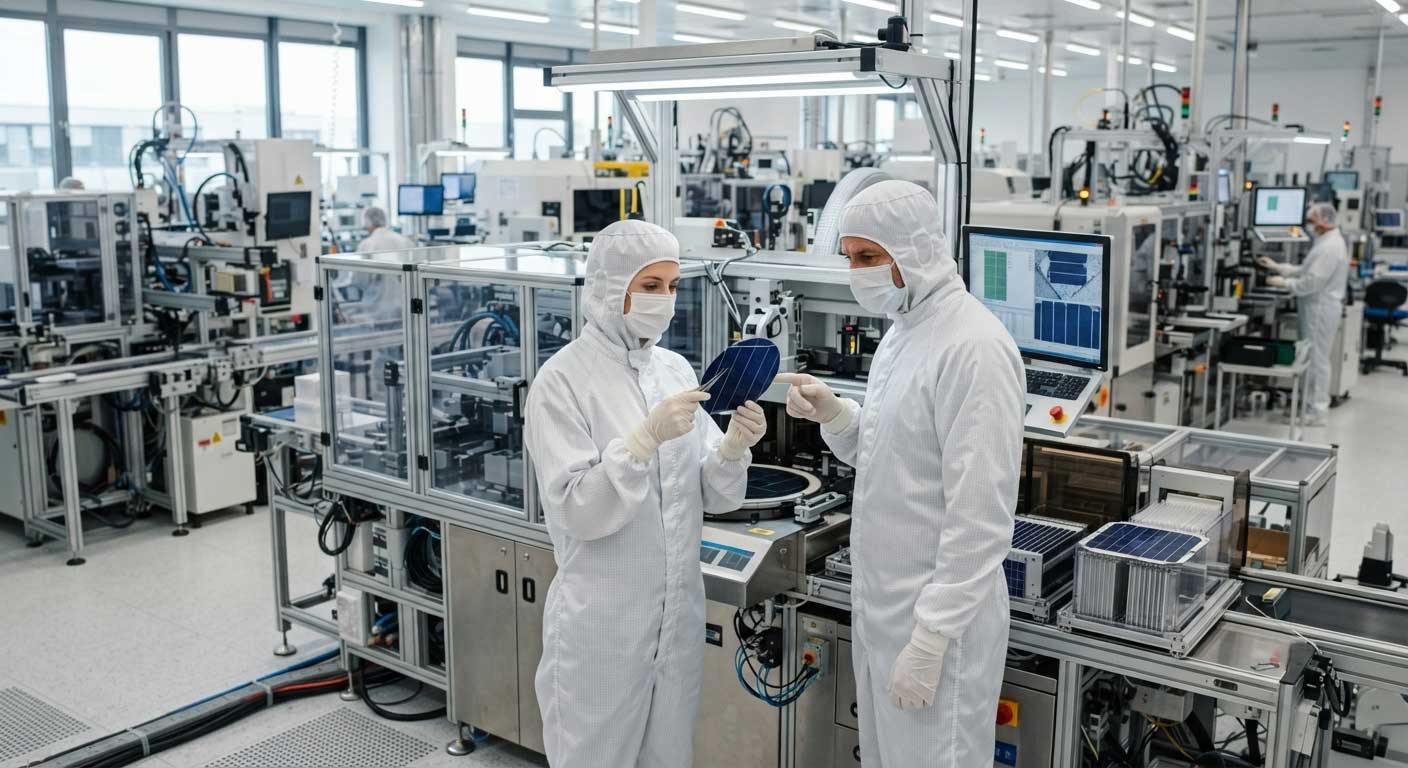
Step 3: Turning Silicon Wafers Into Solar Cells
This is the stage where photovoltaic technology begins.
Solar cells are created by adding special layers to silicon wafers.
The main processes include:
1. Surface Texturing
The wafer surface is modified to capture more sunlight.
A textured surface helps reduce reflection and allows more light to enter the cell.
2. Creating Electrical Properties
Manufacturers add controlled materials to create positive and negative electrical layers.
This allows the solar cell to generate electrical current when exposed to sunlight.
3. Adding Conductive Layers
Metal contacts are added to collect electricity generated by the photovoltaic effect.
The finished solar cell can now convert sunlight into direct current electricity.
Step 4: Connecting Solar Cells Together
Individual solar cells produce limited electricity, so manufacturers connect multiple cells together to create a usable solar module.
This process is called solar cell stringing.
During this stage:
- Solar cells are arranged in rows
- Cells are connected with metal ribbons
- Electrical pathways are created
A typical residential solar panel may contain:
- 60 cells
- 72 cells
- 108 half-cut cells
The arrangement affects the panel’s size, efficiency, and electrical output.
Step 5: Creating the Solar Module Structure
After cells are connected, manufacturers assemble the complete solar module.
A typical solar panel structure includes:
| Layer | Function |
|---|---|
| Glass surface | Protects cells and allows sunlight transmission |
| Encapsulant layer | Protects solar cells from moisture |
| Solar cells | Convert sunlight into electricity |
| Back sheet | Provides electrical insulation |
| Aluminum frame | Adds mechanical strength |
| Junction box | Transfers generated electricity |
Each layer must be carefully aligned before final sealing.
Why Solar Panel Manufacturing Quality Matters
Two solar panels with identical watt ratings can perform differently over time.
During manufacturing, quality control affects:
- Energy efficiency
- Weather resistance
- Mechanical strength
- Long-term degradation rate
At Bright Solar, we focus on materials and production details because flexible solar panels and portable modules often face more demanding environments than traditional rooftop systems.
For example, marine applications, RV installations, and outdoor equipment require different durability considerations compared with fixed residential systems.
Step 6: Solar Panel Lamination Process
After solar cells are connected and arranged, the next stage is lamination. This is one of the most important steps in determining how long a solar panel can survive outdoors.
During lamination, the solar cell layers are placed together and heated under controlled pressure. The encapsulant material melts and bonds the components into a sealed structure.
The lamination process helps protect solar cells from:
- Moisture penetration
- Temperature cycling
- Mechanical stress
- UV exposure
A poorly laminated panel may experience problems such as:
- Delamination
- Water ingress
- Reduced electrical performance
- Shorter operating life
This is why manufacturing precision matters. A solar panel is expected to operate outdoors for decades, not just perform well on the first day.
Step 7: Installing the Junction Box and Frame
After lamination, manufacturers add the final external components.
The main parts include:
Aluminum Frame
The aluminum frame provides structural support and helps the module withstand wind loads and transportation stress.
For traditional rigid solar panels, the frame is usually made from anodized aluminum because it offers:
- Lightweight structure
- Corrosion resistance
- Long-term durability
For flexible solar panels, manufacturers may use different construction methods because weight and flexibility are more important.
Junction Box Installation
The junction box transfers electricity generated by the solar cells to external cables.
It usually contains:
- Bypass diodes
- Electrical connectors
- Protection components
The junction box must maintain reliable performance under outdoor conditions, including heat, rain, and temperature changes.
Step 8: Solar Panel Testing and Quality Inspection
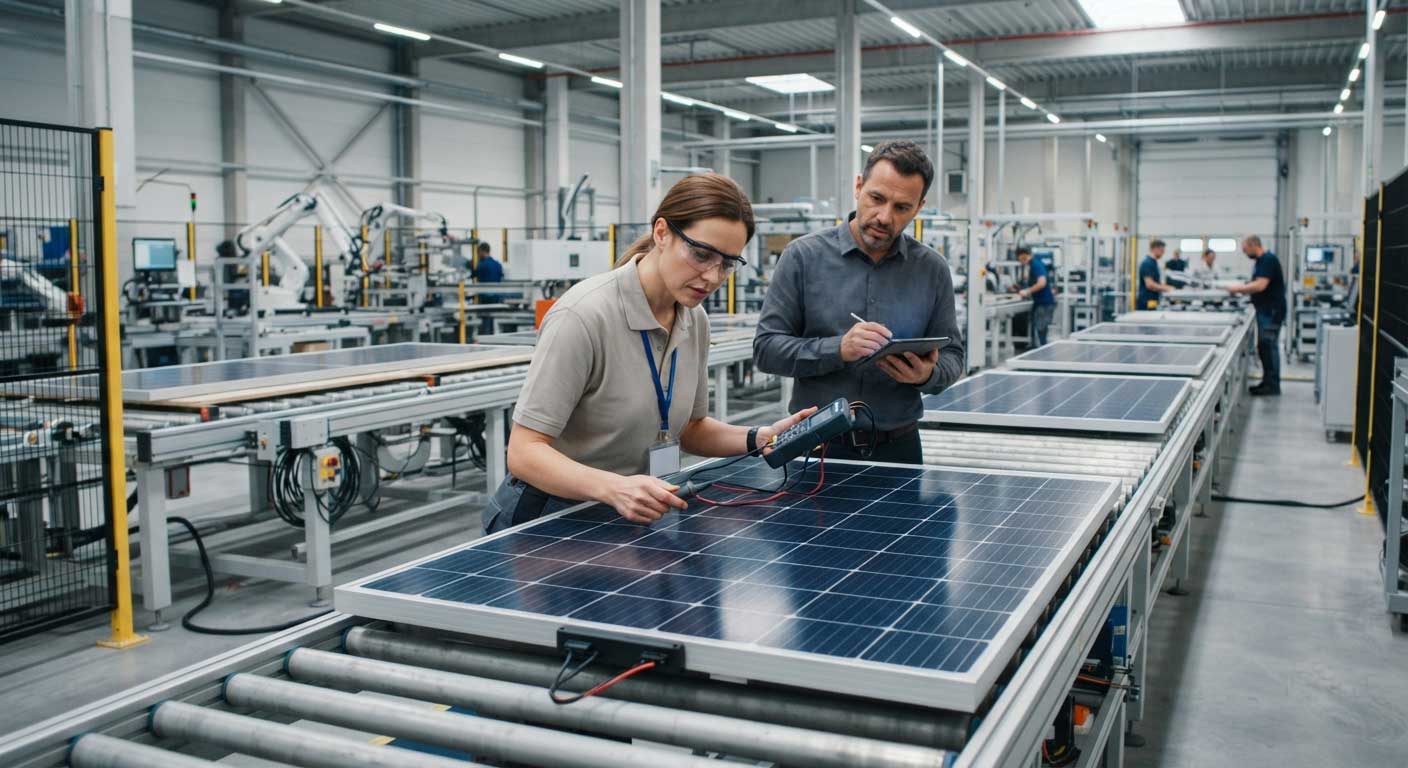
Before solar panels leave the factory, every module goes through testing procedures.
Manufacturers test panels for:
| Testing Item | Purpose |
|---|---|
| Electrical performance test | Measures power output and efficiency |
| Visual inspection | Detects cracks, defects, and alignment issues |
| Insulation test | Checks electrical safety |
| Mechanical load test | Evaluates strength under pressure |
| Thermal cycling test | Simulates temperature changes |
According to the International Electrotechnical Commission (IEC), photovoltaic modules are tested under standards such as IEC 61215 and IEC 61730 to verify durability, safety, and performance.
These tests help ensure solar panels can operate reliably in real-world environments.
How Long Does It Take to Manufacture a Solar Panel?
The manufacturing time depends on factory capacity, automation level, and product type.
A typical production process includes:
- Silicon preparation
- Cell manufacturing
- Module assembly
- Testing
- Packaging
Large automated factories can produce thousands of panels daily.
However, customized products may require additional time because manufacturers need to adjust:
- Panel dimensions
- Materials
- Electrical specifications
- Surface designs
For flexible solar panels, customization often involves additional engineering checks because the panel must balance:
- Lightweight design
- Bendability
- Power output
- Environmental resistance
How Bright Solar Approaches Solar Panel Manufacturing
At Bright Solar, we focus on practical applications rather than only laboratory specifications.
During product development, we evaluate where panels will actually be used.
For example:
A rooftop solar panel mainly needs:
- High efficiency
- Weather resistance
- Long service life
A flexible solar panel used on an RV or boat needs additional considerations:
- Lower weight
- Easier installation
- Vibration resistance
- Space optimization
This difference is important because the “best” solar panel depends on the application.
A lightweight flexible module may outperform a heavier rigid panel in situations where installation space and weight are limited.
FAQ About How Solar Panels Are Made Step by Step?
What material are solar panels made from?
Most solar panels are made using silicon photovoltaic cells combined with protective materials such as glass, encapsulant layers, aluminum frames, and electrical components.
How are solar cells made from silicon?
Solar cells are made by purifying silicon, creating silicon wafers, adding electrical layers, applying conductive materials, and processing the wafers into photovoltaic cells.
Are all solar panels manufactured the same way?
No. Different solar technologies use different manufacturing processes. Rigid panels, flexible solar panels, and portable solar modules may use different materials and structures.
How long do solar panels last after manufacturing?
Most quality solar panels are designed to operate for 25 years or longer. Performance gradually decreases over time rather than stopping suddenly.
Why is solar panel testing important?
Testing ensures that solar panels can handle outdoor conditions such as temperature changes, moisture, mechanical pressure, and long-term sunlight exposure.
Can solar panels be customized during manufacturing?
Yes. Manufacturers can customize solar panels based on application requirements, including size, flexibility, power output, materials, and installation environment.
how are solar panels made?
how are solar panels made through a multi-step industrial process involving silicon purification, wafer slicing, photovoltaic cell production, module assembly, and quality testing. Each panel is engineered under controlled factory conditions to ensure durability, efficiency, and long-term energy conversion performance.Learn more about “how are solar panels made“
Final Thoughts: Understanding How Solar Panels Are Made Step by Step
How are solar panels made step by step? The process starts with raw silicon and continues through wafer production, photovoltaic cell manufacturing, module assembly, testing, and quality control.
A solar panel may appear simple when installed on a roof, but the manufacturing process behind it involves advanced materials science, precision engineering, and strict testing.
From my experience working with solar products, the most reliable panels are not always the ones with the highest specifications. They are the ones designed correctly for their environment and manufactured with attention to every layer.
Bright Solar continues to develop flexible and customized solar solutions for residential, commercial, RV, marine, and off-grid applications, helping customers choose solar technology that matches their real energy needs.
The prev: How Many kWh Does a Solar Panel Generate?The next: How Much Is a Solar Panel for a House?
Related recommendations
-

How Many Kilowatts Can Solar Panels Produce?
30Solar panel capacity depends on panel wattage and quantity, while actual output varies with sunlight, temperature, shading, orientation, and system losses.
View details -
how to use a portable solar panel?
145Use a portable solar panel by placing it in unobstructed sunlight, connecting it to a compatible power station or charge controller, and checking voltage, po...
View details -
How to Mount Flexible Solar Panels on a Fiberglass Roof?
232Learn how to mount flexible solar panels on a fiberglass roof with proven RV and marine installation methods, adhesive selection, heat management, and expert advice.
View details -
How Many Watts Does a Solar Panel Produce?
228Learn how many watts does a solar panel produce, understand solar panel output, energy generation factors, and kWh production with Bright Solar.
View details