How Much Electric Does a Solar Panel Generate?
How Much Electric Does a Solar Panel Generate?
A typical residential solar panel generates between 1.2 and 2.5 kWh of electricity per day, depending on its wattage, sunlight hours, installation angle, temperature, and location. A modern 400W panel commonly produces about 1.6–2.2 kWh daily under favorable conditions.
Most people ask this question expecting one number. After spending years working with flexible solar panels for RVs, marine projects, and commercial off-grid systems at Bright Solar, I’ve learned that there simply isn’t one universal answer. Two identical panels mounted only a few meters apart can finish the day with noticeably different energy production because of shade, roof temperature, cable routing, or even accumulated dust.
That difference becomes obvious once you’ve monitored real systems instead of relying only on laboratory specifications.

How Much Electric Does a Solar Panel Generate in Real Life?
Manufacturers usually publish power ratings under Standard Test Conditions (STC). These laboratory conditions assume:
- Solar irradiance: 1,000 W/m²
- Cell temperature: 25°C (77°F)
- Air Mass (AM): 1.5
Real roofs rarely match those conditions.
During site visits for RV manufacturers and marine installers, I’ve measured perfectly healthy panels delivering anywhere from 65% to over 95% of their rated output depending on weather and installation quality. Summer heat often surprises first-time buyers. Although sunlight is stronger, excessive cell temperature actually lowers electrical efficiency.
According to the U.S. Department of Energy, photovoltaic panels become less efficient as operating temperature increases, making ventilation and installation design important factors in long-term performance.
Reference:
https://www.energy.gov/eere/solar
The National Renewable Energy Laboratory (NREL) also notes that module performance depends heavily on local solar resources, orientation, shading, and operating temperature rather than nameplate wattage alone.
Reference:
Instead of asking only:
“How much electric does a solar panel generate?”
A better question is:
“How much electricity can this panel realistically produce where I actually live?”
That single adjustment changes the accuracy of every estimate.
Average Daily Electricity Production by Solar Panel Size
The table below reflects realistic energy production assuming approximately 4–5 peak sun hours, which is common across many regions in North America and Southern Europe.
| Solar Panel Size | Estimated Daily Output | Estimated Monthly Output | Estimated Annual Output |
|---|---|---|---|
| 100W | 0.4–0.6 kWh | 12–18 kWh | 146–219 kWh |
| 200W | 0.8–1.2 kWh | 24–36 kWh | 292–438 kWh |
| 300W | 1.2–1.8 kWh | 36–54 kWh | 438–657 kWh |
| 400W | 1.6–2.2 kWh | 48–66 kWh | 584–803 kWh |
| 550W | 2.2–3.0 kWh | 66–90 kWh | 803–1,095 kWh |
These figures align with production estimates published by NREL’s PVWatts Calculator, one of the industry’s most trusted solar performance tools.
Reference:
What Determines How Much Electric a Solar Panel Generates?
Many people assume wattage is everything.
It isn’t.
In practice, I usually pay attention to five variables before even looking at panel size.
1. Peak Sun Hours Matter More Than Daylight Hours
One mistake I frequently hear during customer consultations is confusing daylight with productive sunlight.
A location may enjoy twelve hours of daylight while receiving only five effective peak sun hours.
For example:
| Location | Average Peak Sun Hours |
|---|---|
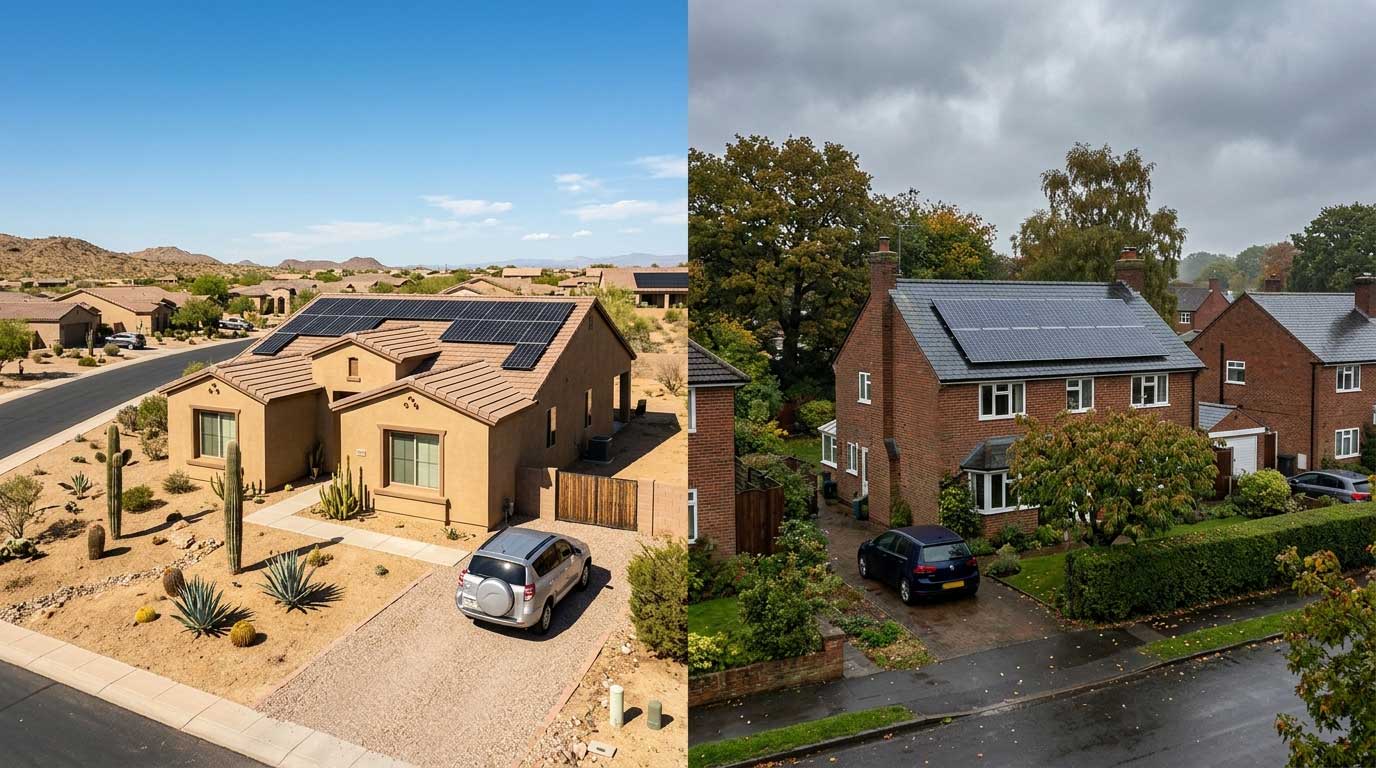
| Arizona | 6–7 hours |
| Texas | 5–6 hours |
| Florida | 5–6 hours |
| Germany | 2.8–4 hours |
| United Kingdom | 2–4 hours |
That difference alone can almost double annual electricity production.
The Global Solar Atlas, developed by the World Bank Group and ESMAP, provides verified solar irradiation data used by engineers worldwide.
Reference:
2. Panel Orientation and Tilt
A panel installed flat on an RV roof is convenient.
A panel tilted toward the winter sun is efficient.
Both statements are true.
We’ve tested identical flexible panels mounted in two different positions during customer demonstrations. Simply adjusting the tilt angle improved daily production by around 15–25% during colder months. That’s significant when charging lithium batteries before sunset.
The exact improvement depends on latitude and season, but orientation remains one of the least expensive ways to increase system output without purchasing additional panels.
3. Temperature Reduces Output
Here’s something that surprises many new solar users.
Solar panels prefer sunlight—not excessive heat.
Most crystalline silicon panels have a temperature coefficient around −0.3% to −0.5% per °C above the standard testing temperature of 25°C.
In practical terms, a rooftop panel operating at 60°C can produce noticeably less electricity than the same panel on a cool spring afternoon, despite stronger sunshine.
Manufacturers rarely advertise this because rated wattage sounds more impressive than discussing thermal losses. Yet anyone who has monitored system data over multiple seasons quickly notices the pattern.
At Bright Solar, we’ve found that flexible panel installation methods that allow airflow beneath the module often maintain more stable operating temperatures compared with fully bonded installations, particularly on marine decks and camper roofs.
Does a 400W Solar Panel Produce Enough Electricity?
Among all the questions we receive at Bright Solar, this one probably appears most often.
Not because 400W is a magic number—it isn’t—but because it sits in a practical middle ground. It’s large enough for many off-grid applications, yet still manageable for RV roofs, boats, utility trailers, and compact cabins.
After supporting OEM customers building camper vans and marine power systems, I’ve noticed that expectations tend to fall into two extremes. Some buyers expect a single 400W panel to power an entire house. Others underestimate it and assume it can barely charge a battery.
Reality sits comfortably in between.
Under favorable conditions, a 400W solar panel typically generates between 1.6 and 2.2 kWh of electricity per day, with annual production often ranging from 580 to 800 kWh, depending on local solar resources and installation quality.
For perspective, here’s what that amount of energy can support in a typical day.
| Appliance | Approximate Daily Consumption | Can One 400W Panel Support It? |
|---|---|---|
| LED lighting (10 bulbs) | 0.3–0.5 kWh | ✔ Easily |
| Laptop computer | 0.3–0.6 kWh | ✔ Easily |
| Wi-Fi router | 0.15–0.25 kWh | ✔ Easily |
| Portable refrigerator | 0.8–1.2 kWh | ✔ Usually |
| CPAP machine | 0.3–0.8 kWh | ✔ Yes |
| Television | 0.4–0.8 kWh | ✔ Yes |
| Electric kettle | 1.2–2.0 kWh (brief use) | ▲ Limited |
| Air conditioner | 3–8+ kWh | ✖ Requires multiple panels |
The important takeaway isn’t that one panel powers specific appliances. It’s that daily energy budgeting matters more than instantaneous power.

Why Two Identical Solar Panels Can Produce Different Electricity
One field visit still stands out in my memory.
Two neighboring RV owners had purchased nearly identical 400W flexible solar panels. They parked side by side at a lakeside campsite and compared battery readings that evening.
One owner had generated almost 18% more electricity.
Neither panel was defective.
The difference came from several small details that, together, created a noticeable gap.
Partial Shading
Even a narrow shadow from an antenna, roof vent, or tree branch can reduce output disproportionately.
Modern bypass diodes help, but they cannot completely eliminate losses caused by shading.
According to the National Renewable Energy Laboratory (NREL), avoiding shading remains one of the most effective ways to maximize photovoltaic energy production.
Reference:
Dust and Surface Contamination
A layer of pollen, road dust, bird droppings, or salt residue doesn’t always look dramatic.
Electrically, however, it matters.
The International Energy Agency (IEA) reports that soiling losses vary widely depending on climate and maintenance practices, with measurable reductions in annual energy yield if panels are left uncleaned for long periods.
Reference:
For marine installations, salt deposits deserve particular attention. During one customer visit along the Mediterranean coast, we recorded noticeably improved charging current after a routine freshwater rinse. It took less than ten minutes.
Cable Losses and System Design
Panel output is only part of the equation.
Poorly sized cables, undersized charge controllers, loose MC4 connectors, and inefficient inverters all consume energy before it reaches usable loads.
In professionally designed systems, total electrical losses are often kept below 10%, while poorly assembled systems may lose significantly more.
How to Estimate How Much Electric Your Solar Panel Will Generate
Rather than relying on marketing claims, I recommend using a straightforward calculation.
Estimated Daily Electricity (kWh) = Panel Wattage × Peak Sun Hours × System Efficiency ÷ 1000
Example:
- Panel size: 400W
- Peak sun hours: 5
- Overall efficiency: 85%
Calculation:
400 × 5 × 0.85 ÷ 1000 = 1.7 kWh/day
It’s simple enough to perform with a calculator, yet accurate enough for most residential, RV, and marine planning.
If greater precision is required, engineers frequently rely on PVWatts, developed by the National Renewable Energy Laboratory, because it incorporates local weather data, tilt angle, and historical solar resources.
Reference:

Professional Insight from Bright Solar
At Bright Solar, we design and manufacture flexible solar panels for OEM manufacturers, distributors, RV builders, marine integrators, and off-grid energy projects across multiple international markets.
After reviewing installation feedback from customers operating in North America, Europe, Australia, and Southeast Asia, one lesson consistently emerges:
The highest-performing systems are not always those with the highest-rated panels.
Instead, they combine:
- Correct panel sizing
- High-quality MPPT charge controllers
- Appropriate battery capacity
- Proper ventilation
- Minimal shading
- Regular cleaning
- Professional cable management
Those improvements often increase annual energy production more than simply adding another panel.
That observation doesn’t come from laboratory testing—it comes from watching real systems operate through changing seasons.
Visit product page: Flexible Solar Panel
FAQ About How Much Electric Does a Solar Panel Generate?
How much electric does a solar panel generate per day?
Most residential solar panels generate 1.2–2.5 kWh of electricity daily, depending on panel size, local sunshine, temperature, orientation, and system efficiency.
How much electricity does a 400 watt solar panel generate?
A modern 400W solar panel generally produces 1.6–2.2 kWh per day, or roughly 580–800 kWh annually under favorable conditions.
Can one solar panel power an entire house?
No. A single panel cannot meet the electricity demand of a typical home. Residential systems usually consist of multiple interconnected panels sized according to household energy consumption.
Does cloudy weather stop solar panels from generating electricity?
No. Solar panels continue producing electricity on cloudy days, although output may fall substantially depending on cloud density and weather conditions.
Why is my solar panel producing less electricity than expected?
Common reasons include shading, dust, high temperatures, seasonal sunlight changes, cable losses, inverter efficiency, incorrect installation angle, or battery charging limitations.
How Much Energy Can a Solar Panel Generate?
A solar panel can typically generate between 0.8 and 2.5 kWh of electricity per day depending on its wattage, sunlight hours, temperature, installation angle, and geographic location. A 400W solar panel often produces 1.6–2.2 kWh daily under good conditions.Learn more about “How Much Energy Can a Solar Panel Generate“
How Many kWh Does a Solar Panel Produce?
A modern residential solar panel typically produces between 1 and 2.5 kWh of electricity per day, or roughly 300–900 kWh per year, depending on its wattage, local sunlight, orientation, temperature, and system efficiency. Most homeowners see actual production fall within this range under normal operating conditions.Learn more about “How Many kWh Does a Solar Panel Produce“
How Much Energy Does a Solar Panel Produce?
A typical residential solar panel produces approximately 1–2.5 kWh of electricity per day, or 300–900 kWh per year, depending on panel wattage, available sunlight, roof orientation, temperature, and overall system efficiency. Actual energy production varies by location and installation quality rather than panel rating alone.Learn more about “How Much Energy Does a Solar Panel Produce“
How Many Kilowatts Can a Solar Panel Produce?
A residential solar panel typically delivers 0.35–0.55 kilowatts (kW) of peak power, depending on its rated capacity. Under normal operating conditions, that translates into roughly 1–3 kilowatt-hours (kWh) of electricity per day, with actual output varying according to sunlight, location, temperature, and installation quality.Learn more about “How Many Kilowatts Can a Solar Panel Produce“
Final Thought
If someone asks, “how much electric does a solar panel generate?”, the most accurate answer is this: the panel’s wattage is only the starting point. Sunlight availability, installation quality, operating temperature, shading, and overall system design ultimately determine how much usable electricity reaches your batteries or appliances. In our experience at Bright Solar, well-designed systems consistently outperform larger but poorly installed ones, making thoughtful engineering just as important as choosing the right solar panel.
The prev: How Do Solar Panels Work?The next: How Many kWh Does a Solar Panel Produce?
Related recommendations
-

how big are solar pv panels?
136how big are solar pv panels? Learn standard solar panel dimensions, sizes, weights, and how to choose the right PV panel size for homes, RVs, and off-grid systems.
View details -
How Much Energy Will a Solar Panel Produce?
200How much energy will a solar panel produce? Learn how panel wattage, sunlight hours, location, and efficiency affect daily and annual solar energy output with Bright Solar.
View details -
How to Attach Solar Panel Semi Flexible?
150How to attach solar panel semi flexible systems securely? Learn proven installation methods, adhesive options, mounting mistakes to avoid, and expert RV and marine tips.
View details -
are portable solar panels any good?
186Are portable solar panels any good for camping, RVs, and backup power? Discover real-world performance, charging speed, and expert insights from Bright Solar.
View details