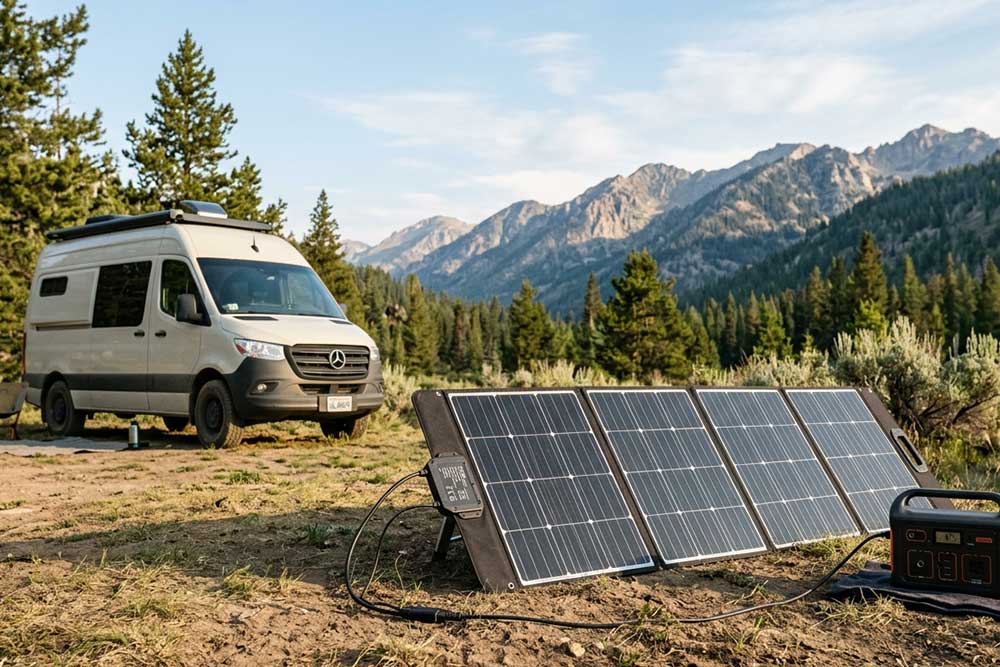
Foldable Solar Panel 100W: Output, Uses and Buying Guide
A foldable solar panel 100W provides portable solar power for camping, RV travel, outdoor electronics, and compatible power stations. Its actual daily energy depends on sunlight, panel positioning, temperature, and charging losses, so check your power needs and device compatibility before buying.
A 100W folding panel sits in a useful middle ground: more capable than many small USB solar chargers, yet easier to transport and reposition than a permanently mounted Rigid Solar Panels. For campers, van owners, and people who need temporary off-grid electricity, that combination can be more valuable than simply choosing the largest panel available.
The important distinction is between rated power and usable energy. A panel marked 100W is rated under specified test conditions; it does not continuously deliver 100W from sunrise to sunset. The U.S. Department of Energy explains that photovoltaic performance changes with solar irradiance, operating temperature, and other conditions.
For Bright Solar customers and outdoor equipment buyers, the practical question is straightforward: will a 100W foldable panel collect enough energy for the devices you intend to run, and can it connect safely to your charging system?
What Is a Foldable Solar Panel 100W?
A foldable solar panel 100W is a portable photovoltaic module or assembly rated for 100 watts of power under its specified test conditions. It typically consists of multiple panel sections that fold together for transport and open into a larger surface for generating electricity.
Unlike a rigid solar module designed for a permanent rack, a folding model is intended to be moved and deployed as needed. Depending on the product, it may include a carrying handle, adjustable kickstands, USB outputs, DC connectors, or cables for compatible portable power stations. These features vary by model and should not be assumed without checking the datasheet.
Typical applications include:
- Charging compatible portable power stations.
- Supporting phones, cameras, GPS devices, and other small electronics.
- Providing supplementary electricity for RVs, campervans, and road trips.
- Powering selected low-consumption equipment through a suitable battery and controller.
- Supplying portable power at temporary off-grid locations.
A 100W panel is not automatically suitable for every battery or appliance. Its output voltage, current, connector, and charging arrangement must match the receiving equipment.
Foldable vs. Rigid 100W Solar Panels
| Feature | Foldable 100W panel | Rigid 100W panel |
|---|---|---|
| Portability | Designed for folding and transport | Usually less convenient to carry |
| Installation | Often uses portable supports | Commonly needs a mounting structure |
| Positioning | Can be moved to follow sunlight | Depends on the fixed installation |
| Storage | Sections fold into a compact package | Requires space for the full module |
| Typical application | Camping, travel, temporary off-grid use | RV mounting, cabins, fixed systems |
| Main consideration | Folding mechanism, packed weight, and stability | Mounting, structural support, and installation |
The choice depends on how the panel will be used. For a camper who moves between campsites, portability and quick setup may matter most. For a permanent installation, a rigid module may be more convenient over the long term.
How Much Power Does a 100W Foldable Solar Panel Produce?
A 100W panel can theoretically produce 100 watt-hours (Wh) in one hour if it sustains its full rated output for that hour. In outdoor use, output fluctuates, so daily energy is better estimated using equivalent peak-sun hours and an allowance for system losses.
Use this planning formula:
Daily energy (Wh) = Panel rating (W) × Peak-sun hours × Estimated system factor
Peak-sun hours represent the day’s solar energy expressed as an equivalent number of hours at a reference irradiance of 1,000 watts per square metre. They are not the same as total daylight hours.
For a simple illustration, assume a 100W panel receives four peak-sun hours and has an estimated system factor of 0.75:
100W × 4 hours × 0.75 = 300Wh per day
The 0.75 factor is an illustrative planning assumption, not a measured Bright Solar product result or a universal industry value. Real output may differ because of shading, temperature, orientation, wiring, and the efficiency of the connected charging equipment.
| Equivalent peak-sun hours | Theoretical daily energy | Illustrative energy after a 25% allowance for losses |
|---|---|---|
| 2 hours | 200Wh | 150Wh |
| 3 hours | 300Wh | 225Wh |
| 4 hours | 400Wh | 300Wh |
| 5 hours | 500Wh | 375Wh |
| 6 hours | 600Wh | 450Wh |
These figures are mathematical examples, not location-specific forecasts. A cloudy day, a shaded campsite, or a poorly oriented panel can produce less energy. Favorable conditions can produce different results, and a connected power station may impose additional input limits.
For location-based solar estimates, the National Renewable Energy Laboratory’s PVWatts Calculator uses weather and system information to estimate photovoltaic production. Its standard model focuses on grid-connected systems, so it is a reference for understanding solar resource variability rather than a direct performance guarantee for a portable 100W panel.
What Can 300Wh Run During a Camping Trip?
Consider a hypothetical camper collecting approximately 300Wh of usable energy in one day. That energy could support a mix of small electronics, depending on their actual consumption and the charging losses involved.
| Device or load | Illustrative energy requirement | What it means for a 300Wh energy budget |
|---|---|---|
| Smartphone recharge | 10–20Wh | Several charges may be possible |
| Headlamp recharge | 3–10Wh | A relatively small share of the budget |
| Camera battery recharge | 10–25Wh | Useful for photography trips |
| Tablet recharge | 20–40Wh | A moderate portion of the budget |
| Small 12V camping refrigerator | Varies widely | Measure the actual daily consumption before sizing the system |
These ranges are illustrative estimates, not specifications for every device. Battery capacity, starting charge, usage, conversion efficiency, and standby consumption all affect the energy needed for a recharge.
The refrigerator is the load that deserves the closest attention. Its compressor may cycle on and off, and daily consumption changes with ambient temperature, ventilation, thermostat settings, insulation, and how often the lid or door is opened. A 100W panel may contribute useful energy without necessarily covering the refrigerator’s full daily demand.
A practical rule: size the system around daily watt-hours rather than the number of devices alone. Three low-energy electronics can require less power than one appliance that operates for many hours.
Where Can You Use a 100W Foldable Solar Panel?
Camping and Outdoor Recreation
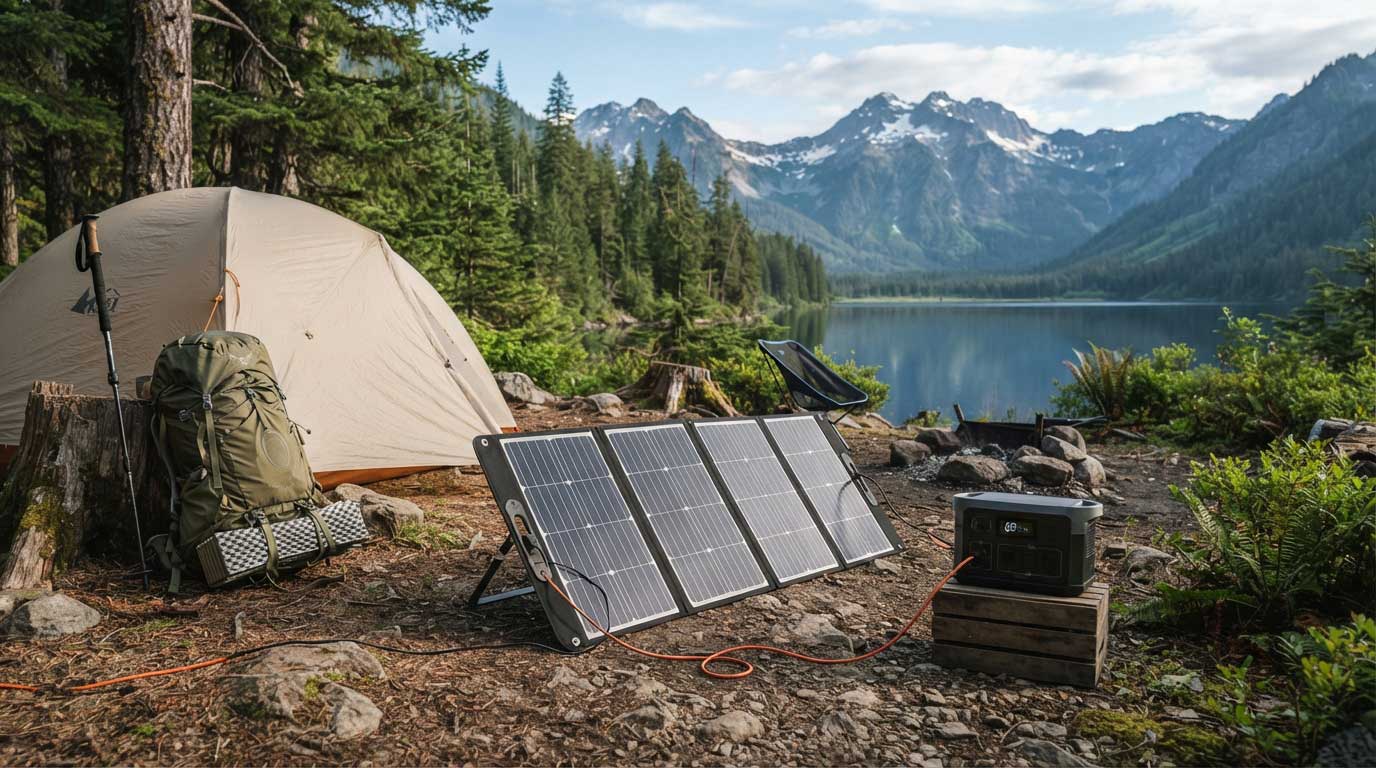
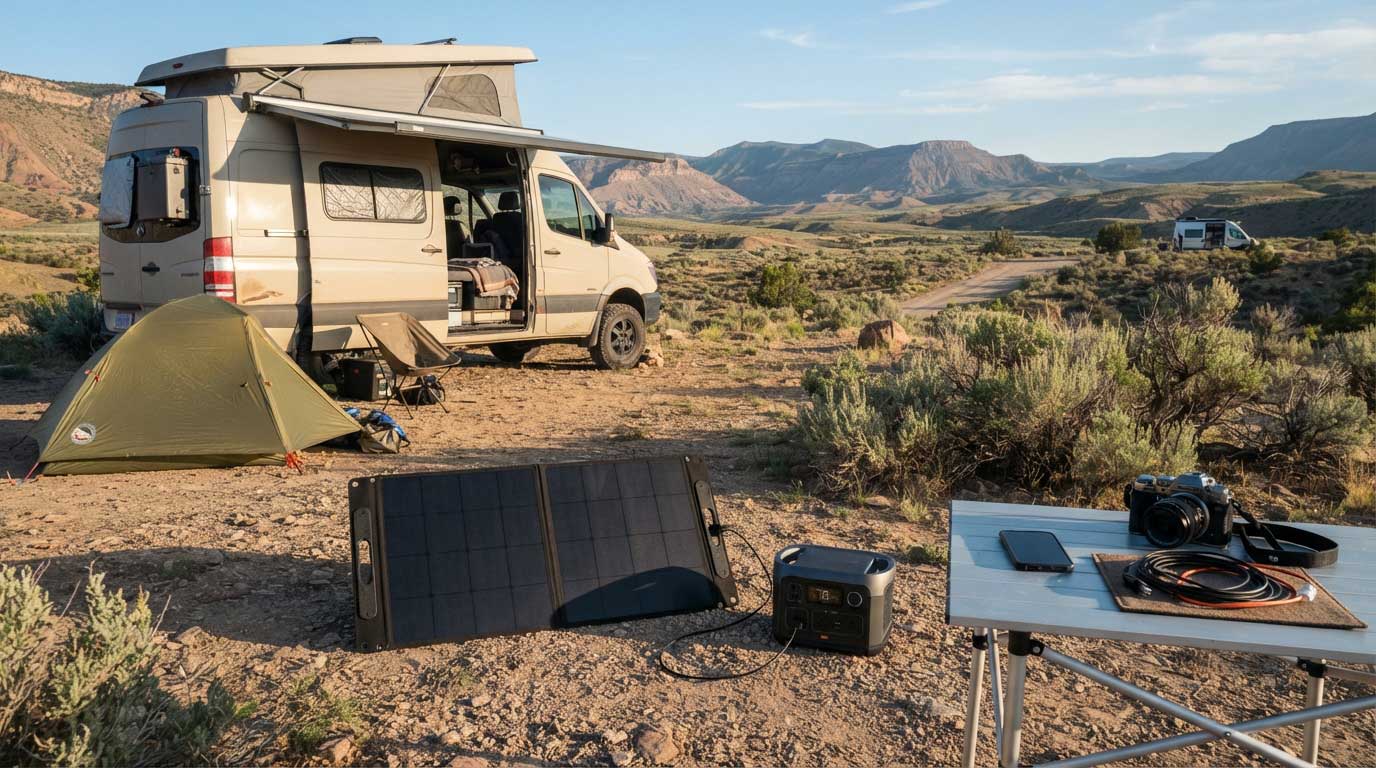
For a weekend campsite, a portable 100W panel can provide supplementary energy for phones, cameras, headlamps, and a compatible power station. The panel can be placed in a sunny area while the tent remains under partial shade, provided the cable reaches safely and the campsite rules permit the arrangement.
A folding design also makes it easier to move the panel when a shadow crosses the campsite. That flexibility is especially useful when the available sunny ground is limited.
RVs and Campervans
A foldable panel can supplement an RV’s existing electrical system without requiring a permanent roof installation. It may be useful when the vehicle is parked, particularly if the roof is shaded or already occupied by other equipment.
However, a portable 100W panel should not be treated as a complete RV energy system by default. Check the battery chemistry, charge-controller requirements, charging voltage, and battery manufacturer’s instructions before connecting it to a house battery.
Remote Work and Outdoor Photography
Photographers, field researchers, and people working remotely sometimes need to recharge cameras, phones, tablets, or other small equipment away from a mains outlet.
A 100W panel may help replenish a power station during daylight, which can then supply compatible equipment when sunlight fades. For laptop use, check the laptop’s power requirements and the power station’s AC or USB-C output specifications. Panel wattage alone does not confirm that a device can be powered directly.
How to Choose a 100W Foldable Solar Panel
A useful specification sheet should answer more than one question: how much power does the panel produce, how easy is it to carry, and what equipment can accept its output?
1. Check Rated Power and Electrical Specifications
Start with the manufacturer’s datasheet. Confirm the rated maximum power (Pmax), voltage at maximum power (Vmp), current at maximum power (Imp), open-circuit voltage (Voc), and short-circuit current (Isc), where applicable.
These values describe different electrical characteristics. Vmp and Imp relate to operation at the maximum power point, while Voc and Isc describe the panel under specific open-circuit and short-circuit conditions. They are not interchangeable.
For a 100W panel, the product’s nominal rating alone does not establish the voltage or current it will deliver. Compare the actual specifications with the input limits of your power station or charge controller.
2. Compare Weight and Folded Dimensions
A folding panel still needs to be carried, stored, and secured. Look for its actual packed dimensions and weight rather than relying on the word portable.
If you travel by car, a slightly larger package may be acceptable. If you carry equipment over uneven ground, the same product may feel cumbersome after a long walk.
Check whether the package includes a carrying case, support legs, cables, and adapters. Accessories add weight, but leaving an essential cable behind can make the panel unusable with your intended setup.
3. Understand the Output Connections
Different foldable panels use different output arrangements. Some provide regulated USB outputs; others provide DC connectors intended for a controller or power station. Some products offer both.
Before buying, confirm:
- The supported output voltage and current.
- The connector type and electrical polarity.
- The receiving device’s permitted solar-input range.
- Whether an external controller or adapter is required.
- Whether the panel’s maximum power exceeds the receiving device’s accepted input.
Never assume that two devices are compatible simply because their plugs fit together. Follow both manufacturers’ electrical and connection instructions.
4. Evaluate Construction for Outdoor Use
Inspect the surface material, hinges, seams, cable exits, and support structure. A product designed for occasional car camping may have different handling requirements from one intended for frequent transport or marine use.
Check the published water-resistance rating, if any, and whether it applies to the whole assembly or only a particular component. Keep connectors and power electronics protected according to the manufacturer’s guidance.
The U.S. Department of Energy notes that temperature, solar resource, and other environmental conditions affect photovoltaic performance. It also explains that higher cell temperatures can reduce voltage. A dark panel left in intense sunlight may become considerably hotter than the surrounding air, so do not assume that hot weather automatically means maximum electrical output.
How to Set Up a Foldable Solar Panel 100W
A repeatable setup routine makes it easier to identify problems and avoid unnecessary cable handling.
Step 1 — Choose an Unshaded Location
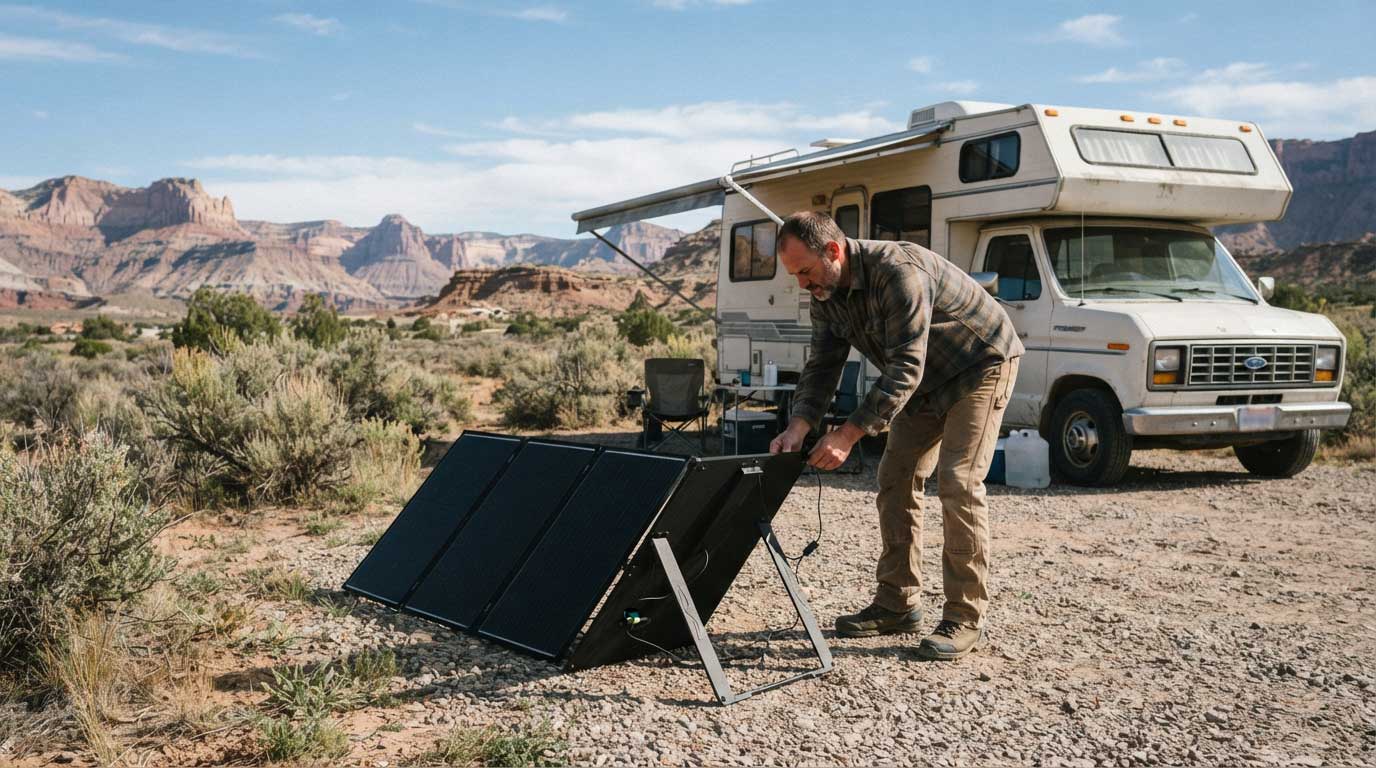
Look for a stable surface that receives direct sunlight during the hours you expect to charge. Check nearby trees, the vehicle, tent fabric, and other objects that could cast shadows across the cells.
Step 2 — Open and Secure the Panel
Unfold the panel according to the instructions. Set the support legs on firm ground and make sure the panel cannot easily tip over in a breeze. Do not force hinges or bend sections beyond their designed movement.
Step 3 — Verify Compatibility Before Connecting
Read the panel and power station specifications. Check voltage, current, polarity, connector requirements, and maximum accepted solar power. Use only the approved cable or adapter and follow the recommended connection sequence.
If you are charging a battery through a separate controller, confirm that the controller is suitable for the battery chemistry and voltage.
Step 4 — Check the Actual Charging Input
If your power station has a display, check its solar input after connecting the panel. A reading below 100W is not necessarily a fault: sunlight, cell temperature, battery charge level, and controller limits can all affect the observed input.
Move the panel out of shade when practical. If the input remains unexpectedly low under stable sunlight, inspect the connections and consult the manufacturer’s troubleshooting guidance.
Step 5 — Disconnect and Store Carefully
Follow the specified shutdown and disconnection procedure. Clean the panel using an approved method, allow it to dry when required, and store the cables without sharp bends or excessive tension.
A Practical Example: Is 100W Enough for a Weekend Trip?
Imagine a couple taking a two-night camping trip. They bring two smartphones, a camera, two headlamps, and a small power station. Before leaving, they estimate their daily electricity needs.
The following figures are illustrative planning values, not measurements from a Bright Solar field test.
| Equipment | Assumed daily energy use |
|---|---|
| Two smartphones | 24Wh |
| Camera battery | 20Wh |
| Two headlamps | 10Wh |
| Other small USB devices | 10Wh |
| Estimated daily total | 64Wh |
If the panel delivers 225Wh of usable energy in a particular day, that would exceed the example’s 64Wh daily load before accounting for any additional losses between the battery and devices. The unused energy could help replenish the power station, subject to its charging limits and battery capacity.
But if the couple adds a refrigerator, laptop, or other substantial load, they must recalculate the daily total. They should also consider what happens when the weather turns cloudy for a day.
This is where a simple energy budget becomes more useful than a product headline. A 100W panel may be adequate for one traveler’s electronics and insufficient for another camper’s complete electrical setup. The answer depends on measured loads, local solar conditions, and the equipment in the system.
FAQ About Foldable Solar Panel 100W
How much power does a foldable solar panel 100W produce per day?
A 100W panel can theoretically produce 300Wh over three equivalent peak-sun hours or 500Wh over five hours. Actual usable energy depends on sunlight, temperature, shading, and charging-system losses.
Can a 100W foldable solar panel charge a power station?
Yes, if the panel’s voltage, current, connector, and output power are compatible with the power station’s solar input. Check the manufacturer’s specifications before connecting the equipment.
Is a 100W folding solar panel enough for camping?
It can support phones, cameras, headlamps, and other modest electrical loads when sunlight is sufficient. Larger appliances may require more generation capacity or a separate power source.
Does a 100W foldable solar panel work on cloudy days?
Yes. Photovoltaic cells can generate electricity from diffuse daylight, but output generally falls when sunlight is reduced by thick cloud cover. Keep additional battery capacity available for periods of poor weather.
Can I connect a 100W foldable solar panel directly to a 12V battery?
Not automatically. Confirm the panel’s electrical characteristics and use a compatible solar charge controller designed for the battery’s chemistry and voltage. Direct connection without suitable charging regulation can damage equipment or create a safety hazard.
Is a foldable 100W panel suitable for RV use?
Yes, it can provide supplementary power for an RV when connected through a compatible charging system. Confirm battery requirements, controller limits, cable specifications, and whether the panel can be secured safely at the campsite.
How do I maintain a foldable solar panel?
Keep the surface clean, inspect hinges and cables, avoid excessive bending, and store the panel according to its manufacturer’s instructions. Check the specified moisture and temperature limits before using it outdoors.
Choose a 100W Foldable Solar Panel for Your Application
A foldable solar panel 100W can be a practical option for camping, RV travel, portable power stations, and selected off-grid applications. Its real value comes from matching the panel’s electrical specifications and daily energy production to the equipment you actually need to power.
Before purchasing, compare rated output, folded dimensions, weight, connector compatibility, and outdoor-use requirements. Estimate daily consumption in watt-hours, allow for changing weather, and verify the complete charging system rather than relying on the panel’s wattage alone.
Bright Solar provides solar panel solutions for different application requirements. For OEM, ODM, or bulk procurement, buyers should confirm the selected model’s datasheet, construction, connector options, and customization requirements with the manufacturer before finalizing a specification.
Author and technical review
Prepared for Bright Solar by its solar product content team. This guide uses established photovoltaic principles and publicly available U.S. Department of Energy and National Renewable Energy Laboratory resources. The energy calculations and camping scenario are illustrative examples, not claims of independently measured product performance. Confirm product-specific specifications against the applicable manufacturer’s datasheet.
Authoritative References
- U.S. Department of Energy — Solar Photovoltaic Performance and Efficiency Basics
- U.S. Department of Energy — Optimizing Solar Photovoltaic Performance for Longevity
- National Renewable Energy Laboratory — PVWatts Calculator
- National Renewable Energy Laboratory — PVWatts V8 Technical Documentation
Related recommendations
-

Foldable Portable Solar Panel: How to Choose and Use One
34Foldable portable solar panels provide mobile electricity for camping, RV travel, outdoor electronics, and off-grid applications. Their actual output depends...
View details -
Series vs Parallel Solar Panels: Which Wiring Method Performs Better?
146Compare series vs parallel solar panels for RVs, homes, and off-grid systems. Bright Solar explains voltage, current, shading, and wiring efficiency.
View details -
100 Watt Semi Flexible Solar Panel: Output, Uses and Installation Guide
252A 100 watt semi flexible solar panel is designed for compact systems such as RVs, vans, boats, and cabins where low weight, slim profile, and limited curvatu...
View details -
Flexible solar panel for car: Lightweight Solar Energy Solution for Modern Vehicles
283Discover flexible solar panel for car solutions from Bright Solar. Learn how lightweight solar panels improve vehicle energy efficiency for EVs, RVs, and off-grid automotive applications.
View details