Camper Flexible Solar Panels: Lightweight Solar Power Solution for RV Travel
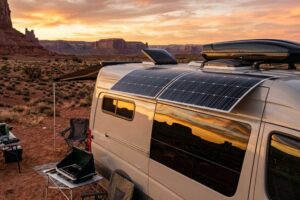
Camper flexible solar panels provide lightweight and space-efficient solar power solutions for campers, RVs, and mobile applications. They are designed for installations where roof weight, limited space, and curved surfaces make traditional rigid panels difficult to use.
For many camper owners, solar installation starts with a simple question: how can more power be added without making the vehicle heavier or sacrificing valuable roof space?
At Bright Solar, we have worked with different mobile solar applications where installation conditions are very different from standard residential rooftops. A camper roof is not a blank surface. It may include air conditioners, vents, storage racks, skylights, and curved sections that affect panel placement.
The challenge is not only producing electricity.
The challenge is creating a system that remains practical after months of travel.
A flexible solar panel designed for campers needs to balance:
- Lightweight construction
- Reliable power output
- Weather resistance
- Installation flexibility
- Long-term outdoor durability
For weekend campers, van-life travelers, and off-grid explorers, flexible solar technology provides another way to build a cleaner and quieter energy system.
What Are Camper Flexible Solar Panels?
Camper flexible solar panels are photovoltaic modules designed with lightweight materials that allow easier installation on mobile structures.
Unlike traditional framed glass solar panels, flexible models typically use thinner construction methods.
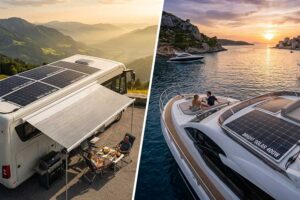
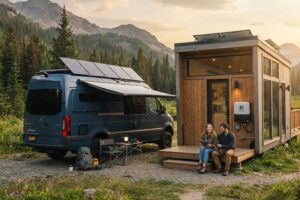
They are commonly used on:
- Camper trailers
- RV roofs
- Conversion vans
- Boats
- Tiny homes
- Portable off-grid systems
The main difference is the physical design.
A traditional rigid solar panel usually includes:
- Glass surface
- Aluminum frame
- Fixed mounting structure
A flexible solar panel generally uses:
- Lightweight polymer materials
- Thin solar cells
- Flexible protective layers
This design helps reduce overall system weight.
For mobile applications, weight matters.
A camper already carries:
- Water tanks
- Batteries
- Camping equipment
- Kitchen supplies
- Outdoor gear
Every additional kilogram affects transportation efficiency and vehicle loading.
Why Choose Flexible Solar Panels for Camper Applications?
The popularity of flexible solar panels among campers comes from practical installation advantages.
1. Lower Weight for Mobile Vehicles
Weight is one of the biggest concerns for camper owners.
A rigid solar panel with aluminum framing and glass construction can add significant load to a camper roof.
Flexible panels are usually lighter, making them attractive for:
- Small travel trailers
- Camper vans
- Lightweight RVs
A lighter solar system can help maintain better vehicle efficiency and simplify installation.
2. Easier Installation on Limited Roof Space
Camper roofs often have irregular layouts.
A typical camper roof may include:
- Roof vents
- Air conditioning units
- Antennas
- Storage systems
- Curved surfaces
Flexible panels can provide more installation options because they have a lower profile and can adapt to certain surfaces.
However, flexibility does not mean unlimited bending.
Every flexible solar panel has a specified maximum bending radius.
Exceeding that limit may damage internal solar connections.
3. Cleaner Appearance
Many camper owners prefer solar systems that maintain the original vehicle appearance.
Flexible panels create a lower-profile installation compared with traditional mounting brackets.
This is especially valuable for:
- Stealth camper conversions
- Compact vans
- Modern RV designs
The result is a more integrated look.
How Much Power Do Camper Flexible Solar Panels Produce?
Solar production depends on:
- Panel wattage
- Sun exposure
- Location
- Temperature
- Shading
- Installation angle
The rated wattage of a solar panel represents laboratory testing conditions, not guaranteed daily output.
The U.S. Department of Energy explains that photovoltaic performance changes according to sunlight availability, system design, orientation, and environmental conditions.
Source:
https://www.energy.gov/
For example:
A camper using:
- 200W flexible solar panels
- 4 peak sunlight hours
- 80% system efficiency
Estimated daily production:
200W × 4 hours × 0.8
≈ 640Wh/day
Actual results vary depending on travel location.
A camper parked in Arizona desert conditions will usually produce different results compared with a vehicle camping under trees in Oregon.
Choosing the Right Camper Flexible Solar Panels
Selecting solar panels for a camper requires more than choosing the highest wattage.
A practical evaluation should include:
| Factor | Why It Matters |
|---|---|
| Panel wattage | Determines energy generation |
| Weight | Affects vehicle load |
| Dimensions | Determines roof layout |
| Voltage | Must match controller and battery system |
| Durability | Important for outdoor exposure |
| Bending radius | Prevents installation damage |
| Temperature range | Affects long-term reliability |
Understanding Camper Energy Requirements
Before purchasing flexible solar panels, calculate daily electricity usage.
Example camper loads:
| Device | Power Consumption | Daily Use |
|---|---|---|
| LED lighting | 10–20W | Several hours |
| Phone charging | 5–15W | Daily |
| Laptop | 40–80W | Several hours |
| Refrigerator control system | Depends on model | Continuous |
| Internet equipment | 20–60W | Several hours |
A camper who only needs basic charging may require a smaller system.
A full-time traveler running:
- Laptop workstation
- Refrigerator
- Camera equipment
- Communication devices
will need a larger solar and battery setup.
The panel size should follow actual energy needs.
Camper Flexible Solar Panels Installation Considerations
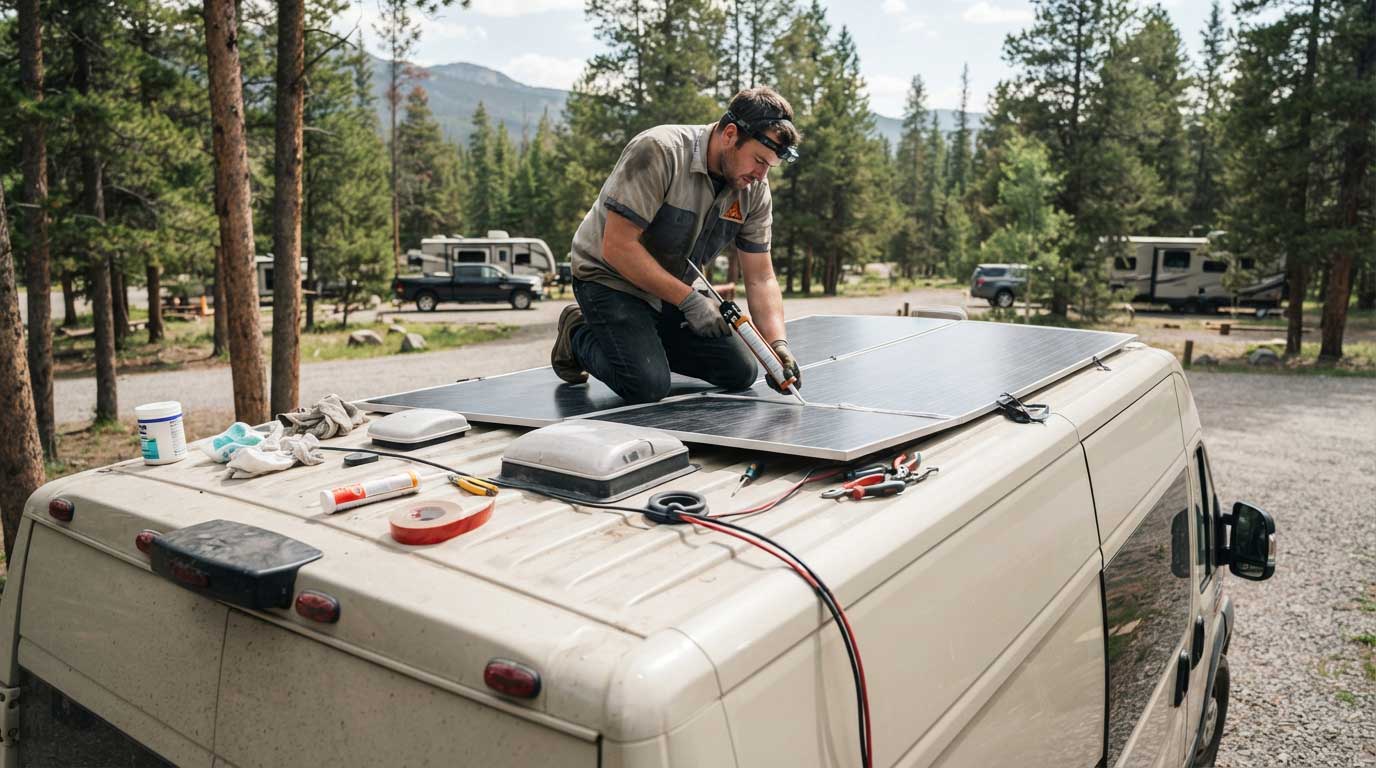
Installing flexible solar panels on a camper requires careful planning.
The most important steps include:
- Checking roof condition
- Measuring available installation space
- Planning cable routes
- Selecting the correct adhesive or mounting method
- Connecting the charge controller correctly
Step 1: Inspect the Camper Roof
Before installation, check:
- Roof material
- Existing sealant condition
- Flat and curved areas
- Possible shading sources
A solar panel installed over a damaged roof surface may create future maintenance problems.
The solar system should support the camper lifestyle, not create additional repairs.
Step 2: Plan Panel Placement
Do not install panels immediately after opening the package.
A better approach:
- Place temporary templates on the roof
- Check sunlight exposure
- Measure cable distance
- Confirm maintenance access
Small layout changes can improve long-term performance.
For example, moving a panel several inches away from an air conditioner may reduce shading during afternoon hours.
Step 3: Connect the Electrical System
A typical camper solar system includes:
Solar panels → Charge controller → Battery → Inverter → Appliances
Important electrical checks include:
- Panel voltage compatibility
- Controller capacity
- Battery charging requirements
- Wire sizing
A high-quality installation considers the complete system rather than only the solar module.
Real Camper Solar Installation Example
A practical example involved a compact camper owner who wanted more independence during extended road trips.
The original setup included:
- Small battery bank
- Portable charging equipment
- Limited off-grid capability
The main challenge was roof space.
The camper roof already contained:
- Ventilation equipment
- Roof storage area
- Curved surface sections
A rigid panel system would have required additional mounting hardware and increased roof load.
The final design used lightweight flexible solar panels positioned around existing roof equipment.
The owner gained:
- More consistent battery charging
- Reduced generator dependence
- Cleaner roof appearance
The important lesson was not simply adding more solar capacity.
It was matching the technology with the vehicle.
Camper Flexible Solar Panels vs Rigid Solar Panels
Both flexible and rigid solar panels have advantages.
| Feature | Flexible Solar Panels | Rigid Solar Panels |
|---|---|---|
| Weight | Lower | Higher |
| Installation profile | Low profile | Raised mounting |
| Roof adaptation | Better for some curved surfaces | Best for flat surfaces |
| Durability | Depends on construction | Strong mechanical protection |
| Maintenance | Application dependent | Easier replacement |
The right choice depends on the camper design.
Flexible panels are often selected when:
- Weight reduction matters
- Roof space is limited
- Appearance is important
Rigid panels may be preferred when:
- Maximum durability is required
- Roof structure supports heavier equipment
- Long-term fixed installation is the priority
How to Install Camper Flexible Solar Panels Correctly
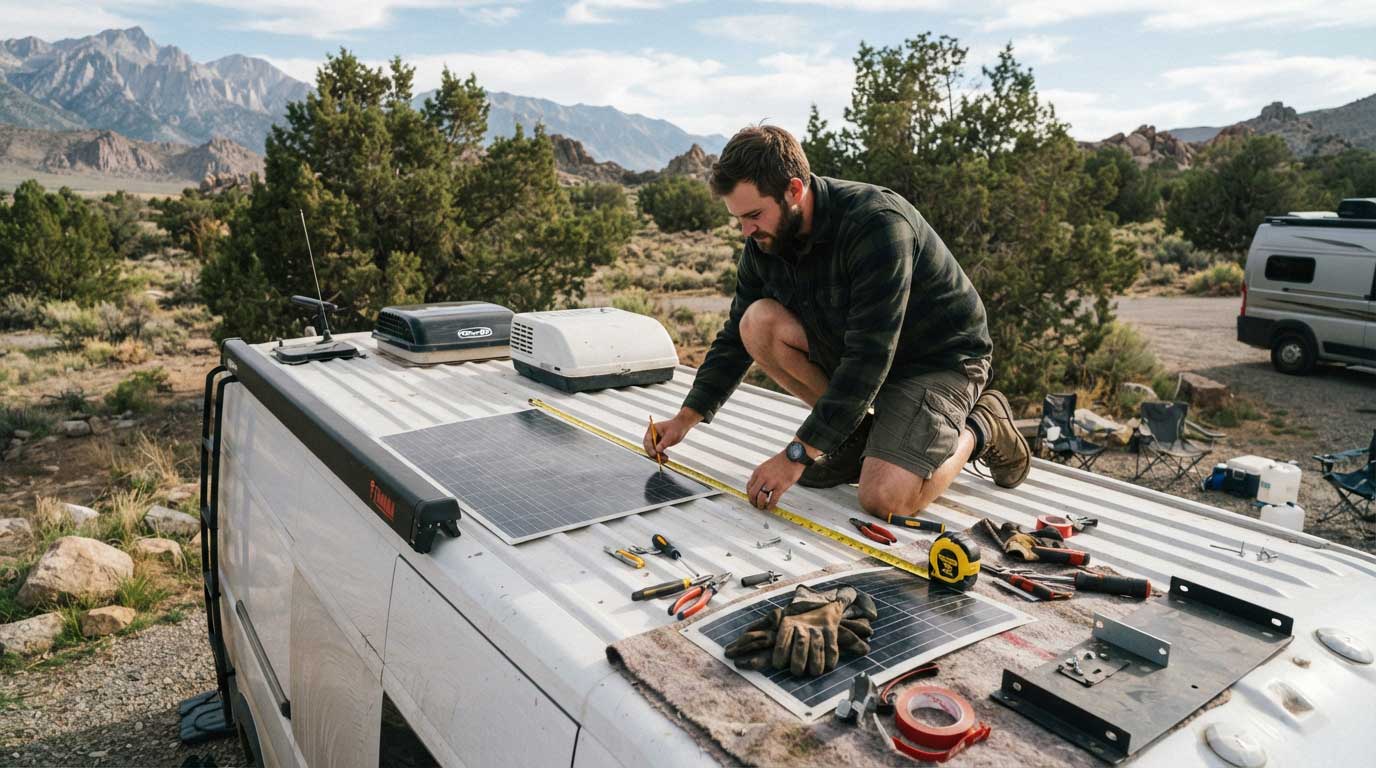
Installing camper flexible solar panels requires attention to both mechanical and electrical details. The lightweight design makes installation easier in many situations, but correct preparation determines long-term reliability.
A common mistake is treating flexible solar panels like simple accessories that can be attached anywhere on a camper roof.
They are still photovoltaic modules that require:
- Proper surface preparation
- Correct electrical connection
- Suitable mounting methods
- Weather protection
- Temperature consideration
A professional installation usually follows these steps:
- Confirm the camper roof condition
- Measure the final panel position
- Prepare the mounting surface
- Install the panel securely
- Route cables safely
- Connect the controller and battery system
- Test the charging performance
Preparing the Camper Roof Surface
The roof surface directly affects installation quality.
Before installing flexible solar panels:
- Remove dust and dirt
- Clean oil or residue
- Check existing roof damage
- Inspect old sealant
- Confirm the mounting area is suitable
A clean surface improves adhesion and reduces the possibility of future separation.
Outdoor vehicles experience vibration, temperature changes, rain, dust, and road movement. The installation method must handle these conditions.
Flexible Solar Panel Mounting Methods for Campers
There are several mounting approaches depending on the application.
Adhesive Installation
Advantages:
- Low profile
- No drilling required
- Cleaner appearance
Considerations:
- Surface preparation is critical
- Removal may be difficult
- Roof material compatibility must be checked
Mechanical Mounting
Advantages:
- Strong physical attachment
- Easier replacement
- Suitable for certain applications
Considerations:
- Requires additional hardware
- May increase installation complexity
Hybrid Installation
Some professional systems combine:
- Adhesive support
- Mechanical securing points
- Additional weather sealing
The correct method depends on:
- Camper roof material
- Panel design
- Travel conditions
- Long-term maintenance plans
Electrical Setup for Camper Flexible Solar Panels
A flexible solar panel system requires correct electrical matching.
The basic connection is:
Flexible Solar Panels → Charge Controller → Battery Bank → Inverter → Camper Appliances
Each component must work together.
Important specifications include:
| Specification | Importance |
|---|---|
| Rated power | Determines available energy |
| Open circuit voltage (Voc) | Ensures controller compatibility |
| Maximum power voltage (Vmp) | Defines operating point |
| Short circuit current (Isc) | Determines protection requirements |
| Operating current (Imp) | Helps size wiring |
The charge controller selection is especially important.
For larger camper systems, MPPT controllers are often preferred because they can improve energy harvesting when solar conditions change.
According to the National Renewable Energy Laboratory (NREL), maximum power point tracking technology helps photovoltaic systems operate closer to their optimal output under changing operating conditions.
Source:
https://www.nrel.gov/
How to Maximize Energy From Camper Flexible Solar Panels
The performance of a solar panel depends heavily on the installation environment.
Even a high-quality panel can underperform if:
- It is shaded
- It is poorly positioned
- The surface overheats excessively
- The wiring creates unnecessary losses
Practical methods to improve performance include:
Avoid Partial Shading
Partial shading is one of the biggest challenges for camper solar systems.
Common shade sources:
- Roof vents
- Air conditioners
- Roof racks
- Trees at campsites
A panel producing energy in the morning may receive much less sunlight in the afternoon after the sun angle changes.
When planning a camper solar layout, check the roof throughout the day rather than only at installation time.
Keep Panels Clean
Camper vehicles travel through different environments:
- Desert dust
- Forest pollen
- Coastal salt air
- Road dirt
A thin layer of contamination can reduce sunlight reaching the solar cells.
Regular inspection helps maintain output.
Recommended checks:
- Before long trips
- After dusty travel
- After extended outdoor storage
Monitor Battery Performance
Solar energy is useful only when the battery system is properly managed.
Monitor:
- Battery voltage
- Charging current
- Daily energy usage
- Controller status
A solar system should be viewed as an energy system, not only a panel installation.
How Many Camper Flexible Solar Panels Do You Need?
The correct number depends on your camping style.
Weekend Camper
Typical usage:
- Phone charging
- LED lighting
- Small electronics
Possible system:
100W–200W solar capacity
Extended Travel Camper
Typical usage:
- Refrigerator
- Laptop
- Internet equipment
- Camera batteries
Possible system:
300W–600W solar capacity
Full-Time Van Life
Typical usage:
- Multiple electronics
- Larger battery bank
- Remote working equipment
Possible system:
600W+
The solar capacity should be matched with battery storage.
A large solar array with insufficient battery capacity may not provide the expected benefit.
A balanced system considers:
- Solar production
- Battery storage
- Daily consumption
Bright Solar Experience: Designing Flexible Solar Systems for Mobile Applications
At Bright Solar, we view camper solar projects differently from standard rooftop installations.
Mobile applications create unique challenges.
A residential roof usually stays in one location.
A camper moves through:
- Different climates
- Different sunlight conditions
- Different road environments
During mobile solar project evaluations, several details repeatedly affect performance:
A panel position that works in one campsite may perform differently in another.
A cable route that looks acceptable during installation may become difficult after adding storage equipment.
A lightweight solution may be more valuable than maximum wattage when vehicle weight is limited.
This practical experience helps guide better solar decisions.
Future Trends of Flexible Solar Panels for Campers
The camper solar market continues moving toward:
- Lighter materials
- Higher efficiency
- Better durability
- Easier installation
Modern travelers increasingly expect their vehicles to support:
- Remote work
- Digital communication
- Extended off-grid stays
Solar power has become an important part of this lifestyle.
Flexible solar panels fit this trend because they focus on solving mobile installation challenges.
FAQ About Camper Flexible Solar Panels
Are flexible solar panels good for campers?
Yes. Flexible solar panels can be a good choice for campers where lightweight design, low installation height, and limited roof space are important. The correct model should match the electrical system and installation conditions.
Can flexible solar panels power a camper refrigerator?
Yes, depending on the panel capacity, battery size, refrigerator type, and sunlight conditions. A complete solar system must be designed around total daily energy consumption.
How long do camper flexible solar panels last?
Lifespan depends on product quality, materials, installation method, and environmental exposure. Proper installation and regular inspection can help maintain long-term performance.
Do flexible solar panels work on cloudy days?
Yes, but energy production decreases under cloudy conditions. Solar output depends on available sunlight intensity and weather conditions.
Can I install flexible solar panels myself?
Many camper owners complete DIY installations, but correct roof preparation, waterproofing, wiring, and controller selection are important for reliability.
Are flexible solar panels better than rigid panels for RVs?
Neither option is always better. Flexible panels are often preferred for lightweight and low-profile installations, while rigid panels may offer advantages in durability and airflow.
Conclusion
Camper flexible solar panels provide a practical solution for travelers who need reliable electricity without adding unnecessary weight or complex rooftop structures. Their lightweight design and installation flexibility make them suitable for many RV, camper van, and off-grid applications.
The best solar setup is not simply the one with the highest wattage. It is the system that matches the vehicle design, energy requirements, battery storage, and travel conditions.
Bright Solar focuses on helping mobile solar users create efficient systems built around real-world applications, from weekend camping trips to extended off-grid adventures.
Related recommendations
-

300W Flexible Solar Panels for Reliable Off-Grid Power
231Explore how 300W flexible solar panels deliver lightweight, reliable off-grid power for RVs, boats, camper vans, and portable solar systems.
View details -
100W Flexible Solar Panels: Lightweight Solar Power for RV, Marine and Off-Grid Applications
283100W flexible solar panels deliver lightweight and portable solar power for RVs, boats, camping, and off-grid systems. Explore Bright Solar solutions and applications.
View details -
400W Flexible Solar Panels for RV, Marine & Off-Grid Systems
208400W flexible solar panels deliver lightweight, high-efficiency off-grid power for RVs, boats, cabins, and mobile solar systems. Explore expert insights from Bright Solar.
View details -
Flexible solar panel 300w: Lightweight Solar Solution for Mobile and Home Applications
216Explore flexible solar panel 300w solutions from Bright Solar. Learn power output, installation methods, real applications, durability, and how 300W flexible solar panels support modern energy needs.
View details