Solar Panel Series vs Parallel: Which Connection Method Is Better?
Introduction
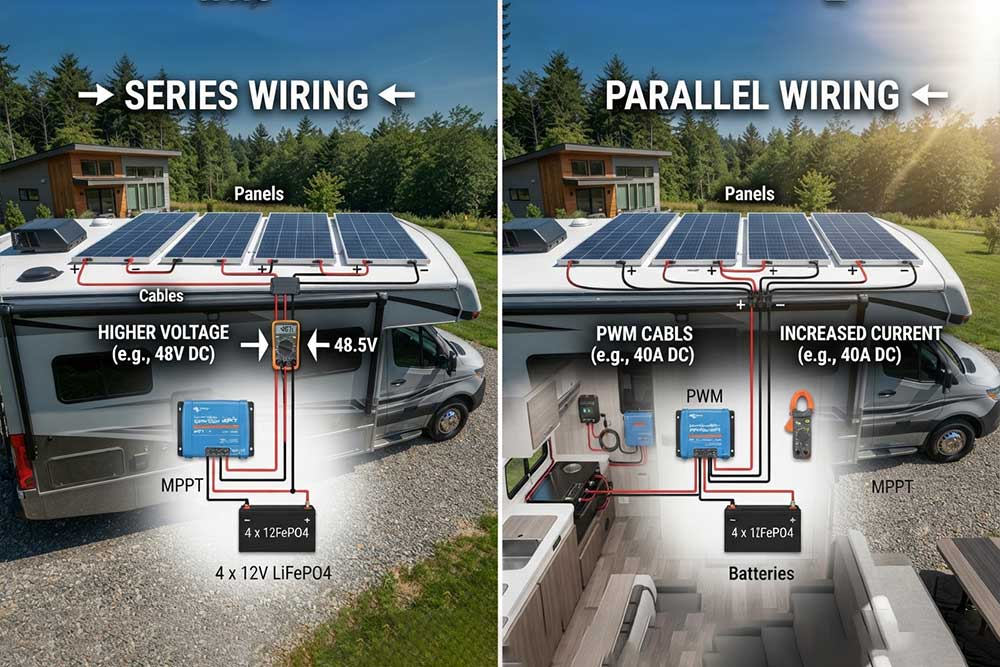
Solar panels can be connected in series or parallel depending on your system requirements. Series connections increase voltage while keeping current the same, while parallel connections increase current while maintaining voltage. The best choice depends on your battery voltage, charge controller, shading conditions, and application.
When expanding a solar system, many users focus on panel wattage but overlook one important factor: how the solar panels are wired together.
The connection method directly affects:
- System voltage
- Current output
- Cable size
- Energy efficiency
- Charge controller compatibility
- Overall system performance
For example, a solar setup installed on an RV roof may have completely different wiring requirements compared with a home rooftop system or an off-grid cabin.
A series connection may be the better option when you need higher voltage and longer cable distances. A parallel connection may work better when shading is a concern or when using a low-voltage battery system.
Understanding the difference between solar panel series vs parallel connections helps you design a safer, more efficient, and more reliable solar power system.
Bright Solar develops flexible solar panel solutions for RVs, marine applications, and off-grid systems where installation flexibility and energy efficiency are important.
What Is Solar Panel Wiring?
Solar panel wiring is the process of connecting multiple solar panels together to create a larger solar array that delivers the required voltage and current for a solar power system.
A single solar panel produces electricity, but most applications require multiple panels to generate enough energy.
By changing how panels are connected, you can control two important electrical factors:
- Voltage (V)
- Current (A)
The relationship between them determines the total power output.
The basic formula is:
Power (W) = Voltage (V) × Current (A)
For example:
A 100W solar panel may produce:
- Voltage: 20V
- Current: 5A
Power:
20V × 5A = 100W
When multiple panels are connected, you can increase voltage, increase current, or increase both depending on the wiring method.
The three common solar panel connection methods are:
- Series connection
- Parallel connection
- Series-parallel connection
Each method has different advantages depending on the system design.
Solar Panels in Series: How Does It Work?
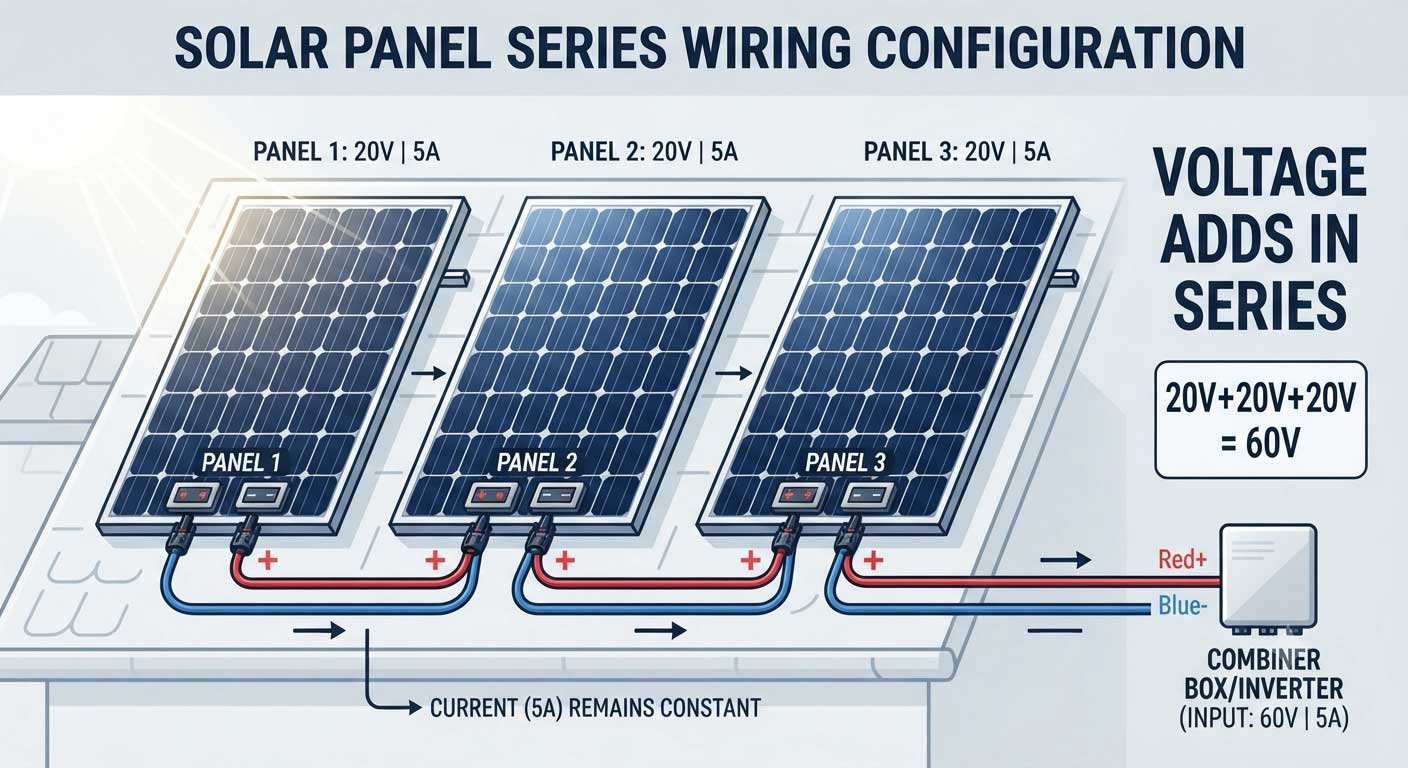
Solar panels connected in series increase the total system voltage while keeping the current unchanged.
A series connection works by connecting the positive terminal of one solar panel to the negative terminal of the next panel.
The remaining positive and negative terminals connect to the solar charge controller or inverter.
The wiring pattern is:
Solar Panel (+) → Solar Panel (-) → Solar Panel (+) → Solar Panel (-)
In this configuration:
- Voltage adds together
- Current remains the same
Example of Solar Panels Connected in Series
Assume you have three 100W solar panels.
Each panel produces:
- Voltage: 20V
- Current: 5A
When connected in series:
Total voltage:
20V + 20V + 20V = 60V
Total current:
5A
Total power:
60V × 5A = 300W
The system produces the same total power, but the voltage becomes higher.
Advantages of Solar Panels Connected in Series
Higher Voltage Improves Energy Transmission
One of the biggest advantages of series wiring is higher voltage output.
Higher voltage allows electricity to travel more efficiently through cables because current remains lower.
Benefits include:
- Reduced voltage drop
- Lower cable losses
- Smaller cable requirements
This makes series connections suitable for installations where solar panels are located far away from batteries or inverters.
Common applications include:
- Residential rooftop solar
- Large off-grid systems
- Ground-mounted solar arrays
Better Compatibility With MPPT Charge Controllers
Series solar panels work especially well with MPPT (Maximum Power Point Tracking) charge controllers.
MPPT controllers can convert higher solar input voltage into usable charging power more efficiently.
For example:
A solar array producing 80V can be converted efficiently to charge a 12V or 24V battery system.
This is why many larger solar installations prefer series wiring combined with MPPT controllers.
Smaller Cable Requirements
Because series connections increase voltage instead of current, they reduce the amount of current flowing through cables.
Lower current helps reduce:
- Heat generation
- Energy loss
- Cable size requirements
For long-distance solar installations, this can reduce both installation complexity and material costs.
Disadvantages of Solar Panels Connected in Series
Shading Can Affect the Entire Solar String
The main disadvantage of series wiring is that panels work together as one electrical chain.
If one panel receives significantly less sunlight, the output of the entire string may decrease.
Common shading sources include:
- Trees
- Buildings
- Roof vents
- Air conditioners
- Dirt accumulation
For example:
Three solar panels connected in series:
- Panel 1: Full sunlight
- Panel 2: Full sunlight
- Panel 3: Heavy shade
The shaded panel may limit the performance of the entire series string.
Requires Careful Voltage Planning
Series connections create higher voltage levels, so every component must be compatible.
Before installation, check:
- Solar panel open-circuit voltage (Voc)
- Charge controller maximum input voltage
- Inverter voltage range
- Safety requirements
Exceeding the maximum voltage rating can damage equipment.
Solar Panels in Parallel: How Does It Work?
Solar panels connected in parallel increase current output while maintaining the same voltage level.
In a parallel connection:
- All positive terminals connect together
- All negative terminals connect together
The wiring pattern is:
Positive → Positive → Positive
Negative → Negative → Negative
In this configuration:
- Voltage remains unchanged
- Current increases
Example of Solar Panels Connected in Parallel
Using the same three 100W solar panels:
Each panel produces:
- Voltage: 20V
- Current: 5A
When connected in parallel:
Total voltage:
20V
Total current:
5A + 5A + 5A = 15A
Total power:
20V × 15A = 300W
The total power remains the same, but the current output increases.
Advantages of Solar Panels Connected in Parallel
Better Performance Under Partial Shading
One major advantage of parallel wiring is improved shading tolerance.
Each solar panel operates more independently.
If one panel receives less sunlight:
- That panel produces less current
- Other panels continue generating power
This makes parallel connections useful for:
- RV solar systems
- Boats
- Mobile solar setups
where complete sunlight exposure is not always possible.
Suitable for Low Voltage Battery Systems
Parallel connections are commonly used in:
- 12V solar systems
- Small RV installations
- Portable solar applications
They allow users to increase solar capacity without creating high system voltage.
Easier Solar System Expansion
Parallel wiring makes future upgrades easier.
Example:
Initial system:
1 × 200W solar panel
Future expansion:
Add another 200W panel
New capacity:
400W solar system
This flexibility is useful for users who expect their energy needs to increase over time.
Disadvantages of Solar Panels Connected in Parallel
Although parallel solar panel connections offer better shading performance and simple expansion, they also increase current requirements and may require larger cables and additional protection components.
Parallel wiring is a good solution for many small and mobile solar systems, but it is not always the most efficient choice for larger installations.
Higher Current Requires Larger Cables
The main disadvantage of parallel connections is increased current.
When current increases, electrical losses become more noticeable, especially when cables are long.
Higher current may require:
- Thicker solar cables
- Higher-rated connectors
- Additional fuses or breakers
For example:
A solar system producing:
20V and 30A
requires more cable capacity than a system producing:
60V and 10A
with the same power output.
This is why larger solar installations often prefer series connections to reduce current.
Less Efficient for Long Cable Distances
Parallel solar panels are usually less suitable when solar panels are installed far away from batteries or controllers.
Long cable distances combined with higher current can increase:
- Voltage drop
- Energy loss
- System inefficiency
For remote solar installations, increasing voltage through series connections is often a more practical solution.
More Complex Current Management
As the number of parallel-connected panels increases, current management becomes more important.
A larger parallel system may require:
- Combiner boxes
- Individual fuses
- Proper circuit protection
Correct design ensures the system operates safely and reliably.
Solar Panel Series vs Parallel Comparison Table
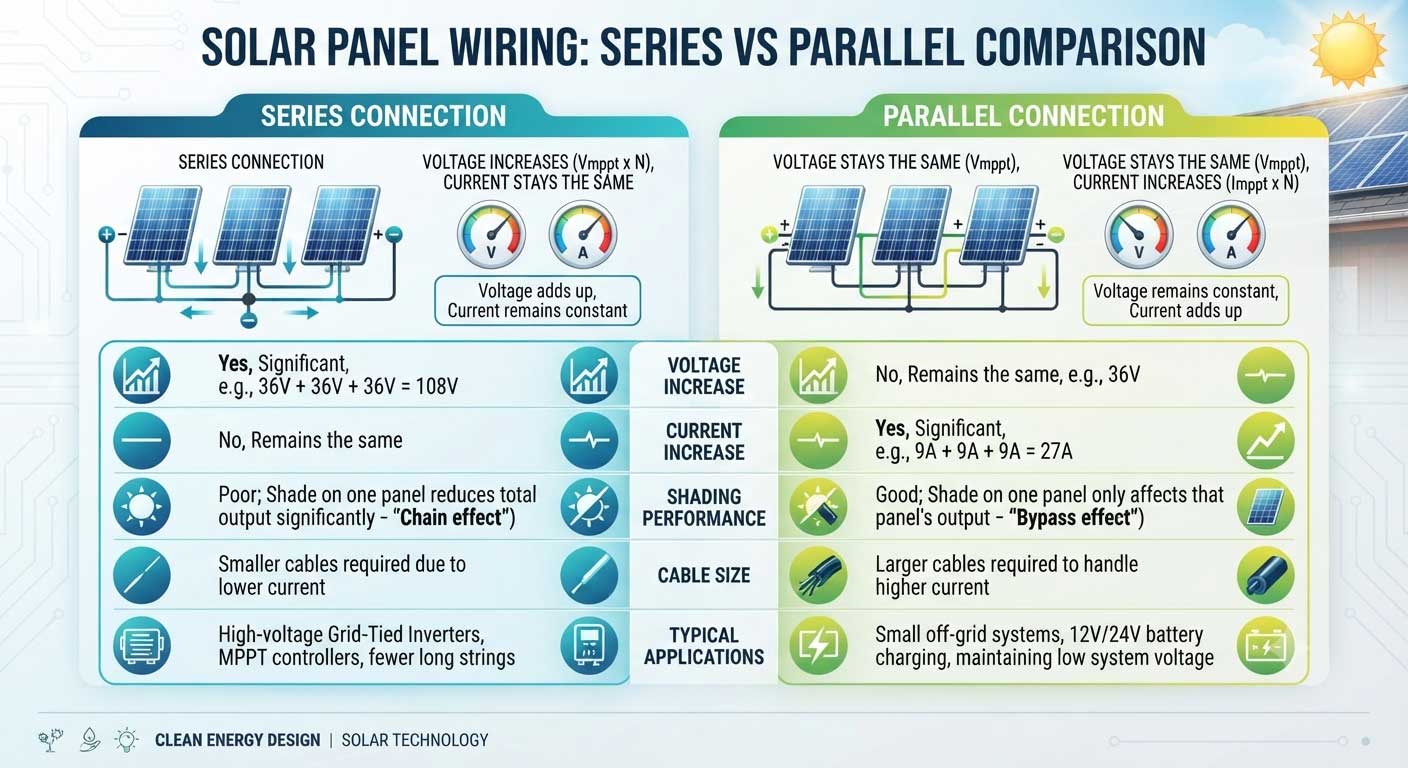
The main difference between solar panel series vs parallel connections is how they affect voltage and current. Series wiring increases voltage, while parallel wiring increases current.
The following comparison helps determine which connection method is suitable for different solar applications.
| Feature | Solar Panels in Series | Solar Panels in Parallel |
|---|---|---|
| Voltage Output | Increases | Remains the same |
| Current Output | Remains the same | Increases |
| Power Output | Same total power | Same total power |
| Cable Requirements | Smaller cables | Larger cables |
| Energy Loss | Lower over long distances | Higher over long distances |
| Shading Performance | More affected | Better performance |
| Charge Controller | Best with MPPT | Works with PWM or MPPT |
| System Voltage | Higher | Lower |
| Installation Difficulty | Moderate | Simple |
| Best Applications | Homes, large systems, off-grid | RVs, boats, small systems |
Series-Parallel Solar Panel Connection Explained
A series-parallel solar panel connection combines both methods to increase voltage and current at the same time.
This configuration is commonly used when a solar system requires higher power output but needs to maintain suitable voltage levels.
Instead of connecting all panels in series or all panels in parallel, installers create multiple series strings and connect those strings together in parallel.
How Series-Parallel Wiring Works
Example:
You have eight 100W solar panels.
Configuration:
- Two panels connected in series
- Four series groups connected in parallel
Each series group:
Panel voltage:
20V + 20V = 40V
Current:
5A
After connecting four groups in parallel:
Voltage:
40V
Current:
5A × 4 = 20A
Total output:
40V × 20A = 800W
Advantages of Series-Parallel Connections
Series-parallel wiring provides several benefits:
Balanced Voltage and Current
It avoids extremely high voltage or current levels.
This helps match:
- Battery voltage
- Inverter requirements
- Charge controller specifications
Suitable for Larger Solar Systems
Series-parallel configurations are common in:
- Large RV solar systems
- Off-grid cabins
- Commercial solar projects
- Residential solar arrays
Better System Design Flexibility
Installers can customize the solar array according to:
- Available roof space
- Energy consumption
- Equipment limitations
This makes series-parallel wiring one of the most versatile solar configurations.
Solar Panel Series vs Parallel for RV Applications
For RV solar systems, the choice between series and parallel depends on roof space, shading conditions, battery voltage, and charge controller type.
RV solar installations are different from residential systems because they have unique limitations:
- Limited roof area
- Curved surfaces
- Weight restrictions
- Moving conditions
- Partial shading from roof equipment
Choosing the right wiring method can significantly improve RV energy performance.
When Series Solar Panels Are Better for RVs
Series connections are useful for RV owners who:
- Use MPPT charge controllers
- Need longer cable distances
- Want lower energy losses
Advantages include:
- Higher voltage charging
- Smaller cable requirements
- Better efficiency
Example:
Two 200W solar panels:
Each panel:
20V / 10A
Series connection:
Voltage:
40V
Current:
10A
Power:
400W
When Parallel Solar Panels Are Better for RVs
Parallel connections are popular for RV applications because they handle shading better.
RV roofs often include:
- Air conditioners
- Roof vents
- Satellite antennas
These objects can create partial shade during the day.
With parallel wiring:
- Shaded panels have less impact
- Other panels continue generating power
This makes parallel connections suitable for many camper and van solar systems.
Flexible Solar Panels for RV Solar Systems
Flexible solar panels are becoming increasingly popular among RV users because they provide advantages that traditional rigid panels cannot always offer.
Benefits include:
- Lightweight construction
- Low-profile installation
- Better roof compatibility
- Easy integration on curved surfaces
Bright Solar flexible solar panels are designed for mobile applications where reducing weight and maximizing available installation space are important.
For RV solar projects, flexible panels can be connected in:
- Series
- Parallel
- Series-parallel configurations
depending on:
- Battery voltage
- Controller specifications
- Energy requirements

Solar Panel Series vs Parallel for Off-Grid Systems
For off-grid solar systems, series connections are often preferred because they provide higher voltage and work efficiently with MPPT charge controllers.
Off-grid systems usually require:
- Reliable power generation
- Long operating hours
- Battery storage
- Efficient energy transmission
The wiring method directly affects overall system performance.
Series Wiring for Off-Grid Solar
Series connections are commonly used in off-grid applications because they reduce current and improve transmission efficiency.
Advantages:
- Lower cable losses
- Higher voltage input
- Better MPPT performance
Common applications:
- Remote cabins
- Farms
- Workshops
- Remote monitoring stations
Example:
Four 300W solar panels:
Each panel:
40V
Series connection:
40V × 4 = 160V
Current remains unchanged.
Parallel Wiring for Off-Grid Solar
Parallel connections can also be useful for smaller off-grid systems.
Suitable applications:
- Small cabins
- Low-voltage battery systems
- Portable solar setups
Advantages:
- Simple design
- Easy expansion
- Better shading tolerance
However, larger systems need careful current management.
How Shading Affects Solar Panel Wiring
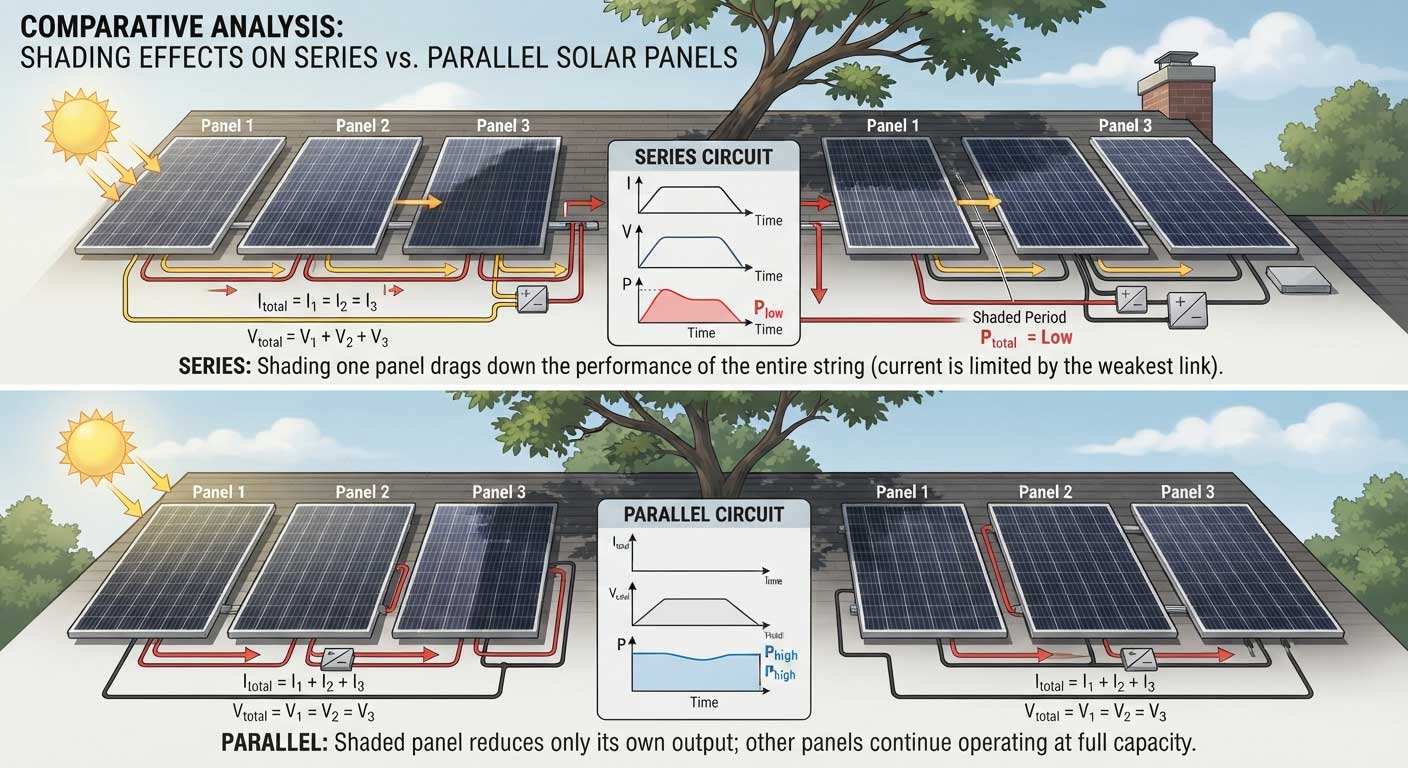
Shading affects series and parallel solar panels differently. Understanding these differences helps prevent unexpected power losses.
Solar panels rarely receive identical sunlight throughout the day.
Common shading sources include:
- Trees
- Buildings
- Roof structures
- Dirt
- Snow
Shading Effects in Series Connections
In a series connection, all panels share the same current path.
If one panel performs poorly, it can reduce the output of the entire string.
Example:
Three panels in series:
Panel 1:
100% sunlight
Panel 2:
100% sunlight
Panel 3:
30% sunlight
The shaded panel may limit the current flowing through the entire series string.
Shading Effects in Parallel Connections
Parallel connections usually perform better under partial shading.
Each panel contributes current independently.
If one panel is shaded:
- The shaded panel produces less energy
- Other panels continue working normally
This is why parallel wiring is often considered for:
- RV roofs
- Boats
- Urban installations
The Role of Bypass Diodes
Modern solar panels include bypass diodes to reduce shading losses.
Bypass diodes help:
- Redirect current around shaded cells
- Protect solar cells
- Maintain system output
However, they cannot completely eliminate shading problems.
Proper panel placement remains important.
MPPT vs PWM Charge Controller for Series and Parallel Solar Panels
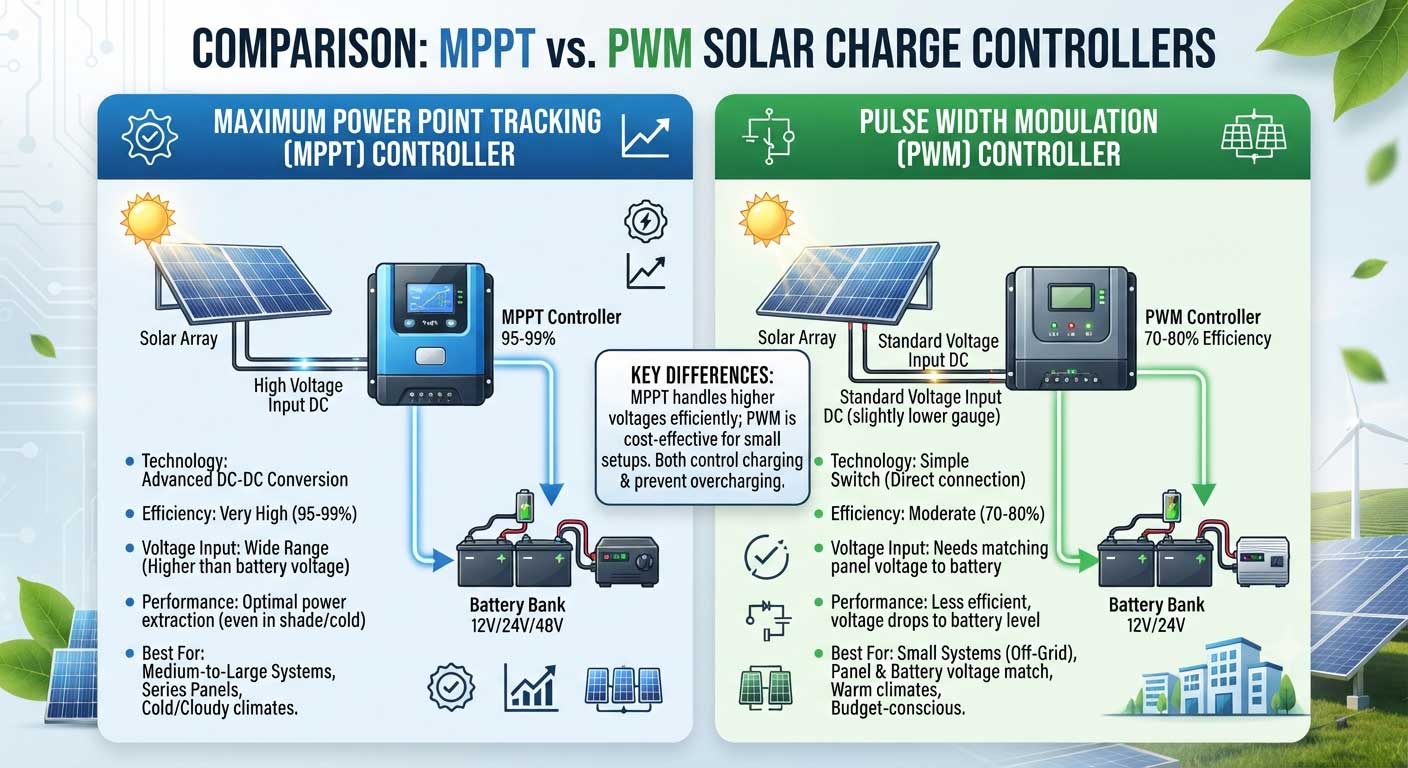
The charge controller type plays an important role when choosing between series and parallel solar panel wiring.
The two most common solar charge controllers are:
- MPPT
- PWM
MPPT Charge Controller
MPPT stands for:
Advantages:
- Higher efficiency
- Supports higher solar input voltage
- Works well with series solar panels
Suitable for:
- Large solar systems
- RV solar upgrades
- Off-grid applications
Example:
Solar array:
80V input
Battery:
12V system
The MPPT controller converts excess voltage into additional charging current.
PWM Charge Controller
PWM stands for:
Pulse Width Modulation
Advantages:
- Lower cost
- Simple operation
- Suitable for small systems
Suitable for:
- Basic RV systems
- Small battery banks
- Low-power applications
PWM controllers generally work better with parallel solar panels where panel voltage matches battery voltage more closely.
MPPT vs PWM Comparison
| Feature | MPPT | PWM |
|---|---|---|
| Efficiency | Higher | Lower |
| Cost | Higher | Lower |
| Input Voltage Range | Wider | Limited |
| Best Connection | Series | Parallel |
| Best Application | Medium/Large Systems | Small Systems |
How to Connect Solar Panels in Series or Parallel Step-by-Step
Connecting solar panels in series or parallel requires correct planning, compatible equipment, and proper safety checks. A well-designed connection improves energy efficiency and helps prevent damage to solar components.
Before connecting solar panels, always check:
- Solar panel voltage and current specifications
- Charge controller maximum input limits
- Battery system voltage
- Cable size requirements
- Connector compatibility
The correct wiring method depends on your energy needs and system design.
Step 1: Check Solar Panel Specifications
Before wiring solar panels together, review the technical information on the panel label.
Important specifications include:
Maximum Power Voltage (Vmp)
Vmp is the voltage when the solar panel produces its rated power output.
It helps determine how the panel performs under normal operating conditions.
Open Circuit Voltage (Voc)
Voc is the maximum voltage produced by a solar panel when it is not connected to a load.
This value is especially important for series connections because voltage increases with every additional panel.
Example:
One solar panel:
Voc = 45V
Three panels in series:
45V × 3 = 135V
The charge controller must support this voltage level.
Short Circuit Current (Isc)
Isc represents the maximum current output of a solar panel under short-circuit conditions.
This value is important when designing parallel systems because current adds together.
Step 2: Choose Series or Parallel Connection
Before installation, decide which configuration matches your application.
Choose Series Connection When:
Use series wiring if you need:
✔ Higher voltage output
✔ Lower current transmission
✔ Smaller cable sizes
✔ Better performance over long distances
✔ MPPT controller compatibility
Common applications:
- Home solar systems
- Large off-grid systems
- Commercial installations
Choose Parallel Connection When:
Use parallel wiring if you need:
✔ Better shading tolerance
✔ Lower system voltage
✔ Easy panel expansion
✔ Compatibility with small battery systems
Common applications:
- RV solar systems
- Boats
- Portable solar setups
Step 3: Connect Solar Panels in Series
Follow these steps:
Step 1:
Place the solar panels in the planned installation position.
Step 2:
Connect the positive (+) terminal of the first solar panel to the negative (-) terminal of the next panel.
Step 3:
Continue connecting panels using the same method.
Step 4:
Connect the remaining positive and negative terminals to the solar charge controller.
Step 5:
Measure the total voltage before connecting the system.
Series Connection Example
Three 200W solar panels:
Each panel:
- Voltage: 20V
- Current: 10A
Series output:
Voltage:
20V + 20V + 20V = 60V
Current:
10A
Total power:
600W
Step 4: Connect Solar Panels in Parallel
Follow these steps:
Step 1:
Connect all positive (+) terminals together.
Step 2:
Connect all negative (-) terminals together.
Step 3:
Connect the combined output cables to the charge controller.
Step 4:
Check the total current rating.
Parallel Connection Example
Three 200W solar panels:
Each panel:
- Voltage: 20V
- Current: 10A
Parallel output:
Voltage:
20V
Current:
10A + 10A + 10A = 30A
Total power:
600W
Step 5: Add Proper Protection Components
A reliable solar system should include appropriate protection devices.
Important components include:
Fuses
Solar fuses protect individual circuits from excessive current.
They are especially important in larger parallel systems.
Circuit Breakers
Circuit breakers allow safe system isolation during maintenance.
Disconnect Switches
Disconnect switches make troubleshooting and repairs safer.
Surge Protection Devices
Surge protection helps protect equipment from unexpected voltage spikes.
Step 6: Test the Solar System
After completing the wiring, check:
- Voltage output
- Current flow
- Charge controller operation
- Battery charging status
A multimeter can help confirm that the solar array is working correctly.
Never connect a system without verifying polarity and voltage first.
Common Solar Panel Wiring Mistakes to Avoid
Many solar system problems come from incorrect wiring decisions rather than solar panel quality. Avoiding common mistakes improves safety, efficiency, and long-term reliability.
Mistake 1: Connecting Incompatible Solar Panels
Mixing solar panels with different specifications can reduce system performance.
Problems may occur when panels have different:
- Wattage ratings
- Voltage ratings
- Current ratings
- Cell technologies
For best results, use solar panels with similar electrical characteristics.
Mistake 2: Exceeding Charge Controller Voltage Limits
This mistake commonly happens with series connections.
Because voltage increases when panels are connected in series, always calculate the maximum voltage.
Formula:
Total Voc = Panel Voc × Number of Panels
Example:
One panel:
Voc = 40V
Four panels in series:
40V × 4 = 160V
If your controller supports only 150V, this configuration is unsafe.
Always leave a safety margin.
Mistake 3: Using Incorrect Cable Sizes
Cable size directly affects solar system efficiency.
Using cables that are too small can cause:
- Voltage drop
- Heat generation
- Energy loss
Parallel systems require special attention because current increases.
Long cable distances also require proper cable sizing.
Mistake 4: Ignoring Shading Conditions
Even a correctly wired solar system will underperform if panels are installed in poor locations.
Avoid placing panels near:
- Trees
- Roof equipment
- Buildings
- Objects creating regular shadows
Before installation, observe sunlight conditions throughout the day.
Mistake 5: Incorrect Positive and Negative Connections
Solar connectors reduce the chance of wiring errors, but polarity should still be checked.
Incorrect polarity can:
- Prevent charging
- Damage controllers
- Create safety issues
Always verify connections before powering the system.
Mistake 6: Choosing the Wrong Wiring Method
A common mistake is copying another solar installation without considering system differences.
A home solar system, RV solar system, and off-grid cabin have different requirements.
The correct choice depends on:
- Battery voltage
- Solar capacity
- Installation location
- Controller type
- Future expansion plans
How to Choose the Right Solar Panel Connection
The best solar panel connection method depends on your application, equipment, and installation environment.
There is no single wiring method that works best for every solar system.
Choose Series Solar Panels If You Need:
✔ Higher voltage output
✔ Long cable distances
✔ Lower current loss
✔ MPPT controller compatibility
Recommended applications:
- Residential rooftops
- Large solar arrays
- Off-grid power systems
Choose Parallel Solar Panels If You Need:
✔ Better partial shading performance
✔ Lower voltage operation
✔ Simple system expansion
✔ Small battery systems
Recommended applications:
- RVs
- Boats
- Portable solar systems
Choose Series-Parallel Solar Panels If You Need:
✔ Higher power output
✔ Balanced voltage and current
✔ Larger solar arrays
Recommended applications:
- Large RV systems
- Remote cabins
- Commercial solar projects
Bright Solar Flexible Solar Panel Applications
Bright Solar provides flexible solar panel solutions designed for RV, marine, portable, and off-grid applications where lightweight design and installation flexibility are important.
Traditional rigid solar panels may not always fit every installation environment.
Flexible solar panels offer advantages for applications where users need:
- Lower installation weight
- Space-saving design
- Curved surface compatibility
- Easy transportation
Bright Solar Flexible Panels for RV Applications
RV owners often face challenges such as:
- Limited roof space
- Weight restrictions
- Irregular roof shapes
Flexible solar panels provide a practical solution by allowing easier installation on mobile platforms.Learn more about “Flexible Solar Panel Installation Guide“
Depending on the system design, Bright Solar flexible panels can be connected in:
- Series
- Parallel
- Series-parallel configurations
Bright Solar Solutions for Off-Grid Energy Systems
Off-grid applications require reliable solar generation.
Typical uses include:
- Remote cabins
- Outdoor equipment
- Emergency power systems
- Remote monitoring devices
The correct combination of:
- Solar panel type
- Wiring method
- Battery storage
- Charge controller
helps maximize system performance.
Why Wiring Design Matters
Choosing high-quality solar panels is only one part of building a reliable system.
A complete solar solution requires:
- Correct panel configuration
- Proper electrical design
- Suitable protection components
- Professional installation planning
Bright Solar focuses on flexible solar technologies that support different energy applications while maintaining reliable outdoor performance.

FAQ About Solar Panel Series vs Parallel
Are solar panels better connected in series or parallel?
Neither option is always better.
Series connections are better when you need:
- Higher voltage
- Lower current
- Long-distance energy transmission
Parallel connections are better when you need:
- Better shading tolerance
- Lower voltage systems
- Easy expansion
The best choice depends on your solar system design.
Do solar panels produce more power in series or parallel?
Solar panels produce the same total power when connected correctly.
The difference is how electrical output changes.
Series:
- Voltage increases
Parallel:
- Current increases
Example:
Three 100W solar panels produce:
300W total power
in either configuration.
Can solar panels with different wattages be connected together?
Yes, but it is generally not recommended.
Different panels may have different:
- Voltage
- Current
- Operating characteristics
This can reduce overall system efficiency.
Using matching solar panels usually provides better performance.
Should RV solar panels be connected in series or parallel?
The best choice depends on the RV system.
Parallel wiring is often preferred when:
- Roof shading exists
- Using a 12V battery system
- Simple expansion is needed
Series wiring may be better when:
- Using an MPPT controller
- Cable distance is longer
- Higher efficiency is needed
Many modern RV systems use series or series-parallel configurations.
Can flexible solar panels be connected in series?
Yes.
Flexible solar panels can be connected in series if the system voltage requirements are suitable.
Before connecting flexible panels, check:
- Panel Voc
- Controller voltage limit
- Cable rating
- Connector compatibility
How many solar panels can be connected together?
The number of solar panels depends on:
- Charge controller capacity
- Inverter rating
- Battery voltage
- Solar panel specifications
Always calculate total voltage and current before expanding a solar array.
Conclusion: Solar Panel Series vs Parallel, Which One Should You Choose?
Solar panel series vs parallel connections both have advantages. The right choice depends on your system voltage, shading conditions, installation environment, and energy requirements.
Series connections are ideal when you need:
- Higher voltage
- Lower current
- Better efficiency over long distances
- MPPT controller compatibility
Parallel connections are suitable when you need:
- Better shading performance
- Lower voltage operation
- Simple system expansion
For larger solar installations, series-parallel wiring can provide the best balance between voltage and current.
Whether you are designing an RV solar system, marine power setup, or off-grid energy solution, selecting the correct wiring method is essential for reliable performance.
Bright Solar provides flexible solar panel solutions designed for modern mobile and off-grid applications, helping users create efficient renewable energy systems with flexible installation options.
With the right solar panel configuration and proper system design, solar energy can provide dependable clean power for years.
Related recommendations
-

Best RV Solar Kit for Off-Grid Travel
197Find the best rv solar kit for off-grid travel. Learn how to size solar panels, batteries, charge controllers and wiring for reliable RV power.
View details -
Solar Panels 300 Watt: Complete Guide to Power, Cost & Uses
298Discover solar panels 300 watt with our complete guide covering power output, cost, applications, installation, and buying tips for RV, home, and off-grid use.
View details -
Enphase Expands Mini Inverter Deployment in Southern California
338Enphase expands Mini inverter deployment in Southern California, with more homes adopting IQ8 Microinverters and IQ Batteries to prepare for summer outages. Local installers from Anaheim to Riverside share how sunlight-only backup and flexible sys...
View details -
Flexible Solar Panel Kits: Complete Solar Solutions for Mobile and Off-Grid Power
166Explore flexible solar panel kits for RVs, boats, campervans, and off-grid systems. Lightweight, efficient, and easy to install for reliable solar power anywhere.
View details