12 Volt Folding Solar Panels: How to Choose and Use Them
12 volt folding solar panels provide portable solar power for compatible 12V batteries, RVs, camping equipment, and small off-grid systems. Their actual output depends on sunlight and system losses, while safe charging requires a compatible controller and the correct connection method.
The term “12 volt” can be confusing when shopping. A panel described as suitable for a 12V battery does not necessarily produce exactly 12 volts at its terminals. Solar modules need enough voltage to charge a battery through the relevant controller, and their operating voltage can vary with sunlight and temperature.
That distinction matters when choosing a kit for a campervan, boat, trailer, or remote worksite. The folding design makes the panel easier to transport and reposition; the electrical specifications determine whether it will work with your battery.
What Are 12 Volt Folding Solar Panels?
12 volt folding solar panels are portable photovoltaic panels designed for charging systems built around a nominal 12V battery or compatible power equipment. They typically use hinged or segmented panel sections that unfold for use and fold together for storage.
Depending on the product, a kit may include:
- Folding solar modules
- A carrying case or integrated support legs
- Output cables and connectors
- A charge controller
- Battery clamps or adapters
- Instructions for connecting to a supported battery or power station
Not every kit includes every component. Some folding panels connect to a separate controller and battery, while others are designed to connect to a portable power station with integrated solar charging electronics.View portable solar panels
Why a “12V Panel” May Produce More Than 12 Volts
A nominal 12V battery does not remain at exactly 12V during every stage of use and charging. A lead-acid battery, for example, typically requires a charging voltage above its nominal voltage. The correct voltage depends on battery chemistry, state of charge, temperature, and the manufacturer’s charging recommendations.
Solar panels are also rated using electrical values such as:
- Vmp: Voltage at maximum power
- Imp: Current at maximum power
- Voc: Open-circuit voltage
- Isc: Short-circuit current
- Pmax: Maximum rated power under specified test conditions
The charge controller regulates the energy transferred from the panel to the battery. Before connecting a panel, check the controller’s permitted PV voltage and current as well as the battery’s required charging profile.
The U.S. Department of Energy’s overview of photovoltaic technology explains how solar cells convert sunlight into electricity and how modules form part of a larger system. See Solar Photovoltaic Technology Basics.
How Much Power Can 12 Volt Folding Solar Panels Produce?
The output depends on the panel’s wattage and the sunlight available. A 100W folding panel is a common example for portable charging, but smaller and larger options are also available.
To estimate daily energy, use:
Daily energy (Wh) = panel power (W) × peak sun hours × system efficiency
Peak sun hours are equivalent hours at a reference solar irradiance of 1,000 watts per square metre. They are not the same as total daylight hours.
For a 100W panel receiving four peak sun hours, theoretical production is 400Wh. If an illustrative system-efficiency factor of 75–85% is applied, estimated energy becomes 300–340Wh per day, before any additional battery-storage or device-conversion losses.
| Peak sun hours | Theoretical energy from a 100W panel | Illustrative energy at 75–85% efficiency |
|---|---|---|
| 2 hours | 200Wh | 150–170Wh |
| 3 hours | 300Wh | 225–255Wh |
| 4 hours | 400Wh | 300–340Wh |
| 5 hours | 500Wh | 375–425Wh |
| 6 hours | 600Wh | 450–510Wh |
These figures are planning estimates, not guaranteed output. Cloud cover, partial shade, panel angle, high temperatures, and controller limits can reduce production. The 75–85% factor is illustrative rather than a specification for every product.
For a location-specific estimate, the National Renewable Energy Laboratory’s PVWatts Calculator can help model solar generation using location and system inputs. Its results should be interpreted as estimates, especially when applying a modelling tool to a small portable system.
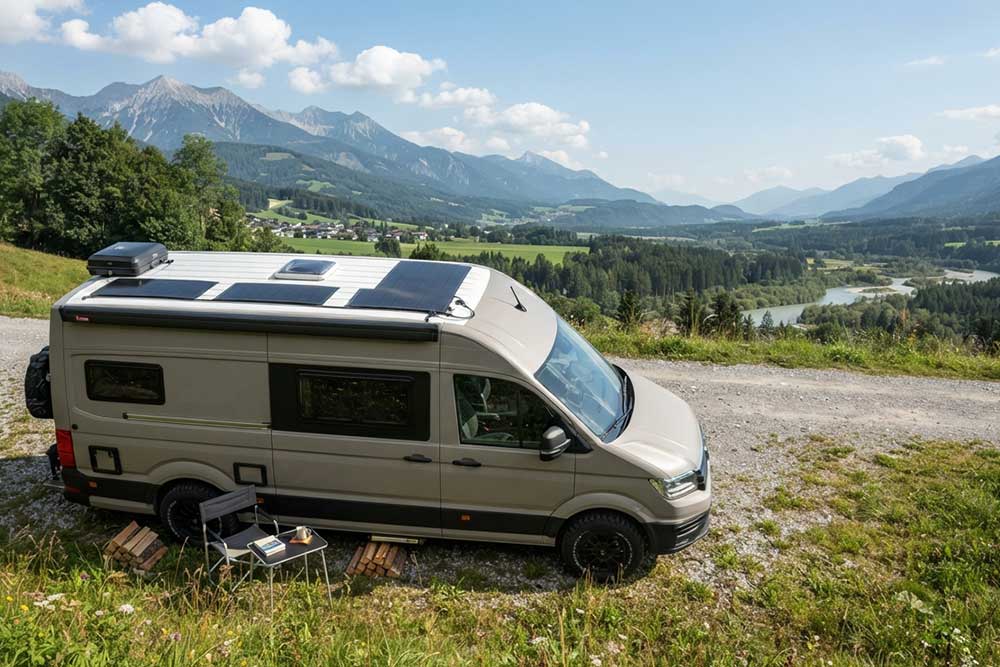
Choosing a 12V Folding Solar Panel for an RV or Camper
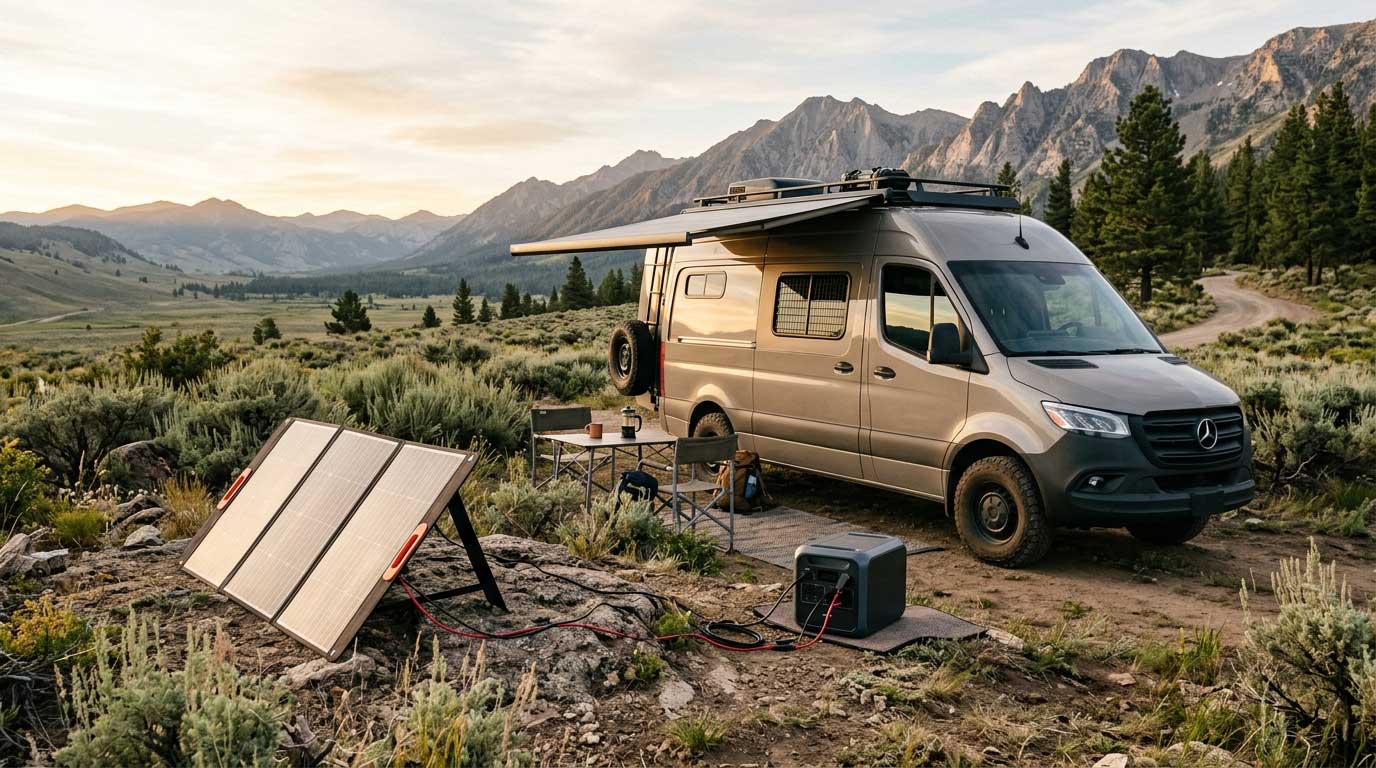
A folding panel can be particularly useful when the vehicle is parked in shade but an open patch of ground receives direct sunlight. You can place the panel where the sun is, then keep the battery or power station in a suitable location nearby.
The right kit depends on the equipment you want to charge, how often you travel, and whether you need occasional top-ups or a dependable daily energy source.
1. Match the Panel to Your Battery
Before buying, identify the battery chemistry and its charging requirements. A 12V lead-acid battery and a 12V lithium battery do not necessarily use the same charging profile.
Check these details:
- Battery nominal voltage and chemistry
- Recommended charging voltage and current
- Controller support for the specific battery type
- Panel operating voltage and maximum open-circuit voltage
- Connector polarity and compatibility
- Whether the kit includes a controller or expects one to be supplied separately
Do not connect a panel directly to a battery unless the equipment manufacturer explicitly permits that arrangement. In most battery-charging setups, a compatible charge controller is needed to regulate charging.
2. Decide How Much Power You Need
Estimate the energy used by your daily loads. If a device is rated in watts, multiply its power by the number of hours it runs to estimate watt-hours.
For example, a 10W light used for three hours consumes 30Wh. A 40W device running for two hours consumes 80Wh. Together, those loads require about 110Wh before system losses.
Compare that daily demand with realistic solar production. A 100W panel may cover modest lighting and electronics loads in favourable conditions, but it may be insufficient for a refrigerator, inverter, or several appliances used every day.
3. Check the Folding Design and Packed Size
A panel that is easy to deploy is more likely to be used consistently. Check the folded dimensions, total weight, handle, cable storage, support legs, and hinge construction. If you camp frequently, think about where the panel will be stored when wet or dusty and whether it can be cleaned without damaging its surface.
For a boat or windy campsite, stability matters as much as portability. Follow the manufacturer’s guidance for securing the panel, and pack it away when conditions become unsafe.
How to Connect 12 Volt Folding Solar Panels Safely
The exact wiring method depends on the kit, controller, and battery. Use the product manual as the final authority. The following sequence is a general planning guide, not a substitute for model-specific instructions.
Step 1 — Place the Panel in Unshaded Sunlight
Set up on stable ground and orient the panel toward the sun. Avoid shadows from trees, awnings, roof racks, or nearby equipment. If the sun moves during the day, adjust the panel when practical.
A small strip of shade can affect output, particularly when part of the panel is shaded by a cable or support. Check the panel’s position rather than assuming a sunny campsite guarantees strong production.
Step 2 — Inspect the Electrical Specifications
Compare the panel’s Vmp, Voc, Imp, and Isc with the controller’s permitted input range. Confirm that the battery voltage and chemistry are supported. Make sure all connectors are compatible and the cables are undamaged.
If you are connecting multiple panels, do not assume their combined voltage or current will remain within the controller’s limits. Series connections increase voltage; parallel connections increase current. The system must be designed around the equipment’s ratings.
Step 3 — Follow the Manufacturer’s Connection Sequence
Some controllers require the battery to be connected before the solar input; others may specify a different procedure. Follow the instructions for the exact controller. Keep connectors dry and handle them as directed, particularly when the panel is producing electricity.
Never bypass the charge controller simply because the panel is labelled “12V.” Nominal voltage labels alone do not establish that direct battery connection is safe.
Step 4 — Confirm Charging at the Display
If the controller or power station provides a display, check the charging current or input power after setup. Output may start low in weak sunlight and rise as the panel is repositioned. A reading below the panel’s rated wattage does not by itself indicate a fault.
If the reading seems unusually low, check for shading, loose or incorrect connections, unsuitable orientation, and input limits on the receiving device.
Step 5 — Store the Panel Properly
Disconnect equipment in the sequence specified by the manufacturer. Fold the panel without forcing the hinges, protect the cables from being pinched, and let damp equipment dry according to its instructions before long-term storage.
What Can a 12V Folding Solar Panel Run?
A 12V folding solar panel is generally more useful for charging a battery than for powering every appliance directly. The battery stores energy for later use, while a compatible controller regulates the charging process.
| Device or load | Example energy use | Practical consideration |
|---|---|---|
| LED camping light | 10W for 3 hours = 30Wh | Usually a modest energy demand |
| Phone charging | About 10–20Wh per charge as an illustrative allowance | Actual energy depends on the phone and charging losses |
| Small electronic accessories | Depends on the device | Check rated power and daily operating time |
| Portable power station | Depends on battery capacity and input limits | The panel replenishes stored energy when sunlight is available |
| Compressor refrigerator | Highly variable | Measure daily consumption before relying on a small panel |
These figures are examples for planning, not guaranteed consumption values for every device. The phone-charging allowance, for instance, is not a universal battery specification.
A useful habit is to separate power from energy. Watts describe the rate at which a device uses electricity. Watt-hours describe the energy consumed over a period. A 12V battery label alone does not tell you how long a particular appliance will run; battery capacity, usable discharge limits, and conversion losses also matter.
A Realistic Weekend Camping Example
Imagine a camper using a 100W folding panel to support a 12V battery system over a two-day trip. Their estimated daily loads are 30Wh for lighting, 30Wh for phone charging, and 50Wh for small accessories—a total of 110Wh per day.
If the panel receives four peak sun hours and the illustrative 75–85% system-efficiency assumption applies, estimated daily generation would be 300–340Wh. On paper, this exceeds the example’s daily demand. In practice, cloudy weather, shade from the vehicle, battery-charging losses, and changes in use may reduce the available margin.
The lesson is not that a 100W panel always produces a surplus. It is that estimating daily energy consumption gives the buyer a more useful starting point than choosing a panel based on voltage alone.
This is an illustrative calculation, not a measured field test or a claim about a particular Bright Solar product.
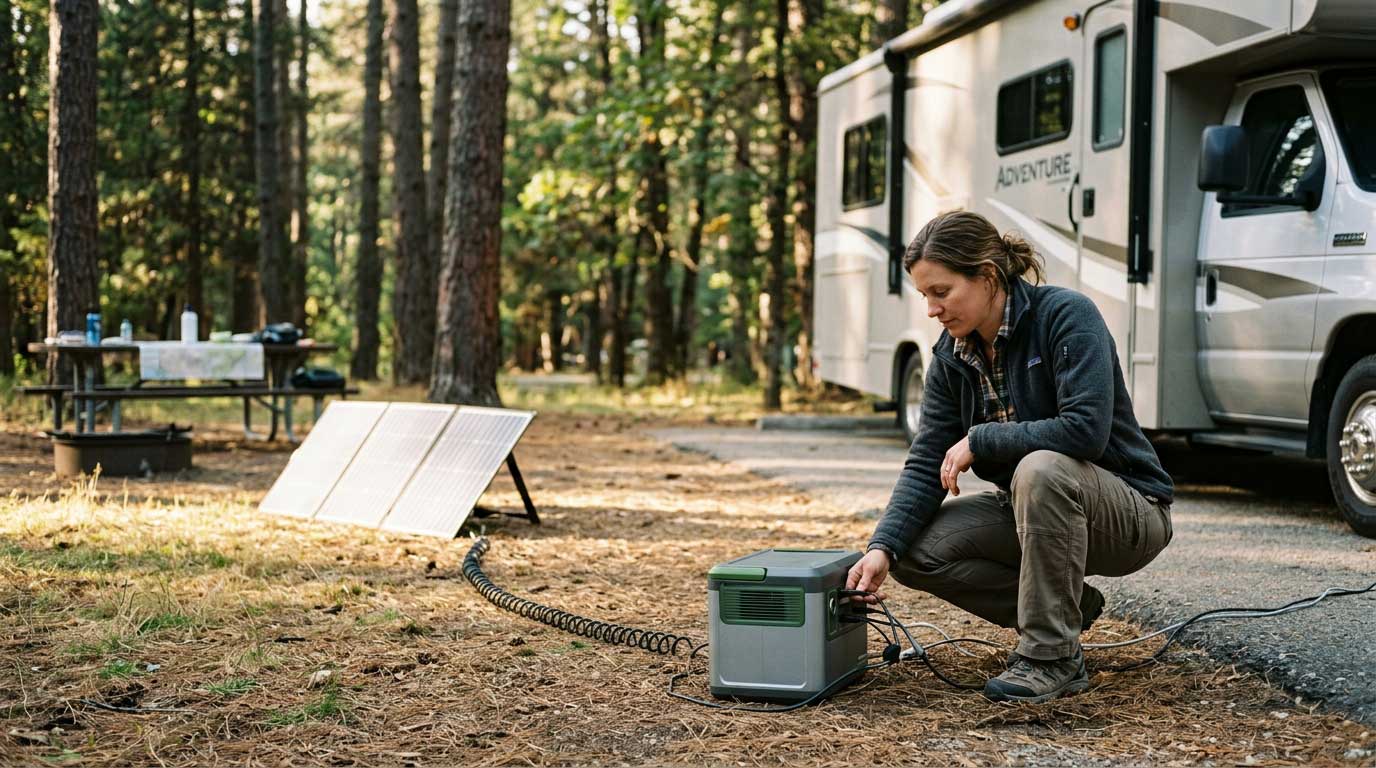
Common Mistakes When Buying 12 Volt Folding Solar Panels
A few avoidable mistakes can make a portable kit inconvenient or unsuitable for the battery it is meant to charge.
- Assuming “12V” means exactly 12 volts: Check the panel’s electrical specifications and the battery’s charging requirements.
- Ignoring controller limits: The panel’s voltage and current must remain within the controller’s permitted input range.
- Buying without checking the connector: A physical fit does not guarantee electrical compatibility or correct polarity.
- Expecting full rated output throughout the day: Solar output changes with sunlight, angle, shading, and temperature.
- Treating a folding panel as permanently mounted equipment: Hinges and portable supports are designed for a different use pattern from a fixed roof installation.
- Assuming weather resistance without documentation: Confirm the stated limits for rain, moisture, wind, and storage.
The U.S. Department of Energy’s resource on Solar Photovoltaic Performance and Efficiency Basics provides background on why real-world solar output differs from rated performance. For a location-based production estimate, consult the NREL PVWatts Calculator.
When a Flexible Solar Panel May Be a Better Fit
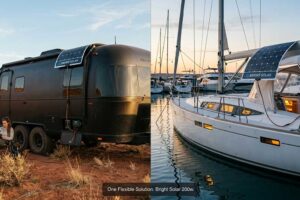
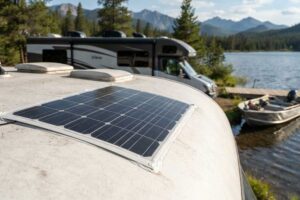
Folding panels are designed for temporary use: carry them, open them, position them, then store them. Flexible solar modules are intended for compatible mounting surfaces where a thin, lightweight design may be beneficial.
Bright Solar supplies flexible solar panel solutions for B2B applications, including projects that require consideration of module dimensions, electrical parameters, and mounting conditions. Its L Series has a stated maximum bending capacity of 30%, but this does not mean it can be folded repeatedly like a camping panel. Buyers should confirm the exact model’s approved bending limit and installation instructions.
For distributors, RV equipment suppliers, and system integrators, the selection process should include:
- Required rated power and electrical output
- Surface shape and mounting method
- Product dimensions and weight
- Environmental exposure and operating conditions
- Cable and connector requirements
- Technical documentation and customization needs
A folding 12V kit and a flexible module can both be useful solar products, but they serve different installation requirements. Choose according to how the system will be deployed, rather than treating the terms as interchangeable.
FAQ About 12 Volt Folding Solar Panels
Are 12 volt folding solar panels suitable for charging a 12V battery?
Yes, if the panel is used with a compatible charging system. Check the panel’s voltage and current ratings, the controller’s input limits, and the battery manufacturer’s charging requirements before connecting it.
Do 12V folding solar panels need a charge controller?
Most setups charging a separate battery need a suitable charge controller to regulate charging. Some portable power stations have built-in solar charging electronics, so a separate controller may not be required. Follow the equipment instructions.
How much power can a 100W folding solar panel generate in a day?
With four peak sun hours, a 100W panel has theoretical production of 400Wh. Using an illustrative 75–85% system-efficiency factor gives an estimate of 300–340Wh per day before additional battery and device-conversion losses.
Can I use 12V folding solar panels for an RV?
Yes. They can charge a compatible battery or portable power station for selected RV loads. Whether one panel is sufficient depends on daily energy use, weather, battery capacity, and available sunlight.
Can I connect two 12V folding solar panels together?
Potentially, but the connection method matters. Series wiring increases voltage, while parallel wiring increases current. Confirm that the combined electrical values are within the controller’s and receiving equipment’s limits before connecting panels.
Are folding solar panels waterproof?
Not necessarily. Weather protection varies by model, and the panel, connectors, controller, and carrying case may have different limitations. Check the manufacturer’s specifications before exposing the equipment to rain or moisture.
What is the difference between folding and flexible solar panels?
Folding panels use hinged sections for portable deployment and storage. Flexible solar panels are designed for compatible mounting surfaces and have specified bending limits. A flexible panel should not be repeatedly folded unless its manufacturer explicitly permits that use.
Conclusion
12 volt folding solar panels offer a practical way to collect solar energy for camping, RV travel, and small off-grid battery systems. The right choice depends on the battery, controller, electrical compatibility, daily energy needs, and conditions in which the panel will be used.
Check the data sheet before purchasing, estimate energy in watt-hours rather than relying on nominal voltage, and allow for changes in weather and sunlight. For B2B projects requiring solar modules designed around particular installation conditions, Bright Solar’s flexible-panel solutions can be assessed against the project’s actual technical requirements.
Technical References
- U.S. Department of Energy: Solar Photovoltaic Technology Basics — an introduction to photovoltaic technology and how solar cells generate electricity.
- U.S. Department of Energy: Solar Photovoltaic Performance and Efficiency Basics — background on the factors affecting solar performance.
- National Renewable Energy Laboratory: PVWatts Calculator — estimates solar energy production using location and system assumptions.
Related recommendations
-

200W Flexible Solar Panel: Lightweight Solar Power for RV, Marine, and Off-Grid Use
381200w flexible solar panel solutions for RVs, boats, and off-grid travel. Discover lightweight ETFE solar panels with high efficiency and real-world durability.
View details -
450 Watt Solar Panel Performance and Applications Guide
348Discover how a 450 watt solar panel delivers reliable power for RVs, homes, marine and off-grid systems. Learn output, efficiency and installation tips.
View details -
10 Watt Flexible Solar Panel: Uses, Output and Installation Guide
247A 10 watt flexible solar panel is designed for low-power applications such as sensors, small lights, GPS devices, battery maintenance, and small RV or marine...
View details -
Flexible 12 Volt Solar Panels: A Practical Guide to RV, Marine and Off-Grid Power
306Flexible 12 volt solar panels suit selected RV, marine, and off-grid systems, but compatibility depends on actual voltage, power, mounting limits, controller...
View details