100w Folding Solar Panel Kit: What It Powers and How to Choose One
A 100w folding solar panel kit is a portable solar charging solution for camping, RV travel, and small off-grid power needs. Its real-world output depends on sunlight, panel angle, shading, and system losses, so check the controller, connectors, and battery compatibility before buying.
A folding kit looks straightforward: open the panel, point it toward the sun, and connect a cable. In practice, the details matter. A panel may be rated at 100 watts under standard test conditions, but that figure is not a promise that it will deliver 100 watts continuously throughout the day. The battery, charge controller, cable connections, and weather all affect the result.
For campers, RV owners, and outdoor equipment suppliers, the useful question is not simply whether the panel is rated at 100W. It is whether the complete kit can collect enough energy for the intended loads, without adding unnecessary weight or incompatible components.
What Is Included in a 100w Folding Solar Panel Kit?
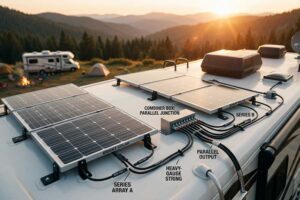
A 100w folding solar panel kit typically combines a foldable photovoltaic panel with cables and a carrying or protective case. Some kits also include a charge controller, adapters, kickstands, or battery clamps. Others are designed to connect directly to a compatible portable power station.
The exact package varies by manufacturer, so review the bill of materials rather than relying on the word “kit.”
| Component | Purpose | What to check |
|---|---|---|
| Folding solar panel | Converts sunlight into DC electricity | Rated power, dimensions, folded size, and cell construction |
| Charge controller | Regulates charging from the panel to a compatible battery | Battery voltage, charging profile, and maximum PV input |
| Output cables | Carry electricity between components | Connector type, cable length, polarity, and current rating |
| Battery clamps or adapter | Connect the kit to a supported battery or power station | Compatibility and manufacturer instructions |
| Carrying case or supports | Protect the panel and help position it | Fabric durability, hinge construction, and stability outdoors |
A controller is not necessarily included. Some portable power stations have their own solar charge controller, so adding a second external controller may be inappropriate. Always follow the equipment manufacturer’s wiring instructions.
Folding Panels Are Not the Same as Flexible Solar Panels
Folding and flexible panels solve different installation problems.
- Folding panels use hinged or segmented sections that open for use and fold for storage. They are generally suited to temporary deployment.
- Flexible solar panels bend within a specified limit and are intended for compatible curved or weight-sensitive surfaces. They are not automatically foldable.
- Rigid solar panels use a solid frame and are commonly selected for permanent installations where mounting space and structural support are available.
Bright Solar offers flexible solar panel solutions for B2B applications, including customized configurations. Buyers evaluating flexible modules should confirm the approved bending limit, mounting method, and electrical specifications for the specific model rather than treating a flexible panel as a folding camping kit.
How Much Power Can a 100W Folding Solar Panel Produce?
A 100W panel can theoretically produce 100 watt-hours of energy for each hour it operates at its full rated output. Actual output changes with irradiance, panel temperature, orientation, and shading.
For a practical estimate, use:
Daily energy (Wh) = panel rating (W) × peak sun hours × system efficiency
Peak sun hours are not the same as total daylight hours. They represent the equivalent number of hours at a reference solar irradiance of 1,000 watts per square metre.
Consider a 100W panel receiving four peak sun hours per day. If an illustrative system-efficiency factor of 75–85% is used to account for combined operating losses, the estimated daily energy is:
- Theoretical energy: 100W × 4 hours = 400Wh
- Estimated usable energy before battery-specific losses: 400Wh × 75–85% = 300–340Wh
This is a planning estimate, not a guaranteed performance result. Cloud cover, poor orientation, heat, shading, and controller limitations can reduce production further. For a location-specific estimate, NREL’s PVWatts calculator can help model solar production, although its assumptions and system setup need to match the equipment being assessed. NREL PVWatts Calculator
Example Loads a 100W Kit May Support
The table below compares illustrative daily energy needs with the estimated 300–340Wh output above. Actual consumption varies by model and operating conditions.
| Device or use | Illustrative energy use | What the comparison means |
|---|---|---|
| Phone charging | 10–20Wh per charge | Several charges may fit within the energy budget |
| LED camping lights | 10–30Wh per evening | Often a modest load, depending on brightness and runtime |
| Small USB devices | Varies by device | Check the device’s wattage and charging time |
| Portable power station | Depends on its capacity and conversion losses | The panel can replenish some stored energy during daylight |
| Compressor fridge | Highly variable | Measure actual daily consumption before relying on a 100W panel |
These examples are not device-performance guarantees. A phone battery’s rated capacity is not identical to the energy drawn from the solar system because charging and conversion introduce losses. Likewise, a refrigerator cycles on and off, so its daily energy use can differ considerably with ambient temperature and ventilation.
A 100W kit is best viewed as a small energy source for selected loads or battery top-ups. It is not a universal replacement for a larger RV or off-grid solar system.
How to Choose a 100 Watt Folding Solar Panel for Camping
A suitable panel is not necessarily the one with the most accessories. Start with the equipment you already own, the amount of energy you use each day, and how much space you have when the kit is packed away.
1. Check Compatibility With Your Power Station or Battery
Before purchasing, compare the panel’s electrical specifications with the input limits of the device you plan to charge.
- Operating voltage: Confirm that the panel’s working voltage is within the supported charging range.
- Open-circuit voltage (Voc): Make sure the panel’s Voc, including possible increases in cold conditions, does not exceed the controller’s maximum PV input voltage.
- Current limit: Check that the panel’s output current is suitable for the controller and connected equipment.
- Connector type: Confirm that the connector fits the power station or controller. Similar-looking connectors are not always electrically interchangeable.
- Battery chemistry: If the kit charges a separate battery, the controller must support the battery manufacturer’s charging requirements.
A panel with the correct wattage can still be incompatible with a particular power station. Read the panel’s data sheet and the receiving device’s solar-input specifications together.
2. Compare Portability, Not Just Folded Size
A folding panel needs to fit both the vehicle and the place where you will use it. Look at the packed dimensions, total kit weight, handle design, cable storage, and how quickly the panel can be deployed.
For a weekend campsite, a carrying handle and integrated supports may be more convenient than a separate stand. For an RV site, longer cables may let you place the panel in sunlight while keeping the power station inside a shaded, ventilated area.
Do not assume that a larger folding panel is automatically more practical. A panel that stays packed away because it is awkward to carry is not delivering useful energy.
3. Look Beyond the Headline Wattage
A sensible buying checklist includes:
- Rated power and the conditions used to measure it
- Cell and protective-surface construction
- Folded and unfolded dimensions
- Water-resistance information, if any, and the limitations stated by the manufacturer
- Controller model and supported battery types
- Warranty terms and replacement-part availability
- Instructions for storage, cleaning, and use in wind
A water-resistant panel is not necessarily safe to leave outdoors during heavy rain, and a weather-resistant fabric case does not establish that the electrical connectors are waterproof. Check the specific product documentation.
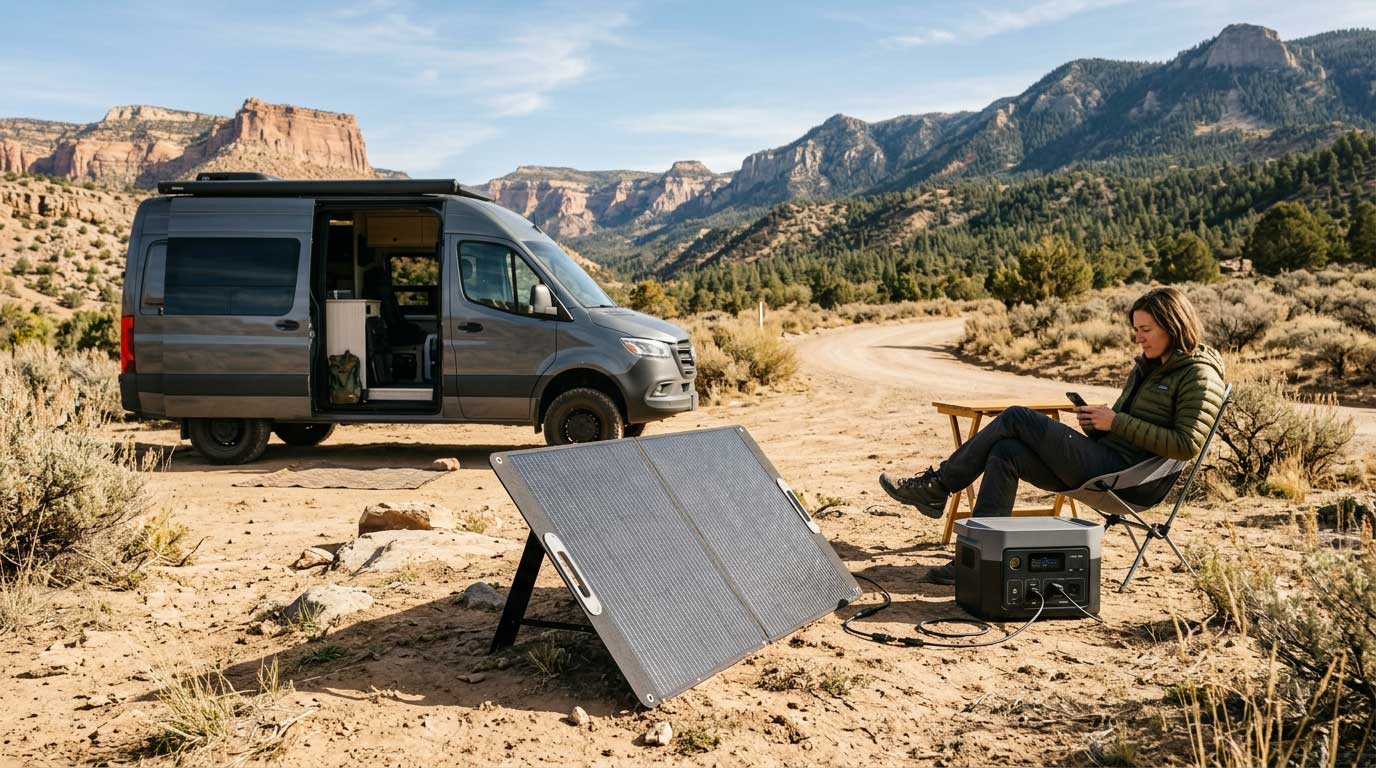
How to Set Up a 100w Folding Solar Panel Kit
Setup should take only a few deliberate steps, but the sequence matters. Follow the kit’s instructions if they differ from this general guide.
Step 1 — Find an Unshaded Position
Place the panel where direct sunlight reaches as much of its active surface as possible. A tree branch, roof rack, awning, or even a narrow shadow can reduce output. Reposition the panel as the sun moves, particularly if you are relying on it to recharge a battery during a short winter day.
Step 2 — Check the Connections Before Powering Up
Inspect cables for cuts, crushed sections, loose connectors, or exposed conductors. Verify polarity and confirm that the panel’s voltage is within the controller or power station’s permitted range. Do not connect or disconnect exposed electrical connectors in a way prohibited by the equipment instructions.
Step 3 — Connect the Correct Charging Equipment
Some systems require the panel to be connected to a compatible charge controller before the battery is connected. Other systems are designed for direct connection to a power station with built-in solar charging electronics. Use the sequence specified by the manufacturer rather than assuming all kits follow the same arrangement.
Step 4 — Check the Actual Input Reading
Look at the power station or controller display, if available. A clear day does not guarantee the panel will reach 100W: the sun angle, temperature, and equipment limits can all affect the reading. If the output is unexpectedly low, first check shading, panel orientation, connector seating, and the input limit of the receiving device.
Step 5 — Pack It Away Dry and Secure
Disconnect the equipment as instructed, fold the panel without forcing its hinges, and store the cables so they do not get pinched. If the panel or case becomes damp, follow the manufacturer’s drying and storage guidance before packing it away for an extended period.
A Realistic Example: A Weekend RV Trip
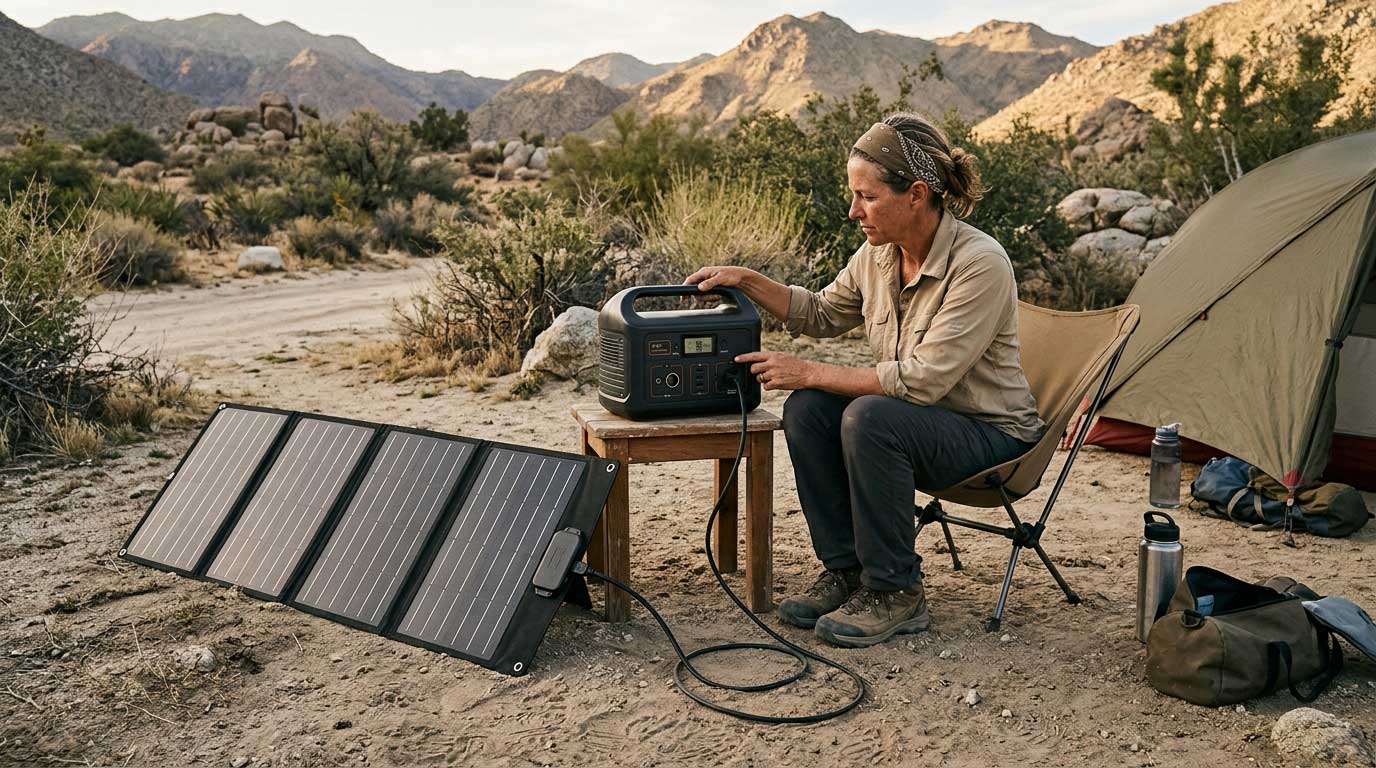
Consider a hypothetical couple spending two nights at a campsite in Arizona. They bring a 100W folding panel and a portable power station to run small electronics and campsite lighting. Their goal is to reduce how often they need to recharge from a vehicle or campground outlet.
Assume the panel receives four peak sun hours on a clear day. Using the illustrative 75–85% system-efficiency factor above, the expected daily energy would be about 300–340Wh. Across two similar days, that is approximately 600–680Wh before accounting for any additional battery-storage or device-conversion losses.
That may be useful for phones, lights, and selected small electronics. It may not be enough if they also want to run a compressor refrigerator, cook with electricity, or recharge a large power station from a low state of charge. A few hours of afternoon cloud or shade from the RV could change the result materially.
The useful lesson is to compare daily energy needs with expected daily production—not to treat the 100W rating as an all-day supply figure. This example is an illustrative calculation, not a measured field test or a claim about a specific Bright Solar product.
Common Mistakes to Avoid
A few small oversights can make a portable kit less useful than expected.
- Buying by wattage alone: A 100W rating does not tell you whether the connector, voltage, controller, or battery is compatible.
- Expecting identical output every day: Solar conditions change by season, location, weather, and panel orientation.
- Leaving the panel in partial shade: Nearby equipment, branches, and vehicle shadows can interfere with generation.
- Ignoring wind: A folding panel can act like a sail. Use its supports as instructed, secure it appropriately, and stow it when conditions become unsafe.
- Assuming “portable” means waterproof: Verify the manufacturer’s stated environmental protection and restrictions.
- Confusing power with energy: Watts describe power at a moment; watt-hours describe energy accumulated over time. Battery capacity is commonly expressed in watt-hours, so it is the more useful unit for estimating runtime.
The U.S. Department of Energy explains that photovoltaic module ratings are measured under standard test conditions, including irradiance of 1,000 W/m² and a cell temperature of 25°C. Outdoor conditions are often different, and sunlight, temperature, and orientation influence performance. U.S. Department of Energy: Optimizing Solar Photovoltaic Performance for Longevity
Is a 100W Folding Kit the Right Choice for Your Application?
A folding kit is a strong candidate when portability and temporary deployment matter more than permanent installation. It can suit short camping trips, emergency charging, day trips, and modest power-station replenishment.
For regular RV living, marine installations, or business projects requiring panels that follow a curved surface, a different configuration may be more appropriate. Bright Solar’s flexible solar panel solutions are intended for B2B buyers who need product options for specific installation conditions. The L Series, for example, has a stated maximum bending capacity of 30%; that specification should not be interpreted as permission to fold the panel repeatedly like a hinged portable kit. Confirm the relevant model’s data sheet and installation instructions before selecting it.
For manufacturers, distributors, and system integrators, compare not only rated power but also dimensions, electrical parameters, construction, mounting requirements, customization options, and the consistency of the supplied technical documentation.
FAQ About 100w Folding Solar Panel Kit
Can a 100w folding solar panel kit charge a power station?
Yes, if the power station supports the panel’s voltage, current, connector, and solar-input range. Check the manufacturer’s specifications before connecting the panel.
How much electricity does a 100W folding solar panel produce per day?
Output depends on peak sun hours and system losses. As an illustrative estimate, four peak sun hours with a 75–85% efficiency factor would yield about 300–340Wh per day before additional battery and device-conversion losses.
Can I use a 100W folding solar panel kit for an RV?
Yes. It can help recharge a compatible power station or battery for modest loads. If you need to run a refrigerator, inverter, or multiple appliances, calculate their daily energy use first.
Does a 100W folding solar panel kit include a charge controller?
Not always. Some kits include an external controller, while others are intended for power stations with built-in solar charging electronics. Check the included components before purchasing.
Can I leave a folding solar panel outside in the rain?
Only if the manufacturer explicitly permits use under those conditions. Check the panel, connectors, controller, and cable protection separately. Never assume that a fabric carrying case or a water-resistant panel makes the entire system waterproof.
Is a folding solar panel better than a flexible solar panel?
Neither is universally better. Folding panels are designed for portable, temporary use; flexible panels are designed for compatible mounting surfaces and have specified bending limits. Choose according to the installation, storage, and electrical requirements.
How do I estimate the size of solar kit I need?
List each device’s wattage and daily operating time, estimate its daily energy use in watt-hours, then account for charging and conversion losses. Compare that total with realistic solar production for your location and season. If the daily energy budget is tight, consider a larger panel or a lower-consumption setup.
Conclusion
A 100w folding solar panel kit is a practical option for portable charging when the energy demand is modest and the equipment is compatible. Its value depends on more than the number printed on the panel: daily sunlight, shading, controller limits, battery capacity, and ease of deployment all influence what it can do.
Estimate your daily watt-hour needs before buying, verify the electrical specifications, and treat production figures as estimates rather than guarantees. If your project requires custom solar modules for curved surfaces, RV integration, marine use, or other B2B applications, Bright Solar can help you assess flexible-panel options against the project’s actual requirements.
Technical References
- U.S. Department of Energy — Optimizing Solar Photovoltaic Performance for Longevity. Explains standard test conditions and factors that affect real-world solar performance.
- U.S. Department of Energy — Solar Photovoltaic Technology Basics. Introduces photovoltaic cells, modules, and system components.
- National Laboratory of the Rockies — PVWatts Calculator. Estimates solar energy production using location and system inputs. Its results are estimates, not guarantees for an individual Portable Solar Panel.
Related recommendations
-

Solar Panel Series vs Parallel: Which Wiring Setup Works Better?
336Compare solar panel series vs parallel wiring for RVs, boats, and off-grid systems. Learn efficiency, shading, voltage, and real installation tips.
View details -
Off Grid Solar System Cost: Complete Price Guide for 2026
354Explore off grid solar system cost with our complete guide covering panels, batteries, installation, and pricing factors to build a reliable solar power solution with Bright Solar.
View details -
Solar Panel Flexible: A Practical Guide to Lightweight Solar Power
263Explore solar panel flexible technology for RVs, marine applications, camping, and off-grid systems. Learn benefits, efficiency, durability, and installation tips.
View details -
Flexible Solar Panels vs Rigid: Which Solar Panel Type Performs Better?
369Compare flexible solar panels vs rigid systems for RVs, boats, mobile homes, and off-grid power. Discover costs, durability, efficiency, and real-world performance.
View details