Bifacial Flexible Solar Panel: Design, Performance, and Applications
A bifacial flexible solar panel generates electricity from light reaching both the front and rear sides of the module. Its actual advantage depends on rear-side irradiance, surface reflectivity, mounting clearance, shading, temperature, and electrical design. For curved roofs, RVs, boats, and specialty off-grid systems, those installation details matter as much as the panel’s rated power.
What Is a Bifacial Flexible Solar Panel?
A bifacial flexible solar panel combines two characteristics that are normally considered separately: a module that can accommodate a controlled amount of bending and photovoltaic cells capable of receiving useful light from both sides.
A conventional monofacial panel is primarily designed around front-side illumination. A bifacial design adds an opportunity to collect light reaching the rear of the active cell structure. That rear light may come from reflected sunlight, diffuse sky radiation, or light entering around the mounting surface.
The distinction is important because bifacial does not automatically mean higher energy production in every installation.
NREL’s bifacial modeling work identifies ground albedo, module spacing, shading, and ground-clearance height as important drivers of rear-side irradiance. Its modeling toolkit can account for reflective surfaces, obstructions, module layout, and rear irradiance over time.
For a flexible module installed directly against an opaque RV roof, the rear surface may receive very little useful light. In that situation, paying extra for bifacial capability may provide limited practical value.
For a raised installation where light can reach the rear surface, the calculation changes.
How Does a Bifacial Flexible Solar Panel Work?
The basic photovoltaic process is the same: semiconductor cells convert absorbed solar radiation into electrical energy. The U.S. Department of Energy notes that silicon is by far the most common semiconductor used in solar cells and that PV output depends on both the characteristics of incoming light and the performance of the cell.
A bifacial module adds another useful optical path.
| Light source | Where it reaches the module | Potential contribution |
|---|---|---|
| Direct sunlight | Front surface | Primary energy source |
| Diffuse sky radiation | Front and rear | Depends on orientation and surroundings |
| Reflected sunlight | Rear surface | Depends strongly on surface reflectivity |
| Light entering beneath a raised panel | Rear surface | Depends on clearance and geometry |
| Light blocked by the mounting surface | Neither side | No rear-side contribution |
This is why a bifacial flexible solar panel should not be evaluated using a simple “front power + fixed percentage” calculation.
NREL research on bifacial PV power ratings points out that one-sun power ratings for bifacial modules have historically been difficult to define because the rear irradiance condition is not fixed in the same way as front-side irradiance. In one simplified reference case evaluated by NREL, front irradiance was 1,000 W/m² while rear irradiance was 130–140 W/m². Actual field conditions vary with self-shading, ground cover, and module height.
That distinction is particularly relevant for buyers comparing supplier datasheets.
What Creates Bifacial Gain?
The rear side needs light.
That sounds obvious, but it is the most frequently overlooked point when a bifacial flexible solar panel is specified for a mobile or curved installation.
Ground and Surface Reflectivity
The amount of reflected light depends on the surface below the module. NREL research specifically identifies albedo as an important variable in bifacial PV planning. For conventional monofacial systems, ground-reflected radiation is generally a small fraction of total incident radiation; for bifacial systems, the same reflected component becomes directly relevant to energy production.
A bright surface can therefore be more useful to a bifacial module than a dark, absorbent surface.
For example:
- Light-colored roofing can reflect more light toward a raised rear surface.
- White membrane roofs may provide a different optical environment from dark EPDM roofing.
- Pale gravel, concrete, or other reflective surfaces can change rear irradiance.
- Dark asphalt generally provides less reflected light than a highly reflective surface.
- Water can create complex reflection patterns rather than behaving like a simple white surface.
The practical lesson is not to assign a universal bifacial gain percentage before inspecting the installation.
Rear Clearance
Clearance is just as important as reflectivity.
If the back of the module is pressed directly against a solid surface, rear-side illumination is restricted. If the module is elevated, light can reach more of the rear surface from different angles.
This creates an unusual design challenge for flexible solar panels.
A rigid bifacial module can often be mounted on a conventional elevated racking system. A flexible panel intended for a curved vehicle roof may instead be bonded or closely mounted to the roof skin. The same word—“bifacial”—therefore describes two very different physical configurations.
Before purchasing, ask the manufacturer for:
- Recommended rear clearance.
- Approved mounting method.
- Rear-side optical requirements.
- Bifaciality information for the actual cell/module design.
- Electrical ratings under the stated test conditions.
- Installation limitations related to bending and heat.
Bifacial Flexible Solar Panel vs. Conventional Flexible Panel
The difference is not simply the number of photovoltaic surfaces.
A conventional flexible panel can be highly effective when the installation surface is opaque and the panel is mounted close to it. A bifacial flexible solar panel becomes more interesting when the installation allows light to reach the rear.Learn more about the Flexible Solar Panel Installation Guide
| Factor | Conventional flexible panel | Bifacial flexible panel |
|---|---|---|
| Front-side sunlight | Yes | Yes |
| Rear-side light | Generally not used as an active generation path | Designed to contribute |
| Direct roof bonding | Often practical | May reduce rear-side benefit |
| Raised mounting | Possible | More useful for rear irradiance |
| Reflective surroundings | Less critical | More important |
| Clearance | Mainly mechanical/thermal consideration | Mechanical, thermal, and optical consideration |
| Best use case | Close-fit curved surfaces | Installations where rear light is accessible |
This is where product selection should move away from marketing language.
If the installation cannot provide meaningful rear irradiance, a lighter or simpler monofacial flexible panel may be the better engineering choice.
Where Can Bifacial Flexible Solar Panels Make Sense?
RV and Camper Applications
An RV roof is rarely an empty rectangle.
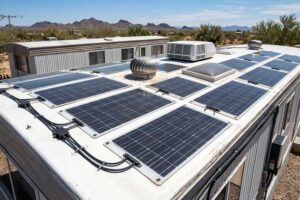
Air-conditioning units, skylights, vents, antennas, roof rails, satellite equipment, and cable glands compete for the same limited surface. Weight is also relevant because a mobile installation has different structural constraints from a ground-mounted solar array.
A bifacial flexible solar panel can make sense on an RV when it is installed with enough separation from the roof to expose its rear surface. It is less compelling when the panel is bonded flat against an opaque roof.
For RV buyers, I would check the roof layout before checking the brochure’s headline wattage.
Measure the usable area. Mark every obstruction. Identify where partial shadows fall between roughly 9 a.m. and 3 p.m. Then determine whether the rear side can actually see light.
That sequence often eliminates unsuitable products before electrical specifications become the deciding factor.

Marine and Boat Applications
Marine installations require another layer of evaluation.
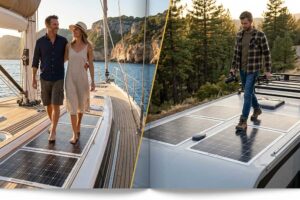
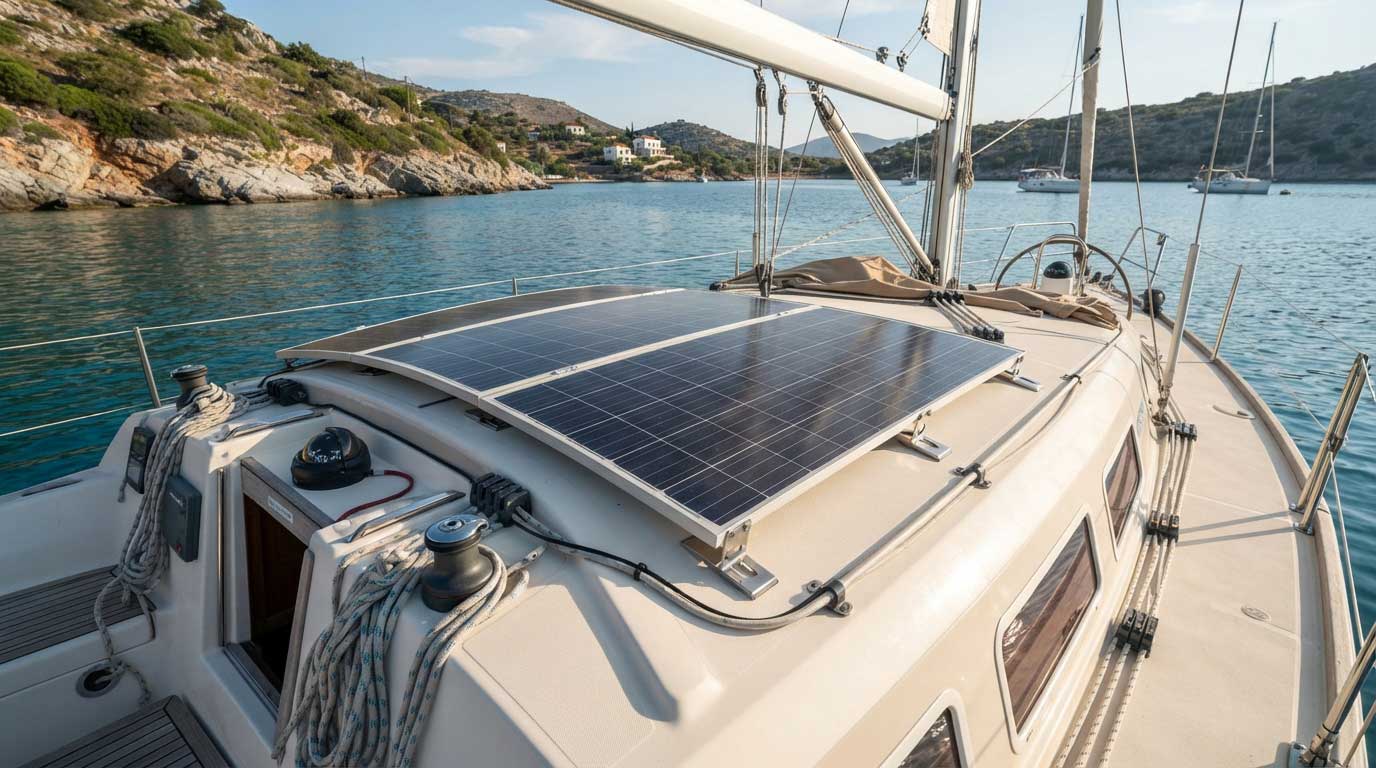
A boat may provide curved surfaces, limited mounting space, salt exposure, standing water, vibration, foot traffic, and frequent changes in orientation. A bifacial flexible solar panel installed above a bright deck or raised marine structure can potentially use rear-side light. A panel adhered tightly to an opaque cabin roof has a different optical situation.
Saltwater resistance and encapsulation also matter.
For marine purchasing, do not treat “bifacial” as the main specification. Ask about the complete module construction, connector protection, junction-box design, environmental rating, adhesive compatibility, and allowable bending radius.
IEC 61215-1:2021 specifically includes design qualification and type-approval provisions for terrestrial PV modules and added test methods for flexible modules, including the MQT 22 bending test. The standard also added instructions concerning qualification and type approval of bifacial PV modules.
IEC 61215-2:2021 likewise includes test methods for bifacial PV modules and flexible modules, including the MQT 22 bending test.
These standards do not mean every flexible or bifacial product automatically has the same performance. They are useful because they give buyers a more rigorous framework for asking what has actually been tested.
Flexible Does Not Mean Unlimited Bending
One of the most important specifications on a flexible module is the permitted bending geometry.
A panel may be described commercially as flexible while still having a defined minimum bending radius. Exceeding that limit can place mechanical stress on the encapsulation, cell interconnections, conductive paths, or other layers.
For procurement, record the roof curvature rather than simply asking whether the product is “flexible.”
A useful field measurement is the approximate radius of the curved surface. Then compare that measurement with the manufacturer’s documented maximum allowable curvature or minimum bending radius.
IEC 61215 recognizes bending as a specific test consideration for flexible PV modules.
Temperature Matters on Flexible Solar Panels
A bifacial design does not remove the normal thermal behavior of photovoltaic cells.
The U.S. Department of Energy explains that solar cells generally perform better at lower temperatures and that increasing temperature causes a much larger decrease in voltage than the associated increase in current. Excessive temperature can also affect module materials and operating life.
This matters on vehicle roofs because a flexible panel can sit close to a roof surface with limited airflow.
During a summer installation, the roof itself can become a major thermal mass. If the panel is mounted with little ventilation, its operating environment may differ significantly from a free-standing laboratory condition.
When comparing products, look beyond the nameplate:
| Specification to check | Why it matters |
|---|---|
| Rated power | Defines nominal electrical capacity |
| Voc | Needed for system voltage design |
| Vmp | Relevant to controller/inverter operating range |
| Isc | Important for protection and controller sizing |
| Temperature coefficient | Helps estimate hot-weather voltage behavior |
| Dimensions | Determines actual roof utilization |
| Weight | Important for mobile applications |
| Bending radius | Prevents unsuitable curvature |
| Rear-side construction | Determines whether bifacial operation is practical |
| Junction-box rating | Relevant to outdoor and marine exposure |
A common mistake is to compare two panels solely by watts per square meter. On a mobile roof, the panel that physically fits around obstructions and operates within the system’s voltage limits may deliver more usable value than a nominally higher-output panel that creates installation compromises.
Practical Design Check Before Buying
For a commercial or OEM purchase, Bright Solar recommends treating the panel and installation surface as one system rather than evaluating the module in isolation.
Start with five measurements:
- Available surface area — measure the usable section after vents and equipment are excluded.
- Curvature — determine whether the roof or deck is flat, cylindrical, compound-curved, or irregular.
- Rear clearance — establish whether sunlight can physically reach the back of the module.
- Electrical window — compare Voc, Vmp, Isc, and Imp with the charge controller or inverter.
- Environmental exposure — identify heat, salt spray, standing water, abrasion, walking loads, and vibration.
That fifth item is often where a technically attractive panel stops being appropriate.
For example, a bifacial flexible solar panel can look excellent on a datasheet but lose much of its bifacial advantage when installed directly on a dark roof. Conversely, a raised panel above a reflective surface may make substantially better use of its two-sided design.
A Practical Selection Example
Consider a hypothetical 30-foot cruising boat with a curved cabin roof. The available mounting zone is approximately 2.4 m × 1.4 m, but the roof includes a hatch and cable access point. The owner wants a low-profile installation and does not want a tall conventional rack.
A sensible evaluation would not begin with “How many watts can fit?”
Instead:
- Map the usable roof area.
- Measure the curvature.
- Determine whether a rear air gap can be maintained.
- Check whether the deck or roof surface reflects meaningful light.
- Identify saltwater exposure.
- Check cable routing and connector accessibility.
- Confirm the controller’s maximum PV voltage and current.
- Compare the actual panel dimensions against the remaining roof area.
The bifacial feature becomes a decision factor only after those physical conditions are established.
That is a useful distinction for distributors and system integrators, too. A product can be technically bifacial without being the right bifacial product for a particular installation.
How Bright Solar Evaluates Bifacial Flexible Solar Panels
For B2B applications, Bright Solar focuses on the relationship between module construction and the customer’s installation rather than treating bifacial performance as a universal percentage.
For an OEM or project inquiry, the useful technical package should include:
- Module rated power and electrical characteristics
- Cell technology
- Front and rear construction
- Bifaciality information where applicable
- Module dimensions and weight
- Minimum bending radius
- Operating-temperature information
- Junction-box and connector specifications
- Mounting recommendations
- Environmental requirements
- Applicable qualification and testing information
This approach is especially important when the intended application is an RV, yacht, curved vehicle roof, portable structure, or specialty off-grid system.
A bifacial flexible solar panel is not simply a conventional flexible panel with another marketing label. Its value depends on whether the physical installation gives the rear side useful light and whether the module construction is suitable for the environment.
How to Install a Bifacial Flexible Solar Panel
Installation is where the difference between a useful bifacial system and an expensive monofacial system often becomes obvious.
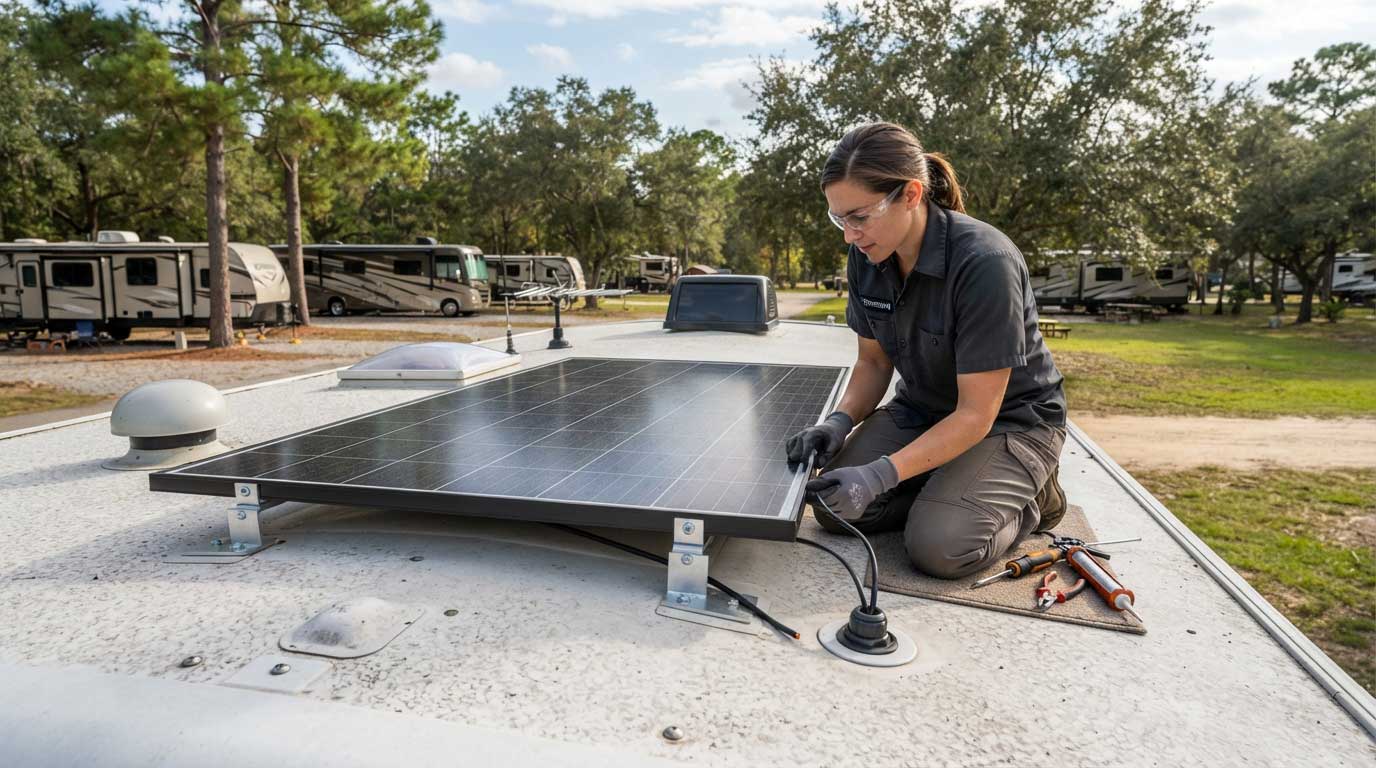
The rear side needs access to light, while the module still needs stable mechanical support. Those requirements can conflict. A mounting method that holds a flexible panel tightly against a roof may be mechanically simple but can reduce the rear irradiance that makes a bifacial design attractive.
Before fixing the panel in position, place the module temporarily over the intended mounting area and inspect the underside from several angles. Look for roof structure, rails, wiring, shadows from nearby equipment, and areas where the rear surface would be completely blocked.
Keep the Rear Surface Open Where Possible
For a bifacial flexible solar panel, an air gap can serve two purposes: it allows light to reach the rear side and can improve ventilation around the module.
The exact clearance should come from the manufacturer’s installation specification rather than an arbitrary number. A larger gap is not automatically better if it creates excessive wind loading, snagging risk, or mechanical movement.
For RVs and boats, low-profile supports are generally more practical than tall open racks. The objective is controlled clearance, not maximum height.
Do Not Assume Adhesive Mounting Is Always Appropriate
Adhesive mounting is attractive for curved vehicles because it keeps the installation low and avoids drilling into the roof. But a fully bonded installation can severely restrict rear-side illumination.
It also changes the thermal environment of the panel.
Before using an adhesive, verify:
- Roof or deck material compatibility
- Surface preparation requirements
- Manufacturer-approved adhesive type
- Expected temperature range
- Expansion and contraction of the substrate
- Water drainage around the module
- Serviceability of cables and connectors
- Whether the rear side must remain exposed for bifacial operation
For an installation where rear-side generation is an important part of the design, a mounting system that preserves controlled rear exposure may be preferable to complete bonding.
Rear-Side Light Is the Real Design Variable
The front of the module is relatively easy to understand: sunlight arrives, cells convert it, and the electrical output is measured.
The rear is less predictable.
A rear surface can receive diffuse sky radiation, reflected sunlight, or direct sunlight entering from the side. The amount changes throughout the day as the sun moves and as nearby objects cast shadows.
NREL’s bifacial PV modeling work treats the rear irradiance environment as a combination of factors including module geometry, shading, albedo, and view factors. In practical terms, the rear side should be evaluated as part of the entire installation rather than assigned a fixed gain number.
That matters when comparing supplier claims.
If a manufacturer says a bifacial module can produce an additional percentage of energy from the rear side, ask:
Under what rear irradiance, mounting height, albedo, and test condition?
Without those conditions, the percentage is difficult to apply to a real RV, boat, or roof.
Series and Parallel Wiring for Bifacial Flexible Panels
The fact that a module is bifacial does not fundamentally change the principles of PV electrical wiring.
In a series connection, module voltages add while current remains approximately limited by the string’s current characteristics.
In a parallel connection, current adds while voltage remains approximately at the operating voltage of the connected modules.
| Configuration | Voltage | Current | Typical design consideration |
|---|---|---|---|
| Series | Increases | Approximately unchanged | Useful when higher PV voltage is required |
| Parallel | Approximately unchanged | Increases | Useful when system voltage is fixed |
| Series-parallel | Increases | Increases | Used for larger arrays |
The important part is matching the array to the controller or inverter.
Do not size a charge controller only from the panel’s nominal wattage. Check the module Voc, Vmp, Isc, and Imp, then account for the lowest expected operating temperature when evaluating maximum string voltage.
This is particularly important for systems installed in regions with cold winter conditions. PV voltage rises as cell temperature falls, so a string that appears acceptable under a simple nameplate calculation can exceed a controller’s voltage limit in cold conditions.
For a B2B project, Bright Solar recommends providing the actual electrical datasheet before the buyer finalizes the string configuration.
Example: A Flexible Bifacial RV Installation
Consider a 32-foot Class C motorhome used for weekend travel and several longer trips each year.
The roof has:
- One air-conditioning unit
- Two roof vents
- One antenna
- A curved rear section
- Approximately 8 m² of practical solar area
The owner initially considers installing the maximum possible wattage directly against the roof.
A second design uses fewer panels but keeps the modules slightly elevated and leaves unobstructed rear exposure.
The second arrangement may be the more rational bifacial design even if its front-side nameplate capacity is lower.
Why?
Because the first design gives the rear surface almost no useful optical environment. The second design creates a path for reflected and diffuse light and also introduces some airflow underneath the panels.
This is a good example of why “more watts” and “more energy from a bifacial system” are not interchangeable statements.
In actual system design, roof geometry usually creates more constraints than the product catalog suggests.
Marine Installation: A Different Set of Constraints
A yacht or cruising boat can be a particularly interesting application because the available surface is limited and the surroundings can be reflective.
But the marine environment is unforgiving.
Salt spray reaches connectors. Foot traffic can occur around equipment. Stainless hardware can create localized shadows. A boom, mast, radar arch, or antenna can shade a panel at particular times of day.
The boat also changes orientation.
A panel that looks perfectly exposed while the vessel is tied to a dock may experience a different irradiance pattern while cruising or swinging at anchor.
For a marine project, inspect the proposed panel location at different times rather than judging the installation from a single photograph.
Marine Material Selection
For long-term marine use, examine the complete construction:
- Front and rear encapsulation
- UV resistance
- Saltwater exposure resistance
- Connector protection
- Junction-box construction
- Water ingress protection
- Mechanical attachment
- Cable strain relief
- Surface abrasion resistance
- Maintenance access
IEC 61215-1:2021 and IEC 61215-2:2021 include qualification and test procedures relevant to flexible and bifacial PV modules, including bending-related testing for flexible modules. These standards provide a useful reference when evaluating a manufacturer’s technical documentation.
They should not, however, be interpreted as proof that two products have identical durability. The actual construction and declared product qualification still need to be checked.
Case Example: Bifacial Flexible Solar Panel for a Cruising Yacht
Imagine a 34-foot cruising yacht operating along the Mediterranean coast.
The cabin roof is curved, the usable mounting area is approximately 4.5 m², and the owner wants to avoid a visually dominant rigid frame.
The first proposal places flexible panels directly on the cabin roof.
The second uses a low-profile mounting arrangement that creates rear exposure while maintaining clearance from deck equipment.
The second configuration gives the bifacial module a more favorable optical environment. A light-colored roof also provides a different rear-side reflection environment from a dark painted surface.
The correct procurement question therefore becomes:
Can the rear side receive enough light in this exact installation to justify the additional module complexity?
That is a much better question than asking for a universal bifacial gain percentage.
For a supplier or system integrator, the project documentation should include a roof drawing, panel dimensions, mounting method, electrical configuration, environmental conditions, and expected operating profile.
How Much More Energy Can a Bifacial Flexible Solar Panel Produce?
There is no single percentage that can responsibly be applied to every bifacial installation.
Rear-side gain depends on the amount and spectrum of irradiance reaching the rear surface. The installation geometry can change that substantially.
For example, a panel elevated over a highly reflective surface has access to a different rear irradiance environment than the same panel mounted a few millimeters above a dark roof.
This is also why a laboratory rating should not be presented as a guaranteed field-energy increase.
The U.S. Department of Energy notes that actual PV system energy yield is affected by conditions including solar irradiance, temperature, dirt, shading, and system characteristics.
For project calculations, use the actual site and mounting assumptions whenever possible.
A useful engineering model is:
Expected energy = front-side contribution + rear-side contribution − system losses
The rear-side contribution should be modeled using realistic irradiance assumptions rather than a generic percentage copied from a product brochure.
What Buyers Should Ask a Bifacial Flexible Solar Panel Manufacturer
For distributors, OEMs, installers, and system integrators, a technical conversation should go beyond “How many watts is the panel?”
Ask these questions:
- What is the rated front-side power?
- How is bifacial performance specified?
- Is a rear-side irradiance condition provided?
- What is the module’s bifaciality value, if applicable?
- What is the minimum bending radius?
- Can the module be installed on a curved surface?
- What mounting arrangement is recommended?
- How much rear clearance is required?
- What are Voc, Vmp, Isc, and Imp?
- What are the temperature coefficients?
- What are the dimensions and weight?
- What environmental and qualification testing applies?
- What connector and junction-box specifications are used?
- Is customization available for dimensions, cable location, or electrical configuration?
- What documentation is available for bulk procurement?
For custom projects, dimensions can be just as important as cell efficiency. A panel that fits around a roof vent without wasting installation area may be more valuable than a slightly more efficient panel with an unsuitable shape.
Bright Solar Bifacial Flexible Solar Panel Solutions
Bright Solar approaches flexible solar panel projects from the installation side as well as the module side.
For B2B customers, the important starting information is normally the application, usable dimensions, curvature, expected environment, required power, and electrical system. This allows the panel specification to be evaluated against the actual project instead of treating one standard configuration as suitable for every roof, boat, or off-grid structure.
For marine applications, material and environmental requirements need particular attention. For RV and vehicle applications, weight, dimensions, curvature, cable routing, and roof equipment can dominate the design.
Where a bifacial configuration is proposed, rear-side exposure should also be considered from the beginning.
The result is a more useful specification package for distributors and system integrators: electrical data, mechanical dimensions, bending limitations, construction details, and installation guidance are considered together.
Maintenance and Inspection
A flexible module does not eliminate routine inspection.
For RV and marine systems, check the installation whenever the vehicle or vessel is serviced.
Look for:
- Loose mounting points
- Lifted edges
- Damaged cables
- Connector contamination
- Water ingress
- Surface cracking
- Abrasion
- New shading from added equipment
- Dirt accumulation
- Changes in roof or deck condition
Cleaning should be based on the manufacturer’s instructions and local environmental conditions. Avoid aggressive tools or chemicals that could damage the module surface.
For marine installations, salt deposits deserve particular attention because they can accumulate on the module surface and surrounding hardware.
A useful inspection habit is to photograph the installation after commissioning. Later photographs can be compared with the original condition. Small edge lifting or cable movement is much easier to identify when there is a reference image.
FAQ About Bifacial Flexible Solar Panel
What is a bifacial flexible solar panel?
A bifacial flexible solar panel is a photovoltaic module designed to receive usable light from both its front and rear sides while accommodating controlled mechanical bending. Its real-world benefit depends on rear-side irradiance and installation conditions.
Are bifacial flexible solar panels better than regular flexible panels?
Not automatically. A bifacial model is more useful when light can reach its rear surface. If it is bonded directly to an opaque roof, much of the potential rear-side advantage may be unavailable.
Can a bifacial flexible solar panel be installed on an RV?
Yes, provided the module’s bending limits and mounting requirements suit the RV roof. For meaningful bifacial operation, the installation should also provide practical access to rear-side light.
Can bifacial flexible solar panels be used on boats?
Yes. Boats can be suitable when there is adequate space, controlled curvature, appropriate environmental protection, and rear-side exposure. Marine salt, vibration, shading, water, and mechanical loading should all be considered.
Does a bifacial solar panel produce twice as much power?
No. Bifacial does not mean the output automatically doubles. Rear-side production depends on the irradiance reaching the back of the module, including reflected and diffuse light.
Does a bifacial flexible panel need an air gap?
A rear gap can help expose the back of the module to light and may improve ventilation, but the required mounting clearance depends on the product design and installation specification.
How should I choose a bifacial flexible solar panel?
Start with the installation surface, curvature, available area, rear-side exposure, environmental conditions, and electrical system. Then compare rated power, dimensions, weight, bending radius, cell technology, construction, and manufacturer documentation.
Conclusion
A bifacial flexible solar panel is most valuable when its physical installation allows both sides of the module to contribute useful photovoltaic generation. Rear clearance, reflective surroundings, roof geometry, temperature, shading, and electrical design can have a greater practical effect than the bifacial label itself.
For RVs, boats, curved roofs, and specialized off-grid systems, the best solution is therefore not necessarily the panel with the highest advertised bifacial percentage. It is the panel whose construction, dimensions, bending capability, electrical characteristics, and mounting arrangement match the real installation.
For B2B buyers, that means evaluating the module together with its application from the first technical discussion. Bright Solar can use the project dimensions and system requirements to help determine whether a bifacial flexible configuration is technically appropriate.
Related recommendations
-

Renewed strategic cooperation between CLP and Munich Re
125Zonergy Corporation presents advanced energy storage solutions and smart microgrid technologies at EES Europe. The company offers residential, commercial, and large-scale photovoltaic and storage products, driving the growth of renewable energy in...
View details -
Solar Panels in Parallel: When Parallel Wiring Is the Smartest Choice
234Learn how solar panels in parallel improve system reliability, reduce shading losses, and optimize 12V battery charging. Expert guide from Bright Solar.
View details -
400w Solar Panel Size: Dimensions, Power Output, and Installation Guide
160A 400W solar panel typically measures about 65–82 × 39–44 inches, with actual dimensions varying by manufacturer, cell technology, and module design.
View details -
Walkable Solar Panels for Boats, RVs and High-Traffic Surfaces
219Discover how walkable solar panels provide reliable power while supporting foot traffic on boats, RVs, and marine decks. Learn key specifications, durability, and installation tips.
View details