
Solar Panel Series vs Parallel: Which Wiring Setup Works Better?
Solar panel series vs parallel wiring depends on system voltage, shading conditions, cable distance, and charging equipment. Series wiring increases voltage and improves efficiency across long cable runs, while parallel wiring improves stability when panels experience partial shading from trees, rooftop equipment, or marine rigging.
The clean diagrams online make this decision look simple.
Reality usually is not.
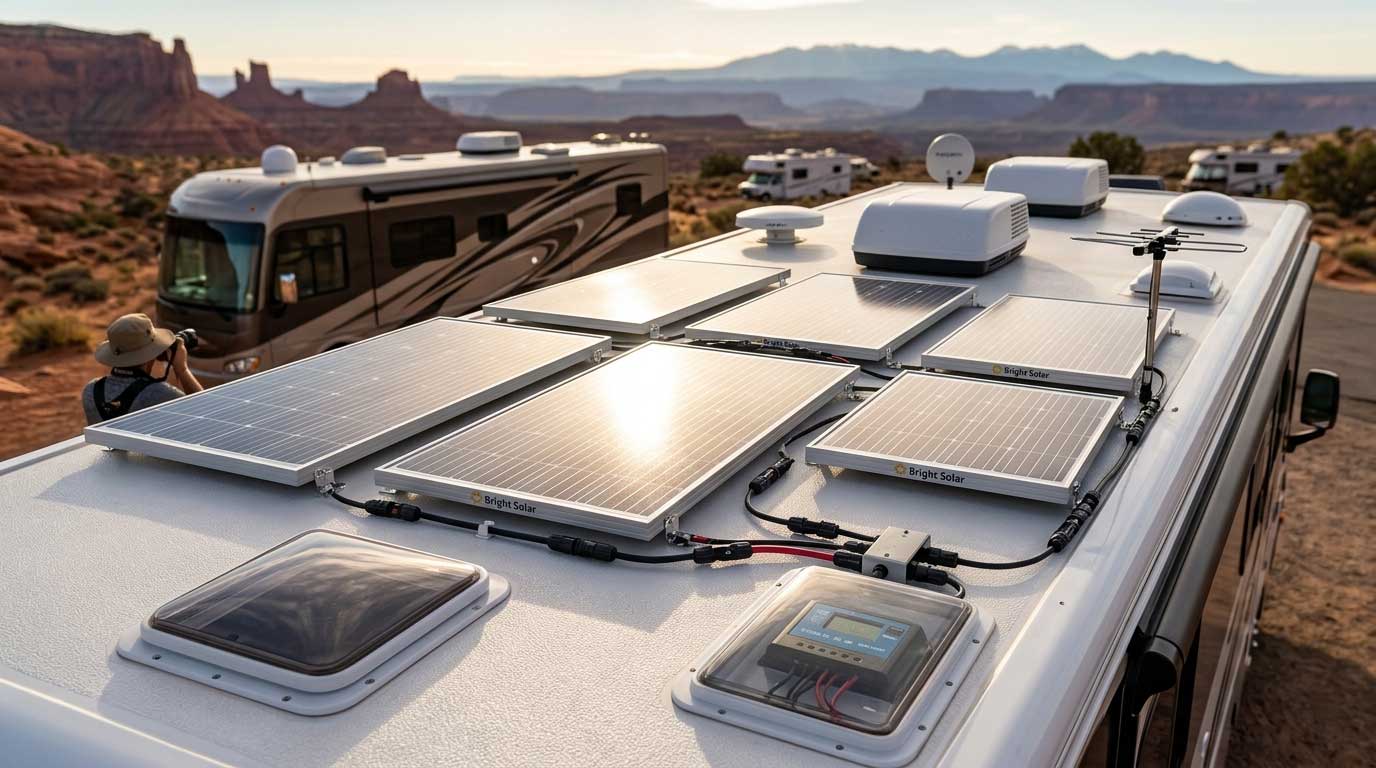
A few years ago, I worked with a retired couple traveling through Arizona in a fifth-wheel RV. Their rooftop solar system looked impressive on paper:
- Four 200W panels
- Lithium battery bank
- Premium inverter
- MPPT charge controller
Yet the batteries kept falling below expected charging levels every afternoon.
At first they blamed the panels.
Then the batteries.
Eventually we climbed onto the roof during peak sunlight and found the actual problem. One air-conditioning shroud cast a narrow shadow across a single panel for about three hours each day.
The entire array had been wired in series.
That tiny strip of shade reduced production across the whole string.
After converting the system into a series-parallel configuration, daily charging improved noticeably within hours.
Not theoretically.
Visibly.
That experience reinforced something I’ve seen repeatedly across RVs, boats, and off-grid cabins:
The best solar wiring setup is rarely chosen by formulas alone. It is chosen by real environmental conditions.
And outdoor environments are messy.
Understanding Solar Panel Series vs Parallel Wiring
Before comparing performance, it helps to understand how each electrical configuration works.
Series Wiring Explained
When solar panels connect in series:
- Voltage increases
- Current remains constant
Example:
- Two 12V 100W panels
- Wired in series
- Result: 24V output
Series wiring is commonly used for:
- MPPT charging systems
- Long cable distances
- Higher-voltage battery banks
- Large off-grid systems
The advantage is efficiency.
Higher voltage means lower current for the same power output, which reduces transmission loss through wiring.
Parallel Wiring Explained
When solar panels connect in parallel:
- Current increases
- Voltage stays the same
Example:
- Two 12V 100W panels
- Wired in parallel
- Result: 12V output with doubled current
Parallel wiring is common for:
- RV solar systems
- Marine solar setups
- Small battery banks
- Partial shading environments
And shading matters far more outdoors than many first-time solar owners expect.
Why Voltage Loss Matters More Than Most Beginners Realize
One thing solar marketing rarely explains clearly is voltage drop.
Long cable runs create electrical resistance.
Resistance wastes energy.
According to the U.S. Department of Energy, higher-voltage solar systems reduce resistive transmission losses and improve overall system efficiency.
Source: U.S. Department of Energy
https://www.energy.gov/eere/solar
This becomes extremely important in:
- Large RVs
- Cabins
- Marine installations
- Remote battery locations
I once inspected a van conversion in Utah where the installer placed batteries beneath the rear bed platform while routing solar cables from the front roof section.
The cable distance exceeded 25 feet round-trip.
The system was wired entirely in parallel.
During peak afternoon charging, voltage drop became significant enough that charging current fell almost 18% below expected output.
After rewiring into series configuration:
- Cable temperatures decreased
- Charging stabilized
- MPPT efficiency improved immediately
The owner noticed the difference on the controller display before I even finished packing tools.
Series Wiring Advantages
Series wiring works especially well in stable sunlight environments.
Desert installations often benefit from this setup because shading remains minimal for long periods.
Main Benefits of Series Solar Wiring
| Advantage | Real-World Benefit |
|---|---|
| Higher voltage | Better transmission efficiency |
| Lower current | Reduced cable heat |
| Smaller wire size | Easier installation |
| Strong MPPT compatibility | Improved charging performance |
Case Study: Off-Grid Cabin in Colorado
One Bright Solar customer installed:
- Six 300W solar panels
- 48V lithium battery bank
- MPPT charge controllers
- Mountain cabin energy system
Initially, the installer considered parallel wiring because it seemed simpler.
But the solar array sat nearly 80 feet from the battery room.
Series wiring dramatically reduced voltage loss over that distance.
Winter charging performance improved especially well because cold temperatures increase solar voltage output naturally.
According to National Renewable Energy Laboratory (NREL) research, photovoltaic modules often perform more efficiently under cooler environmental conditions.
Source: National Renewable Energy Laboratory
https://www.nrel.gov
That mountain system still performs reliably through snow seasons today.
Parallel Wiring Advantages
Parallel wiring becomes valuable when partial shading cannot be avoided.
And honestly, that describes many mobile solar systems perfectly.
RV roofs are crowded:
- Air conditioners
- Roof vents
- Cargo racks
- Satellite equipment
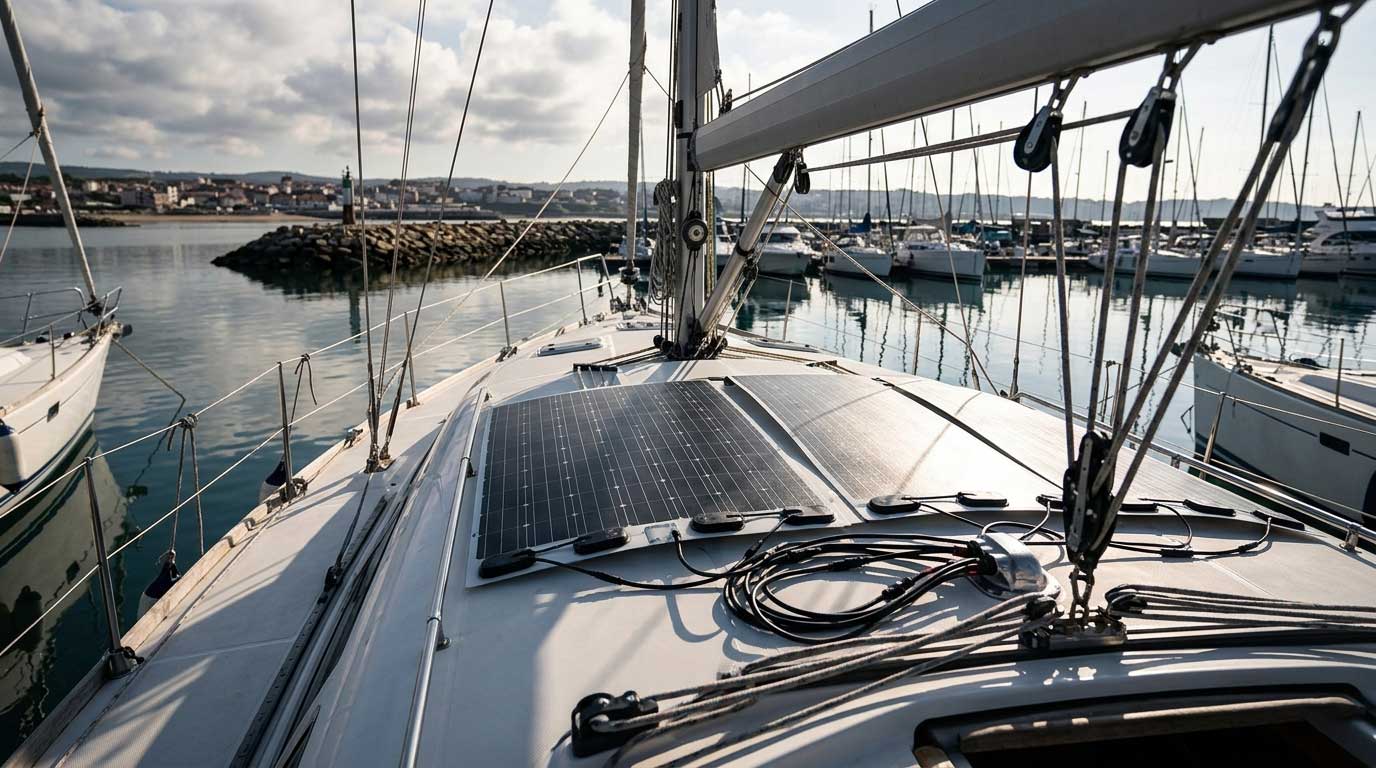
Boat decks create even more shading challenges because:
- Mast shadows move constantly
- Rigging changes throughout the day
- Coastal cloud cover shifts rapidly
Main Benefits of Parallel Wiring
| Advantage | Real-World Benefit |
|---|---|
| Better shading resistance | More stable daily output |
| Simpler expansion | Easy to add panels later |
| Stable voltage | Good for small battery systems |
| Flexible panel behavior | Useful for marine applications |
Real Marine Installation Example
A customer operating a 38-foot sailboat near Fort Lauderdale installed:
- Four flexible solar panels
- Refrigeration system
- Navigation electronics
- Lithium battery bank
The original installer wired all panels in series.
During offshore sailing, mast shadows repeatedly crossed one section of the array.
Output fluctuated constantly.
Battery recovery became unreliable after cloudy afternoons.
Eventually the owner rewired the system into parallel configuration.
Peak efficiency dropped slightly under perfect sunlight.
But real-world energy production improved substantially over multi-day sailing trips.
That tradeoff mattered more offshore than laboratory efficiency numbers.
Why Many Professional Installers Prefer Hybrid Wiring
Pure series wiring is not always ideal.
Pure parallel wiring is not always ideal either.
Many advanced systems combine both approaches.
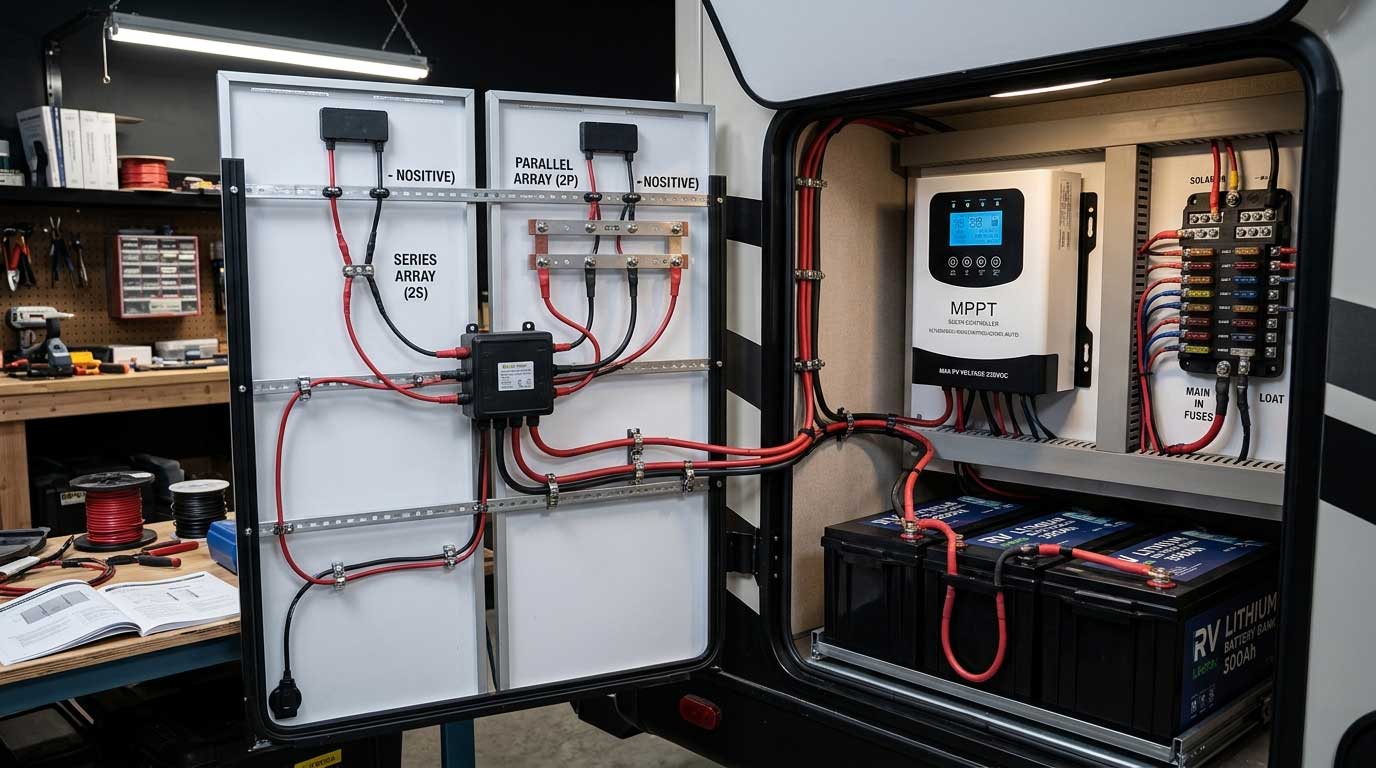
This is called series-parallel wiring.
Example:
- Two panels wired in series
- Multiple series strings connected in parallel
This setup balances:
- Voltage efficiency
- Shading tolerance
- Cable management
- System scalability
Several larger RV systems I’ve inspected over the last two years used hybrid configurations almost exclusively above 600W capacity.
Especially on expedition vehicles where rooftop obstructions are unavoidable.
How MPPT Controllers Change the Equation
MPPT charge controllers significantly improve series solar performance.
Unlike PWM controllers, MPPT systems convert excess voltage into usable charging current more efficiently.
According to Victron Energy technical documentation, MPPT controllers improve charging performance under changing sunlight and temperature conditions.
Source: Victron Energy
https://www.victronenergy.com
This becomes very noticeable during:
- Cold mornings
- Cloud transitions
- Partial shading recovery
- Long cable installations
Real RV Upgrade Example
One overlanding truck in New Mexico upgraded from:
- PWM charging
to - MPPT charging with series wiring
The solar array itself never changed.
Yet average daily charging increased by roughly 15–20% during field testing over several weeks.
The owner initially thought the batteries had improved.
They had not.
The wiring and charge management simply became more efficient.
Common Mistakes in Solar Panel Series vs Parallel Installations
Most underperforming solar systems are not caused by defective panels.
Installation decisions cause the majority of real-world problems.
Ignoring Shade Patterns
One roof vent can reduce output dramatically in a series string.
Mixing Different Solar Panels
Unequal voltage behavior creates instability.
Especially dangerous in series configurations.
Undersized Wiring
High-current parallel systems require thicker cable to prevent excessive voltage loss.
Solar Panel Series vs Parallel Comparison Table
| Feature | Series Wiring | Parallel Wiring |
|---|---|---|
| Voltage | Higher | Lower |
| Current | Lower | Higher |
| Shade Tolerance | Lower | Better |
| Cable Efficiency | Better | Lower |
| Best For | Long cable runs | Partial shading |
| Ideal Controller | MPPT | PWM or MPPT |
FAQ: Solar Panel Series vs Parallel
Is series or parallel wiring better for solar panels?
It depends on the environment. Series wiring improves efficiency and reduces voltage loss, while parallel wiring handles partial shading better.
Do solar panels charge faster in series?
Series wiring often improves charging efficiency when paired with MPPT controllers because higher voltage reduces transmission losses.
What happens if one solar panel is shaded in series?
In series wiring, one shaded panel can reduce output across the entire string significantly.
Can I combine series and parallel solar wiring?
Yes. Many larger solar systems use hybrid series-parallel configurations for balanced performance.
Is parallel solar wiring safer?
Parallel systems operate at lower voltage, which some installers prefer for smaller RV and marine applications.
Final Thoughts
The solar panel series vs parallel debate sounds technical online.
Outdoors, it becomes practical very quickly.
If your system faces:
- Long cable distances
- Stable sunlight
- High-voltage MPPT charging
Series wiring often performs better.
If your setup deals with:
- Trees
- Boat rigging
- Rooftop shadows
- Variable sunlight
Parallel wiring may produce more consistent energy overall.
And after enough years around mobile solar systems, one truth keeps repeating itself:
The best solar installation is rarely the one with the highest theoretical efficiency.
It is the one still quietly charging batteries after weeks of heat, vibration, clouds, dust, and imperfect conditions.
That is the setup people actually trust on the road.
Related recommendations
-

Flexible Solar Panel Installation for RVs, Boats, and Off-Grid Systems
149Learn flexible solar panel installation for RVs, boats, vans, and off-grid systems. Discover lightweight mounting methods and real-world tips.
View details -
Flexible solar panel boat: Lightweight Marine Solar Solution for Modern Vessels
230Discover flexible solar panel boat solutions from Bright Solar. Learn how lightweight marine solar panels improve boat energy efficiency, installation flexibility, and off-grid performance.
View details -
Flexible RV Solar Panels for Reliable Off-Grid Power
180Flexible RV solar panels deliver lightweight off-grid energy for campers, vans, and motorhomes. Discover durable ETFE solar solutions from Bright Solar.
View details -
200 Watt Flexible Solar Panel for RV, Marine, and Off-Grid Applications
206200 watt flexible solar panel solutions provide lightweight, durable off-grid energy for RVs, boats, cabins, and mobile systems with reliable solar efficiency.
View details