Folding Camping Solar Panels: A Practical Guide to Portable Power
Folding camping solar panels provide portable electricity for phones, lights, cameras, laptops, batteries, and compatible power stations. Their key advantage is that campers can move the panel into better sunlight instead of relying on a fixed position.
Camping solar is less about chasing a perfect number on a specification sheet and more about where the panel actually spends the day. A 200W panel sitting under a pine tree is still a 200W panel on paper. It simply has a poor solar resource.
The U.S. Department of Energy explains that solar radiation varies with location, time of day, season, local landscape, and weather. Solar energy reaching the ground is generally greatest when sunlight strikes the surface more directly.
That is the practical reason folding panels work so well outdoors: the generating surface can move when the sunlight moves.
What Are Folding Camping Solar Panels?
Folding camping solar panels are portable photovoltaic panels designed with multiple connected sections that fold together for transportation and storage. When opened, the sections create a larger solar collection surface; when closed, the package becomes easier to carry and store.
The electricity itself is generated through conventional photovoltaic technology. The DOE explains that PV materials convert sunlight into electricity, while individual cells are connected into modules and larger arrays to increase power output.
The folding structure changes the form factor, not the basic photovoltaic process.
A typical camping system can include:
- Folding solar panel
- Solar cable
- MC4-style or other compatible connectors
- Solar charge controller, when required
- Portable power station or battery
- Inverter for AC loads, when applicable
- Camping devices and appliances
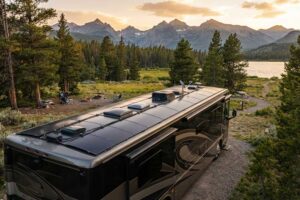
This makes folding solar different from a permanently mounted RV panel.
The fixed panel is always ready, but it is tied to the location where it was installed. The folding panel requires setup, but it can be carried into an open patch of sunlight.
That tradeoff is often worthwhile at campsites.
Folding vs. Flexible Solar Panels
The terms are sometimes used interchangeably in online listings, but they should not be.
| Type | Main characteristic | Typical use |
|---|---|---|
| Rigid solar panel | Fixed structural frame | RV roofs, homes, permanent installations |
| Flexible solar panel | Bendable construction | Curved roofs, vehicles, lightweight installations |
| Folding solar panel | Multiple sections fold together | Camping, portable batteries, temporary use |
| Folding flexible panel | Combines folding and flexible construction | Specialized portable applications |
A folding product should not be assumed to tolerate unlimited bending.
If a manufacturer specifies a bending radius, folding direction, hinge movement, or storage procedure, those are operating requirements—not optional suggestions.
For B2B buyers, this distinction becomes important when defining an OEM product. A panel designed for backpacking does not necessarily need the same construction as a larger RV-oriented folding system.
Why Use Folding Camping Solar Panels?
The strongest advantage is placement freedom.
Imagine arriving at a campsite in the afternoon. The best tent location is beneath a group of trees. It is cooler, quieter and more comfortable.
Unfortunately, it is also shaded.
Thirty feet away, there is an open gravel area receiving direct sunlight.
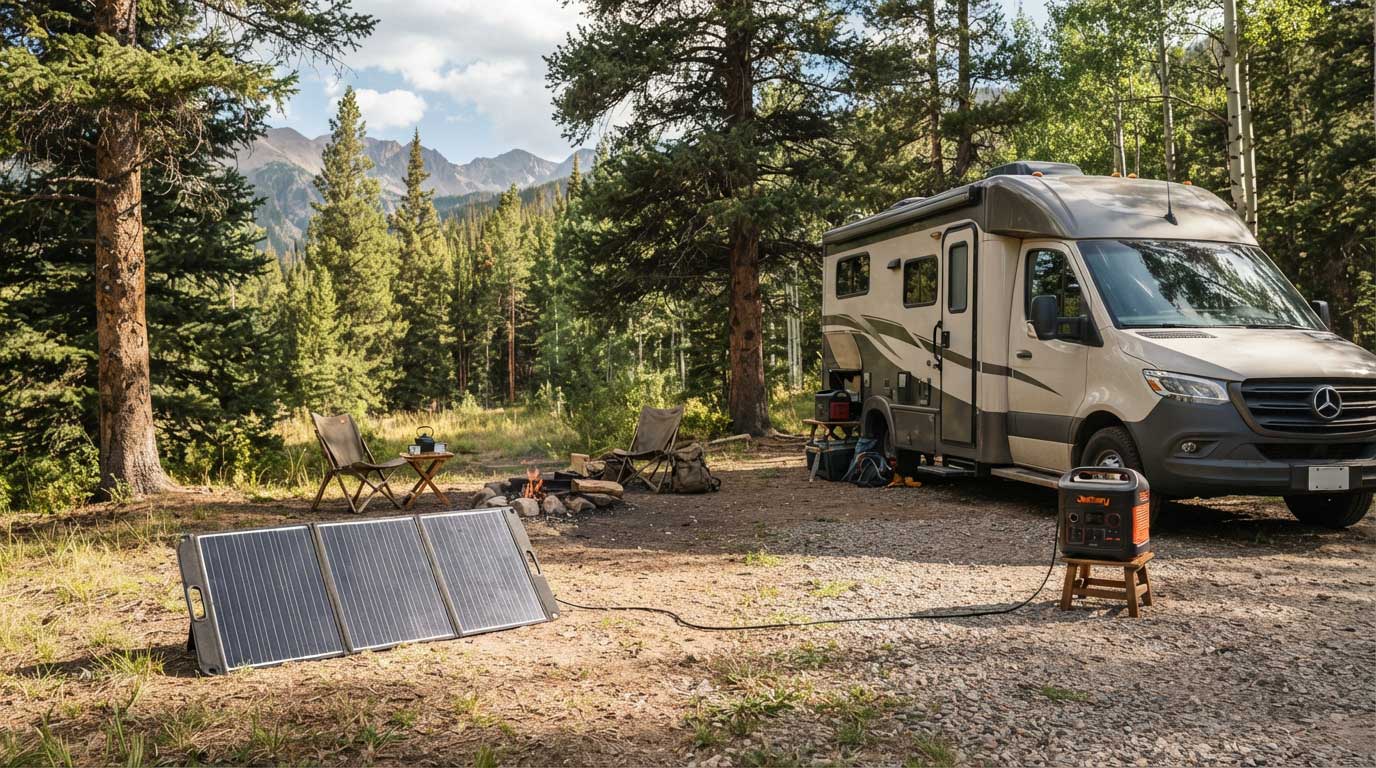
A folding panel can go there.
The power station can remain beside the tent or inside the RV.
That simple separation is one of the most useful characteristics of portable solar.
The DOE notes that early morning and late afternoon sunlight travels through more atmosphere because the sun is lower in the sky, while solar energy reaching the surface is generally greatest around solar noon.
A portable panel lets the user respond to those changes instead of leaving the panel in one fixed position.
Main Advantages for Campers
- Portable between campsites
- Compact when folded
- Easy to deploy temporarily
- Can be moved away from shade
- Can be angled toward the sun
- Useful with portable power stations
- No permanent roof installation
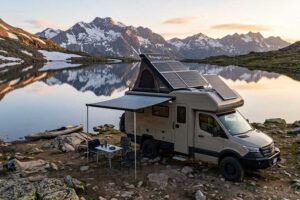
- Suitable for RVs, vans and car camping
- Can supplement existing solar systems
- Easy to store between trips
There is also a quieter benefit.
The solar panel does not have to occupy the same space as the person using the electricity.
A panel can sit at the sunny edge of a campsite while the battery, refrigerator, laptop, or lighting remains under shelter.
For a weekend trip, that can make the whole setup less intrusive.
How Folding Camping Solar Panels Generate Electricity
The solar cells absorb sunlight and generate DC electricity.
The DOE identifies silicon as the most common semiconductor material used in solar cells, with crystalline silicon forming the basis of many photovoltaic products.
The panel output then enters the charging system.
A simplified camping configuration is:
Sunlight → folding solar panel → charge controller or power station input → battery → camping equipment
The exact configuration depends on the equipment.
Some portable power stations accept solar input directly because charging electronics are integrated into the unit. A separate battery installation may require an external solar charge controller.
That is why the connector alone is never enough to determine compatibility.
A plug can fit and the electrical specifications can still be wrong.
What Affects Solar Panel Efficiency?
Not all sunlight reaching a photovoltaic cell becomes usable electrical energy.
The DOE identifies wavelength, recombination, temperature and reflection among the factors affecting PV conversion efficiency. Higher temperatures can reduce voltage, while reflection prevents some incoming light from being absorbed by the cell.
Outdoor conditions are therefore different from laboratory ratings.
The DOE also explains that PV performance is measured under controlled conditions and that actual operating conditions can vary significantly.
This is why a camping solar panel should be evaluated by its complete operating conditions rather than its headline wattage alone.
How Much Power Do Folding Camping Solar Panels Produce?
A folding camping solar panel’s rated wattage describes its electrical output under specified test conditions. It does not represent guaranteed daily energy production.
For basic planning, campers can use:
Estimated energy = panel wattage × equivalent peak-sun hours
For example, a theoretical 200W panel exposed to the equivalent of four full-sun hours would produce:
200W × 4h = 800Wh
That calculation is deliberately simple. Real energy delivered to a battery will normally be affected by weather, orientation, shading, temperature, wiring and conversion losses.
| Panel rating | 3 sun-hours | 4 sun-hours | 5 sun-hours |
|---|---|---|---|
| 100W | 300Wh | 400Wh | 500Wh |
| 200W | 600Wh | 800Wh | 1,000Wh |
| 300W | 900Wh | 1,200Wh | 1,500Wh |
| 400W | 1,200Wh | 1,600Wh | 2,000Wh |
These figures are planning examples, not guaranteed output.
The actual solar resource depends heavily on location and weather. The DOE states that geographic location, season, time of day, landscape and weather all affect the amount of solar radiation reaching a site.
A 200W Panel Does Not Produce 200W All Day
This is one of the most common misunderstandings in portable solar.
A panel rated at 200W may approach its rated output under favorable conditions, but sunlight changes continuously.
Clouds move.
The sun changes angle.
A tree shadow reaches the panel.
The panel heats up.
The battery’s charging system may limit input.
Even the cable can contribute to losses.
The DOE explains that electrical power from a PV device is determined through its current-voltage behavior under controlled test conditions.
For camping, therefore, it is more useful to think in watt-hours per day than to expect a fixed wattage throughout daylight.
Why Shade Matters So Much at a Campsite
A campsite can be visually bright without being a good solar location.
Under dense tree cover, much of the direct sunlight is blocked or scattered.
The DOE explains that atmospheric conditions can reduce direct beam solar radiation by about 10% even on clear, dry days and can eliminate direct beam radiation during thick cloud conditions.
Trees create a different shading pattern, but the practical point is the same: the solar resource available to the panel is not constant.
This is where a folding design earns its keep.
Move the panel.
Not the RV.
Not the tent.
Not the entire campsite.
How to Set Up Folding Camping Solar Panels
Step 1: Find the Longest Useful Sunlight
Before unfolding the panel, look around the campsite.
Identify:
- Tall trees
- Vehicle shadows
- Buildings
- Hills
- Rock formations
- Morning shade
- Afternoon shade
A sunny patch at 10 a.m. may be shaded by 2 p.m.
For longer camping trips, this matters more than finding a single perfect position.
Step 2: Choose a Durable Surface
Portable solar equipment should not require damaging the campsite to find sunlight.
The National Park Service recommends camping and traveling on durable surfaces such as established campsites, rock, gravel, dry grass and snow, while advising campers not to unnecessarily alter a site.
For a folding panel, gravel, packed ground or an existing campsite surface can be practical choices.
Avoid placing the panel where repeated foot traffic will disturb vegetation.
The solar panel needs sunlight.
It does not need a new trail.
Step 3: Unfold the Panel Completely
Open the panel according to the manufacturer’s instructions.
Make sure:
- All sections are properly opened
- Hinges are not under tension
- Cables are not trapped
- The active surface is unobstructed
- The panel is stable
Do not force a folding section beyond its intended position.
A flexible panel should also not be repeatedly creased unless its construction is specifically designed for that operation.
Step 4: Position the Panel Toward the Sun
Orientation matters.
The DOE explains that the angle of incoming solar radiation changes throughout the day, with the greatest solar energy generally reaching the surface around solar noon when the sun is highest.
A folding panel does not need to be mathematically perfect to be useful.
A practical field approach is:
Morning: aim toward the morning sun.
Midday: check whether the panel has become shaded.
Afternoon: reposition if necessary.
The point is not to spend the entire day adjusting the panel.
It is to prevent an avoidable shadow from sitting across it for hours.
Step 5: Connect the Power System
Check the electrical specifications before connecting.
Important values include:
- Rated power
- Vmp
- Voc
- Imp
- Isc
- Maximum solar input
- Connector type
- Polarity
- Charge-controller voltage range
For portable power stations, verify the manufacturer’s maximum solar-input voltage and current.
Do not assume that a higher-wattage panel will automatically charge a power station faster. The receiving system may impose an input limit.
Step 6: Watch the First Charging Cycle
The first deployment is the best time to establish a baseline.
Check the power station display.
Record the approximate solar input under stable sunlight.
Notice what happens when a cloud passes.
If the output remains unusually low after direct sunlight returns, inspect:
- Shading
- Panel orientation
- Cable connection
- Connector condition
- Power-station input limits
This is faster than immediately assuming the panel is defective.
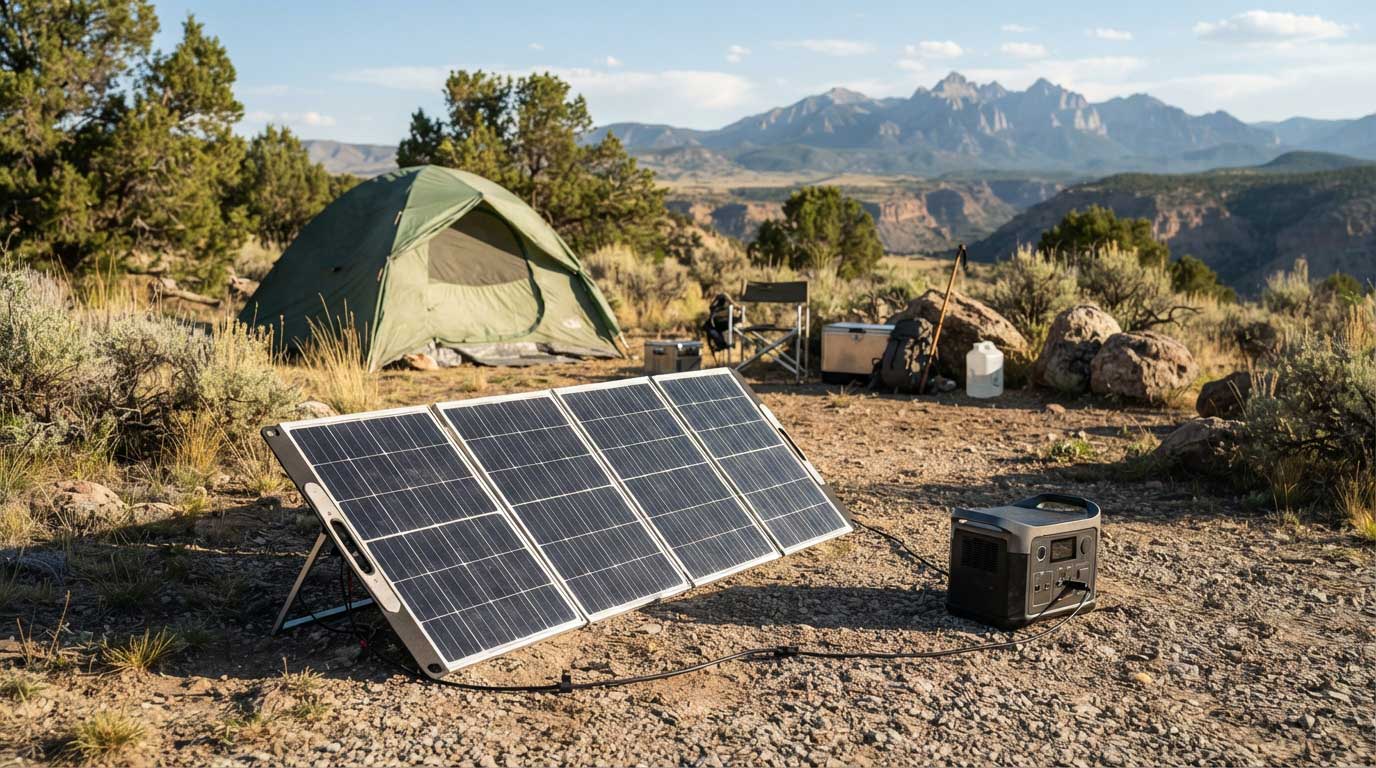
How to Choose Folding Camping Solar Panels
The best panel is not necessarily the largest one.
It is the one that fits the trip.
Panel Wattage
Start with daily energy demand.
A camper charging only a phone and camera batteries has different requirements from an RV user running a refrigerator, laptop and communication equipment.
Folded Size
Measure the actual storage location.
A panel may look compact in product photography and still be awkward inside a vehicle.
For OEM buyers, folded dimensions should be specified before mechanical tooling is finalized.
Deployed Size
The panel also needs enough space to open fully.
A large folding array may be excellent at a spacious RV campground and inconvenient at a crowded tent site.
Weight
Weight matters according to the transportation method.
For backpacking, every extra kilogram becomes part of the load.
For RV camping, weight is usually less restrictive because the panel travels inside the vehicle.
Cell Type
Monocrystalline silicon is widely used in solar modules. The DOE identifies silicon as the most common semiconductor used for solar cells.
For B2B projects, however, cell selection should be considered alongside:
- Target power
- Product dimensions
- Efficiency requirements
- Cost
- Temperature conditions
- Mechanical design
Surface Construction
Outdoor solar panels encounter:
- UV exposure
- Dust
- Moisture
- Temperature changes
- Repeated folding
- Abrasion
- Transport impacts
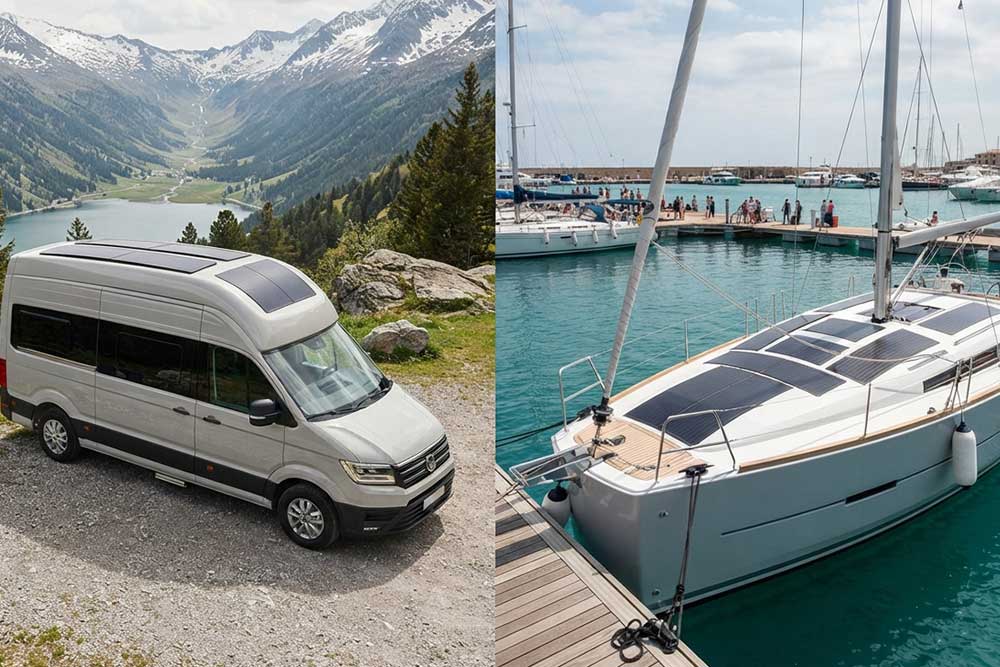
A camping product and a marine product should not automatically use identical construction.
Bright Solar’s product range reflects this application-specific approach. The L Series has a maximum bending capacity of 30% and is designed around lightweight flexible applications. The H Series is positioned for marine/yacht use with double ETFE construction and a walkable design.
The correct construction depends on the environment.
Folding Camping Solar Panels for RVs and Vans
RV and van users often have two conflicting requirements:
Shade for people. Sunlight for solar.
A vehicle parked under trees may be the perfect place to spend an afternoon but a poor place to collect solar energy.
A folding panel solves the positioning problem.
The panel can sit at the sunny edge of the campsite while the battery remains inside the vehicle.
This makes folding solar particularly useful as:
- Supplementary RV solar
- Temporary charging
- Off-grid camping power
- Emergency charging
- Backup for portable power stations
It does not necessarily replace roof-mounted solar.
In many cases, the two systems serve different purposes.
A roof panel is always installed.
A folding panel is available when you need to move the solar collection area.
Folding Camping Solar Panels for Portable Power Stations
Portable power stations have made folding solar easier for casual users because the battery, inverter, display and charging electronics are integrated into one enclosure.
But the panel still has to match the station.
Before purchasing, compare:
| Specification | Panel | Power station |
|---|---|---|
| Operating voltage | Must be compatible | Input voltage range |
| Current | Must stay within limit | Maximum input current |
| Power | Panel rated output | Maximum solar input |
| Connector | Must physically/electrically match | Required connector |
| Polarity | Must match | Input polarity |
| Number of panels | Series/parallel rules | Permitted configuration |
Never build a series connection simply to increase voltage without checking the power station’s maximum input voltage.
This is especially important with cold-weather camping, when open-circuit voltage can rise.
For B2B products, these electrical boundaries should be designed into the product specification rather than left for customers to discover during installation.
A Practical Camping Example
Consider a couple spending three days in a camper van.
Their main daytime loads are:
- Two smartphones
- Camera batteries
- Laptop
- LED lighting
- Portable refrigerator
- Small communication equipment
The van is parked beneath trees because the site is cooler there.
A fixed roof panel receives intermittent sunlight.
A folding solar panel is carried to an open gravel area roughly 10–15 metres away.
The battery remains in the van.
Around midday, the panel produces substantially more useful charging power because the active surface is exposed to direct sunlight instead of the tree canopy.
Later, a long shadow reaches the panel.
One person moves it several metres.
That is the entire intervention.
No rewiring.
No vehicle relocation.
No change to the campsite.
This is a realistic advantage of folding solar that is difficult to capture in a product specification table: the user can react to the site.
What Can You Power With Folding Camping Solar Panels?
Start with energy consumption rather than appliance count.
| Camping load | Relative demand | Suitable solar planning |
|---|---|---|
| Phone | Low | Small portable system |
| GPS | Low | Small portable system |
| Camera batteries | Low–medium | Compact panel |
| LED lights | Low | Compact panel |
| Laptop | Medium | Larger panel/battery combination |
| Portable refrigerator | Medium–high | Larger solar + battery system |
| Cooking appliances | High | Substantially larger system |
| Air conditioning | Very high | Large dedicated energy system |
These are application categories rather than fixed consumption figures. Actual energy use depends on device efficiency, operating time, temperature and duty cycle.
A refrigerator illustrates the problem nicely.
Its compressor may cycle instead of running continuously. A laptop may draw more power during rendering than during writing. A phone may consume little energy during normal use but become important when used for navigation all day.
For serious system sizing, measure actual watt-hours whenever possible.
Common Mistakes With Folding Camping Solar Panels
Leaving the Panel Beside the Tent All Day
Convenient does not always mean productive.
If the tent is in shade, the panel may be too.
Move it.
Treating Rated Wattage as Daily Output
A 200W rating is not an 800Wh daily guarantee.
Solar resource varies by location, weather, season and time of day.
Using Fragile Ground Without Considering Site Impact
The National Park Service recommends durable surfaces for camping and emphasizes that good campsites should be found rather than unnecessarily altered.
A solar setup should follow the same principle.
Ignoring Wind
A folding panel has a relatively large surface area.
A sudden gust can turn a carefully positioned panel into a moving object.
Secure it according to the manufacturer’s instructions and local conditions.
Choosing Only by Wattage
A heavier panel with a larger footprint may produce more electricity but be so inconvenient that the owner rarely deploys it.
The best portable solar system is one that people will actually carry and use.
Maintenance for Folding Camping Solar Panels
Portable equipment spends more time being handled than permanently mounted equipment.
Before folding the panel:
- Remove loose dirt and debris
- Check the surface
- Inspect cables
- Inspect connectors
- Check hinges or folding sections
- Look for impact damage
- Make sure no cable is trapped between sections
Do not fold dirt and gravel into the product.
Keep the panel stored according to the manufacturer’s recommendations.
If the panel has been used around salt water, pay particular attention to connectors, cables and exposed hardware.
The product’s environmental rating should determine the cleaning and storage procedure rather than a generic assumption that every solar panel is waterproof.
Bright Solar Folding Camping Solar Panel Solutions
Bright Solar develops flexible and portable solar products for B2B applications including RVs, mobile homes, camping, boats, ships, portable power stations and off-grid systems.
For commercial buyers, a folding camping solar panel often needs customization beyond wattage.
Typical requirements include:
- Rated power
- Folded dimensions
- Deployed dimensions
- Cell configuration
- Surface material
- Cable length
- Connector type
- Weight target
- Electrical configuration
- OEM branding
- Packaging
- Bulk procurement
Bright Solar’s product experience also shows why application-specific construction matters.
The L Series supports a maximum bending capacity of 30% and is intended for lightweight flexible applications. The H Series is designed for marine/yacht applications and uses double ETFE construction with a walkable design.
Those products should not be treated as interchangeable simply because both are flexible solar products.
For a camping-focused OEM project, the better starting point is the actual operating scenario:
Who carries the panel? Where is it stored? How often is it folded? What battery will it charge? How much space is available when deployed? What weather conditions are expected?
Those answers usually reveal the correct product architecture faster than choosing a wattage first.
FAQ About Folding Camping Solar Panels
Are folding camping solar panels worth buying?
Yes. They are particularly useful when users need portable electricity and want to move the solar panel into direct sunlight. They work well for camping, RVs, vans, portable power stations and temporary off-grid applications.
How do folding camping solar panels work?
They use photovoltaic cells to convert sunlight into DC electricity. The generated power is then supplied to a compatible battery, charge controller or portable power station.
What size folding solar panel do I need for camping?
The required size depends on daily energy consumption, battery capacity, sunlight availability and the devices being powered. Phones and lights need much less energy than refrigerators, laptops or high-power appliances.
Do folding camping solar panels work in cloudy weather?
Yes, but output normally decreases because clouds change the amount of direct and diffuse solar radiation reaching the panel. Thick clouds can eliminate direct beam solar radiation at the surface.
Can folding camping solar panels charge a portable power station?
Yes, if the panel’s voltage, current, connector and power rating are compatible with the power station’s solar input. Always check the power station’s maximum solar-input limits before connecting.
Can I use folding camping solar panels with an RV?
Yes. Folding panels can supplement roof-mounted RV solar or provide portable charging when the RV roof is shaded. They can be placed away from the vehicle in an area with better sunlight.
How should I store folding camping solar panels?
Clean the panel according to the manufacturer’s instructions, inspect the cables and folding sections, then store it in the specified folded position in a dry, protected location. Avoid crushing the folded panel under heavy equipment.
Conclusion
Folding camping solar panels are most useful when portability improves access to sunlight. The panel can leave the shade of an RV, move around a campsite, follow changing sunlight and return to a compact storage format after the trip.
The practical value is not simply the number printed in watts. It is the combination of power, folded size, weight, deployed area, electrical compatibility, mechanical durability and ease of deployment.
For B2B buyers, Bright Solar provides flexible and portable solar solutions for RV, camping, portable power and off-grid applications, including OEM, ODM and bulk procurement requirements.
Related recommendations
-

1000 Watt Flexible Solar Panel: Output, Sizing and Installation Guide
297A 1000 watt flexible solar panel system is suitable for large RVs, vans, boats, and cabins where roof shape and weight matter. Actual energy production depen...
View details -
Disadvantages of Flexible Solar Panels: What to Know Before Buying
178Flexible solar panels can have limitations in heat management, physical protection, bending, installation, repair, cost, and service life. Product-specific c...
View details -
Solar Panel Flexible: A Practical Guide to Lightweight Solar Power
235Explore solar panel flexible technology for RVs, marine applications, camping, and off-grid systems. Learn benefits, efficiency, durability, and installation tips.
View details -
Solar Panel Pergola: Combining Outdoor Living and Renewable Energy
242Explore solar panel pergola solutions that combine outdoor shade and renewable energy. Learn design options, costs, benefits, and installation tips from Bright Solar.
View details