100W Foldable Solar Panel Charger: Output, Uses and Setup
A 100w foldable solar panel charger converts sunlight into portable electricity for charging compatible power stations, batteries and small devices. With four peak sun hours and typical system losses, a 100W panel may deliver around 300–340Wh per day, depending on weather, orientation and equipment.
The important detail is what you intend to charge. A phone and a camping light need relatively little energy; a refrigerator or laptop used throughout the day can demand much more. Choosing the right charger means checking both the panel’s output and the input requirements of the device receiving that energy.
What Is a 100W Foldable Solar Panel Charger?
A 100W foldable solar panel charger is a portable solar module designed to open for use and fold for transport. It collects sunlight and produces direct-current (DC) electricity. Depending on its design, it may connect to a portable power station, a compatible battery charging controller or supported USB charging electronics.
Not every product with “charger” in its name can charge every device directly. Some folding panels provide a solar output connector intended for a power station; others have regulated USB outputs for smaller electronics. Check the actual ports and electrical specifications rather than relying on the product title.
Common charger types
| Type | Typical connection | Best suited to |
|---|---|---|
| Folding panel with solar output cable | Compatible power station or solar charge controller | Battery storage and off-grid power |
| Folding panel with USB output | Supported USB devices | Phones and small electronics |
| Folding panel supplied with a controller | Compatible standalone battery | Battery charging where the controller is correctly matched |
| Folding panel bundled with a power station | Manufacturer-approved solar input | A portable system with energy storage |
A solar panel produces power only when light is available. If you need to charge a phone after dark or keep equipment running overnight, you will need a battery or power bank with enough stored energy. A panel advertised as 100W does not necessarily include that storage.
Bright Solar manufactures flexible and semi-flexible solar panels for RV, marine and off-grid applications. These are distinct from folding solar chargers: flexible modules are intended for suitable mounted installations, while folding chargers are designed for temporary deployment and convenient storage. The correct product depends on whether the project needs a portable charger or a panel installed on a vehicle or another surface.
How Much Power Does a 100W Foldable Solar Charger Produce?
The 100W rating describes nominal power under specified test conditions. It does not mean that the panel generates 100 watts continuously throughout the day.
A useful planning calculation is:
Daily energy (Wh) = panel power (W) × peak sun hours × system efficiency
The estimates below assume an illustrative overall efficiency of 75%–85%. They are not measured results for a particular model and should not be treated as guaranteed output.
| Peak sun hours | Estimated daily energy |
|---|---|
| 2 hours | 150–170Wh |
| 3 hours | 225–255Wh |
| 4 hours | 300–340Wh |
| 5 hours | 375–425Wh |
| 6 hours | 450–510Wh |
Peak sun hours represent equivalent hours at a reference solar irradiance of 1,000 watts per square metre. They are different from total daylight hours. A location can have ten hours of daylight but fewer than ten peak sun hours.
For location-based estimates, use the National Renewable Energy Laboratory’s PVWatts Calculator. It estimates photovoltaic production using location and system assumptions. Its standard results are useful for understanding solar resources, but a portable folding panel may behave differently because of changing angles, partial shade and frequent repositioning.
What can 300Wh of solar energy support?
Actual device consumption varies, so the examples below are for planning only.
| Device or activity | Illustrative energy use | Practical implication |
|---|---|---|
| Smartphone charging | 10–20Wh per charge | Several charges may be possible |
| LED camping light | 5W × 4 hours = 20Wh | A modest energy requirement |
| Laptop charging | 50–80Wh per charge | May use a meaningful share of daily output |
| USB fan | 10W × 5 hours = 50Wh | Often manageable in sunny conditions |
| Portable compressor cooler | 300–600Wh/day as an illustrative range | May consume most or all of the available energy |
The table does not account for every conversion loss or charging behavior. For example, a phone’s battery capacity is not the same as the energy drawn from a power bank or solar generator. Likewise, a cooler’s consumption changes with ambient temperature, ventilation, contents and thermostat settings.
A 100W panel is generally best treated as a supplemental energy source for small loads unless a careful energy budget shows that it can meet a larger demand.
How to Set Up a 100W Foldable Solar Panel Charger
The setup process depends on whether the panel has USB outputs, a dedicated solar cable or a bundled charge controller. Read the equipment manual first; the correct connection sequence is not the same for every system.
Step 1 — Position the panel in direct sunlight
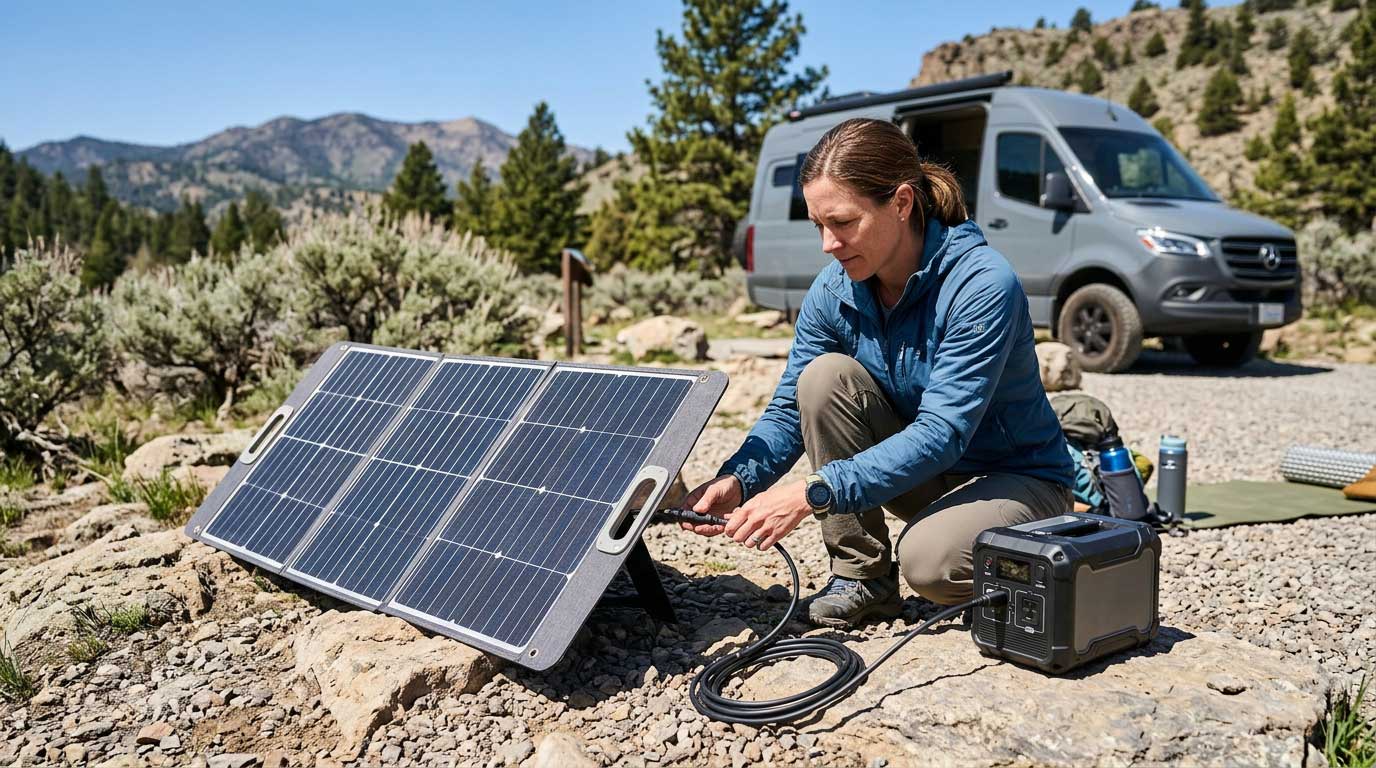
Open the panel fully on a stable surface. Keep it away from shadows cast by trees, tents, awnings or the vehicle itself. Adjust the angle toward the sun when practical, and make sure the supports will not tip over in wind.
A panel on the ground beside an RV is often easier to reposition than a roof-mounted panel. That flexibility is useful when the vehicle is parked under trees, but it also means the panel needs a clear space and occasional attention.
Step 2 — Check the electrical connection
Before plugging in the panel, confirm:
- The receiving device supports the panel’s voltage and current.
- The connector type and polarity match.
- The power station’s solar input limit is not exceeded.
- A standalone battery has a suitable charge controller.
- The cable and adapters are rated for the intended use.
Do not connect a panel directly to a battery unless the manufacturer specifically approves that arrangement. Never assume an adapter is safe just because it fits the connector.
Step 3 — Start charging and check the reading
If the receiving device has a charging display, check whether it detects solar input. Move the panel into unobstructed sunlight and observe how the reading changes. Cloud cover, panel temperature and the receiving device’s charging limit can all affect the displayed wattage.
If output is unexpectedly low, check for shading, loose connections, incorrect adapters and input restrictions before assuming the panel is faulty.
Step 4 — Store the panel safely
Disconnect equipment according to its manual, fold the panel without forcing its joints, and keep cables from being trapped between sections. Store the panel dry and protect connectors from dirt and physical damage. If the product has specific cleaning or storage instructions, follow those rather than using household chemicals or abrasive materials.
How to Choose the Right Charger for Camping or RV Use
The best panel is not necessarily the one with the highest advertised wattage. It is the one that fits your storage space, charging equipment and daily energy needs.
Compare these specifications
| Buying factor | Why it matters |
|---|---|
| Rated power | Indicates nominal output under specified test conditions |
| Folded dimensions | Determines whether the panel fits your vehicle or gear storage |
| Weight | Affects how easily one person can carry and reposition it |
| Output ports | Determines whether it can charge USB devices directly or needs another device |
| Solar input compatibility | Prevents voltage, current and connector mismatches |
| Included accessories | Clarifies whether a controller, adapters or cables must be purchased separately |
| Weather rating | Shows which conditions the product is designed to tolerate |
| Warranty and support | Helps clarify repair, replacement and technical assistance options |
Pay attention to the difference between a panel’s output ports and its rated solar output. A panel may be rated at 100W but have a USB output that supplies much less power than the full panel rating. This is not necessarily a defect; the USB circuitry may be designed for small devices rather than for transferring the entire panel output.
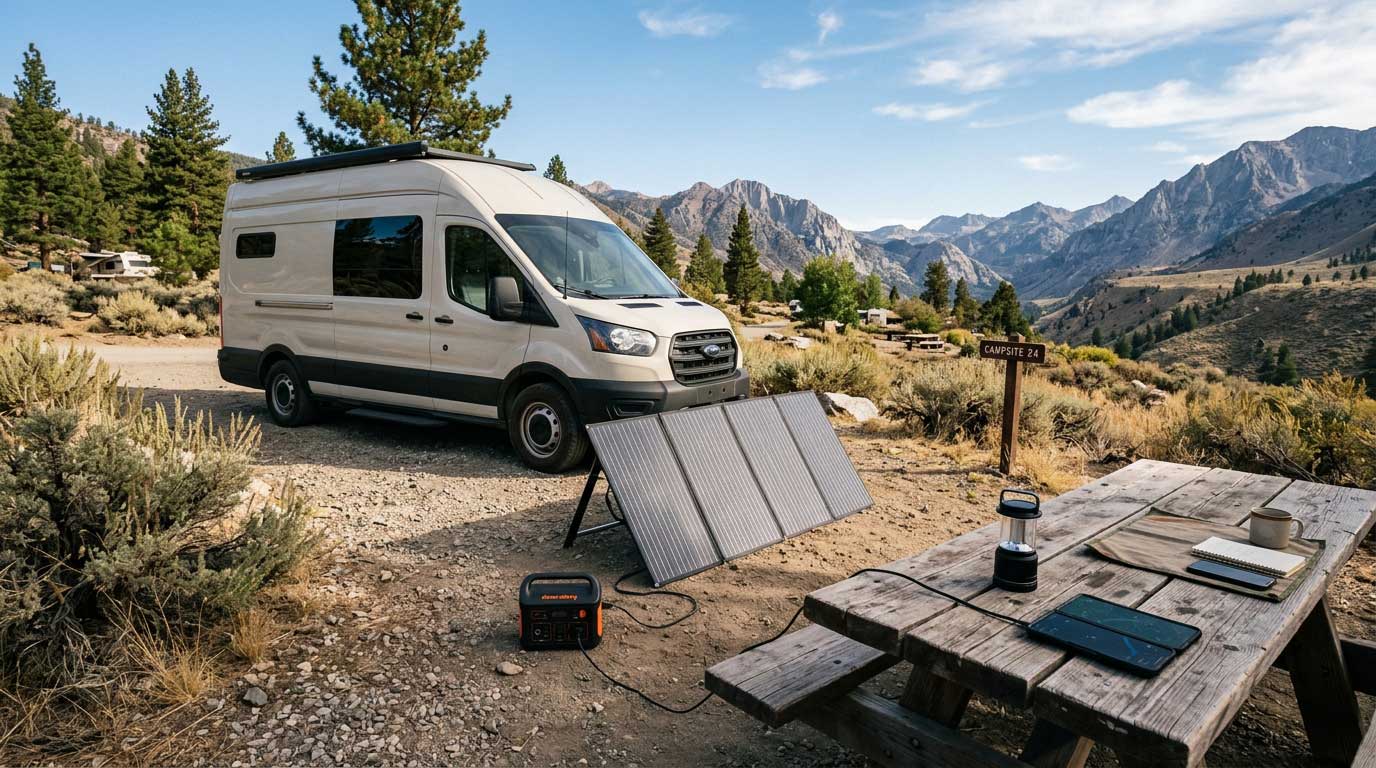
If you want to charge a power station, use the solar input connection specified by its manufacturer. If you want to charge a phone directly, check the USB output’s supported voltage, current and charging protocol.
Folding solar charger or flexible solar panel?
A folding solar charger is designed for temporary use. You unfold it when you need power and pack it away when you leave. A flexible solar panel is intended for a suitable mounting surface and may be more appropriate for a permanent RV or marine installation.
Bright Solar’s flexible solar panel products are designed for applications such as RVs, campers, selected marine uses and off-grid systems. Their mounting requirements and bending limits must be checked against the relevant specifications. A flexible module should not be treated as a portable folding charger unless the manufacturer explicitly designs it for repeated folding.
For OEM buyers, distributors and system integrators, this distinction affects product selection, packaging, mounting hardware and end-user instructions. Specify whether the final application needs a portable product, a mounted module or a complete charging system before comparing suppliers.
A Practical Example: Planning a Weekend Camping Setup
Imagine a traveler using a 100W folding solar charger for a two-night camping trip. The main loads are two phone charges per day, an LED lantern and a small USB fan.
| Device | Illustrative daily use | Energy per day |
|---|---|---|
| Smartphone | Two charges at 15Wh each | 30Wh |
| LED lantern | 5W × 4 hours | 20Wh |
| USB fan | 10W × 3 hours | 30Wh |
| Total | 80Wh |
If the panel supplies 300Wh of usable energy on a sunny day, the example’s 80Wh load is comfortably below estimated daily production. Some energy could be stored for evening use, depending on the battery and charging losses.
Now add a portable cooler that uses an illustrative 400Wh per day. The combined daily demand rises to 480Wh. A 100W panel may not cover that load consistently, especially in cloudy weather or during shorter winter days.
This is a calculated example, not a field test of a specific product. It illustrates a useful purchasing rule: estimate energy consumption in watt-hours, not just appliance wattage. A 10W fan running for five hours uses 50Wh; a 1,000W appliance running for three minutes uses about 50Wh before accounting for conversion losses. The high-wattage appliance may need a more capable inverter, even if its total energy consumption is modest.
For a real trip, list the equipment you will use, estimate the daily energy requirement and leave room for weather variability. If your devices are essential, plan for a power bank, larger battery or alternative charging source instead of relying on ideal sunlight every day.
FAQ About 100W Foldable Solar Panel Charger
How much power does a 100W foldable solar panel charger generate per day?
With four peak sun hours and an illustrative overall system efficiency of 75%–85%, a 100W panel may deliver about 300–340Wh per day. Actual output varies with sunlight, shading, temperature, orientation and charging equipment.
Can a 100W foldable solar panel charger charge a phone directly?
Yes, if the panel includes a compatible, regulated USB output. If it has only a solar output cable, you may need a compatible power station, power bank or charge controller. Check the product’s output specifications before connecting a phone.
Can it charge a portable power station?
Yes, if the panel’s voltage, current and connector match the power station’s solar input requirements. Confirm the input limits in the power station manual; a connector that physically fits is not proof of electrical compatibility.
How long does it take to charge a 300Wh power station?
At a constant 100W input, 300Wh divided by 100W equals three hours in ideal arithmetic. Real charging usually takes longer because solar output fluctuates and the charging process has losses. The power station may also limit the charging rate.
Does a foldable solar charger work on cloudy days?
It can still produce electricity from diffuse daylight, but output is usually lower than in direct sunlight. Thick cloud cover can reduce production substantially, so do not plan essential power needs around peak output every day.
Can I leave a folding solar charger outside in the rain?
Only if the manufacturer’s environmental ratings and instructions allow it. The panel, connectors, cables and connected power station may have different levels of weather protection. Keep electrical connections protected and follow the product manual.
Is a foldable solar charger better than a flexible solar panel?
They serve different needs. A folding charger is designed for temporary use and storage; a flexible panel may suit a permanent installation on an appropriate surface. Choose based on the mounting method, portability requirements and intended application.
Conclusion
A 100w foldable solar panel charger is a practical source of portable energy for camping, RV travel and small off-grid loads when its output matches your needs. Its 100W rating is a starting point, not a promise of constant output or a guarantee that every device can be charged directly.
Before purchasing, check the output ports, electrical compatibility, included accessories, folded dimensions and realistic daily energy production. For location-based estimates, consult NREL’s PVWatts Calculator and remember that its standard estimates are not a direct performance guarantee for a portable folding panel. If your project needs a permanently mounted module rather than a portable charger, compare the application with Bright Solar’s flexible solar panel range and verify the relevant product specifications.
Authoritative References
1. National Renewable Energy Laboratory (NREL) — PVWatts Calculator https://pvwatts.nrel.gov/ Provides estimates of photovoltaic energy production based on location and system assumptions.
PVWatts
2. U.S. Department of Energy — Solar Photovoltaic Technology Basics https://www.energy.gov/cmei/systems/solar-photovoltaic-technology-basics Explains how photovoltaic cells and modules convert sunlight into electricity.
Department of Energy
3. U.S. Department of Energy — Solar Photovoltaic Performance and Efficiency Basics https://www.energy.gov/cmei/systems/solar-photovoltaic-performance-and-efficiency-basics Covers solar conversion efficiency and the effects of temperature and other factors on performance.
Department of Energy
4. U.S. Department of Energy — Solar Photovoltaic System Design Basics https://www.energy.gov/cmei/systems/solar-photovoltaic-system-design-basics Provides background on PV system components, inverters, mounting and battery storage.
Related recommendations
-

Flexible Solar Panels RV: The Smarter Solar Upgrade for Modern Campers
299Explore how flexible solar panels RV systems provide lightweight, durable off-grid power for campers, vans, and motorhomes with Bright Solar.
View details -
solar panel 12v 40w flexible (Real Micro Energy Guide from Bright Solar)
317solar panel 12v 40w flexible explained with real RV and boat use cases, low-power system behavior, charging data, and installation insights for off-grid setups.
View details -
12 Volt PV Panels: The Complete Guide for Reliable Battery Charging and Off-Grid Power
276Discover how 12 volt PV panels power RVs, boats, cabins, and battery systems. Learn sizing, charging performance, installation tips, and expert buying advice.
View details -
350 watt solar panels: Output, Size and Installation Guide
316350 watt solar panels provide 350W of rated DC power under STC, while actual daily output depends on sunlight, temperature, shading, orientation, wiring, and...
View details