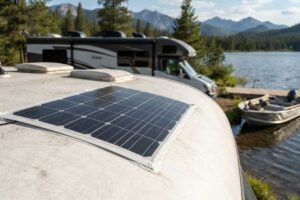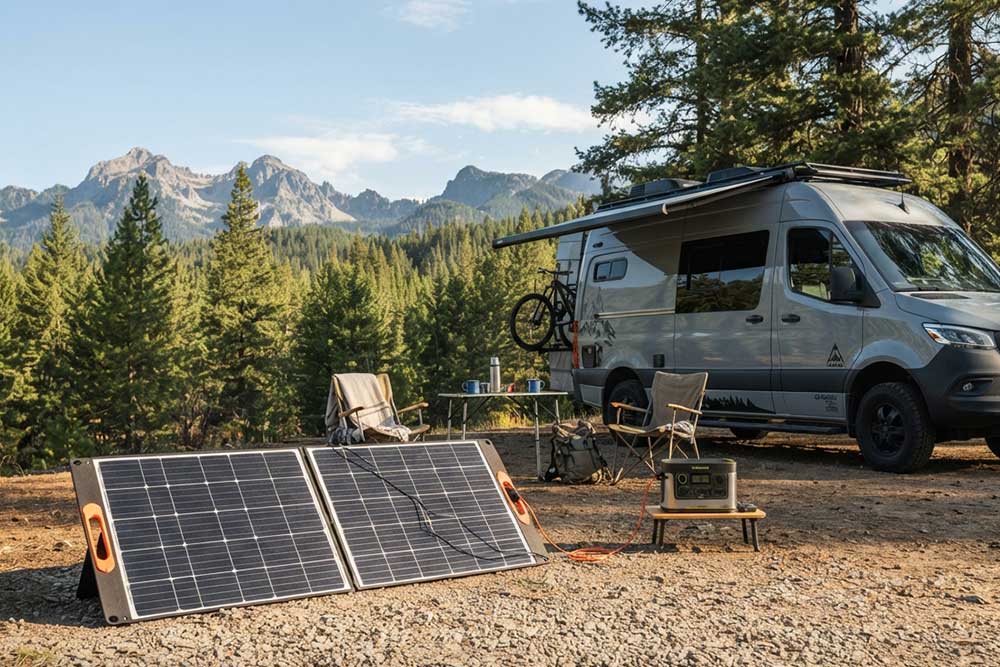
100 Watt Semi Flexible Solar Panel: Output, Uses and Installation Guide
A 100 watt semi flexible solar panel is best suited to RVs, vans, boats, cabins, and other compact solar systems where low weight, a slim profile, and modest flexibility matter more than maximum power. Its real output depends on sunlight, temperature, shading, orientation, and installation conditions.
A 100W rating is easy to understand on paper. Installation is where things become less obvious.
A semi flexible panel has to satisfy two requirements at the same time: it needs to produce useful electrical power, and it needs to survive the mechanical conditions of the surface where it is installed. That becomes especially important on curved RV roofs, boat decks, camper vans, and lightweight structures.
At Bright Solar, I would evaluate a 100W semi flexible module as part of the complete installation rather than judging it only by its nameplate wattage. The panel, mounting surface, wiring, charge controller, battery, shading, and daily load all affect whether the system actually works as intended.
What Is a 100 Watt Semi Flexible Solar Panel?
A 100 watt semi flexible solar panel is a photovoltaic module rated to produce up to 100 watts under specified test conditions while allowing a limited amount of controlled bending.
The word semi flexible matters.
It does not mean the panel can be rolled, folded, or bent repeatedly in any direction. The allowable curvature depends on the module’s construction and the manufacturer’s specified bending limit.
IEC 61215:2021 added test methods for flexible PV modules, including a dedicated bending test, MQT 22. IEC also states that qualification testing should not be interpreted as a quantitative prediction of actual module lifetime.
That distinction is important during installation.
A panel may look thin enough to bend easily, but forcing it around a tight roof edge can create mechanical stress that the product was never designed to handle.
Why Semi Flexible Construction Is Useful
A conventional framed solar panel is straightforward on a flat roof. The problem starts when the mounting surface becomes curved or when adding a raised frame is undesirable.
A semi flexible panel can be useful on:
- RV and camper roofs
- Camper vans
- Boats
- Small cabins
- Utility vehicles
- Portable structures
- Lightweight off-grid equipment
The main practical advantages are:
- Lower installation profile
- Reduced mounting structure
- Easier adaptation to modest curves
- Useful for weight-sensitive installations
- Cleaner appearance on some vehicles
The trade-off is that flexibility does not eliminate the need for careful mechanical installation.
How Much Power Does a 100 Watt Semi Flexible Solar Panel Produce?
A 100W panel is rated for 100 watts of maximum output under its specified test conditions. It does not produce 100 watts continuously throughout the day.
For a simple planning example:
100W × 4 peak-sun-hours = 400Wh/day
At five equivalent peak-sun-hours:
100W × 5h = 500Wh/day
These figures are theoretical planning values before system losses.
The U.S. Department of Energy explains that PV module ratings are measured under standard test conditions of 1,000 W/m² irradiance and 25°C cell temperature. In actual installations, sunlight intensity and cell temperature are usually different. DOE also identifies solar resource, temperature, and other operating conditions as factors affecting energy production.
Simple 100W Output Reference
| Equivalent Peak Sun Hours | Theoretical Energy |
|---|---|
| 2 hours | 200Wh |
| 3 hours | 300Wh |
| 4 hours | 400Wh |
| 5 hours | 500Wh |
| 6 hours | 600Wh |
This table is useful for initial planning, not for promising a daily yield.
A panel mounted on a vehicle can experience conditions that are very different from laboratory testing. The roof may become hot, an air-conditioning unit may shade part of the module, and the panel may not remain at an ideal angle to the sun.
NREL’s PVWatts model explicitly accounts for operating cell temperature using irradiance, wind speed, and ambient temperature rather than assuming the module remains at laboratory temperature.
Where Is a 100 Watt Semi Flexible Solar Panel Most Useful?
A 100W semi flexible module works best where the electrical demand is modest and installation constraints matter.
Typical applications include:
- RV battery charging
- Camper van auxiliary power
- Marine electronics
- Cabin lighting
- Small monitoring equipment
- GPS equipment
- USB charging
- Small ventilation fans
- Low-power communication equipment
- Sensors
- Small off-grid systems
It is not sensible to judge the panel by asking whether “100 watts is enough” without knowing what the equipment consumes.
A small LED lighting system and an air conditioner are completely different loads.
A More Useful Way to Size the System
Start with daily energy consumption.
For example, if a device consumes:
20W × 4 hours = 80Wh/day
then a 100W panel may be relevant to the application.
If another load requires:
500Wh/day
the same panel has much less margin.
This is why I prefer to look at the load profile before discussing panel quantity. The number printed on the panel tells you its rated power; it does not tell you whether the complete system will have enough energy.
100 Watt Semi Flexible Solar Panel for RVs
RV applications are one of the clearest use cases for a semi flexible panel.
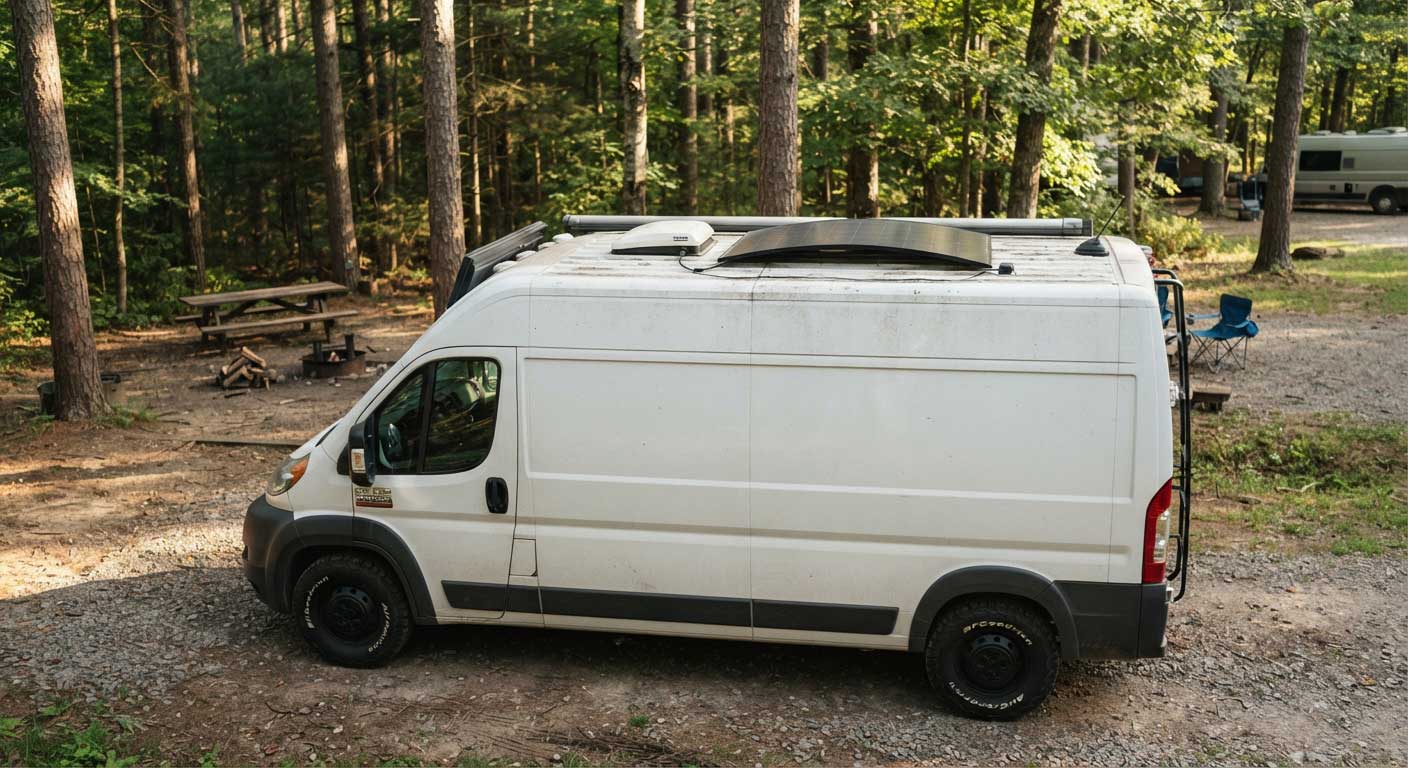
An RV roof rarely looks like a blank rectangle. It can contain air-conditioning equipment, roof vents, skylights, antennas, racks, cable penetrations, and maintenance areas.
A rigid panel may technically fit while still creating an awkward installation.
A semi flexible 100W panel can sometimes occupy a section of roof where a framed module would be inconvenient.
What I Check Before Installing on an RV
Before permanently mounting the panel, I would check:
- Available roof dimensions
- Roof curvature
- Air-conditioning equipment
- Roof vents and skylights
- Antennas and racks
- Cable-routing distance
- Areas exposed to foot traffic
- Shading at different times of day
- Mounting-surface compatibility
- Panel bending limits
One detail is easy to overlook: walk around the RV at different times of day.
A roof vent that looks harmless at 10 a.m. can cast a much longer shadow later in the afternoon.
That is not a theoretical concern. It is one of those installation details that is much easier to discover before adhesive is applied.
100 Watt Semi Flexible Solar Panel and Battery Sizing
A 100W panel should be matched to the battery system rather than selected independently.
Consider a nominal 12V 50Ah battery:
12V × 50Ah = 600Wh
That is the battery’s nominal stored energy.
A simplified 100W panel calculation producing 400Wh/day before losses could represent a substantial portion of that capacity under suitable solar conditions.
But it would be incorrect to assume that a 100W panel will automatically recharge a deeply discharged 50Ah battery every day.
There are several variables:
- Available solar energy
- Temperature
- Shading
- Wiring losses
- Charge-controller losses
- Battery charging losses
- Daily electrical consumption
The practical calculation is therefore closer to:
Daily load + system losses + available solar resource + desired reserve = required system capacity
Battery capacity is one input, not the entire design.
How to Install a 100 Watt Semi Flexible Solar Panel
Installation quality matters more than many buyers expect.
Step 1 — Measure the Surface
Measure the usable length and width before ordering.
Also identify:
- Curved sections
- Roof equipment
- Cable entry points
- Maintenance areas
- Drainage paths
Do not assume every empty section of roof is available for solar.
Step 2 — Inspect and Prepare the Surface
For adhesive installation, the mounting surface should be compatible with the selected adhesive system.
Surface preparation is critical.
Dust, grease, wax, oxidation, or incompatible coatings can interfere with adhesion.
Step 3 — Dry-Fit the Panel
Place the panel in position before permanently mounting it.
Then step back.
Look at the installation from different angles and check the likely shadow pattern throughout the day.
This simple dry-fit stage can prevent a surprisingly expensive mistake.
Step 4 — Plan the Cable Route
Keep the cable protected from:
- Sharp edges
- Excessive mechanical movement
- Hot surfaces
- Water accumulation
- Poorly protected penetrations
The shortest route is not automatically the best route.
Step 5 — Respect the Bend Limit
Never force the panel into a tighter curve than the manufacturer’s specified minimum bend radius.
Do not crease the module.
Do not pull on the junction box or cables to position the panel.
IEC 61215:2021 specifically includes bending-test methods for flexible PV modules.
That is a useful reminder that flexibility is an engineered characteristic, not permission to repeatedly fold the panel.
Step 6 — Complete the Electrical Connections
A typical battery-based arrangement is:
100W semi flexible solar panel → charge controller → battery → electrical loads
Check panel polarity and electrical specifications before energizing the controller.
The charge controller must be compatible with the panel and the battery chemistry.
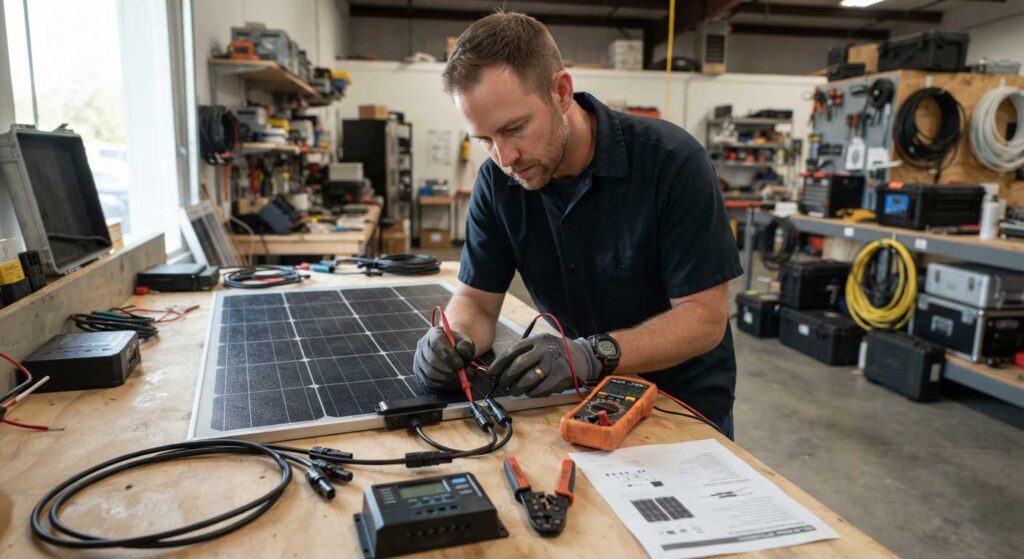
Step 7 — Test the Installation
Before considering the installation finished, check:
- Panel voltage
- Battery voltage
- Controller status
- Charging current
- Polarity
- Connector condition
- Cable condition
Testing at this stage is much easier than troubleshooting after everything has been permanently sealed.
100W Semi Flexible vs. Rigid Solar Panel
| Feature | 100W Semi Flexible | 100W Rigid |
|---|---|---|
| Weight | Usually lower | Usually higher |
| Installation height | Low | Higher |
| Curved surface | Strong advantage | Limited |
| Flat roof | Suitable | Excellent |
| Mounting structure | Often reduced | Usually required |
| Mechanical protection | Depends on construction | Generally stronger |
| RV applications | Very useful | Useful |
| Portable applications | Convenient | Less convenient |
| Low-profile appearance | Strong advantage | More visible |
There is no universal winner.
On a flat workshop roof where mechanical protection and conventional mounting are the priority, rigid construction can make more sense.
On a curved camper roof where weight and installation height matter, semi flexible construction can be more attractive.
The installation decides the technology.
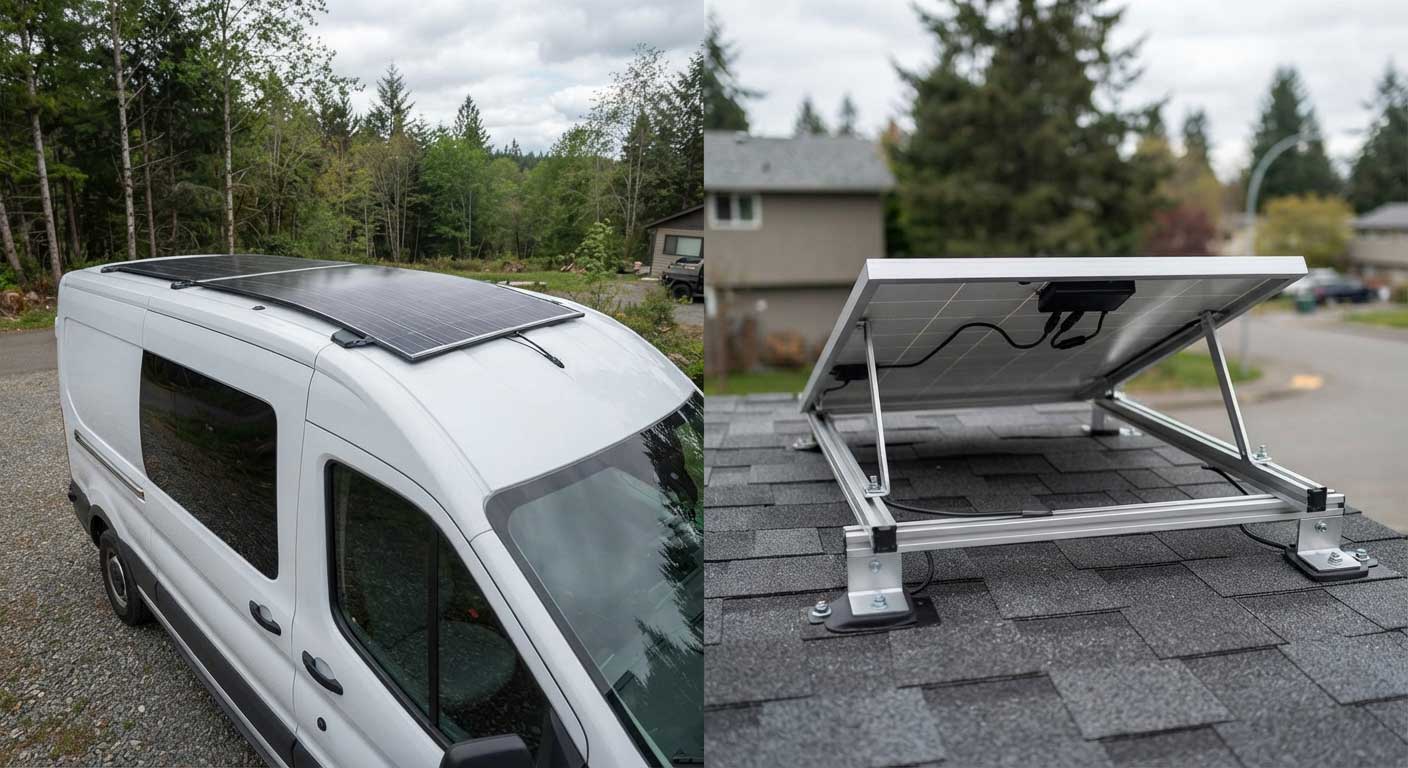
How Temperature and Shading Affect 100W Panel Output
The 100W rating is established under controlled test conditions.
A real installation is not a laboratory.
DOE states that actual PV operating conditions commonly differ from STC, including lower solar intensity and higher cell temperatures. Temperature, solar resource, and other conditions can affect expected electricity production.
For a semi flexible panel mounted close to a roof surface, this deserves attention.
The panel may receive strong sunlight while operating considerably hotter than the 25°C cell temperature used for standard ratings.
Shading deserves the same attention.
A roof vent, antenna, rack, or nearby equipment can shade part of the module. The effect depends on the module’s electrical architecture and bypass-diode configuration.
My practical rule is simple: inspect the environment before blaming the panel.
If output looks lower than expected, check the sun exposure, temperature, wiring, connectors, and shading before assuming the nameplate rating is wrong.
What Specifications Should You Check?
A 100W semi flexible solar panel should not be purchased on wattage alone.
| Specification | Why It Matters |
|---|---|
| Pmax | Confirms rated power |
| Vmp | Shows operating voltage |
| Imp | Shows operating current |
| Voc | Important for system voltage limits |
| Isc | Useful for electrical design |
| Dimensions | Confirms physical fit |
| Weight | Important for RV and marine use |
| Bend radius | Defines mechanical flexibility |
| Connector type | Helps installation compatibility |
| Maximum system voltage | Important for system design |
| Operating temperature | Relevant to installation conditions |
| Warranty | Helps evaluate manufacturer support |
For B2B buyers, I would also request the technical datasheet and installation documentation before approving a production order.
If a supplier provides only “100W” and a product photo, there is not enough information for a serious engineering review.
Is a 100 Watt Semi Flexible Solar Panel Good for an RV?
Yes, when the RV has a modest energy requirement and the installation benefits from low weight, low profile, or a curved mounting surface.
It is especially practical for:
- Auxiliary battery charging
- LED lighting
- USB charging
- Monitoring equipment
- Small fans
- GPS equipment
- Communication devices
It is not reasonable to treat one 100W panel as the sole power source for high-energy RV equipment without performing a complete energy calculation.
The important number is not simply panel wattage.
It is daily watt-hours required versus realistically available solar energy.
How Long Can a Semi Flexible Solar Panel Last?
There is no single service-life figure that should be applied to every semi flexible panel.
IEC 61215 explains that qualification testing evaluates whether PV modules can withstand defined environmental stresses, but the test results are not a quantitative prediction of module lifetime. Actual useful life depends on design, environment, and operating conditions.
For a buyer, I would therefore ask:
- What materials are used?
- What bending limits apply?
- What outdoor testing has been performed?
- What installation method is specified?
- What environmental conditions is the module designed for?
- What warranty is provided?
Those questions tell you considerably more than a generic lifetime number.
Bright Solar 100 Watt Semi Flexible Solar Panel Selection
For a Bright Solar application, I recommend starting with the installation rather than starting with the product wattage.
Measure the available surface.
Estimate daily consumption.
Identify the battery voltage and chemistry.
Check the expected solar exposure.
Then verify the panel’s electrical specifications and mechanical limitations.
That sequence avoids a common purchasing mistake: choosing a panel because it physically fits and discovering later that the electrical system or mounting conditions were never properly matched.
For RV and marine applications, I would pay particular attention to roof curvature, cable routing, shading from equipment, surface preparation, connector protection, and the manufacturer’s bending limits.
The same 100W module can be a very sensible solution on one vehicle and a poor choice on another simply because the installation conditions are different.
100 Watt Semi Flexible Solar Panel FAQ
What is a 100 watt semi flexible solar panel?
A 100 watt semi flexible solar panel is a photovoltaic module rated for up to 100W under specified test conditions while allowing limited controlled bending. It is commonly considered for RVs, vans, boats, cabins, and other installations where low profile and curved-surface mounting are useful.
How much power does a 100W semi flexible solar panel produce per day?
A simple four-peak-sun-hour calculation gives 400Wh before system losses. Actual production varies with sunlight, temperature, shading, orientation, wiring, dirt, and other operating conditions.
Can a 100W semi flexible panel charge a 12V battery?
Yes. It can be used with a 12V battery when paired with a compatible charge controller. The controller must match the panel’s electrical characteristics and the battery chemistry.
Is a 100W semi flexible panel good for an RV?
Yes. It is particularly useful when RV roof weight, installation height, or curved surfaces make a conventional rigid panel less convenient. It is generally better suited to auxiliary loads than high-power appliances.
Can I bend a 100W semi flexible solar panel?
Yes, but only within the manufacturer’s specified bending limits. Semi flexible does not mean unlimited bending or repeated folding. IEC 61215:2021 includes bending-test methods for flexible PV modules.
Is a semi flexible panel better than a rigid panel?
Neither is universally better. Semi flexible construction is advantageous when weight, profile, and curved mounting matter. Rigid construction can be preferable where conventional mounting and mechanical protection are more important.
What should I check before buying a 100W semi flexible solar panel?
Check Pmax, Vmp, Imp, Voc, Isc, dimensions, weight, bend radius, connector type, maximum system voltage, operating temperature, warranty, and installation requirements. For B2B purchases, request the complete technical datasheet.
Technical References
The technical guidance in this article is based on recognized PV performance and qualification references.
The U.S. Department of Energy explains that PV module performance ratings are measured under standard test conditions of 1,000 W/m² irradiance and 25°C cell temperature, while real installations experience changing solar resource and temperature.
NREL PVWatts uses a thermal model that calculates operating cell temperature using factors including irradiance, wind speed, and ambient temperature.
IEC 61215:2021 includes additional test methods for flexible PV modules, including bending testing, while emphasizing that qualification results are not a quantitative prediction of actual module lifetime.
Final Takeaway
A 100 watt semi flexible solar panel is a practical choice when the system needs modest solar power and the installation benefits from a low profile, reduced mounting structure, or a gently curved surface.
The important evaluation is not simply whether the panel says 100W.
Check the daily load, battery system, available solar resource, shading, temperature, electrical specifications, mounting surface, and bending limits before installation.
For Bright Solar applications, that system-level approach is the most reliable way to determine whether a 100W semi flexible panel is genuinely suitable for the job.
Related recommendations
-

10 Watt Flexible Solar Panel: Uses, Output and Installation Guide
171A 10 watt flexible solar panel is designed for low-power applications such as sensors, small lights, GPS devices, battery maintenance, and small RV or marine...
View details -
Folding Camping Solar Panels: A Practical Guide to Portable Power
70Folding camping solar panels provide portable electricity and can be moved into better sunlight as campsite conditions change.
View details -
Flexible 100 Watt Solar Panel for RV, Marine and Off-Grid Applications
123Discover flexible 100 watt solar panel solutions from Bright Solar. Learn efficiency, applications, installation tips, and why lightweight solar fits RV, marine, and off-grid energy needs.
View details -
400 W Solar Panel: Real-World Power Output, Applications, and Buying Guide
279Discover how a 400 w solar panel performs in real-world conditions. Learn daily power production, battery charging capacity, installation methods, and expert buying advice from Bright Solar.
View details