100 Watt Foldable Solar Panel Kit: Output, Setup and Uses
A 100 watt foldable solar panel kit provides portable solar power for camping, RV trips, emergency charging and small off-grid applications. Under favorable sunlight, a 100W panel can generate about 300–500Wh per day, depending on peak sun hours, shading, temperature, orientation and system losses.
The key is to look beyond the 100W label. A kit’s practical value depends on its charge controller, connector compatibility, battery voltage, portability and the amount of energy your devices consume. A well-matched setup can keep small electronics running without a generator, but it will not reliably power every appliance in an RV.
What Is a 100 Watt Foldable Solar Panel Kit?
A 100 watt foldable solar panel kit combines a portable solar module with supporting components for collecting sunlight and charging a compatible power station or battery. Depending on the product, the package may include a charge controller, connecting cables, adapters, kickstands or a carrying case.
The word kit does not guarantee that every component is included. Some packages contain only the folding panel and cable, while others include a controller and battery clamps. Check the package contents before comparing prices.
Typical components and their functions
| Component | What it does | What to check |
|---|---|---|
| Foldable solar panel | Converts sunlight into DC electricity | Rated output, folded size and weight |
| Charge controller | Regulates charging from the panel to a compatible battery | Battery chemistry, voltage and current rating |
| Connecting cable | Carries electricity between components | Connector type, polarity and cable length |
| Kickstand or support | Positions the panel toward the sun | Stability and adjustment range |
| Battery or power station | Stores energy for later use | Capacity in Wh, input limits and charging compatibility |
Some portable power stations already contain a solar charge controller, so an additional external controller may not be needed. Connecting two controllers in the wrong configuration can prevent proper charging or create a compatibility problem.
Bright Solar manufactures flexible and semi-flexible solar panels for applications including RVs, outdoor power and off-grid systems. Its flexible panels serve a different purpose from a folding briefcase-style kit: they are designed for installation on suitable surfaces, whereas foldable kits are designed to be deployed and packed away. Buyers should select the product format that fits the intended installation rather than assuming the two are interchangeable.
How Much Power Can a 100 Watt Foldable Solar Panel Kit Produce?
A 100W rating describes the panel’s nominal power under specified test conditions. It does not mean the panel produces 100 watts continuously throughout the day.
A useful first estimate is:
Daily energy (Wh) = panel rating (W) × peak sun hours × system efficiency
For a 100W panel, the following examples use an illustrative 75%–85% overall energy factor to account for real-world losses. This is a planning estimate, not a guaranteed performance specification.
| Peak sun hours per day | Estimated daily energy |
|---|---|
| 2 hours | 150–170Wh |
| 3 hours | 225–255Wh |
| 4 hours | 300–340Wh |
| 5 hours | 375–425Wh |
| 6 hours | 450–510Wh |
Peak sun hours represent the equivalent number of hours at a reference solar irradiance of 1,000 watts per square metre. They are not the same as the total number of daylight hours.
For a location-specific estimate, use the U.S. Department of Energy’s PVWatts Calculator, developed by the National Renewable Energy Laboratory (NREL). Its estimates depend on location and system assumptions. A portable panel may perform differently from a fixed installation because the user can reposition it during the day, but may also leave it at a suboptimal angle or place it in partial shade.
What can that energy run?
The table below shows approximate energy consumption for illustrative loads. Actual consumption varies by device and usage.
| Device or activity | Example energy use | What a 100W kit may provide |
|---|---|---|
| Smartphone charging | 10–20Wh per charge | Several charges in suitable conditions |
| LED camping light | 5W × 4 hours = 20Wh | Several evenings, subject to daily generation |
| Laptop charging | 50–80Wh per charge | Often around one to several charges |
| Portable 12V cooler | 300–600Wh per day as an illustrative range | May offset part of its daily demand, but not necessarily all of it |
| Small fan | 20W × 5 hours = 100Wh | Potentially several hours of operation |
These are examples for planning, not promises about specific products. Conversion losses, battery charging losses, device efficiency and changing sunlight all affect the usable result. A refrigerator or cooler is particularly difficult to size by its running wattage alone because its compressor cycles on and off and its energy use depends on ambient temperature and ventilation.
Why rated output and actual output differ
Several factors can reduce production:
- Cloud cover: Solar irradiance drops when clouds block or scatter sunlight.
- Panel angle: A panel facing away from the sun generally captures less energy.
- Heat: Solar cells typically produce less voltage as cell temperature rises.
- Shade: A branch, tent edge or vehicle mirror can reduce output, sometimes disproportionately depending on the panel’s electrical design.
- Conversion losses: A power station, controller and battery do not deliver every watt-hour collected by the panel to the final device.
For a foldable panel, one practical advantage is easy repositioning. Instead of leaving a panel flat on the ground all afternoon, you can adjust its orientation as the sun moves. That helps, but it does not remove the effect of weather or limited daylight.
Choosing the Right 100W Portable Solar Panel Kit
Two products can both be advertised as 100W kits and still deliver different results in everyday use. Compare the complete system rather than relying on the panel rating alone.
Check the battery and power station input limits
Before buying, check the solar input specifications for the battery or power station. The key details are:
- Maximum solar input power: A 100W panel is within the power limit of many portable power stations, but confirm the specific model’s limit.
- Input voltage range: The panel’s operating voltage and open-circuit voltage must be compatible with the device.
- Connector type: Common connectors include MC4-style solar connectors and proprietary power-station adapters. Physical fit alone does not prove electrical compatibility.
- Battery chemistry: Lead-acid, lithium-ion and LiFePO₄ batteries require suitable charging settings and protection.
- Controller requirements: If charging a standalone battery, use an appropriate solar charge controller unless the kit already includes one designed for that purpose.
Never connect a solar panel directly to a battery without confirming that the charging arrangement is suitable. Follow the battery and controller manufacturers’ instructions, including their voltage, current and polarity requirements.
Consider folded size, weight and durability
A foldable panel is useful when it fits the way you travel. Check both its deployed dimensions and its packed dimensions. A large panel may collect more sunlight than a smaller one, but it can also occupy more storage space and be less convenient to move.
Look for reinforced handles, secure hinges, weather-resistant construction and a support system that stays stable on the ground. Do not assume that a panel is waterproof simply because it is sold for camping. The panel, connectors, controller and power station may have different environmental ratings.
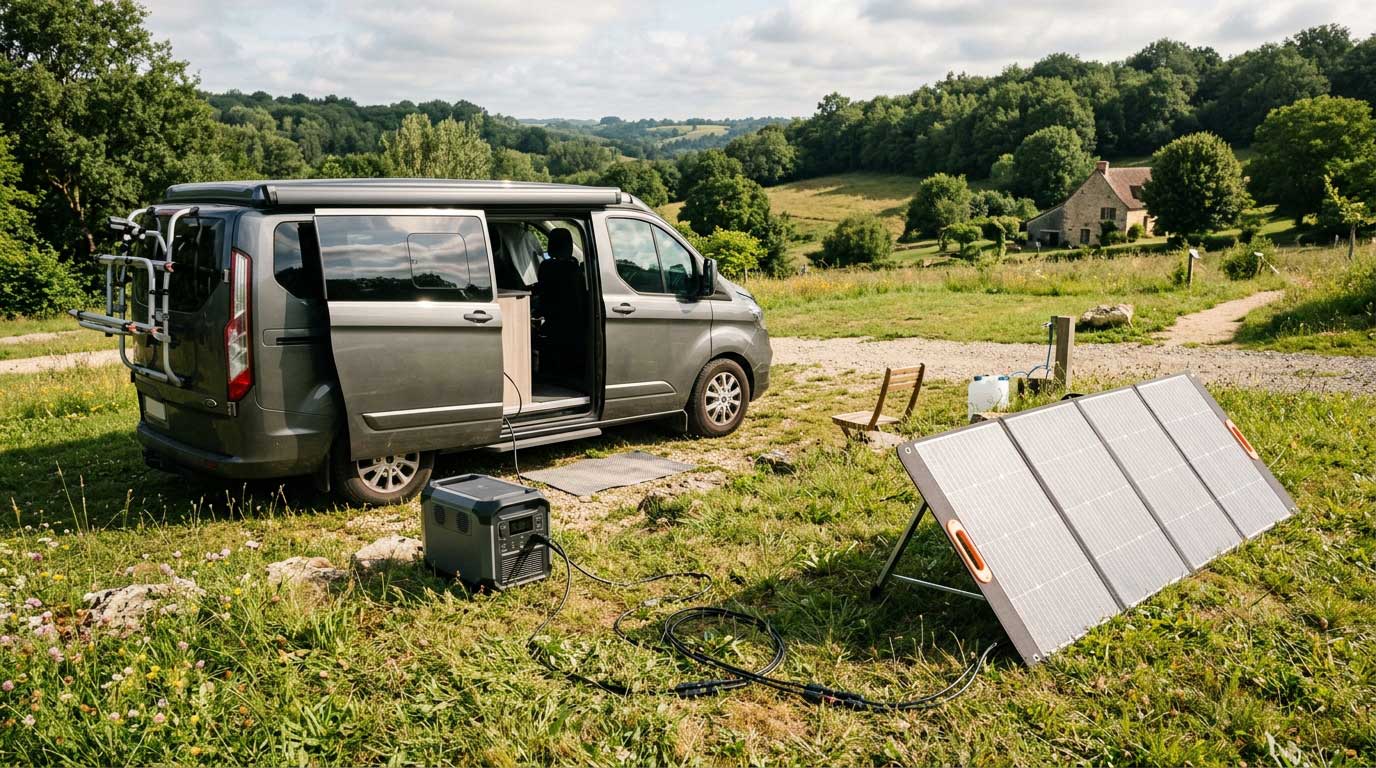
How to Set Up a 100 Watt Foldable Solar Panel Kit
Setup is usually straightforward, but the order matters. Start with the power station or battery manual rather than assuming every kit uses the same connection sequence.
Step 1 — Choose a sunny, stable location
Place the panel where it receives direct sunlight for as much of the day as practical. Keep it away from vehicle shadows, trees, awnings and foot traffic. On uneven ground, make sure the stands are secure and the panel cannot easily tip over in wind.
Step 2 — Check the electrical specifications
Confirm the panel’s output, connector, polarity and voltage against the receiving device’s solar input requirements. If a separate charge controller is supplied, verify that it is compatible with the battery and panel.
Do not rely on the product name alone. Two panels rated at 100W can have different voltage and current characteristics.
Step 3 — Connect according to the manufacturer’s instructions
Follow the sequence specified by the power station, charge controller and battery manufacturers. Some systems require the battery to be connected to the controller before the solar panel; others use an integrated input designed for direct panel connection. There is no universal sequence for every kit.
Keep connectors dry and clean. Avoid plugging or unplugging exposed connectors in wet conditions, and never force a connector that does not match.
Step 4 — Check charging status
Look at the power station or controller display, if available. Check whether the device detects solar input and whether the displayed wattage changes as the panel moves into better sunlight. Output can fluctuate when clouds pass or the panel angle changes.
A zero or unexpectedly low reading does not automatically mean the panel is defective. Check for shading, loose connections, incorrect adapters, input limits and incompatible voltage before drawing conclusions.
Step 5 — Reposition and pack away safely
Adjust the panel periodically as the sun moves, if doing so is practical and safe. Before packing it, disconnect the system as instructed by the manufacturer, fold the panel carefully and store cables so the connectors do not press against the cells or hinges.
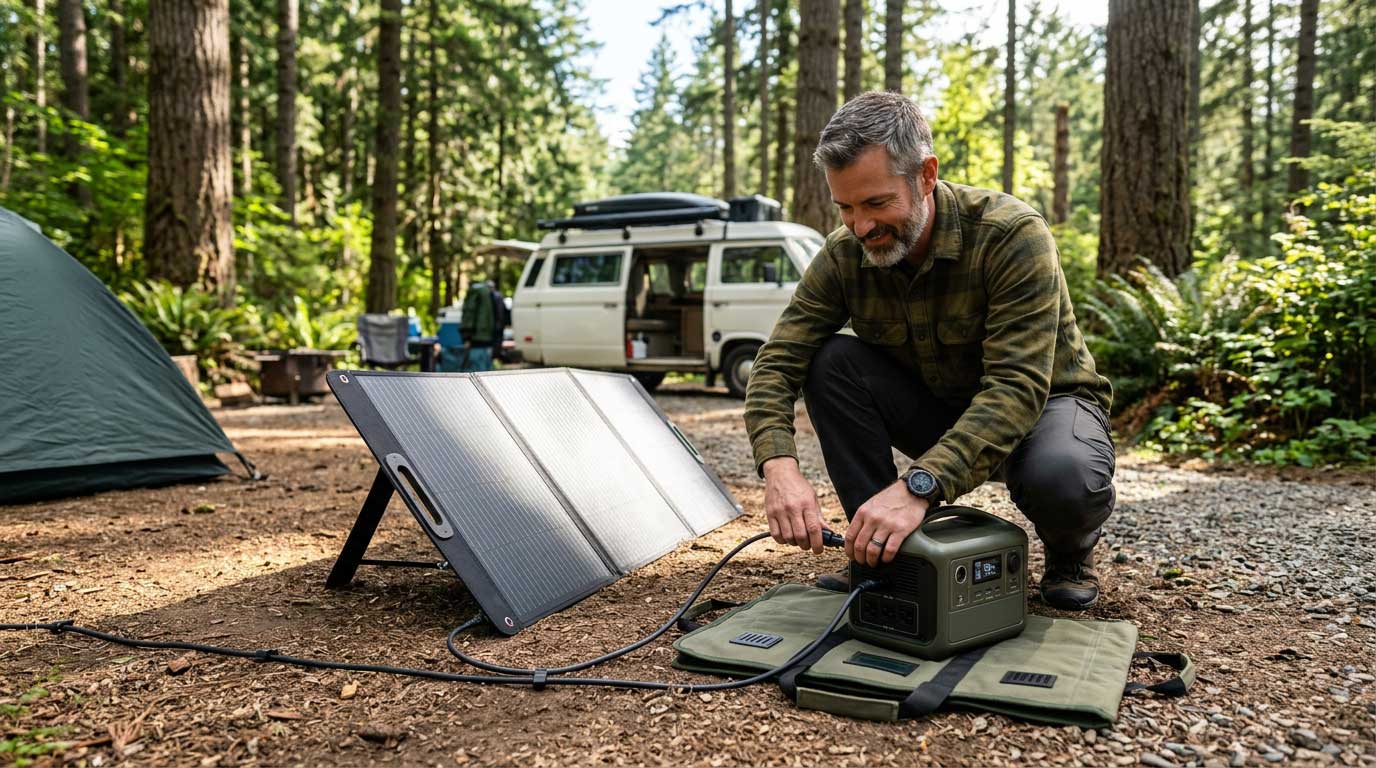
A Realistic Camping Example: What Can 100W Cover?
Consider a hypothetical two-night camping trip where a traveler uses a phone, LED lights and a small USB-powered device. The daily energy budget might look like this:
| Load | Illustrative daily use | Daily energy |
|---|---|---|
| Two phone charges | 15Wh each | 30Wh |
| LED camp light | 5W × 4 hours | 20Wh |
| USB fan | 10W × 3 hours | 30Wh |
| Total | 80Wh |
If the panel produces 300Wh of usable energy on a sunny day, this example’s 80Wh load is comfortably below the estimated daily generation. The remaining energy could help recharge the battery, but actual results depend on when devices are used, how the battery is charged and whether the panel receives enough sunlight.
Now add a compressor cooler that consumes an illustrative 400Wh per day. The total load rises to 480Wh. A 100W panel may not cover that demand every day, especially in cloudy weather or during short winter days. The difference is important: a system that works well for phones and lights may be undersized for refrigeration.
This is a planning example, not a measured field test or a claim about a particular cooler. For your own setup, check the device’s energy consumption in watt-hours per day rather than relying only on its rated running watts.
Estimate your own daily energy needs
Use this simple process before choosing a panel:
- List each device you intend to run.
- Multiply its wattage by the number of hours it runs each day.
- Add the daily watt-hours for all devices.
- Add a margin for charging and conversion losses.
- Compare the total with the likely solar energy available at your destination.
For example, a device drawing 20W for five hours uses 100Wh. If your total daily load is 400Wh, a single 100W panel could struggle to meet it consistently. A larger panel, a lower energy budget or a combination of both may be necessary.
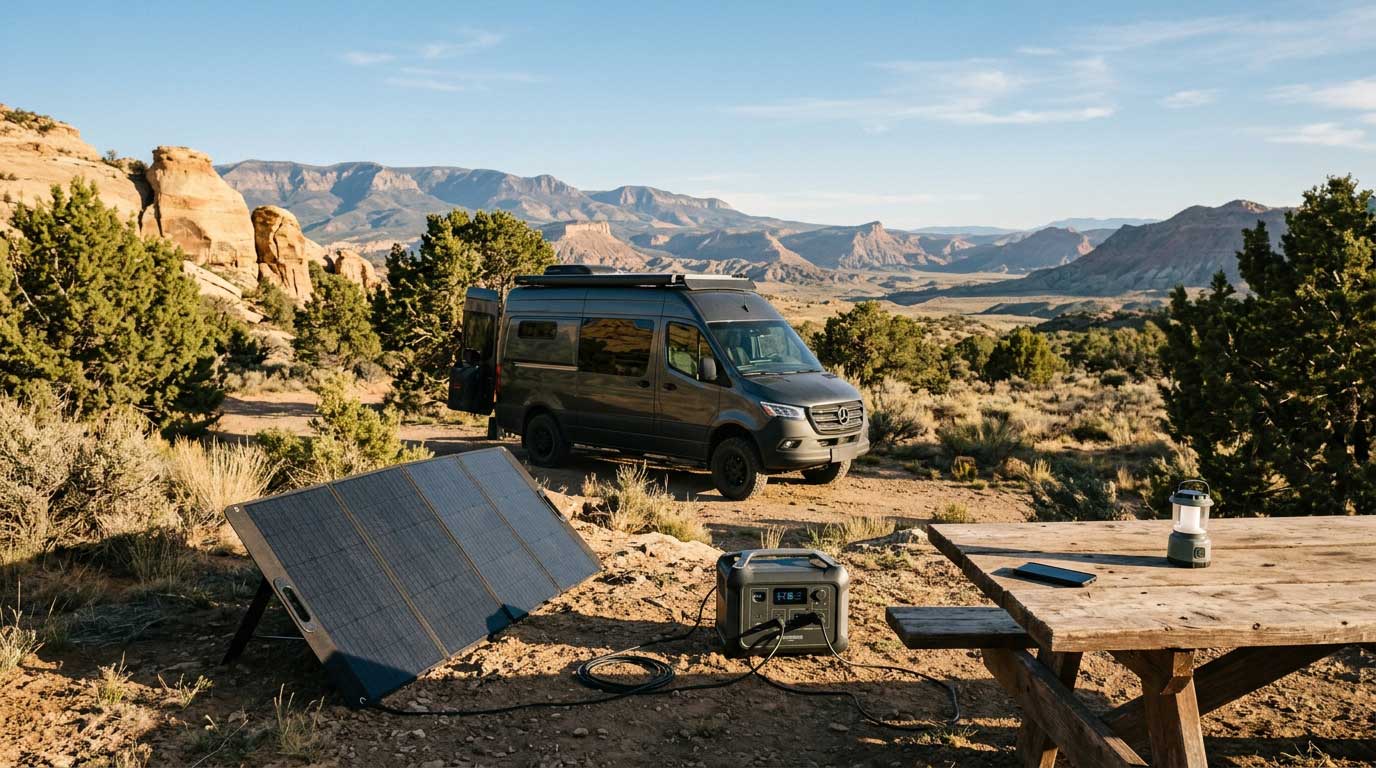
Foldable Solar Panels vs. Flexible Solar Panels
These two product types solve different problems, even though both are designed to be portable or lightweight.
| Feature | Foldable solar panel kit | Flexible solar panel |
|---|---|---|
| Typical use | Temporary deployment at campsites or outdoor locations | Installation on suitable curved or lightweight surfaces |
| Setup | Unfold, position and connect | Mount according to product specifications |
| Storage | Folds into a compact package | Usually stored or left installed as a single module |
| Best fit | Travelers who need to move or pack away the panel | RV, marine and off-grid projects where a suitable permanent mounting surface is available |
| Main consideration | Packed size, stands, connectors and power-station compatibility | Mounting method, surface compatibility, heat management and product-specific bending limits |
Bright Solar’s L Series flexible panels are designed for applications such as RVs, campers and selected off-grid or marine uses. The series has a stated maximum bending capacity of 30%; the exact mounting approach and suitability still need to be checked against the product specifications. That does not mean the panel can be folded repeatedly like a portable folding kit.
For B2B buyers sourcing panels for a branded product, RV installation or an OEM/ODM project, the right comparison includes module dimensions, electrical characteristics, mounting requirements and expected operating conditions. A foldable kit and a flexible module should not be treated as direct substitutes without checking the application.
FAQ About 100 Watt Foldable Solar Panel Kit
Is a 100 watt foldable solar panel kit enough for camping?
Yes, for many small loads such as phones, LED lights and selected USB devices. It may be insufficient for energy-intensive equipment, including a refrigerator, induction cooker or air conditioner. Calculate daily watt-hour consumption before choosing the system.
Can a 100W foldable solar panel charge a power station?
Yes, if the panel’s voltage, connectors and output are compatible with the power station’s solar input. Check the power station’s permitted input range and the panel’s electrical specifications before connecting them.
How long does a 100W solar panel take to charge a battery?
It depends on battery capacity, starting charge level, sunlight and charging losses. A 300Wh battery would theoretically require three hours at a constant 100W input, but solar output is not constant and the charging process has losses. Actual charging can take longer.
Can a 100 watt foldable solar panel kit work on cloudy days?
Yes, it can still generate electricity under diffuse sunlight, but output is generally lower than in direct, unobstructed sun. The amount depends on cloud thickness, weather and panel orientation. Do not plan essential loads around peak output every day.
Does a 100W solar panel produce 100 watts all day?
No. The 100W rating refers to power under specified test conditions. Output changes with sunlight, temperature, angle, shade and other factors, so daily energy is measured in watt-hours rather than watts.
Should I buy a kit with a battery included?
Choose a kit with a battery if you need to store solar energy for evening use or for periods without sunlight. If you already own a compatible power station or battery system, a panel-only package may be more practical. Compare the complete package contents and charging limits before buying.
Is a foldable solar panel better than a flexible solar panel for an RV?
For temporary campsite use, a foldable panel is often more convenient because it can be deployed when parked and stored during travel. A flexible panel may be more suitable for a permanent installation on an appropriate surface. The best option depends on mounting conditions, storage space and how you intend to use the RV.
Conclusion
A 100 watt foldable solar panel kit is a practical choice for portable, small-scale solar charging when its output matches your energy needs. It can support phones, lights and other modest loads in suitable sunlight, but it should not be treated as a guaranteed source of power for high-consumption appliances.
Before purchasing, confirm the included components, panel-to-battery compatibility, connector type, folded dimensions and realistic daily energy production. Use NREL’s PVWatts Calculator as a reference for understanding local solar resources, while remembering that its standard estimates are for grid-connected systems and may not precisely predict a portable panel’s performance. For RV or marine projects that require a mounted module rather than a temporary folding kit, compare the application with Bright Solar’s flexible solar panel options and verify the relevant product specifications.
Technical References
1. National Renewable Energy Laboratory (NREL) — PVWatts Calculator https://pvwatts.nrel.gov/ A tool for estimating photovoltaic energy production based on location and system inputs.
2. U.S. Department of Energy — Solar Photovoltaic System Design Basics https://www.energy.gov/cmei/systems/solar-photovoltaic-system-design-basics Explains key PV system components, mounting considerations and factors affecting system design.
3. U.S. Department of Energy — Solar Photovoltaic Technology Basics https://www.energy.gov/cmei/systems/solar-photovoltaic-technology-basics Provides background on how photovoltaic cells and modules convert sunlight into electricity.
Related recommendations
-

300 Watt Solar Panels for RV, Marine and Off-Grid Power Systems
297Discover how 300 watt solar panels power RVs, boats, cabins, and off-grid systems. Learn real performance, battery charging, and installation tips from Bright Solar.
View details -
Lightweight Solar Panels for Mobile Homes
298Discover how lightweight solar panels for mobile homes reduce roof load while delivering reliable off-grid energy. Learn sizing, costs, installation tips, and real-world performance.
View details -
Solar Panel for 12 Volt Battery – Charging Guide & Sizing
315Learn how to choose the best solar panel for 12 volt battery charging. Discover sizing, charging times, real-world performance, and off-grid solar system design tips.
View details -
3kW Solar System for Homes, Cabins and Off-Grid Energy Solutions
280Discover how a 3kW solar system powers homes, cabins, and off-grid applications. Learn costs, output, batteries, and installation tips from Bright Solar.
View details