1000W Foldable Solar Panel: Output, Setup and Buying Guide
A 1000w foldable solar panel system can provide substantial portable solar power for off-grid sites, RVs and outdoor work, but its actual output depends on sunlight, panel configuration and equipment limits. At 3–5 peak sun hours, a 1,000W array could generate roughly 2.25–4.25kWh per day after illustrative system losses.
The first thing to clarify is what “1000W foldable” means on a product listing. It may refer to the combined rated power of several folding panels rather than one single folding module. That distinction affects transport, setup space, wiring, charging compatibility and the amount of energy you can realistically collect.
What Is a 1000W Foldable Solar Panel?
A 1000W foldable solar panel setup is a portable solar array with a combined rated output of 1,000 watts under specified test conditions. It may use several folding panels connected together, with cables and a compatible power station or battery system.
The rated wattage is a power figure, not a daily energy guarantee. A 1,000W array does not produce 1,000W continuously from sunrise to sunset. Sunlight intensity changes throughout the day, and the array may be limited by shade, temperature, panel angle or the connected device.
One 1,000W unit or several folding panels?
Before buying, ask the seller how the advertised capacity is achieved. A product described as a “1000W foldable solar panel” might actually consist of multiple portable modules whose ratings add up to 1,000W.
For example, an array could theoretically be assembled from:
- Ten 100W folding panels.
- Five 200W folding panels.
- Four 250W folding panels.
- Another combination whose rated outputs total 1,000W.
These are configuration examples, not a claim that every combination is commercially available or electrically compatible. Actual panels differ in voltage, current, connector design, folded dimensions and weight. The modules must be designed to work together, and their combined electrical characteristics must remain within the input limits of the controller or power station.
What does the kit usually include?
| Component | Function | What to confirm |
|---|---|---|
| Folding solar modules | Collect sunlight and produce DC electricity | Combined rated power and individual module specifications |
| Connecting cables | Connect modules to charging equipment | Connector type, wire rating and polarity |
| Branch connectors or combiner | Combine compatible panel circuits | Current rating and system design |
| Solar charge controller | Regulates charging into a compatible battery | Maximum input voltage, current and power |
| Battery or power station | Stores energy for later use | Capacity, charging limits and chemistry |
| Stands or support frames | Position panels toward the sun | Stability, adjustment and wind exposure |
A listing may include the panels but not the battery, controller or cables needed for a complete system. Confirm the bill of materials before comparing prices. A low advertised price can become less attractive if essential electrical components must be purchased separately.
Bright Solar manufactures flexible and semi-flexible solar panels for RV, marine and off-grid applications. These products are not automatically equivalent to a 1,000W portable folding array. A flexible module is selected for an appropriate installation surface; a folding panel is designed to be deployed and packed away. Buyers should match the product type to the intended use and verify all ratings from the relevant product documentation.
How Much Energy Can a 1000W Foldable Solar Panel Generate?
A useful first estimate is:
Daily energy (kWh) = array power (kW) × peak sun hours × system efficiency
For a 1,000W array, the rated power is 1kW. The following estimates assume an illustrative overall efficiency of 75%–85% to account for losses. They are planning figures, not guaranteed performance or measured results for a specific product.
| Peak sun hours per day | Estimated daily energy |
|---|---|
| 2 hours | 1.5–1.7kWh |
| 3 hours | 2.25–2.55kWh |
| 4 hours | 3.0–3.4kWh |
| 5 hours | 3.75–4.25kWh |
| 6 hours | 4.5–5.1kWh |
Peak sun hours represent equivalent hours at a reference solar irradiance of 1,000 watts per square metre. They are not the same as total daylight hours.
For a location-based estimate, use the National Renewable Energy Laboratory’s PVWatts Calculator. It provides photovoltaic production estimates based on location and system assumptions. A portable array can perform differently from a fixed rooftop system because it may be repositioned during the day, but it can also be left at an inefficient angle or partly shaded.
What can 2–4kWh per day support?
Daily energy consumption varies widely by appliance. The table below uses illustrative examples to show how loads add up; actual consumption should be checked against the manufacturer’s data or measured with a suitable energy meter.
| Appliance or use | Illustrative energy use | What it means for a 1,000W array |
|---|---|---|
| Laptop | 60Wh per charge | Small relative to a few kWh of daily production |
| LED lighting | 10W × 5 hours = 50Wh | A relatively small daily load |
| Portable fridge or cooler | 400–800Wh/day | Can consume a significant share of production |
| Electric kettle | 1,500W × 5 minutes = 125Wh | May use modest energy but needs adequate inverter power if AC-powered |
| Microwave | 1,200W × 10 minutes = 200Wh | Requires an inverter and battery capable of handling its power demand |
| Air conditioner | Highly variable; often substantial | Must be sized using actual running energy and startup requirements |
Two separate questions matter here: How much energy can the array collect? and How much power can the system deliver at one time?
A 1,000W solar array does not automatically run a 1,500W appliance directly. The battery, inverter, wiring and controller each have their own limits. An appliance can exceed the inverter’s power rating even if the battery has plenty of stored energy. Likewise, a battery can run a load at night, but the solar array must collect enough energy over time to replenish what was used.
What Affects Real-World Output?
A folding array rated at 1,000W can still deliver far less than its rated power at a particular moment. The difference often comes down to conditions that are easy to overlook when choosing equipment online.
Sunlight, temperature and panel angle
Direct sunlight usually produces more power than heavily overcast conditions. Panels also tend to produce less voltage as their cells heat up, so a hot, clear afternoon does not guarantee the maximum rated output.
Portable panels offer one advantage over fixed installations: you can change their position. If the array is divided into several folding sections, check that all sections can be placed in direct sunlight without one panel shading another.
Shade and mismatched panels
A shadow from a tree, awning or vehicle can reduce production. The effect depends on the module’s cell layout, bypass diodes and how the panels are electrically connected.
Avoid combining panels with different electrical specifications unless the system manufacturer confirms that the configuration is appropriate. In series connections, current mismatch can limit the string’s output; in parallel connections, voltage compatibility remains important. The controller must also stay within its maximum voltage and current ratings.
Cable and conversion losses
Energy can be lost as electricity passes through cables, controllers, batteries and inverters. Long or undersized cables can create additional voltage drop. If the stored energy will be used for AC appliances, inverter efficiency also affects the energy ultimately available to the load.
For this reason, the illustrative 75%–85% system-efficiency factor used earlier should be treated as an assumption for rough planning, not a universal rating. A real installation may fall outside that range depending on its design and operating conditions.
Choosing the Right Battery and Power Station
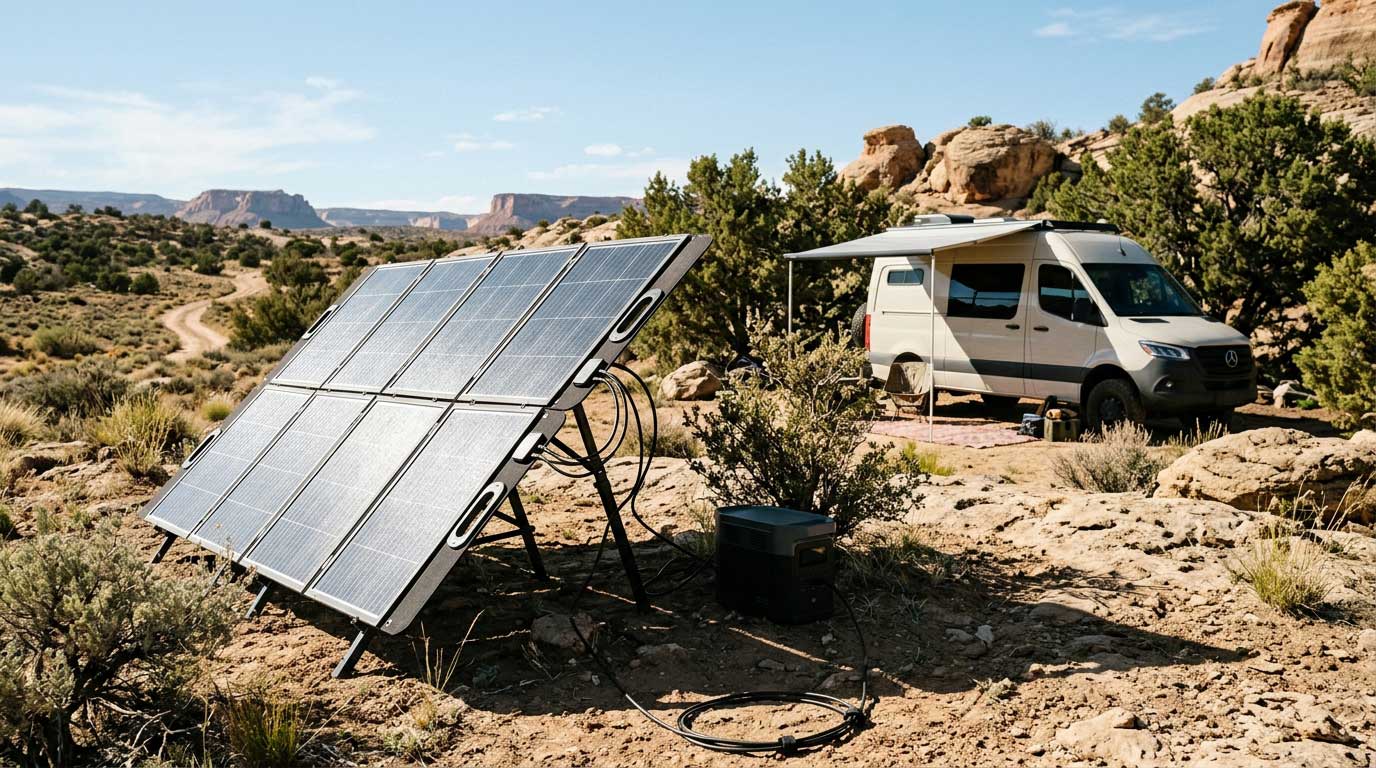
A 1,000W array needs charging equipment that can accept its electrical output. The battery also needs enough capacity to store useful energy without exceeding its permitted charging rate.
Check the solar input rating first
Before connecting the array, verify these specifications in the power station or controller manual:
- Maximum PV input power: The maximum solar power the equipment is designed to accept.
- Maximum open-circuit voltage (Voc): The array voltage with no load must remain below the equipment’s permitted limit, including in cold conditions when panel voltage may rise.
- Operating voltage range: The array must operate within the controller’s supported range.
- Maximum input current: Parallel strings or combined modules must not exceed the specified current limit.
- Battery charging limits: The controller must use settings appropriate for the battery chemistry and manufacturer’s requirements.
A power station advertised with a 1,000W solar input may accept the full rated array under suitable conditions, but its exact voltage and current limits still matter. Another unit may accept less than 1,000W, meaning the array’s potential output could be curtailed.
Do not assume that two cables can simply be connected together to increase input. Use only compatible connectors and an electrical configuration approved by the equipment manufacturer. If the system is unfamiliar, have a qualified installer verify the design before use.
Estimate battery capacity from daily demand
Battery capacity is measured in watt-hours (Wh) or kilowatt-hours (kWh). A 2kWh battery stores a nominal 2,000Wh, although usable energy depends on the battery’s design, discharge limits and conversion losses.
Suppose a campsite uses 1.5kWh per day. A 2kWh battery might cover a substantial portion of that demand, but it would not necessarily provide a full day of usable AC energy after losses and reserve limits. If the same campsite uses 3kWh per day, the battery may need regular solar replenishment and a larger capacity or backup charging option.
Think of the array and battery as two different parts of the system:
- The solar array determines how quickly energy can be collected under current conditions.
- The battery determines how much energy can be stored for later.
- The inverter determines which AC loads can run and how much power they can draw simultaneously.
Buying a larger array without checking battery input limits can waste some available solar power. Buying a large battery without sufficient charging capacity can leave it undercharged after several cloudy days.
How to Set Up a 1000W Foldable Solar Panel System
A larger folding array takes more space and requires more attention to wiring than a small portable panel. Work through the system design before deploying the panels.
Step 1 — Choose a clear, stable site
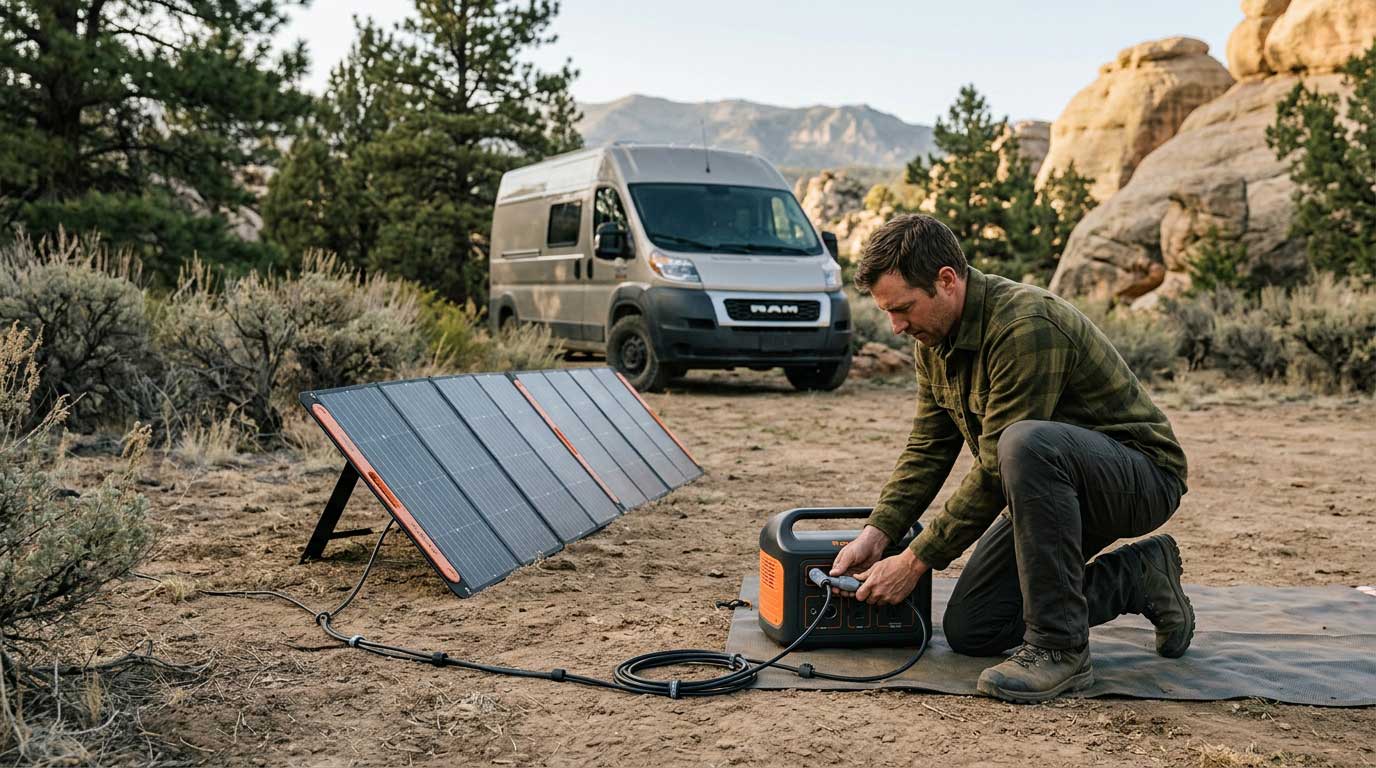
Find a location that receives direct sunlight and leaves enough room to unfold every section. Avoid vehicle paths, uneven slopes and areas where people may trip over cables. Secure the stands against expected wind and follow the manufacturer’s guidance for outdoor use.
Step 2 — Check the array configuration
Identify the voltage and current of each panel and determine whether the system uses series connections, parallel connections or a manufacturer-designed combination. Do not choose a wiring arrangement based only on convenience: series connections increase voltage, while parallel connections increase current.
Make sure the combined array remains within the controller or power station’s operating range. Electrical calculations should use the actual module specifications, including open-circuit voltage and short-circuit current, with the appropriate design margins.
Step 3 — Connect the controller and battery correctly
Follow the equipment manufacturer’s connection sequence. Some standalone charge controllers require the battery connection before the solar input; integrated power stations may be designed for direct connection to an approved array. Never assume the sequence is universal.
Keep connectors dry and inspect the cables for damage. Do not disconnect exposed connectors under load unless the equipment instructions explicitly permit it. If the system uses multiple modules or high-current wiring, professional review is sensible.
Step 4 — Monitor input and battery charging
Check the controller or power station display for input voltage, current and watts if those readings are available. A low reading may indicate cloud cover, partial shading, a poor connection, a mismatched array or an input limit.
Measure production under consistent conditions before drawing conclusions about performance. One reading taken early in the morning is not a fair test of a panel’s rated output under standard test conditions.
Step 5 — Pack the system away carefully
Disconnect equipment as instructed by the manufacturer, fold the modules without forcing hinges or seams, and store cables to prevent connector damage. Inspect panels and supports after transport. For a multi-section array, check every section rather than assuming that a working display proves all modules are undamaged.
Practical Example — Sizing Solar for a Weekend Off-Grid Stay
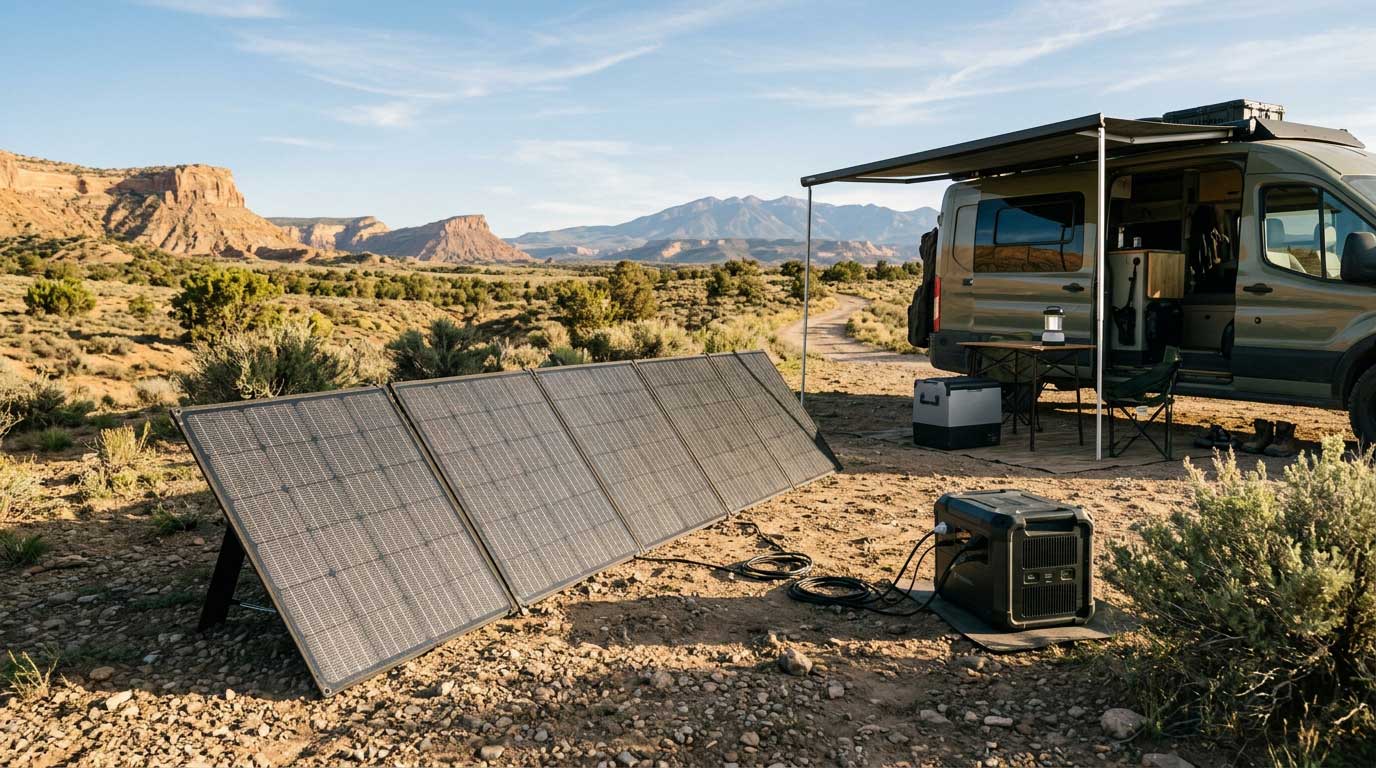
Consider a small off-grid campsite with a refrigerator, lights, laptops and phone chargers. The following is an illustrative daily energy budget, not a measured test of a specific product.
| Load | Example daily consumption |
|---|---|
| Portable refrigerator | 600Wh |
| LED lighting | 100Wh |
| Laptop charging | 160Wh |
| Phone and small-device charging | 60Wh |
| Total daily load | 920Wh |
At an estimated 3kWh of solar energy collected per day, the array could theoretically supply this 920Wh load and leave energy for charging losses or storage, provided the battery and power electronics can accept the available power. But a cloudy day producing only 1.5kWh before storage and conversion losses gives the system less headroom.
This is why sizing by appliance wattage alone is misleading. A refrigerator may draw relatively modest power while running, yet consume energy throughout the day. A kettle may run for only a few minutes but demand high instantaneous power. The first load determines much of the daily energy requirement; the second can determine the inverter’s required power rating.
For a real installation, record energy use in watt-hours over a typical day. Then estimate solar production for the location and season, account for charging and conversion losses, and choose enough battery capacity to cover the periods when solar input is low. If essential loads must operate through several cloudy days, plan for a backup charging method rather than relying on an ideal-weather estimate.
FAQ About 1000W Foldable Solar Panel
How much electricity does a 1000W foldable solar panel generate per day?
With three to five peak sun hours and an illustrative overall efficiency of 75%–85%, a 1,000W array could generate approximately 2.25–4.25kWh per day. Real output depends on location, weather, panel angle, shade, temperature and system design.
Can a 1000W foldable solar panel run a refrigerator?
It may provide enough daily energy for some refrigerators, depending on their consumption and the available sunlight. The battery and inverter must also support the refrigerator’s running and startup requirements. Check the appliance’s actual daily energy use before sizing the system.
What battery size is suitable for a 1,000W solar array?
There is no universal battery size. Choose capacity based on daily consumption, the amount of energy you want to store and how long the system must operate without sunlight. Also confirm that the controller or power station supports the array’s input power, voltage and current.
Can I connect multiple folding solar panels together?
Yes, if the panels and charging equipment are designed for the proposed configuration. Series connections raise voltage, while parallel connections raise current. Verify open-circuit voltage, short-circuit current, connector ratings and controller limits before combining modules.
Is a 1000W folding solar panel waterproof?
The answer depends on the exact product and its environmental ratings. The panel, connectors, controller and power station may have different levels of weather protection. Check the manufacturer’s documentation and do not expose equipment to rain unless its instructions permit it.
Is a 1000W folding solar panel suitable for an RV?
It can be useful for an RV or campsite with enough room to deploy the array and a compatible battery system. Consider storage space, setup time, cable routing and the risk of theft or wind damage. A folding array is generally for use while parked, not for unsecured operation while driving.
What is the difference between a foldable solar array and Bright Solar flexible panels?
A foldable array is designed for temporary deployment and storage. Bright Solar’s flexible panels are designed for appropriate mounted applications, including selected RV, marine and off-grid projects. Their mounting requirements, electrical specifications and bending limits must be checked before installation; they should not be assumed to fold repeatedly like portable panels.
Conclusion
A 1000w foldable solar panel array can provide meaningful portable energy for off-grid sites, RV travel and outdoor work, but the rated wattage is only the starting point. Daily energy production, battery capacity, inverter power and charging compatibility determine what the complete system can actually do.
Before purchasing, confirm whether the advertised 1,000W is the combined rating of multiple modules, check the controller or power station’s electrical limits, and calculate the daily energy needs of your appliances. Use realistic solar estimates rather than best-case output figures. For projects that need mounted modules rather than a portable folding array, compare the application with Bright Solar’s flexible solar panel options and verify the relevant product specifications.
Authoritative References
1. National Renewable Energy Laboratory (NREL) — PVWatts Calculator https://pvwatts.nrel.gov/ Useful for estimating photovoltaic energy production from location and system assumptions.
2. U.S. Department of Energy — Solar Photovoltaic System Design Basics https://www.energy.gov/cmei/systems/solar-photovoltaic-system-design-basics Covers the core components and design considerations of PV systems.
3. U.S. Department of Energy — Solar Photovoltaic Technology Basics https://www.energy.gov/cmei/systems/solar-photovoltaic-technology-basics Explains how photovoltaic cells and modules convert sunlight into electricity.
4. National Renewable Energy Laboratory (NREL) — Best Practices for Operation and Maintenance of Photovoltaic and Energy Storage Systems https://www.nrel.gov/docs/fy19osti/73822.pdf Provides technical guidance on PV system operation, maintenance and performance considerations.
Related recommendations
-

Flexible RV Solar Panels: Complete Guide to Choosing, Installing, and Using Solar Power for RVs
265Discover flexible RV solar panels for campers and motorhomes. Learn benefits, installation, sizing, and how to choose reliable solar solutions for off-grid travel.
View details -
Pergola for Solar Panels: A Smart Way to Create Shade and Generate Power
326Discover how a pergola for solar panels creates shade, generates clean energy, and maximizes unused outdoor space. Learn design tips, costs, and real-world applications.
View details -
Portable Solar Generator for RV: Complete Buying and Setup Guide
327A portable solar generator for RV stores solar energy in a battery and provides power through an inverter for compatible RV appliances and electronics.
View details -
Flexible solar panel 200w home: Lightweight Solar Power for Modern Homes
183Discover flexible solar panel 200w home solutions from Bright Solar. Learn how 200W flexible panels support home backup power, installation tips, output, and real applications.
View details