Solar Powered Battery Charger for Boat: Complete Marine Guide
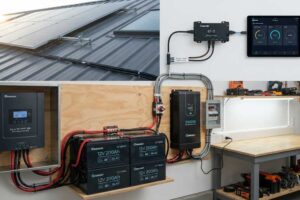
A solar powered battery charger for boat use is a practical way to maintain and recharge onboard batteries without running the engine or staying connected to shore power. The basic system combines solar panels, a properly matched charge controller, battery storage, marine-grade wiring, and suitable protection.
The idea is simple.
The installation is not.
On a boat, the available solar area may be curved, partly shaded, exposed to salt spray, walked on, or occupied by hatches, antennas, rigging, and other equipment. The battery may also be doing several jobs at once: starting the engine, running refrigeration, powering navigation electronics, operating pumps, and supporting lights or communications.
That changes how a solar charger should be designed.
At Bright Solar, marine solar projects are usually evaluated from the mounting surface and daily electrical demand first, rather than starting with a panel wattage number. The practical question is not simply, “How many watts can I fit?” It is, “How much useful charging can this particular boat collect without creating another installation problem?”
How Does a Solar Powered Battery Charger for Boat Work?
A boat solar charging system converts sunlight into DC electricity, sends that power through a solar charge controller, and then uses the controlled output to charge the battery bank.
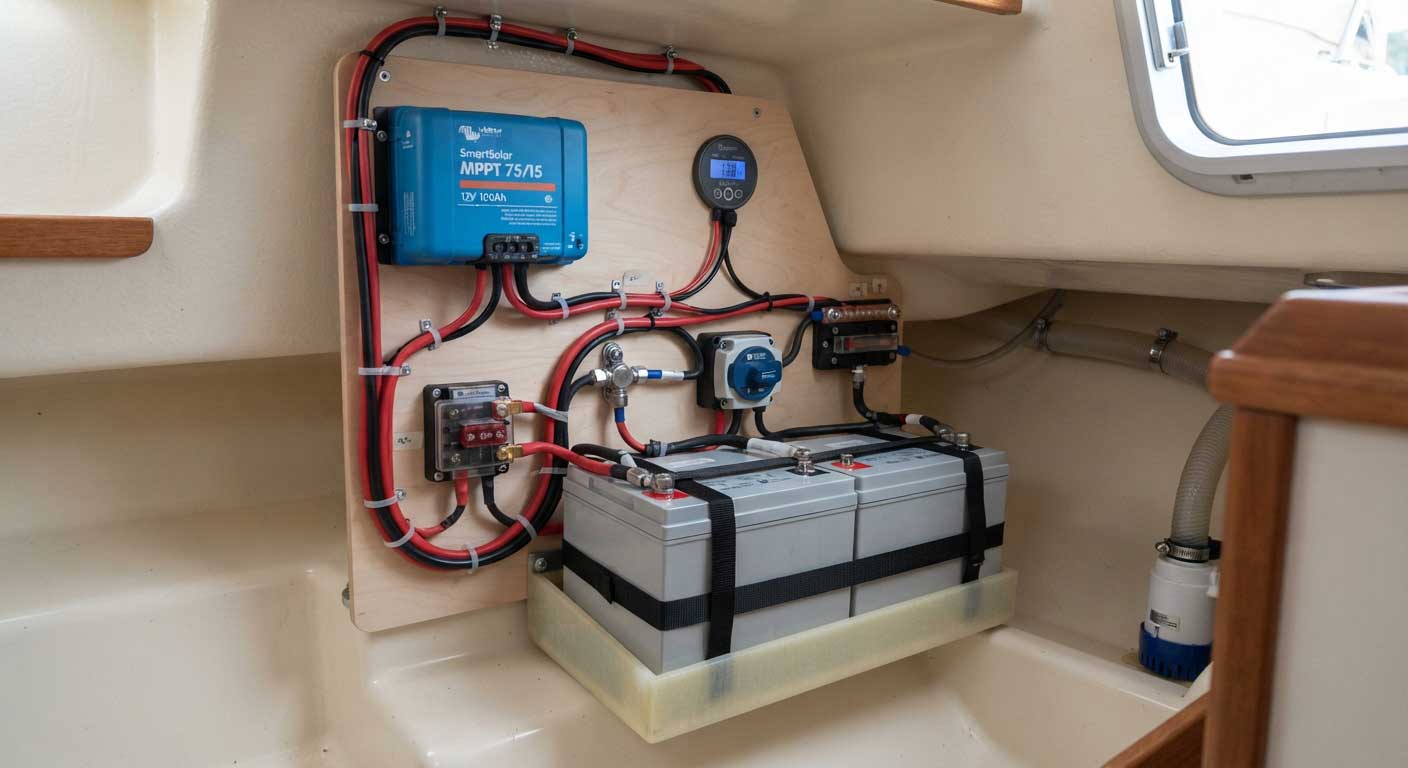
A basic system contains:
- Solar panel or flexible solar panel
- Solar charge controller
- Boat battery or battery bank
- Marine-grade PV and battery cables
- Proper fuses or overcurrent protection
- Connectors and cable glands
- Battery monitoring equipment where required
West Marine describes the same basic architecture: solar panels produce DC power, the charge controller regulates that power, and the battery stores the energy for later use.
The controller matters.
A solar panel should not simply be connected directly to a boat battery as a general-purpose charging method. The controller manages the panel’s electrical output and provides an appropriate charging profile for the battery system.
For a larger installation, an MPPT controller can be particularly useful because it tracks the panel’s operating point and converts the available PV power into a suitable battery-charging output.
Solar charging is different from shore-power charging
A shore-power charger can deliver controlled charging whenever AC power is available.
Solar is different.
Production changes throughout the day with sunlight, panel orientation, clouds, shading, temperature, and the physical location of the boat. DOE notes that solar production varies with season, time of day, clouds, dust, haze, shadows, rain, snow, and dirt.
That variability is why battery capacity and solar capacity need to be considered together.
How Much Solar Power Does a Boat Battery Need?
There is no single panel size that fits every boat.
Start with the battery bank and the actual electrical loads.
For a boat that sits at a dock or mooring with relatively small standby consumption, a small solar panel may be enough to offset self-discharge and parasitic loads. For a cruising boat running refrigeration, navigation electronics, lighting, pumps, communications, and other house loads, the required array can become much larger.
West Marine currently gives approximately 25–35Ah per day from 100W of solar under average conditions and describes 50–100W as a practical range for modest standby loads, while 200–400W is a common range for cruising boats with moderate daily consumption.
Those numbers are planning references, not guarantees.
Example: estimating daily battery demand
Suppose a boat has the following daily loads:
| Load | Approx. Daily Consumption |
|---|---|
| Refrigerator | 600 Wh |
| Navigation electronics | 150 Wh |
| LED lighting | 80 Wh |
| Fans | 120 Wh |
| Phone/laptop charging | 100 Wh |
| Water pump and miscellaneous loads | 150 Wh |
| Total | 1,200 Wh/day |
At a nominal 12V battery voltage:
1,200 Wh ÷ 12V ≈ 100Ah
The boat therefore needs roughly 100Ah of daily energy before accounting for charging losses and real-world solar variation.
This is where many installations go wrong.
A 300W panel array does not mean 300W will arrive at the battery continuously. The array produces power only when usable sunlight reaches the modules, and the output changes throughout the day.
The better approach is to compare daily energy demand with realistic solar production for the actual cruising location.
Why Battery Capacity Matters in Marine Solar Systems
Solar panels produce energy during daylight. Boats often consume energy after sunset.
The battery is the bridge between those two periods.
DOE explains that energy storage allows solar-generated electricity to be used at a different time from when it is produced, although storage itself is not 100% efficient.
This becomes particularly important on boats.
Imagine a vessel uses 80–100Ah per day. A cloudy day may provide substantially less solar energy than expected. Two consecutive cloudy days create an even larger gap.
That is why a solar charger should not be designed around the best sunny day.
It should survive ordinary days.
And preferably an awkward one.
Choosing the Right Solar Panels for a Boat
The panel type should follow the boat.
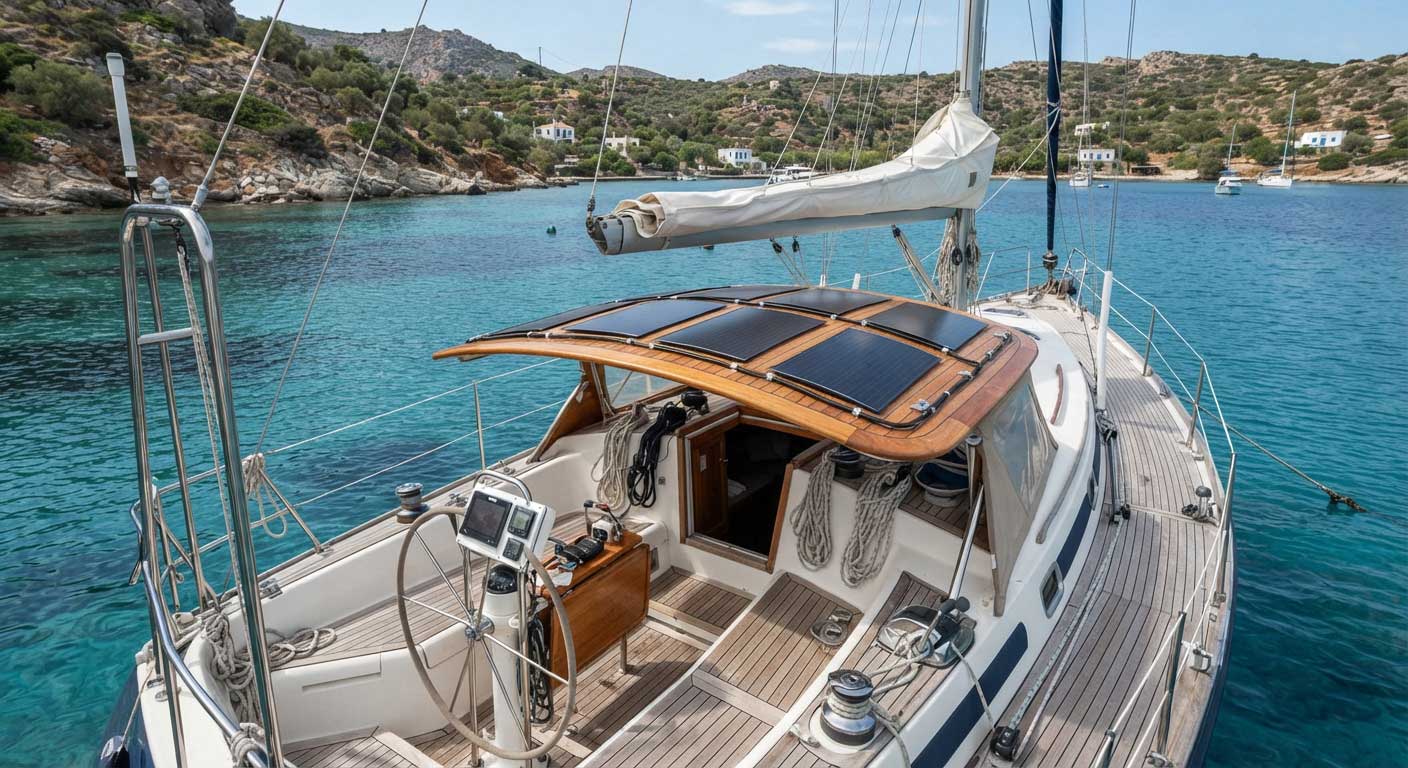
Rigid crystalline modules remain useful where there is a strong, flat mounting structure such as a hardtop, arch, or dedicated solar frame.
Flexible panels become interesting when the boat has:
- Curved cabin roofs
- Limited deck space
- Bimini surfaces
- Lightweight structures
- Walkable areas
- Irregular mounting surfaces
- Areas where low profile matters
Bright Solar’s H Series marine flexible panels are available from 35W to 200W, with listed module efficiencies of approximately 22.5%–25.8%, depending on the model. The product range includes 100W, 120W, 150W, 160W and 200W configurations.
Bright Solar H Series Marine Flexible Solar Panels
The H Series is designed around marine conditions, including saltwater exposure, vibration, humidity and outdoor temperature changes. Bright Solar also lists reinforced construction, ETFE protection and a low-profile flexible structure for marine applications.
Do not choose a panel only by wattage
Two panels with the same wattage can behave differently electrically.
Before selecting a panel, check:
- Maximum power voltage
- Maximum power current
- Open-circuit voltage
- Short-circuit current
- Temperature characteristics
- Physical dimensions
- Weight
- Connector type
- Maximum system voltage
- Environmental requirements
For a marine system, physical fit can be just as important as electrical specification.
How to Install a Solar Powered Battery Charger for Boat
Step 1: Map the usable solar area
Walk the boat before buying the panels.
Look at:
- Bimini frames
- Radar arches
- Cabin roofs
- Hatches
- Antennas
- Rigging
- Boom and sails
- Dinghy equipment
- Walkways
- Shaded areas
- Cable-entry points
A panel that fits physically but sits under a boom shadow for several hours every afternoon may be a poor use of limited deck space.
On a sailboat, the sun moves.
So does the shadow.
Step 2: Estimate the daily electrical load
List every important DC load.
For each device, record:
Current × operating hours = daily amp-hours
For watt-based equipment:
Watts × operating hours = daily watt-hours
Add refrigeration, electronics, lighting, pumps, communications and other regular loads.
Do not forget standby consumption.
Step 3: Select the panel array
Use the daily energy requirement, available mounting area and expected solar conditions to determine the array size.
For a small boat used mostly on weekends, the goal may simply be maintaining the battery between trips.
For a cruising sailboat, the solar array may need to contribute a significant part of daily house consumption.
West Marine notes that a well-designed 200–600W solar installation can produce roughly 30–100Ah or more per day in good conditions, depending on the installation and conditions.
Again, “good conditions” matters.
Step 4: Match the charge controller
The controller should match:
- Solar array voltage
- Solar array current
- Battery voltage
- Battery chemistry
- Maximum PV input voltage
- Required charging profile
For many larger marine systems, MPPT is a practical choice.
Do not select the controller only from the battery voltage.
The PV side has its own voltage and current limits.
Step 5: Install marine-grade wiring and protection
This is where a clean solar design can become a bad boat installation.
Keep cable runs practical.
Protect wiring from:
- Chafing
- Standing water
- UV exposure
- Sharp edges
- Excessive heat
- Mechanical movement
Connections should be mechanically secure and properly protected against the marine environment.
BoatUS specifically emphasizes the importance of a fuse close to the battery because an unfused short can create a direct high-current path from the battery and present a fire risk.
Step 6: Connect the controller to the battery correctly
Follow the specific controller manufacturer’s connection sequence.
West Marine notes that the controller should be connected according to its instructions and that incorrect wiring sequence can damage the controller.
For a multi-battery boat, do not assume the starting battery and house bank should simply be connected together.
The starting battery should normally remain protected from house-load discharge. Marine electrical systems may use separate charging outputs, battery isolators or combiners depending on the system architecture.
Solar Charger for Boat: MPPT vs PWM
The controller is not an accessory.
It is part of the charging system.
PWM controllers are relatively simple and can work well in smaller systems where the panel and battery voltage are closely matched.
MPPT controllers provide more sophisticated tracking of the PV operating point and can be particularly useful when the panel array operates at a higher voltage than the battery bank.
For example, a higher-voltage solar array can feed an MPPT controller that converts the PV input into the voltage required by a 12V or 24V battery system.
The important point is not that one controller is automatically better for every boat.
The controller must match the actual array and battery.
Marine Solar Battery Charging Case Study
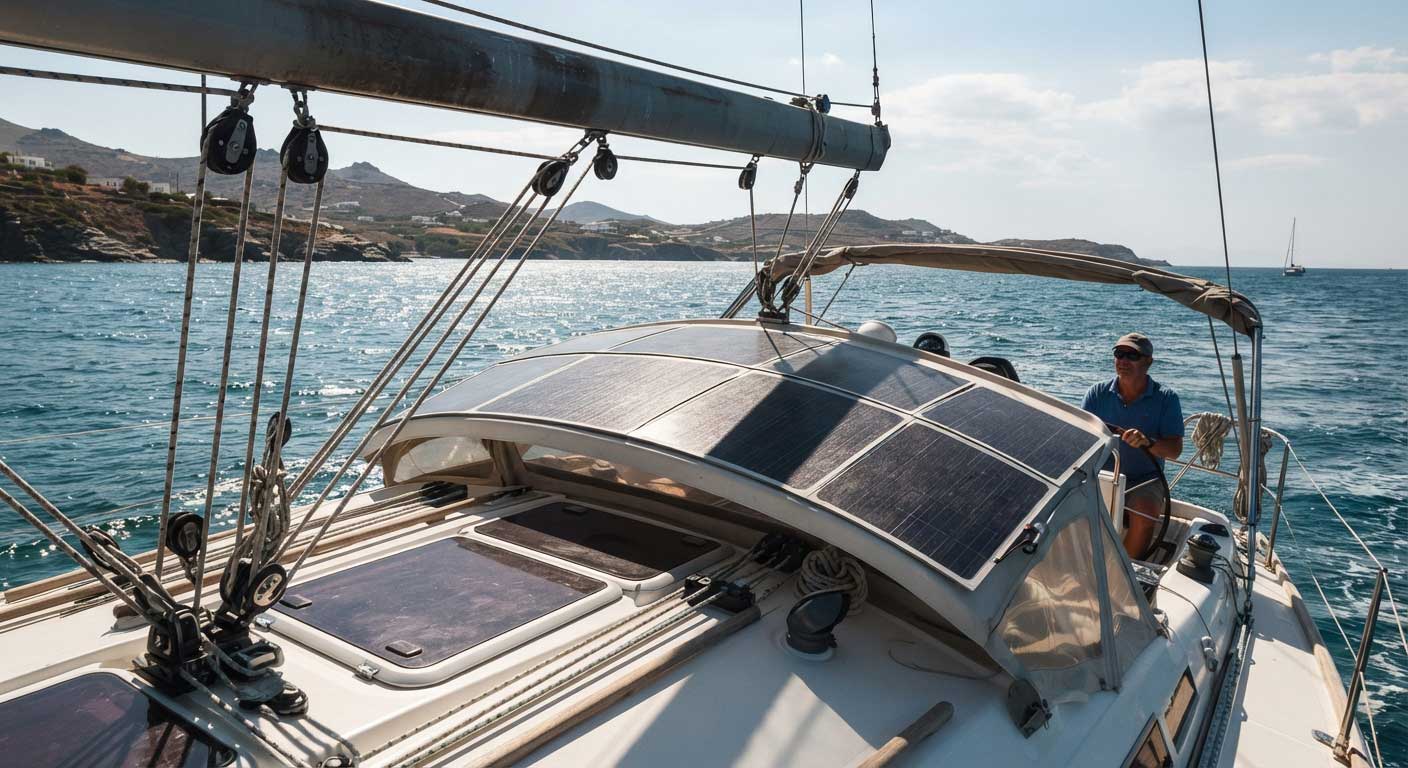
A useful Bright Solar marine application involved four 100W flexible panels installed on a curved yacht deck where rigid panels could not fit properly.
That created an 800? No.
It created a 400W flexible solar array.
The significance of the project was not simply the 400W number.
The four modules made use of a curved deck area that was difficult to accommodate with conventional framed modules, while providing charging support for lighting, batteries and onboard electronics. Bright Solar documents this application as a liveaboard marine use case.
This is a useful reminder when planning a boat system:
available mounting area can determine the practical system size before battery capacity does.
A larger theoretical array is irrelevant if the vessel cannot safely accommodate it.
Managing Heat, Saltwater and Shading
Marine solar panels have a difficult operating environment.
Salt spray is obvious.
Heat is easier to overlook.
NREL’s PVWatts model uses irradiance and cell temperature as key inputs to estimate PV DC output, with a reference cell temperature of 25°C and reference irradiance of 1,000 W/m². The model also accounts for installation-related operating temperature differences.
That matters on a boat because a dark deck can become very hot under direct sun.
A flexible panel mounted directly against a surface may have less airflow than an elevated rigid module.
Bright Solar’s marine applications therefore emphasize the installation environment rather than treating the module as an isolated product.
Salt residue deserves regular attention too.
Bright Solar recommends fresh water and a soft cloth for cleaning marine flexible panels to remove salt residue, dust and debris.
Common Problems With Boat Solar Battery Chargers
Installing the biggest panel that fits
More watts are not automatically better.
A crowded deck can create shading, maintenance problems, cable-routing issues and poor access.
Ignoring the battery chemistry
Flooded lead-acid, AGM, gel and LiFePO4 batteries require different charging profiles.
West Marine explicitly recommends matching the charger to the battery chemistry because incorrect charging settings can damage batteries.
Putting the charger in a bad location
A controller needs protection from direct water exposure and sufficient ventilation.
West Marine also cautions against placing chargers directly above batteries because charging gases can contribute to corrosion, particularly with liquid-electrolyte batteries.
Forgetting the starting battery
A boat can have plenty of house-bank energy and still have a dead starting battery.
Keep the charging architecture clear.
House loads and engine starting requirements are not necessarily the same problem.
Ignoring shade
A boom, mast, radar arch, antenna or nearby structure can cast moving shadows across the array.
A few minutes of observation before installation can prevent months of disappointing production.
How to Maintain a Solar Powered Battery Charger for Boat
Marine solar systems do not need complicated daily maintenance, but they do need inspection.
Check the panels for:
- Salt deposits
- Bird droppings
- Dirt
- Surface damage
- Loose mounting points
- Cable damage
Check the electrical side for:
- Corroded terminals
- Loose connectors
- Water intrusion
- Chafed cables
- Unusual voltage readings
- Unexpected charging behavior
If the controller provides monitoring, record daily solar production and battery voltage.
A baseline is useful.
If the array normally produces a particular range under similar weather conditions and suddenly falls well below it, troubleshooting becomes much easier.
Solar Powered Battery Charger for Boat: Practical Sizing Guide
| Boat Use | Starting Solar Range | Main Objective |
|---|---|---|
| Stored boat / standby loads | 50–100W | Battery maintenance |
| Weekend recreational boat | 100–200W | Battery top-up |
| Moderate cruising | 200–400W | Daily load support |
| Larger cruising loads | 400–800W+ | Significant house-load offset |
| High-demand vessel | 800W+ | Part of a multi-source charging system |
These are planning ranges rather than guaranteed production figures. Actual output depends on sunlight, location, season, orientation, shading, panel temperature, system losses and daily usage. West Marine provides similar planning ranges for small standby boats and cruising applications.
For offshore or extended cruising, solar should also be considered alongside other charging sources.
A boat may use:
- Solar
- Engine alternator
- Shore power
- Wind generation
- Portable or auxiliary charging
West Marine notes that cruising boats commonly combine multiple charging sources rather than relying on one source in every condition.
FAQ: Solar Powered Battery Charger for Boat
Can a solar panel charge a boat battery?
Yes. A solar panel can charge a boat battery through a properly matched solar charge controller. The controller regulates the PV output and provides the appropriate charging process for the battery system.
How many watts of solar do I need for a boat?
It depends on battery capacity and daily consumption. West Marine suggests roughly 50–100W for modest standby loads and 200–400W for many cruising applications, while larger electrical loads may require 400–800W or more.
Can flexible solar panels charge boat batteries?
Yes. Flexible panels are particularly useful where boats have curved, lightweight or space-limited mounting surfaces. Bright Solar’s H Series includes marine flexible panels from 35W to 200W and is designed for marine applications.
Do I need a charge controller for a boat solar panel?
For a properly designed marine solar charging system, yes. The controller regulates solar power before it reaches the battery and must be selected according to the panel array and battery specifications.
Can solar maintain a boat battery while it is stored?
Yes. Small solar systems can offset battery self-discharge and standby loads when a boat is stored or left at a mooring. BoatUS describes small solar panels as a practical method for maintaining batteries on boats that sit unused for extended periods.
Is MPPT better for marine solar charging?
MPPT can be useful when the solar array operates at a higher voltage than the battery and when extracting available PV power efficiently is important. The controller still needs to match the actual panel and battery specifications.
Can solar completely replace shore power on a boat?
Sometimes for modest electrical loads, but not universally. Larger loads such as air conditioning, high inverter use or electric propulsion may require additional charging sources. Solar is often best treated as one part of the boat’s overall charging strategy.
Final Takeaway
A solar powered battery charger for boat use is most effective when the panel array, controller, battery bank and physical installation are designed as one system.
Start with the boat’s actual electrical demand.
Then look at the usable solar surface.
After that, match the panel voltage and current to the controller and battery.
For small boats, a modest panel may be enough to maintain batteries between trips. Cruising boats with refrigeration, navigation equipment, pumps and electronics usually need a larger array and more battery capacity. Marine installations also demand more attention to saltwater exposure, heat, cable protection, shading and mechanical movement than a typical rooftop system.
For Bright Solar marine applications, flexible panels are particularly useful when curved surfaces, low profile and limited mounting space make conventional framed modules difficult to use. The H Series provides marine-oriented flexible options from 35W to 200W, with models listed at up to 25.8% efficiency.
The most useful design habit is also the least complicated:
Measure the boat before choosing the panel.
A well-sized solar array in the right location is far more useful than a larger array that looks impressive on paper but spends half the day shaded, overheated, inaccessible or poorly matched to the battery system.
Authority Sources
The article’s external technical references include the U.S. Department of Energy for solar/storage principles, NREL for PV performance modeling, BoatUS for marine battery-maintenance guidance, and West Marine for practical marine solar and battery-system installation guidance.
Bright Solar’s own marine product and application information is also incorporated for the H Series specifications and documented four-panel yacht application.
Related recommendations
-

How to Connect Solar Panels to Charge Controller: Complete Wiring Guide
288Learn how to connect solar panels to charge controller with step-by-step wiring instructions, safety tips, MPPT and PWM setup guidance for efficient solar systems.
View details -
Flexible CIGS Solar Panel: Efficiency, Uses and Buying Guide
82A flexible CIGS solar panel uses thin-film copper indium gallium diselenide technology to create lightweight, bendable modules for curved and space-constrain...
View details -
140 Watt Folding Solar Panel: Output, Battery Charging and Camping Guide
26A 140W folding solar panel provides portable power for camping, RVs, and small off-grid systems. Actual energy output depends on sunlight, system efficiency,...
View details -
Solar Panel Flexible: A Practical Guide to Lightweight Solar Power
235Explore solar panel flexible technology for RVs, marine applications, camping, and off-grid systems. Learn benefits, efficiency, durability, and installation tips.
View details