Solar Camping Gear: A Practical Guide to Off-Grid Power
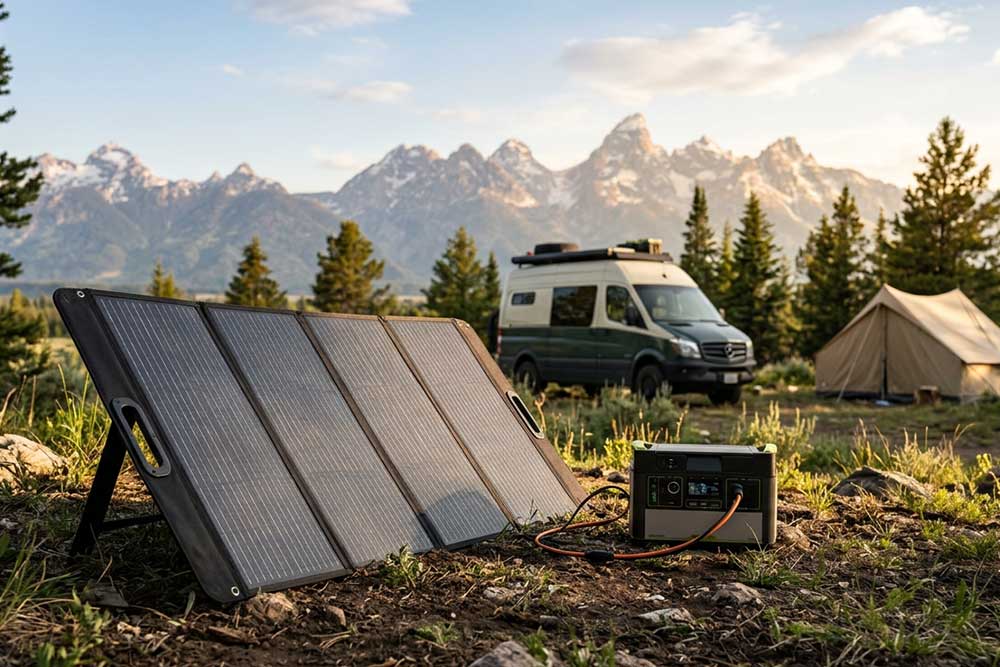
Solar camping gear provides practical off-grid electricity for charging phones, lights, cameras, GPS devices, refrigerators, and other campsite equipment. A useful setup typically combines portable solar panels with a battery or power station, allowing daytime sunlight to be stored and used after sunset or during periods of weak solar production.
Camping has changed. A weekend in the mountains may still mean a tent, stove, and sleeping bag, but it can also involve a satellite communicator, camera batteries, GPS, laptop, refrigerator, or medical device. The challenge is not simply generating electricity. It is carrying enough equipment without turning the back of a vehicle into a mobile power plant.
The best solar camping gear is therefore the equipment that matches the trip rather than the equipment with the largest wattage printed on the package.
What Is Solar Camping Gear?
Solar camping gear refers to portable equipment that uses sunlight to generate, store, or directly use electrical energy outdoors.
The category can include:
- Portable solar panels
- Foldable solar panels
- Flexible and semi-flexible solar panels
- Portable power stations
- Solar battery banks
- Solar lanterns
- USB solar chargers
- Solar-powered refrigerators
- DC charging cables
- Portable LED lighting
- Charge controllers
- Extension cables and connectors
For a simple weekend trip, a 100W-class panel and compact battery may be enough. An RV staying off-grid for several days may require several hundred watts of solar and a much larger battery.
The U.S. Department of Energy explains that solar generation varies with weather, season, time of day, shading, dust, and other environmental conditions. Battery storage changes the usefulness of that electricity by allowing energy generated during the day to be used later.
That distinction is important at a campsite.
A solar panel produces electricity when the sun is available. A battery gives that electricity somewhere to go.
Solar panel versus solar battery
The two are often marketed together, but they perform completely different jobs.
| Component | Main function | Typical specification |
|---|---|---|
| Solar panel | Generates electricity | Watts (W) |
| Battery | Stores electricity | Watt-hours (Wh) |
| Inverter | Converts DC to AC | Continuous watts |
| Charge controller | Regulates solar charging | Voltage/current range |
| Power station | Combines several functions | Wh + W + solar input |
A 200W solar panel does not mean you have 200Wh of stored energy. Likewise, a 2,000Wh battery does not tell you how quickly it can recharge.
That is where proper system sizing begins.
Why Use Solar Camping Gear?
The strongest reason to use solar at a campsite is independence from electrical hookups.
A portable solar setup can be useful when camping:
- Far from campgrounds with electrical connections
- In national forests or dispersed camping areas
- At beaches and remote coastal locations
- On multi-day RV trips
- During road trips
- At temporary outdoor work sites
- During emergency situations
- At locations where fuel generators are undesirable
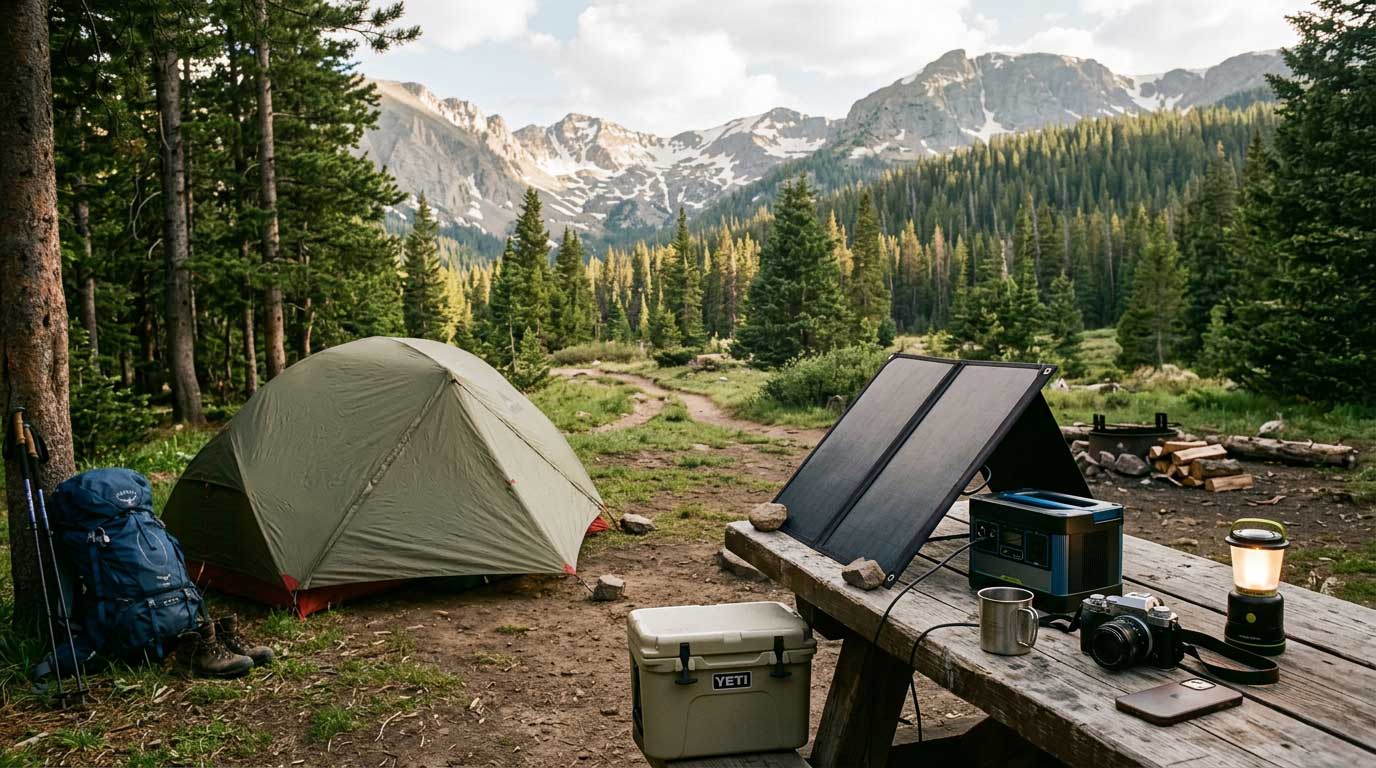
EnergySage describes portable solar as particularly useful for mobile applications such as camping, road trips, RVs, and van travel. It also notes that portable panels can be positioned separately from the vehicle, allowing campers to park in shade while placing the panels in a sunnier location.
That is a surprisingly useful advantage.
An RV parked under a pine tree can be comfortable. Its roof-mounted solar panels may not be.
A portable array can be moved into an open patch of ground 20 or 30 feet away, provided the cable and system design allow it.
Best Solar Camping Gear for Different Camping Styles
There is no single “best” solar camping setup. The correct combination depends heavily on how the campsite is used.
Car camping
Car camping gives you more room, so weight is less restrictive.
A practical setup may include:
- 100–300W portable solar panels
- 500–1,000Wh battery
- USB-C charging
- 12V DC output
- Small AC inverter
- LED camping lights
This is enough for many electronic loads without requiring permanent installation.
Backpacking
Backpacking changes the calculation completely.
Every additional kilogram is carried on your back.
The priorities become:
- Low weight
- Compact folded size
- Adequate phone/GPS charging
- Durable construction
- Simple deployment
- Reliable connectors
Large portable panels and heavy power stations make little sense when the primary loads are a phone, GPS communicator, camera, and headlamp.
NREL has long investigated lightweight and flexible photovoltaic technologies for portable applications, including equipment intended for hikers, campers, and boaters. Its research also highlights the potential of flexible PV where conventional rigid structures are inconvenient.
RV and camper camping
RV users have considerably higher electrical demand.
A refrigerator, water pump, lights, laptops, Wi-Fi equipment, fans, and kitchen appliances can quickly push daily energy consumption into the kilowatt-hour range.
EnergySage reports that portable RV solar is particularly attractive for smaller coaches, trailers, and campervans, while larger permanent systems can make more sense for frequent boondocking.
For RV use, 200–600W of portable solar is a useful planning range for many moderate systems, but the actual array should be determined from daily energy consumption and the battery’s solar-input capability.
Boat and marine camping
Marine environments introduce another requirement: resistance to moisture, salt exposure, and repeated handling.
For a boat, the panel should be evaluated not only by wattage but also by:
- Surface construction
- Connector protection
- Water resistance
- Salt exposure
- Mounting method
- Cable routing
- Weight
- Storage requirements
This is one area where flexible or semi-flexible solar products can become attractive because the installation surface may not be a convenient flat rectangle.”Learn more about the Flexible Solar Panel Installation Guide“
How to Choose Solar Panels for Camping
The panel is the energy source, so its specifications deserve closer attention than a simple “100W” or “200W” label.
100W portable solar panels
A 100W panel is a sensible starting point for light camping.
It can support relatively small loads such as:
- Smartphones
- GPS devices
- Headlamps
- Cameras
- Small battery banks
- Portable speakers
- USB lighting
The important word is small.
A 100W-rated panel does not continuously deliver 100W from sunrise to sunset. Actual production changes with sunlight intensity, temperature, orientation, shading, and other conditions. DOE specifically identifies these environmental factors as contributors to changing PV output.
200W portable solar panels
At 200W, a portable array becomes more useful for car camping and small RVs.
It can provide substantially more charging capacity while remaining manageable for many vehicle-based trips.
EnergySage’s 2025 review of portable solar products included 200W-class portable panels among practical options for camping and mobile applications, illustrating how this power class has become common in portable solar equipment.
400W and larger portable arrays
A 400W system makes more sense when the battery is larger and daily loads are higher.
It is particularly useful for:
- Refrigeration
- Several electronic devices
- Longer RV trips
- Work-from-campsite setups
- Multi-day dry camping
At this point, however, cable sizing, connectors, PV voltage, charge-controller limits, and battery input specifications become much more important.
More wattage is not automatically better if the receiving power station cannot accept it.
How Much Battery Storage Do You Need for Camping?
Battery capacity is measured in watt-hours.
A 1,000Wh battery theoretically stores 1kWh of energy, although the amount available to connected AC loads will be lower after conversion losses and operating limits.
A simple estimate is:
Energy use = Power × Time
For example:
| Camping load | Estimated power | Use | Daily energy |
|---|---|---|---|
| LED lighting | 20W | 4 hours | 80Wh |
| Smartphone charging | 10W | 3 hours | 30Wh |
| Laptop | 60W | 5 hours | 300Wh |
| Camera charging | 30W | 2 hours | 60Wh |
| Portable refrigerator | 45W average* | 10 hours | 450Wh |
| Estimated total | — | — | 920Wh |
*Actual refrigerator consumption depends on compressor cycling, ambient temperature, insulation, thermostat settings, and model.
This example suggests that a 1,000Wh battery would be relatively close to one day’s calculated consumption. It does not mean a 1,000Wh battery is automatically the right choice. Some reserve is valuable, particularly when the weather is uncertain.
The Department of Energy distinguishes energy capacity from power capacity: one describes how much energy storage is available, while the other describes how quickly that energy can be delivered.
That distinction is often missed when consumers shop for camping batteries.
A battery can have plenty of Wh and still have an inverter too small to start a compressor or power a high-demand appliance.
Portable Solar Panels and Battery Storage: A Better Combination
Portable panels and batteries solve different parts of the same problem.
During the afternoon, the solar panel may produce more energy than the campsite needs. The battery captures that surplus.
At night, the battery becomes the energy source.
This arrangement is particularly useful for camping because electrical demand and solar production rarely happen at exactly the same time.
The refrigerator may need energy overnight.
Your laptop may be used after sunset.
Lights are usually needed when the sun has disappeared.
A camera battery might be nearly empty at 9 p.m., precisely when the solar panel is producing nothing.
A battery bridges that timing gap.
EnergySage defines a solar generator essentially as portable battery storage powered by solar panels and notes its usefulness for camping, RVs, boats, small devices, and limited emergency power.
How to Set Up Solar Camping Gear
A good setup should be simple enough to deploy before breakfast and pack away without turning into a cable puzzle.
Step 1: Estimate your actual loads
List the equipment you expect to use.
Separate it into:
DC loads: USB devices, 12V refrigerators, lights, fans.
AC loads: laptops, small kitchen appliances, chargers, and other devices using conventional outlets.
This immediately shows whether you actually need a large inverter.
Step 2: Estimate daily watt-hours
Calculate the energy required by each device.
For example:
60W laptop × 5 hours = 300Wh
Repeat the calculation for the other loads.
Do not use appliance wattage alone. A 1,000W appliance used for five minutes is not equivalent to a 1,000W appliance used continuously for five hours.
Step 3: Choose the battery
Select a battery that can cover the expected usage while leaving reasonable reserve.
For weekend car camping, 500–1,000Wh may be sufficient for many users.
For larger RV systems, 1,500–3,000Wh or more may be appropriate.
These are planning ranges, not universal specifications.
Step 4: Match the solar array
The solar array should be capable of replacing the energy you consume under realistic conditions.
A simple theoretical calculation is:
Solar energy = Panel watts × equivalent sun hours
For example:
400W × 4 hours = 1,600Wh
That is not a guaranteed daily harvest. It is a theoretical starting point before accounting for temperature, orientation, shading, conversion efficiency, and other losses.
Step 5: Check PV compatibility
Before connecting a panel to a battery or power station, check:
- Open-circuit voltage (Voc)
- Operating voltage (Vmp)
- Short-circuit current (Isc)
- Operating current (Imp)
- Maximum PV input voltage
- Maximum PV input current
- Maximum solar input wattage
This is particularly important when connecting third-party panels to portable power stations.
A 400W panel system is only useful if the receiving equipment is designed to accept it.
Step 6: Find the sun before you find the perfect campsite
This sounds backwards, but it can save hours of frustration.
For a portable setup, look at the campsite from two perspectives:
Where will I sleep?
and
Where can I put the panels?
A shaded tent location and a sunny panel location can coexist.
That is one of portable solar’s biggest practical advantages over a permanently mounted panel.
Solar Camping Gear for RV Refrigerators and Other Appliances
Refrigeration is often the first serious electrical load encountered during extended camping.
A refrigerator may have a relatively modest average energy consumption even though its compressor draws a higher instantaneous load when operating.
That is why battery sizing should use realistic daily energy consumption rather than simply multiplying the compressor’s rated wattage by 24 hours.
The same issue appears with pumps and motors.
For an inverter-powered appliance, check both:
- Continuous inverter output
- Peak or surge output
If the appliance requires 1,200W while running and a substantially higher startup surge, a 1,000W inverter may be unsuitable even if the battery itself has plenty of capacity.
For larger RV applications, EnergySage cautions that air conditioning is considerably more demanding than basic RV loads and can be difficult to operate from a modest solar system for extended periods.
That is a useful dividing line.
Solar camping gear is excellent for essential and moderate electrical loads. It should not be marketed as a universal replacement for campground shore power without considering the actual load profile.
Flexible Solar Panels for Camping
Flexible solar panels can be useful when portability, weight, storage, or mounting surface matters.
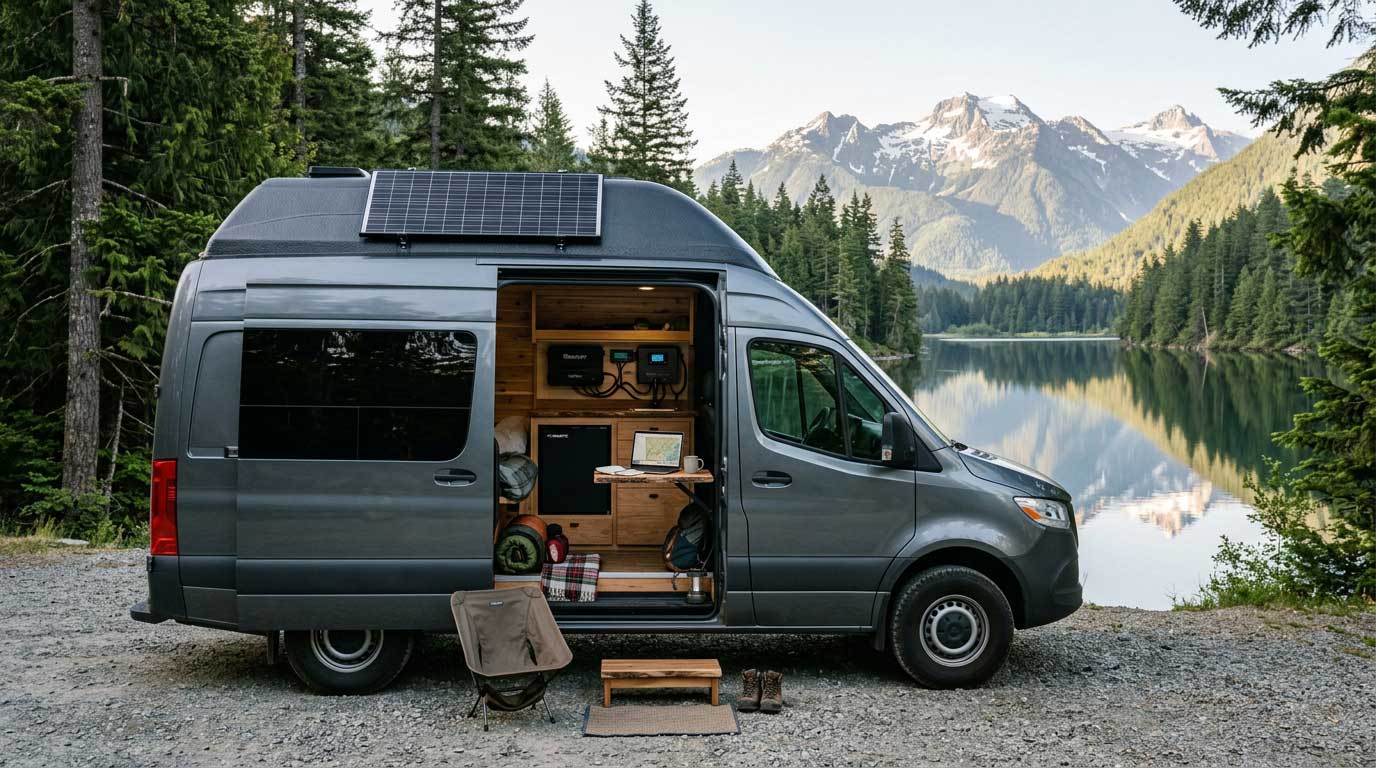
A rigid framed panel is straightforward when there is plenty of storage space. A flexible product can be more convenient when equipment must fit into a narrow vehicle compartment or when the panel needs to conform to a suitable curved surface.
NREL has identified flexible photovoltaic technology as an important research area, including applications where conventional rigid PV structures are difficult to use.
For Bright Solar, this is an important product-design consideration.
The question should not simply be:
“Which panel has the highest wattage?”
A better question is:
“Which panel delivers the required electrical output while fitting the physical constraints of the camping system?”
For mobile equipment, those constraints may include:
- Storage thickness
- Folded dimensions
- Weight
- Surface shape
- Deployment time
- Cable routing
- Outdoor exposure
- Battery compatibility
How Weather Changes Solar Camping Performance
The campsite may look perfect while the solar array performs poorly.
A clear sky is not the only variable.
Performance can be affected by:
- Cloud cover
- Shadows
- Dust
- Dirt
- High module temperature
- Poor panel orientation
- Partial obstruction
- Short winter days
- Changing sun angle
DOE specifically lists clouds, shadows, dust, haze, rain, snow, dirt, season, and time of day among factors that affect solar energy production.
This is why field experience often produces different results from a specification sheet.
A panel rated at 200W is tested under defined conditions. A forest campsite at 4 p.m. is not one of those conditions.
For portable camping, the ability to move the panel can sometimes compensate for a less-than-ideal parking position.
A Realistic 400W Solar Camping Gear Example
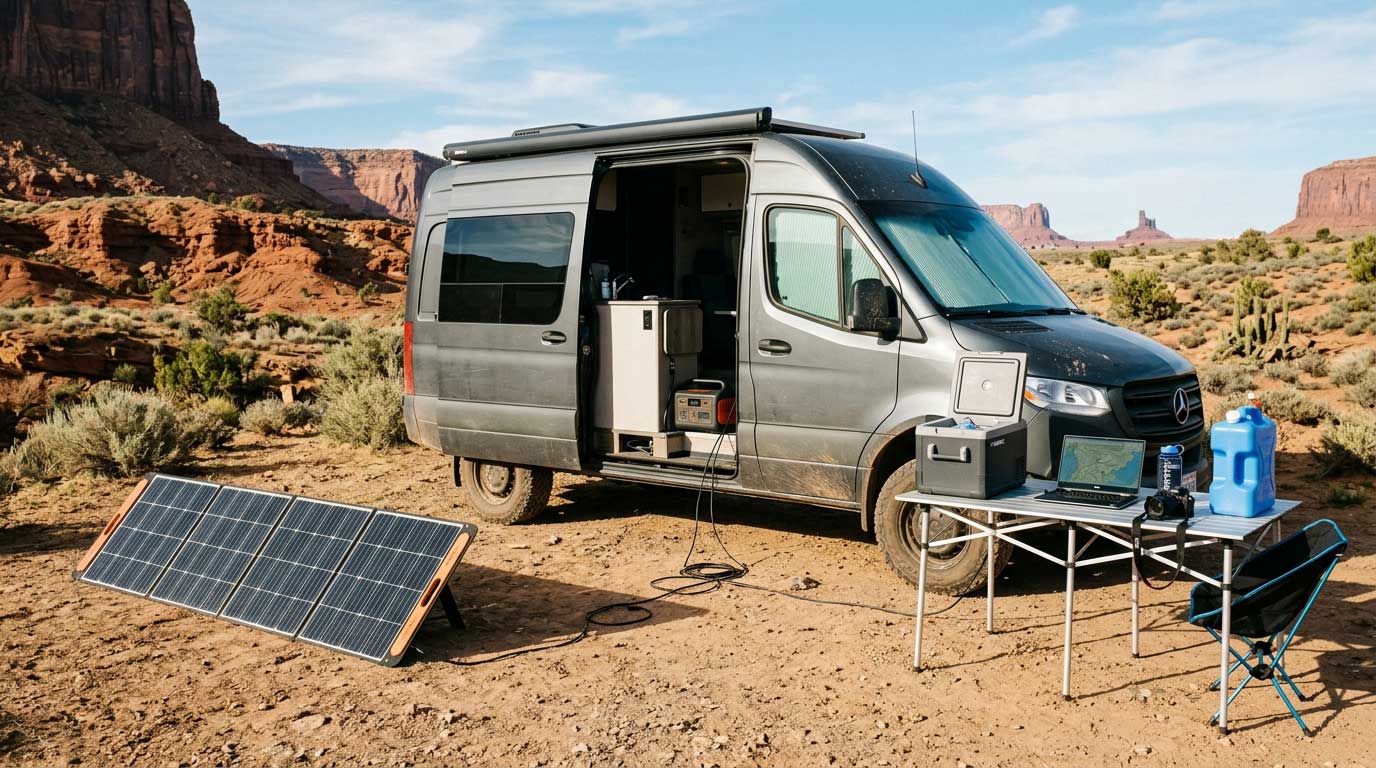
Consider a couple traveling through the American Southwest for four days.
They use:
- 400W portable solar panels
- 1,500Wh battery
- 12V refrigerator
- Two smartphones
- One laptop
- LED lighting
- Camera equipment
- Wi-Fi hotspot
Their estimated daily consumption is approximately 800–1,100Wh.
On a strong sunny day, the solar array may produce enough energy to replace most or all of the previous day’s consumption.
But imagine the second campsite is surrounded by tall cottonwood trees.
The panels are moved away from the vehicle, but a section remains shaded during part of the afternoon.
The system still works. It simply collects less energy.
That difference matters.
Instead of designing the system around a perfect 400W × 5-hour calculation, a practical designer leaves enough battery capacity to absorb a poor solar day.
This is one of the more useful lessons from portable system design: storage is not just for nighttime. It is also a buffer against bad solar conditions.
Common Solar Camping Gear Mistakes
Buying the largest panel without checking the battery
The battery or power station has a maximum solar-input rating.
If it accepts 200W, connecting a much larger array will not necessarily increase charging power.
Using a battery that is too small
A panel can generate plenty of energy during the day while the battery runs out every evening.
For multi-day camping, storage capacity is often more important than peak panel output.
Ignoring inverter power
Battery capacity and inverter output are different specifications.
A 2,000Wh battery does not necessarily mean a 2,000W appliance can run from it.
Leaving panels in partial shade
Portable panels are easy to move, so use that advantage.
A few minutes spent finding a better position can be more valuable than adding another small panel.
Choosing equipment based only on weight
Ultra-light equipment can be attractive for backpacking, but vehicle-based camping has different priorities.
Durability, connector quality, weather resistance, storage dimensions, and long-term handling may matter more.
Solar Camping Gear Maintenance
Portable equipment gets handled more often than rooftop equipment.
That changes maintenance requirements.
Before each trip, inspect:
- Panel surface
- Cable insulation
- Connectors
- Folding hinges
- Mounting points
- Battery enclosure
- Cooling vents
- USB and AC outlets
Keep the panel surface reasonably clean. Dust, mud, pollen, and bird droppings can reduce the light reaching the photovoltaic cells.
Do not pack wet equipment into a sealed storage case for extended periods.
For battery systems, follow the manufacturer’s charging, storage-temperature, and transport instructions. Do not leave a battery or power station exposed unnecessarily to extreme heat inside a closed vehicle.
Solar Camping Gear Buying Checklist
Before purchasing, compare the complete system rather than one headline specification.
| Question | What to check |
|---|---|
| How much energy do I use? | Daily Wh |
| How much storage do I need? | Battery usable Wh |
| What appliances will I run? | Continuous and peak watts |
| How much solar can I use? | Panel wattage |
| Will the battery accept it? | PV voltage/current/input watts |
| How portable is it? | Weight and folded dimensions |
| Where will it be used? | Weather and environmental conditions |
| How often will it be deployed? | Construction and connector durability |
| What type of camping? | Backpacking, car camping, RV, marine |
| Can the panel be moved? | Cable length and deployment design |
For Bright Solar, this system-level approach is especially relevant when selecting flexible or semi-flexible panels for portable applications. The panel should be evaluated as part of the complete energy system, not as an isolated product.
FAQs About Solar Camping Gear
What is the best solar camping gear for beginners?
For basic camping, a portable solar panel paired with a 500–1,000Wh battery is a practical starting point. Add USB-C, 12V, or AC outputs according to the devices you actually use. Backpackers should prioritize low weight, while car campers can carry larger panels and batteries.
How many watts of solar do I need for camping?
Light camping may only require 50–150W. Car camping commonly benefits from around 100–300W, while RV and multi-day off-grid use may justify 400–600W or more. The correct size depends on daily energy consumption, sunlight, battery capacity, and the receiving system’s maximum PV input.
Can a 100W solar panel be enough for camping?
Yes, for small loads such as phones, cameras, GPS equipment, lights, and small battery banks. It is less suitable for heavy refrigeration or multiple AC appliances. A 100W rating is a maximum operating condition, not a guarantee of 100W throughout the day.
Do I need a battery with portable solar panels?
A battery is strongly recommended if electricity is needed after sunset or during changing weather. Solar panels produce power only when sunlight is available, while battery storage allows energy generated earlier in the day to be used later.
Are flexible solar panels good for camping?
They can be useful when low weight, limited storage space, or unusual mounting surfaces are important. They are especially relevant to vans, boats, RVs, and other mobile applications. The electrical specifications still need to match the battery or power station.
Can solar camping gear run a refrigerator?
Yes, provided the battery, inverter, and solar array are sized for the refrigerator’s actual energy consumption and startup requirements. Refrigerator loads cycle, so daily Wh consumption is more useful for system sizing than simply using the compressor’s maximum wattage.
Can solar camping gear replace a gas generator?
For many small and moderate loads, yes. Portable solar and battery systems can provide quiet power for electronics, lighting, refrigeration, and communications. They are not automatically equivalent to a fuel generator for high-power loads or extended periods of poor solar conditions.
Conclusion
The most useful solar camping gear is not necessarily the largest, lightest, or most expensive equipment on the market. It is a balanced combination of solar generation, battery storage, power conversion, portability, and real-world durability.
For a short camping trip, 100–200W of solar and a compact battery may be enough. RV travelers and multi-day campers often need several hundred watts of solar and substantially more storage. Backpackers have a different priority: every gram matters.
For Bright Solar, portable and flexible solar applications are best approached from the complete system outward. Start with the loads, estimate daily watt-hours, choose practical battery storage, then match the panel’s voltage and current to the charging equipment.
A campsite does not need to look like a power station.
It simply needs enough energy, stored in the right place, at the right time.
Solar camping gear makes that possible while keeping the system mobile enough to move with the trip rather than tying the trip to an electrical hookup.
Related recommendations
-

Portable Folding Solar Panel: How to Choose and Use One
8A portable folding solar panel provides mobile electricity for camping, RV travel, and off-grid charging. Choose a model based on energy demand, total weight...
View details -
Most Powerful Solar Panel: How to Choose the Highest Output Solar Solution
225Discover the most powerful solar panel options for maximum energy output. Learn efficiency ratings, real-world performance, and how Bright Solar solutions support RV, marine, and off-grid applications.
View details -
Solar Panels for Mobile Homes: A Practical Guide Based on Real Installations
235Discover how solar panels for mobile homes reduce electricity costs, improve energy independence, and deliver long-term savings. Learn sizing, costs, installation tips, and real project insights.
View details -
12V Flexible Solar Panel Kit: The Complete Guide for Mobile Solar Power
163Discover how a 12V flexible solar panel kit provides lightweight, efficient power for RVs, boats, campervans, and off-grid systems. Installation tips included.
View details