Flexible 400 Watt Solar Panel: Output, Uses and Installation
A flexible 400 watt solar panel is a photovoltaic module rated to produce up to 400 watts under specified test conditions. It may be considered for suitable RV roofs, campervans, boats, and off-grid systems where weight, available space, or mounting-surface shape matters. Real-world energy production varies with sunlight, temperature, shading, orientation, and system losses.
The 400W figure describes nominal power—not a guaranteed daily energy supply. Before choosing a panel, check its dimensions, weight, electrical ratings, permitted bending, mounting method, and compatibility with the charge controller and battery. For B2B buyers, matching these details to the application is more useful than comparing wattage alone.
How Much Energy Does a Flexible 400 Watt Solar Panel Produce?
A flexible 400W panel is rated at 0.4 kilowatts (kW). To estimate daily energy, multiply that rating by the equivalent peak-sun-hours and then account for system losses.
Planning formula:
Daily energy (kWh) = 0.4kW × peak-sun-hours × assumed system factor
The following examples use an illustrative system factor of 0.8. It is a calculation assumption—not a measured efficiency or guaranteed performance value for a Bright Solar product.
| Equivalent peak-sun-hours | Calculation | Illustrative daily energy |
|---|---|---|
| 2 hours | 0.4 × 2 × 0.8 | 0.64 kWh |
| 3 hours | 0.4 × 3 × 0.8 | 0.96 kWh |
| 4 hours | 0.4 × 4 × 0.8 | 1.28 kWh |
| 5 hours | 0.4 × 5 × 0.8 | 1.60 kWh |
| 6 hours | 0.4 × 6 × 0.8 | 1.92 kWh |
These are scenario calculations, not forecasts for a particular location. A dependable estimate needs the installation location, orientation, tilt, shading, weather data, module characteristics, and system configuration.
The U.S. Department of Energy explains that module ratings are measured under standardized conditions, while field output changes with solar resource, temperature, and other operating factors. NLR’s PVWatts tool estimates system production from location and system inputs, while warning users that modeled results contain assumptions and uncertainty.
Why actual output changes throughout the day
A panel’s output is not constant from sunrise to sunset. Early and late sunlight arrives at a different angle; clouds reduce irradiance; and nearby objects may cast moving shadows across the module. Heat can also change electrical performance.
For a vehicle or boat, the installation surface adds another layer of uncertainty. A roof-mounted panel may not have the same orientation or airflow as a panel on an open rack. Avoid transferring a performance estimate from one mounting arrangement to another without checking the assumptions.
For a site-specific estimate, use the official PVWatts Calculator as a starting point. Its grid-connected system model is useful for preliminary analysis, but a mobile or specialized flexible-panel installation may require additional engineering judgment and manufacturer data.
Applications for a Flexible 400 Watt Solar Panel
RVs and campervans
An RV roof is rarely a blank rectangle. Air conditioners, vents, antennas, roof rails, and access paths compete for space. A flexible panel may be useful where its form and mounting requirements suit a particular roof section.
Before selecting a location:
- Measure the usable roof area, including clearance around accessories.
- Observe where shadows fall at different times of day.
- Check whether the roof material and surface condition are compatible with the specified mounting method.
- Confirm that the panel’s permitted curvature matches the roof.
- Plan a protected route for cables and connectors.
The important question is not simply whether a 400W module fits on the roof. It is whether it can be installed without violating the panel’s mechanical limits or creating avoidable shading and maintenance problems.
Marine and boat installations
On boats, low-profile solar can be attractive when deck or roof space is limited. However, marine use introduces exposure to salt, moisture, vibration, movement, and sometimes foot traffic.
A flexible panel should not be assumed to be walkable or suitable for continuous marine exposure just because it can bend. Check the model-specific environmental ratings, installation instructions, and warranty conditions. Confirm that the mounting surface is appropriate and that cable connections are protected for the actual environment.
Off-grid systems and remote equipment
A flexible 400 watt solar panel may be considered as part of an off-grid array for battery charging, lighting, communications, or other DC loads. The panel is only one part of the system.
A complete design also needs:
- A charge controller compatible with the panel’s voltage and current.
- A battery selected for the required storage and discharge conditions.
- Appropriate conductors, connectors, and overcurrent protection.
- A load assessment based on actual energy use.
- A plan for cloudy periods and seasonal changes in solar availability.
If uninterrupted power is essential, a single panel’s estimated daily contribution should not be treated as a guarantee. Storage, backup charging, and demand management may be necessary.

What to Check Before Buying a Flexible 400 Watt Solar Panel
A product’s rated wattage is only one line in its datasheet. For project selection and procurement, confirm the exact model’s mechanical and electrical details rather than relying on general claims about flexible panels.
| Specification | What to verify |
|---|---|
| Rated power | Confirm the nominal output and the conditions under which it is rated. |
| Dimensions | Check the available mounting area and required clearances. |
| Weight | Confirm that the installation surface and project weight limits can accommodate it. |
| Voc | Check open-circuit voltage against controller and system limits, including cold-weather considerations. |
| Isc | Confirm short-circuit current for wiring and protective-device selection. |
| Vmp and Imp | Use the operating voltage and current values when designing the system. |
| Bending limit | Confirm the permitted curvature and how the manufacturer defines it. |
| Mounting method | Check approved adhesives, fasteners, support requirements, and surface compatibility. |
| Temperature range | Verify that expected operating conditions are within the product’s stated limits. |
| Environmental ratings | Confirm any specific water, UV, salt, or other resistance claims in the datasheet. |
| Warranty | Review the coverage, exclusions, installation requirements, and claim process. |
B2B procurement checklist
For OEM, ODM, distributor, and bulk purchasing, it is useful to send the supplier a concise technical brief. Include the intended application, installation environment, usable dimensions, electrical-system details, expected quantity, and any required customization.
Ask the supplier to provide:
- The current datasheet for the exact proposed model.
- The installation manual and permitted mounting methods.
- Electrical ratings and applicable test conditions.
- Bending limits and any restrictions on repeated flexing.
- Environmental ratings relevant to the intended use.
- Available customization options and their effect on the specification.
- Sample availability, production lead time, warranty terms, and quality documentation.
This approach reduces the risk of comparing products that share a wattage label but differ in dimensions, electrical characteristics, or installation requirements.
How to Install a Flexible 400W Solar Panel
Follow the manufacturer’s instructions for the specific module. Flexible construction does not eliminate the need for careful mounting, correct wiring, and electrical protection.
Step 1 — Inspect the mounting surface
Check for sharp edges, raised fasteners, cracks, loose coatings, and areas that may flex independently. Clean the surface using a method compatible with its material. Mark the panel position and check clearances around vents, hatches, and other equipment.
Step 2 — Confirm the permitted curvature
Do not crease the module or force it around a tight corner. A panel designed to tolerate limited bending is not necessarily designed for repeated flexing, rolling, or folding. Use only the mounting method and curvature permitted by the manufacturer.
Step 3 — Design the electrical connection
Review Voc, Isc, Vmp, and Imp before connecting the panel. Confirm that the charge controller can accept the module’s electrical characteristics and that the battery settings are appropriate for the battery type.
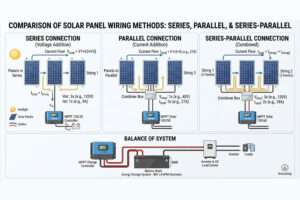
For multiple modules, calculate the combined voltage and current for the proposed series or parallel arrangement. Check the controller’s limits and account for relevant temperature conditions.
Step 4 — Mount the panel and protect the wiring
Use the specified fixing method. Route cables away from sharp edges, hot surfaces, moving components, and locations where water can accumulate. Provide appropriate strain relief and ensure connectors are compatible and properly secured.
For vehicles and boats, include vibration and movement in the installation assessment. A mounting solution that seems secure while stationary may behave differently during travel or operation.
Step 5 — Test and record the system
Inspect the installation before energizing it. Follow the equipment instructions for commissioning, then record baseline readings and conditions such as time, weather, shading, and battery state. These notes can help distinguish a change in sunlight from a wiring, controller, or module issue later.
Electrical work should comply with applicable local requirements. Use a qualified installer where required, particularly when working with high-current DC systems or integrating solar equipment into a vehicle or vessel.

Flexible 400W Solar Panel vs. Rigid 400W Solar Panel
Both formats can provide a nominal 400W rating, but their mounting and mechanical characteristics may differ. The correct choice depends on the installation rather than the wattage label.
| Factor | Flexible panel | Rigid panel |
|---|---|---|
| Mounting surface | May suit certain gently curved surfaces within stated limits | Commonly installed on a suitable flat or angled mounting structure |
| Profile | Typically designed for a lower-profile installation | Often has a frame or more substantial supporting structure |
| Mechanical handling | Bending and handling limits require particular attention | Frame, glass, and mounting loads need to be considered |
| Integration | May help where a compatible curved or constrained surface is available | Often fits roofs or racks designed for framed modules |
| Selection priorities | Curvature, mounting compatibility, environmental ratings, and electrical data | Structure, load requirements, dimensions, and electrical data |
Do not assume that one type is always lighter, more durable, more efficient, or better suited to a particular environment. Compare the actual products’ specifications and installation requirements.
Practical Planning Example: A Campervan Solar Upgrade
The following is a hypothetical design example, not a verified Bright Solar customer case or a measured result.
A campervan owner wants to add solar charging but must preserve access to roof vents and maintenance points. The owner is considering a flexible 400W module. The installer first measures the usable area, checks for shade from roof fittings, and confirms whether the roof curvature is within the module’s permitted limit.
The electrical review comes next. The installer compares the panel’s datasheet values with the charge controller and battery system, checks cable routes, and determines whether the proposed layout allows safe inspection and maintenance.
For an initial energy scenario, suppose the design uses 4 equivalent peak-sun-hours per day and an assumed system factor of 0.8:
0.4kW × 4 hours × 0.8 = 1.28kWh/day
That is a planning estimate only. The owner should compare it with an itemized daily load profile and account for season, weather, shading, and periods when the vehicle is parked in partial shade. If expected consumption is higher than the solar contribution, the design may require additional generation, reduced loads, or another charging source.
Once installed, the system’s readings can be recorded under known conditions. That record gives the owner a reference point for later troubleshooting and avoids treating a single cloudy-day measurement as proof of a product fault.
Common Mistakes to Avoid
- Assuming 400W means 400W all day: rated power is not a constant output or a daily energy total.
- Ignoring shadows: vents, antennas, roof rails, and nearby objects can reduce production.
- Exceeding the bending limit: flexible does not mean crease-proof, foldable, or suitable for every curve.
- Choosing a controller by wattage alone: voltage, current, battery requirements, and system configuration also matter.
- Assuming marine suitability: verify the actual module’s environmental ratings and installation instructions.
- Skipping commissioning records: baseline measurements make later troubleshooting more meaningful.
- Using specifications from another model: confirm every claim against the exact product and configuration being purchased.
Bright Solar Flexible Solar Panel Solutions
Bright Solar provides flexible and semi-flexible solar panel solutions for B2B applications. For OEM, ODM, and bulk procurement projects, the appropriate module should be selected against the customer’s installation conditions and confirmed product specifications.
When discussing a flexible 400 watt solar panel project with Bright Solar, prepare the intended application, available mounting dimensions, surface shape, electrical-system details, environmental exposure, and expected order quantity. Request the model-specific datasheet and installation documentation before finalizing the design.
Product options and technical features can vary by model and configuration. Confirm any requested dimensions, cell options, connectors, environmental performance, or customization directly against the current documentation rather than assuming they apply to every product.
FAQ About flexible 400 watt solar panel
How much electricity does a flexible 400 watt solar panel produce per day?
It depends on the available sunlight and system conditions. As an illustration, 4 peak-sun-hours and an assumed 0.8 system factor produce a calculation of 1.28kWh per day. This is not a guarantee for a specific panel or location.
Can I use a flexible 400W solar panel on an RV?
Potentially, if the exact module is compatible with the roof surface, curvature, mounting method, and electrical system. Check dimensions, bending limits, electrical ratings, and installation instructions before fitting it.
Is a flexible 400W solar panel suitable for a boat?
Some flexible modules may suit selected marine installations. Confirm the model’s environmental ratings, permitted mounting surface, and use restrictions. Do not assume it is walkable or rated for continuous salt-water exposure unless the documentation says so.
Does a 400W flexible solar panel need a charge controller?
A typical battery-charging system uses a compatible charge controller to regulate the panel’s output for the battery. The controller must be selected according to the module’s electrical characteristics and the battery system’s requirements.
Can I connect two 400W flexible solar panels together?
Multiple panels can be connected in series or parallel when the modules and system components are compatible. The combined voltage and current must remain within the controller, wiring, and protection-device limits. Follow the equipment manufacturers’ instructions.
What is the difference between a flexible and rigid 400W solar panel?
The main differences relate to construction, mounting, and mechanical requirements. Flexible modules may accommodate limited curvature when permitted; rigid modules are generally installed on suitable supporting structures. Compare actual dimensions, weight, electrical ratings, durability requirements, and mounting instructions.
What should B2B buyers confirm before placing an order?
Request the exact model’s datasheet, installation manual, dimensions, weight, electrical parameters, bending limits, environmental ratings, warranty terms, and available customization details. Confirm that the supplied documents match the quoted configuration.
Conclusion
A flexible 400 watt solar panel may be suitable for selected RV, campervan, marine, and off-grid projects where installation space, surface shape, or profile influences the design. Its nominal rating is only a starting point. Mechanical limits, electrical compatibility, mounting conditions, and realistic energy estimates all need to be considered.
For Bright Solar B2B projects, verify the specifications of the exact module and configuration before procurement or installation. A carefully assessed panel, correctly designed system, and documented commissioning process provide a sound basis for evaluating real-world performance.
Related recommendations
-

Series and Parallel Solar Panels: How to Connect Solar Panels Correctly
268Learn how series and parallel solar panels work, compare wiring methods, and choose the best PV setup for RV, off-grid, and flexible solar systems with Bright Solar.
View details -
12 Volt DC Solar Panel Guide for RVs, Boats, Mobile Homes and Off-Grid Power
252Discover how a 12 volt DC solar panel powers RVs, boats, mobile homes, and off-grid systems. Learn sizing, wiring, battery charging, and real-world performance insights.
View details -
100 Watt Folding Solar Panel: Output, Uses and Setup Guide
30A 100 watt folding solar panel provides portable electricity for camping, RV travel, and small off-grid systems. Actual energy production depends on sunlight...
View details -
Flexible 100 Watt Solar Panel for RV, Marine and Off-Grid Applications
124Discover flexible 100 watt solar panel solutions from Bright Solar. Learn efficiency, applications, installation tips, and why lightweight solar fits RV, marine, and off-grid energy needs.
View details